HANDWRITTEN
DIGIT
RECOGNITION
(A Convolutional Neural Network Approach)
Rishabh Tyagi
(Maharaja Agrasen
Institute of Technology)
MAIN GOAL & APPLICATIONS
• Handwritten Digit Recognition is used to
recognize the Digits which are written by
hand.
• A handwritten digit recognition system is used
to visualize artificial neural networks.
• It is already widely used in the automatic
processing of bank cheques, postal addresses,
in mobile phones etc
•Scientists believe that the most intelligent
device is the Human Brain.
•There is no computer which can beat the level
of efficiency of human brain. These Inefficiencies
of the computer has lead to evolution of
“Artificial Neural Network”.
•They differ from conventional systems in the
sense that rather than being programmed these
system learn to recognize pattern.
Introduction
What are Neural Networks?
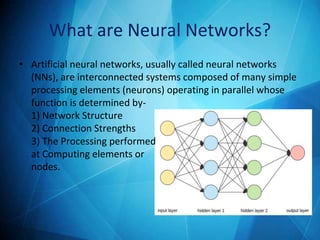
• Artificial neural networks, usually called neural networks
(NNs), are interconnected systems composed of many simple
processing elements (neurons) operating in parallel whose
function is determined by-
1) Network Structure
2) Connection Strengths
3) The Processing performed
at Computing elements or
nodes.
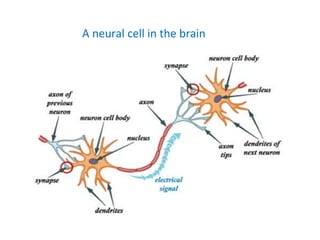
A neural cell in the brain
Training Dataset
• Training of the network is done by a dataset
named MNIST dataset.
• MNIST dataset has a training set of 60,000
examples, and a test set of 10,000 examples.
• All the images in the dataset are of 28x28
pixels.
•It is a good database for people who want to try learning
techniques and pattern recognition methods on real-world
data while spending minimal efforts on preprocessing and
formatting.
Why Convolutions?
Convolution is a simple mathematical operation
between two matrices in which one is multiplied to
the other element wise and sum of all these
multiplications is calculated.
Convolutions are performed for various reasons-
• Convolutions provide better feature extraction
• They save a lot of computation compared to ANNs.
• Less number of parameters are created than those in
pure fully connected layers.
• Due to less number of required parameters,
lesser fully connected layers are needed.
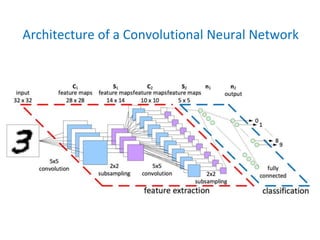
Architecture of a Convolutional Neural Network
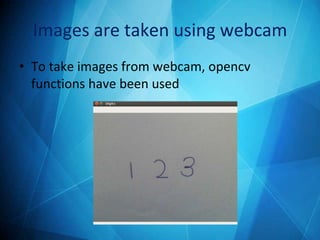
Images are taken using webcam
• To take images from webcam, opencv
functions have been used
Pre-Processing of images
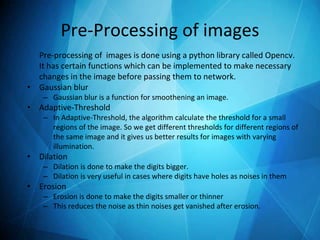
Pre-processing of images is done using a python library called Opencv.
It has certain functions which can be implemented to make necessary
changes in the image before passing them to network.
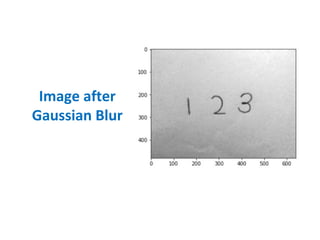
• Gaussian blur
– Gaussian blur is a function for smoothening an image.
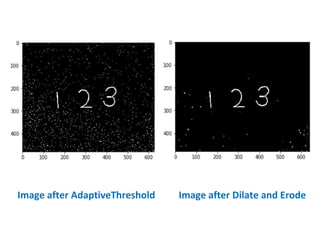
• Adaptive-Threshold
– In Adaptive-Threshold, the algorithm calculate the threshold for a small
regions of the image. So we get different thresholds for different regions of
the same image and it gives us better results for images with varying
illumination.
• Dilation
– Dilation is done to make the digits bigger.
– Dilation is very useful in cases where digits have holes as noises in them
• Erosion
– Erosion is done to make the digits smaller or thinner
– This reduces the noise as thin noises get vanished after erosion.
Image after
Gaussian Blur
Image after AdaptiveThreshold Image after Dilate and Erode
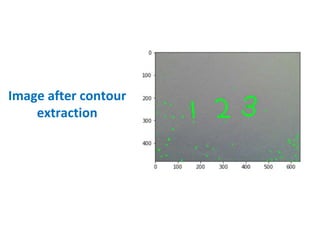
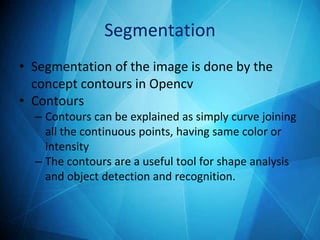
Segmentation
• Segmentation of the image is done by the
concept contours in Opencv
• Contours
– Contours can be explained as simply curve joining
all the continuous points, having same color or
intensity
– The contours are a useful tool for shape analysis
and object detection and recognition.
Image after contour
extraction
Convolutional Neural Network
Architecture
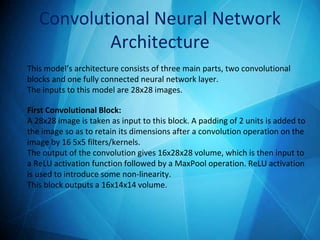
This model’s architecture consists of three main parts, two convolutional
blocks and one fully connected neural network layer.
The inputs to this model are 28x28 images.
First Convolutional Block:
A 28x28 image is taken as input to this block. A padding of 2 units is added to
the image so as to retain its dimensions after a convolution operation on the
image by 16 5x5 filters/kernels.
The output of the convolution gives 16x28x28 volume, which is then input to
a ReLU activation function followed by a MaxPool operation. ReLU activation
is used to introduce some non-linearity.
This block outputs a 16x14x14 volume.
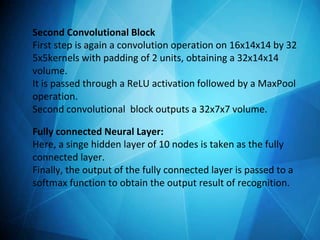
Second Convolutional Block
First step is again a convolution operation on 16x14x14 by 32
5x5kernels with padding of 2 units, obtaining a 32x14x14
volume.
It is passed through a ReLU activation followed by a MaxPool
operation.
Second convolutional block outputs a 32x7x7 volume.
Fully connected Neural Layer:
Here, a singe hidden layer of 10 nodes is taken as the fully
connected layer.
Finally, the output of the fully connected layer is passed to a
softmax function to obtain the output result of recognition.
Conclusion
• The handwritten digit recognition using
convolutional neural network has proved to
be of a fairly good efficiency.
• It works better than any other algorithm,
including artificial neural networks.
THANK YOU
Rishabh Tyagi
(Maharaja Agrasen
Institute of Technology)

Handwritten Digit Recognition(Convolutional Neural Network) PPT

  • 1.
    HANDWRITTEN DIGIT RECOGNITION (A Convolutional NeuralNetwork Approach) Rishabh Tyagi (Maharaja Agrasen Institute of Technology)
  • 2.
    MAIN GOAL &APPLICATIONS • Handwritten Digit Recognition is used to recognize the Digits which are written by hand. • A handwritten digit recognition system is used to visualize artificial neural networks. • It is already widely used in the automatic processing of bank cheques, postal addresses, in mobile phones etc
  • 3.
    •Scientists believe thatthe most intelligent device is the Human Brain. •There is no computer which can beat the level of efficiency of human brain. These Inefficiencies of the computer has lead to evolution of “Artificial Neural Network”. •They differ from conventional systems in the sense that rather than being programmed these system learn to recognize pattern. Introduction
  • 4.
    What are NeuralNetworks? • Artificial neural networks, usually called neural networks (NNs), are interconnected systems composed of many simple processing elements (neurons) operating in parallel whose function is determined by- 1) Network Structure 2) Connection Strengths 3) The Processing performed at Computing elements or nodes.
  • 5.
    A neural cellin the brain
  • 6.
    Training Dataset • Trainingof the network is done by a dataset named MNIST dataset. • MNIST dataset has a training set of 60,000 examples, and a test set of 10,000 examples. • All the images in the dataset are of 28x28 pixels.
  • 7.
    •It is agood database for people who want to try learning techniques and pattern recognition methods on real-world data while spending minimal efforts on preprocessing and formatting.
  • 8.
    Why Convolutions? Convolution isa simple mathematical operation between two matrices in which one is multiplied to the other element wise and sum of all these multiplications is calculated. Convolutions are performed for various reasons- • Convolutions provide better feature extraction • They save a lot of computation compared to ANNs. • Less number of parameters are created than those in pure fully connected layers. • Due to less number of required parameters, lesser fully connected layers are needed.
  • 9.
    Architecture of aConvolutional Neural Network
  • 10.
    Images are takenusing webcam • To take images from webcam, opencv functions have been used
  • 11.
    Pre-Processing of images Pre-processingof images is done using a python library called Opencv. It has certain functions which can be implemented to make necessary changes in the image before passing them to network. • Gaussian blur – Gaussian blur is a function for smoothening an image. • Adaptive-Threshold – In Adaptive-Threshold, the algorithm calculate the threshold for a small regions of the image. So we get different thresholds for different regions of the same image and it gives us better results for images with varying illumination. • Dilation – Dilation is done to make the digits bigger. – Dilation is very useful in cases where digits have holes as noises in them • Erosion – Erosion is done to make the digits smaller or thinner – This reduces the noise as thin noises get vanished after erosion.
  • 12.
  • 13.
    Image after AdaptiveThresholdImage after Dilate and Erode
  • 14.
    Segmentation • Segmentation ofthe image is done by the concept contours in Opencv • Contours – Contours can be explained as simply curve joining all the continuous points, having same color or intensity – The contours are a useful tool for shape analysis and object detection and recognition.
  • 15.
  • 16.
    Convolutional Neural Network Architecture Thismodel’s architecture consists of three main parts, two convolutional blocks and one fully connected neural network layer. The inputs to this model are 28x28 images. First Convolutional Block: A 28x28 image is taken as input to this block. A padding of 2 units is added to the image so as to retain its dimensions after a convolution operation on the image by 16 5x5 filters/kernels. The output of the convolution gives 16x28x28 volume, which is then input to a ReLU activation function followed by a MaxPool operation. ReLU activation is used to introduce some non-linearity. This block outputs a 16x14x14 volume.
  • 17.
    Second Convolutional Block Firststep is again a convolution operation on 16x14x14 by 32 5x5kernels with padding of 2 units, obtaining a 32x14x14 volume. It is passed through a ReLU activation followed by a MaxPool operation. Second convolutional block outputs a 32x7x7 volume. Fully connected Neural Layer: Here, a singe hidden layer of 10 nodes is taken as the fully connected layer. Finally, the output of the fully connected layer is passed to a softmax function to obtain the output result of recognition.
  • 18.
    Conclusion • The handwrittendigit recognition using convolutional neural network has proved to be of a fairly good efficiency. • It works better than any other algorithm, including artificial neural networks.
  • 19.
    THANK YOU Rishabh Tyagi (MaharajaAgrasen Institute of Technology)