Chapter 11
Development of the head and
neck, the eye and ear
Done by: Sumaiah Alghamdi
Hind alsubeie
Submitted to Dr. Afrah
• Pharyngeal arches , clefts and pouches
• Development of the tongue and thyroid gland.
• Development of the face
• Development of the nasal cavity
• Formation of the palate
• Development of the eye and ear
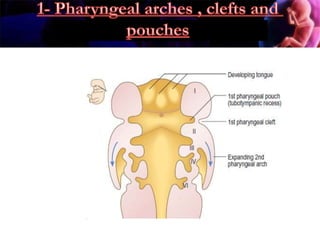
A. Pharyngeal arches :
• Start : fourth week
• Origin: mesenchyme cell from the neural crest, the lateral
plate mesoderm and the paraxial mesoderm.
• Structure : Five pairs of pharyngeal arches, numbered 1, 2, 3, 4
and 6, form in craniocaudal sequence and by the end of the fifth
week. Each arches has an outer covering of ectoderm and is
lined internally by endoderm.
• also, each pharyngeal arch differentiates into a bar of cartilage,
the associated muscle and an aortic arch artery.
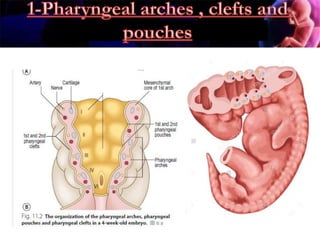
B. Pharyngeal clefts :
The four pharyngeal clefts separate the pharyngeal arches
externally
• The first pair of pharyngeal clefts is the only one that
contributes to adult structures.
• The second pharyngeal arch enlarges and grows rapidly as a
flap over the remaining three pharyngeal clefts.
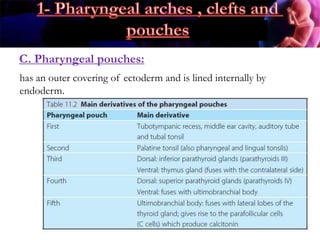
C. Pharyngeal pouches:
has an outer covering of ectoderm and is lined internally by
endoderm.
.
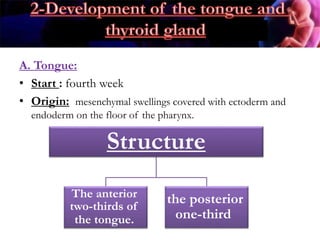
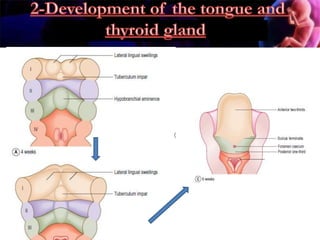
A. Tongue:
• Start : fourth week
• Origin: mesenchymal swellings covered with ectoderm and
endoderm on the floor of the pharynx.
Structure
The anterior
two-thirds of
the tongue.
the posterior
one-third
.
The anterior two-thirds of the tongue:
• Origin: three swellings derived from the first arch
mesenchyme, the lateral lingual swellings and a median
tuberculum impar .
The posterior one-third :
• Origin: comes from a single swelling, the hypobranchial
eminence, derived from the third and fourth pharyngeal arches.
• A midline depression at the apex of the sulcus
terminalis, called foramen caecum
.
.
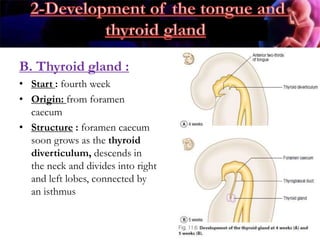
B. Thyroid gland :
• Start : fourth week
• Origin: from foramen
caecum
• Structure : foramen caecum
soon grows as the thyroid
diverticulum, descends in
the neck and divides into right
and left lobes, connected by
an isthmus
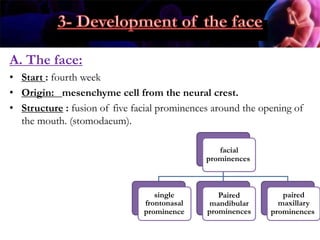
A. The face:
• Start : fourth week
• Origin: mesenchyme cell from the neural crest.
• Structure : fusion of five facial prominences around the opening of
the mouth. (stomodaeum).
facial
prominences
single
frontonasal
prominence
Paired
mandibular
prominences
paired
maxillary
prominences
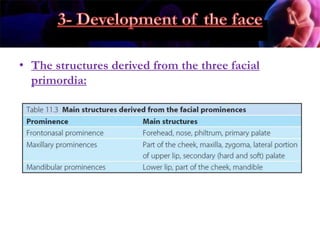
• The structures derived from the three facial
primordia:
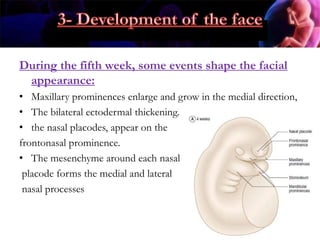
During the fifth week, some events shape the facial
appearance:
• Maxillary prominences enlarge and grow in the medial direction,
• The bilateral ectodermal thickening.
• the nasal placodes, appear on the
frontonasal prominence.
• The mesenchyme around each nasal
placode forms the medial and lateral
nasal processes
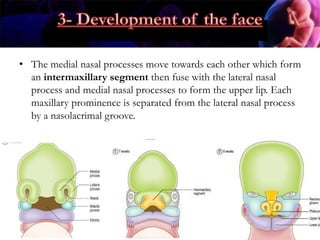
• The medial nasal processes move towards each other which form
an intermaxillary segment then fuse with the lateral nasal
process and medial nasal processes to form the upper lip. Each
maxillary prominence is separated from the lateral nasal process
by a nasolacrimal groove.
.
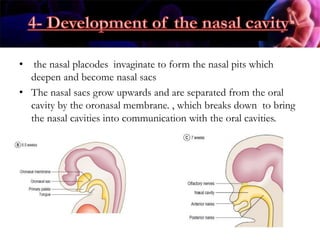
• the nasal placodes invaginate to form the nasal pits which
deepen and become nasal sacs
• The nasal sacs grow upwards and are separated from the oral
cavity by the oronasal membrane. , which breaks down to bring
the nasal cavities into communication with the oral cavities.
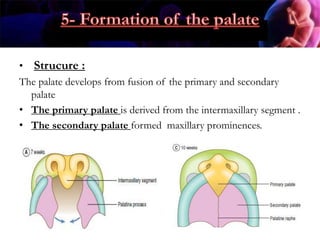
• Strucure :
The palate develops from fusion of the primary and secondary
palate
• The primary palate is derived from the intermaxillary segment .
• The secondary palate formed maxillary prominences.
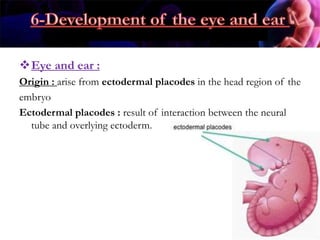
Eye and ear :
Origin : arise from ectodermal placodes in the head region of the
embryo
Ectodermal placodes : result of interaction between the neural
tube and overlying ectoderm.
A. The eye :
• Start : fourth week
• Origin: outgrowth from the lateral wall of the forebrain as optic
vesicle.
• Structure :
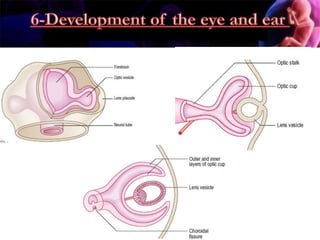
• The optic vesicle acts on the surface ectoderm to form lens placode
which invaginates to form the lens vesicle
• lens vesicle detaches from the surface ectoderm and sinks into the
optic vesicle,
• the connection between the optic vesicle and the brain narrows to
form the optic stalk.
• The optic vesicle is now indented to become a double-walled
optic cup.
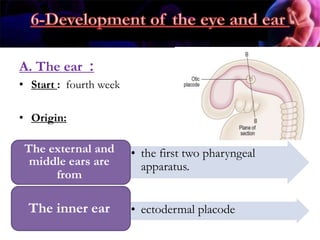
A. The ear :
• Start : fourth week
• Origin:
• the first two pharyngeal
apparatus.
The external and
middle ears are
from
• ectodermal placodeThe inner ear
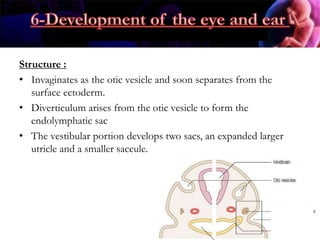
Structure :
• Invaginates as the otic vesicle and soon separates from the
surface ectoderm.
• Diverticulum arises from the otic vesicle to form the
endolymphatic sac
• The vestibular portion develops two sacs, an expanded larger
utricle and a smaller saccule.
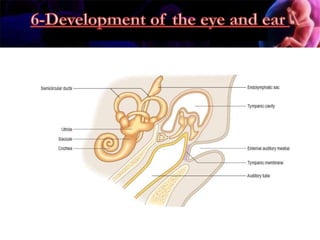
Structure :
• Three tubes grow from the utricle to give rise to the semicircular
ducts.
• The lower part of the saccule elongates and spirals as the
cochlea.
• The mesenchyme around the membranous labyrinth becomes
the cartilaginous otic capsule;
• The cavities that appear in the otic capsule merge to form a
perilymphatic space which develops to the scala tympani and
the scala vestibule.
Embryology
Embryology

Embryology

  • 1.
    Chapter 11 Development ofthe head and neck, the eye and ear Done by: Sumaiah Alghamdi Hind alsubeie Submitted to Dr. Afrah
  • 2.
    • Pharyngeal arches, clefts and pouches • Development of the tongue and thyroid gland. • Development of the face • Development of the nasal cavity • Formation of the palate • Development of the eye and ear
  • 3.
    A. Pharyngeal arches: • Start : fourth week • Origin: mesenchyme cell from the neural crest, the lateral plate mesoderm and the paraxial mesoderm. • Structure : Five pairs of pharyngeal arches, numbered 1, 2, 3, 4 and 6, form in craniocaudal sequence and by the end of the fifth week. Each arches has an outer covering of ectoderm and is lined internally by endoderm. • also, each pharyngeal arch differentiates into a bar of cartilage, the associated muscle and an aortic arch artery.
  • 5.
    B. Pharyngeal clefts: The four pharyngeal clefts separate the pharyngeal arches externally • The first pair of pharyngeal clefts is the only one that contributes to adult structures. • The second pharyngeal arch enlarges and grows rapidly as a flap over the remaining three pharyngeal clefts.
  • 7.
    C. Pharyngeal pouches: hasan outer covering of ectoderm and is lined internally by endoderm.
  • 8.
    . A. Tongue: • Start: fourth week • Origin: mesenchymal swellings covered with ectoderm and endoderm on the floor of the pharynx. Structure The anterior two-thirds of the tongue. the posterior one-third
  • 9.
    . The anterior two-thirdsof the tongue: • Origin: three swellings derived from the first arch mesenchyme, the lateral lingual swellings and a median tuberculum impar . The posterior one-third : • Origin: comes from a single swelling, the hypobranchial eminence, derived from the third and fourth pharyngeal arches. • A midline depression at the apex of the sulcus terminalis, called foramen caecum
  • 10.
  • 11.
    . B. Thyroid gland: • Start : fourth week • Origin: from foramen caecum • Structure : foramen caecum soon grows as the thyroid diverticulum, descends in the neck and divides into right and left lobes, connected by an isthmus
  • 12.
    A. The face: •Start : fourth week • Origin: mesenchyme cell from the neural crest. • Structure : fusion of five facial prominences around the opening of the mouth. (stomodaeum). facial prominences single frontonasal prominence Paired mandibular prominences paired maxillary prominences
  • 13.
    • The structuresderived from the three facial primordia:
  • 14.
    During the fifthweek, some events shape the facial appearance: • Maxillary prominences enlarge and grow in the medial direction, • The bilateral ectodermal thickening. • the nasal placodes, appear on the frontonasal prominence. • The mesenchyme around each nasal placode forms the medial and lateral nasal processes
  • 15.
    • The medialnasal processes move towards each other which form an intermaxillary segment then fuse with the lateral nasal process and medial nasal processes to form the upper lip. Each maxillary prominence is separated from the lateral nasal process by a nasolacrimal groove.
  • 16.
    . • the nasalplacodes invaginate to form the nasal pits which deepen and become nasal sacs • The nasal sacs grow upwards and are separated from the oral cavity by the oronasal membrane. , which breaks down to bring the nasal cavities into communication with the oral cavities.
  • 17.
    • Strucure : Thepalate develops from fusion of the primary and secondary palate • The primary palate is derived from the intermaxillary segment . • The secondary palate formed maxillary prominences.
  • 18.
    Eye and ear: Origin : arise from ectodermal placodes in the head region of the embryo Ectodermal placodes : result of interaction between the neural tube and overlying ectoderm.
  • 19.
    A. The eye: • Start : fourth week • Origin: outgrowth from the lateral wall of the forebrain as optic vesicle. • Structure : • The optic vesicle acts on the surface ectoderm to form lens placode which invaginates to form the lens vesicle • lens vesicle detaches from the surface ectoderm and sinks into the optic vesicle, • the connection between the optic vesicle and the brain narrows to form the optic stalk. • The optic vesicle is now indented to become a double-walled optic cup.
  • 22.
    A. The ear: • Start : fourth week • Origin: • the first two pharyngeal apparatus. The external and middle ears are from • ectodermal placodeThe inner ear
  • 23.
    Structure : • Invaginatesas the otic vesicle and soon separates from the surface ectoderm. • Diverticulum arises from the otic vesicle to form the endolymphatic sac • The vestibular portion develops two sacs, an expanded larger utricle and a smaller saccule.
  • 24.
    Structure : • Threetubes grow from the utricle to give rise to the semicircular ducts. • The lower part of the saccule elongates and spirals as the cochlea. • The mesenchyme around the membranous labyrinth becomes the cartilaginous otic capsule; • The cavities that appear in the otic capsule merge to form a perilymphatic space which develops to the scala tympani and the scala vestibule.