Stratification of different aquatic biomes
Prepared By
HIND AL_SUBAIE - Norah Alhoshani
Sumaiah Alghamdi - Nora Alkahtani
For supervisor
Dr. Ohoud D Alamri
20151
 The biosphere is that portion of earth inhabited by life and represents
the sum of all communities and ecosystem
 A biome is a broad regional type of ecosystem characterized by
distinctive climate and soil conditions and a distinctive kind of
biological community adapted to those conditions.
2
Aquatic Biomes
Include aquatic ecosystems: fresh water and sea water and
transitional waters
It can make a distinction between these sections large on the
basis of differences in salt ratio We know that aquatic
ecosystems constitute about 70% of the Earth's surface area,
and thus these environmental have dominance and
characteristics prevailing added to the enormous diversity of
the species due to chemical, physical and biological
components regulations.
3
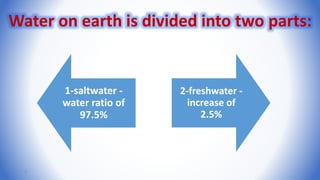
1-saltwater -
water ratio of
97.5%
2-freshwater -
increase of
2.5%
4
Water on earth is divided into two parts:
1-deep water
2-dimension from the beach
3-salinity
4-latitude
5
Abiotic factors : -
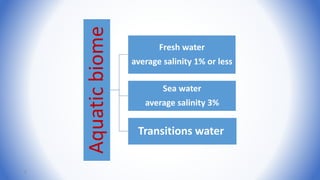
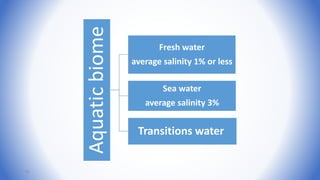
Aquaticbiome
Fresh water
average salinity 1% or less
Sea water
average salinity 3%
Transitions water
6
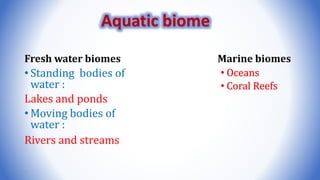
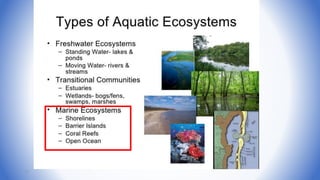
Fresh water biomes
• Standing bodies of
water :
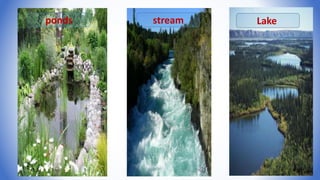
Lakes and ponds
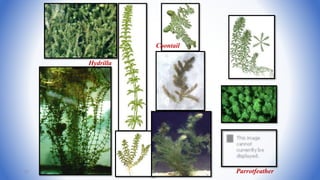
• Moving bodies of
water :
Rivers and streams
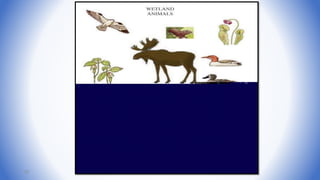
Marine biomes
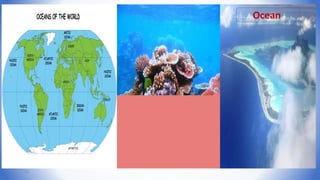
• Oceans
• Coral Reefs
7
Aquatic biome
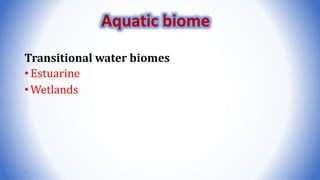
Transitional water biomes
•Estuarine
•Wetlands
8
Aquatic biome
ponds stream Lake
9
10
Ocean
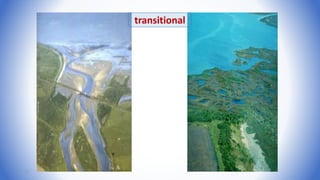
transitional
11
Marine biomes
Largest Ecosystem and include oceans
and coral reefs
evaporation of the sea water provides
rainwater for the land
these include the oceans on a huge
variety of organisms that are affected in
terms of abundance and distribution of
various factors (food materials - heat -
tides movement - and water currents)
12
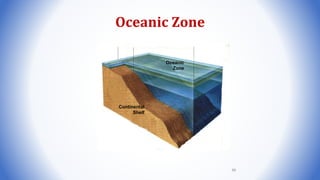
1- surface Zone
2- deep Zone
3- bottom zone
13
Marine ecosystem is divided into three sections:
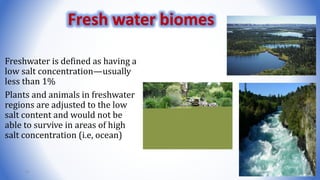
Freshwater is defined as having a
low salt concentration—usually
less than 1%
Plants and animals in freshwater
regions are adjusted to the low
salt content and would not be
able to survive in areas of high
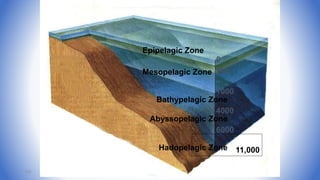
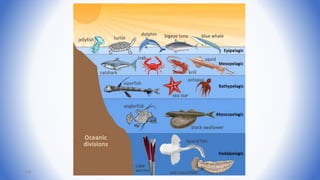
salt concentration (i.e, ocean)
14
Fresh water biomes
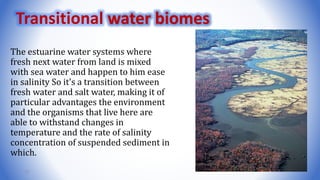
The estuarine water systems where
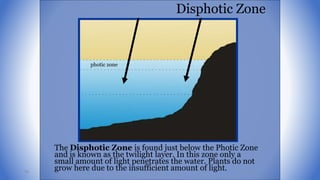
fresh next water from land is mixed
with sea water and happen to him ease
in salinity So it's a transition between
fresh water and salt water, making it of
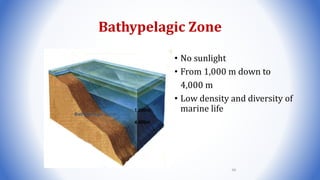
particular advantages the environment
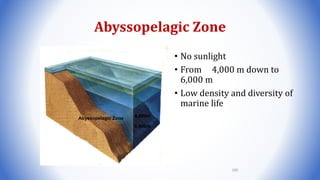
and the organisms that live here are
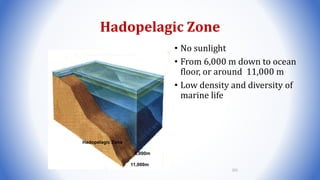
able to withstand changes in
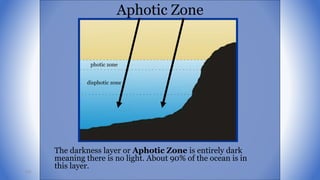
temperature and the rate of salinity
concentration of suspended sediment in
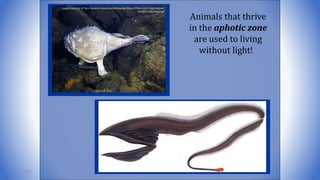
which.
15
Transitional water biomes
Aquaticbiome
Fresh water
average salinity 1% or less
Sea water
average salinity 3%
Transitions water
16
Videos
• http://geography.howstuffworks.com/28105-assignment-discovery-
aquatic-biomes-video.htm
• http://www.discovery.com/tv-shows/other-
shows/videos/assignment-discovery-shorts-iii-biomes-aquatic/
• http://study.com/academy/lesson/freshwater-biomes-climate-
locations-plants-animals.html
17
18
Stratification of freshwater
Freshwater are areas which having low salt concentration
approximately less than 1%, and organisms that can not survive in
other regions that have high salt concentration such as sea and oceans.
19
Fresh water biome
1- ponds and lakes
2- streams and rivers
20
Freshwater types
 those area differ form just a few square meters to thousands of square
kilometers.
 speared on earth
 a result of remain from the Pleistocene glaciation.
 Many ponds are seasonal, lasting for a few months, while lakes may
exist for hundreds of years.
21
General characteristics of ponds and lakes
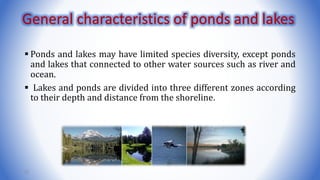
 Ponds and lakes may have limited species diversity, except ponds
and lakes that connected to other water sources such as river and
ocean.
 Lakes and ponds are divided into three different zones according
to their depth and distance from the shoreline.
22
General characteristics of ponds and lakes
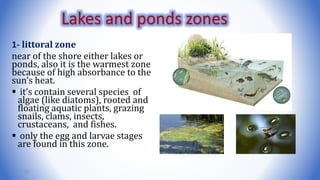
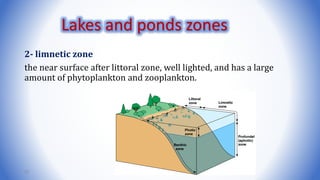
1- littoral zone
near of the shore either lakes or
ponds, also it is the warmest zone
because of high absorbance to the
sun’s heat.
 it’s contain several species of
algae (like diatoms), rooted and
floating aquatic plants, grazing
snails, clams, insects,
crustaceans, and fishes.
 only the egg and larvae stages
are found in this zone.
23
Lakes and ponds zones
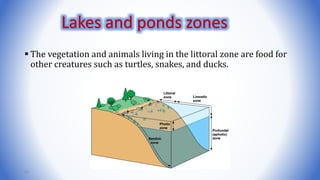
 The vegetation and animals living in the littoral zone are food for
other creatures such as turtles, snakes, and ducks.
24
Lakes and ponds zones
2- limnetic zone
the near surface after littoral zone, well lighted, and has a large
amount of phytoplankton and zooplankton.
25
Lakes and ponds zones
3- profundal zone
This zone is much colder, also there is a Little light penetrates into
this zone.
 zone’s organisms are heterotrophs, , meaning that they eat dead
organisms and use oxygen for cellular respiration.
 For example, dead plankton that fall down from limnetic zone.
26
Lakes and ponds zones
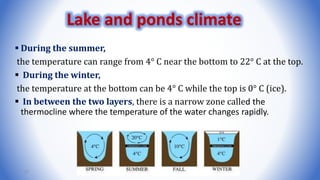
 During the summer,
the temperature can range from 4° C near the bottom to 22° C at the top.
 During the winter,
the temperature at the bottom can be 4° C while the top is 0° C (ice).
 In between the two layers, there is a narrow zone called the
thermocline where the temperature of the water changes rapidly.
27
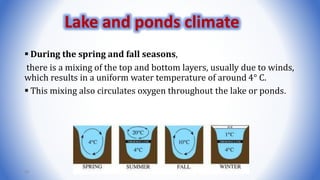
Lake and ponds climate
 During the spring and fall seasons,
there is a mixing of the top and bottom layers, usually due to winds,
which results in a uniform water temperature of around 4° C.
 This mixing also circulates oxygen throughout the lake or ponds.
28
Lake and ponds climate
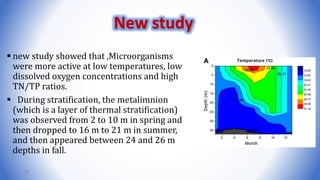
 new study showed that ,Microorganisms
were more active at low temperatures, low
dissolved oxygen concentrations and high
TN/TP ratios.
 During stratification, the metalimnion
(which is a layer of thermal stratification)
was observed from 2 to 10 m in spring and
then dropped to 16 m to 21 m in summer,
and then appeared between 24 and 26 m
depths in fall.
29
New study
 Also, during stratification, temperature, and pH were significantly
higher in the epilimnion and rapidly dropping down in the
hypolimnion.
 The nutrient concentrations were stable in the water column, except
for total phosphorus.
 Specifically, the TN/TP mass ratio was significantly lower in
epilimnion
30
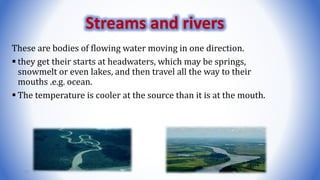
These are bodies of flowing water moving in one direction.
 they get their starts at headwaters, which may be springs,
snowmelt or even lakes, and then travel all the way to their
mouths .e.g. ocean.
 The temperature is cooler at the source than it is at the mouth.
31
Streams and rivers
 the water has high oxygen levels, and freshwater fish such as
trout and heterotrophs can be found there
32
 The middle part of the stream/river, the width increases, as does
species diversity, also numerous aquatic green plants and algae can
be found.
 The mouth of the river/stream, the water becomes murky from all
the sediments that it has picked up upstream, decreasing the amount
of light that can penetrate through the water.
33
 Because of the lower oxygen levels in mouth, fish that require less
oxygen, such as catfish and carp, can be found. However, Since
there is less light, there is less diversity of flora.
34
Stream and rivers parts
35
Transitional waters
• Transitional waters are those waters between the land and the sea
or river and sea and include estuaries, lagoons,
• Transitional waters are often characterized by frequently changing
salinity which make transitional waters highly dynamic and create a
particular and characteristic flora and fauna.
36
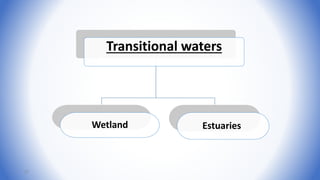
Transitional waters
Wetland Estuaries
37
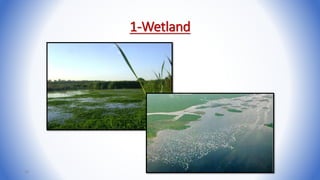
1-Wetland
38
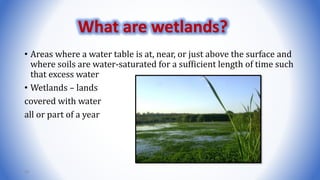
• Areas where a water table is at, near, or just above the surface and
where soils are water-saturated for a sufficient length of time such
that excess water
• Wetlands – lands
covered with water
all or part of a year
39
What are wetlands?
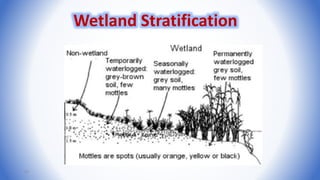
• Hydric (saturated) soils – saturated long enough to create an
anaerobic state in the soil horizon
• Hydrophytic plants – adapted to thrive in wetlands despite the
stresses of an anaerobic and flooded environment
• Hydrologic regime – dynamic or dominant presence of water
40
Wetland Stratification :
41
Wetland Stratification
• Dependent mostly on a combination of the above conditions, the
"traditional terminology" distinguishes between two major
wetland types – mineral and organic such as Marsh,swamp, fen
and bog
42
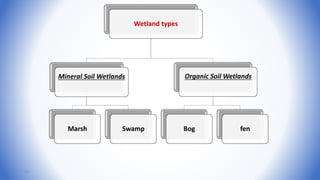
Wetlands Types
Wetland types
Mineral Soil Wetlands
Marsh Swamp
Organic Soil Wetlands
Bog fen
43
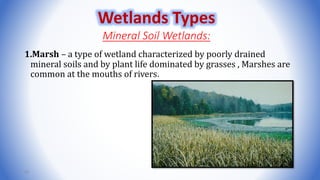
Mineral Soil Wetlands:
1.Marsh – a type of wetland characterized by poorly drained
mineral soils and by plant life dominated by grasses , Marshes are
common at the mouths of rivers.
44
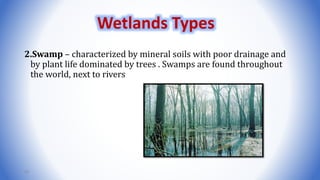
Wetlands Types
2.Swamp – characterized by mineral soils with poor drainage and
by plant life dominated by trees . Swamps are found throughout
the world, next to rivers
45
Wetlands Types
Organic Soil Wetlands:
• Generally these wetlands are referred to as "peatlands" in
recognition of their common ability to form peat (organic soil
produced by the accumulation of plant material). There are two
major types of peatlands – bogs and fens.
46
Wetlands Types
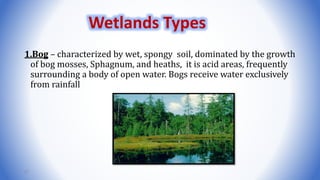
1.Bog – characterized by wet, spongy soil, dominated by the growth
of bog mosses, Sphagnum, and heaths, it is acid areas, frequently
surrounding a body of open water. Bogs receive water exclusively
from rainfall
47
Wetlands Types
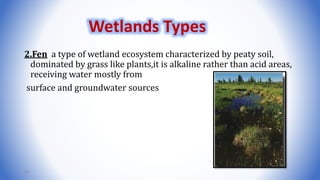
2.Fen a type of wetland ecosystem characterized by peaty soil,
dominated by grass like plants,it is alkaline rather than acid areas,
receiving water mostly from
surface and groundwater sources
48
Wetlands Types
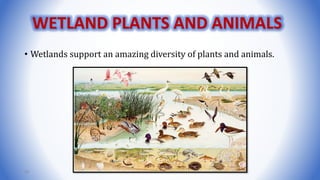
• Wetlands support an amazing diversity of plants and animals.
49
WETLAND PLANTS AND ANIMALS
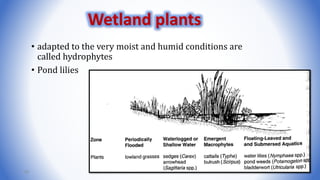
• adapted to the very moist and humid conditions are
called hydrophytes
• Pond lilies
50
Wetland plants
Hydrilla
Coontail
Parrotfeather51
• Almost half of Oregon's over 450 species birds live part or most of
the time in and around wetlands.
• vertebrates (birds, mammals, reptiles, amphibians and fish)
• invertebrates (worms, insects and mollusks..etc
52
Wetland animals
53
• The wetland is a key wintering area for tens of thousands of
flamingos and other birds that migrate from northern Asia.
• The specialized algae and bacteria growing in the lake provide
striking water colors and support the lake ecology that, in turn,
sustains the migrating waterfowl. There is other wildlife in the
nearby forests, where Nilgai move freely along with deer and
foxes.
54
Importance
55
Latest studies
56
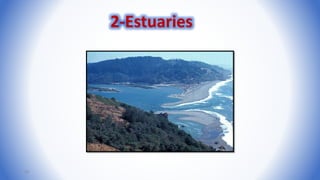
2-Estuaries
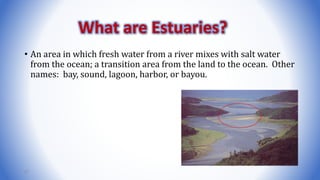
• An area in which fresh water from a river mixes with salt water
from the ocean; a transition area from the land to the ocean. Other
names: bay, sound, lagoon, harbor, or bayou.
57
What are Estuaries?
58
Estuaries stratification
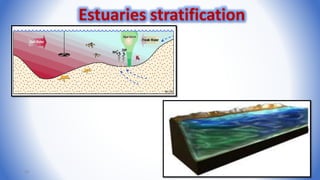
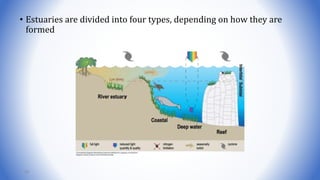
• Estuaries are divided into four types, depending on how they are
formed
59
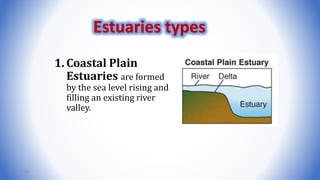
1. Coastal Plain
Estuaries are formed
by the sea level rising and
filling an existing river
valley.
60
Estuaries types
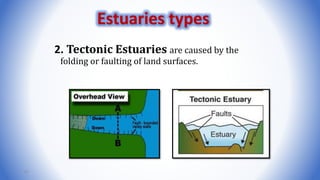
2. Tectonic Estuaries are caused by the
folding or faulting of land surfaces.
61
Estuaries types
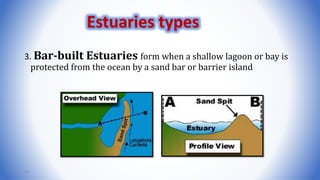
3. Bar-built Estuaries form when a shallow lagoon or bay is
protected from the ocean by a sand bar or barrier island
62
Estuaries types
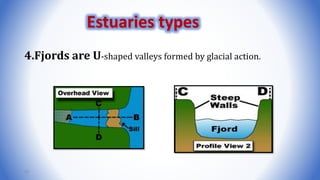
4.Fjords are U-shaped valleys formed by glacial action.
63
Estuaries types
64
Estuaries plants and animals
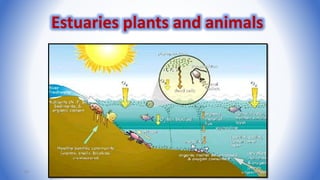
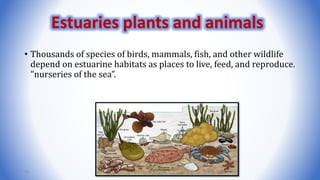
• Thousands of species of birds, mammals, fish, and other wildlife
depend on estuarine habitats as places to live, feed, and reproduce.
"nurseries of the sea”.
65
Estuaries plants and animals
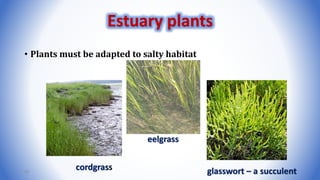
• Plants must be adapted to salty habitat
cordgrass
eelgrass
glasswort – a succulent66
Estuary plants
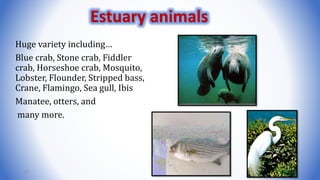
Huge variety including…
Blue crab, Stone crab, Fiddler
crab, Horseshoe crab, Mosquito,
Lobster, Flounder, Stripped bass,
Crane, Flamingo, Sea gull, Ibis
Manatee, otters, and
many more.
67
Estuary animals
• Estuaries have important commercial value and their resources
provide economic benefits for tourism, fisheries, and recreational
activities. The protected coastal waters of estuaries also support
important public infrastructure, serving as harbors and ports vital
for shipping and transportation
68
Estuaries Importance
69
Latest studies
70
Stratification Of Marine
71
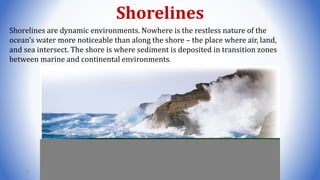
Shorelines
Shorelines are dynamic environments. Nowhere is the restless nature of the
ocean’s water more noticeable than along the shore – the place where air, land,
and sea intersect. The shore is where sediment is deposited in transition zones
between marine and continental environments.
72
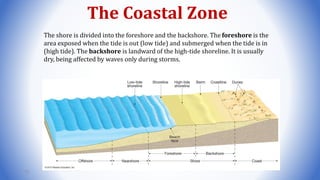
The shore is divided into the foreshore and the backshore. The foreshore is the
area exposed when the tide is out (low tide) and submerged when the tide is in
(high tide). The backshore is landward of the high-tide shoreline. It is usually
dry, being affected by waves only during storms.
The Coastal Zone
73
The Coastal Zone
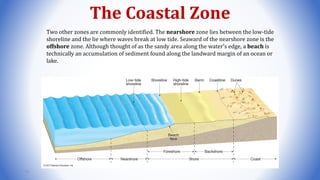
Two other zones are commonly identified. The nearshore zone lies between the low-tide
shoreline and the lie where waves break at low tide. Seaward of the nearshore zone is the
offshore zone. Although thought of as the sandy area along the water’s edge, a beach is
technically an accumulation of sediment found along the landward margin of an ocean or
lake.
74
The Coastal Zone
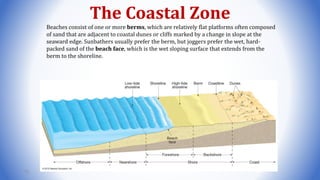
Beaches consist of one or more berms, which are relatively flat platforms often composed
of sand that are adjacent to coastal dunes or cliffs marked by a change in slope at the
seaward edge. Sunbathers usually prefer the berm, but joggers prefer the wet, hard-
packed sand of the beach face, which is the wet sloping surface that extends from the
berm to the shoreline.
75
Ocean Zones
76
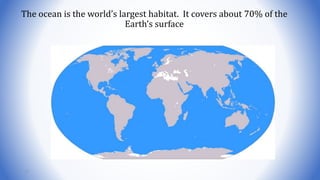
The ocean is the world’s largest habitat. It covers about 70% of the
Earth’s surface
77
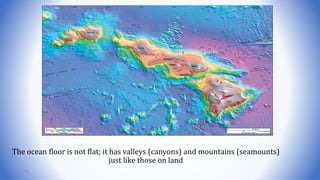
The ocean floor is not flat; it has valleys (canyons) and mountains (seamounts)
just like those on land
78
Ocean Zones
(shoreline to open ocean)
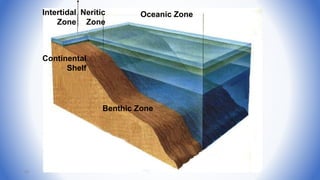
• The four major zones are :
• Intertidal Zone
• Neritic Zone
• Oceanic Zone
• Benthic Zone
79
Sunlight
Intertidal
Zone
Neritic
Zone
Oceanic Zone
Continental
Shelf
Benthic Zone
80
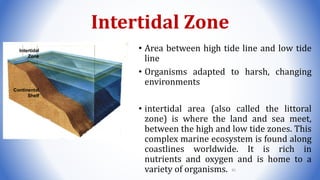
Intertidal Zone
• Area between high tide line and low tide
line
• Organisms adapted to harsh, changing
environments
• intertidal area (also called the littoral
zone) is where the land and sea meet,
between the high and low tide zones. This
complex marine ecosystem is found along
coastlines worldwide. It is rich in
nutrients and oxygen and is home to a
variety of organisms.
Intertidal
Zone
Continental
Shelf
81
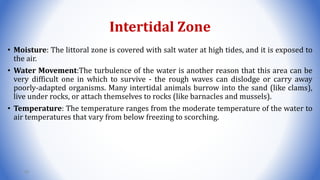
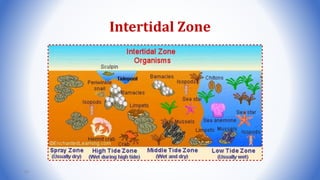
Intertidal Zone
• Moisture: The littoral zone is covered with salt water at high tides, and it is exposed to
the air.
• Water Movement:The turbulence of the water is another reason that this area can be
very difficult one in which to survive - the rough waves can dislodge or carry away
poorly-adapted organisms. Many intertidal animals burrow into the sand (like clams),
live under rocks, or attach themselves to rocks (like barnacles and mussels).
• Temperature: The temperature ranges from the moderate temperature of the water to
air temperatures that vary from below freezing to scorching.
82
Intertidal Zone
83
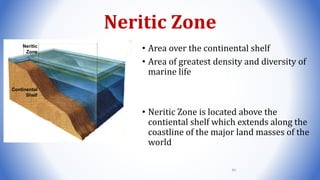
Neritic Zone
• Area over the continental shelf
• Area of greatest density and diversity of
marine life
• Neritic Zone is located above the
contiental shelf which extends along the
coastline of the major land masses of the
world
Neritic
Zone
Continental
Shelf
84
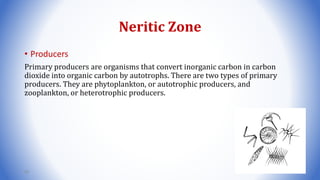
Neritic Zone
• Producers
Primary producers are organisms that convert inorganic carbon in carbon
dioxide into organic carbon by autotrophs. There are two types of primary
producers. They are phytoplankton, or autotrophic producers, and
zooplankton, or heterotrophic producers.
85
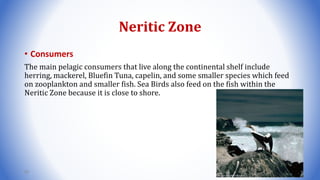
Neritic Zone
• Consumers
The main pelagic consumers that live along the continental shelf include
herring, mackerel, Bluefin Tuna, capelin, and some smaller species which feed
on zooplankton and smaller fish. Sea Birds also feed on the fish within the
Neritic Zone because it is close to shore.
86
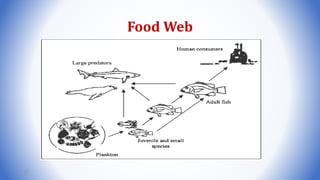
Food Web
87
Oceanic Zone
Oceanic
Zone
Continental
Shelf
88
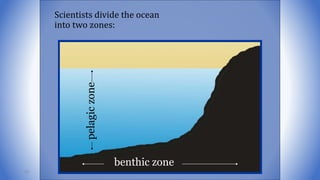
Scientists divide the ocean
into two zones:
benthic zone
pelagiczone
89
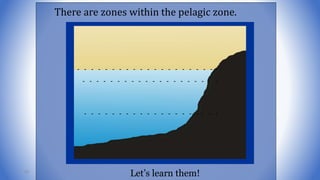
There are zones within the pelagic zone.
Let’s learn them!
- - - - - - - - - - - - - - - - - - - -
- - - - - - - - - - - - - - - - - - - -
- - - - - - - - - - - - - - - - - - - - -
90
Ocean Zones
(surface to ocean floor)
Epipelagic Zone
• Photic Zone or Sunlight Zone
Mesopelagic Zone
• Disphotic Zone or Twilight Zone
Bathypelagic Zone
• Aphotic zone or Midnight Zone
Abyssopelagic Zone
• Aphotic Zone or Midnight Zone
Hadopelagic Zone
• Aphotic Zone or Midnight Zone
91
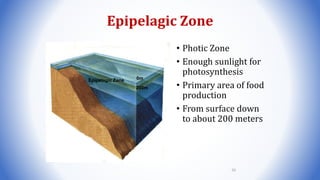
Epipelagic Zone
• Photic Zone
• Enough sunlight for
photosynthesis
• Primary area of food
production
• From surface down
to about 200 meters
Sunlight Zone
Photic Zone
Epipelagic Zone 0m
200m
92
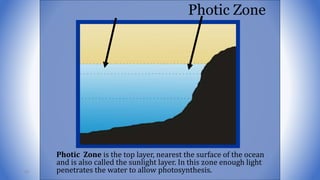
Photic Zone
Photic Zone is the top layer, nearest the surface of the ocean
and is also called the sunlight layer. In this zone enough light
penetrates the water to allow photosynthesis.93
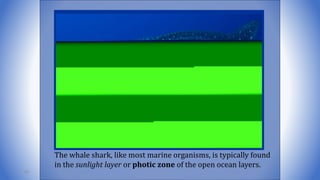
The whale shark, like most marine organisms, is typically found
in the sunlight layer or photic zone of the open ocean layers.
94
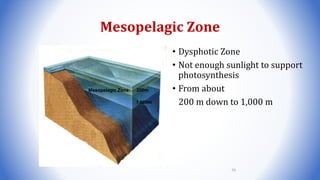
Mesopelagic Zone
• Dysphotic Zone
• Not enough sunlight to support
photosynthesis
• From about
200 m down to 1,000 m
Mesopelagic Zone 200m
1,000m
95
photic zone
Disphotic Zone
The Disphotic Zone is found just below the Photic Zone
and is known as the twilight layer. In this zone only a
small amount of light penetrates the water. Plants do not
grow here due to the insufficient amount of light.96
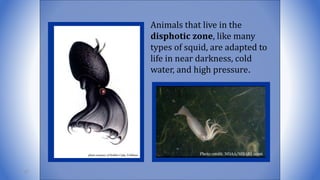
Animals that live in the
disphotic zone, like many
types of squid, are adapted to
life in near darkness, cold
water, and high pressure.
97
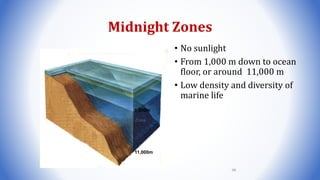
Midnight Zones
• No sunlight
• From 1,000 m down to ocean
floor, or around 11,000 m
• Low density and diversity of
marine life
Midnight Zone
1,000m
11,000m
98
Bathypelagic Zone
• No sunlight
• From 1,000 m down to
4,000 m
• Low density and diversity of
marine lifeBathypelagic Zone
1,000m
4,000m
99
Abyssopelagic Zone
• No sunlight
• From 4,000 m down to
6,000 m
• Low density and diversity of
marine life
Abyssopelagic Zone 4,000m
6,000m
100
Hadopelagic Zone
• No sunlight
• From 6,000 m down to ocean
floor, or around 11,000 m
• Low density and diversity of
marine life
Hadopelagic Zone
6,000m
11,000m
101
Epipelagic Zone
Mesopelagic Zone
Bathypelagic Zone
Abyssopelagic Zone
Hadopelagic Zone
0
200
1000
4000
6000
11,000
102
photic zone
disphotic zone
Aphotic Zone
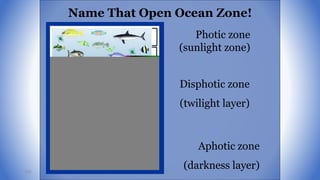
The darkness layer or Aphotic Zone is entirely dark
meaning there is no light. About 90% of the ocean is in
this layer.
103
Animals that thrive
in the aphotic zone
are used to living
without light!
104
105
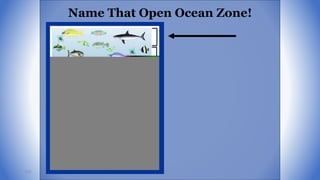
Name That Open Ocean Zone!
106
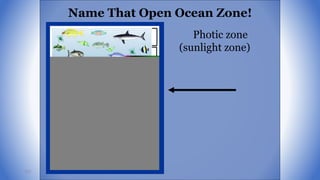
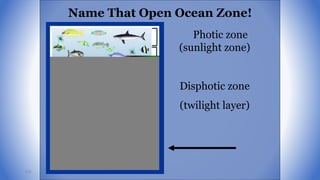
Photic zone
(sunlight zone)
Name That Open Ocean Zone!
107
Photic zone
(sunlight zone)
Disphotic zone
(twilight layer)
Name That Open Ocean Zone!
108
Aphotic zone
(darkness layer)
Name That Open Ocean Zone!
Photic zone
(sunlight zone)
Disphotic zone
(twilight layer)
109
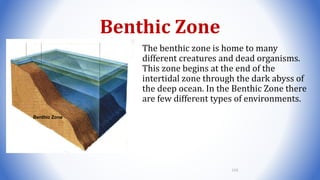
Benthic Zone
The benthic zone is home to many
different creatures and dead organisms.
This zone begins at the end of the
intertidal zone through the dark abyss of
the deep ocean. In the Benthic Zone there
are few different types of environments.
Benthic Zone
110
Benthos
(bottom dwellers)
• 2 Basic Types:
• Sessile - Live attached to the bottom
• Vagrant - Able to move about
111
Benthos
(bottom dwellers)
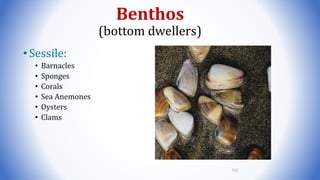
•Sessile:
• Barnacles
• Sponges
• Corals
• Sea Anemones
• Oysters
• Clams
112
Benthos
(bottom dwellers)
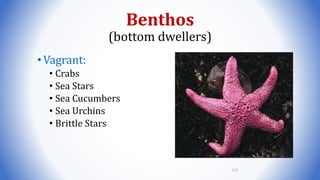
•Vagrant:
• Crabs
• Sea Stars
• Sea Cucumbers
• Sea Urchins
• Brittle Stars
113
Reference
http://www.ucmp.berkeley.edu/exhibits/biomes/freshwater.php
http://www.nature.com/srep/2014/140725/srep05821/full/srep05821.
html
http://www.personal.ceu.hu/students/03/nature_conservation/wwdd
etail/Types_classif.html
• http://w3.shorecrest.org/~Lisa_Peck/MarineBio/syllabus/ch11_ecosy
stems/ecosystem_wp/neriticzone_jonathan_wade/homepage.html
• http://www.the-science-site.com/oceanic-zones.html
• http://global.britannica.com/EBchecked/topic/409490/neritic-zone
• The biology of the deep ocean .ppt
114
115

stratification of water environments -

  • 1.
    Stratification of differentaquatic biomes Prepared By HIND AL_SUBAIE - Norah Alhoshani Sumaiah Alghamdi - Nora Alkahtani For supervisor Dr. Ohoud D Alamri 20151
  • 2.
     The biosphereis that portion of earth inhabited by life and represents the sum of all communities and ecosystem  A biome is a broad regional type of ecosystem characterized by distinctive climate and soil conditions and a distinctive kind of biological community adapted to those conditions. 2 Aquatic Biomes
  • 3.
    Include aquatic ecosystems:fresh water and sea water and transitional waters It can make a distinction between these sections large on the basis of differences in salt ratio We know that aquatic ecosystems constitute about 70% of the Earth's surface area, and thus these environmental have dominance and characteristics prevailing added to the enormous diversity of the species due to chemical, physical and biological components regulations. 3
  • 4.
    1-saltwater - water ratioof 97.5% 2-freshwater - increase of 2.5% 4 Water on earth is divided into two parts:
  • 5.
    1-deep water 2-dimension fromthe beach 3-salinity 4-latitude 5 Abiotic factors : -
  • 6.
    Aquaticbiome Fresh water average salinity1% or less Sea water average salinity 3% Transitions water 6
  • 7.
    Fresh water biomes •Standing bodies of water : Lakes and ponds • Moving bodies of water : Rivers and streams Marine biomes • Oceans • Coral Reefs 7 Aquatic biome
  • 8.
  • 9.
  • 10.
  • 11.
  • 12.
    Marine biomes Largest Ecosystemand include oceans and coral reefs evaporation of the sea water provides rainwater for the land these include the oceans on a huge variety of organisms that are affected in terms of abundance and distribution of various factors (food materials - heat - tides movement - and water currents) 12
  • 13.
    1- surface Zone 2-deep Zone 3- bottom zone 13 Marine ecosystem is divided into three sections:
  • 14.
    Freshwater is definedas having a low salt concentration—usually less than 1% Plants and animals in freshwater regions are adjusted to the low salt content and would not be able to survive in areas of high salt concentration (i.e, ocean) 14 Fresh water biomes
  • 15.
    The estuarine watersystems where fresh next water from land is mixed with sea water and happen to him ease in salinity So it's a transition between fresh water and salt water, making it of particular advantages the environment and the organisms that live here are able to withstand changes in temperature and the rate of salinity concentration of suspended sediment in which. 15 Transitional water biomes
  • 16.
    Aquaticbiome Fresh water average salinity1% or less Sea water average salinity 3% Transitions water 16
  • 17.
  • 18.
  • 19.
    Freshwater are areaswhich having low salt concentration approximately less than 1%, and organisms that can not survive in other regions that have high salt concentration such as sea and oceans. 19 Fresh water biome
  • 20.
    1- ponds andlakes 2- streams and rivers 20 Freshwater types
  • 21.
     those areadiffer form just a few square meters to thousands of square kilometers.  speared on earth  a result of remain from the Pleistocene glaciation.  Many ponds are seasonal, lasting for a few months, while lakes may exist for hundreds of years. 21 General characteristics of ponds and lakes
  • 22.
     Ponds andlakes may have limited species diversity, except ponds and lakes that connected to other water sources such as river and ocean.  Lakes and ponds are divided into three different zones according to their depth and distance from the shoreline. 22 General characteristics of ponds and lakes
  • 23.
    1- littoral zone nearof the shore either lakes or ponds, also it is the warmest zone because of high absorbance to the sun’s heat.  it’s contain several species of algae (like diatoms), rooted and floating aquatic plants, grazing snails, clams, insects, crustaceans, and fishes.  only the egg and larvae stages are found in this zone. 23 Lakes and ponds zones
  • 24.
     The vegetationand animals living in the littoral zone are food for other creatures such as turtles, snakes, and ducks. 24 Lakes and ponds zones
  • 25.
    2- limnetic zone thenear surface after littoral zone, well lighted, and has a large amount of phytoplankton and zooplankton. 25 Lakes and ponds zones
  • 26.
    3- profundal zone Thiszone is much colder, also there is a Little light penetrates into this zone.  zone’s organisms are heterotrophs, , meaning that they eat dead organisms and use oxygen for cellular respiration.  For example, dead plankton that fall down from limnetic zone. 26 Lakes and ponds zones
  • 27.
     During thesummer, the temperature can range from 4° C near the bottom to 22° C at the top.  During the winter, the temperature at the bottom can be 4° C while the top is 0° C (ice).  In between the two layers, there is a narrow zone called the thermocline where the temperature of the water changes rapidly. 27 Lake and ponds climate
  • 28.
     During thespring and fall seasons, there is a mixing of the top and bottom layers, usually due to winds, which results in a uniform water temperature of around 4° C.  This mixing also circulates oxygen throughout the lake or ponds. 28 Lake and ponds climate
  • 29.
     new studyshowed that ,Microorganisms were more active at low temperatures, low dissolved oxygen concentrations and high TN/TP ratios.  During stratification, the metalimnion (which is a layer of thermal stratification) was observed from 2 to 10 m in spring and then dropped to 16 m to 21 m in summer, and then appeared between 24 and 26 m depths in fall. 29 New study
  • 30.
     Also, duringstratification, temperature, and pH were significantly higher in the epilimnion and rapidly dropping down in the hypolimnion.  The nutrient concentrations were stable in the water column, except for total phosphorus.  Specifically, the TN/TP mass ratio was significantly lower in epilimnion 30
  • 31.
    These are bodiesof flowing water moving in one direction.  they get their starts at headwaters, which may be springs, snowmelt or even lakes, and then travel all the way to their mouths .e.g. ocean.  The temperature is cooler at the source than it is at the mouth. 31 Streams and rivers
  • 32.
     the waterhas high oxygen levels, and freshwater fish such as trout and heterotrophs can be found there 32
  • 33.
     The middlepart of the stream/river, the width increases, as does species diversity, also numerous aquatic green plants and algae can be found.  The mouth of the river/stream, the water becomes murky from all the sediments that it has picked up upstream, decreasing the amount of light that can penetrate through the water. 33
  • 34.
     Because ofthe lower oxygen levels in mouth, fish that require less oxygen, such as catfish and carp, can be found. However, Since there is less light, there is less diversity of flora. 34 Stream and rivers parts
  • 35.
  • 36.
    Transitional waters • Transitionalwaters are those waters between the land and the sea or river and sea and include estuaries, lagoons, • Transitional waters are often characterized by frequently changing salinity which make transitional waters highly dynamic and create a particular and characteristic flora and fauna. 36
  • 37.
  • 38.
  • 39.
    • Areas wherea water table is at, near, or just above the surface and where soils are water-saturated for a sufficient length of time such that excess water • Wetlands – lands covered with water all or part of a year 39 What are wetlands?
  • 40.
    • Hydric (saturated)soils – saturated long enough to create an anaerobic state in the soil horizon • Hydrophytic plants – adapted to thrive in wetlands despite the stresses of an anaerobic and flooded environment • Hydrologic regime – dynamic or dominant presence of water 40 Wetland Stratification :
  • 41.
  • 42.
    • Dependent mostlyon a combination of the above conditions, the "traditional terminology" distinguishes between two major wetland types – mineral and organic such as Marsh,swamp, fen and bog 42 Wetlands Types
  • 43.
    Wetland types Mineral SoilWetlands Marsh Swamp Organic Soil Wetlands Bog fen 43
  • 44.
    Mineral Soil Wetlands: 1.Marsh– a type of wetland characterized by poorly drained mineral soils and by plant life dominated by grasses , Marshes are common at the mouths of rivers. 44 Wetlands Types
  • 45.
    2.Swamp – characterizedby mineral soils with poor drainage and by plant life dominated by trees . Swamps are found throughout the world, next to rivers 45 Wetlands Types
  • 46.
    Organic Soil Wetlands: •Generally these wetlands are referred to as "peatlands" in recognition of their common ability to form peat (organic soil produced by the accumulation of plant material). There are two major types of peatlands – bogs and fens. 46 Wetlands Types
  • 47.
    1.Bog – characterizedby wet, spongy soil, dominated by the growth of bog mosses, Sphagnum, and heaths, it is acid areas, frequently surrounding a body of open water. Bogs receive water exclusively from rainfall 47 Wetlands Types
  • 48.
    2.Fen a typeof wetland ecosystem characterized by peaty soil, dominated by grass like plants,it is alkaline rather than acid areas, receiving water mostly from surface and groundwater sources 48 Wetlands Types
  • 49.
    • Wetlands supportan amazing diversity of plants and animals. 49 WETLAND PLANTS AND ANIMALS
  • 50.
    • adapted tothe very moist and humid conditions are called hydrophytes • Pond lilies 50 Wetland plants
  • 51.
  • 52.
    • Almost halfof Oregon's over 450 species birds live part or most of the time in and around wetlands. • vertebrates (birds, mammals, reptiles, amphibians and fish) • invertebrates (worms, insects and mollusks..etc 52 Wetland animals
  • 53.
  • 54.
    • The wetlandis a key wintering area for tens of thousands of flamingos and other birds that migrate from northern Asia. • The specialized algae and bacteria growing in the lake provide striking water colors and support the lake ecology that, in turn, sustains the migrating waterfowl. There is other wildlife in the nearby forests, where Nilgai move freely along with deer and foxes. 54 Importance
  • 55.
  • 56.
  • 57.
    • An areain which fresh water from a river mixes with salt water from the ocean; a transition area from the land to the ocean. Other names: bay, sound, lagoon, harbor, or bayou. 57 What are Estuaries?
  • 58.
  • 59.
    • Estuaries aredivided into four types, depending on how they are formed 59
  • 60.
    1. Coastal Plain Estuariesare formed by the sea level rising and filling an existing river valley. 60 Estuaries types
  • 61.
    2. Tectonic Estuariesare caused by the folding or faulting of land surfaces. 61 Estuaries types
  • 62.
    3. Bar-built Estuariesform when a shallow lagoon or bay is protected from the ocean by a sand bar or barrier island 62 Estuaries types
  • 63.
    4.Fjords are U-shapedvalleys formed by glacial action. 63 Estuaries types
  • 64.
  • 65.
    • Thousands ofspecies of birds, mammals, fish, and other wildlife depend on estuarine habitats as places to live, feed, and reproduce. "nurseries of the sea”. 65 Estuaries plants and animals
  • 66.
    • Plants mustbe adapted to salty habitat cordgrass eelgrass glasswort – a succulent66 Estuary plants
  • 67.
    Huge variety including… Bluecrab, Stone crab, Fiddler crab, Horseshoe crab, Mosquito, Lobster, Flounder, Stripped bass, Crane, Flamingo, Sea gull, Ibis Manatee, otters, and many more. 67 Estuary animals
  • 68.
    • Estuaries haveimportant commercial value and their resources provide economic benefits for tourism, fisheries, and recreational activities. The protected coastal waters of estuaries also support important public infrastructure, serving as harbors and ports vital for shipping and transportation 68 Estuaries Importance
  • 69.
  • 70.
  • 71.
  • 72.
    Shorelines Shorelines are dynamicenvironments. Nowhere is the restless nature of the ocean’s water more noticeable than along the shore – the place where air, land, and sea intersect. The shore is where sediment is deposited in transition zones between marine and continental environments. 72
  • 73.
    The shore isdivided into the foreshore and the backshore. The foreshore is the area exposed when the tide is out (low tide) and submerged when the tide is in (high tide). The backshore is landward of the high-tide shoreline. It is usually dry, being affected by waves only during storms. The Coastal Zone 73
  • 74.
    The Coastal Zone Twoother zones are commonly identified. The nearshore zone lies between the low-tide shoreline and the lie where waves break at low tide. Seaward of the nearshore zone is the offshore zone. Although thought of as the sandy area along the water’s edge, a beach is technically an accumulation of sediment found along the landward margin of an ocean or lake. 74
  • 75.
    The Coastal Zone Beachesconsist of one or more berms, which are relatively flat platforms often composed of sand that are adjacent to coastal dunes or cliffs marked by a change in slope at the seaward edge. Sunbathers usually prefer the berm, but joggers prefer the wet, hard- packed sand of the beach face, which is the wet sloping surface that extends from the berm to the shoreline. 75
  • 76.
  • 77.
    The ocean isthe world’s largest habitat. It covers about 70% of the Earth’s surface 77
  • 78.
    The ocean flooris not flat; it has valleys (canyons) and mountains (seamounts) just like those on land 78
  • 79.
    Ocean Zones (shoreline toopen ocean) • The four major zones are : • Intertidal Zone • Neritic Zone • Oceanic Zone • Benthic Zone 79
  • 80.
  • 81.
    Intertidal Zone • Areabetween high tide line and low tide line • Organisms adapted to harsh, changing environments • intertidal area (also called the littoral zone) is where the land and sea meet, between the high and low tide zones. This complex marine ecosystem is found along coastlines worldwide. It is rich in nutrients and oxygen and is home to a variety of organisms. Intertidal Zone Continental Shelf 81
  • 82.
    Intertidal Zone • Moisture:The littoral zone is covered with salt water at high tides, and it is exposed to the air. • Water Movement:The turbulence of the water is another reason that this area can be very difficult one in which to survive - the rough waves can dislodge or carry away poorly-adapted organisms. Many intertidal animals burrow into the sand (like clams), live under rocks, or attach themselves to rocks (like barnacles and mussels). • Temperature: The temperature ranges from the moderate temperature of the water to air temperatures that vary from below freezing to scorching. 82
  • 83.
  • 84.
    Neritic Zone • Areaover the continental shelf • Area of greatest density and diversity of marine life • Neritic Zone is located above the contiental shelf which extends along the coastline of the major land masses of the world Neritic Zone Continental Shelf 84
  • 85.
    Neritic Zone • Producers Primaryproducers are organisms that convert inorganic carbon in carbon dioxide into organic carbon by autotrophs. There are two types of primary producers. They are phytoplankton, or autotrophic producers, and zooplankton, or heterotrophic producers. 85
  • 86.
    Neritic Zone • Consumers Themain pelagic consumers that live along the continental shelf include herring, mackerel, Bluefin Tuna, capelin, and some smaller species which feed on zooplankton and smaller fish. Sea Birds also feed on the fish within the Neritic Zone because it is close to shore. 86
  • 87.
  • 88.
  • 89.
    Scientists divide theocean into two zones: benthic zone pelagiczone 89
  • 90.
    There are zoneswithin the pelagic zone. Let’s learn them! - - - - - - - - - - - - - - - - - - - - - - - - - - - - - - - - - - - - - - - - - - - - - - - - - - - - - - - - - - - - - 90
  • 91.
    Ocean Zones (surface toocean floor) Epipelagic Zone • Photic Zone or Sunlight Zone Mesopelagic Zone • Disphotic Zone or Twilight Zone Bathypelagic Zone • Aphotic zone or Midnight Zone Abyssopelagic Zone • Aphotic Zone or Midnight Zone Hadopelagic Zone • Aphotic Zone or Midnight Zone 91
  • 92.
    Epipelagic Zone • PhoticZone • Enough sunlight for photosynthesis • Primary area of food production • From surface down to about 200 meters Sunlight Zone Photic Zone Epipelagic Zone 0m 200m 92
  • 93.
    Photic Zone Photic Zoneis the top layer, nearest the surface of the ocean and is also called the sunlight layer. In this zone enough light penetrates the water to allow photosynthesis.93
  • 94.
    The whale shark,like most marine organisms, is typically found in the sunlight layer or photic zone of the open ocean layers. 94
  • 95.
    Mesopelagic Zone • DysphoticZone • Not enough sunlight to support photosynthesis • From about 200 m down to 1,000 m Mesopelagic Zone 200m 1,000m 95
  • 96.
    photic zone Disphotic Zone TheDisphotic Zone is found just below the Photic Zone and is known as the twilight layer. In this zone only a small amount of light penetrates the water. Plants do not grow here due to the insufficient amount of light.96
  • 97.
    Animals that livein the disphotic zone, like many types of squid, are adapted to life in near darkness, cold water, and high pressure. 97
  • 98.
    Midnight Zones • Nosunlight • From 1,000 m down to ocean floor, or around 11,000 m • Low density and diversity of marine life Midnight Zone 1,000m 11,000m 98
  • 99.
    Bathypelagic Zone • Nosunlight • From 1,000 m down to 4,000 m • Low density and diversity of marine lifeBathypelagic Zone 1,000m 4,000m 99
  • 100.
    Abyssopelagic Zone • Nosunlight • From 4,000 m down to 6,000 m • Low density and diversity of marine life Abyssopelagic Zone 4,000m 6,000m 100
  • 101.
    Hadopelagic Zone • Nosunlight • From 6,000 m down to ocean floor, or around 11,000 m • Low density and diversity of marine life Hadopelagic Zone 6,000m 11,000m 101
  • 102.
    Epipelagic Zone Mesopelagic Zone BathypelagicZone Abyssopelagic Zone Hadopelagic Zone 0 200 1000 4000 6000 11,000 102
  • 103.
    photic zone disphotic zone AphoticZone The darkness layer or Aphotic Zone is entirely dark meaning there is no light. About 90% of the ocean is in this layer. 103
  • 104.
    Animals that thrive inthe aphotic zone are used to living without light! 104
  • 105.
  • 106.
    Name That OpenOcean Zone! 106
  • 107.
    Photic zone (sunlight zone) NameThat Open Ocean Zone! 107
  • 108.
    Photic zone (sunlight zone) Disphoticzone (twilight layer) Name That Open Ocean Zone! 108
  • 109.
    Aphotic zone (darkness layer) NameThat Open Ocean Zone! Photic zone (sunlight zone) Disphotic zone (twilight layer) 109
  • 110.
    Benthic Zone The benthiczone is home to many different creatures and dead organisms. This zone begins at the end of the intertidal zone through the dark abyss of the deep ocean. In the Benthic Zone there are few different types of environments. Benthic Zone 110
  • 111.
    Benthos (bottom dwellers) • 2Basic Types: • Sessile - Live attached to the bottom • Vagrant - Able to move about 111
  • 112.
    Benthos (bottom dwellers) •Sessile: • Barnacles •Sponges • Corals • Sea Anemones • Oysters • Clams 112
  • 113.
    Benthos (bottom dwellers) •Vagrant: • Crabs •Sea Stars • Sea Cucumbers • Sea Urchins • Brittle Stars 113
  • 114.
  • 115.