EMBEDDED 
PRESENTATION 
Prepared by :- 
Rahul sharma (11ece29) 
Nitin (11ece25) 
Piyush gupta (11ece27) 
Priya (11ece28) 
Incharge:_ 
Mr. Naresh Tanwar 
ECE department 
A.C.E.M
contents 
1.Embedded system 
2.Port 
3.Port types 
4.Peripheral devices 
5.Interfacing 
6.Output devices
Embedded system 
 embedded system means processor is 
embedded into that 
application. 
 We can say that it is a computing device 
that does a ‘specific focused job’. 
examples:air conditioner,VCD player,DVD 
player,printer,fax machine,mobile phones.
port 
 A port is a device 
 to receive the bytes from external 
peripheral(s) [or device(s) or processor(s) 
or controllers] for reading them later using 
instructions executed on the processor or 
 to send the bytes to external peripheral or 
device or processor using instructions 
executed on processor
example 
 SI serial interface in 8051 
 SPI serial peripheral interface in 68HC11 
 PPI parallel peripheral interface 8255 
 Ports P0, P1, P2 and P3 in 8051 or PA, PB, 
PC and PD in 68HC11 
 COM1 and COM2 ports in an IBM PC
I/O port types 
1.Serial input output ports 
2.Parallel input output ports
Serial I/O ports 
 Synchronous Serial Input 
 Synchronous Serial Output 
 Asynchronous Serial UART input 
 Asynchronous Serial UART output 
 Both as input and as output, for example, 
modem.
Parallel I/O ports 
 Parallel port one bit Input 
 Parallel one bit output 
 Parallel Port multi-bit Input 
 Parallel Port multi-bit Output
For example 
 IF we take pic microcontroller it have 
five input output ports which are: 
1.Port A 
2.Port B 
3.Port C 
4.Port D 
5.Port E
Pic18f458 (as example) 
 PIC18F458 has totally 40 Pins, A total of 
33 pins are set aside for the five 
ports PORTA , PORTB, PORTC, 
PORTD and PORTE . 
 We can use these ports as 
a INPUT OrOUTPUT ports. The rest of 
the pins are designated for Vdd (Vcc) , Vss 
(GND),OSC1,OSC2,MCLR(reset) and 
another set of Vdd and Vss
Pins of ports 
 PORTA 7 pins 
 PORTB 8 pins 
 PORTC 8pins 
 PORTD 8 pins 
 PORTE 3 pins
Block Diagram of I/O Interfacing 
Access one port at a time 
8-bit registers 
I/O ports are associated with a SFR 
Each port is associated with 3 registers: 
PORT / LAT / TRIS 
Buffer 
Latch
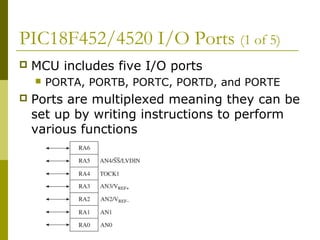
PIC18F452/4520 I/O Ports (1 of 5) 
 MCU includes five I/O ports 
 PORTA, PORTB, PORTC, PORTD, and PORTE 
 Ports are multiplexed meaning they can be 
set up by writing instructions to perform 
various functions
Interfacing Output Peripherals (1 of 2) 
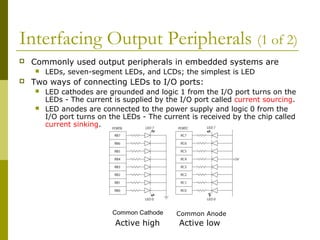
 Commonly used output peripherals in embedded systems are 
 LEDs, seven-segment LEDs, and LCDs; the simplest is LED 
 Two ways of connecting LEDs to I/O ports: 
 LED cathodes are grounded and logic 1 from the I/O port turns on the 
LEDs - The current is supplied by the I/O port called current sourcing. 
 LED anodes are connected to the power supply and logic 0 from the 
I/O port turns on the LEDs - The current is received by the chip called 
current sinking. 
Common Cathode Common Anode 
Active high Active low
Interfacing Seven-Segment 
LEDs as an Output (1 of 4) 
 Seven-segment LEDs 
 Often used to display BCD numbers (1 through 
9) and a few alphabets 
 A group of eight LEDs physically mounted in 
the shape of the number eight plus a decimal 
point as shown in Figure 9-5 (a) 
 Each LED is called a segment and labeled as ‘a’ 
through ‘g’.
Interfacing Seven-Segment 
LEDs as an Output (2 of 4) 
 Two types of seven-segment 
LEDs 
 Common anode 
 Common cathode 
decimal point
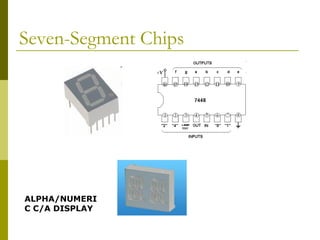
Seven-Segment Chips 
ALPHA/NUMERI 
C C/A DISPLAY
Interfacing Input Peripherals 
 Commonly used input peripherals in embedded 
systems are: 
1.Push button keys 
2.Dip switches 
3.Keyboard 
4.Mouse 
5.touchscreen
Output devices 
1.LCD screen 
2.Printer 
3.PC’s 
4.
Thank you !!!

Embedded systems and its ports

  • 1.
    EMBEDDED PRESENTATION Preparedby :- Rahul sharma (11ece29) Nitin (11ece25) Piyush gupta (11ece27) Priya (11ece28) Incharge:_ Mr. Naresh Tanwar ECE department A.C.E.M
  • 2.
    contents 1.Embedded system 2.Port 3.Port types 4.Peripheral devices 5.Interfacing 6.Output devices
  • 3.
    Embedded system embedded system means processor is embedded into that application.  We can say that it is a computing device that does a ‘specific focused job’. examples:air conditioner,VCD player,DVD player,printer,fax machine,mobile phones.
  • 4.
    port  Aport is a device  to receive the bytes from external peripheral(s) [or device(s) or processor(s) or controllers] for reading them later using instructions executed on the processor or  to send the bytes to external peripheral or device or processor using instructions executed on processor
  • 5.
    example  SIserial interface in 8051  SPI serial peripheral interface in 68HC11  PPI parallel peripheral interface 8255  Ports P0, P1, P2 and P3 in 8051 or PA, PB, PC and PD in 68HC11  COM1 and COM2 ports in an IBM PC
  • 6.
    I/O port types 1.Serial input output ports 2.Parallel input output ports
  • 7.
    Serial I/O ports  Synchronous Serial Input  Synchronous Serial Output  Asynchronous Serial UART input  Asynchronous Serial UART output  Both as input and as output, for example, modem.
  • 8.
    Parallel I/O ports  Parallel port one bit Input  Parallel one bit output  Parallel Port multi-bit Input  Parallel Port multi-bit Output
  • 9.
    For example IF we take pic microcontroller it have five input output ports which are: 1.Port A 2.Port B 3.Port C 4.Port D 5.Port E
  • 10.
    Pic18f458 (as example)  PIC18F458 has totally 40 Pins, A total of 33 pins are set aside for the five ports PORTA , PORTB, PORTC, PORTD and PORTE .  We can use these ports as a INPUT OrOUTPUT ports. The rest of the pins are designated for Vdd (Vcc) , Vss (GND),OSC1,OSC2,MCLR(reset) and another set of Vdd and Vss
  • 11.
    Pins of ports  PORTA 7 pins  PORTB 8 pins  PORTC 8pins  PORTD 8 pins  PORTE 3 pins
  • 12.
    Block Diagram ofI/O Interfacing Access one port at a time 8-bit registers I/O ports are associated with a SFR Each port is associated with 3 registers: PORT / LAT / TRIS Buffer Latch
  • 13.
    PIC18F452/4520 I/O Ports(1 of 5)  MCU includes five I/O ports  PORTA, PORTB, PORTC, PORTD, and PORTE  Ports are multiplexed meaning they can be set up by writing instructions to perform various functions
  • 14.
    Interfacing Output Peripherals(1 of 2)  Commonly used output peripherals in embedded systems are  LEDs, seven-segment LEDs, and LCDs; the simplest is LED  Two ways of connecting LEDs to I/O ports:  LED cathodes are grounded and logic 1 from the I/O port turns on the LEDs - The current is supplied by the I/O port called current sourcing.  LED anodes are connected to the power supply and logic 0 from the I/O port turns on the LEDs - The current is received by the chip called current sinking. Common Cathode Common Anode Active high Active low
  • 15.
    Interfacing Seven-Segment LEDsas an Output (1 of 4)  Seven-segment LEDs  Often used to display BCD numbers (1 through 9) and a few alphabets  A group of eight LEDs physically mounted in the shape of the number eight plus a decimal point as shown in Figure 9-5 (a)  Each LED is called a segment and labeled as ‘a’ through ‘g’.
  • 16.
    Interfacing Seven-Segment LEDsas an Output (2 of 4)  Two types of seven-segment LEDs  Common anode  Common cathode decimal point
  • 17.
  • 18.
    Interfacing Input Peripherals  Commonly used input peripherals in embedded systems are: 1.Push button keys 2.Dip switches 3.Keyboard 4.Mouse 5.touchscreen
  • 19.
    Output devices 1.LCDscreen 2.Printer 3.PC’s 4.
  • 20.