Embedded E-books and E-Readers in
Distance Learning


Terese Bird
Learning Technologist and SCORE Research Fellow
Beyond Distance Research Alliance, University of Leicester

MobiLearnAsia 2012 24-26 October, Sentosa, Singapore
www.le.ac.uk
What will we talk about?
• Learning advantages of e-
  readers in DUCKLING project
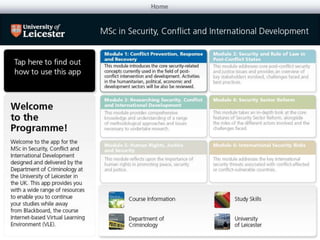
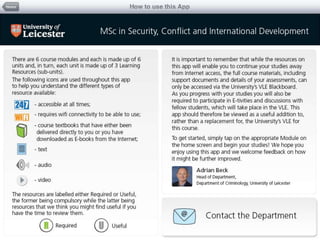
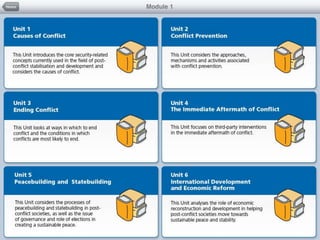
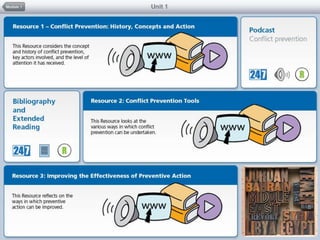
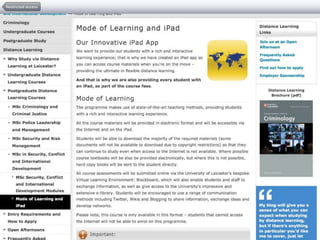
• Criminology iPad and app –
  one-iPad-per-student
• Caveats of e-readers
• How to do it
• Future-gazing
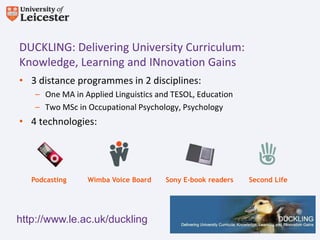
DUCKLING: Delivering University Curriculum:
Knowledge, Learning and INnovation Gains
• 3 distance programmes in 2 disciplines:
    – One MA in Applied Linguistics and TESOL, Education
    – Two MSc in Occupational Psychology, Psychology
• 4 technologies:


   Podcasting    Wimba Voice Board    Sony E-book readers   Second Life


http://www.le.ac.uk/duckling
Purposes of using e-book readers
•   Increase curriculum flexibility
•   Accommodate demands of mobile learners
•   Maximise limited study time
•   Increase access to essential readings
•   Cost-saving


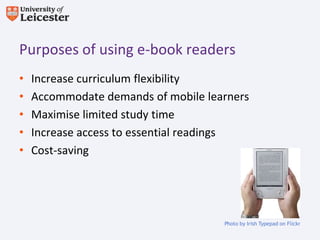
                                     Photo by Irish Typepad on Flickr
The pilot and research
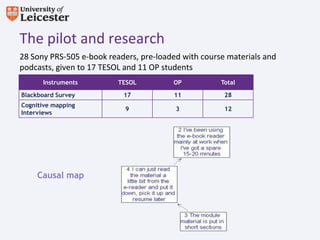
28 Sony PRS-505 e-book readers, pre-loaded with course materials and
podcasts, given to 17 TESOL and 11 OP students
      Instruments         TESOL         OP           Total

Blackboard Survey          17           11            28
Cognitive mapping
                            9            3            12
Interviews


     Causal map
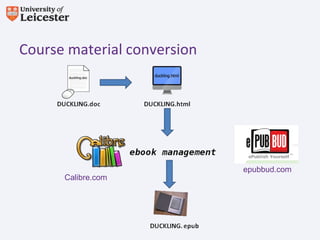
Course material conversion


                             epubbud.com
      Calibre.com
Flexibility and mobility
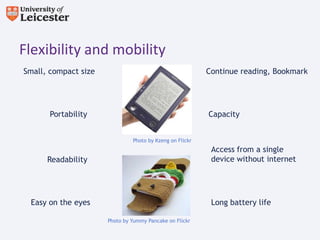
Small, compact size                                       Continue reading, Bookmark


       Portability                                        Capacity


                               Photo by Kzeng on Flickr
                                                           Access from a single
      Readability                                          device without internet


 Easy on the eyes                                          Long battery life

                      Photo by Yummy Pancake on Flickr
Maximise study time
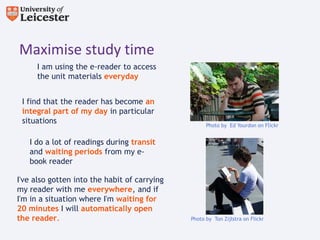
     I am using the e-reader to access
     the unit materials everyday


 I find that the reader has become an
 integral part of my day in particular
 situations                                         Photo by Ed Yourdon on Flickr


   I do a lot of readings during transit
   and waiting periods from my e-
   book reader

I've also gotten into the habit of carrying
my reader with me everywhere, and if
I'm in a situation where I'm waiting for
20 minutes I will automatically open
the reader.                                   Photo by Ton Zijlstra on Flickr
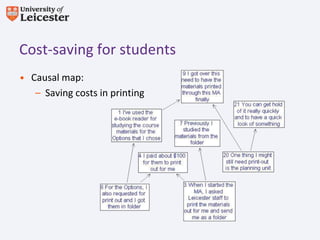
Cost-saving for students
• Causal map:
   – Saving costs in printing
Change in study strategies
Changing strategy   The e-book reader changed my way to keep notes and made my
                    study more effective. Before, I used my laptop to write a lot of
in keeping notes    notes because I feel I will forget the whole thing if I don’t take
                    them down. But taking notes is time-consuming and not that
                    effective because I never really use the notes. With the e-book
                    reader … I can remember where the material was and go back to
                    the module on the e-reader and look through it. As a result of
                    that, I didn’t take a lot of notes and I don’t think that it [not
                    taking notes] makes a difference to my study.


Changing strategy   The e-book reader has changed my approach to how I do
                    assignments to some extent. Previously, I started my assignments
for reading and     after I’ve done all the readings from print. I now start from the
approaches to       assignment and then read the material. I’m being more selective
                    now in what I’m reading, and it’s saving me time in a way.
assignments         Before I just tried to read everything, I worked a lot harder
                    before but I didn’t really get the grades.
Co-existence with other devices, personal
preferences
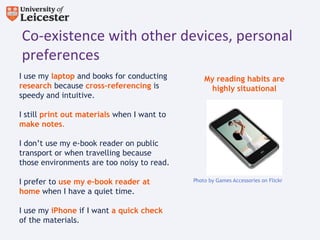
I use my laptop and books for conducting         My reading habits are
research because cross-referencing is             highly situational
speedy and intuitive.

I still print out materials when I want to
make notes.

I don’t use my e-book reader on public
transport or when travelling because
those environments are too noisy to read.

I prefer to use my e-book reader at          Photo by Games Accessories on Flickr

home when I have a quiet time.

I use my iPhone if I want a quick check
of the materials.
Conclusions and further research
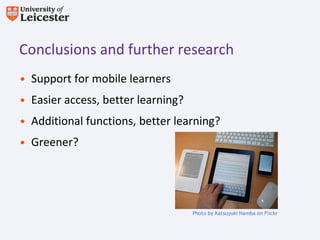
• Support for mobile learners
• Easier access, better learning?
• Additional functions, better learning?
• Greener?


                                    Photo by Katsuyuki Namba on Flickr
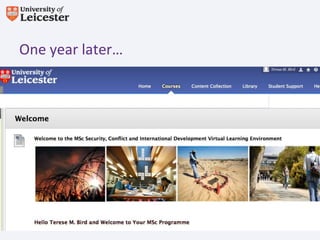
One year later…
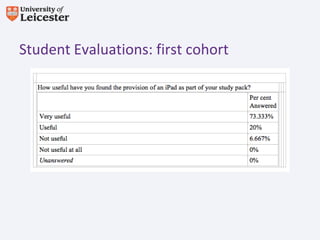
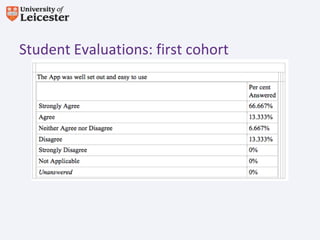
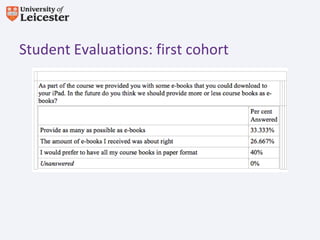
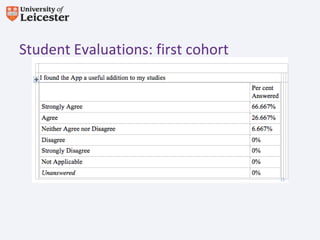
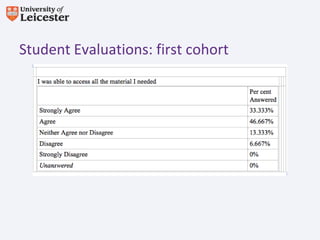
Student Evaluations: first cohort
Student Evaluation Summaries
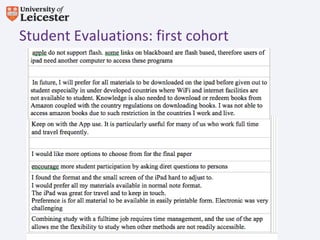
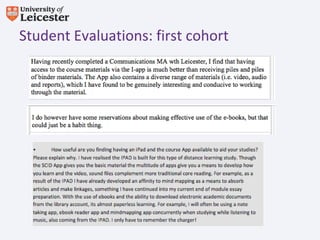
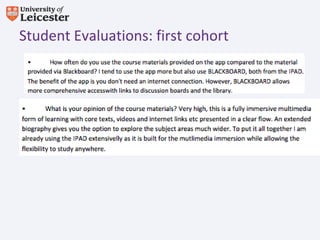
• “iPad is built for this type of distance learning study”
• Very positive for convenience, immersive
  multimedia, new ways of working, paperless, no-
  internet-required
• 8 out of 13 respondents reported using the iPad
  more than the LMS
• Wi-fi a problem in some regions (Africa); will use 3G
  iPads next cohort
• Amazon books cannot be purchased in some
  countries
Two new distance programs
• Another one-iPad-per-student but completely DIY
  using iBooks Author
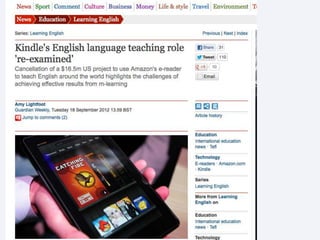
• Attempted one-Kindle-Touch-per-student did not
  happen
How to make ebooks
• Epub: Word -> html -> Calibre -> epub
• Epubbud.com
• Epub is good for all e-readers except Kindle
• Kindle Mobi: Word -> html -> Calibre -> mobi
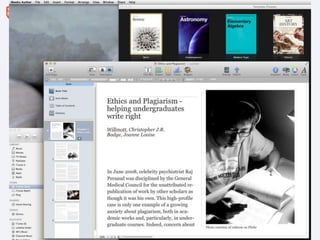
• IF iPad, then ibooks using iBooks Author, or stick
  with pdf
• IF you need for every single kind of device: use
  iBooks Author for ibooks and pdf, and Pages for
  epub. But you must cut and paste afresh into Pages.
  If you must use Windows, use InDesign.
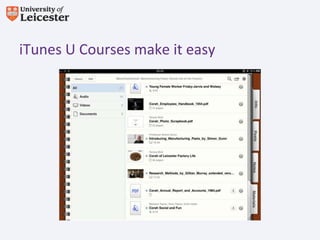
iTunes U Courses make it easy
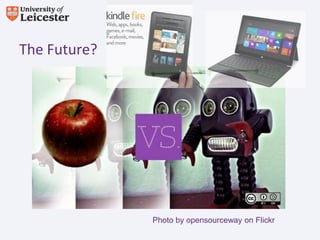
The Future?


              Photo by opensourceway on Flickr
The Future is Apple … for now … sort of

• Worldwide customer service
• Infrastructure
• Apple is making it easy
• IF you have confidence in another tablet hardware,
  just post your epub and pdf docs on a website,
  students will use tablet to connect to website, and
  you have it sorted.

                                Photo by cattias.photos on Flickr
With thanks for prior work to…
• Ming Nie
• Gabi Witthaus
• Kelly Barkland
• Alejandro Armellini
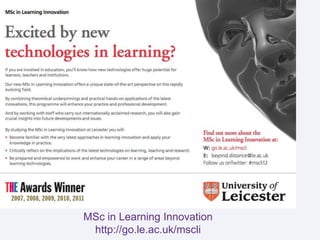
MSc in Learning Innovation
 http://go.le.ac.uk/mscli
Thank you!


Any questions?

Embedded E-books and E-Readers in Distance Learning

  • 1.
    Embedded E-books andE-Readers in Distance Learning Terese Bird Learning Technologist and SCORE Research Fellow Beyond Distance Research Alliance, University of Leicester MobiLearnAsia 2012 24-26 October, Sentosa, Singapore www.le.ac.uk
  • 2.
    What will wetalk about? • Learning advantages of e- readers in DUCKLING project • Criminology iPad and app – one-iPad-per-student • Caveats of e-readers • How to do it • Future-gazing
  • 3.
    DUCKLING: Delivering UniversityCurriculum: Knowledge, Learning and INnovation Gains • 3 distance programmes in 2 disciplines: – One MA in Applied Linguistics and TESOL, Education – Two MSc in Occupational Psychology, Psychology • 4 technologies: Podcasting Wimba Voice Board Sony E-book readers Second Life http://www.le.ac.uk/duckling
  • 4.
    Purposes of usinge-book readers • Increase curriculum flexibility • Accommodate demands of mobile learners • Maximise limited study time • Increase access to essential readings • Cost-saving Photo by Irish Typepad on Flickr
  • 5.
    The pilot andresearch 28 Sony PRS-505 e-book readers, pre-loaded with course materials and podcasts, given to 17 TESOL and 11 OP students Instruments TESOL OP Total Blackboard Survey 17 11 28 Cognitive mapping 9 3 12 Interviews Causal map
  • 6.
    Course material conversion epubbud.com Calibre.com
  • 7.
    Flexibility and mobility Small,compact size Continue reading, Bookmark Portability Capacity Photo by Kzeng on Flickr Access from a single Readability device without internet Easy on the eyes Long battery life Photo by Yummy Pancake on Flickr
  • 8.
    Maximise study time I am using the e-reader to access the unit materials everyday I find that the reader has become an integral part of my day in particular situations Photo by Ed Yourdon on Flickr I do a lot of readings during transit and waiting periods from my e- book reader I've also gotten into the habit of carrying my reader with me everywhere, and if I'm in a situation where I'm waiting for 20 minutes I will automatically open the reader. Photo by Ton Zijlstra on Flickr
  • 9.
    Cost-saving for students •Causal map: – Saving costs in printing
  • 10.
    Change in studystrategies Changing strategy The e-book reader changed my way to keep notes and made my study more effective. Before, I used my laptop to write a lot of in keeping notes notes because I feel I will forget the whole thing if I don’t take them down. But taking notes is time-consuming and not that effective because I never really use the notes. With the e-book reader … I can remember where the material was and go back to the module on the e-reader and look through it. As a result of that, I didn’t take a lot of notes and I don’t think that it [not taking notes] makes a difference to my study. Changing strategy The e-book reader has changed my approach to how I do assignments to some extent. Previously, I started my assignments for reading and after I’ve done all the readings from print. I now start from the approaches to assignment and then read the material. I’m being more selective now in what I’m reading, and it’s saving me time in a way. assignments Before I just tried to read everything, I worked a lot harder before but I didn’t really get the grades.
  • 11.
    Co-existence with otherdevices, personal preferences I use my laptop and books for conducting My reading habits are research because cross-referencing is highly situational speedy and intuitive. I still print out materials when I want to make notes. I don’t use my e-book reader on public transport or when travelling because those environments are too noisy to read. I prefer to use my e-book reader at Photo by Games Accessories on Flickr home when I have a quiet time. I use my iPhone if I want a quick check of the materials.
  • 12.
    Conclusions and furtherresearch • Support for mobile learners • Easier access, better learning? • Additional functions, better learning? • Greener? Photo by Katsuyuki Namba on Flickr
  • 13.
  • 21.
  • 22.
  • 23.
  • 24.
  • 25.
  • 26.
  • 27.
  • 28.
  • 29.
    Student Evaluation Summaries •“iPad is built for this type of distance learning study” • Very positive for convenience, immersive multimedia, new ways of working, paperless, no- internet-required • 8 out of 13 respondents reported using the iPad more than the LMS • Wi-fi a problem in some regions (Africa); will use 3G iPads next cohort • Amazon books cannot be purchased in some countries
  • 30.
    Two new distanceprograms • Another one-iPad-per-student but completely DIY using iBooks Author • Attempted one-Kindle-Touch-per-student did not happen
  • 32.
    How to makeebooks • Epub: Word -> html -> Calibre -> epub • Epubbud.com • Epub is good for all e-readers except Kindle • Kindle Mobi: Word -> html -> Calibre -> mobi • IF iPad, then ibooks using iBooks Author, or stick with pdf • IF you need for every single kind of device: use iBooks Author for ibooks and pdf, and Pages for epub. But you must cut and paste afresh into Pages. If you must use Windows, use InDesign.
  • 34.
    iTunes U Coursesmake it easy
  • 35.
    The Future? Photo by opensourceway on Flickr
  • 36.
    The Future isApple … for now … sort of • Worldwide customer service • Infrastructure • Apple is making it easy • IF you have confidence in another tablet hardware, just post your epub and pdf docs on a website, students will use tablet to connect to website, and you have it sorted. Photo by cattias.photos on Flickr
  • 37.
    With thanks forprior work to… • Ming Nie • Gabi Witthaus • Kelly Barkland • Alejandro Armellini
  • 38.
    MSc in LearningInnovation http://go.le.ac.uk/mscli
  • 39.