Why Would Your Students Give Up Theirs, If the U.S. President Didn't? Using Mobile Technologies in the Classroom Kimberly Conely, Wayne State University and Windsor University Anne-Marie Armstrong, Wayne State University
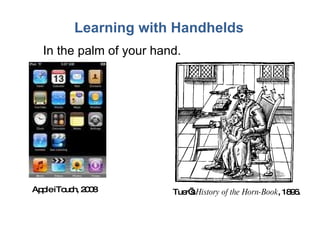
Learning with Handhelds In the palm of your hand. Tuer’s  History of the Horn-Book , 1896. Apple iTouch, 2008
Overview Demonstration Discovery Experimentation Storage and Retrieval Accessibility Instantaneous information Small enough to be taken anywhere Mobility Not tethered to one place Adaptability User changes behavior
M-Learning defined Uses PDAs, tablet PCs and digital cell phones Focuses on instant messaging and wireless access pages (WAPs) Modularizes and delivers information and small learning objects Provides information anytime users need it Transmits  …  ubiquitous, pervasive, personal, and connected learning
Why Use what you have Extend learning outside classroom Link people and places in real and virtual worlds Expertise on demand Support a mobile/global society Support lifetime learning
M-Learning Examples Mobile audio/SMS wikipedia Historical/geographical tours Citizen activism Dissemination of JIT information Collect real time data for research and evaluation Video historians Document solutions to problems http://www.youtube.com/watch?v=EsPRpQfHYOY   Geohistory project  http:// www.mobisitegalore.com/index.html
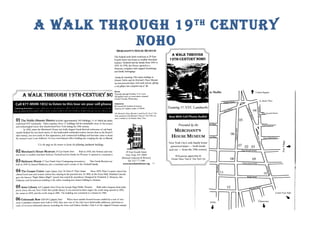
A Walk Through 19 th  Century NOHO
Mobile Devices and Types of Learning Behaviorism : Quick feedback or reinforcement can be facilitated through mobile devices. Constructivism : Enable immersive experiences such as those provided by simulations or games. Situated learning : Learners can take mobile devices into authentic learning environments or "context-aware" environments, such as specially equipped museums  Collaborative learning : Provide a handy additional means of communication and a portable means of electronic information gathering and sharing. Informal/lifelong learning : Accompany users in their everyday experiences and become a convenient source of information or means of communication that assists with learning. Support/coordination : Provide just-in-time access to learning resources, news, information, planners, address books, calculators, and so forth.  L. Naismith et al., "Literature Review in Mobile Technologies and Learning," 2004,  http://www.futurelab.org.uk/research/lit_reviews.htm#lr11   retrieved January 26, 2007 and quoted in Educause Quarterly, Vol 30, Nov, 2007
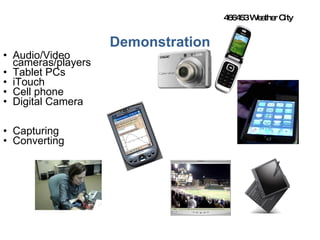
Demonstration Audio/Video  cameras/players Tablet PCs iTouch Cell phone Digital Camera Capturing Converting 466453 Weather City
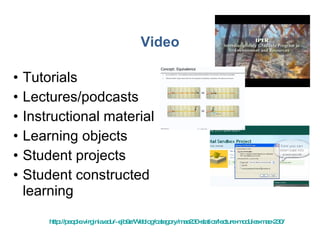
Video Tutorials Lectures/podcasts Instructional material Learning objects Student projects Student constructed learning http://people.virginia.edu/~ejb9z/Weblog/category/mae230-statics/lecture-modules-mae-230/
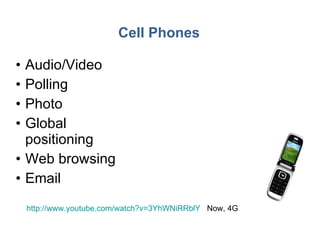
Cell Phones Audio/Video Polling Photo Global positioning Web browsing Email http:// www.youtube.com/watch?v =3YhWNiRRblY   Now, 4G
Polling Which mobile device(s) do you own? Use your cell phone Choose new text message To:99503 Message: 12850 (cell phone) 12851 (iphone, itouch) 12852 (pda) 11629 (laptop) Send What is your recommended source for news and information? Use your cell phone Choose new text message To:99503 Message: 14873 and your answer Send http://www.polleverywhere.com
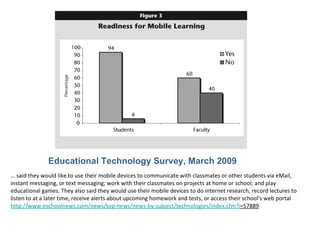
Educational Technology Survey, March 2009 …  said they would like to use their mobile devices to communicate with classmates or other students via eMail, instant messaging, or text messaging; work with their classmates on projects at home or school; and play educational games. They also said they would use their mobile devices to do internet research, record lectures to listen to at a later time, receive alerts about upcoming homework and tests, or access their school's web portal  http://www.eschoolnews.com/news/top-news/news-by-subject/technologies/index.cfm?i =57889
Results of Kim’s survey
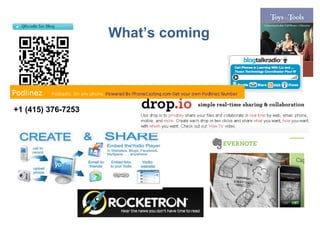
What’s coming +1 (415) 376-7253
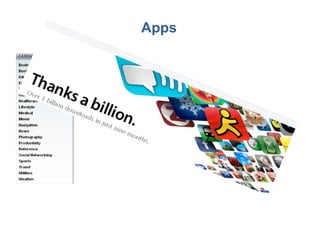
Apps
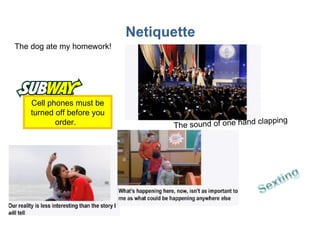
Netiquette Cell phones must be turned off before you order.  The dog ate my homework! The sound of one hand clapping
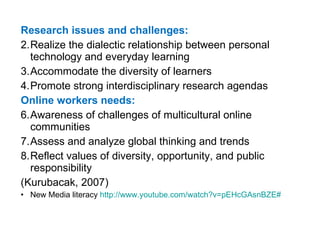
Research issues and challenges: Realize the dialectic relationship between personal technology and everyday learning Accommodate the diversity of learners Promote strong interdisciplinary research agendas Online workers needs: Awareness of challenges of multicultural online communities Assess and analyze global thinking and trends Reflect values of diversity, opportunity, and public responsibility (Kurubacak, 2007) New Media literacy  http:// www.youtube.com/watch?v = pEHcGAsnBZE #
 
 
Contact Anne-Marie Armstrong [email_address] Kimberly Conely
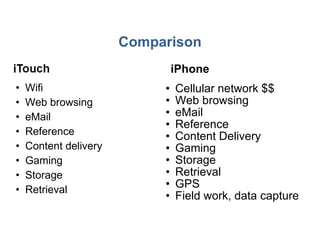
Comparison Wifi Web browsing eMail Reference Content delivery Gaming Storage Retrieval Cellular network $$ Web browsing eMail Reference Content Delivery Gaming Storage Retrieval GPS Field work, data capture iPhone
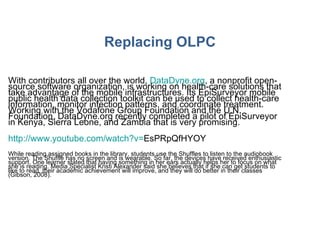
Replacing OLPC With contributors all over the world,  DataDyne.org , a nonprofit open-source software organization, is working on health-care solutions that take advantage of the mobile infrastructures. Its EpiSurveyor mobile public health data collection toolkit can be used to collect health-care information, monitor infection patterns, and coordinate treatment. Working with the Vodafone Group Foundation and the U.N. Foundation, DataDyne.org recently completed a pilot of EpiSurveyor in Kenya, Sierra Leone, and Zambia that is very promising. http:// www.youtube.com/watch?v = EsPRpQfHYOY   While reading assigned books in the library, students use the Shuffles to listen to the audiobook version. The Shuffle has no screen and is wearable. So far, the devices have received enthusiastic support. One learner stated that having something in her ears actually helps her to focus on what she is reading. Media Specialist Kristi Alexander said she believes that if she can get students to like to read, their academic achievement will improve, and they will do better in their classes (Gibson, 2008).

Nmcinteractives Handhelds

  • 1.
    Why Would YourStudents Give Up Theirs, If the U.S. President Didn't? Using Mobile Technologies in the Classroom Kimberly Conely, Wayne State University and Windsor University Anne-Marie Armstrong, Wayne State University
  • 2.
    Learning with HandheldsIn the palm of your hand. Tuer’s History of the Horn-Book , 1896. Apple iTouch, 2008
  • 3.
    Overview Demonstration DiscoveryExperimentation Storage and Retrieval Accessibility Instantaneous information Small enough to be taken anywhere Mobility Not tethered to one place Adaptability User changes behavior
  • 4.
    M-Learning defined UsesPDAs, tablet PCs and digital cell phones Focuses on instant messaging and wireless access pages (WAPs) Modularizes and delivers information and small learning objects Provides information anytime users need it Transmits … ubiquitous, pervasive, personal, and connected learning
  • 5.
    Why Use whatyou have Extend learning outside classroom Link people and places in real and virtual worlds Expertise on demand Support a mobile/global society Support lifetime learning
  • 6.
    M-Learning Examples Mobileaudio/SMS wikipedia Historical/geographical tours Citizen activism Dissemination of JIT information Collect real time data for research and evaluation Video historians Document solutions to problems http://www.youtube.com/watch?v=EsPRpQfHYOY Geohistory project http:// www.mobisitegalore.com/index.html
  • 7.
    A Walk Through19 th Century NOHO
  • 8.
    Mobile Devices andTypes of Learning Behaviorism : Quick feedback or reinforcement can be facilitated through mobile devices. Constructivism : Enable immersive experiences such as those provided by simulations or games. Situated learning : Learners can take mobile devices into authentic learning environments or "context-aware" environments, such as specially equipped museums Collaborative learning : Provide a handy additional means of communication and a portable means of electronic information gathering and sharing. Informal/lifelong learning : Accompany users in their everyday experiences and become a convenient source of information or means of communication that assists with learning. Support/coordination : Provide just-in-time access to learning resources, news, information, planners, address books, calculators, and so forth. L. Naismith et al., "Literature Review in Mobile Technologies and Learning," 2004, http://www.futurelab.org.uk/research/lit_reviews.htm#lr11 retrieved January 26, 2007 and quoted in Educause Quarterly, Vol 30, Nov, 2007
  • 9.
    Demonstration Audio/Video cameras/players Tablet PCs iTouch Cell phone Digital Camera Capturing Converting 466453 Weather City
  • 10.
    Video Tutorials Lectures/podcastsInstructional material Learning objects Student projects Student constructed learning http://people.virginia.edu/~ejb9z/Weblog/category/mae230-statics/lecture-modules-mae-230/
  • 11.
    Cell Phones Audio/VideoPolling Photo Global positioning Web browsing Email http:// www.youtube.com/watch?v =3YhWNiRRblY Now, 4G
  • 12.
    Polling Which mobiledevice(s) do you own? Use your cell phone Choose new text message To:99503 Message: 12850 (cell phone) 12851 (iphone, itouch) 12852 (pda) 11629 (laptop) Send What is your recommended source for news and information? Use your cell phone Choose new text message To:99503 Message: 14873 and your answer Send http://www.polleverywhere.com
  • 13.
    Educational Technology Survey,March 2009 … said they would like to use their mobile devices to communicate with classmates or other students via eMail, instant messaging, or text messaging; work with their classmates on projects at home or school; and play educational games. They also said they would use their mobile devices to do internet research, record lectures to listen to at a later time, receive alerts about upcoming homework and tests, or access their school's web portal http://www.eschoolnews.com/news/top-news/news-by-subject/technologies/index.cfm?i =57889
  • 14.
  • 15.
    What’s coming +1(415) 376-7253
  • 16.
  • 17.
    Netiquette Cell phonesmust be turned off before you order. The dog ate my homework! The sound of one hand clapping
  • 18.
    Research issues andchallenges: Realize the dialectic relationship between personal technology and everyday learning Accommodate the diversity of learners Promote strong interdisciplinary research agendas Online workers needs: Awareness of challenges of multicultural online communities Assess and analyze global thinking and trends Reflect values of diversity, opportunity, and public responsibility (Kurubacak, 2007) New Media literacy http:// www.youtube.com/watch?v = pEHcGAsnBZE #
  • 19.
  • 20.
  • 21.
    Contact Anne-Marie Armstrong[email_address] Kimberly Conely
  • 22.
    Comparison Wifi Webbrowsing eMail Reference Content delivery Gaming Storage Retrieval Cellular network $$ Web browsing eMail Reference Content Delivery Gaming Storage Retrieval GPS Field work, data capture iPhone
  • 23.
    Replacing OLPC Withcontributors all over the world, DataDyne.org , a nonprofit open-source software organization, is working on health-care solutions that take advantage of the mobile infrastructures. Its EpiSurveyor mobile public health data collection toolkit can be used to collect health-care information, monitor infection patterns, and coordinate treatment. Working with the Vodafone Group Foundation and the U.N. Foundation, DataDyne.org recently completed a pilot of EpiSurveyor in Kenya, Sierra Leone, and Zambia that is very promising. http:// www.youtube.com/watch?v = EsPRpQfHYOY While reading assigned books in the library, students use the Shuffles to listen to the audiobook version. The Shuffle has no screen and is wearable. So far, the devices have received enthusiastic support. One learner stated that having something in her ears actually helps her to focus on what she is reading. Media Specialist Kristi Alexander said she believes that if she can get students to like to read, their academic achievement will improve, and they will do better in their classes (Gibson, 2008).