"Sitting up & taking notes":
Using the iPad for reading
         and writing
              Johan Geertsema
        University Scholars Programme
                 January 2012


                      1
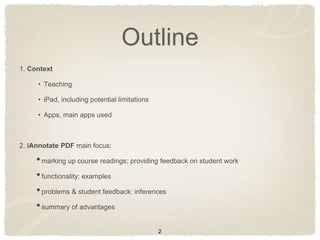
Outline
1. Context

     • Teaching

     • iPad, including potential limitations

     • Apps, main apps used


2. iAnnotate PDF main focus:

     • marking up course readings; providing feedback on student work
     • functionality: examples
     • problems & student feedback: inferences
     • summary of advantages

                                               2
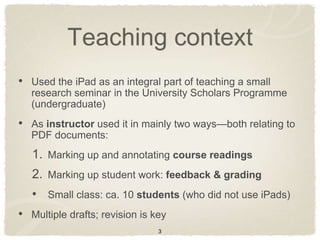
Teaching context
• Used the iPad as an integral part of teaching a small
   research seminar in the University Scholars Programme
   (undergraduate)
• As instructor used it in mainly two ways—both relating to
   PDF documents:
   1. Marking up and annotating course readings
   2. Marking up student work: feedback & grading
   • Small class: ca. 10 students (who did not use iPads)
• Multiple drafts; revision is key
                                3
iPad
  Skeptics might ask (certainly have asked):

    Just a big smartphone (albeit one that can‟t make calls
    …)?

    Entertainment mainly? Video, games, surfing

    Can it be a replacement for a laptop?

They might then ask:

  How can I use the iPad in my teaching?

  What actual benefits might it have?

                              4
Potential limitations
1. Arranging all files into folders as on Mac or PC not possible
     ✳ But search function works well
2. Non-tactile keyboard: some find this annoying, and it seems
    true that typing is slower/more awkward
3. Though wireless keyboard is possible, not ideal due to
    touchscreen interface
     ✳ Lack of mouse: the whole point of the iPad interface is to
        use one‟s fingers, but that makes an external keyboard
        awkward
✳ Because of its small size and touchscreen interface iPad is best
    used for more limited kinds of writing, but does this very well.

                                  5
Apps
Of course, there are zillions (well, thousands) of brilliant
“apps” available in Apple‟s App Store.
Fascinating things one could do with the iPad, also in the
classroom.
Modelling, virtual reality: very many high-tech things.
But: I am not really a very high-tech person—rather, an
ordinary educator using the iPad in class as part of CIT‟s
Loan Scheme
Main purpose for which I have used iPad is a very basic
one: taking notes, in particular annotating texts


                              6
Main apps used
Some note taking apps:
     iAnnotate: for reading and annotating PDF files (my focus)
     Evernote and Soundnote: for creating and organizing notes
     Kobo and Bluefire Reader: for reading and annotating
     eBooks—DRM-protected ePub files
While note taking is a very basic function, it is one all academic
 readers and writers—whether students or faculty—engage in
 regularly: & of course very valuable pedagogically.
   Research: documentation, highlighting key words, etc.
   Feedback to students

                                7
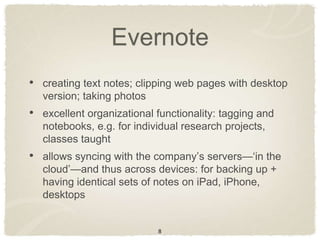
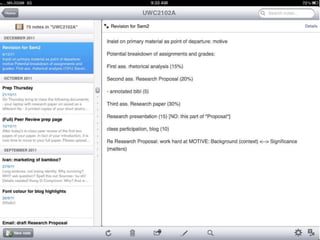
Evernote
• creating text notes; clipping web pages with desktop
  version; taking photos
• excellent organizational functionality: tagging and
  notebooks, e.g. for individual research projects,
  classes taught
• allows syncing with the company‟s servers—„in the
  cloud‟—and thus across devices: for backing up +
  having identical sets of notes on iPad, iPhone,
  desktops


                           8
9
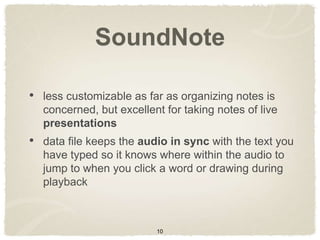
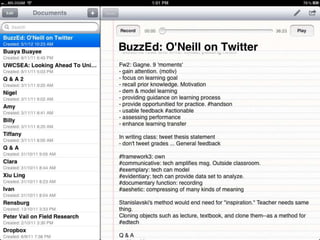
SoundNote

• less customizable as far as organizing notes is
  concerned, but excellent for taking notes of live
  presentations
• data file keeps the audio in sync with the text you
  have typed so it knows where within the audio to
  jump to when you click a word or drawing during
  playback


                         10
11
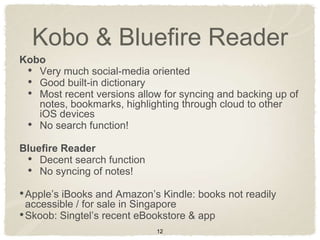
Kobo & Bluefire Reader
Kobo
 • Very much social-media oriented
 • Good built-in dictionary
 • Most recent versions allow for syncing and backing up of
   notes, bookmarks, highlighting through cloud to other
   iOS devices
 • No search function!
Bluefire Reader
 • Decent search function
 • No syncing of notes!
• Apple‟s iBooks and Amazon‟s Kindle: books not readily
  accessible / for sale in Singapore
• Skoob: Singtel‟s recent eBookstore & app
                             12
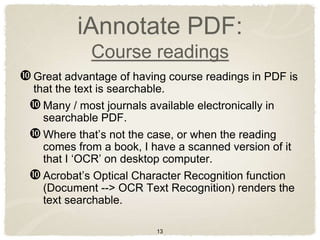
iAnnotate PDF:
             Course readings
 Great advantage of having course readings in PDF is
 that the text is searchable.
  Many / most journals available electronically in
   searchable PDF.
  Where that‟s not the case, or when the reading
   comes from a book, I have a scanned version of it
   that I „OCR‟ on desktop computer.
  Acrobat‟s Optical Character Recognition function
   (Document --> OCR Text Recognition) renders the
   text searchable.

                          13
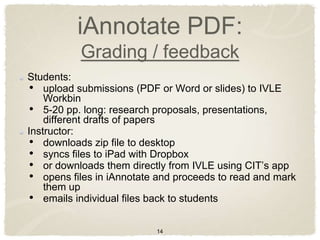
iAnnotate PDF:
           Grading / feedback
Students:
 • upload submissions (PDF or Word or slides) to IVLE
    Workbin
 • 5-20 pp. long: research proposals, presentations,
    different drafts of papers
Instructor:
 • downloads zip file to desktop
 • syncs files to iPad with Dropbox
 • or downloads them directly from IVLE using CIT‟s app
 • opens files in iAnnotate and proceeds to read and mark
    them up
 • emails individual files back to students

                           14
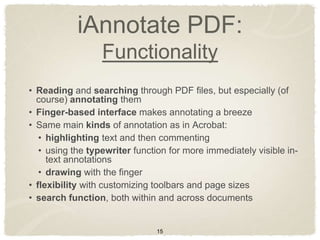
iAnnotate PDF:
                  Functionality
• Reading and searching through PDF files, but especially (of
  course) annotating them
• Finger-based interface makes annotating a breeze
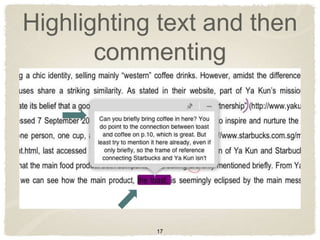
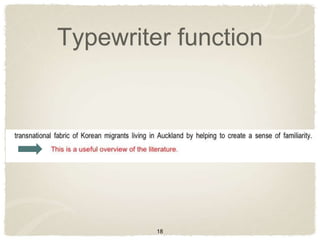
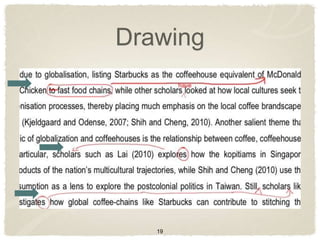
• Same main kinds of annotation as in Acrobat:
   • highlighting text and then commenting
   • using the typewriter function for more immediately visible in-
     text annotations
   • drawing with the finger
• flexibility with customizing toolbars and page sizes
• search function, both within and across documents


                               15
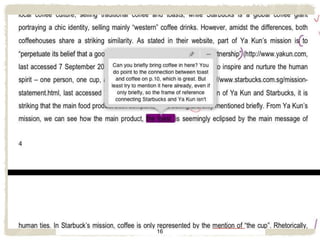
Annotated pages


       16
Highlighting text and then
       commenting


            17
Typewriter function


         18
Drawing


   19
Problems using the app

• Not many problems: very stable
• Students highlighted some issues (will get to them)
• But: larger and / or more graphics-intensive files, in
  particular some scanned files, can take too long to
  load when e.g. moving from one page to another or
  zooming in and out.


                            20
Loading …


    21
Loading …
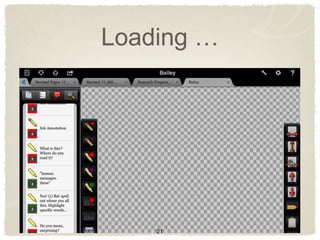
• Sometimes it can take 10 seconds or even longer; this is the one
  area where I have found using iAnnotate, and the iPad more
  generally, deficient when reading PDFs.

  • Workaround: reduce document seize, and/or OCR.
• iPad is not usable in classroom situations in the case of scanned
  files that exhibit this behaviour, since it simply takes too long to
  turn pages.

• Hopefully iPad 3 will have more internal memory and a faster
  processor?


                                  22
Student Feedback
             Question
8. Did you find my COMMENTS on your writing
 helpful? Please elaborate on: (a) the quality and
 quantity of comments you received (b) the format
 in which you received them (PDF)
 Caveats:
     Small seminar-style class
     Have run survey once only
     I.e. these results are statistically not significant, but
     even so I have found them useful.

                              23
Student Feedback
        Responses (1)
I find the comments REALLY helpful…. The PDF format is good
because it saves the student the hassle to print it out or to
rush to school to submit the paper. However there might be
technical glitches here and there. 11/20/2011 12:27 AM
Certainly! The comments I received really helped me progress
to the next stage of the research process and I do find the
format neat. One grouse I have with this format is that I can't
print it out (as I prefer to have a hard copy with me as I edit
instead of having to switch between windows on my laptop). So
in summary, the format was really neat (at least it's completely
legible …) but I would have preferred to be able to print them
without having too much hassle copying and pasting the
comments. 11/11/2011 2:40 PM


                             24
Student Feedback
         Responses (2)
Yes I do find your comments very helpful…. a. the quality of comments I
received so far is critical enough. …. b. I sometimes struggle[d] clicking
the comments one by one, especially if I need to print it from a PC. I
must open all the comments in the .pdf file then print as .pdf from my mac,
then send to my email to be printed from a PC computer. However, it's
nice to receive the last commented conference paper draft because
the comments are put as endnotes. I am not sure if this is very
subjective, but the latter is much more friendly to me! 11/10/2011 12:49

Yes, I would have preferred it printed out with pen marks but that's
because I'm a traditional person and have a small screen so I can't see
everything. 11/9/2011 11:41 PM

I think the comments on the papers were very helpful in pointing out
mistakes and errors in my paper that I would have otherwise not noticed.
The PDF format was also very easy to read and convenient 11/9/2011
9:53 PM

                                  25
Inferences
Students note convenience and user friendliness,
though there may be technical issues.
Printing is a key issue for some: want to work on
paper, yet didn‟t know how they could print the file
with all the comments included.
Indication that some prefer separately listed
comments.


                         26
Therefore …

I will this semester do two or three things differently:
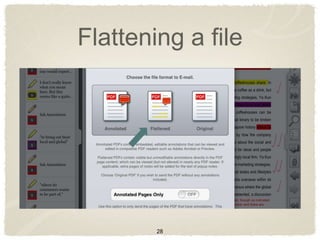
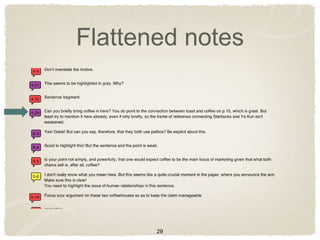
1. Use iAnnotate‟s “Flattening” function when
   returning papers. It prints all annotations by page
   and line number with hyperlinks at the end of the
   document.


                          27
Flattening a file


        28
Flattened notes


       29
or:

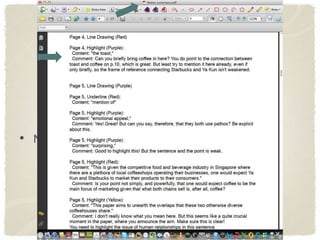
2.Provide students with a separate file, generated by
 iAnnotate, that lists comments


                           30
or:


2.Provide them with a separate file that lists comments


                           31
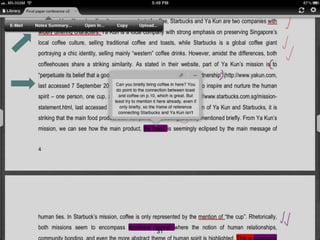
Notes


• Notes extracted


                      32
and …
3. Most importantly, brief students better, e.g. how to
   view the documents (and/or print them)
  • I simply assumed students would know how to
      open and print marked-up PDF documents—and
      access the annotations: invalid assumption
4. Would be really great if students could use the app
   on the iPad for their own pack of course readings,
   and for accessing my comments on their
   assignments: CIT??


                            33
Finally: some main
             advantages
• Student work in PDF: document not editable
      In my view, students must decide how to use my feedback: providing
      feedback in a Word document has always seemed to me to be too
      interventionist, coming too close to making revisions that should
      properly speaking be carried out by the student. (This is especially
      the case where students submit multiple drafts, as they do for my
      classes: I teaching writing and critical thinking in the USP.)
• Searchability: finding passages with key terms very convenient
• Mobility: on the bus, the plane, in a compact device
• ‘Centrality’: really useful to take iPad into classroom rather than stacks
   of paper—all notes on all class readings are centrally available, and all
   student papers / projects


                                     34
Thank you!


    35

"Sitting up and taking notes": Using the iPad for reading and writing

  • 1.
    "Sitting up &taking notes": Using the iPad for reading and writing Johan Geertsema University Scholars Programme January 2012 1
  • 2.
    Outline 1. Context • Teaching • iPad, including potential limitations • Apps, main apps used 2. iAnnotate PDF main focus: • marking up course readings; providing feedback on student work • functionality: examples • problems & student feedback: inferences • summary of advantages 2
  • 3.
    Teaching context • Usedthe iPad as an integral part of teaching a small research seminar in the University Scholars Programme (undergraduate) • As instructor used it in mainly two ways—both relating to PDF documents: 1. Marking up and annotating course readings 2. Marking up student work: feedback & grading • Small class: ca. 10 students (who did not use iPads) • Multiple drafts; revision is key 3
  • 4.
    iPad Skepticsmight ask (certainly have asked): Just a big smartphone (albeit one that can‟t make calls …)? Entertainment mainly? Video, games, surfing Can it be a replacement for a laptop? They might then ask: How can I use the iPad in my teaching? What actual benefits might it have? 4
  • 5.
    Potential limitations 1. Arrangingall files into folders as on Mac or PC not possible ✳ But search function works well 2. Non-tactile keyboard: some find this annoying, and it seems true that typing is slower/more awkward 3. Though wireless keyboard is possible, not ideal due to touchscreen interface ✳ Lack of mouse: the whole point of the iPad interface is to use one‟s fingers, but that makes an external keyboard awkward ✳ Because of its small size and touchscreen interface iPad is best used for more limited kinds of writing, but does this very well. 5
  • 6.
    Apps Of course, thereare zillions (well, thousands) of brilliant “apps” available in Apple‟s App Store. Fascinating things one could do with the iPad, also in the classroom. Modelling, virtual reality: very many high-tech things. But: I am not really a very high-tech person—rather, an ordinary educator using the iPad in class as part of CIT‟s Loan Scheme Main purpose for which I have used iPad is a very basic one: taking notes, in particular annotating texts 6
  • 7.
    Main apps used Somenote taking apps: iAnnotate: for reading and annotating PDF files (my focus) Evernote and Soundnote: for creating and organizing notes Kobo and Bluefire Reader: for reading and annotating eBooks—DRM-protected ePub files While note taking is a very basic function, it is one all academic readers and writers—whether students or faculty—engage in regularly: & of course very valuable pedagogically.  Research: documentation, highlighting key words, etc.  Feedback to students 7
  • 8.
    Evernote • creating textnotes; clipping web pages with desktop version; taking photos • excellent organizational functionality: tagging and notebooks, e.g. for individual research projects, classes taught • allows syncing with the company‟s servers—„in the cloud‟—and thus across devices: for backing up + having identical sets of notes on iPad, iPhone, desktops 8
  • 9.
  • 10.
    SoundNote • less customizableas far as organizing notes is concerned, but excellent for taking notes of live presentations • data file keeps the audio in sync with the text you have typed so it knows where within the audio to jump to when you click a word or drawing during playback 10
  • 11.
  • 12.
    Kobo & BluefireReader Kobo • Very much social-media oriented • Good built-in dictionary • Most recent versions allow for syncing and backing up of notes, bookmarks, highlighting through cloud to other iOS devices • No search function! Bluefire Reader • Decent search function • No syncing of notes! • Apple‟s iBooks and Amazon‟s Kindle: books not readily accessible / for sale in Singapore • Skoob: Singtel‟s recent eBookstore & app 12
  • 13.
    iAnnotate PDF: Course readings  Great advantage of having course readings in PDF is that the text is searchable.  Many / most journals available electronically in searchable PDF.  Where that‟s not the case, or when the reading comes from a book, I have a scanned version of it that I „OCR‟ on desktop computer.  Acrobat‟s Optical Character Recognition function (Document --> OCR Text Recognition) renders the text searchable. 13
  • 14.
    iAnnotate PDF: Grading / feedback Students: • upload submissions (PDF or Word or slides) to IVLE Workbin • 5-20 pp. long: research proposals, presentations, different drafts of papers Instructor: • downloads zip file to desktop • syncs files to iPad with Dropbox • or downloads them directly from IVLE using CIT‟s app • opens files in iAnnotate and proceeds to read and mark them up • emails individual files back to students 14
  • 15.
    iAnnotate PDF: Functionality • Reading and searching through PDF files, but especially (of course) annotating them • Finger-based interface makes annotating a breeze • Same main kinds of annotation as in Acrobat: • highlighting text and then commenting • using the typewriter function for more immediately visible in- text annotations • drawing with the finger • flexibility with customizing toolbars and page sizes • search function, both within and across documents 15
  • 16.
  • 17.
    Highlighting text andthen commenting 17
  • 18.
  • 19.
  • 20.
    Problems using theapp • Not many problems: very stable • Students highlighted some issues (will get to them) • But: larger and / or more graphics-intensive files, in particular some scanned files, can take too long to load when e.g. moving from one page to another or zooming in and out. 20
  • 21.
  • 22.
    Loading … • Sometimesit can take 10 seconds or even longer; this is the one area where I have found using iAnnotate, and the iPad more generally, deficient when reading PDFs. • Workaround: reduce document seize, and/or OCR. • iPad is not usable in classroom situations in the case of scanned files that exhibit this behaviour, since it simply takes too long to turn pages. • Hopefully iPad 3 will have more internal memory and a faster processor? 22
  • 23.
    Student Feedback Question 8. Did you find my COMMENTS on your writing helpful? Please elaborate on: (a) the quality and quantity of comments you received (b) the format in which you received them (PDF) Caveats: Small seminar-style class Have run survey once only I.e. these results are statistically not significant, but even so I have found them useful. 23
  • 24.
    Student Feedback Responses (1) I find the comments REALLY helpful…. The PDF format is good because it saves the student the hassle to print it out or to rush to school to submit the paper. However there might be technical glitches here and there. 11/20/2011 12:27 AM Certainly! The comments I received really helped me progress to the next stage of the research process and I do find the format neat. One grouse I have with this format is that I can't print it out (as I prefer to have a hard copy with me as I edit instead of having to switch between windows on my laptop). So in summary, the format was really neat (at least it's completely legible …) but I would have preferred to be able to print them without having too much hassle copying and pasting the comments. 11/11/2011 2:40 PM 24
  • 25.
    Student Feedback Responses (2) Yes I do find your comments very helpful…. a. the quality of comments I received so far is critical enough. …. b. I sometimes struggle[d] clicking the comments one by one, especially if I need to print it from a PC. I must open all the comments in the .pdf file then print as .pdf from my mac, then send to my email to be printed from a PC computer. However, it's nice to receive the last commented conference paper draft because the comments are put as endnotes. I am not sure if this is very subjective, but the latter is much more friendly to me! 11/10/2011 12:49 Yes, I would have preferred it printed out with pen marks but that's because I'm a traditional person and have a small screen so I can't see everything. 11/9/2011 11:41 PM I think the comments on the papers were very helpful in pointing out mistakes and errors in my paper that I would have otherwise not noticed. The PDF format was also very easy to read and convenient 11/9/2011 9:53 PM 25
  • 26.
    Inferences Students note convenienceand user friendliness, though there may be technical issues. Printing is a key issue for some: want to work on paper, yet didn‟t know how they could print the file with all the comments included. Indication that some prefer separately listed comments. 26
  • 27.
    Therefore … I willthis semester do two or three things differently: 1. Use iAnnotate‟s “Flattening” function when returning papers. It prints all annotations by page and line number with hyperlinks at the end of the document. 27
  • 28.
  • 29.
  • 30.
    or: 2.Provide students witha separate file, generated by iAnnotate, that lists comments 30
  • 31.
    or: 2.Provide them witha separate file that lists comments 31
  • 32.
  • 33.
    and … 3. Mostimportantly, brief students better, e.g. how to view the documents (and/or print them) • I simply assumed students would know how to open and print marked-up PDF documents—and access the annotations: invalid assumption 4. Would be really great if students could use the app on the iPad for their own pack of course readings, and for accessing my comments on their assignments: CIT?? 33
  • 34.
    Finally: some main advantages • Student work in PDF: document not editable In my view, students must decide how to use my feedback: providing feedback in a Word document has always seemed to me to be too interventionist, coming too close to making revisions that should properly speaking be carried out by the student. (This is especially the case where students submit multiple drafts, as they do for my classes: I teaching writing and critical thinking in the USP.) • Searchability: finding passages with key terms very convenient • Mobility: on the bus, the plane, in a compact device • ‘Centrality’: really useful to take iPad into classroom rather than stacks of paper—all notes on all class readings are centrally available, and all student papers / projects 34
  • 35.