INTEGRATION OF
MOBILE DEVICES
Technology Considerations
with mobile devices
Introduction to Research
How might an instructional designer bridge the
gap that exists between the digital world and
the hardback, textbook traditions with mobile
technology?
Maureen Gorman
Table of Contents
 Introduction
 Vision and Vices
 Abstract
 Aiming at a moving target
 Time Will Tell
 Time Factor
 Technology Emphasis
 Statistics
 Educating the Mobile Generations
 Conclusion
 Key Ideas
 Vision
 E-readers
 iPad
 Literature Reviews/Observations
 References
Introduction
With technology:
the individual, educators, and educational
institutions are faced with choices to make for
the 21st century learner. Those choices are
also expectations of interest groups, national,
state and local decision makers, while a
decision on what to use in classrooms has
gone beyond the planning and purchasing of
textbooks.
Visions and Vices
This is supported by an introduction from
the article “Integrating the iPod Touch in K-12
Education: Visions and Vices” in which Savilla
Banister notes “Various interest groups,
including state and national accreditation
bodies, continue to expect that student (K-16)
learn to effectively use computer technologies
(ISTE, 2004; Swain & Pearson, 2002 a,
2002b) (Banister, 2010).
Abstract
Education is changing so quickly, we as
educators need to keep our eyes on the target
and aim for the most centralized decision on
how we will use technology to challenge the
learner to maximize their opportunities to make
the most of their inner capabilities.
Aiming at a Moving Target
A comparison is made in the article
“Aiming at a Moving Target” (2010) which calls
attention to investigate the time needed before
investment. In a pilot study of urban New
York, the University of New York used pilot
testing for prospective student taking summer
class at John Jay College. New E-readers
where changing quickly and too fast to make a
decision for the future. The educators felt like
they were “aiming at a moving target”.
Time Will Tell
Time Factor
With time e-books and e-readers will evolve
with greater possibilities. “Though there is no
doubt that eBooks will be an expanding part of
information delivery in libraries, the dedicated
e-reader has not yet reached a point where the
technology is worth investing in, particularly in
these tough economic times.” (Kiriakova,
Okamoto, Zubarev, & Gross, March, 1010).
Technology Emphasis
“ In digital technology education, this can only be
achieved if more emphasis and resources are
devoted by institutions to developing the multi-
media literacy of academics and developing
sustainable work practices which benefit both
teacher and student alike” (Kiarakova, 2010)
Statistics
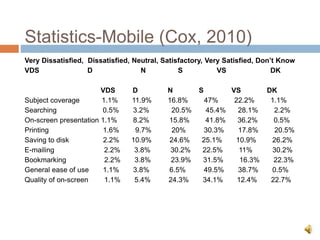
Statistics-Mobile (Cox, 2010)
Very Dissatisfied, Dissatisfied, Neutral, Satisfactory, Very Satisfied, Don’t Know
VDS D N S VS DK
VDS D N S VS DK
Subject coverage 1.1% 11.9% 16.8% 47% 22.2% 1.1%
Searching 0.5% 3.2% 20.5% 45.4% 28.1% 2.2%
On-screen presentation 1.1% 8.2% 15.8% 41.8% 36.2% 0.5%
Printing 1.6% 9.7% 20% 30.3% 17.8% 20.5%
Saving to disk 2.2% 10.9% 24.6% 25.1% 10.9% 26.2%
E-mailing 2.2% 3.8% 30.2% 22.5% 11% 30.2%
Bookmarking 2.2% 3.8% 23.9% 31.5% 16.3% 22.3%
General ease of use 1.1% 3.8% 6.5% 49.5% 38.7% 0.5%
Quality of on-screen 1.1% 5.4% 24.3% 34.1% 12.4% 22.7%
Educating the Mobile Generations
http://newlearninginstitute.org/21stcenturye
ducation/21st-century-learning/educating-
the-mobile-generation.html
Conclusion
Today I propose that an investment in
training start with the educators and the
possibilities of the eBook and eBook readers.
From there, qualified pilot studies research this
technology within the educational community
over a sustained amount of time with
documentation and observation. Even though
there are studies in place, further studies could
substantiate a decision for each individual unit
of learning.
Key Ideas
Changing role of teaching and learning
practices as a result of technology.
Possibilities of using “mobile devices”
needs visionaries to test, purchase,
teach, learn and implement research
studies and then convince
stakeholders of an appropriate plan of
action.
With community and
financial support
classrooms can
experience the same
tools that are used in
the business world.
Key Ideas
Key Ideas-Technology training for
college students can be used to benefit
K-12 classrooms. Discussion threads
using literature, e-books, Power Points,
chat rooms, discussion formats, and a
combination of technological methods is
a process/project way of stimulating
learning experiences. Teaching reading
with the use of Literature has many
formats to use in combination with
original formats. State and local
agencies are faced with a dilemma that
will be answered with an investment of
time and resources. (Baniste ,2010).
Vision
The roles of teaching will
change to accommodate
the needs of the current
generation. More
collaborative efforts with the
emphasis on project
planning is to take place.
Possibilities of using
“mobile devices” needs
visionaries to test,
purchase, teach, learn and
implement research studies
and then convince
stakeholders of an
appropriate plan of action.
E-Readers
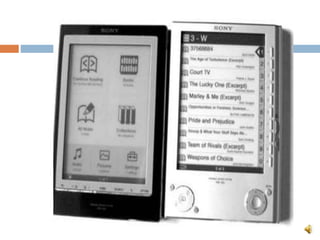
E-Readers E-Reader
Applications
Ipad iPod
Kindle DX iPod touch
Nook iPhone
Sony-600 laptop
Kindle 3 notebooks
Alex ereader BeeBook
Neo
Astec Pro EE-PC
COOL-ER
Kobo
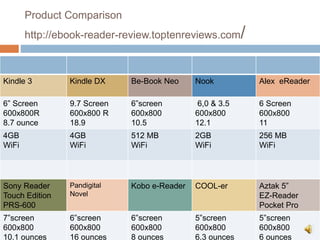
Product Comparison
http://ebook-reader-review.toptenreviews.com/
Kindle 3 Kindle DX Be-Book Neo Nook Alex eReader
6” Screen
600x800R
8.7 ounce
9.7 Screen
600x800 R
18.9
6”screen
600x800
10.5
6,0 & 3.5
600x800
12.1
6 Screen
600x800
11
4GB
WiFi
4GB
WiFi
512 MB
WiFi
2GB
WiFi
256 MB
WiFi
Sony Reader
Touch Edition
PRS-600
Pandigital
Novel
Kobo e-Reader COOL-er Aztak 5”
EZ-Reader
Pocket Pro
7”screen
600x800
10.1 ounces
6”screen
600x800
16 ounces
6”screen
600x800
8 ounces
5”screen
600x800
6.3 ounces
5”screen
600x800
6 ounces
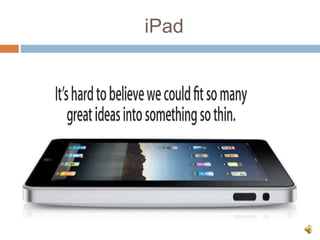
iPad
iPad
 Multi-Touch
 The Multi-Touch screen on iPad is based on
the same revolutionary technology on iPhone.
But the technology has been completely
reengineered for the larger iPad surface,
making it extremely precise and responsive.
So whether you’re zooming in on a map,
flicking through your photos, or deleting an
email, iPad responds with incredible accuracy.
And it does just what you want it to.
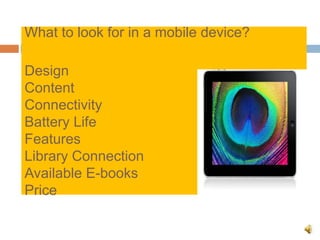
What to look for in a mobile device?
Design
Content
Connectivity
Battery Life
Features
Library Connection
Available E-books
Price
Pro’s www.slj.com/tech
iPod and iPad
Apple has special book interaction features with the
iPad books.
Audio and video notes are part of the iPad
applications.
Embedded quizzes with scoring applications.
Much lighter in weight in comparison to a textbook.
Textbook companies can incorporate e-books.
Learning with the mobile extends learning to the
real world of applications.
Con’s
Need for customer oriented licensing.
Temporary extensive staffing, training needed.
Full feature with more interaction for input.
Battles with publishing companies and licensing.
E-books are secondary to esthetic, historic,
nostalgic, sharing potential of books.
More flexible/onscreen delivery needed for e-books
and greater customer satisfaction. (Cox, 2010)
http://www.edutopia.org/electronic-readers-versus-
classroom-texts
“After all, every electronic medium relies for storage on
plain old magnetism . And magnetism a has a host of
enemies, just like the elastic in old tube socks.”
(Edward, 2010)
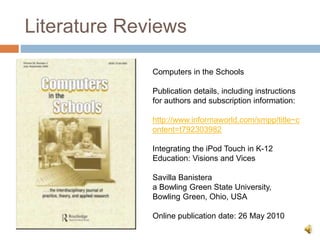
Literature Reviews
Computers in the Schools
Publication details, including instructions
for authors and subscription information:
http://www.informaworld.com/smpp/title~c
ontent=t792303982
Integrating the iPod Touch in K-12
Education: Visions and Vices
Savilla Banistera
a Bowling Green State University,
Bowling Green, Ohio, USA
Online publication date: 26 May 2010
Observations-(Banister, May, 2004)
Early childhood
education can use
mobile devices for
learning.
Specific content area
for elementary and
upper elementary
content has various
applications.
More than 60,000 web
applications were in
place at the time of
the study.
Challenges for
teachers include
tracking, charging
devices.
Time, effort and
vigilance is needed to
implement this 21st
method of learning
and teaching
Literature Review
Mobile math: math educators and students
engage in mobile learning
Teresa Franklin Æ Li-Wei Peng
Published online: 23 October 2008
Springer Science Business Media, LLC 2008
Observations-(Franklin, Peng2008)
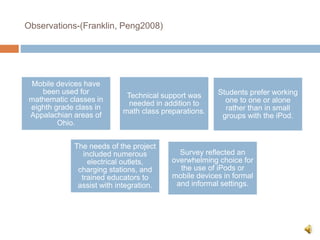
Mobile devices have
been used for
mathematic classes in
eighth grade class in
Appalachian areas of
Ohio.
Technical support was
needed in addition to
math class preparations.
Students prefer working
one to one or alone
rather than in small
groups with the iPod.
The needs of the project
included numerous
electrical outlets,
charging stations, and
trained educators to
assist with integration.
Survey reflected an
overwhelming choice for
the use of iPods or
mobile devices in formal
and informal settings.
Aiming at a Moving Target
“Though there is no doubt that eBooks will be an expanding
part of information delivery in libraries, the dedicated e-reader
han not yet reached a point where the technology is worth
investing in, particularly in these though economic times.”
(Kiniskova, Okamoto, Zubarev, & Gross)
Library Issues
E-readers quickly become outdated.
Issues of circulation in libraries have to be
considered.
At the time of the study distributors have not refined
the distribution of the portable reading devices.
Copyright/Content Acquisition/Physical
Management/Cataloging
Observations-(Kirakova, Okamoto, Zubarev, & Gross 2010)
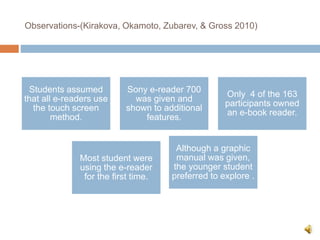
Students assumed
that all e-readers use
the touch screen
method.
Sony e-reader 700
was given and
shown to additional
features.
Only 4 of the 163
participants owned
an e-book reader.
Most student were
using the e-reader
for the first time.
Although a graphic
manual was given,
the younger student
preferred to explore .
Literature Review
Journal of University Teaching & Learning
Practice
Volume 7, Issue 1 2010 Article 3
Digital Technology Education and its Impact
on Traditional Academic Roles and Practice
Jennifer Sappey Dr Stephen Relfy
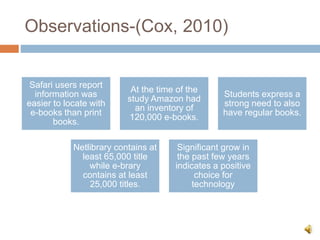
Observations-(Cox, 2010)
Safari users report
information was
easier to locate with
e-books than print
books.
At the time of the
study Amazon had
an inventory of
120,000 e-books.
Students express a
strong need to also
have regular books.
Netlibrary contains at
least 65,000 title
while e-brary
contains at least
25,000 titles.
Significant grow in
the past few years
indicates a positive
choice for
technology
Literature Review
D-Lib Magazine
October 2004
Volume 10 Number 10
ISSN 1082-9873
E-Books
Challenges and Opportunities
John Cox
Deputy Librarian
National University of Ireland, Galway
Galway, Ireland
<john.cox@nuigalway.ie>
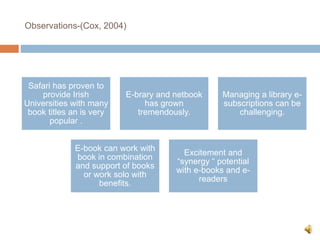
Observations-(Cox, 2004)
Safari has proven to
provide Irish
Universities with many
book titles an is very
popular .
E-brary and netbook
has grown
tremendously.
Managing a library e-
subscriptions can be
challenging.
E-book can work with
book in combination
and support of books
or work solo with
benefits.
Excitement and
“synergy “ potential
with e-books and e-
readers
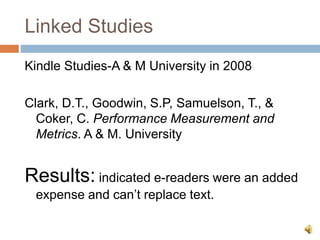
Linked Studies
Kindle Studies-A & M University in 2008
Clark, D.T., Goodwin, S.P, Samuelson, T., &
Coker, C. Performance Measurement and
Metrics. A & M. University
Results: indicated e-readers were an added
expense and can’t replace text.
References
References
Banister, S., (2010) Integrating the iPod Touch in K-12 Education: Visions and Vices Computers in Schools pp.121-131 Routledge, Taylor and
Francis Group LLC
Cox, J., (2004) E-Books Challenges and Opportunities National University of Ireland, Galway
Ireland D-Lib Magazine, October 2004 Volume 10 Number 10
Franklin, T., Peng, L.W., (2008) Mobile math: math educators and students engage in mobile learning. Springer –Business Media, LLC October,
2008 [retrieved online October, 2010]
Kiriakova,M., Okamoto, K.S., Zubarev, M. & Gross, G. “Aiming at a Moving Target: Pilot Testing Ebook Readers in an Urban Academic Library”
Computers in Libraries Information Today, March, 2010
Larson, L., (2008) Electronic Reading Workshop: Beyond Books with New Literacies and Instructional Technologies. Journal of Adolescent &
Adult Literacy October, 2008 International Reading Association (pp. 121-131)
Sappey J., & Relf, S. (2010) Digital Technology Education and its Impact on Traditional Academic Roles and Practices Journal of University
Teaching & Learning Practices
Soloway, E., & Norris, C., Educating the Mobile Generation Pearsons Foundation, New Learning Institute 2010
http://newlearninginstitute.org/21stcenturyeducation/21st-century-learning/educating-the-mobile-generation.html
http://office.microsoft.com/en-us/images/

Integration of mobile devices

  • 1.
    INTEGRATION OF MOBILE DEVICES TechnologyConsiderations with mobile devices
  • 2.
    Introduction to Research Howmight an instructional designer bridge the gap that exists between the digital world and the hardback, textbook traditions with mobile technology? Maureen Gorman
  • 3.
    Table of Contents Introduction  Vision and Vices  Abstract  Aiming at a moving target  Time Will Tell  Time Factor  Technology Emphasis  Statistics  Educating the Mobile Generations  Conclusion  Key Ideas  Vision  E-readers  iPad  Literature Reviews/Observations  References
  • 4.
    Introduction With technology: the individual,educators, and educational institutions are faced with choices to make for the 21st century learner. Those choices are also expectations of interest groups, national, state and local decision makers, while a decision on what to use in classrooms has gone beyond the planning and purchasing of textbooks.
  • 5.
    Visions and Vices Thisis supported by an introduction from the article “Integrating the iPod Touch in K-12 Education: Visions and Vices” in which Savilla Banister notes “Various interest groups, including state and national accreditation bodies, continue to expect that student (K-16) learn to effectively use computer technologies (ISTE, 2004; Swain & Pearson, 2002 a, 2002b) (Banister, 2010).
  • 6.
    Abstract Education is changingso quickly, we as educators need to keep our eyes on the target and aim for the most centralized decision on how we will use technology to challenge the learner to maximize their opportunities to make the most of their inner capabilities.
  • 7.
    Aiming at aMoving Target A comparison is made in the article “Aiming at a Moving Target” (2010) which calls attention to investigate the time needed before investment. In a pilot study of urban New York, the University of New York used pilot testing for prospective student taking summer class at John Jay College. New E-readers where changing quickly and too fast to make a decision for the future. The educators felt like they were “aiming at a moving target”.
  • 8.
  • 9.
    Time Factor With timee-books and e-readers will evolve with greater possibilities. “Though there is no doubt that eBooks will be an expanding part of information delivery in libraries, the dedicated e-reader has not yet reached a point where the technology is worth investing in, particularly in these tough economic times.” (Kiriakova, Okamoto, Zubarev, & Gross, March, 1010).
  • 10.
    Technology Emphasis “ Indigital technology education, this can only be achieved if more emphasis and resources are devoted by institutions to developing the multi- media literacy of academics and developing sustainable work practices which benefit both teacher and student alike” (Kiarakova, 2010)
  • 11.
  • 12.
    Statistics-Mobile (Cox, 2010) VeryDissatisfied, Dissatisfied, Neutral, Satisfactory, Very Satisfied, Don’t Know VDS D N S VS DK VDS D N S VS DK Subject coverage 1.1% 11.9% 16.8% 47% 22.2% 1.1% Searching 0.5% 3.2% 20.5% 45.4% 28.1% 2.2% On-screen presentation 1.1% 8.2% 15.8% 41.8% 36.2% 0.5% Printing 1.6% 9.7% 20% 30.3% 17.8% 20.5% Saving to disk 2.2% 10.9% 24.6% 25.1% 10.9% 26.2% E-mailing 2.2% 3.8% 30.2% 22.5% 11% 30.2% Bookmarking 2.2% 3.8% 23.9% 31.5% 16.3% 22.3% General ease of use 1.1% 3.8% 6.5% 49.5% 38.7% 0.5% Quality of on-screen 1.1% 5.4% 24.3% 34.1% 12.4% 22.7%
  • 13.
    Educating the MobileGenerations http://newlearninginstitute.org/21stcenturye ducation/21st-century-learning/educating- the-mobile-generation.html
  • 14.
    Conclusion Today I proposethat an investment in training start with the educators and the possibilities of the eBook and eBook readers. From there, qualified pilot studies research this technology within the educational community over a sustained amount of time with documentation and observation. Even though there are studies in place, further studies could substantiate a decision for each individual unit of learning.
  • 15.
    Key Ideas Changing roleof teaching and learning practices as a result of technology. Possibilities of using “mobile devices” needs visionaries to test, purchase, teach, learn and implement research studies and then convince stakeholders of an appropriate plan of action. With community and financial support classrooms can experience the same tools that are used in the business world.
  • 16.
    Key Ideas Key Ideas-Technologytraining for college students can be used to benefit K-12 classrooms. Discussion threads using literature, e-books, Power Points, chat rooms, discussion formats, and a combination of technological methods is a process/project way of stimulating learning experiences. Teaching reading with the use of Literature has many formats to use in combination with original formats. State and local agencies are faced with a dilemma that will be answered with an investment of time and resources. (Baniste ,2010).
  • 17.
    Vision The roles ofteaching will change to accommodate the needs of the current generation. More collaborative efforts with the emphasis on project planning is to take place. Possibilities of using “mobile devices” needs visionaries to test, purchase, teach, learn and implement research studies and then convince stakeholders of an appropriate plan of action.
  • 19.
    E-Readers E-Readers E-Reader Applications Ipad iPod KindleDX iPod touch Nook iPhone Sony-600 laptop Kindle 3 notebooks Alex ereader BeeBook Neo Astec Pro EE-PC COOL-ER Kobo
  • 20.
    Product Comparison http://ebook-reader-review.toptenreviews.com/ Kindle 3Kindle DX Be-Book Neo Nook Alex eReader 6” Screen 600x800R 8.7 ounce 9.7 Screen 600x800 R 18.9 6”screen 600x800 10.5 6,0 & 3.5 600x800 12.1 6 Screen 600x800 11 4GB WiFi 4GB WiFi 512 MB WiFi 2GB WiFi 256 MB WiFi Sony Reader Touch Edition PRS-600 Pandigital Novel Kobo e-Reader COOL-er Aztak 5” EZ-Reader Pocket Pro 7”screen 600x800 10.1 ounces 6”screen 600x800 16 ounces 6”screen 600x800 8 ounces 5”screen 600x800 6.3 ounces 5”screen 600x800 6 ounces
  • 21.
  • 22.
    iPad  Multi-Touch  TheMulti-Touch screen on iPad is based on the same revolutionary technology on iPhone. But the technology has been completely reengineered for the larger iPad surface, making it extremely precise and responsive. So whether you’re zooming in on a map, flicking through your photos, or deleting an email, iPad responds with incredible accuracy. And it does just what you want it to.
  • 23.
    What to lookfor in a mobile device? Design Content Connectivity Battery Life Features Library Connection Available E-books Price
  • 24.
    Pro’s www.slj.com/tech iPod andiPad Apple has special book interaction features with the iPad books. Audio and video notes are part of the iPad applications. Embedded quizzes with scoring applications. Much lighter in weight in comparison to a textbook. Textbook companies can incorporate e-books. Learning with the mobile extends learning to the real world of applications.
  • 25.
    Con’s Need for customeroriented licensing. Temporary extensive staffing, training needed. Full feature with more interaction for input. Battles with publishing companies and licensing. E-books are secondary to esthetic, historic, nostalgic, sharing potential of books. More flexible/onscreen delivery needed for e-books and greater customer satisfaction. (Cox, 2010) http://www.edutopia.org/electronic-readers-versus- classroom-texts “After all, every electronic medium relies for storage on plain old magnetism . And magnetism a has a host of enemies, just like the elastic in old tube socks.” (Edward, 2010)
  • 26.
    Literature Reviews Computers inthe Schools Publication details, including instructions for authors and subscription information: http://www.informaworld.com/smpp/title~c ontent=t792303982 Integrating the iPod Touch in K-12 Education: Visions and Vices Savilla Banistera a Bowling Green State University, Bowling Green, Ohio, USA Online publication date: 26 May 2010
  • 27.
    Observations-(Banister, May, 2004) Earlychildhood education can use mobile devices for learning. Specific content area for elementary and upper elementary content has various applications. More than 60,000 web applications were in place at the time of the study. Challenges for teachers include tracking, charging devices. Time, effort and vigilance is needed to implement this 21st method of learning and teaching
  • 28.
    Literature Review Mobile math:math educators and students engage in mobile learning Teresa Franklin Æ Li-Wei Peng Published online: 23 October 2008 Springer Science Business Media, LLC 2008
  • 29.
    Observations-(Franklin, Peng2008) Mobile deviceshave been used for mathematic classes in eighth grade class in Appalachian areas of Ohio. Technical support was needed in addition to math class preparations. Students prefer working one to one or alone rather than in small groups with the iPod. The needs of the project included numerous electrical outlets, charging stations, and trained educators to assist with integration. Survey reflected an overwhelming choice for the use of iPods or mobile devices in formal and informal settings.
  • 30.
    Aiming at aMoving Target “Though there is no doubt that eBooks will be an expanding part of information delivery in libraries, the dedicated e-reader han not yet reached a point where the technology is worth investing in, particularly in these though economic times.” (Kiniskova, Okamoto, Zubarev, & Gross)
  • 31.
    Library Issues E-readers quicklybecome outdated. Issues of circulation in libraries have to be considered. At the time of the study distributors have not refined the distribution of the portable reading devices. Copyright/Content Acquisition/Physical Management/Cataloging
  • 32.
    Observations-(Kirakova, Okamoto, Zubarev,& Gross 2010) Students assumed that all e-readers use the touch screen method. Sony e-reader 700 was given and shown to additional features. Only 4 of the 163 participants owned an e-book reader. Most student were using the e-reader for the first time. Although a graphic manual was given, the younger student preferred to explore .
  • 33.
    Literature Review Journal ofUniversity Teaching & Learning Practice Volume 7, Issue 1 2010 Article 3 Digital Technology Education and its Impact on Traditional Academic Roles and Practice Jennifer Sappey Dr Stephen Relfy
  • 34.
    Observations-(Cox, 2010) Safari usersreport information was easier to locate with e-books than print books. At the time of the study Amazon had an inventory of 120,000 e-books. Students express a strong need to also have regular books. Netlibrary contains at least 65,000 title while e-brary contains at least 25,000 titles. Significant grow in the past few years indicates a positive choice for technology
  • 35.
    Literature Review D-Lib Magazine October2004 Volume 10 Number 10 ISSN 1082-9873 E-Books Challenges and Opportunities John Cox Deputy Librarian National University of Ireland, Galway Galway, Ireland <john.cox@nuigalway.ie>
  • 36.
    Observations-(Cox, 2004) Safari hasproven to provide Irish Universities with many book titles an is very popular . E-brary and netbook has grown tremendously. Managing a library e- subscriptions can be challenging. E-book can work with book in combination and support of books or work solo with benefits. Excitement and “synergy “ potential with e-books and e- readers
  • 37.
    Linked Studies Kindle Studies-A& M University in 2008 Clark, D.T., Goodwin, S.P, Samuelson, T., & Coker, C. Performance Measurement and Metrics. A & M. University Results: indicated e-readers were an added expense and can’t replace text.
  • 38.
    References References Banister, S., (2010)Integrating the iPod Touch in K-12 Education: Visions and Vices Computers in Schools pp.121-131 Routledge, Taylor and Francis Group LLC Cox, J., (2004) E-Books Challenges and Opportunities National University of Ireland, Galway Ireland D-Lib Magazine, October 2004 Volume 10 Number 10 Franklin, T., Peng, L.W., (2008) Mobile math: math educators and students engage in mobile learning. Springer –Business Media, LLC October, 2008 [retrieved online October, 2010] Kiriakova,M., Okamoto, K.S., Zubarev, M. & Gross, G. “Aiming at a Moving Target: Pilot Testing Ebook Readers in an Urban Academic Library” Computers in Libraries Information Today, March, 2010 Larson, L., (2008) Electronic Reading Workshop: Beyond Books with New Literacies and Instructional Technologies. Journal of Adolescent & Adult Literacy October, 2008 International Reading Association (pp. 121-131) Sappey J., & Relf, S. (2010) Digital Technology Education and its Impact on Traditional Academic Roles and Practices Journal of University Teaching & Learning Practices Soloway, E., & Norris, C., Educating the Mobile Generation Pearsons Foundation, New Learning Institute 2010 http://newlearninginstitute.org/21stcenturyeducation/21st-century-learning/educating-the-mobile-generation.html http://office.microsoft.com/en-us/images/