www.le.ac.uk
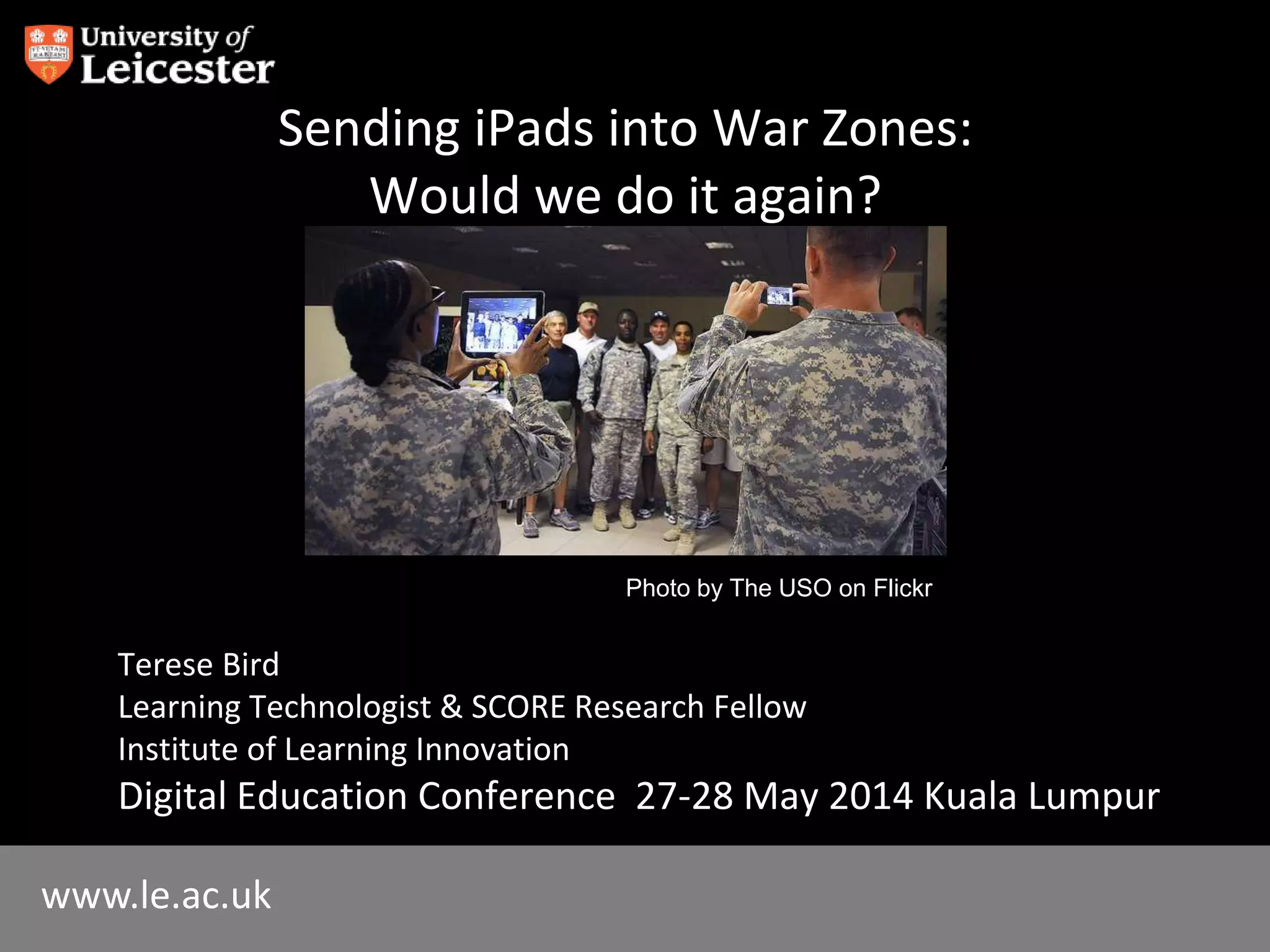
Sending iPads into War Zones:
Would we do it again?
Terese Bird
Learning Technologist & SCORE Research Fellow
Institute of Learning Innovation
Digital Education Conference 27-28 May 2014 Kuala Lumpur
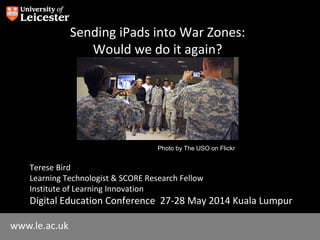
Photo by The USO on Flickr
What will we talk about?
• Overview of mobile learning
• Why iPads into War Zones?
• Problems... solutions
• Would we do it again?
• What are we doing now?
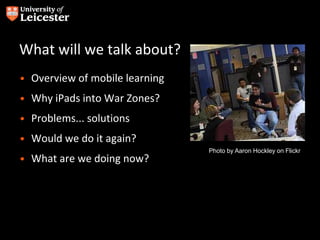
Photo by Aaron Hockley on Flickr
Why mobile learning?
• “…we have to recognise that mobile, personal, and
wireless devices are now radically transforming
societal notions of discourse and knowledge, and are
responsible for new forms of art, employment,
language, commerce, deprivation, and crime, as well
as learning.” (Traxler, 2009)
• “Learner freely moving in his physical (and virtual)
environment” (Laouris and Eteokleous, 2005)
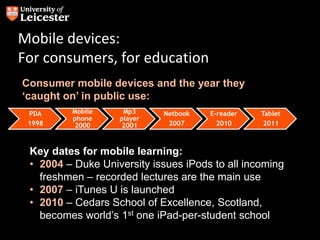
Mobile devices:
For consumers, for education
PDA
1998
Mobile
phone
2000
Mp3
player
2001
Netbook
2007
E-reader
2010
Tablet
2011
Consumer mobile devices and the year they
‘caught on’ in public use:
Key dates for mobile learning:
• 2004 – Duke University issues iPods to all incoming
freshmen – recorded lectures are the main use
• 2007 – iTunes U is launched
• 2010 – Cedars School of Excellence, Scotland,
becomes world’s 1st one iPad-per-student school
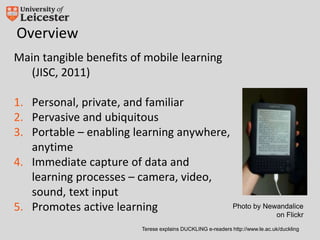
Overview
Main tangible benefits of mobile learning
(JISC, 2011)
1. Personal, private, and familiar
2. Pervasive and ubiquitous
3. Portable – enabling learning anywhere,
anytime
4. Immediate capture of data and
learning processes – camera, video,
sound, text input
5. Promotes active learning
Terese explains DUCKLING e-readers http://www.le.ac.uk/duckling
Photo by Newandalice
on Flickr
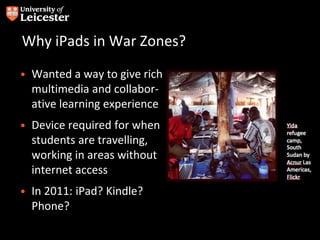
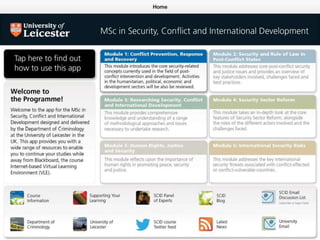
Why iPads in War Zones?
• Wanted a way to give rich
multimedia and collabor-
ative learning experience
• Device required for when
students are travelling,
working in areas without
internet access
• In 2011: iPad? Kindle?
Phone?
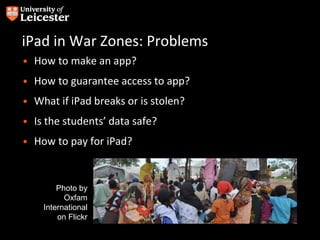
iPad in War Zones: Problems
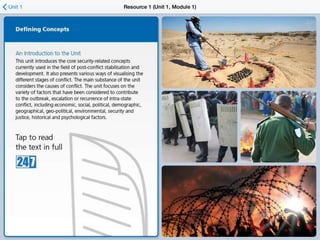
• How to make an app?
• How to guarantee access to app?
• What if iPad breaks or is stolen?
• Is the students’ data safe?
• How to pay for iPad?
Photo by
Oxfam
International
on Flickr
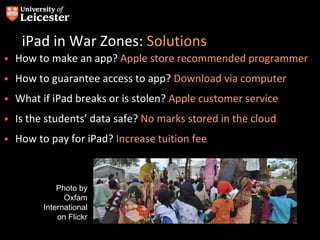
iPad in War Zones: Solutions
• How to make an app? Apple store recommended programmer
• How to guarantee access to app? Download via computer
• What if iPad breaks or is stolen? Apple customer service
• Is the students’ data safe? No marks stored in the cloud
• How to pay for iPad? Increase tuition fee
Photo by
Oxfam
International
on Flickr
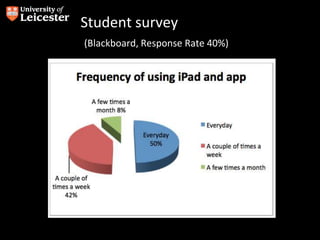
Student survey
(Blackboard, Response Rate 40%)
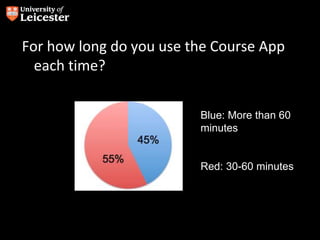
For how long do you use the Course App
each time?
Blue: More than 60
minutes
Red: 30-60 minutes
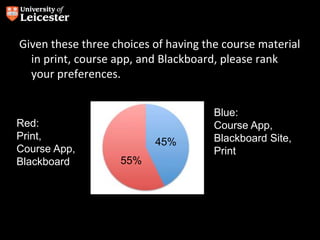
Given these three choices of having the course material
in print, course app, and Blackboard, please rank
your preferences.
Blue:
Course App,
Blackboard Site,
Print
Red:
Print,
Course App,
Blackboard 55%
45%
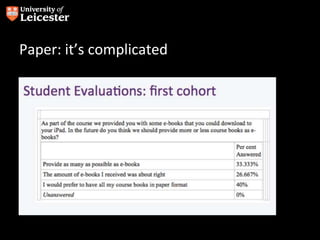
Paper: it’s complicated
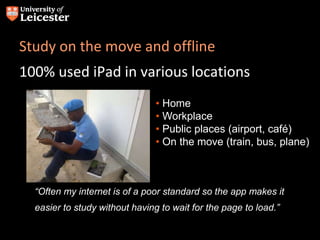
Study on the move and offline
100% used iPad in various locations
• Home
• Workplace
• Public places (airport, café)
• On the move (train, bus, plane)
“Often my internet is of a poor standard so the app makes it
easier to study without having to wait for the page to load.”
Time management
• “It has enabled me to read the material without carrying a
bundle of books and is very good for studying at work during
the free time.”
• “Having access to the information wherever I go has allowed
for better time management particularly as a distance
learning student and under full time employment.”
• “I have thus far enjoyed the experience using the iPad and
Course App, it is a dynamic learning tool, which has done an
excellent job in filling the gap for the working student who is
unable to be on campus, by making the material available
everywhere you go.”
Motivation and Engagement
• “Firstly I am more motivated, as it is structured and
organised. I am getting through more than I would if I was
solely given a recommended reading list.”
• “The Course App is easily accessed, it is pre-structured and
organised. I find it a logical progression and a great guide to
complete a unit by using the course app.”
• “It is more interactive than other conventional means of
studying. You can use audio visual options, plus get to online
links which can help maintaining focus while studying. Plus
this is like mobile education as you don’t need to go a physical
space, e.g. study room or library to study.”
Skills development (Digital literacy)
“I have found the course material, the iPad and [the] Blackboard all very
useful. It is forcing me to maintain pace with technology, a point I needed to
with having two boys both studying at the 6th form and university respectively.
I am really enjoying using and blending all the teaching methods available.”
Student
Kindle
app
PDF
Readers
Twitter
Pages
Ever-
note
iTunes
U
Skype
iBrain-
storm
Drop-
box
Blackboard
Mobile
Learn
War Zones: iPads - negatives
• Customs charges upon shipment to student - paid
• E-books on Amazon somewhat problematic – some
countries cannot get Amazon – send books
• One or two countries (i.e. Sudan) could not get Apple
store online – send books
• Flash on iPad requires special browser (Puffin)
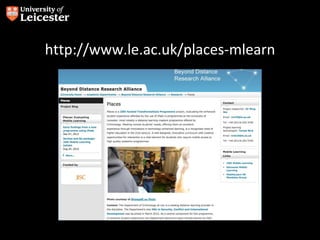
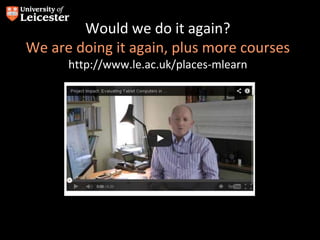
http://www.le.ac.uk/places-mlearn
Would we do it again?
We are doing it again, plus more courses
http://www.le.ac.uk/places-mlearn
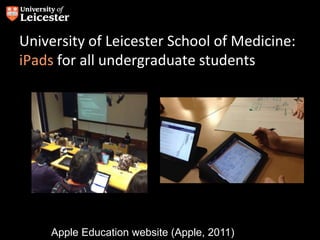
University of Leicester School of Medicine:
iPads for all undergraduate students
Apple Education website (Apple, 2011)
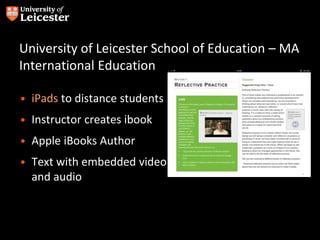
University of Leicester School of Education – MA
International Education
• iPads to distance students
• Instructor creates ibook
• Apple iBooks Author
• Text with embedded video
and audio
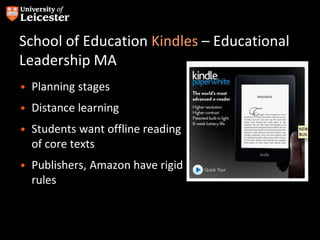
School of Education Kindles – Educational
Leadership MA
• Planning stages
• Distance learning
• Students want offline reading
of core texts
• Publishers, Amazon have rigid
rules
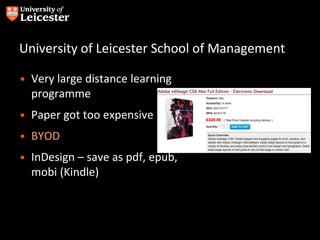
University of Leicester School of Management
• Very large distance learning
programme
• Paper got too expensive
• BYOD
• InDesign – save as pdf, epub,
mobi (Kindle)
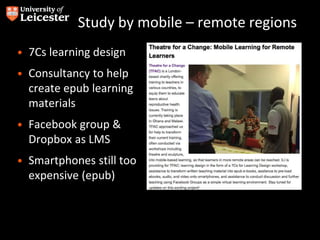
Study by mobile – remote regions
• 7Cs learning design
• Consultancy to help
create epub learning
materials
• Facebook group &
Dropbox as LMS
• Smartphones still too
expensive (epub)
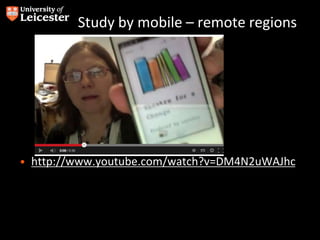
Study by mobile – remote regions
• http://www.youtube.com/watch?v=DM4N2uWAJhc
References and Thanks
• Apple. (2011). Apple (United Kingdom) - Education - Profiles - Leeds School of Medicine changes learning culture with work-based
iPhones. Apple Education Case studies. Retrieved January 6, 2013, from http://www.apple.com/uk/education/profiles/leeds-uni/
• JISC. (2011). Mobile Learning infokit / Home. Retrieved August 22, 2012, from
https://mobilelearninginfokit.pbworks.com/w/page/41122430/Home
• Joly, K. (2005). Duke University iPod first-year experience: So, was it worth it? | collegewebeditor.com. College Web Editor website.
Retrieved August 19, 2011, from http://collegewebeditor.com/blog/index.php/archives/2005/06/16/duke-university-ipod-first-year-
experience-so-was-it-worth-it/
• Laouris, Y. and N. Eteokleous (2005). We need an educationally relevant definition of mobile learning. mLearning, South Africa.
• McFayden, S. (2010). Scottish school becomes first in world where all lessons take place using computers - The Daily Record. Daily
Record. Retrieved January 5, 2012, from http://www.dailyrecord.co.uk/news/science-and-technology/2010/08/31/scottish-school-
becomes-first-in-world-where-all-lessons-take-place-using-computers-86908-22525988/
• Nie, M., Armellini, A., Witthaus, G., & Barkland, K. (2010). Delivering University Curricula: Knowledge, Learning and INnovation Gains —
University of Leicester. Leicester. Retrieved from http://www2.le.ac.uk/departments/beyond-distance-research-
alliance/projects/duckling
• Payne, K. F., Wharrad, H., & Watts, K. (2012). Smartphone and medical related App use among medical students and junior doctors in
the United Kingdom (UK): a regional survey. BMC medical informatics and decision making, 12(1), 121. doi:10.1186/1472-6947-12-121
• The Paypers. Insights in payments. (2012). Retrieved January 3, 2013, from http://www.thepaypers.com/news/mobile-
payments/smartphone-adoption-in-uk-reaches-51-students-lead-the-way/747745-16
• Traxler, J. (2009). Current State of Mobile Learning. (M. Ally, Ed.)Mobile Learning Transforming the Delivery of Education and Training,
5(2), 9–24. Retrieved from http://www.aupress.ca/books/120155/ebook/01_Mohamed_Ally_2009-Article1.pdf
• Wiley, C. (2012). Twitter in the University Classroom: Live-Tweeting During Lectures | Educational Vignettes on WordPress.com.
Educational Vignettes. Retrieved January 10, 2013, from http://educationalvignettes.wordpress.com/2013/01/03/twitter-in-the-
university-classroom-live-tweeting-during-lectures/
Email me with questions - t.bird@le.ac.uk

Sending iPads into War Zones: Would we do it again?

  • 1.
    www.le.ac.uk Sending iPads intoWar Zones: Would we do it again? Terese Bird Learning Technologist & SCORE Research Fellow Institute of Learning Innovation Digital Education Conference 27-28 May 2014 Kuala Lumpur Photo by The USO on Flickr
  • 2.
    What will wetalk about? • Overview of mobile learning • Why iPads into War Zones? • Problems... solutions • Would we do it again? • What are we doing now? Photo by Aaron Hockley on Flickr
  • 3.
    Why mobile learning? •“…we have to recognise that mobile, personal, and wireless devices are now radically transforming societal notions of discourse and knowledge, and are responsible for new forms of art, employment, language, commerce, deprivation, and crime, as well as learning.” (Traxler, 2009) • “Learner freely moving in his physical (and virtual) environment” (Laouris and Eteokleous, 2005)
  • 4.
    Mobile devices: For consumers,for education PDA 1998 Mobile phone 2000 Mp3 player 2001 Netbook 2007 E-reader 2010 Tablet 2011 Consumer mobile devices and the year they ‘caught on’ in public use: Key dates for mobile learning: • 2004 – Duke University issues iPods to all incoming freshmen – recorded lectures are the main use • 2007 – iTunes U is launched • 2010 – Cedars School of Excellence, Scotland, becomes world’s 1st one iPad-per-student school
  • 5.
    Overview Main tangible benefitsof mobile learning (JISC, 2011) 1. Personal, private, and familiar 2. Pervasive and ubiquitous 3. Portable – enabling learning anywhere, anytime 4. Immediate capture of data and learning processes – camera, video, sound, text input 5. Promotes active learning Terese explains DUCKLING e-readers http://www.le.ac.uk/duckling Photo by Newandalice on Flickr
  • 6.
    Why iPads inWar Zones? • Wanted a way to give rich multimedia and collabor- ative learning experience • Device required for when students are travelling, working in areas without internet access • In 2011: iPad? Kindle? Phone?
  • 7.
    iPad in WarZones: Problems • How to make an app? • How to guarantee access to app? • What if iPad breaks or is stolen? • Is the students’ data safe? • How to pay for iPad? Photo by Oxfam International on Flickr
  • 8.
    iPad in WarZones: Solutions • How to make an app? Apple store recommended programmer • How to guarantee access to app? Download via computer • What if iPad breaks or is stolen? Apple customer service • Is the students’ data safe? No marks stored in the cloud • How to pay for iPad? Increase tuition fee Photo by Oxfam International on Flickr
  • 11.
  • 12.
    For how longdo you use the Course App each time? Blue: More than 60 minutes Red: 30-60 minutes
  • 13.
    Given these threechoices of having the course material in print, course app, and Blackboard, please rank your preferences. Blue: Course App, Blackboard Site, Print Red: Print, Course App, Blackboard 55% 45%
  • 14.
  • 15.
    Study on themove and offline 100% used iPad in various locations • Home • Workplace • Public places (airport, café) • On the move (train, bus, plane) “Often my internet is of a poor standard so the app makes it easier to study without having to wait for the page to load.”
  • 16.
    Time management • “Ithas enabled me to read the material without carrying a bundle of books and is very good for studying at work during the free time.” • “Having access to the information wherever I go has allowed for better time management particularly as a distance learning student and under full time employment.” • “I have thus far enjoyed the experience using the iPad and Course App, it is a dynamic learning tool, which has done an excellent job in filling the gap for the working student who is unable to be on campus, by making the material available everywhere you go.”
  • 17.
    Motivation and Engagement •“Firstly I am more motivated, as it is structured and organised. I am getting through more than I would if I was solely given a recommended reading list.” • “The Course App is easily accessed, it is pre-structured and organised. I find it a logical progression and a great guide to complete a unit by using the course app.” • “It is more interactive than other conventional means of studying. You can use audio visual options, plus get to online links which can help maintaining focus while studying. Plus this is like mobile education as you don’t need to go a physical space, e.g. study room or library to study.”
  • 18.
    Skills development (Digitalliteracy) “I have found the course material, the iPad and [the] Blackboard all very useful. It is forcing me to maintain pace with technology, a point I needed to with having two boys both studying at the 6th form and university respectively. I am really enjoying using and blending all the teaching methods available.” Student Kindle app PDF Readers Twitter Pages Ever- note iTunes U Skype iBrain- storm Drop- box Blackboard Mobile Learn
  • 19.
    War Zones: iPads- negatives • Customs charges upon shipment to student - paid • E-books on Amazon somewhat problematic – some countries cannot get Amazon – send books • One or two countries (i.e. Sudan) could not get Apple store online – send books • Flash on iPad requires special browser (Puffin)
  • 20.
  • 21.
    Would we doit again? We are doing it again, plus more courses http://www.le.ac.uk/places-mlearn
  • 22.
    University of LeicesterSchool of Medicine: iPads for all undergraduate students Apple Education website (Apple, 2011)
  • 23.
    University of LeicesterSchool of Education – MA International Education • iPads to distance students • Instructor creates ibook • Apple iBooks Author • Text with embedded video and audio
  • 24.
    School of EducationKindles – Educational Leadership MA • Planning stages • Distance learning • Students want offline reading of core texts • Publishers, Amazon have rigid rules
  • 25.
    University of LeicesterSchool of Management • Very large distance learning programme • Paper got too expensive • BYOD • InDesign – save as pdf, epub, mobi (Kindle)
  • 26.
    Study by mobile– remote regions • 7Cs learning design • Consultancy to help create epub learning materials • Facebook group & Dropbox as LMS • Smartphones still too expensive (epub)
  • 27.
    Study by mobile– remote regions • http://www.youtube.com/watch?v=DM4N2uWAJhc
  • 28.
    References and Thanks •Apple. (2011). Apple (United Kingdom) - Education - Profiles - Leeds School of Medicine changes learning culture with work-based iPhones. Apple Education Case studies. Retrieved January 6, 2013, from http://www.apple.com/uk/education/profiles/leeds-uni/ • JISC. (2011). Mobile Learning infokit / Home. Retrieved August 22, 2012, from https://mobilelearninginfokit.pbworks.com/w/page/41122430/Home • Joly, K. (2005). Duke University iPod first-year experience: So, was it worth it? | collegewebeditor.com. College Web Editor website. Retrieved August 19, 2011, from http://collegewebeditor.com/blog/index.php/archives/2005/06/16/duke-university-ipod-first-year- experience-so-was-it-worth-it/ • Laouris, Y. and N. Eteokleous (2005). We need an educationally relevant definition of mobile learning. mLearning, South Africa. • McFayden, S. (2010). Scottish school becomes first in world where all lessons take place using computers - The Daily Record. Daily Record. Retrieved January 5, 2012, from http://www.dailyrecord.co.uk/news/science-and-technology/2010/08/31/scottish-school- becomes-first-in-world-where-all-lessons-take-place-using-computers-86908-22525988/ • Nie, M., Armellini, A., Witthaus, G., & Barkland, K. (2010). Delivering University Curricula: Knowledge, Learning and INnovation Gains — University of Leicester. Leicester. Retrieved from http://www2.le.ac.uk/departments/beyond-distance-research- alliance/projects/duckling • Payne, K. F., Wharrad, H., & Watts, K. (2012). Smartphone and medical related App use among medical students and junior doctors in the United Kingdom (UK): a regional survey. BMC medical informatics and decision making, 12(1), 121. doi:10.1186/1472-6947-12-121 • The Paypers. Insights in payments. (2012). Retrieved January 3, 2013, from http://www.thepaypers.com/news/mobile- payments/smartphone-adoption-in-uk-reaches-51-students-lead-the-way/747745-16 • Traxler, J. (2009). Current State of Mobile Learning. (M. Ally, Ed.)Mobile Learning Transforming the Delivery of Education and Training, 5(2), 9–24. Retrieved from http://www.aupress.ca/books/120155/ebook/01_Mohamed_Ally_2009-Article1.pdf • Wiley, C. (2012). Twitter in the University Classroom: Live-Tweeting During Lectures | Educational Vignettes on WordPress.com. Educational Vignettes. Retrieved January 10, 2013, from http://educationalvignettes.wordpress.com/2013/01/03/twitter-in-the- university-classroom-live-tweeting-during-lectures/
  • 29.
    Email me withquestions - t.bird@le.ac.uk

Editor's Notes

  • #6 Giddens – late modernity, Castells – networked society, Engestrom - - activity theory Affordance refers to the perceived and actual properties of a thing, primarily those functional properties that determine just how the thing could possibly be used. Salomon, 1993 p51