Course:MBA
Subject: Quantitative Technique
Unit :5
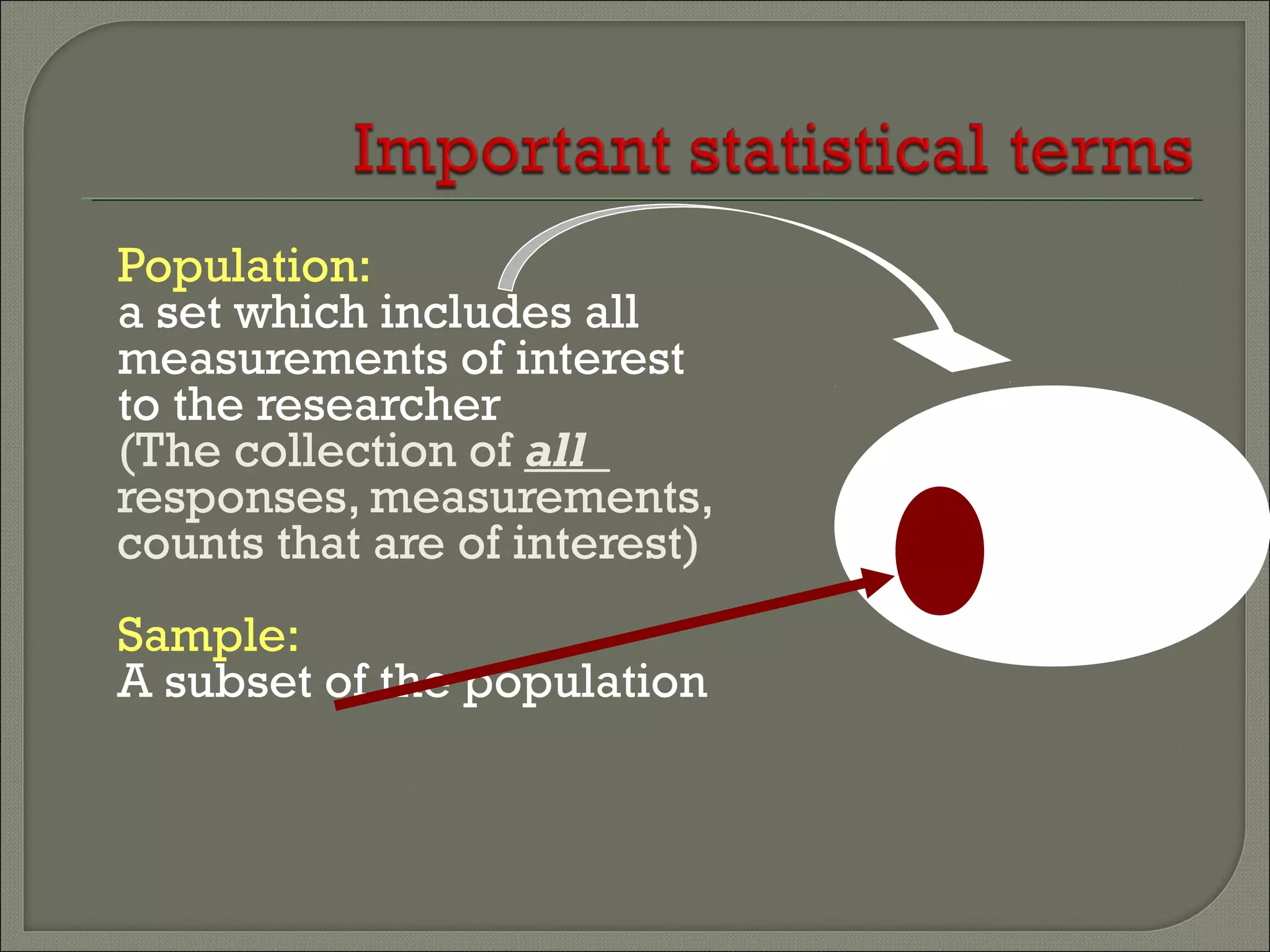
Population:
a set which includes all
measurements of interest
to the researcher
(The collection of all
responses, measurements, or
counts that are of interest)
Sample:
A subset of the population
Get information about large populations
 Less costs
 Less field time
 More accuracy i.e. Can Do A Better Job of
Data Collection
 When it’s impossible to study the whole
population
Target Population:
The population to be studied/ to which the
investigator wants to generalize his results
Sampling Unit:
smallest unit from which sample can be
selected
Sampling frame
List of all the sampling units from which sample
is drawn
Sampling scheme
Method of selecting sampling units from
sampling frame
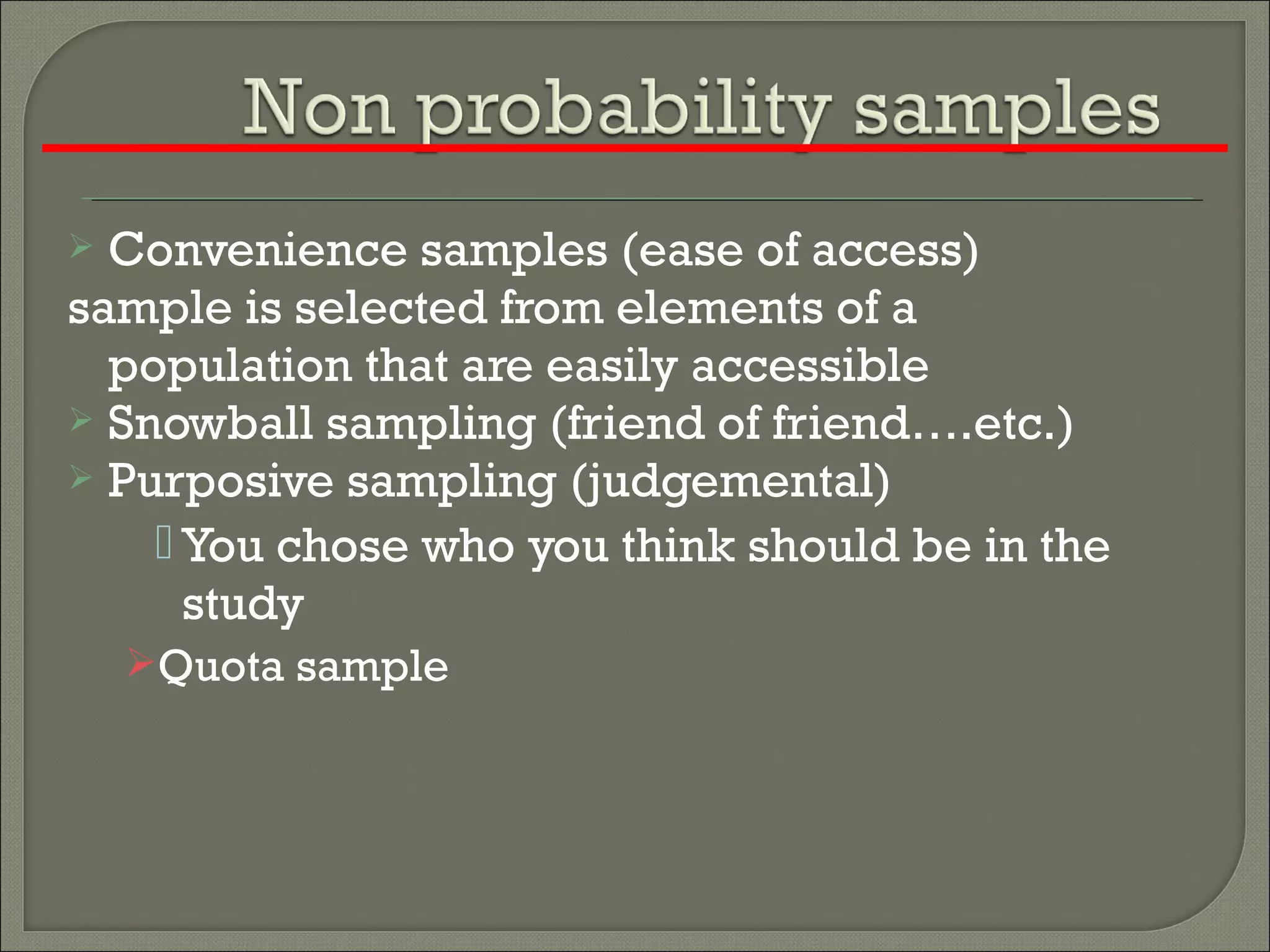
 Non-probability samples
 Probability samples
 Convenience samples (ease of access)
sample is selected from elements of a
population that are easily accessible
 Snowball sampling (friend of friend….etc.)
 Purposive sampling (judgemental)
 You chose who you think should be in the
study
Quota sample
Probability of being chosen is unknown
Cheaper- but unable to generalise
potential for bias
 Random sampling
• Each subject has a known probability of
being selected
 Allows application of statistical
sampling theory to results to:
• Generalise
• Test hypotheses
 Probability samples are the best
 Ensure
• Representativeness
• Precision
 Simple random sampling
 Systematic sampling
 Stratified sampling
 Multi-stage sampling
 Cluster sampling
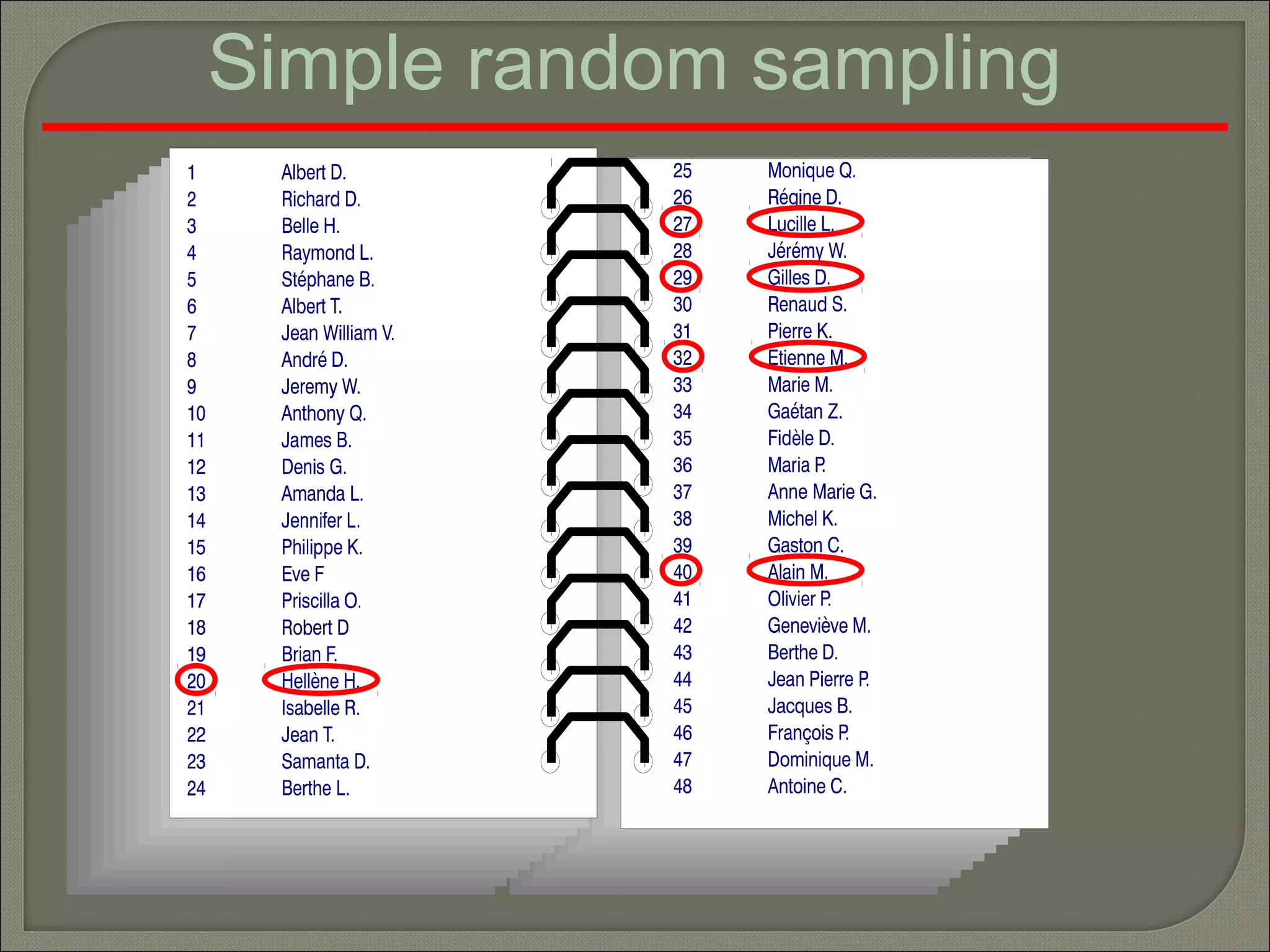
Simple random sampling
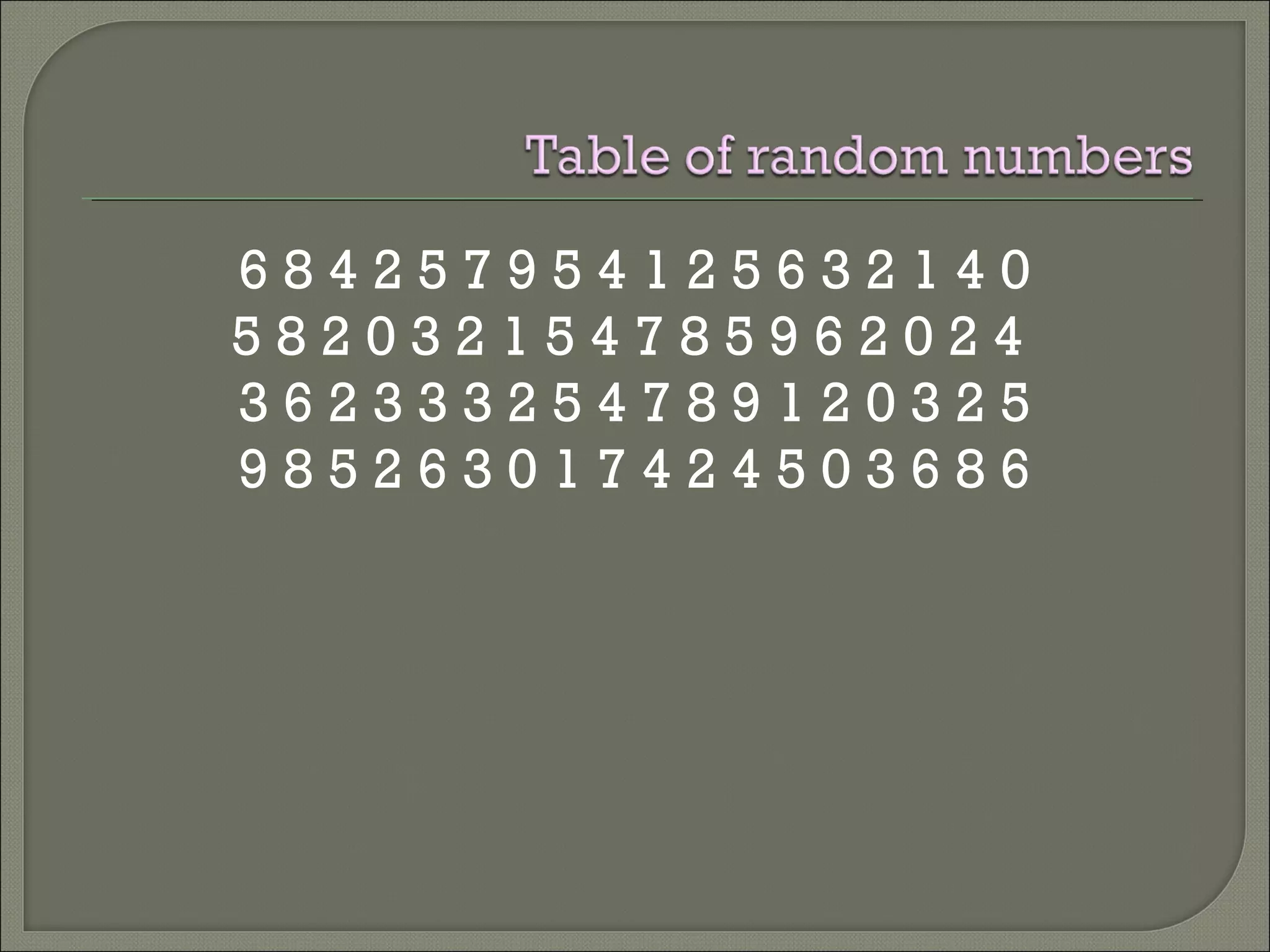
6 8 4 2 5 7 9 5 4 1 2 5 6 3 2 1 4 0
5 8 2 0 3 2 1 5 4 7 8 5 9 6 2 0 2 4
3 6 2 3 3 3 2 5 4 7 8 9 1 2 0 3 2 5
9 8 5 2 6 3 0 1 7 4 2 4 5 0 3 6 8 6
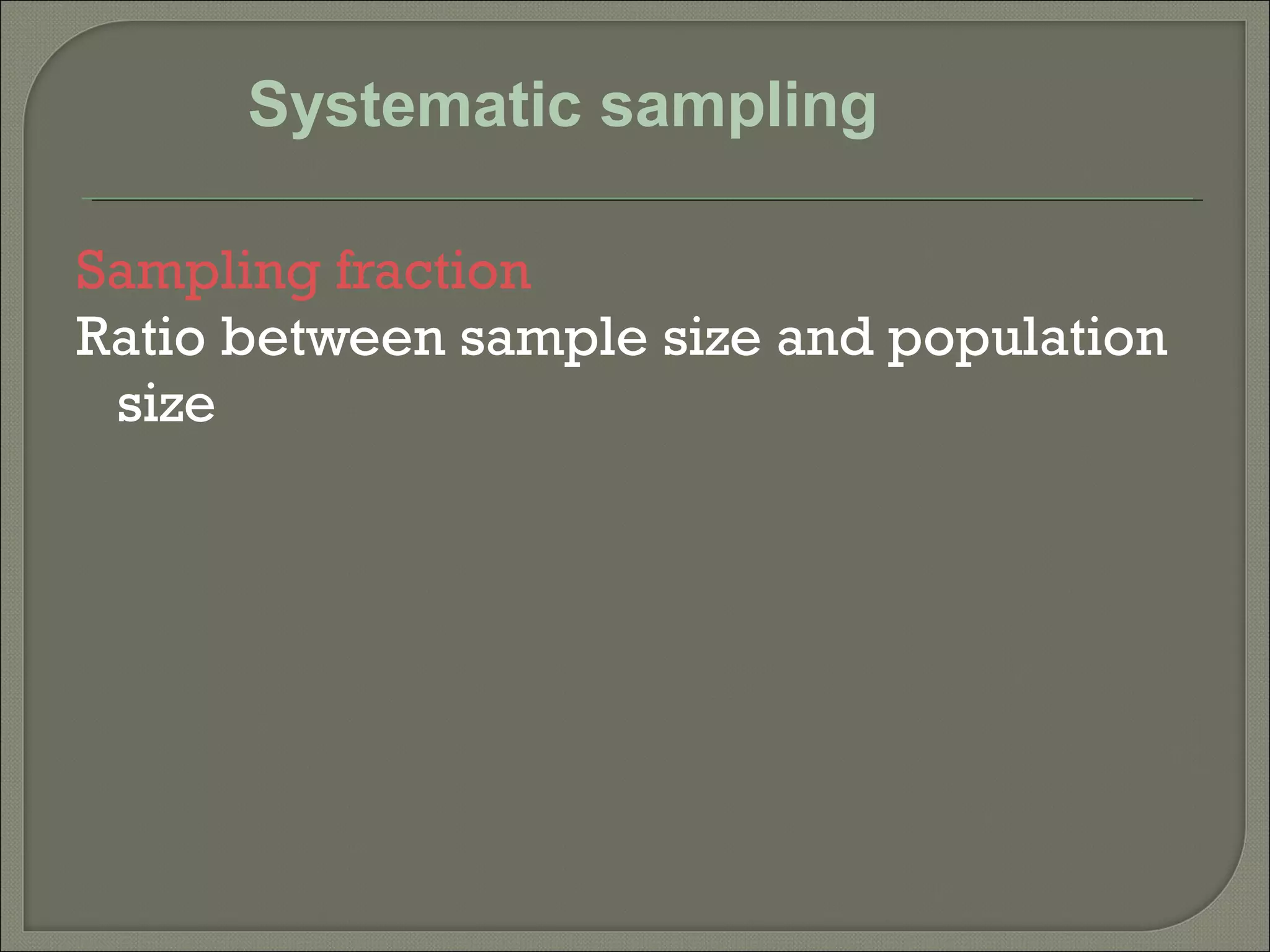
Sampling fraction
Ratio between sample size and population
size
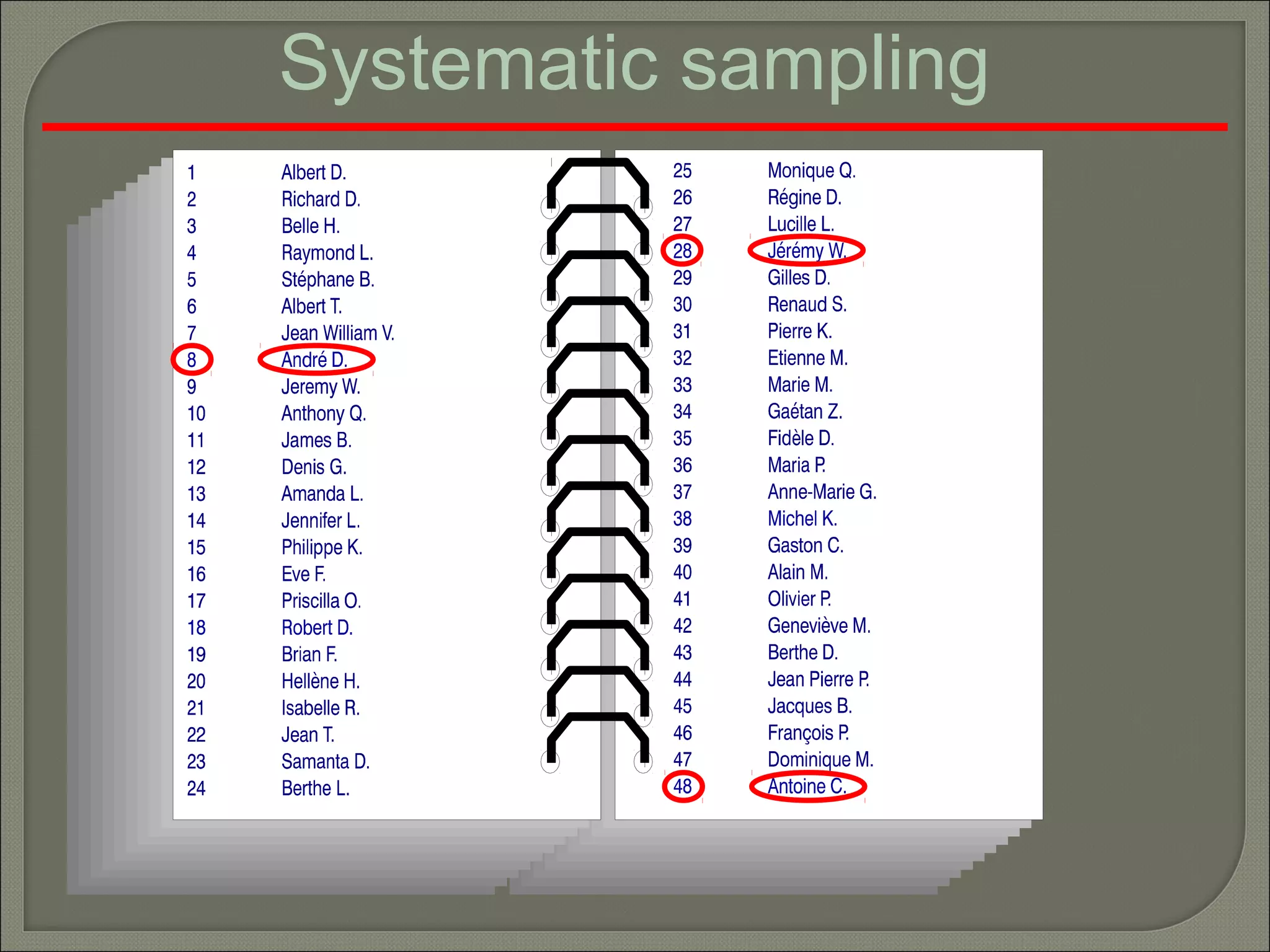
Systematic sampling
Systematic sampling
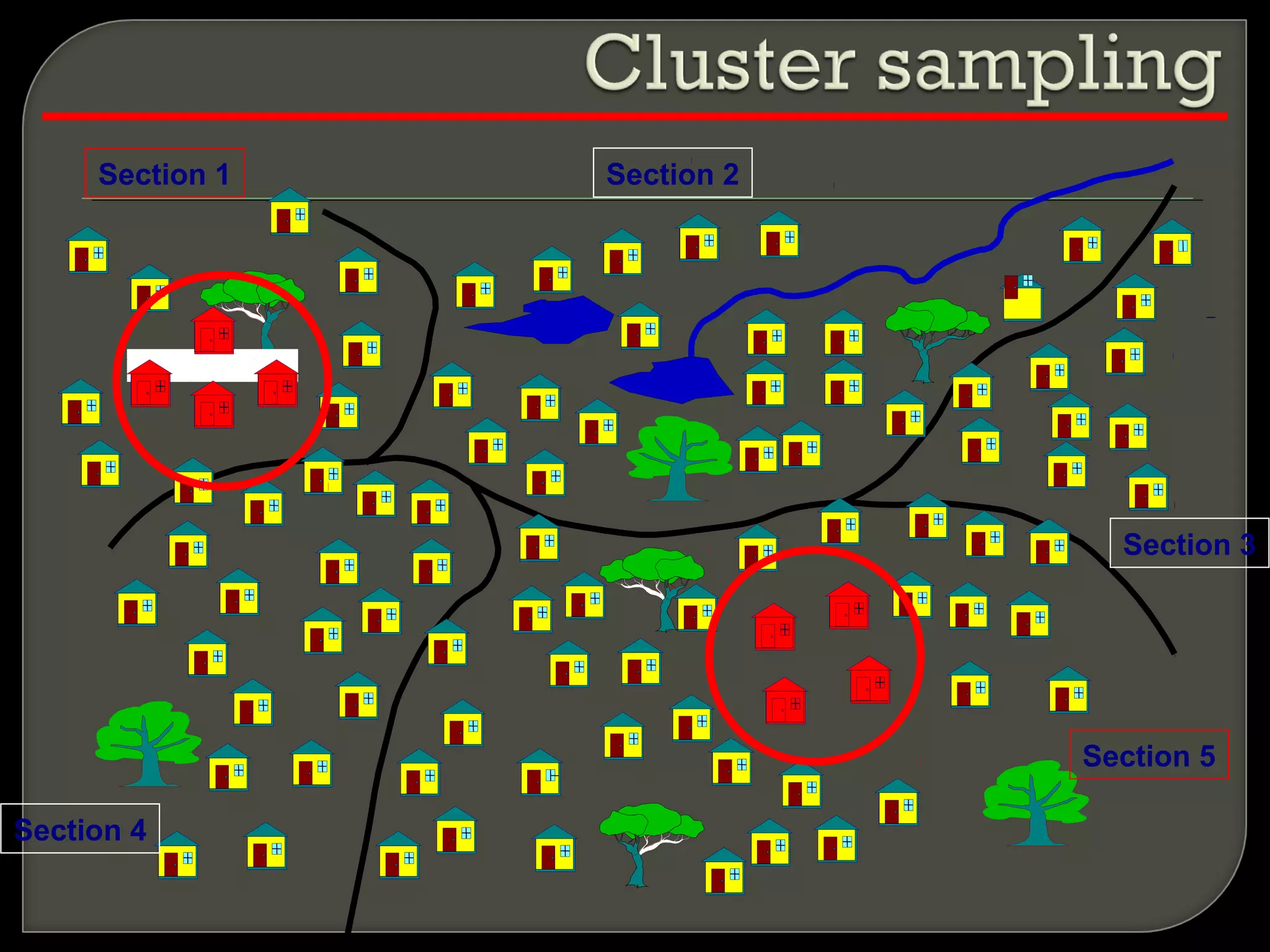
Cluster: a group of sampling units close to each
other i.e. crowding together in the same area or
neighborhood
Section 4
Section 5
Section 3
Section 2Section 1
 Stratified sampling
 Multi-stage sampling
Systematic error (or bias)
Inaccurate response (information bias)
Selection bias
Sampling error (random error)
Errors in sample
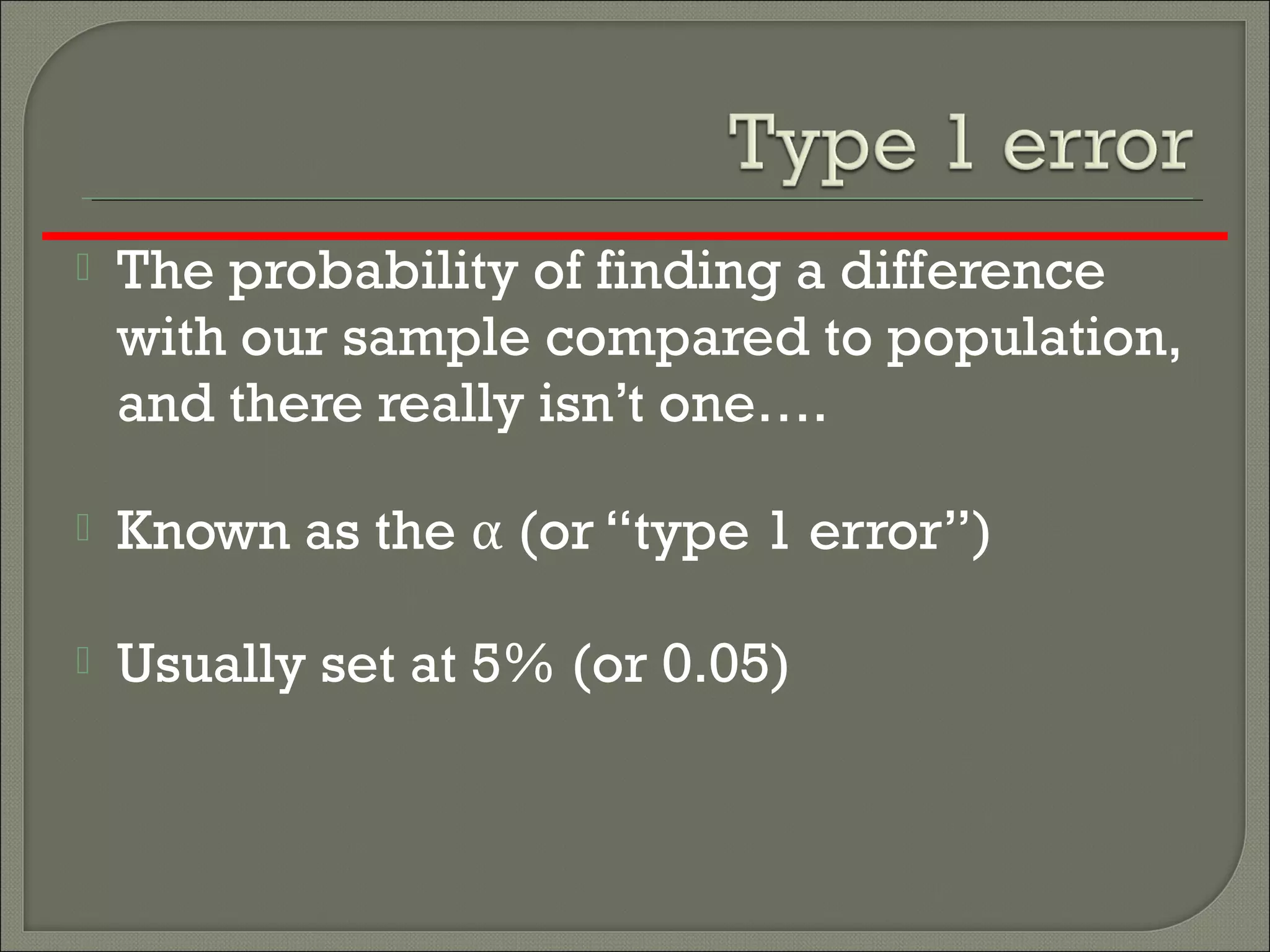
 The probability of finding a difference
with our sample compared to population,
and there really isn’t one….
 Known as the α (or “type 1 error”)
 Usually set at 5% (or 0.05)
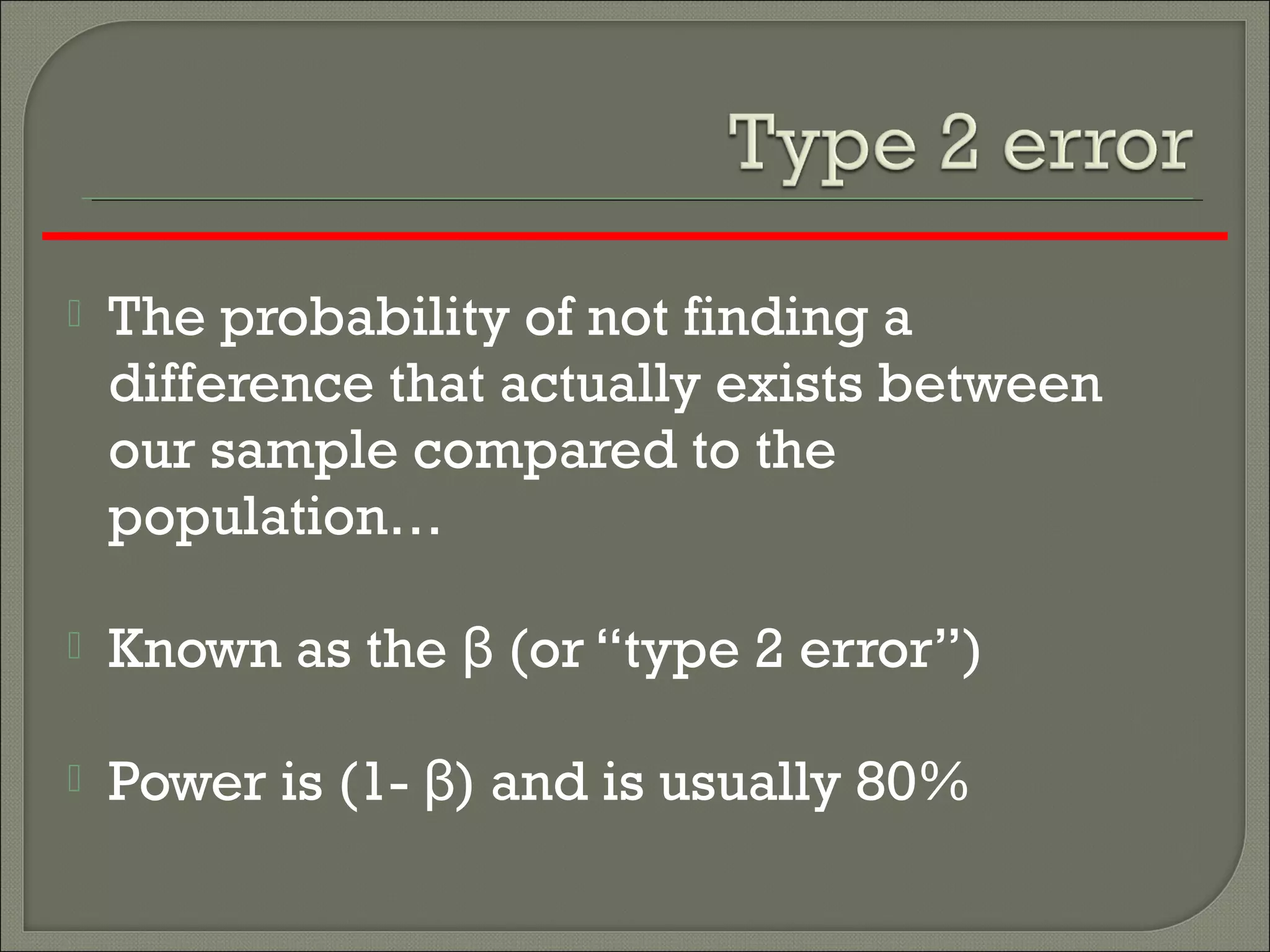
 The probability of not finding a
difference that actually exists between
our sample compared to the
population…
 Known as the (or “type 2 error”)β
 Power is (1- ) and is usually 80%β
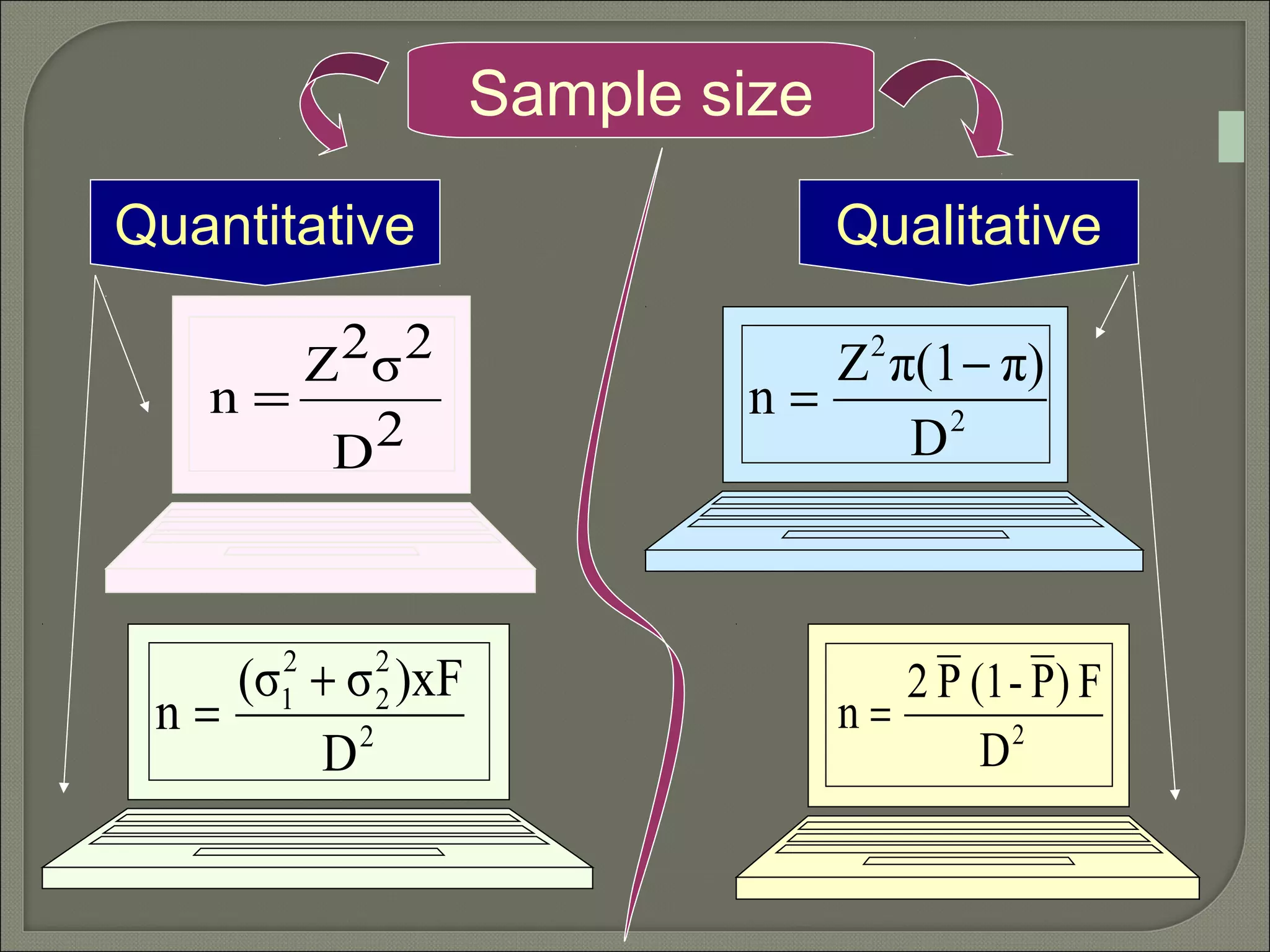
Sample size
Quantitative Qualitative
2D
2σ2Z
n =
2
2
2
2
1
D
)xFσ(σ
n
+
=
2
2
D
π)π(1Z
n
−
=
2
D
F)P-(1P2
n =
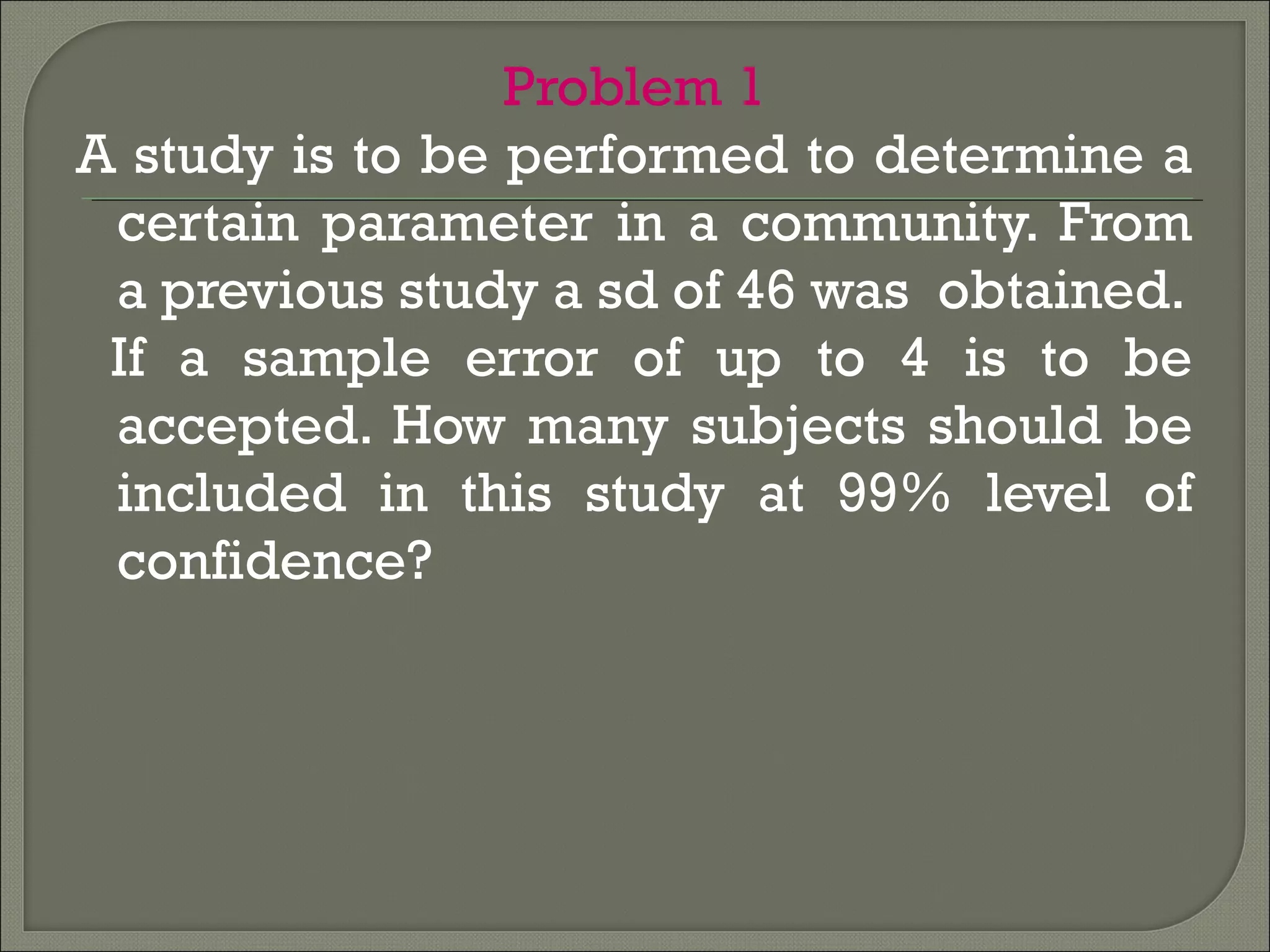
Problem 1
A study is to be performed to determine a
certain parameter in a community. From
a previous study a sd of 46 was obtained.
If a sample error of up to 4 is to be
accepted. How many subjects should be
included in this study at 99% level of
confidence?
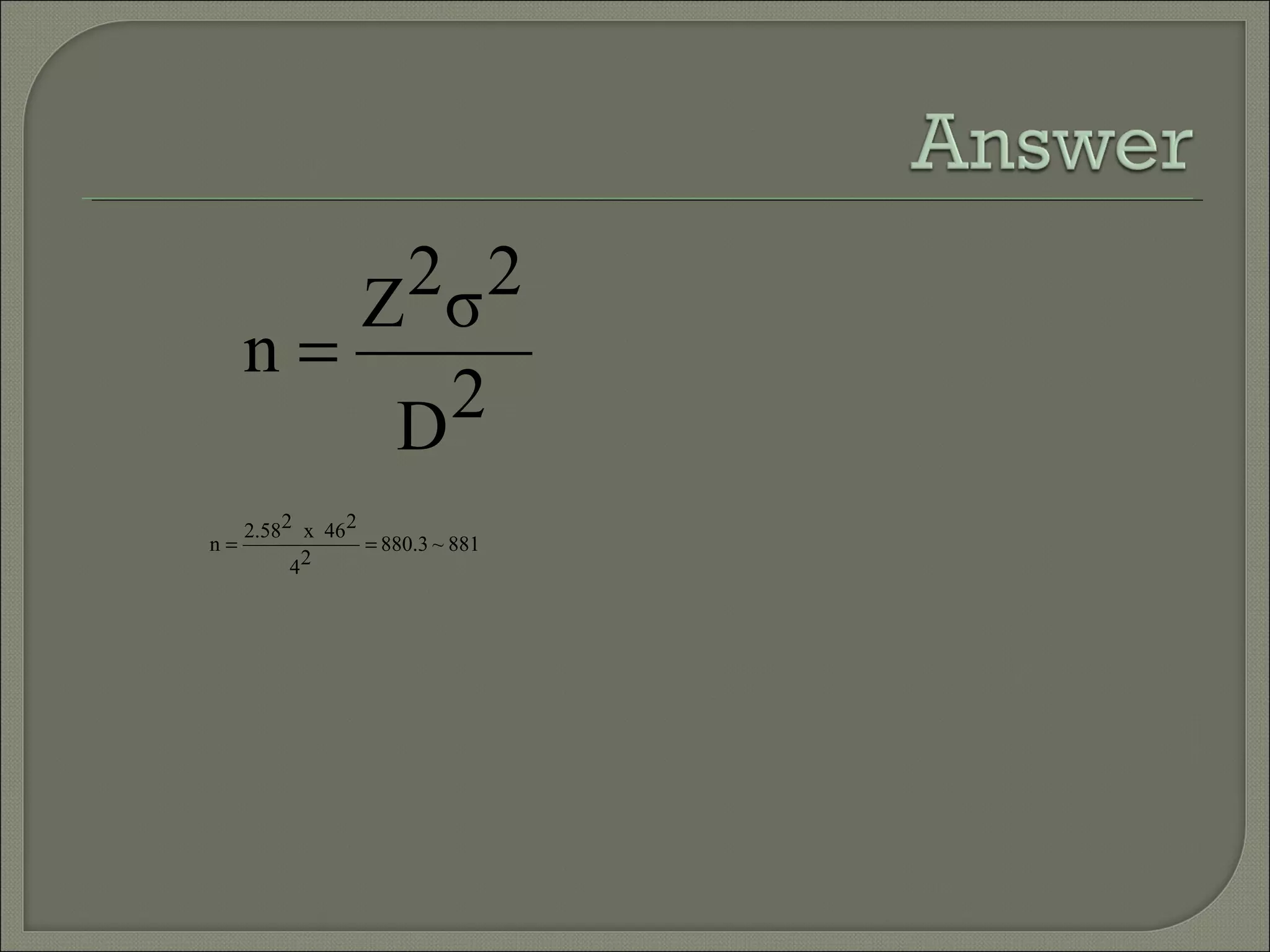
881~3.880
24
246x22.58
n ==
2D
2σ2Z
n =
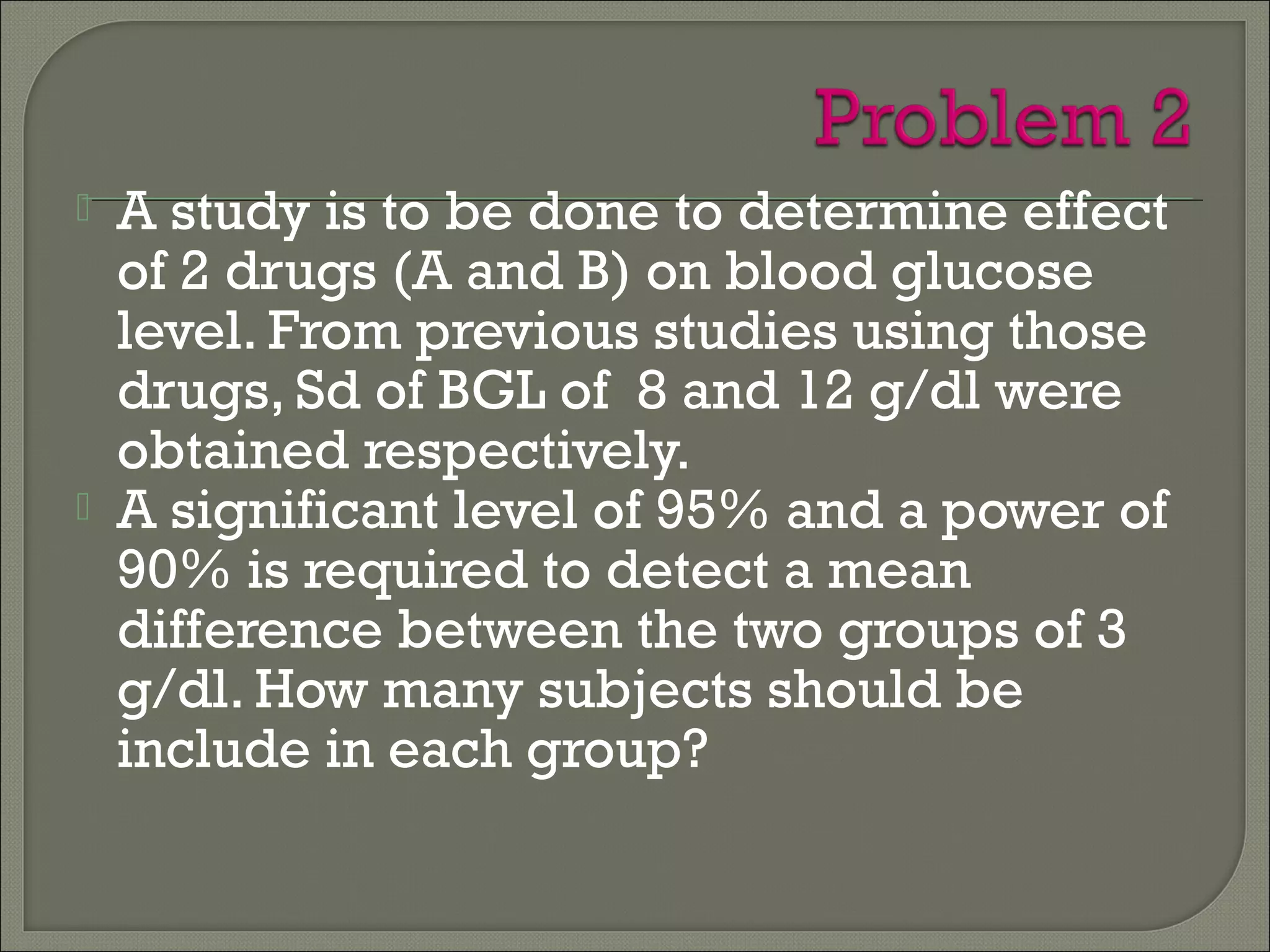
 A study is to be done to determine effect
of 2 drugs (A and B) on blood glucose
level. From previous studies using those
drugs, Sd of BGL of 8 and 12 g/dl were
obtained respectively.
 A significant level of 95% and a power of
90% is required to detect a mean
difference between the two groups of 3
g/dl. How many subjects should be
include in each group?
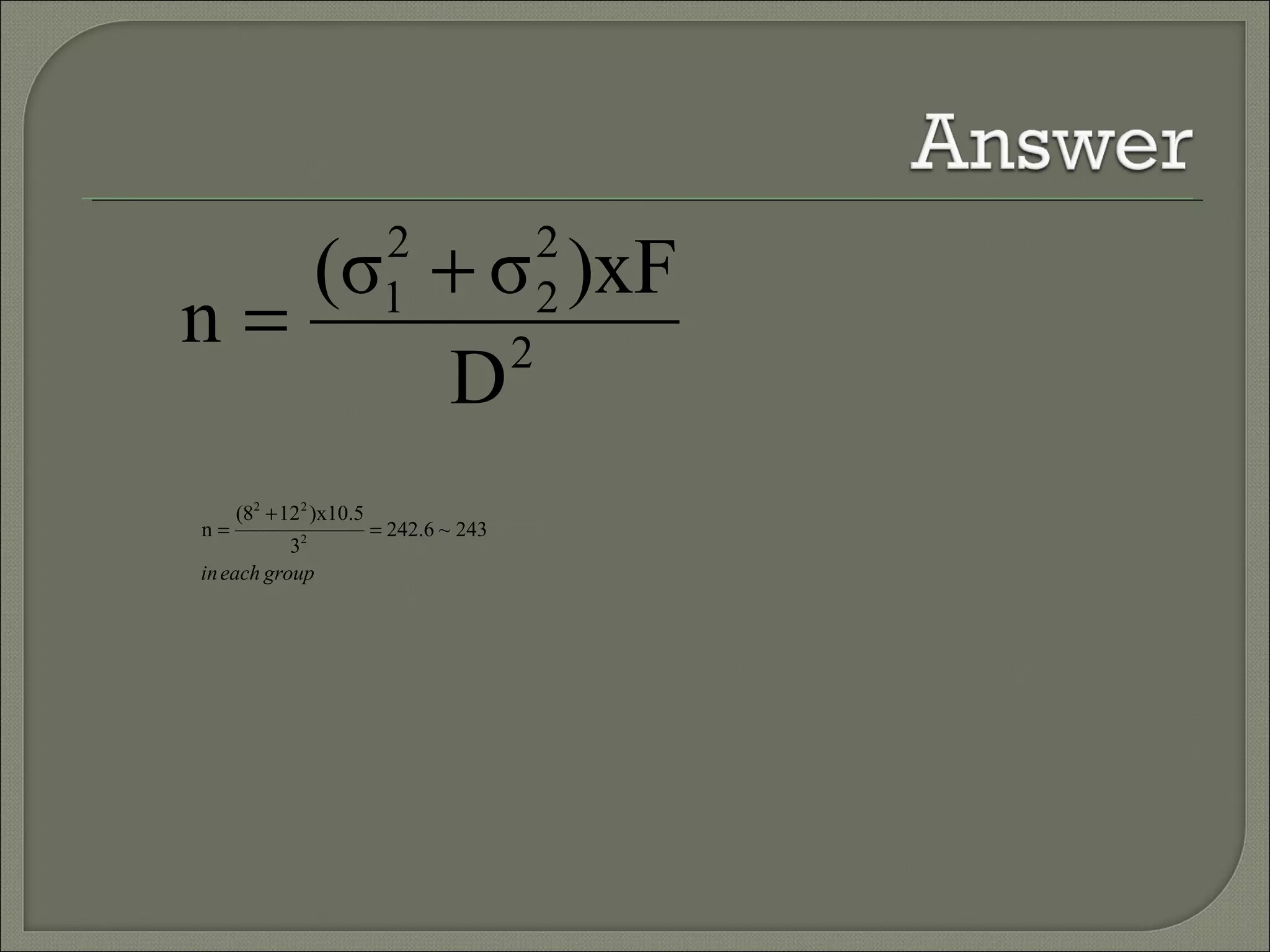
groupeachin
243~6.242
3
)x10.512(8
n 2
22
=
+
=
2
2
2
2
1
D
)xFσ(σ
n
+
=
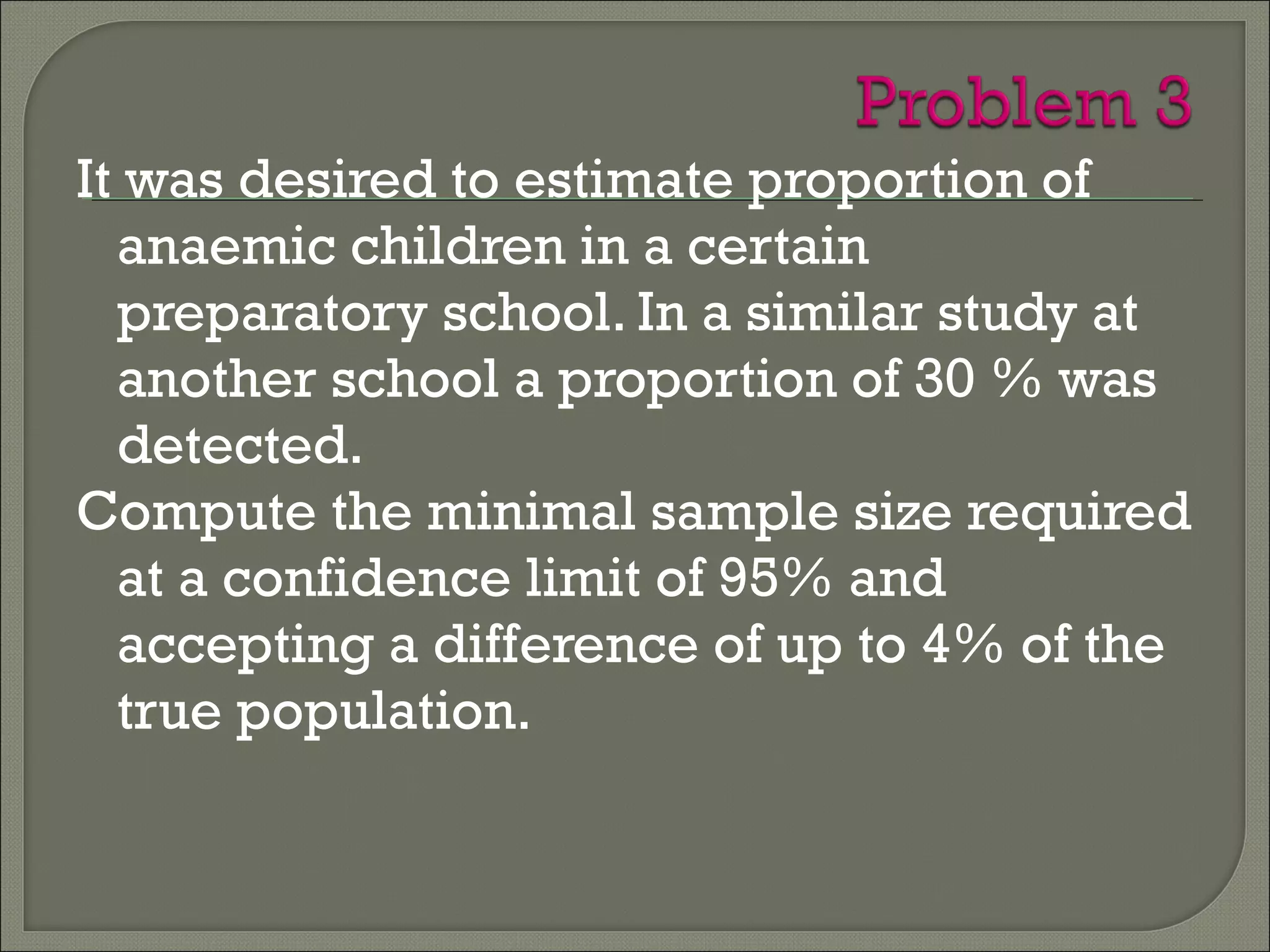
It was desired to estimate proportion of
anaemic children in a certain
preparatory school. In a similar study at
another school a proportion of 30 % was
detected.
Compute the minimal sample size required
at a confidence limit of 95% and
accepting a difference of up to 4% of the
true population.
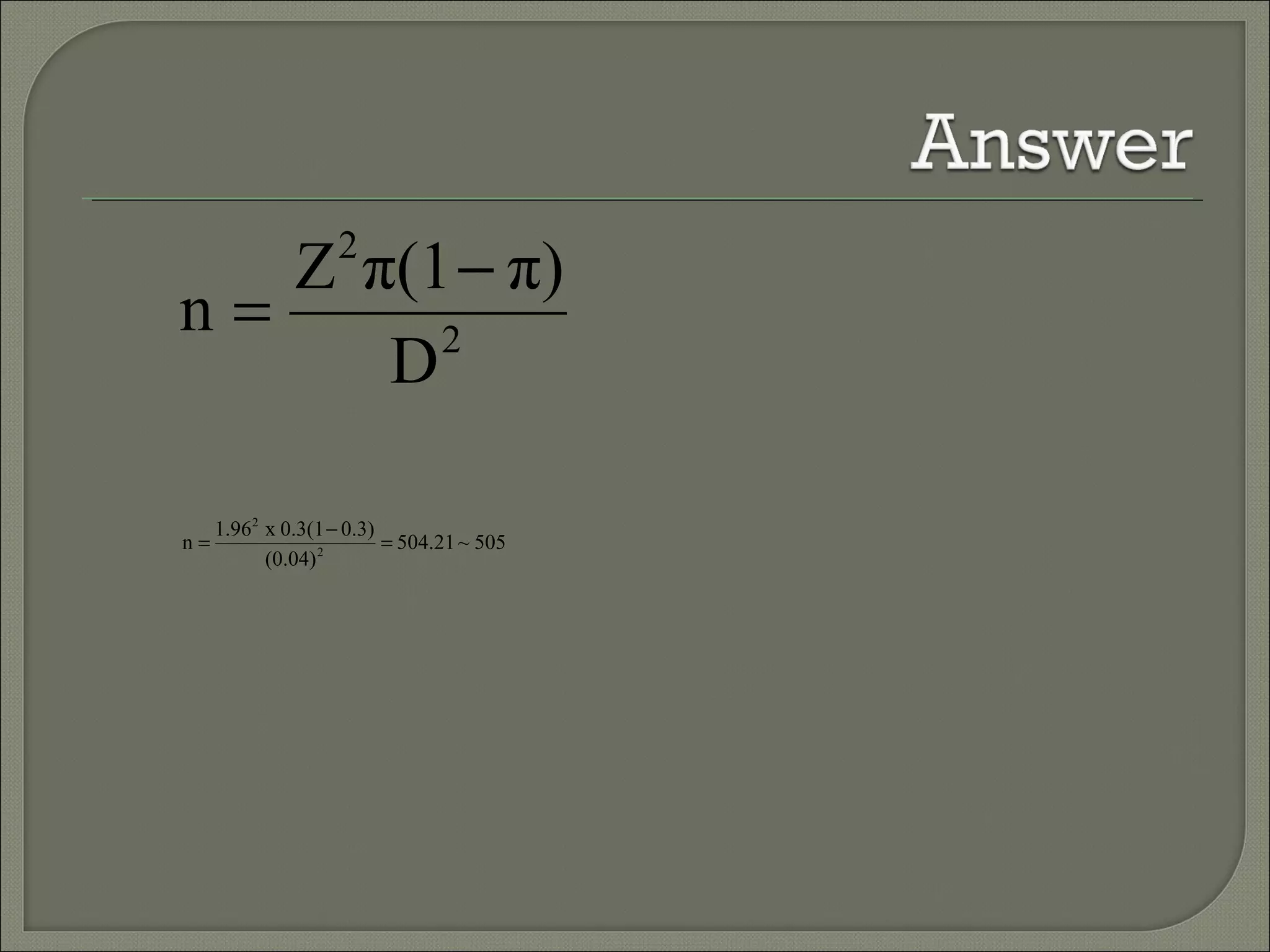
505~21.504
(0.04)
0.3)0.3(1x1.96
n 2
2
=
−
=
2
2
D
π)π(1Z
n
−
=
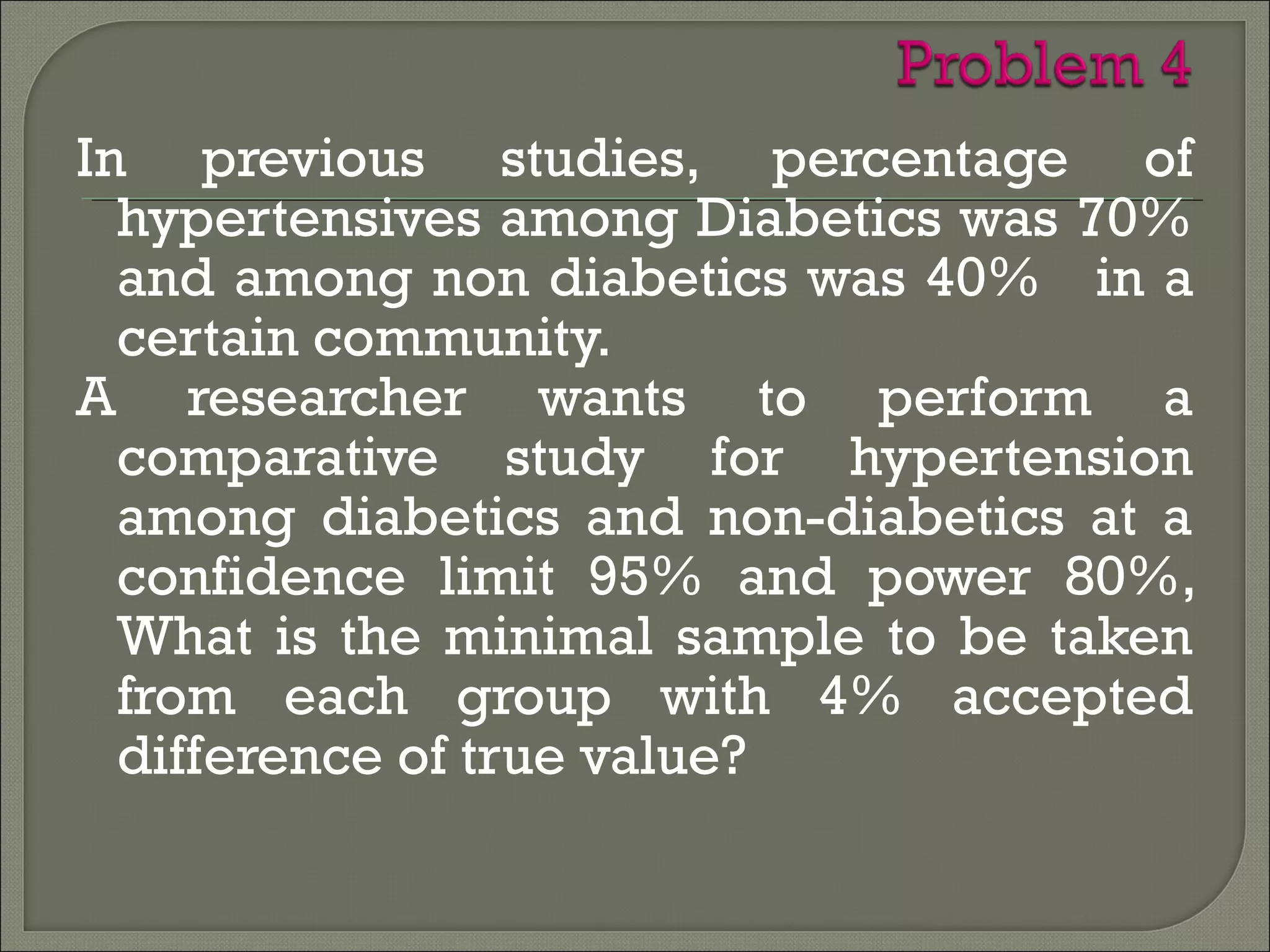
In previous studies, percentage of
hypertensives among Diabetics was 70%
and among non diabetics was 40% in a
certain community.
A researcher wants to perform a
comparative study for hypertension
among diabetics and non-diabetics at a
confidence limit 95% and power 80%,
What is the minimal sample to be taken
from each group with 4% accepted
difference of true value?
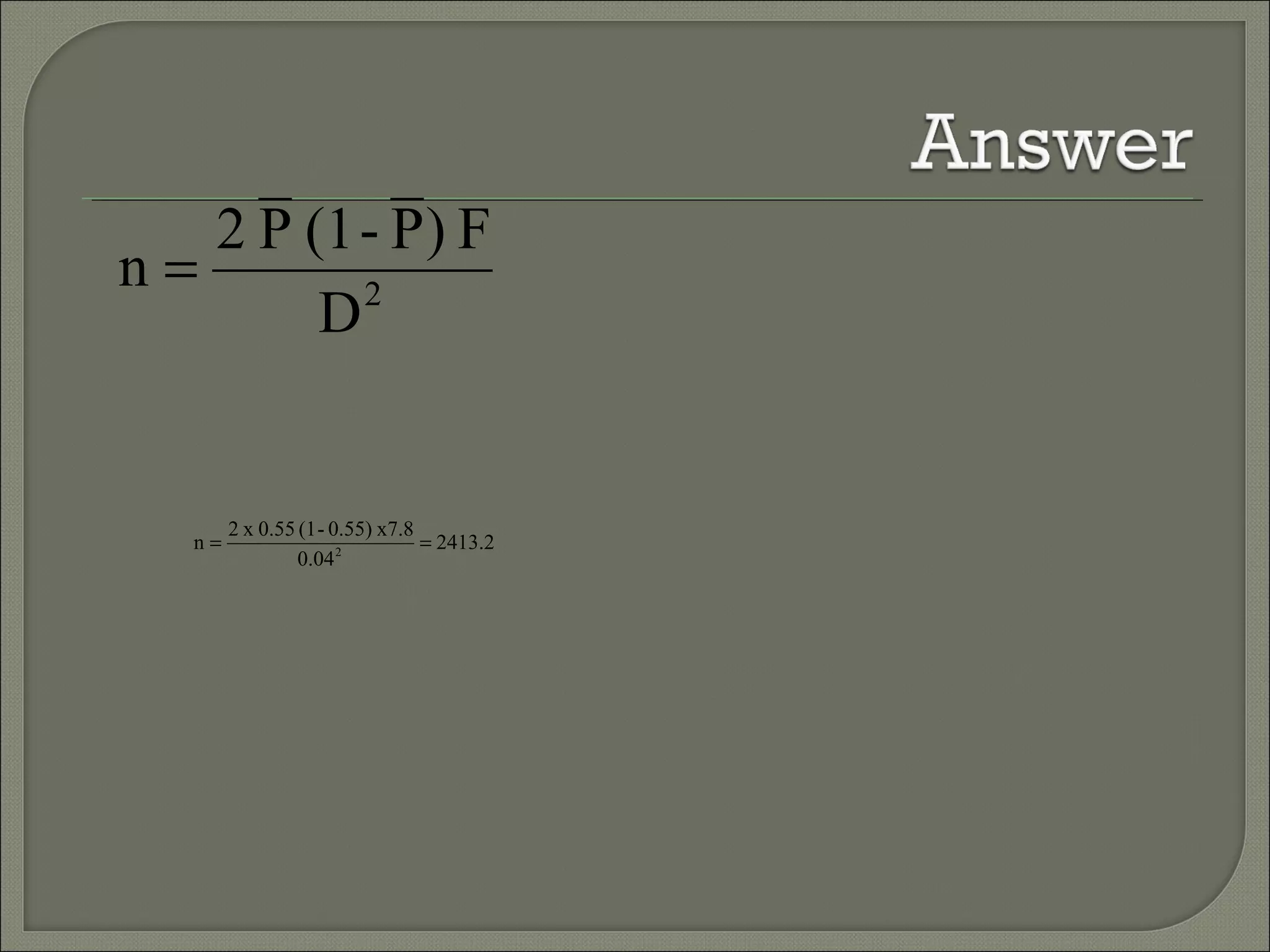
2.2413
0.04
x7.80.55)-(10.55x2
n 2
==
2
D
F)P-(1P2
n =
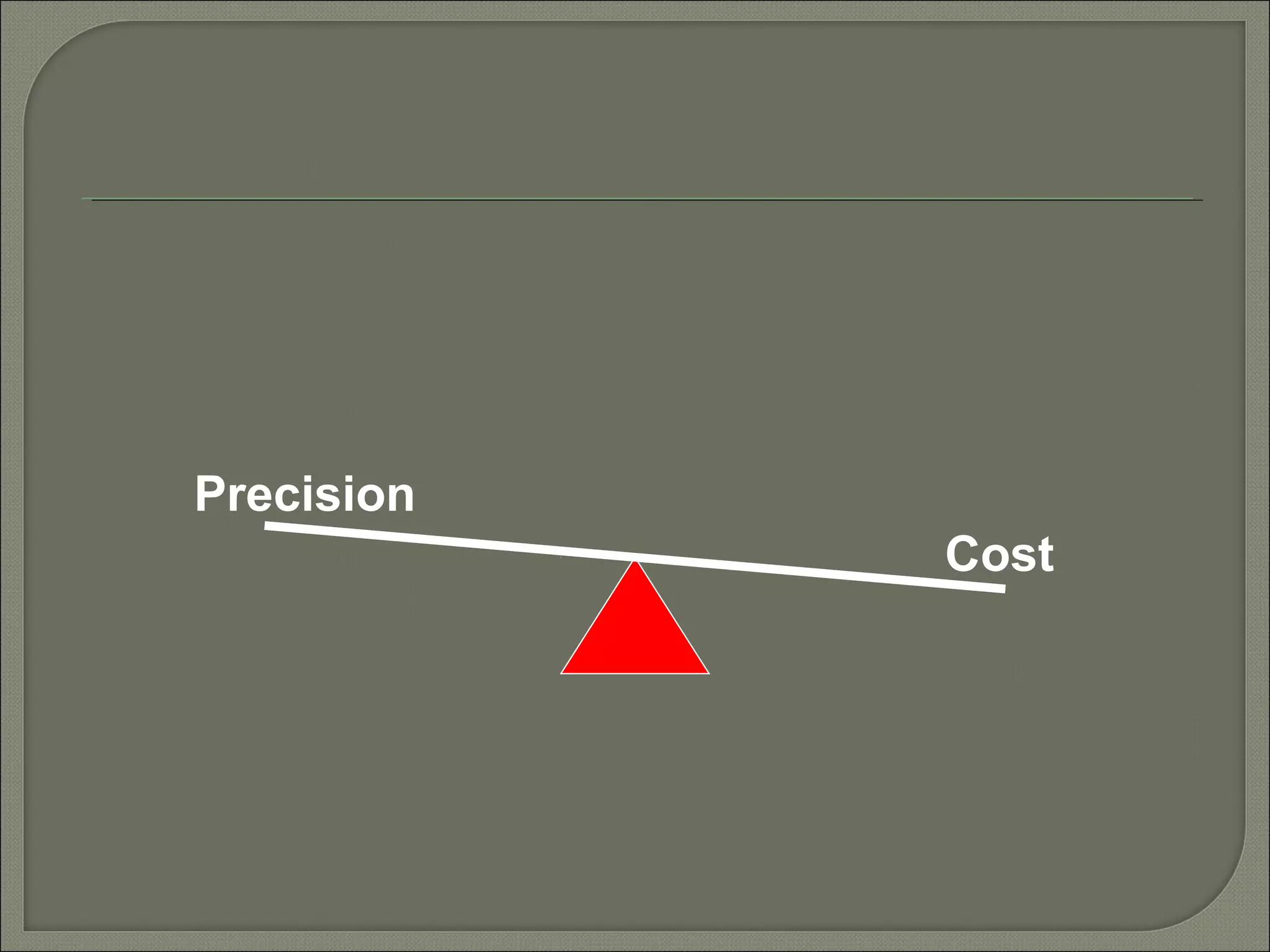
Precision
Cost
 Fundamentals of Statistics by SC Guta
Publisher Sultan Chand               
 Quantitative Techniques in management
by N.D.Vohra Publisher:Tata Mcgraw hill

eMba i qt unit-5_sampling

  • 1.
  • 2.
    Population: a set whichincludes all measurements of interest to the researcher (The collection of all responses, measurements, or counts that are of interest) Sample: A subset of the population
  • 3.
    Get information aboutlarge populations  Less costs  Less field time  More accuracy i.e. Can Do A Better Job of Data Collection  When it’s impossible to study the whole population
  • 4.
    Target Population: The populationto be studied/ to which the investigator wants to generalize his results Sampling Unit: smallest unit from which sample can be selected Sampling frame List of all the sampling units from which sample is drawn Sampling scheme Method of selecting sampling units from sampling frame
  • 5.
  • 6.
     Convenience samples(ease of access) sample is selected from elements of a population that are easily accessible  Snowball sampling (friend of friend….etc.)  Purposive sampling (judgemental)  You chose who you think should be in the study Quota sample
  • 7.
    Probability of beingchosen is unknown Cheaper- but unable to generalise potential for bias
  • 8.
     Random sampling •Each subject has a known probability of being selected  Allows application of statistical sampling theory to results to: • Generalise • Test hypotheses
  • 9.
     Probability samplesare the best  Ensure • Representativeness • Precision
  • 10.
     Simple randomsampling  Systematic sampling  Stratified sampling  Multi-stage sampling  Cluster sampling
  • 11.
  • 12.
    6 8 42 5 7 9 5 4 1 2 5 6 3 2 1 4 0 5 8 2 0 3 2 1 5 4 7 8 5 9 6 2 0 2 4 3 6 2 3 3 3 2 5 4 7 8 9 1 2 0 3 2 5 9 8 5 2 6 3 0 1 7 4 2 4 5 0 3 6 8 6
  • 13.
    Sampling fraction Ratio betweensample size and population size Systematic sampling
  • 14.
  • 15.
    Cluster: a groupof sampling units close to each other i.e. crowding together in the same area or neighborhood
  • 16.
    Section 4 Section 5 Section3 Section 2Section 1
  • 17.
     Stratified sampling Multi-stage sampling
  • 18.
    Systematic error (orbias) Inaccurate response (information bias) Selection bias Sampling error (random error) Errors in sample
  • 19.
     The probabilityof finding a difference with our sample compared to population, and there really isn’t one….  Known as the α (or “type 1 error”)  Usually set at 5% (or 0.05)
  • 20.
     The probabilityof not finding a difference that actually exists between our sample compared to the population…  Known as the (or “type 2 error”)β  Power is (1- ) and is usually 80%β
  • 21.
    Sample size Quantitative Qualitative 2D 2σ2Z n= 2 2 2 2 1 D )xFσ(σ n + = 2 2 D π)π(1Z n − = 2 D F)P-(1P2 n =
  • 22.
    Problem 1 A studyis to be performed to determine a certain parameter in a community. From a previous study a sd of 46 was obtained. If a sample error of up to 4 is to be accepted. How many subjects should be included in this study at 99% level of confidence?
  • 23.
  • 24.
     A studyis to be done to determine effect of 2 drugs (A and B) on blood glucose level. From previous studies using those drugs, Sd of BGL of 8 and 12 g/dl were obtained respectively.  A significant level of 95% and a power of 90% is required to detect a mean difference between the two groups of 3 g/dl. How many subjects should be include in each group?
  • 25.
  • 26.
    It was desiredto estimate proportion of anaemic children in a certain preparatory school. In a similar study at another school a proportion of 30 % was detected. Compute the minimal sample size required at a confidence limit of 95% and accepting a difference of up to 4% of the true population.
  • 27.
  • 28.
    In previous studies,percentage of hypertensives among Diabetics was 70% and among non diabetics was 40% in a certain community. A researcher wants to perform a comparative study for hypertension among diabetics and non-diabetics at a confidence limit 95% and power 80%, What is the minimal sample to be taken from each group with 4% accepted difference of true value?
  • 29.
  • 30.
  • 31.
     Fundamentals ofStatistics by SC Guta Publisher Sultan Chand                 Quantitative Techniques in management by N.D.Vohra Publisher:Tata Mcgraw hill