Population and Sampling
methods
Abebe Tolera (BSC, MPH in Epidemiology)
1/23/2023 1
Sampling and data collection
methods
 Unit objectives
 At the end of this unit, students are
expected to:
1. Understand concept of sampling and
types of sampling methods
2. Differentiate the Strength and Limitation
of each sampling techniques
1/23/2023 2
Sampling and data collection
methods
 What is sampling?
 Why is it important?
 What are the different types sampling?
 What are the advantages and limitations of
the different sampling techniques?
1/23/2023 3
Population in Statisticians
 In statistics the term “population” has a slightly
different meaning from the one given to it in
ordinary speech.
 It need not refer only to people or to animate
creatures
 Statisticians also speak of a population of
objects, or events, or procedures, or
observations, including such things as the
quantity of lead in urine, visits to the doctor, or
surgical operations.
 A population is thus an aggregate of
creatures, things, cases and so on.
1/23/2023 4
Population in Statisticians
 Generally, population refers to the people who live in
a particular area at a specific time.
 In statistics, population is the entire set of items or
data on your study of interest.
 It can be a group of individuals, objects, events,
organizations, etc.
 Although a statistician should clearly define the
population he or she is dealing with, they may not be
able to enumerate it exactly.
 A population commonly contains too many
individuals to study conveniently, so an investigation
is often restricted to one or more samples drawn
from it.
1/23/2023 5
Sampling…
 Researchers often use sample survey
methodology to obtain information
about a larger population by selecting
and measuring a sample from that
population.
 Since population is too large, we rely on
the information collected from the
sample.
 Thus, for Cost minimization
1/23/2023 6
Sampling…
 Sampling: is a process used in statistical
analysis in which a predetermined
number of observations are taken from a
larger population.
 The methodology used to sample from a
larger population depends on the type of
analysis being performed
1/23/2023 7
Sampling…
 It is the process of selecting a portion of
the population to represent the entire
population.
 A main concern in sampling:
1. Ensure that the sample represents the
population, and
2. The findings can be generalized.
1/23/2023 8
Samples are used when :
◦ The population is too large to collect data.
◦ The data collected is not reliable.
◦ The population is hypothetical and is
unlimited in size.
◦ Take the example of a study that
documents the results of a new medical
procedure. It is unknown how the
procedure will affect people across the
globe, so a test group is used to find out
how people react to it.
1/23/2023 9
Sampling…
Steps needed to select a sample and
ensure that this sample will fulfill its
goals.
1. Establish the study's objectives
 –Clarifying the aims of the survey is critical
to its ultimate success
2. Define the target population
 –The target population is the total population
for which the information is required
1/23/2023 10
Sampling…
 Reference population (or target
population): the population of interest to
whom the researchers would like to make
generalizations.
 Sampling population: the subset of the
target population from which a sample will be
drawn.
 Study population: the actual group in which
the study is conducted = Sample
 Study unit: the units on which information
will be collected: persons, housing units, etc.
1/23/2023 11
1/23/2023 12
Sampling…
3. Decide on the data to be collected
The data requirements of the survey
must be established.
To ensure that the requirements are
operationally sound, the necessary
data terms and definitions also need
to be determined
1/23/2023 13
Sampling…
4. Set the level of precision
There is a level of uncertainty associated
with estimates coming from a sample.
Researchers can estimate the sampling
error associated with a particular sampling
plan, and try to minimize it.
Sample-to-sample variation causes
sampling error
Acceptable precision is important
1/23/2023 14
Sampling…
5. Decide on the methods of
measurement
 Choose measuring instrument and
method of approach to the population
1/23/2023 15
Sampling…
6. Preparing Frame
 List of all members of the population
from which the sample will be taken
 The elements must not overlap
1/23/2023 16
A sample should generally :
◦ Satisfy all different variations present
in the population as well as a well-
defined selection criterion.
◦ Be utterly unbiased on the properties
of the objects being selected.
◦ Be random to choose the objects of
study fairly.
1/23/2023 17
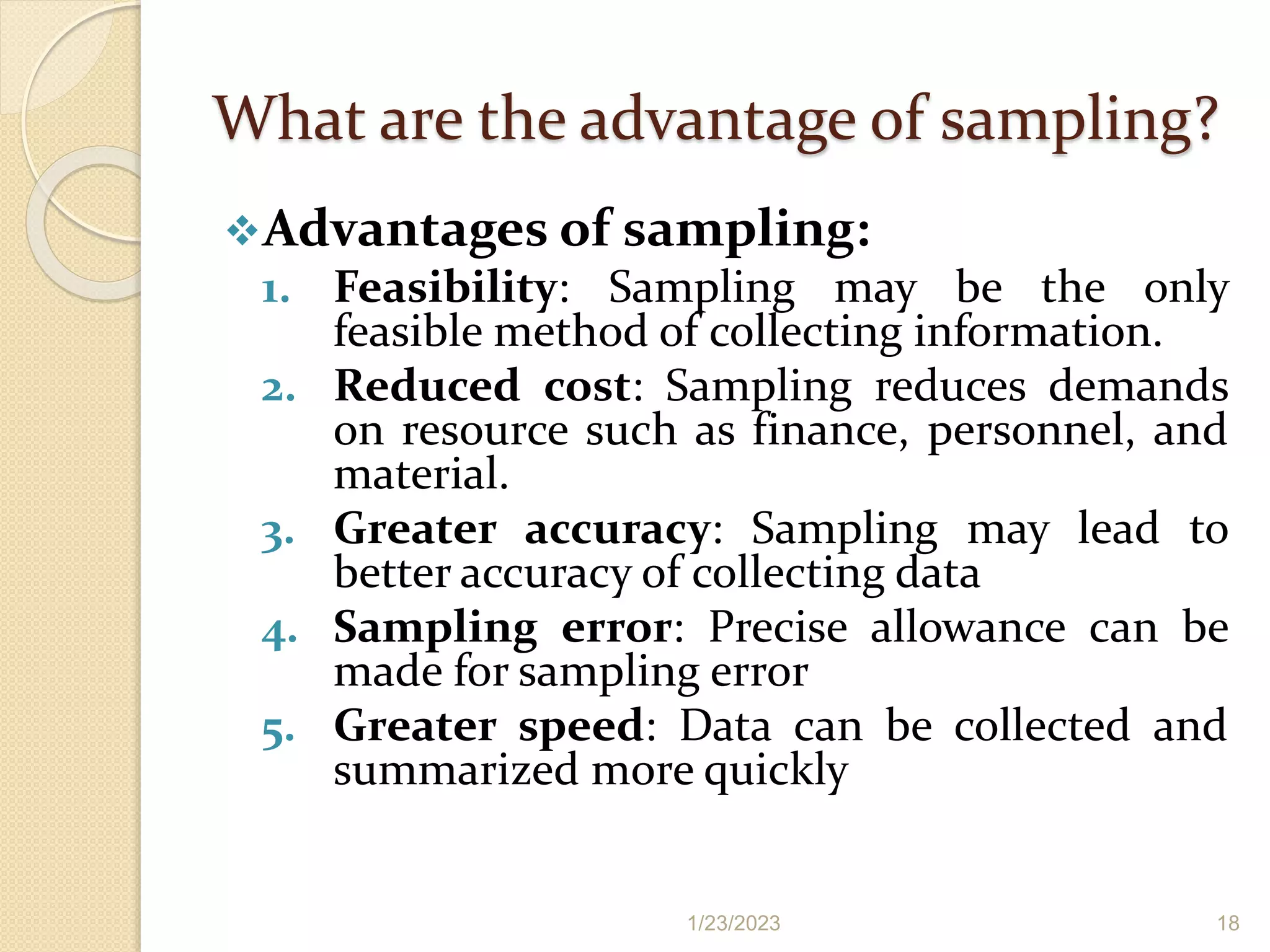
What are the advantage of sampling?
Advantages of sampling:
1. Feasibility: Sampling may be the only
feasible method of collecting information.
2. Reduced cost: Sampling reduces demands
on resource such as finance, personnel, and
material.
3. Greater accuracy: Sampling may lead to
better accuracy of collecting data
4. Sampling error: Precise allowance can be
made for sampling error
5. Greater speed: Data can be collected and
summarized more quickly
1/23/2023 18
Disadvantages of sampling:
 The following are some of the
limitations of sampling.
1. Estimates based on sample are subjected to
sampling error.
2. Bias, if sample are not representative.
1/23/2023 19
Sampling…
While selecting a SAMPLE, there are
basic questions:
◦ What is the group of people (STUDY
POPULATION) from which we want to
draw a sample?
◦ How many people do we need in our
sample?
◦ How will these people be selected?
1/23/2023 20
Sampling Methods
Two broad divisions:
1. Probability sampling methods
2. Non-probability sampling methods
1/23/2023 21
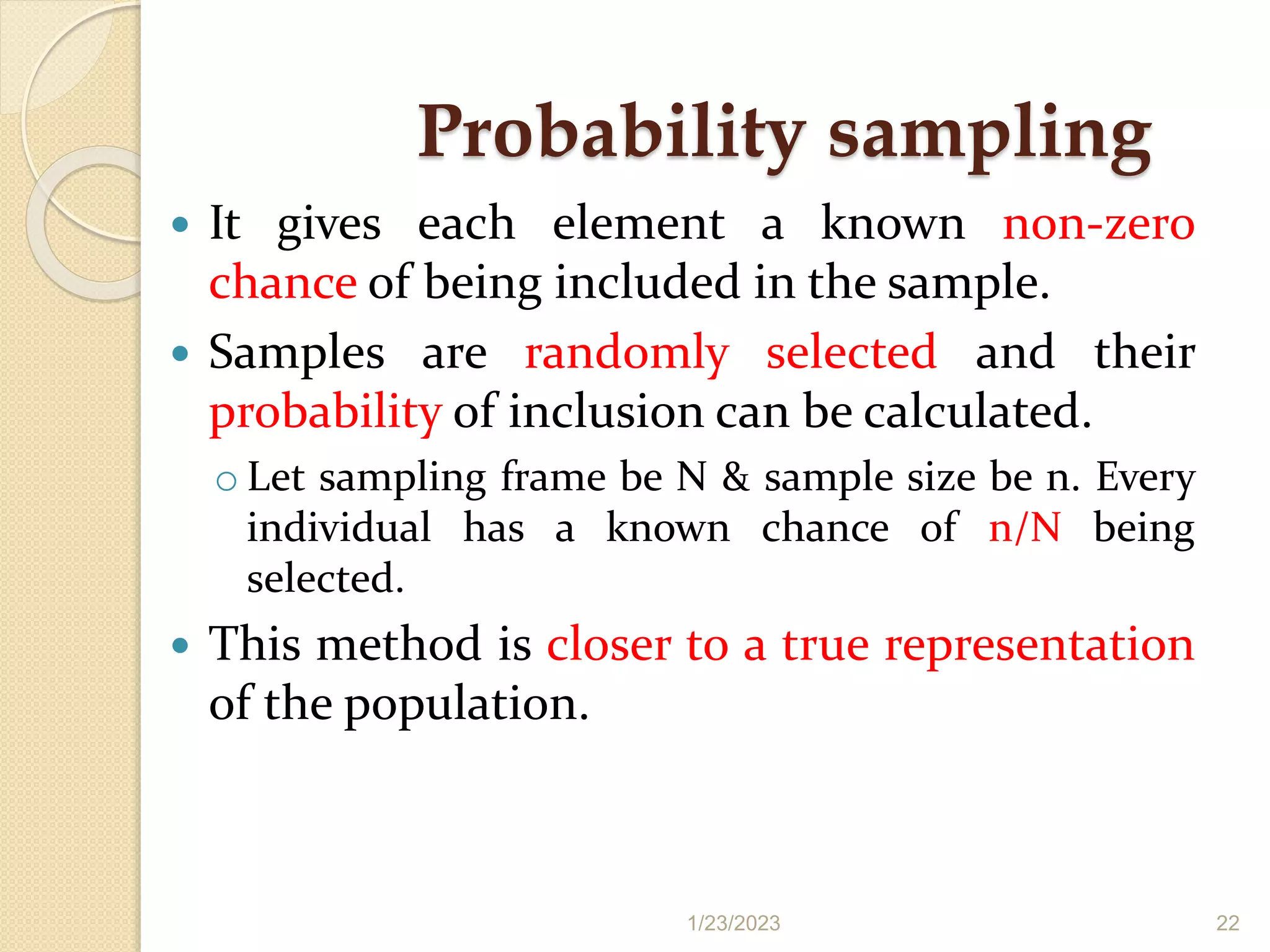
Probability sampling
 It gives each element a known non-zero
chance of being included in the sample.
 Samples are randomly selected and their
probability of inclusion can be calculated.
o Let sampling frame be N & sample size be n. Every
individual has a known chance of n/N being
selected.
 This method is closer to a true representation
of the population.
1/23/2023 22
Probability sampling
 It can be difficult to use due to size of
the sample and cost to obtain,
 but the generalizations that come from
it are more likely to be closer to the a
true representation of the population.
1/23/2023 23
Probability sampling…
 The following are the most common
probability sampling methods:
1. Simple random sampling
2. Systematic random sampling
3. Stratified random sampling
4. Cluster sampling
5. Multi‐stage sampling
6. Sampling with probability proportional to size
1/23/2023 24
Simple Random Sampling
 SRS is the most basic scheme and simplest form
of probability/random sampling.
 Involves the selection of a sample from a
population, based on chance
 Each measurement or count in the population
has the same or known chance (probability) of
being selected.
 Representativeness is also ensured.
1/23/2023 25
Step is conducting simple random
sampling
1. Make a list
2. Assign sequential number
3. Use random number generator
4. Choose sample
1/23/2023 26
Simple Random Sampling…
 Select the required number of study units, using
random methods like:
A.Use of “lottery’ methods
B.Table of random numbers
C.Computer programs
 Standard statistical software (e.g. STATA, SPSS)
have commands for automated random sample
selection.
1/23/2023 27
1/23/2023 28
 Advantages:
 Each unit in the sampling frame has an equal
chance of being selected.
 It does not require additional information on the
frame (such as geographic areas)
 Easy to apply to small populations.
 Limitations:
 Expensive and unfeasible for large dispersed
populations
 Requires a sampling frame.
 Minority subgroups may not be selected.
1/23/2023 29
Simple Random Sampling…
Systematic Random Sampling
 Also interval sampling, systematic
sampling where there is a gap, or interval,
between each selected unit in the sample.
 Selection of individuals from the sampling
frame systematically.
 In systematic sampling, only the first unit is
selected at random.
 Less time consuming and easier to
perform than Simple RS.
1/23/2023 30
Systematic Random Sampling…
 Steps in systematic random sampling:
1. Number the units on your frame from 1 to N (where N is the total
population size).
2. Determine the sampling interval (K) by dividing the number of
units in the population (N) by the desired sample size (n).
3. Select a number between one and K at random. This number is
called the random start and would be the first number included
in your sample.
4. Select every Kth unit after that first number
1/23/2023 31
 Example:
 To select a sample of 100 from a population of 400, you would
need a sampling interval of 400 ÷ 100 = 4. Therefore, K = 4.
 You will need to select one unit out of every four units to end
up with a total of 100 units
 Select a number between 1 and 4 from a table of random
numbers.
 If you choose 3, the third unit on your frame would be the first
unit included in your sample;
 The sample might consist of the following units to make up a
sample of 100: 3 (the random start), 7, 11, 15, 19...395, 399 (up to
N, which is 400 in this case).
1/23/2023 32
Systematic Random Sampling…
 Advantages:
 Less time consuming and easier to perform than
simple RS.
 Important when the population from which sample
is to be drawn is homogeneously distributed.
 Can be conducted without a sampling frame (useful
in some situations where a sampling frame is not
readily available).
 Disadvantages:
 Can not be used when a cyclic repetition is inherent
in the sampling frame. In which case, the sample
will not be representative of the population.
1/23/2023 33
Systematic Random Sampling…
 It is done when the population is known to be have
heterogeneity with regard to some characteristics
and those characteristics are used for stratification.
 The population is divided into homogeneous, non-
over lapping mutually exclusive groups called
strata according to certain characteristics of
interest (e.g., age, sex, province of residence,
income, etc.).
 The population (elements) should be homogenous
within stratum and heterogeneous between the
strata.
1/23/2023 34
Stratified Random Sampling
Stratified Random Sampling…
 The principal objective of stratification is to reduce
sampling errors.
 Then, independent samples are selected from each
stratum sing any of the sampling methods discussed
above.
 The sampling method can vary from one stratum to
another.
 Each stratum becomes an independent population and
you will need to decide the sample size for each stratum.
1/23/2023 35
1/23/2023 36
Stratified Random Sampling…
 Proportionate Allocation:
 Each member of the survey population has a chance of being included
in the sample, but it does not require that this chance be the same for
everyone.
 With this method, the bigger the size of the unit, the higher the
chance it has of being included in the sample.
 E.G. Your study area has 3 villages with total population 1000. Village A
has 200, village B has 500 and village C has 300 populations.
 Determine sample size for each village if total sample size is 120.
A. Village A=120/1000 X 200 = 24
B. Village B =120/1000 X 500 = 60
C. Village C =120/1000 X 300 = 36
1/23/2023 37
Stratified Random Sampling
 Advantage:
 More efficient sampling strategy.
 Adequate representation of minority subgroups of interest
can be ensured.
 Improves the accuracy of estimation
 Disadvantages
 Sampling frame for the entire population has to be prepared
separately for each stratum.
 Not suitable if there are no homogeneous subgroups
 Can be expensive
 Requires accurate information about the population, or
introduces bias.
1/23/2023 38
 Sometimes it is too expensive to spread a sample
across the population as a whole.
 Travel costs can become expensive if interviewers
have to survey people from one end of the country to
the other.
 To reduce costs, researchers may choose a cluster
sampling technique.
 The clusters should be homogeneous unlike stratified
sampling where the strata are heterogeneous.
 The sampling unit is a cluster, and the sampling
frame is a list of these clusters.
1/23/2023 39
Cluster Sampling
Steps in Cluster Sampling
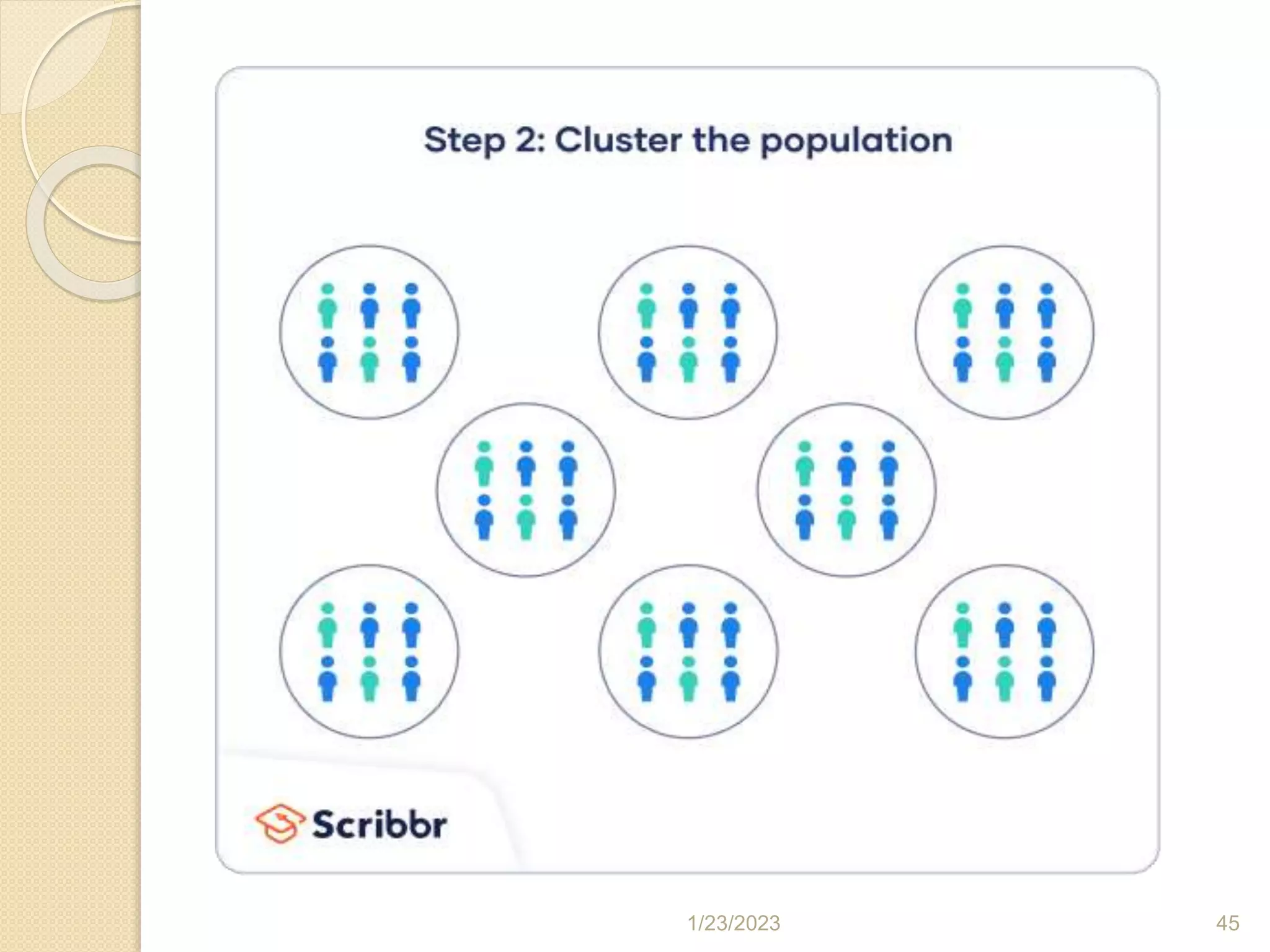
o Cluster sampling divides the population into groups
or clusters.
o A number of clusters are selected randomly to
represent the total population, and then all units
within selected clusters are included in the sample.
o No units from non‐selected clusters are included in
the sample—they are represented by those from
selected clusters.
o This differs from stratified sampling, where some
units are selected from each group.
 Example:
◦ In a school based study, we assume students of the same
school are homogeneous. We can select randomly sections
and include all students of the selected sections only.
1/23/2023 40
Cluster Sampling …
 Cost reduction is a reason for using cluster
sampling.
 It creates 'pockets' of sampled units instead of
spreading the sample over the whole territory and
reduce cost.
 Another reason is that sometimes a list of all units
in the population is not available, while a list of all
clusters is either available or easy to create.
 Mostly used for widely scattered population and if
there is no sampling frame under well defined
clusters.
1/23/2023 41
 The main drawback is a loss of efficiency when
compared with simple RS.
 It is usually better to survey a large number of
small clusters instead of a small number of large
clusters.
 Sampling error is usually higher than for a simple
random sample of the same size.
 It is based on the assumption that the
characteristic to be studied is uniformly
distributed throughout the reference population,
which may not always be the case.
 You do not have total control over the final
sample size. The final size may be larger or
smaller than you expected.
1/23/2023 42
Cluster Sampling …
 Appropriate when the reference population is large
and widely scattered.
 This type of sampling requires at least two stages.
1. The primary sampling unit (PSU) is the sampling
unit in the first sampling stage.
◦ In the first stage, large groups or clusters are identified and
selected. These clusters contain more population units than
are needed for the final sample.
2. The secondary sampling unit (SSU) is the sampling
unit in the second sampling stage, etc.
◦ In the second stage, population units are picked from
within the selected clusters (using any of the possible
probability sampling methods) for a final sample.
1/23/2023 43
Multistage Sampling
Multistage Sampling…
 If more than two stages are used, the process of
choosing population units within clusters
continues until there is a final sample.
 Finally sample size will be calculated by
multiplying by the number of stages used (which
we call the design effect).
 Benefit of a more concentrated sample for cost
reduction.
 More information is needed in this type of
sample than what is required in cluster
sampling.
 However, multi‐stage sampling still saves a
great amount of time and effort by not having to
create a list of all of the units in a population.
Because, No need of sampling frame for the
reference population.
1/23/2023 44
1/23/2023 45
 Advantage
 Cuts the cost of preparing the sample frame
 Disadvantage
 Sampling error is high compared with simple
random sampling (so we need to use design effect)
 Less precise estimation than SRS for the same
sample but the reduction in cost outweighs this
and allow for a large sample size
1/23/2023 46
Multistage Sampling…
Sampling with probability
proportional to size
 Probability sampling requires that each
member of the survey population has a
chance of being included in the sample, but
it does not require that this chance be the
same for everyone.
 Requires that a sampling frame of clusters
with measures of size be available
 Read the detail approach of this method
1/23/2023 47
 Non-probability sampling
1/23/2023 48
Non-probability sampling
 Every element in the population [sampling
frame] does not have equal probability of being
chosen in the sample.
 Operationally convenient and simple in theory.
 When using non-probability sampling, sample
size is unrelated to accuracy, so cost benefit
consideration must be used.
49
1/23/2023
Non-probability sampling
when to use non-probability sampling
methods?
 Can not get a complete list of members of the
population
 When generalizability may not be of great
importance
 One OR a limited number of sites OR groups relevant
to the research
 Difficult to take samples from the possible study
population
1/23/2023 50
Convenience
sampling/haphazard sampling
 Drawn at the convenience of the researcher.
 The study units that happen to be available at
the time of data collection are selected.
 Or because the researcher is unable to employ
more acceptable sampling methods.
 Selected neither by probability nor by
judgment
51
1/23/2023
Convenience sampling ….
To sample employees in companies in a
nearby area, sample from a pool of friends or
neighbors.
 The people on the street interview
conducted by researcher or TV program
 Researcher studying on university students
might visit library, some department and
interview certain number of students.
1/23/2023 52
Convenience sampling….
Advantages
 Very easy method of sampling.
 Useful in pilot studies
 It is an economical method.
Disadvantages
 Not a representative of the population.
 Results usually biased & unsatisfactory
1/23/2023 53
Volunteer sampling
 As the term implies, this type of
sampling occurs when people volunteer
to be involved in the study.
 In these instances, the sample is taken
from a group of volunteers.
 •Sometimes, the researcher offers
payment to attract respondents.
 Sampling voluntary participants as
opposed to the general population may
introduce strong biases.
1/23/2023 54
Judgmental sampling
 Based on some judgment, gut-feelings or
experience of the researcher.
 Selection of a group from the population on the
basis of available information thought.
 Strategies for qualitative studies:
 Strategically select a limited number of
informants, so that their in-depth information is
used on an issue about which little is known.
1/23/2023 55
Judgmental sampling
Advantages
 Knowledge of the investigator can be best
used
 Economical.
 Urgent public policy & business decisions
 Study unknown traits/case sampling
Disadvantages
 personal prejudice and bias
 No objective way of evaluating reliability
of data
1/23/2023 56
Quota sampling
 Non-probability equivalent of stratified
sampling
 This differs from stratified sampling, where
the stratums are filled by random sampling.
 Quota set up according to some specified
characteristics
 In this method the investigator interviews as
many people in each category of study unit as
he can find until he has filled his quota
 Within the quota, selection depends on
personal judgment
1/23/2023 57
Quota sampling
Advantages
 Improvement over the judgment sampling.
 Easy sampling technique.
 Most frequently used in social surveys.
Disadvantages
 Not a representative sample.
 Not free from error.
1/23/2023 58
Snow ball sampling
 It is special non probability method used
when the desired sample characteristic is rare
 Relies on referrals from initial subjects to
generate additional subjects
 When we need to do in case of snowball
sampling is that first identify someone who
meets the criteria & then let him/her bring
the other he/she know
1/23/2023 59
Snow ball sampling
Advantage
 Access to difficult to reach population
Disadvantage
 Not representatives of the population
 Result in biased sample
1/23/2023 60

Population and Sampling_ppt (1).pptx

  • 1.
    Population and Sampling methods AbebeTolera (BSC, MPH in Epidemiology) 1/23/2023 1
  • 2.
    Sampling and datacollection methods  Unit objectives  At the end of this unit, students are expected to: 1. Understand concept of sampling and types of sampling methods 2. Differentiate the Strength and Limitation of each sampling techniques 1/23/2023 2
  • 3.
    Sampling and datacollection methods  What is sampling?  Why is it important?  What are the different types sampling?  What are the advantages and limitations of the different sampling techniques? 1/23/2023 3
  • 4.
    Population in Statisticians In statistics the term “population” has a slightly different meaning from the one given to it in ordinary speech.  It need not refer only to people or to animate creatures  Statisticians also speak of a population of objects, or events, or procedures, or observations, including such things as the quantity of lead in urine, visits to the doctor, or surgical operations.  A population is thus an aggregate of creatures, things, cases and so on. 1/23/2023 4
  • 5.
    Population in Statisticians Generally, population refers to the people who live in a particular area at a specific time.  In statistics, population is the entire set of items or data on your study of interest.  It can be a group of individuals, objects, events, organizations, etc.  Although a statistician should clearly define the population he or she is dealing with, they may not be able to enumerate it exactly.  A population commonly contains too many individuals to study conveniently, so an investigation is often restricted to one or more samples drawn from it. 1/23/2023 5
  • 6.
    Sampling…  Researchers oftenuse sample survey methodology to obtain information about a larger population by selecting and measuring a sample from that population.  Since population is too large, we rely on the information collected from the sample.  Thus, for Cost minimization 1/23/2023 6
  • 7.
    Sampling…  Sampling: isa process used in statistical analysis in which a predetermined number of observations are taken from a larger population.  The methodology used to sample from a larger population depends on the type of analysis being performed 1/23/2023 7
  • 8.
    Sampling…  It isthe process of selecting a portion of the population to represent the entire population.  A main concern in sampling: 1. Ensure that the sample represents the population, and 2. The findings can be generalized. 1/23/2023 8
  • 9.
    Samples are usedwhen : ◦ The population is too large to collect data. ◦ The data collected is not reliable. ◦ The population is hypothetical and is unlimited in size. ◦ Take the example of a study that documents the results of a new medical procedure. It is unknown how the procedure will affect people across the globe, so a test group is used to find out how people react to it. 1/23/2023 9
  • 10.
    Sampling… Steps needed toselect a sample and ensure that this sample will fulfill its goals. 1. Establish the study's objectives  –Clarifying the aims of the survey is critical to its ultimate success 2. Define the target population  –The target population is the total population for which the information is required 1/23/2023 10
  • 11.
    Sampling…  Reference population(or target population): the population of interest to whom the researchers would like to make generalizations.  Sampling population: the subset of the target population from which a sample will be drawn.  Study population: the actual group in which the study is conducted = Sample  Study unit: the units on which information will be collected: persons, housing units, etc. 1/23/2023 11
  • 12.
  • 13.
    Sampling… 3. Decide onthe data to be collected The data requirements of the survey must be established. To ensure that the requirements are operationally sound, the necessary data terms and definitions also need to be determined 1/23/2023 13
  • 14.
    Sampling… 4. Set thelevel of precision There is a level of uncertainty associated with estimates coming from a sample. Researchers can estimate the sampling error associated with a particular sampling plan, and try to minimize it. Sample-to-sample variation causes sampling error Acceptable precision is important 1/23/2023 14
  • 15.
    Sampling… 5. Decide onthe methods of measurement  Choose measuring instrument and method of approach to the population 1/23/2023 15
  • 16.
    Sampling… 6. Preparing Frame List of all members of the population from which the sample will be taken  The elements must not overlap 1/23/2023 16
  • 17.
    A sample shouldgenerally : ◦ Satisfy all different variations present in the population as well as a well- defined selection criterion. ◦ Be utterly unbiased on the properties of the objects being selected. ◦ Be random to choose the objects of study fairly. 1/23/2023 17
  • 18.
    What are theadvantage of sampling? Advantages of sampling: 1. Feasibility: Sampling may be the only feasible method of collecting information. 2. Reduced cost: Sampling reduces demands on resource such as finance, personnel, and material. 3. Greater accuracy: Sampling may lead to better accuracy of collecting data 4. Sampling error: Precise allowance can be made for sampling error 5. Greater speed: Data can be collected and summarized more quickly 1/23/2023 18
  • 19.
    Disadvantages of sampling: The following are some of the limitations of sampling. 1. Estimates based on sample are subjected to sampling error. 2. Bias, if sample are not representative. 1/23/2023 19
  • 20.
    Sampling… While selecting aSAMPLE, there are basic questions: ◦ What is the group of people (STUDY POPULATION) from which we want to draw a sample? ◦ How many people do we need in our sample? ◦ How will these people be selected? 1/23/2023 20
  • 21.
    Sampling Methods Two broaddivisions: 1. Probability sampling methods 2. Non-probability sampling methods 1/23/2023 21
  • 22.
    Probability sampling  Itgives each element a known non-zero chance of being included in the sample.  Samples are randomly selected and their probability of inclusion can be calculated. o Let sampling frame be N & sample size be n. Every individual has a known chance of n/N being selected.  This method is closer to a true representation of the population. 1/23/2023 22
  • 23.
    Probability sampling  Itcan be difficult to use due to size of the sample and cost to obtain,  but the generalizations that come from it are more likely to be closer to the a true representation of the population. 1/23/2023 23
  • 24.
    Probability sampling…  Thefollowing are the most common probability sampling methods: 1. Simple random sampling 2. Systematic random sampling 3. Stratified random sampling 4. Cluster sampling 5. Multi‐stage sampling 6. Sampling with probability proportional to size 1/23/2023 24
  • 25.
    Simple Random Sampling SRS is the most basic scheme and simplest form of probability/random sampling.  Involves the selection of a sample from a population, based on chance  Each measurement or count in the population has the same or known chance (probability) of being selected.  Representativeness is also ensured. 1/23/2023 25
  • 26.
    Step is conductingsimple random sampling 1. Make a list 2. Assign sequential number 3. Use random number generator 4. Choose sample 1/23/2023 26
  • 27.
    Simple Random Sampling… Select the required number of study units, using random methods like: A.Use of “lottery’ methods B.Table of random numbers C.Computer programs  Standard statistical software (e.g. STATA, SPSS) have commands for automated random sample selection. 1/23/2023 27
  • 28.
  • 29.
     Advantages:  Eachunit in the sampling frame has an equal chance of being selected.  It does not require additional information on the frame (such as geographic areas)  Easy to apply to small populations.  Limitations:  Expensive and unfeasible for large dispersed populations  Requires a sampling frame.  Minority subgroups may not be selected. 1/23/2023 29 Simple Random Sampling…
  • 30.
    Systematic Random Sampling Also interval sampling, systematic sampling where there is a gap, or interval, between each selected unit in the sample.  Selection of individuals from the sampling frame systematically.  In systematic sampling, only the first unit is selected at random.  Less time consuming and easier to perform than Simple RS. 1/23/2023 30
  • 31.
    Systematic Random Sampling… Steps in systematic random sampling: 1. Number the units on your frame from 1 to N (where N is the total population size). 2. Determine the sampling interval (K) by dividing the number of units in the population (N) by the desired sample size (n). 3. Select a number between one and K at random. This number is called the random start and would be the first number included in your sample. 4. Select every Kth unit after that first number 1/23/2023 31
  • 32.
     Example:  Toselect a sample of 100 from a population of 400, you would need a sampling interval of 400 ÷ 100 = 4. Therefore, K = 4.  You will need to select one unit out of every four units to end up with a total of 100 units  Select a number between 1 and 4 from a table of random numbers.  If you choose 3, the third unit on your frame would be the first unit included in your sample;  The sample might consist of the following units to make up a sample of 100: 3 (the random start), 7, 11, 15, 19...395, 399 (up to N, which is 400 in this case). 1/23/2023 32 Systematic Random Sampling…
  • 33.
     Advantages:  Lesstime consuming and easier to perform than simple RS.  Important when the population from which sample is to be drawn is homogeneously distributed.  Can be conducted without a sampling frame (useful in some situations where a sampling frame is not readily available).  Disadvantages:  Can not be used when a cyclic repetition is inherent in the sampling frame. In which case, the sample will not be representative of the population. 1/23/2023 33 Systematic Random Sampling…
  • 34.
     It isdone when the population is known to be have heterogeneity with regard to some characteristics and those characteristics are used for stratification.  The population is divided into homogeneous, non- over lapping mutually exclusive groups called strata according to certain characteristics of interest (e.g., age, sex, province of residence, income, etc.).  The population (elements) should be homogenous within stratum and heterogeneous between the strata. 1/23/2023 34 Stratified Random Sampling
  • 35.
    Stratified Random Sampling… The principal objective of stratification is to reduce sampling errors.  Then, independent samples are selected from each stratum sing any of the sampling methods discussed above.  The sampling method can vary from one stratum to another.  Each stratum becomes an independent population and you will need to decide the sample size for each stratum. 1/23/2023 35
  • 36.
  • 37.
    Stratified Random Sampling… Proportionate Allocation:  Each member of the survey population has a chance of being included in the sample, but it does not require that this chance be the same for everyone.  With this method, the bigger the size of the unit, the higher the chance it has of being included in the sample.  E.G. Your study area has 3 villages with total population 1000. Village A has 200, village B has 500 and village C has 300 populations.  Determine sample size for each village if total sample size is 120. A. Village A=120/1000 X 200 = 24 B. Village B =120/1000 X 500 = 60 C. Village C =120/1000 X 300 = 36 1/23/2023 37
  • 38.
    Stratified Random Sampling Advantage:  More efficient sampling strategy.  Adequate representation of minority subgroups of interest can be ensured.  Improves the accuracy of estimation  Disadvantages  Sampling frame for the entire population has to be prepared separately for each stratum.  Not suitable if there are no homogeneous subgroups  Can be expensive  Requires accurate information about the population, or introduces bias. 1/23/2023 38
  • 39.
     Sometimes itis too expensive to spread a sample across the population as a whole.  Travel costs can become expensive if interviewers have to survey people from one end of the country to the other.  To reduce costs, researchers may choose a cluster sampling technique.  The clusters should be homogeneous unlike stratified sampling where the strata are heterogeneous.  The sampling unit is a cluster, and the sampling frame is a list of these clusters. 1/23/2023 39 Cluster Sampling
  • 40.
    Steps in ClusterSampling o Cluster sampling divides the population into groups or clusters. o A number of clusters are selected randomly to represent the total population, and then all units within selected clusters are included in the sample. o No units from non‐selected clusters are included in the sample—they are represented by those from selected clusters. o This differs from stratified sampling, where some units are selected from each group.  Example: ◦ In a school based study, we assume students of the same school are homogeneous. We can select randomly sections and include all students of the selected sections only. 1/23/2023 40
  • 41.
    Cluster Sampling … Cost reduction is a reason for using cluster sampling.  It creates 'pockets' of sampled units instead of spreading the sample over the whole territory and reduce cost.  Another reason is that sometimes a list of all units in the population is not available, while a list of all clusters is either available or easy to create.  Mostly used for widely scattered population and if there is no sampling frame under well defined clusters. 1/23/2023 41
  • 42.
     The maindrawback is a loss of efficiency when compared with simple RS.  It is usually better to survey a large number of small clusters instead of a small number of large clusters.  Sampling error is usually higher than for a simple random sample of the same size.  It is based on the assumption that the characteristic to be studied is uniformly distributed throughout the reference population, which may not always be the case.  You do not have total control over the final sample size. The final size may be larger or smaller than you expected. 1/23/2023 42 Cluster Sampling …
  • 43.
     Appropriate whenthe reference population is large and widely scattered.  This type of sampling requires at least two stages. 1. The primary sampling unit (PSU) is the sampling unit in the first sampling stage. ◦ In the first stage, large groups or clusters are identified and selected. These clusters contain more population units than are needed for the final sample. 2. The secondary sampling unit (SSU) is the sampling unit in the second sampling stage, etc. ◦ In the second stage, population units are picked from within the selected clusters (using any of the possible probability sampling methods) for a final sample. 1/23/2023 43 Multistage Sampling
  • 44.
    Multistage Sampling…  Ifmore than two stages are used, the process of choosing population units within clusters continues until there is a final sample.  Finally sample size will be calculated by multiplying by the number of stages used (which we call the design effect).  Benefit of a more concentrated sample for cost reduction.  More information is needed in this type of sample than what is required in cluster sampling.  However, multi‐stage sampling still saves a great amount of time and effort by not having to create a list of all of the units in a population. Because, No need of sampling frame for the reference population. 1/23/2023 44
  • 45.
  • 46.
     Advantage  Cutsthe cost of preparing the sample frame  Disadvantage  Sampling error is high compared with simple random sampling (so we need to use design effect)  Less precise estimation than SRS for the same sample but the reduction in cost outweighs this and allow for a large sample size 1/23/2023 46 Multistage Sampling…
  • 47.
    Sampling with probability proportionalto size  Probability sampling requires that each member of the survey population has a chance of being included in the sample, but it does not require that this chance be the same for everyone.  Requires that a sampling frame of clusters with measures of size be available  Read the detail approach of this method 1/23/2023 47
  • 48.
  • 49.
    Non-probability sampling  Everyelement in the population [sampling frame] does not have equal probability of being chosen in the sample.  Operationally convenient and simple in theory.  When using non-probability sampling, sample size is unrelated to accuracy, so cost benefit consideration must be used. 49 1/23/2023
  • 50.
    Non-probability sampling when touse non-probability sampling methods?  Can not get a complete list of members of the population  When generalizability may not be of great importance  One OR a limited number of sites OR groups relevant to the research  Difficult to take samples from the possible study population 1/23/2023 50
  • 51.
    Convenience sampling/haphazard sampling  Drawnat the convenience of the researcher.  The study units that happen to be available at the time of data collection are selected.  Or because the researcher is unable to employ more acceptable sampling methods.  Selected neither by probability nor by judgment 51 1/23/2023
  • 52.
    Convenience sampling …. Tosample employees in companies in a nearby area, sample from a pool of friends or neighbors.  The people on the street interview conducted by researcher or TV program  Researcher studying on university students might visit library, some department and interview certain number of students. 1/23/2023 52
  • 53.
    Convenience sampling…. Advantages  Veryeasy method of sampling.  Useful in pilot studies  It is an economical method. Disadvantages  Not a representative of the population.  Results usually biased & unsatisfactory 1/23/2023 53
  • 54.
    Volunteer sampling  Asthe term implies, this type of sampling occurs when people volunteer to be involved in the study.  In these instances, the sample is taken from a group of volunteers.  •Sometimes, the researcher offers payment to attract respondents.  Sampling voluntary participants as opposed to the general population may introduce strong biases. 1/23/2023 54
  • 55.
    Judgmental sampling  Basedon some judgment, gut-feelings or experience of the researcher.  Selection of a group from the population on the basis of available information thought.  Strategies for qualitative studies:  Strategically select a limited number of informants, so that their in-depth information is used on an issue about which little is known. 1/23/2023 55
  • 56.
    Judgmental sampling Advantages  Knowledgeof the investigator can be best used  Economical.  Urgent public policy & business decisions  Study unknown traits/case sampling Disadvantages  personal prejudice and bias  No objective way of evaluating reliability of data 1/23/2023 56
  • 57.
    Quota sampling  Non-probabilityequivalent of stratified sampling  This differs from stratified sampling, where the stratums are filled by random sampling.  Quota set up according to some specified characteristics  In this method the investigator interviews as many people in each category of study unit as he can find until he has filled his quota  Within the quota, selection depends on personal judgment 1/23/2023 57
  • 58.
    Quota sampling Advantages  Improvementover the judgment sampling.  Easy sampling technique.  Most frequently used in social surveys. Disadvantages  Not a representative sample.  Not free from error. 1/23/2023 58
  • 59.
    Snow ball sampling It is special non probability method used when the desired sample characteristic is rare  Relies on referrals from initial subjects to generate additional subjects  When we need to do in case of snowball sampling is that first identify someone who meets the criteria & then let him/her bring the other he/she know 1/23/2023 59
  • 60.
    Snow ball sampling Advantage Access to difficult to reach population Disadvantage  Not representatives of the population  Result in biased sample 1/23/2023 60