


MURTAZA KAMAL
STAR HOSPITALS
16TH MARCH, 2019
1
AT THE END OF TALK…
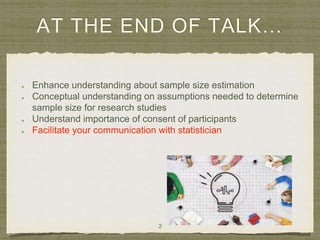
Enhance understanding about sample size estimation
Conceptual understanding on assumptions needed to determine
sample size for research studies
Understand importance of consent of participants
Facilitate your communication with statistician
2
SAMPLING
Act/ process/ technique of selecting representative part of
population for purpose of determining parameters/
characteristics of whole population
TIME/ MONEY/ MANPOWER (T/M/M)
3
IMPORTANCE…
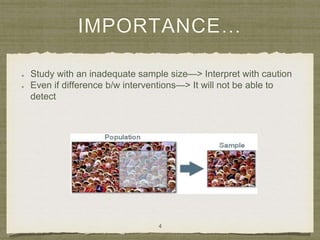
Study with an inadequate sample size—> Interpret with caution
Even if difference b/w interventions—> It will not be able to
detect
4
WHY TO CALCULATE?
Impossible to study whole population
Size: Just large enough detect difference if exists
If large:
Wastage of resources/ time/ money/ manpower
Very small clinically insignificant differences detected as
statistically results—> Not useful at practical level
If small: May not be able to detect significant difference
Helps in planning study-> Estimating resource, time, money
Helps to ensure validity+ reliability+ ethical integrity
5
SAMPLING PROCESS (5
STEPS)
Defining population
Developing a sampling frame
Determining sample size
Specifying sampling method
Selecting the sample
6
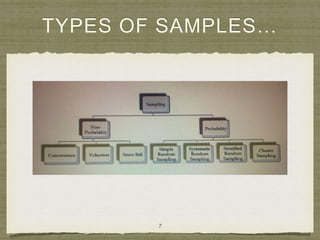
TYPES OF SAMPLES…
7
SAMPLE SIZE DETERMINATION
REQUIREMENTS
Type of study
Determination of estimate
Hypothesis testing
Primary outcome variable
Estimated value of primary outcome variable and acceptable
precision
Acceptable type 1+ 11 errors—> Needed for values on
hypothesis testing
Desired effect
8
FOR SAMPLE SIZE
CALCULATION
Need to know following:
Estimated prevalence/ SD
Confidence interval (CI)
Power - Ability to find significance when 2 groups are really
different (80%)
Allowable error or precision (5-10%)
9
1. TYPE OF STUDY
1. Finding an estimate
2. Doing a hypothesis testing
10
1A. STUDIES ON DETERMINING
AN ESTIMATE
Doing descriptive/ prevalence study
Mean/ proportion of a variable
No null hypothesis: Do not want to compare 2 variables or find
any association
If precision needed (CI- smaller)—> Study large sample size
If smaller sample size studied—> CI larger—> Imprecise results
Hence—> One needs to specify level of precision (CI), one
wants to estimate in order to decide on sample size
11
CONFIDENCE INTERVAL
CI= Point estimate (obtained from sample studied) ±margin of
error (this determines sample size and vice versa)
Eg:
10% margin of error—> Can be achieved with sample size
100
5% margin of error—> SS 400 (making point estimate more
precise)
Hence—> For reducing error/ increasing precision—> 4x
increase in SS
12
1B. STUDIES TO TEST A
HYPOTHESIS
Studies involving hypothesis—> Intend to compare 2 or more
interventions
Measured in terms of proportion of success/ treated or mean
value of a particular variable
Null hypothesis: 2 effects have an equal effect—> AIM: Able to
reject it if its false
13
2. PRIMARY OUTCOME OF
STUDY
In trials where 2 interventions compared-> Outcome can be
assessed in different ways
Avoid overloading study design with too many objectives—>
Measurement+ comparision of too many outcomes
Each clinical trial should have only 1 primary endpoint—> To be
defined before study initiation—> Will decide sample size
needed
If too many primary outcome variables—> You need to calculate
SS for each separately—> Large no
14
3. WHAT IS MARGIN OF ERROR
ACCEPTABLE
Margin of error:
Decided by you
For “0” sampling error—> Study whole population
As one decreases sample size—> Sampling error
increases
15
4. TYPE I+ II ERRORS
To test a hypothesis
NULL HYPOTHESIS: There is no difference b/w 2 groups
Truth:
A. No difference exists
B. A difference exists
16
ERRORS
Type I/ Alpha error:
If no difference exists in reality and study finds a difference
Usually fixed at 5%
Probability of finding a difference when no difference should be < 5%
Type II/ Beta error:
If there is a difference existing in reality+ study is not able to find
By convention taken as 20%
Probability of not finding a difference when there is a difference
should be< 20%
80% probability of making a correct decision of not reporting a
difference when there is no actual difference—> POWER (1-B)—>
PROBABILITY OF DRAWING CORRECT CONCLUSION
17
5. EFFECT SIZE THAT YOU
INTEND TO DETECT
Statistical term used to measure population characteristics
Method which takes both difference in means + standard
deviation into account
Not just a difference in means—> Standardised difference in
means
Sample size is like magnification of microscope—> By
increasing it one is able to detect even smaller difference (effect
size)
SS inversely related to effect size
18
ADJUSTING SAMPLE SIZE
1. Feasibility
Time/ Finances/ Resources
2. Non response rate
3. Dropouts
n1= n/ (1-nonresponse rate)
n2= n1/ (1- drop out rate)
19
THESE ERRORS CAN ALSO
CREEP IN…
Sampling error: (eg: HT in females)
Chance
Bias (eg: Ht. In school kids)
Non sampling errors (eg: Skilled labourer)
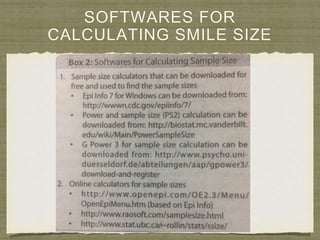
SOFTWARES FOR
CALCULATING SMILE SIZE
21
Personal interactions governed by morals
Professional interactions by ethics
Societal interactions by law
22
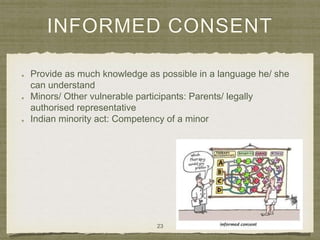
INFORMED CONSENT
Provide as much knowledge as possible in a language he/ she
can understand
Minors/ Other vulnerable participants: Parents/ legally
authorised representative
Indian minority act: Competency of a minor
23
DEFINITION OF INFORMED
CONSENT
Consent given by a competent individual who:
Has received necessary information
Has adequately understood information
After considering information—> Arrived at a decision
without having been subjected to coercion/ undue
influence/ inducement/ intimidation
24
ELEMENTS OF INFORMED
CONSENT
A. Voluntarism
B. Information disclosure
C. Decision making capacity
Written in language which participant understands
25
PROVIDE FOLLOWING INFO:
Purpose of study
Expectations from participants
Responsibility of investigators
Risks/ benefits of intervention/ method
Alternatives available (if interventional study)
Options to withdraw from study
Form should be signed by a witness (Unrelated to investigator/
participant)
26
VULNERABLE
PARTICIPANTS
Any individual who lacks ability to fully consent to participate in a
study
Kids/ persons with disabilities/ illiterate persons
Despite their inability to consent—> Can still participate in a
study if additional safeguards+ procedures used—> Respect for
autonomy
27
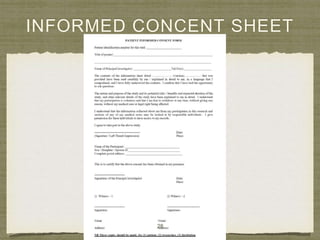
INFORMED CONCENT SHEET
28
PARTICIPANT/ PATIENT INFO
SHEET
1. Title of project
2. Nature+ purpose of study—> Stating it is a research
3. Identity of research teams, address+ ph no
4.Duration of participation+ no of participants
5. Procedures to be followed
6. Investigations
7. Benefits that might reasonably be expected as an outcome of
research—> To subject/ community/ medical profession
8. Foreseeable risks/ discomforts adequately described, if
project involves> minimal risk
29
PIS
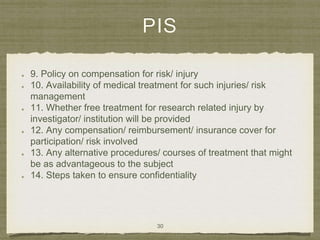
9. Policy on compensation for risk/ injury
10. Availability of medical treatment for such injuries/ risk
management
11. Whether free treatment for research related injury by
investigator/ institution will be provided
12. Any compensation/ reimbursement/ insurance cover for
participation/ risk involved
13. Any alternative procedures/ courses of treatment that might
be as advantageous to the subject
14. Steps taken to ensure confidentiality
30
PIS
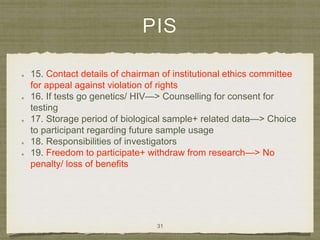
15. Contact details of chairman of institutional ethics committee
for appeal against violation of rights
16. If tests go genetics/ HIV—> Counselling for consent for
testing
17. Storage period of biological sample+ related data—> Choice
to participant regarding future sample usage
18. Responsibilities of investigators
19. Freedom to participate+ withdraw from research—> No
penalty/ loss of benefits
31
PIS
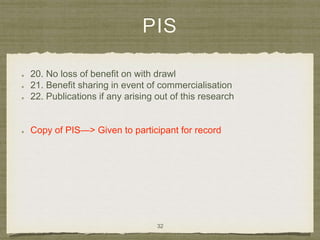
20. No loss of benefit on with drawl
21. Benefit sharing in event of commercialisation
22. Publications if any arising out of this research
Copy of PIS—> Given to participant for record
32
PIS
33
TAKE HOME MESSAGE
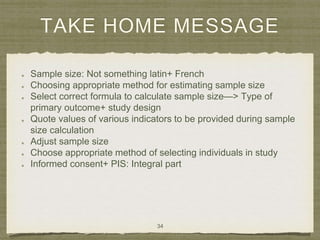
Sample size: Not something latin+ French
Choosing appropriate method for estimating sample size
Select correct formula to calculate sample size—> Type of
primary outcome+ study design
Quote values of various indicators to be provided during sample
size calculation
Adjust sample size
Choose appropriate method of selecting individuals in study
Informed consent+ PIS: Integral part
34
MURTAZA.VMMC@GMAIL.COM

SAMPLE SIZE, CONSENT, STATISTICS

  • 1.
  • 2.
    AT THE ENDOF TALK… Enhance understanding about sample size estimation Conceptual understanding on assumptions needed to determine sample size for research studies Understand importance of consent of participants Facilitate your communication with statistician 2
  • 3.
    SAMPLING Act/ process/ techniqueof selecting representative part of population for purpose of determining parameters/ characteristics of whole population TIME/ MONEY/ MANPOWER (T/M/M) 3
  • 4.
    IMPORTANCE… Study with aninadequate sample size—> Interpret with caution Even if difference b/w interventions—> It will not be able to detect 4
  • 5.
    WHY TO CALCULATE? Impossibleto study whole population Size: Just large enough detect difference if exists If large: Wastage of resources/ time/ money/ manpower Very small clinically insignificant differences detected as statistically results—> Not useful at practical level If small: May not be able to detect significant difference Helps in planning study-> Estimating resource, time, money Helps to ensure validity+ reliability+ ethical integrity 5
  • 6.
    SAMPLING PROCESS (5 STEPS) Definingpopulation Developing a sampling frame Determining sample size Specifying sampling method Selecting the sample 6
  • 7.
  • 8.
    SAMPLE SIZE DETERMINATION REQUIREMENTS Typeof study Determination of estimate Hypothesis testing Primary outcome variable Estimated value of primary outcome variable and acceptable precision Acceptable type 1+ 11 errors—> Needed for values on hypothesis testing Desired effect 8
  • 9.
    FOR SAMPLE SIZE CALCULATION Needto know following: Estimated prevalence/ SD Confidence interval (CI) Power - Ability to find significance when 2 groups are really different (80%) Allowable error or precision (5-10%) 9
  • 10.
    1. TYPE OFSTUDY 1. Finding an estimate 2. Doing a hypothesis testing 10
  • 11.
    1A. STUDIES ONDETERMINING AN ESTIMATE Doing descriptive/ prevalence study Mean/ proportion of a variable No null hypothesis: Do not want to compare 2 variables or find any association If precision needed (CI- smaller)—> Study large sample size If smaller sample size studied—> CI larger—> Imprecise results Hence—> One needs to specify level of precision (CI), one wants to estimate in order to decide on sample size 11
  • 12.
    CONFIDENCE INTERVAL CI= Pointestimate (obtained from sample studied) ±margin of error (this determines sample size and vice versa) Eg: 10% margin of error—> Can be achieved with sample size 100 5% margin of error—> SS 400 (making point estimate more precise) Hence—> For reducing error/ increasing precision—> 4x increase in SS 12
  • 13.
    1B. STUDIES TOTEST A HYPOTHESIS Studies involving hypothesis—> Intend to compare 2 or more interventions Measured in terms of proportion of success/ treated or mean value of a particular variable Null hypothesis: 2 effects have an equal effect—> AIM: Able to reject it if its false 13
  • 14.
    2. PRIMARY OUTCOMEOF STUDY In trials where 2 interventions compared-> Outcome can be assessed in different ways Avoid overloading study design with too many objectives—> Measurement+ comparision of too many outcomes Each clinical trial should have only 1 primary endpoint—> To be defined before study initiation—> Will decide sample size needed If too many primary outcome variables—> You need to calculate SS for each separately—> Large no 14
  • 15.
    3. WHAT ISMARGIN OF ERROR ACCEPTABLE Margin of error: Decided by you For “0” sampling error—> Study whole population As one decreases sample size—> Sampling error increases 15
  • 16.
    4. TYPE I+II ERRORS To test a hypothesis NULL HYPOTHESIS: There is no difference b/w 2 groups Truth: A. No difference exists B. A difference exists 16
  • 17.
    ERRORS Type I/ Alphaerror: If no difference exists in reality and study finds a difference Usually fixed at 5% Probability of finding a difference when no difference should be < 5% Type II/ Beta error: If there is a difference existing in reality+ study is not able to find By convention taken as 20% Probability of not finding a difference when there is a difference should be< 20% 80% probability of making a correct decision of not reporting a difference when there is no actual difference—> POWER (1-B)—> PROBABILITY OF DRAWING CORRECT CONCLUSION 17
  • 18.
    5. EFFECT SIZETHAT YOU INTEND TO DETECT Statistical term used to measure population characteristics Method which takes both difference in means + standard deviation into account Not just a difference in means—> Standardised difference in means Sample size is like magnification of microscope—> By increasing it one is able to detect even smaller difference (effect size) SS inversely related to effect size 18
  • 19.
    ADJUSTING SAMPLE SIZE 1.Feasibility Time/ Finances/ Resources 2. Non response rate 3. Dropouts n1= n/ (1-nonresponse rate) n2= n1/ (1- drop out rate) 19
  • 20.
    THESE ERRORS CANALSO CREEP IN… Sampling error: (eg: HT in females) Chance Bias (eg: Ht. In school kids) Non sampling errors (eg: Skilled labourer)
  • 21.
  • 22.
    Personal interactions governedby morals Professional interactions by ethics Societal interactions by law 22
  • 23.
    INFORMED CONSENT Provide asmuch knowledge as possible in a language he/ she can understand Minors/ Other vulnerable participants: Parents/ legally authorised representative Indian minority act: Competency of a minor 23
  • 24.
    DEFINITION OF INFORMED CONSENT Consentgiven by a competent individual who: Has received necessary information Has adequately understood information After considering information—> Arrived at a decision without having been subjected to coercion/ undue influence/ inducement/ intimidation 24
  • 25.
    ELEMENTS OF INFORMED CONSENT A.Voluntarism B. Information disclosure C. Decision making capacity Written in language which participant understands 25
  • 26.
    PROVIDE FOLLOWING INFO: Purposeof study Expectations from participants Responsibility of investigators Risks/ benefits of intervention/ method Alternatives available (if interventional study) Options to withdraw from study Form should be signed by a witness (Unrelated to investigator/ participant) 26
  • 27.
    VULNERABLE PARTICIPANTS Any individual wholacks ability to fully consent to participate in a study Kids/ persons with disabilities/ illiterate persons Despite their inability to consent—> Can still participate in a study if additional safeguards+ procedures used—> Respect for autonomy 27
  • 28.
  • 29.
    PARTICIPANT/ PATIENT INFO SHEET 1.Title of project 2. Nature+ purpose of study—> Stating it is a research 3. Identity of research teams, address+ ph no 4.Duration of participation+ no of participants 5. Procedures to be followed 6. Investigations 7. Benefits that might reasonably be expected as an outcome of research—> To subject/ community/ medical profession 8. Foreseeable risks/ discomforts adequately described, if project involves> minimal risk 29
  • 30.
    PIS 9. Policy oncompensation for risk/ injury 10. Availability of medical treatment for such injuries/ risk management 11. Whether free treatment for research related injury by investigator/ institution will be provided 12. Any compensation/ reimbursement/ insurance cover for participation/ risk involved 13. Any alternative procedures/ courses of treatment that might be as advantageous to the subject 14. Steps taken to ensure confidentiality 30
  • 31.
    PIS 15. Contact detailsof chairman of institutional ethics committee for appeal against violation of rights 16. If tests go genetics/ HIV—> Counselling for consent for testing 17. Storage period of biological sample+ related data—> Choice to participant regarding future sample usage 18. Responsibilities of investigators 19. Freedom to participate+ withdraw from research—> No penalty/ loss of benefits 31
  • 32.
    PIS 20. No lossof benefit on with drawl 21. Benefit sharing in event of commercialisation 22. Publications if any arising out of this research Copy of PIS—> Given to participant for record 32
  • 33.
  • 34.
    TAKE HOME MESSAGE Samplesize: Not something latin+ French Choosing appropriate method for estimating sample size Select correct formula to calculate sample size—> Type of primary outcome+ study design Quote values of various indicators to be provided during sample size calculation Adjust sample size Choose appropriate method of selecting individuals in study Informed consent+ PIS: Integral part 34
  • 35.