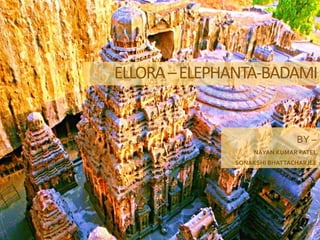


ELLORA–ELEPHANTA-BADAMI
BY –
NAYAN KUMAR PATEL
SONAKSHI BHATTACHARJEE
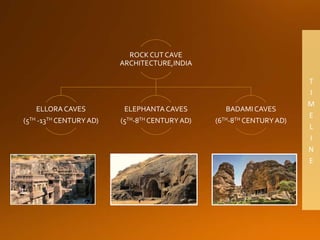
ROCKCUT CAVE
ARCHITECTURE,INDIA
ELLORA CAVES
(5TH -13TH CENTURYAD)
ELEPHANTA CAVES
(5TH-8TH CENTURYAD)
BADAMI CAVES
(6TH-8TH CENTURYAD)
T
I
M
E
L
I
N
E
• Ellora Caves – A World Heritage
Monument
The group of caves is prescribed by the
UNESCO as a WORLD HERITAGE
MONUMENT in 1983.Inscription on this list
confirms the exceptional universal value of a
cultural or natural site which deserves
protection for the benefit of all humanity.
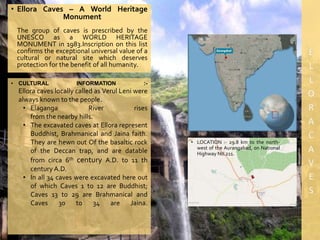
• LOCATION :- 29.8 km to the north-
west of the Aurangabad, on National
Highway No.211.
• CULTURAL INFORMATION :-
Ellora caves locally called as Verul Leni were
always known to the people.
• Elaganga River rises
from the nearby hills.
• The excavated caves at Ellora represent
Buddhist, Brahmanical and Jaina faith.
They are hewn out Of the basaltic rock
of the Deccan trap, and are datable
from circa 6th century A.D. to 11 th
century A.D.
• In all 34 caves were excavated here out
of which Caves 1 to 12 are Buddhist;
Caves 13 to 29 are Brahmanical and
Caves 30 to 34 are Jaina.
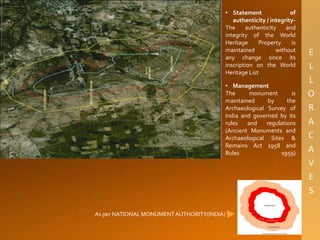
As per NATIONAL MONUMENTAUTHORITY(INDIA)
• Statement of
authenticity / integrity-
The authenticity and
integrity of the World
Heritage Property is
maintained without
any change since its
inscription on the World
Heritage List
• Management
The monument is
maintained by the
Archaeological Survey of
India and governed by its
rules and regulations
(Ancient Monuments and
Archaeological Sites &
Remains Act 1958 and
Rules 1959)
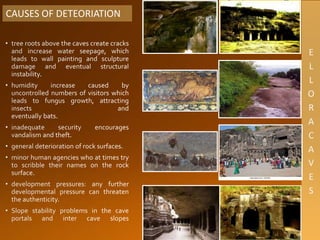
CAUSES OF DETEORIATION
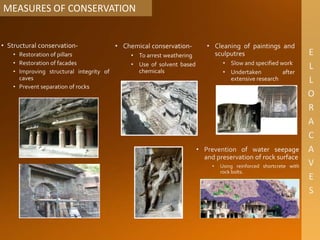
MEASURES OF CONSERVATION
MANAGEMENT
• construction of visitor center,
• arrival area,
• interpretation
center,
• site museum,
• virtual reality hall,
• restaurants, plazas &
service areas.
FUTURE DEVELOPMENT PLANS
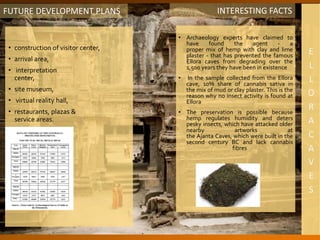
• Archaeology experts have claimed to
have found the agent - a
proper mix of hemp with clay and lime
plaster - that has prevented the famous
Ellora caves from degrading over the
1,500 years they have been in existence
• In the sample collected from the Ellora
cave, 10% share of cannabis sativa in
the mix of mud or clay plaster. This is the
reason why no insect activity is found at
Ellora
• The preservation is possible because
hemp regulates humidity and deters
pesky insects, which have attacked older
nearby artworks at
the Ajanta Caves, which were built in the
second century BC and lack cannabis
fibres
INTERESTING FACTS
CULTURAL INFORMATION-
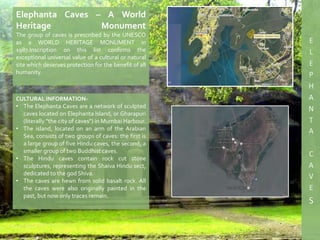
• The Elephanta Caves are a network of sculpted
caves located on Elephanta Island, or Gharapuri
(literally "the city of caves") in Mumbai Harbour.
• The island, located on an arm of the Arabian
Sea, consists of two groups of caves: the first is
a large group of five Hindu caves, the second, a
smaller group of two Buddhist caves.
• The Hindu caves contain rock cut stone
sculptures, representing the Shaiva Hindu sect,
dedicated to the god Shiva.
• The caves are hewn from solid basalt rock. All
the caves were also originally painted in the
past, but now only traces remain.
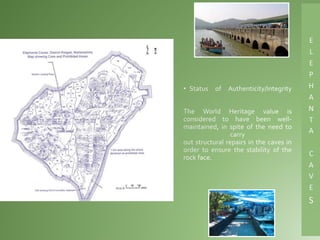
Elephanta Caves – A World
Heritage Monument
The group of caves is prescribed by the UNESCO
as a WORLD HERITAGE MONUMENT in
1987.Inscription on this list confirms the
exceptional universal value of a cultural or natural
site which deserves protection for the benefit of all
humanity.
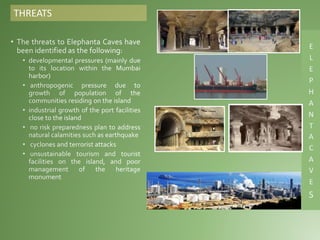
THREATS
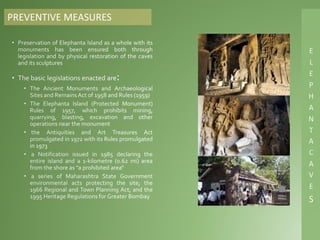
PREVENTIVE MEASURES
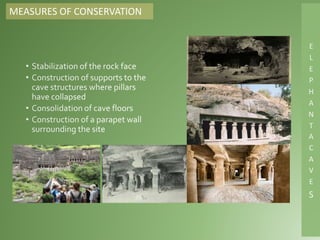
MEASURES OF CONSERVATION
MANAGEMENT
• Monitoring of the environmental
impact of tourists on the cave and
island environments is also foreseen.
Monitoring Indicators
• Monitoring indicators used included:
(i)visual inspection (for cracks, rock
falls,
etc.)
(ii) monitoring of relative humidity
inside and outside of the caves
(iii) monitoring of the air pollution
levels on the island
(iv) monitoring of temperature
variations between the interior and
exterior of the caves
(v) monitoring of rainfall.
MONITORING
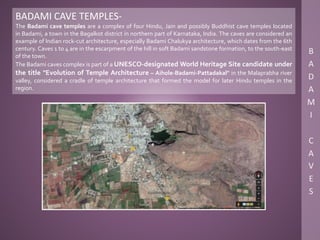
BADAMI CAVE TEMPLES-
The Badami cave temples are a complex of four Hindu, Jain and possibly Buddhist cave temples located
in Badami, a town in the Bagalkot district in northern part of Karnataka, India. The caves are considered an
example of Indian rock-cut architecture, especially Badami Chalukya architecture, which dates from the 6th
century. Caves 1 to 4 are in the escarpment of the hill in soft Badami sandstone formation, to the south-east
of the town.
The Badami caves complex is part of a UNESCO-designated World Heritage Site candidate under
the title "Evolution of Temple Architecture – Aihole-Badami-Pattadakal" in the Malaprabha river
valley, considered a cradle of temple architecture that formed the model for later Hindu temples in the
region.
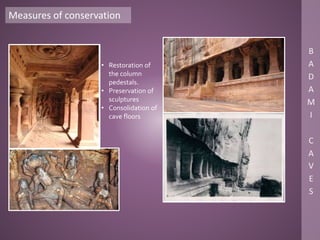
Measures of conservation
• Restoration of
the column
pedestals.
• Preservation of
sculptures
• Consolidation of
cave floors
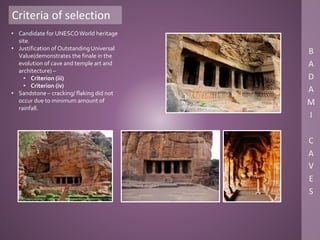
Criteria of selection
• Candidate for UNESCOWorld heritage
site.
• Justification of OutstandingUniversal
Value(demonstrates the finale in the
evolution of cave and temple art and
architecture) –
• Criterion (iii)
• Criterion (iv)
• Sandstone – cracking/ flaking did not
occur due to minimum amount of
rainfall.
Ellora – elephanta badami

Ellora – elephanta badami

  • 1.
  • 2.
    ROCKCUT CAVE ARCHITECTURE,INDIA ELLORA CAVES (5TH-13TH CENTURYAD) ELEPHANTA CAVES (5TH-8TH CENTURYAD) BADAMI CAVES (6TH-8TH CENTURYAD) T I M E L I N E
  • 3.
    • Ellora Caves– A World Heritage Monument The group of caves is prescribed by the UNESCO as a WORLD HERITAGE MONUMENT in 1983.Inscription on this list confirms the exceptional universal value of a cultural or natural site which deserves protection for the benefit of all humanity. • LOCATION :- 29.8 km to the north- west of the Aurangabad, on National Highway No.211. • CULTURAL INFORMATION :- Ellora caves locally called as Verul Leni were always known to the people. • Elaganga River rises from the nearby hills. • The excavated caves at Ellora represent Buddhist, Brahmanical and Jaina faith. They are hewn out Of the basaltic rock of the Deccan trap, and are datable from circa 6th century A.D. to 11 th century A.D. • In all 34 caves were excavated here out of which Caves 1 to 12 are Buddhist; Caves 13 to 29 are Brahmanical and Caves 30 to 34 are Jaina.
  • 4.
    As per NATIONALMONUMENTAUTHORITY(INDIA) • Statement of authenticity / integrity- The authenticity and integrity of the World Heritage Property is maintained without any change since its inscription on the World Heritage List • Management The monument is maintained by the Archaeological Survey of India and governed by its rules and regulations (Ancient Monuments and Archaeological Sites & Remains Act 1958 and Rules 1959)
  • 5.
  • 6.
  • 7.
  • 8.
    • construction ofvisitor center, • arrival area, • interpretation center, • site museum, • virtual reality hall, • restaurants, plazas & service areas. FUTURE DEVELOPMENT PLANS • Archaeology experts have claimed to have found the agent - a proper mix of hemp with clay and lime plaster - that has prevented the famous Ellora caves from degrading over the 1,500 years they have been in existence • In the sample collected from the Ellora cave, 10% share of cannabis sativa in the mix of mud or clay plaster. This is the reason why no insect activity is found at Ellora • The preservation is possible because hemp regulates humidity and deters pesky insects, which have attacked older nearby artworks at the Ajanta Caves, which were built in the second century BC and lack cannabis fibres INTERESTING FACTS
  • 9.
    CULTURAL INFORMATION- • TheElephanta Caves are a network of sculpted caves located on Elephanta Island, or Gharapuri (literally "the city of caves") in Mumbai Harbour. • The island, located on an arm of the Arabian Sea, consists of two groups of caves: the first is a large group of five Hindu caves, the second, a smaller group of two Buddhist caves. • The Hindu caves contain rock cut stone sculptures, representing the Shaiva Hindu sect, dedicated to the god Shiva. • The caves are hewn from solid basalt rock. All the caves were also originally painted in the past, but now only traces remain. Elephanta Caves – A World Heritage Monument The group of caves is prescribed by the UNESCO as a WORLD HERITAGE MONUMENT in 1987.Inscription on this list confirms the exceptional universal value of a cultural or natural site which deserves protection for the benefit of all humanity.
  • 11.
  • 12.
  • 13.
  • 14.
    MANAGEMENT • Monitoring ofthe environmental impact of tourists on the cave and island environments is also foreseen. Monitoring Indicators • Monitoring indicators used included: (i)visual inspection (for cracks, rock falls, etc.) (ii) monitoring of relative humidity inside and outside of the caves (iii) monitoring of the air pollution levels on the island (iv) monitoring of temperature variations between the interior and exterior of the caves (v) monitoring of rainfall. MONITORING
  • 15.
    BADAMI CAVE TEMPLES- TheBadami cave temples are a complex of four Hindu, Jain and possibly Buddhist cave temples located in Badami, a town in the Bagalkot district in northern part of Karnataka, India. The caves are considered an example of Indian rock-cut architecture, especially Badami Chalukya architecture, which dates from the 6th century. Caves 1 to 4 are in the escarpment of the hill in soft Badami sandstone formation, to the south-east of the town. The Badami caves complex is part of a UNESCO-designated World Heritage Site candidate under the title "Evolution of Temple Architecture – Aihole-Badami-Pattadakal" in the Malaprabha river valley, considered a cradle of temple architecture that formed the model for later Hindu temples in the region.
  • 16.
    Measures of conservation •Restoration of the column pedestals. • Preservation of sculptures • Consolidation of cave floors
  • 17.
    Criteria of selection •Candidate for UNESCOWorld heritage site. • Justification of OutstandingUniversal Value(demonstrates the finale in the evolution of cave and temple art and architecture) – • Criterion (iii) • Criterion (iv) • Sandstone – cracking/ flaking did not occur due to minimum amount of rainfall.