
MEENAKSHI AMMAN
1
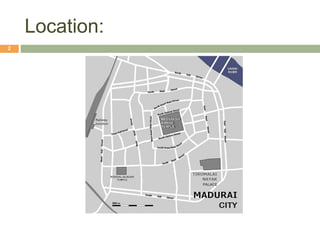
Location:
2
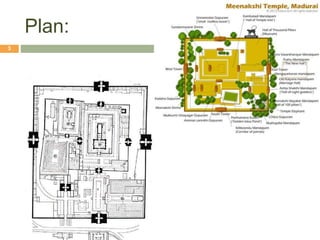
Plan:
3
History:
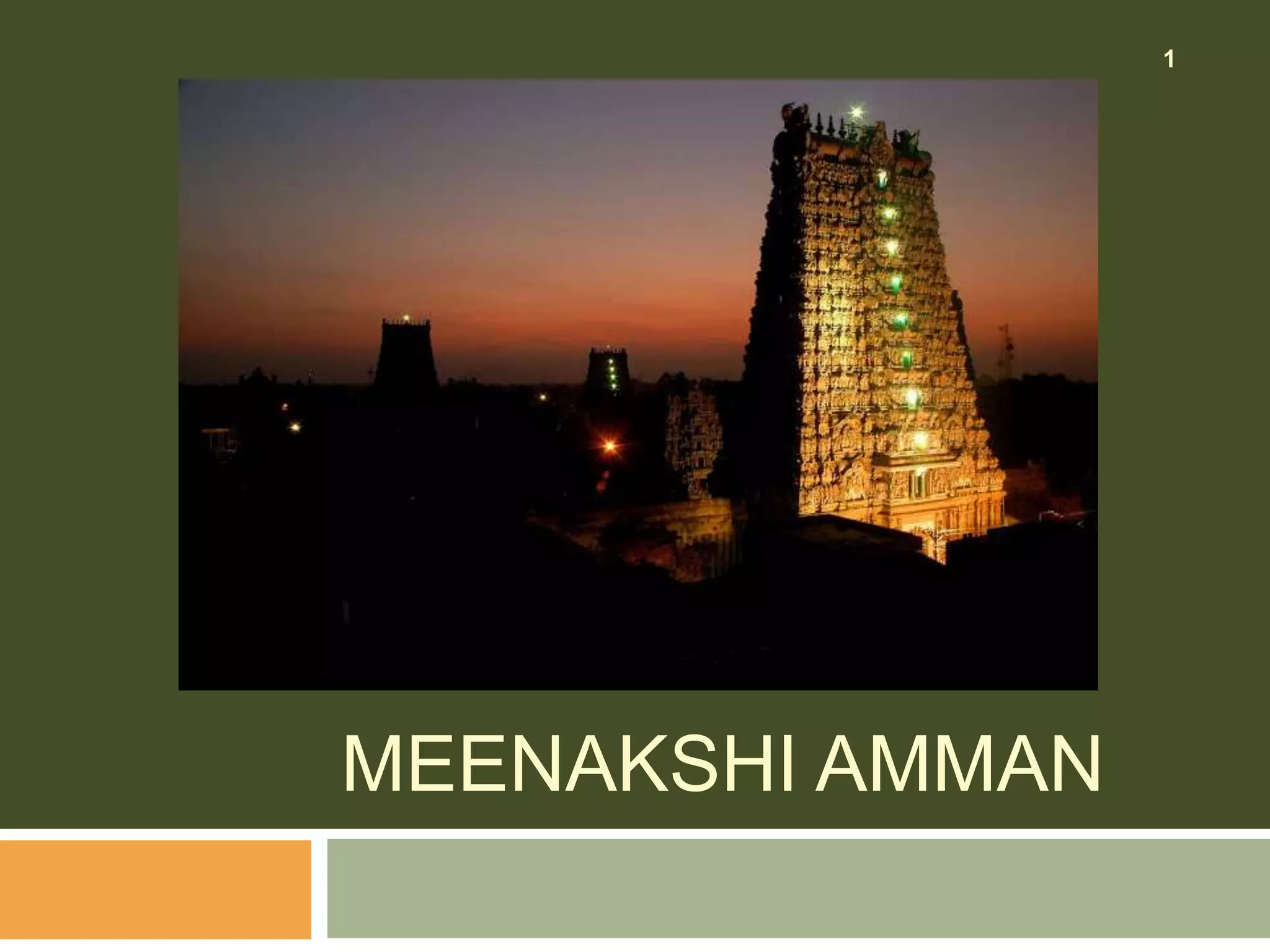
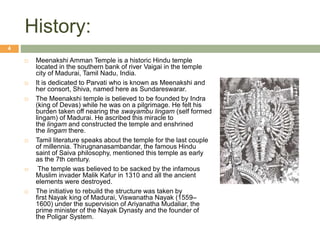
 Meenakshi Amman Temple is a historic Hindu temple
located in the southern bank of river Vaigai in the temple
city of Madurai, Tamil Nadu, India.
 It is dedicated to Parvati who is known as Meenakshi and
her consort, Shiva, named here as Sundareswarar.
 The Meenakshi temple is believed to be founded by Indra
(king of Devas) while he was on a pilgrimage. He felt his
burden taken off nearing the swayambu lingam (self formed
lingam) of Madurai. He ascribed this miracle to
the lingam and constructed the temple and enshrined
the lingam there.
 Tamil literature speaks about the temple for the last couple
of millennia. Thirugnanasambandar, the famous Hindu
saint of Saiva philosophy, mentioned this temple as early
as the 7th century.
 The temple was believed to be sacked by the infamous
Muslim invader Malik Kafur in 1310 and all the ancient
elements were destroyed.
 The initiative to rebuild the structure was taken by
first Nayak king of Madurai, Viswanatha Nayak (1559–
1600) under the supervision of Ariyanatha Mudaliar, the
prime minister of the Nayak Dynasty and the founder of
the Poligar System.
4
 The original design by Vishwanatha Nayak in 1560 was substantially
expanded to the current structure during the reign of Thirumalai
Nayak(1623–55). He erected many complexes inside the temple. His major
contributions are the Vasantha Mandapam for
celebrating vasanthorsavam(spring festival) and Kilikoondu
Mandapam (corridor of parrots).
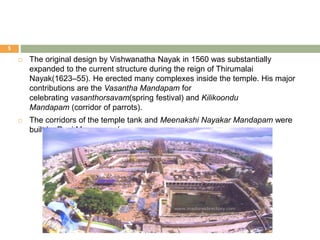
 The corridors of the temple tank and Meenakshi Nayakar Mandapam were
built by Rani Mangammal.
5
Gopurams:
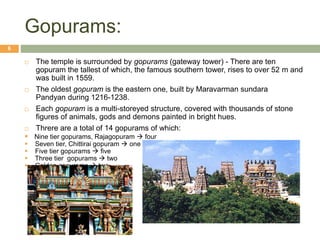
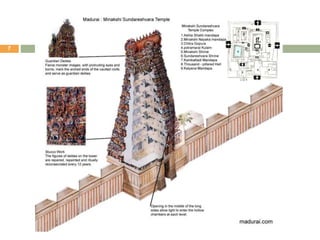
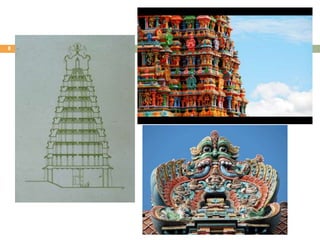
 The temple is surrounded by gopurams (gateway tower) - There are ten
gopuram the tallest of which, the famous southern tower, rises to over 52 m and
was built in 1559.
 The oldest gopuram is the eastern one, built by Maravarman sundara
Pandyan during 1216-1238.
 Each gopuram is a multi-storeyed structure, covered with thousands of stone
figures of animals, gods and demons painted in bright hues.
 Threre are a total of 14 gopurams of which:
 Nine tier gopurams, Rajagopuram  four
 Seven tier, Chittirai gopuram  one
 Five tier gopurams  five
 Three tier gopurams  two
 Golden gopurams  two
6
7
8
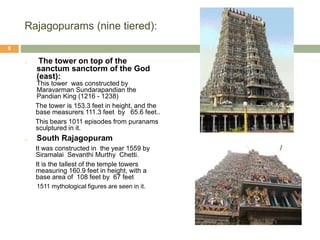
Rajagopurams (nine tiered):
o The tower on top of the
sanctum sanctorm of the God
(east):
This tower was constructed by
Maravarman Sundarapandian the
Pandian King (1216 - 1238)
The tower is 153.3 feet in height, and the
base measurers 111.3 feet by 65.6 feet..
This bears 1011 episodes from puranams
sculptured in it.
o South Rajagopuram
It was constructed in the year 1559 by
Siramalai Sevanthi Murthy Chetti.
It is the tallest of the temple towers
measuring 160.9 feet in height, with a
base area of 108 feet by 67 feet
1511 mythological figures are seen in it.
9
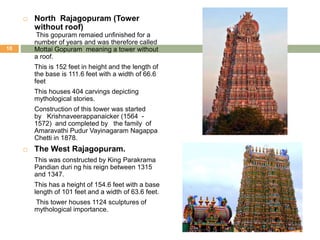
 North Rajagopuram (Tower
without roof)
This gopuram remaied unfinished for a
number of years and was therefore called
Mottai Gopuram meaning a tower without
a roof.
This is 152 feet in height and the length of
the base is 111.6 feet with a width of 66.6
feet
This houses 404 carvings depicting
mythological stories.
Construction of this tower was started
by Krishnaveerappanaicker (1564 -
1572) and completed by the family of
Amaravathi Pudur Vayinagaram Nagappa
Chetti in 1878.
 The West Rajagopuram.
This was constructed by King Parakrama
Pandian duri ng his reign between 1315
and 1347.
This has a height of 154.6 feet with a base
length of 101 feet and a width of 63.6 feet.
This tower houses 1124 sculptures of
mythological importance.
10
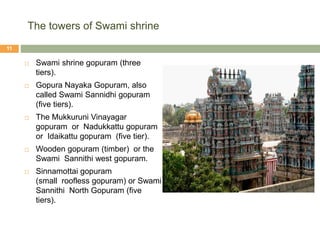
The towers of Swami shrine
 Swami shrine gopuram (three
tiers).
 Gopura Nayaka Gopuram, also
called Swami Sannidhi gopuram
(five tiers).
 The Mukkuruni Vinayagar
gopuram or Nadukkattu gopuram
or Idaikattu gopuram (five tier).
 Wooden gopuram (timber) or the
Swami Sannithi west gopuram.
 Sinnamottai gopuram
(small roofless gopuram) or Swami
Sannithi North Gopuram (five
tiers).
11
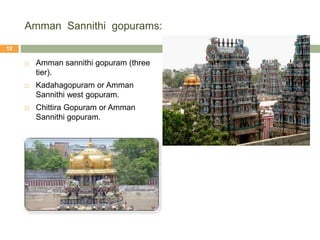
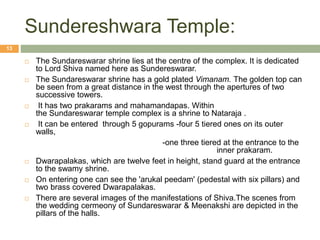
Amman Sannithi gopurams:
 Amman sannithi gopuram (three
tier).
 Kadahagopuram or Amman
Sannithi west gopuram.
 Chittira Gopuram or Amman
Sannithi gopuram.
12
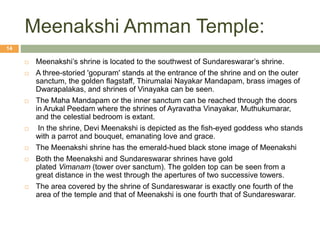
Sundereshwara Temple:
 The Sundareswarar shrine lies at the centre of the complex. It is dedicated
to Lord Shiva named here as Sundereswarar.
 The Sundareswarar shrine has a gold plated Vimanam. The golden top can
be seen from a great distance in the west through the apertures of two
successive towers.
 It has two prakarams and mahamandapas. Within
the Sundareswarar temple complex is a shrine to Nataraja .
 It can be entered through 5 gopurams -four 5 tiered ones on its outer
walls,
-one three tiered at the entrance to the
inner prakaram.
 Dwarapalakas, which are twelve feet in height, stand guard at the entrance
to the swamy shrine.
 On entering one can see the 'arukal peedam' (pedestal with six pillars) and
two brass covered Dwarapalakas.
 There are several images of the manifestations of Shiva.The scenes from
the wedding cermeony of Sundareswarar & Meenakshi are depicted in the
pillars of the halls.
13
Meenakshi Amman Temple:
 Meenakshi’s shrine is located to the southwest of Sundareswarar’s shrine.
 A three-storied 'gopuram' stands at the entrance of the shrine and on the outer
sanctum, the golden flagstaff, Thirumalai Nayakar Mandapam, brass images of
Dwarapalakas, and shrines of Vinayaka can be seen.
 The Maha Mandapam or the inner sanctum can be reached through the doors
in Arukal Peedam where the shrines of Ayravatha Vinayakar, Muthukumarar,
and the celestial bedroom is extant.
 In the shrine, Devi Meenakshi is depicted as the fish-eyed goddess who stands
with a parrot and bouquet, emanating love and grace.
 The Meenakshi shrine has the emerald-hued black stone image of Meenakshi
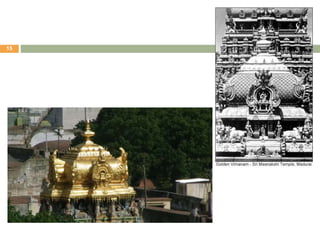
 Both the Meenakshi and Sundareswarar shrines have gold
plated Vimanam (tower over sanctum). The golden top can be seen from a
great distance in the west through the apertures of two successive towers.
 The area covered by the shrine of Sundareswarar is exactly one fourth of the
area of the temple and that of Meenakshi is one fourth that of Sundareswarar.
14
15
Temple Tank:
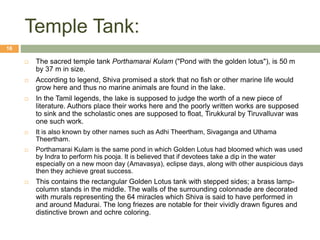
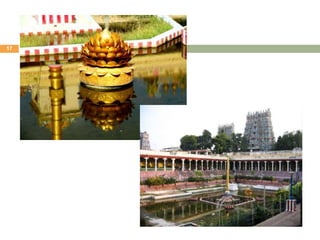
 The sacred temple tank Porthamarai Kulam ("Pond with the golden lotus"), is 50 m
by 37 m in size.
 According to legend, Shiva promised a stork that no fish or other marine life would
grow here and thus no marine animals are found in the lake.
 In the Tamil legends, the lake is supposed to judge the worth of a new piece of
literature. Authors place their works here and the poorly written works are supposed
to sink and the scholastic ones are supposed to float, Tirukkural by Tiruvalluvar was
one such work.
 It is also known by other names such as Adhi Theertham, Sivaganga and Uthama
Theertham.
 Porthamarai Kulam is the same pond in which Golden Lotus had bloomed which was used
by Indra to perform his pooja. It is believed that if devotees take a dip in the water
especially on a new moon day (Amavasya), eclipse days, along with other auspicious days
then they achieve great success.
 This contains the rectangular Golden Lotus tank with stepped sides; a brass lamp-
column stands in the middle. The walls of the surrounding colonnade are decorated
with murals representing the 64 miracles which Shiva is said to have performed in
and around Madurai. The long friezes are notable for their vividly drawn figures and
distinctive brown and ochre coloring.
16
17
Thousand pillared hall:
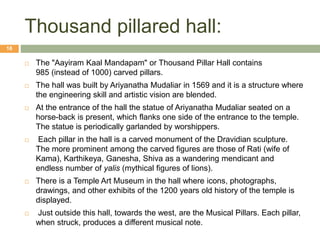
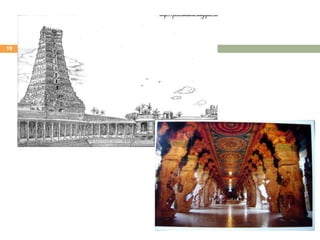
 The "Aayiram Kaal Mandapam" or Thousand Pillar Hall contains
985 (instead of 1000) carved pillars.
 The hall was built by Ariyanatha Mudaliar in 1569 and it is a structure where
the engineering skill and artistic vision are blended.
 At the entrance of the hall the statue of Ariyanatha Mudaliar seated on a
horse-back is present, which flanks one side of the entrance to the temple.
The statue is periodically garlanded by worshippers.
 Each pillar in the hall is a carved monument of the Dravidian sculpture.
The more prominent among the carved figures are those of Rati (wife of
Kama), Karthikeya, Ganesha, Shiva as a wandering mendicant and
endless number of yalis (mythical figures of lions).
 There is a Temple Art Museum in the hall where icons, photographs,
drawings, and other exhibits of the 1200 years old history of the temple is
displayed.
 Just outside this hall, towards the west, are the Musical Pillars. Each pillar,
when struck, produces a different musical note.
18
19
THANK
YOU.
20

Meenakshi amman

  • 1.
  • 2.
  • 3.
  • 4.
    History:  Meenakshi AmmanTemple is a historic Hindu temple located in the southern bank of river Vaigai in the temple city of Madurai, Tamil Nadu, India.  It is dedicated to Parvati who is known as Meenakshi and her consort, Shiva, named here as Sundareswarar.  The Meenakshi temple is believed to be founded by Indra (king of Devas) while he was on a pilgrimage. He felt his burden taken off nearing the swayambu lingam (self formed lingam) of Madurai. He ascribed this miracle to the lingam and constructed the temple and enshrined the lingam there.  Tamil literature speaks about the temple for the last couple of millennia. Thirugnanasambandar, the famous Hindu saint of Saiva philosophy, mentioned this temple as early as the 7th century.  The temple was believed to be sacked by the infamous Muslim invader Malik Kafur in 1310 and all the ancient elements were destroyed.  The initiative to rebuild the structure was taken by first Nayak king of Madurai, Viswanatha Nayak (1559– 1600) under the supervision of Ariyanatha Mudaliar, the prime minister of the Nayak Dynasty and the founder of the Poligar System. 4
  • 5.
     The originaldesign by Vishwanatha Nayak in 1560 was substantially expanded to the current structure during the reign of Thirumalai Nayak(1623–55). He erected many complexes inside the temple. His major contributions are the Vasantha Mandapam for celebrating vasanthorsavam(spring festival) and Kilikoondu Mandapam (corridor of parrots).  The corridors of the temple tank and Meenakshi Nayakar Mandapam were built by Rani Mangammal. 5
  • 6.
    Gopurams:  The templeis surrounded by gopurams (gateway tower) - There are ten gopuram the tallest of which, the famous southern tower, rises to over 52 m and was built in 1559.  The oldest gopuram is the eastern one, built by Maravarman sundara Pandyan during 1216-1238.  Each gopuram is a multi-storeyed structure, covered with thousands of stone figures of animals, gods and demons painted in bright hues.  Threre are a total of 14 gopurams of which:  Nine tier gopurams, Rajagopuram  four  Seven tier, Chittirai gopuram  one  Five tier gopurams  five  Three tier gopurams  two  Golden gopurams  two 6
  • 7.
  • 8.
  • 9.
    Rajagopurams (nine tiered): oThe tower on top of the sanctum sanctorm of the God (east): This tower was constructed by Maravarman Sundarapandian the Pandian King (1216 - 1238) The tower is 153.3 feet in height, and the base measurers 111.3 feet by 65.6 feet.. This bears 1011 episodes from puranams sculptured in it. o South Rajagopuram It was constructed in the year 1559 by Siramalai Sevanthi Murthy Chetti. It is the tallest of the temple towers measuring 160.9 feet in height, with a base area of 108 feet by 67 feet 1511 mythological figures are seen in it. 9
  • 10.
     North Rajagopuram(Tower without roof) This gopuram remaied unfinished for a number of years and was therefore called Mottai Gopuram meaning a tower without a roof. This is 152 feet in height and the length of the base is 111.6 feet with a width of 66.6 feet This houses 404 carvings depicting mythological stories. Construction of this tower was started by Krishnaveerappanaicker (1564 - 1572) and completed by the family of Amaravathi Pudur Vayinagaram Nagappa Chetti in 1878.  The West Rajagopuram. This was constructed by King Parakrama Pandian duri ng his reign between 1315 and 1347. This has a height of 154.6 feet with a base length of 101 feet and a width of 63.6 feet. This tower houses 1124 sculptures of mythological importance. 10
  • 11.
    The towers ofSwami shrine  Swami shrine gopuram (three tiers).  Gopura Nayaka Gopuram, also called Swami Sannidhi gopuram (five tiers).  The Mukkuruni Vinayagar gopuram or Nadukkattu gopuram or Idaikattu gopuram (five tier).  Wooden gopuram (timber) or the Swami Sannithi west gopuram.  Sinnamottai gopuram (small roofless gopuram) or Swami Sannithi North Gopuram (five tiers). 11
  • 12.
    Amman Sannithi gopurams: Amman sannithi gopuram (three tier).  Kadahagopuram or Amman Sannithi west gopuram.  Chittira Gopuram or Amman Sannithi gopuram. 12
  • 13.
    Sundereshwara Temple:  TheSundareswarar shrine lies at the centre of the complex. It is dedicated to Lord Shiva named here as Sundereswarar.  The Sundareswarar shrine has a gold plated Vimanam. The golden top can be seen from a great distance in the west through the apertures of two successive towers.  It has two prakarams and mahamandapas. Within the Sundareswarar temple complex is a shrine to Nataraja .  It can be entered through 5 gopurams -four 5 tiered ones on its outer walls, -one three tiered at the entrance to the inner prakaram.  Dwarapalakas, which are twelve feet in height, stand guard at the entrance to the swamy shrine.  On entering one can see the 'arukal peedam' (pedestal with six pillars) and two brass covered Dwarapalakas.  There are several images of the manifestations of Shiva.The scenes from the wedding cermeony of Sundareswarar & Meenakshi are depicted in the pillars of the halls. 13
  • 14.
    Meenakshi Amman Temple: Meenakshi’s shrine is located to the southwest of Sundareswarar’s shrine.  A three-storied 'gopuram' stands at the entrance of the shrine and on the outer sanctum, the golden flagstaff, Thirumalai Nayakar Mandapam, brass images of Dwarapalakas, and shrines of Vinayaka can be seen.  The Maha Mandapam or the inner sanctum can be reached through the doors in Arukal Peedam where the shrines of Ayravatha Vinayakar, Muthukumarar, and the celestial bedroom is extant.  In the shrine, Devi Meenakshi is depicted as the fish-eyed goddess who stands with a parrot and bouquet, emanating love and grace.  The Meenakshi shrine has the emerald-hued black stone image of Meenakshi  Both the Meenakshi and Sundareswarar shrines have gold plated Vimanam (tower over sanctum). The golden top can be seen from a great distance in the west through the apertures of two successive towers.  The area covered by the shrine of Sundareswarar is exactly one fourth of the area of the temple and that of Meenakshi is one fourth that of Sundareswarar. 14
  • 15.
  • 16.
    Temple Tank:  Thesacred temple tank Porthamarai Kulam ("Pond with the golden lotus"), is 50 m by 37 m in size.  According to legend, Shiva promised a stork that no fish or other marine life would grow here and thus no marine animals are found in the lake.  In the Tamil legends, the lake is supposed to judge the worth of a new piece of literature. Authors place their works here and the poorly written works are supposed to sink and the scholastic ones are supposed to float, Tirukkural by Tiruvalluvar was one such work.  It is also known by other names such as Adhi Theertham, Sivaganga and Uthama Theertham.  Porthamarai Kulam is the same pond in which Golden Lotus had bloomed which was used by Indra to perform his pooja. It is believed that if devotees take a dip in the water especially on a new moon day (Amavasya), eclipse days, along with other auspicious days then they achieve great success.  This contains the rectangular Golden Lotus tank with stepped sides; a brass lamp- column stands in the middle. The walls of the surrounding colonnade are decorated with murals representing the 64 miracles which Shiva is said to have performed in and around Madurai. The long friezes are notable for their vividly drawn figures and distinctive brown and ochre coloring. 16
  • 17.
  • 18.
    Thousand pillared hall: The "Aayiram Kaal Mandapam" or Thousand Pillar Hall contains 985 (instead of 1000) carved pillars.  The hall was built by Ariyanatha Mudaliar in 1569 and it is a structure where the engineering skill and artistic vision are blended.  At the entrance of the hall the statue of Ariyanatha Mudaliar seated on a horse-back is present, which flanks one side of the entrance to the temple. The statue is periodically garlanded by worshippers.  Each pillar in the hall is a carved monument of the Dravidian sculpture. The more prominent among the carved figures are those of Rati (wife of Kama), Karthikeya, Ganesha, Shiva as a wandering mendicant and endless number of yalis (mythical figures of lions).  There is a Temple Art Museum in the hall where icons, photographs, drawings, and other exhibits of the 1200 years old history of the temple is displayed.  Just outside this hall, towards the west, are the Musical Pillars. Each pillar, when struck, produces a different musical note. 18
  • 19.
  • 20.