History
of
ArcHitecture
iii
isLAMic
ArcHitecture
iN iNDiA
MoDuLe - ii
isLAMic ArcHiecture
JAUNPUR
BENGAL
AHMEDABAD
BIJAPUR
Provincial Styles Of Architecture
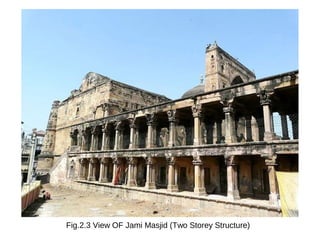
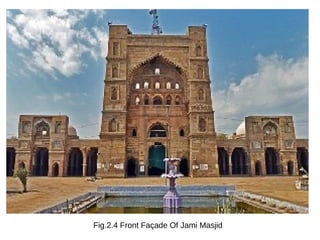
• The Provincial (belonging to some particular province; local ) Style of
Architecture encompasses the architectural trends and developments
noticed in different provincial capitals in India, but specifically in:
• Punjab (1150 – 1325 AD).
• Bengal (1203 – 1573 AD).
• Gujurat(1300 – 1572 AD).
• Jaunpur(1376 – 1479 AD).
• Malwa(1405 -1569 AD).
• Deccan(1347 – 1617 AD).
• Bijapur(1409 – 1656 AD).
• Khandesh(1425 – 1650 AD).
• Kashmir(1410 onwards).
Definition
Islamic Architecture can be definied as building traditions of muslim
populations of the middle eastand any countries where Islam has
been from the 7th century.
Types Of Islamic Architecture:
• Mosque –Muslim Centre, Place for worship.
• Madrasah –Public School.
• Hammam-A Structural Design for bathhouse.
• Caravanserai-A roadsideinn for travellers.
• Casbah/Citadel –A Fortress.
• Mausoleum –A Tomb or A Monument.
Jaunpur
(Founded on 1359AD)
• Located in the state of Uttar Pradesh
• Found on 1359, by Feroz Shah Tughlaq.
• Named for Mohammed Bin Tugluq, Whose name
was Jauna Khan.
• Jaunpur Style of Architecture.
Jaunpur Style
(1360 – 1480AD)
• Under the rule of the Sharqi Dynasty, Jaunpur became
an important centre for Islamic Art and Architecture.
• Most Structures Were destoryed by Sikander Lodi of
Delhi when he reconquered Janpur, and left only 5
Mosques.
• The Style was mainly formed under Sultan Shams-ud-din
Ibrahim(1402-1436AD).
Atala Masjid
(15th
century, Jaunpur)
• Located at Jaunpur, Uttar Pradesh, India.
• Was built by Sultan Ibrahim(1402-1436AD), Sharqi Sultan of Jaunpur laid
the foundation.
• Construction Started in 1377AD.
• A Madrasa Named Madrasa Din Dunia is housed in the central complex.
• Built on the site of Atala Devi Temple Whose Materials along the materials
of other temples were used in construction.
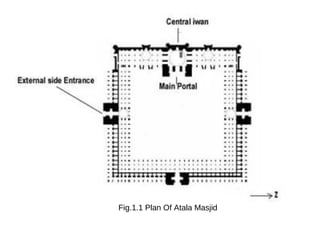
• The Mosque consist of a square courtyard of 54m side with Cloisters on 3
sides and the sanctuary on the fourth(western side)
• Entire Mosque is of 79m side.
• Cloister are spacious being 13m across and dividedinto 5 Aisles.
• Cloister rise upto 2 storeys.
• Two Aisles of the lower storey are formed into a series of cells with a
pillared verandah facing the street to provide accomodationto visitors and
merchants.
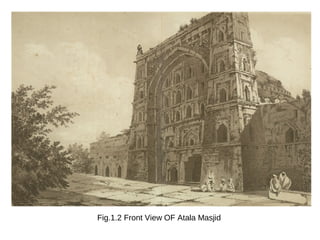
• The 3 entrance gateway, one in the centre of each Cloister with the northern
and southern ones are surmounted by domes
Fig.1.1 Plan Of Atala Masjid
Fig.1.2 Front View OF Atala Masjid
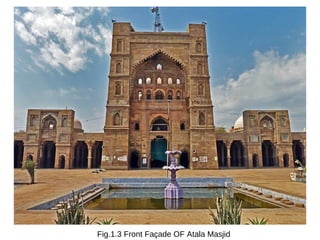
Fig.1.3 Front Façade OF Atala Masjid
Fig.1.4 Main Pishtaq leading into the Iwan of Atala Masjid
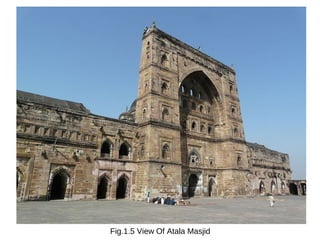
Fig.1.5 View Of Atala Masjid
• Located At Jaunpur, Uttar Pradesh, India.
• Jaunpur Style of Architecture.
• Built By Husain Shah In 1470AD.
• Repeats Many features of Atala Masjid on a larger scale.
• The Entire structure is raised on a plinth 5-6m in height and approached by
steep but imposing flight of steps.
• The courtyard is a square of 64m side.
• Surrounded by cloisters on three sides and sanctuary on the west.
• Cloisters are 2 storey high.
• They are two aisles in width.
• In centre of each cloister is an entrance hall covered by dome.
• In the centre of the scantuary façade is pylon 25m high and 23.5m wide at
the base.
• The interior consist of the Nave of 12m side.
Jami Masjid
(14th
century, Jaunpur)
Fig.2.1 Plan Of Jami Masjid(Jaunpur)
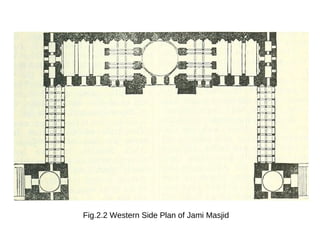
Fig.2.2 Western Side Plan of Jami Masjid
Fig.2.3 View OF Jami Masjid (Two Storey Structure)
Fig.2.4 Front Façade Of Jami Masjid
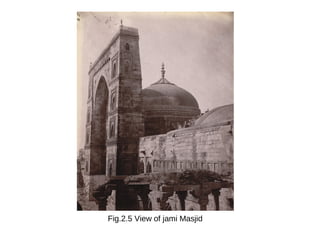
Fig.2.5 View of jami Masjid
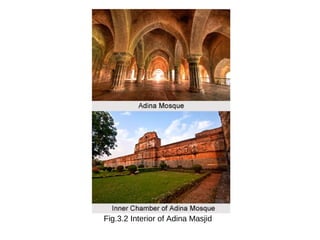
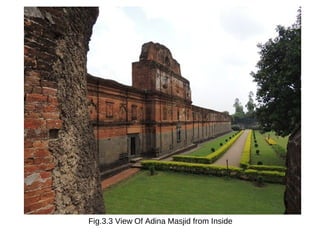
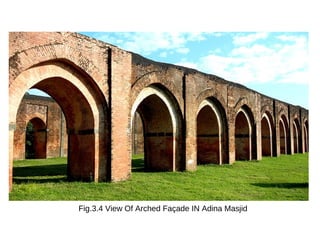
Adina Masjid
(14th
Century, Bengal)
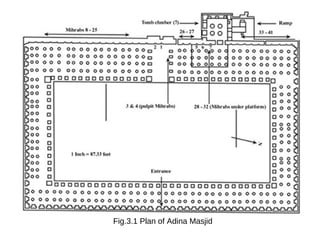
• Located at Pandua of Maldah District, West Bengal.
• Adina Mosque Ruins Are the largest mosque ruins in the Indian Continent.
• Constructed in 1373.
• Was built during the Reign of Sikandar Shah.
• The design incorporated Bengali, Arab,Persian and Byzantine elements.
• It was built with Brick and Stone.
• It had a rectrangular hyspostyle structure with an open courtyard.
• The Structure measured 172x97m, with several hundred domes.
• The mosque’s most prominent feature is its moumental ribbed barrel vault
over the central nave.
• The prayer hall is five aisles deep, while the north, southand east cloisters
around the courtyard consist of triple aisles.
• These aisles had 260 pillarsand 387 dombed bays.
Fig.3.1 Plan of Adina Masjid
Fig.3.2 Interior of Adina Masjid
Fig.3.3 View Of Adina Masjid from Inside
Fig.3.4 View Of Arched Façade IN Adina Masjid
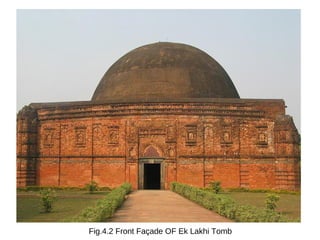
Ek Lakhi Mousoleum
(14th
Century, Bengal)
• Located At Malda, West Bengal, India.
• Also Known as Mousoleum of Jalauddin Muhammad Shah.
• Its said that One Lakh rupees was spent inconstruction hence the
name.
• The tomb is situated to the south west of Adina Mosque.
• The exterior of the building is strengthened by four octangonal
towers at the corners, and is opend by four doorways, one each in
the middle of each side.
• Pointed arches with lintels crowning the doorjams span and the
doorways.
• The ornamentation of the ek lakhi Masjid consist of braced string-
mouldings of the corner towers.
• The dome of this mosque, like all other domes of the sultanate
Bengal, appears to be covered with a round rim in the form of a
hormonica.
Fig.4.1 Plan OF Ek Lakhi Tomb
Fig.4.2 Front Façade OF Ek Lakhi Tomb
Dakhil Darwaza
(15th
Century, Bengal)
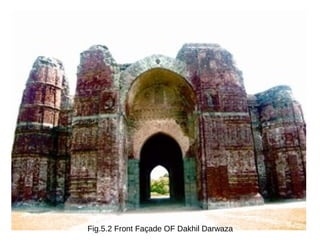
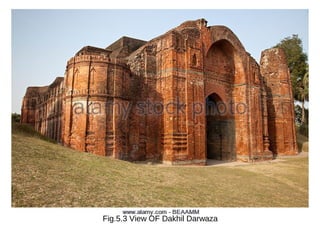
• Located at Gaur, West Bengal, India.
• Is a Gateway for a fort.
• Also Popularly Known as Salaami Darwaza as Cannons used to be
fired from it.
• It was erected by Nasiruddin Mahmud Shah.
• The Gateway built of brick except the piers between the doorways,
which are faced with stone up to the springing of the arches
measuring 102.5x22.5m
• Consists of a passage 4.5m wide through the middle of the
structure.
• The height of the gateway was about 14.95m of which the entrance
arch is 10.35m.
Fig.5.1 Plan Of Dakhil Darwaza
Fig.5.2 Front Façade OF Dakhil Darwaza
Fig.5.3 View OF Dakhil Darwaza
Gujarat
(Provincial style of architecture 13th
century)
• Located in western side of India.
• Gujarat experienced major Indo-Islamic architectural
activites for over 250years starting from 13th
century.
• The Indo-Islamic style entered Gujarat when the
governors appointed by the Khalji Sulatans established
themselves in the towns of western seaboards.
VAVS At Gujarat
(also known as Stepwells of Gujarat)
• They are one of the unique architectural features of Indian Traditions of rain
water harvesting.
• Old saying, the wells were built to get the gods to come down from their
Abode and sipe water in these stone vavs.
• Architecturally, The wells were builtso that they can resist earthquakes of
great magnitude.
• Mainly built to collect water for weary travellers.
• Most of the stepwells were built in the 5th
and 19th
century.
• The ancient city of mohenjo-daro itself had 700 wells in just one section.
• Two most famous vavs
– Adalaj ni vav
– Rani ni vav
Adalaj ni Vav
(also known as Rudabai Stepwell)
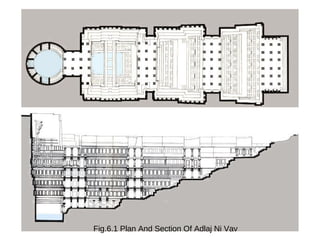
• Located in Ahmedabad, Gujarat, India.
• The stepwell at Adalaj, named after the nearby town.
• It is 5 storeys below th ground level and well over 75m in length.
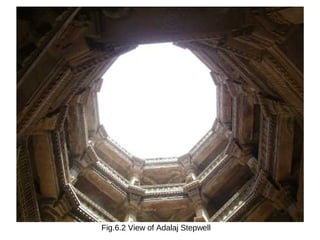
• Octagonal in shape.
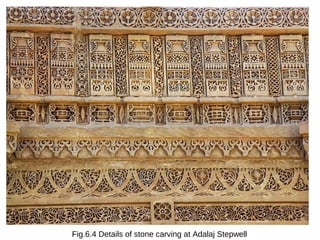
• Surrounded by intricately carved pillars and columns.
• Walking down to the deepest end to find water stored in circular well, which
is open to sky.
• The entrance has staircase leading from three directions to the first landing.
• The landings are surrounded by four fabulously carved balconies or
Zarokhas.
• Walls are carved with intricately carved with Hindu and jain dieties and
islamic motifs and flowers.
• Built in sandstone in the solanki architectural style.
Fig.6.1 Plan And Section Of Adlaj Ni Vav
Fig.6.2 View of Adalaj Stepwell
Fig.6.3 Adalaj Stepwell view
Fig.6.4 Details of stone carving at Adalaj Stepwell
Rani ni Vav
(Queen’s stepwell)
• Located in Patna, Gujarat, India.
• Near the banks of river saraswathi.
• Was built in the Complex Maru-Gujara Architectural style, Designed as an
inverted temple.
• The east facing well is about 64m in length, 20m wide and 27m deep.
• A stepped corridor compartmented at regular intervals with ornately carved
pillared milti-storeyed pavilion.
• There are more than 800 elaborate sculptures in the seven galleries.
• Below the vav is a tunnel 30km in length, leading to the town of sidhpur, this
tunnel was used by the king to escape during war.
• It appears that the walls were built of brick and faced with stone.
• From this wall project vertical brackets in pairs, which supported the
different galleries of the well shafts.
• The Bracketing is arranged in tiers and is richly carved.
Fig.7.1 Plan and Section Of Rani ni Vav
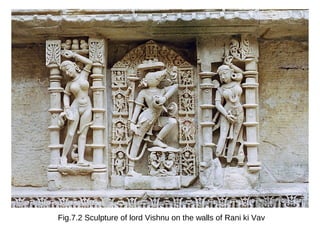
Fig.7.2 Sculpture of lord Vishnu on the walls of Rani ki Vav
Fig.7.3 View Of rani ki Vav
Fig.7.4 View Of Rani ki vav
Fig.7.5 Scketch Of external view of Rani ki VAV
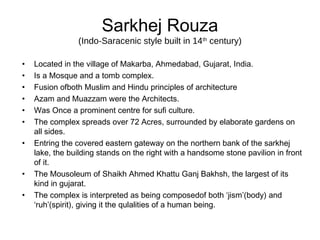
Sarkhej Rouza
(Indo-Saracenic style built in 14th
century)
• Located in the village of Makarba, Ahmedabad, Gujarat, India.
• Is a Mosque and a tomb complex.
• Fusion ofboth Muslim and Hindu principles of architecture
• Azam and Muazzam were the Architects.
• Was Once a prominent centre for sufi culture.
• The complex spreads over 72 Acres, surrounded by elaborate gardens on
all sides.
• Entring the covered eastern gateway on the northern bank of the sarkhej
lake, the building stands on the right with a handsome stone pavilion in front
of it.
• The Mousoleum of Shaikh Ahmed Khattu Ganj Bakhsh, the largest of its
kind in gujarat.
• The complex is interpreted as being composedof both ‘jism’(body) and
‘ruh’(spirit), giving it the qulalities of a human being.
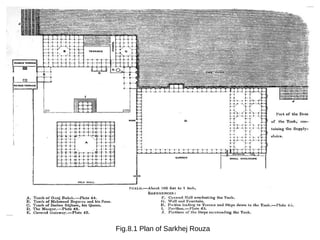
Fig.8.1 Plan of Sarkhej Rouza
Fig.8.2 Ganj Baksh’s Tomb within the complex
Fig.8.3 Outlet of Sarkhej rouza tank
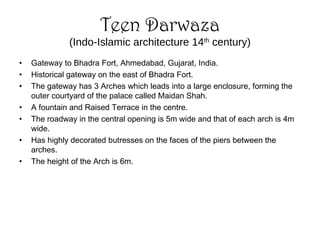
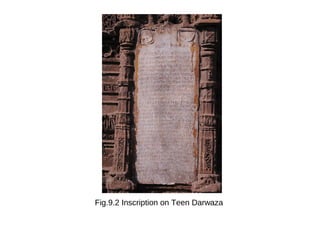
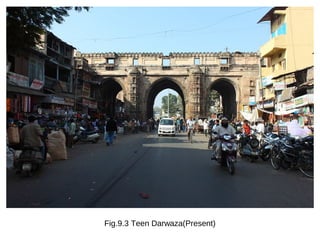
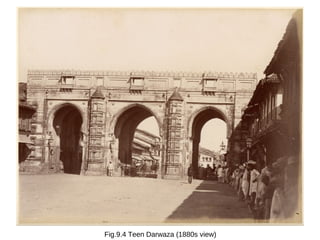
Teen Darwaza
(Indo-Islamic architecture 14th
century)
• Gateway to Bhadra Fort, Ahmedabad, Gujarat, India.
• Historical gateway on the east of Bhadra Fort.
• The gateway has 3 Arches which leads into a large enclosure, forming the
outer courtyard of the palace called Maidan Shah.
• A fountain and Raised Terrace in the centre.
• The roadway in the central opening is 5m wide and that of each arch is 4m
wide.
• Has highly decorated butresses on the faces of the piers between the
arches.
• The height of the Arch is 6m.
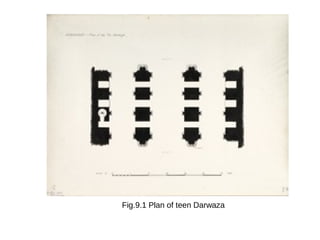
Fig.9.1 Plan of teen Darwaza
Fig.9.2 Inscription on Teen Darwaza
Fig.9.3 Teen Darwaza(Present)
Fig.9.4 Teen Darwaza (1880s view)
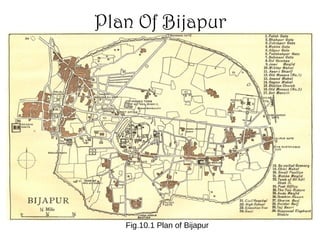
BIJAPUR
(Provincial Style of Architecture (1490-1656 AD))
• Location –North Karnataka, India.
• Under the Muslim rulers in th Mediveal Period.
• First City to experience its Islamic Architecture in the end of 13th
century under Allaudin Khilji and later under Bahamani Empire in
1347.
• Bijapur was decked and dotted by Adil Shahi dynasty in 15th
Century.
• Capital Of Adil Shahi Dynasty.
• 15th
century, greatest period for art and architecture in Bijapur.
Plan Of Bijapur
Fig.10.1 Plan of Bijapur
Style of Architecture
• Influenced from the reginoal culture of Turkish origin with that of
India culture.
• Was also famous for its sculptural elements.
• Plastic art was used to decorate the patterns on buildings.
• They usedCornice,a characteris architecturalornament which is
famous for their remarkable size and projection.
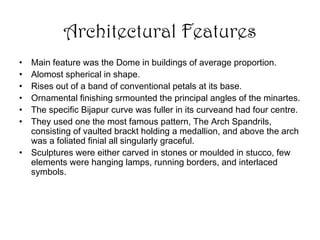
Architectural Features
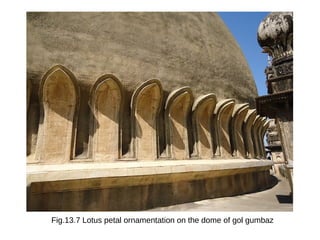
• Main feature was the Dome in buildings of average proportion.
• Alomost spherical in shape.
• Rises out of a band of conventional petals at its base.
• Ornamental finishing srmounted the principal angles of the minartes.
• The specific Bijapur curve was fuller in its curveand had four centre.
• They used one the most famous pattern, The Arch Spandrils,
consisting of vaulted brackt holding a medallion, and above the arch
was a foliated finial all singularly graceful.
• Sculptures were either carved in stones or moulded in stucco, few
elements were hanging lamps, running borders, and interlaced
symbols.
Jami Masjid
(Bijapur)
• Located in Bijapur, Karnataka, India.
• Built in the reign of Ail Adil Shah.
• Structure covers a rectangular area of 138m X 69m.
• A square Courtyard of 43m side.
• Square nave wth 12 arches with 22.8m diametre.
• Interior Scantury of large hall measuring of 63.4m X 32.6m and is
divided into 5 aisles by arches.
• The arches intersect at top to form octagonal cornice to support the
base of the dome.
• The structure was never complete with lack of 2 minarets.
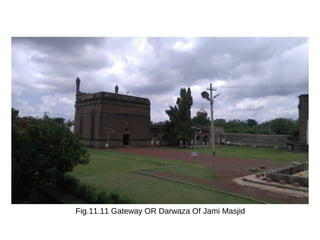
• The entrace gate way was added later by Emperor Aurangzeb.
• A wide and deep cornice supported on brackets projects above this
arcade.
Fig.11.2 Interior view of Jami Masjid
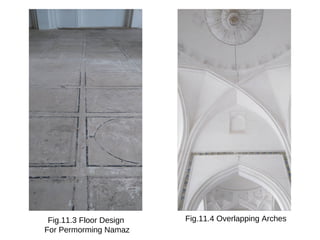
Fig.11.3 Floor Design
For Permorming Namaz
Fig.11.4 Overlapping Arches
Fig.11.5 arched Hall Fig.11.6 Over Lapping Of Arches
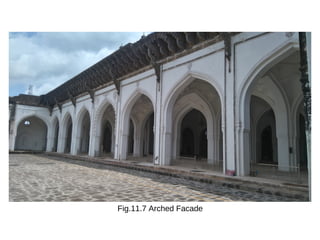
Fig.11.7 Arched Facade
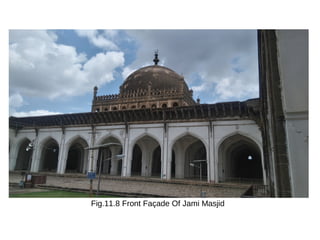
Fig.11.8 Front Façade Of Jami Masjid
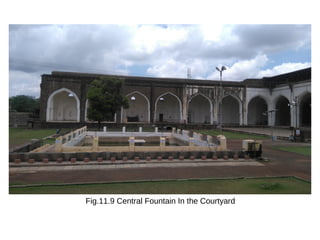
Fig.11.9 Central Fountain In the Courtyard
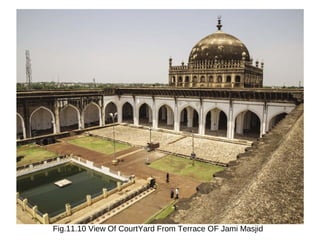
Fig.11.10 View Of CourtYard From Terrace OF Jami Masjid
Fig.11.11 Gateway OR Darwaza Of Jami Masjid
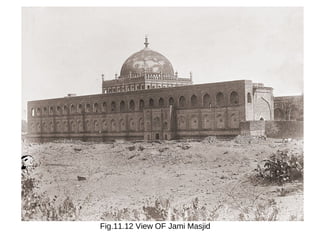
Fig.11.12 View OF Jami Masjid
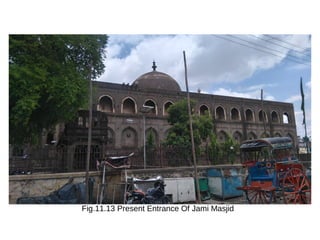
Fig.11.13 Present Entrance Of Jami Masjid
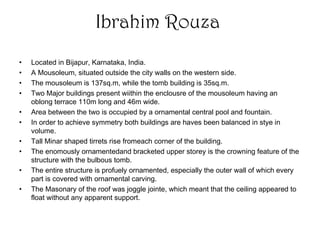
Ibrahim Rouza
• Located in Bijapur, Karnataka, India.
• A Mousoleum, situated outside the city walls on the western side.
• The mousoleum is 137sq.m, while the tomb building is 35sq.m.
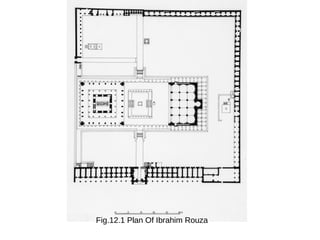
• Two Major buildings present wiithin the enclousre of the mousoleum having an
oblong terrace 110m long and 46m wide.
• Area between the two is occupied by a ornamental central pool and fountain.
• In order to achieve symmetry both buildings are haves been balanced in stye in
volume.
• Tall Minar shaped tirrets rise fromeach corner of the building.
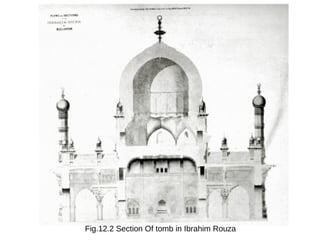
• The enomously ornamentedand bracketed upper storey is the crowning feature of the
structure with the bulbous tomb.
• The entire structure is profuely ornamented, especially the outer wall of which every
part is covered with ornamental carving.
• The Masonary of the roof was joggle jointe, which meant that the ceiling appeared to
float without any apparent support.
Fig.12.1 Plan Of Ibrahim Rouza
Fig.12.2 Section Of tomb in Ibrahim Rouza
Fig.12.3 Interior view of mosque at ibrahim rouza
Fig.12.4 View of corridor in the tomb of ibrahim rouza
Fig.12.5 Use of arch and rose window in the corridor
in the tomb of ibrahim rouza
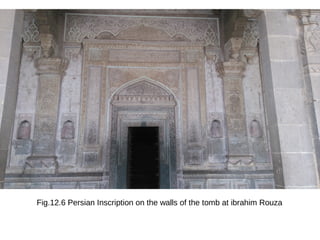
Fig.12.6 Persian Inscription on the walls of the tomb at ibrahim Rouza
Fig.12.7 Central water tank and decorative fountain
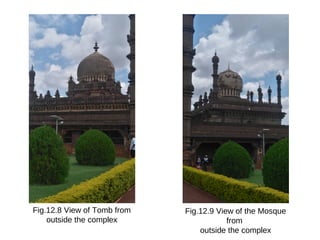
Fig.12.8 View of Tomb from
outside the complex
Fig.12.9 View of the Mosque
from
outside the complex
Fig.12.10 View of Mosque from the tomb at ibrahim Rouza
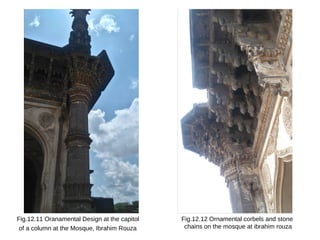
Fig.12.11 Oranamental Design at the capitol
of a column at the Mosque, Ibrahim Rouza
Fig.12.12 Ornamental corbels and stone
chains on the mosque at ibrahim rouza
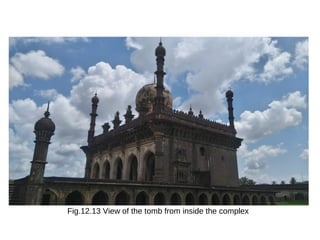
Fig.12.13 View of the tomb from inside the complex
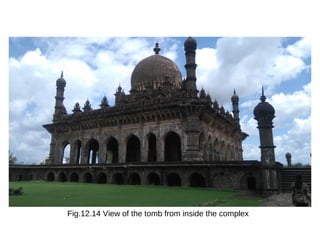
Fig.12.14 View of the tomb from inside the complex
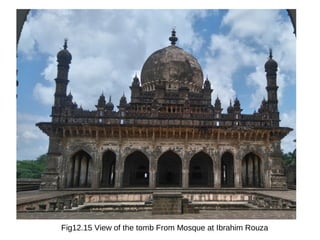
Fig12.15 View of the tomb From Mosque at Ibrahim Rouza
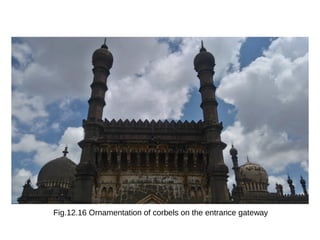
Fig.12.16 Ornamentation of corbels on the entrance gateway
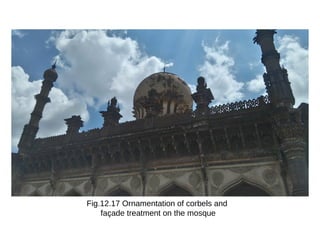
Fig.12.17 Ornamentation of corbels and
façade treatment on the mosque
Fig.12.18 View from the entrance
Fig.12.19 View Of Ibrahim Rouza
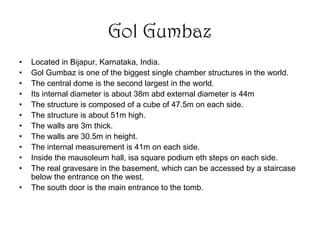
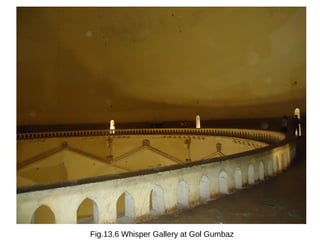
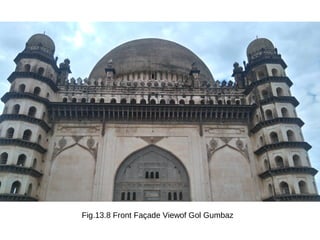
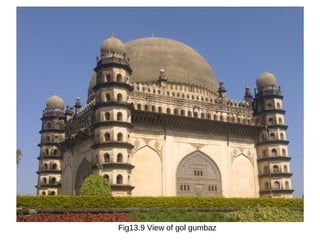
Gol Gumbaz
• Located in Bijapur, Karnataka, India.
• Gol Gumbaz is one of the biggest single chamber structures in the world.
• The central dome is the second largest in the world.
• Its internal diameter is about 38m abd external diameter is 44m
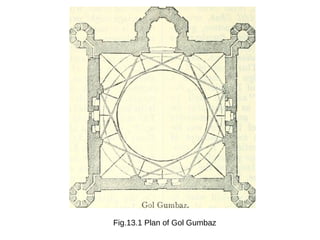
• The structure is composed of a cube of 47.5m on each side.
• The structure is about 51m high.
• The walls are 3m thick.
• The walls are 30.5m in height.
• The internal measurement is 41m on each side.
• Inside the mausoleum hall, isa square podium eth steps on each side.
• The real gravesare in the basement, which can be accessed by a staircase
below the entrance on the west.
• The south door is the main entrance to the tomb.
Fig.13.1 Plan of Gol Gumbaz
Fig.13.3 Interior of gol gumbazFig.13.2 Sectional Elevation
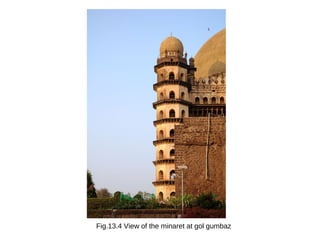
Fig.13.4 View of the minaret at gol gumbaz
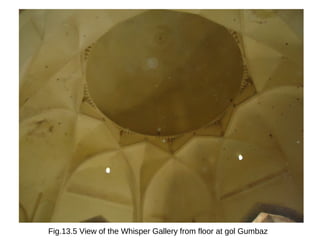
Fig.13.5 View of the Whisper Gallery from floor at gol Gumbaz
Fig.13.6 Whisper Gallery at Gol Gumbaz
Fig.13.7 Lotus petal ornamentation on the dome of gol gumbaz
Fig.13.8 Front Façade Viewof Gol Gumbaz
Fig13.9 View of gol gumbaz
Baro Shona Masjid
(15th
century, Gaur)
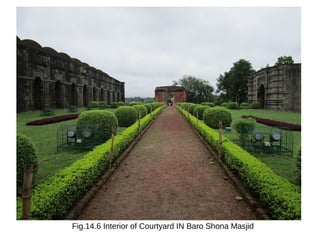
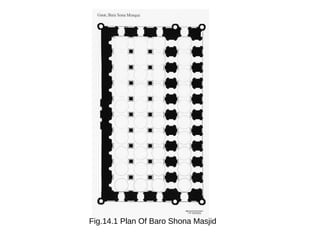
• Also Known As The Great Golden Mosque and Baroduari.
• Located in Gour, India.
• Completed in 1526.
• A gaiganti Rectangluar structure of brick and stone.
• It is 52m long by 24m wide and has an 6m high parapet forming a long
shallow curve.
• The Name means 12 doors but the monument has 11 entrances.
• Two Butresses, Four towers and a spacious courtyard of 70m diameter
• The building is placed in plain stone and the doors would originally have
been framed by mosaics of glazed colored tiles.
• The roof was was strewn with 44 hemispherical domes
• The domes were gilded and hence the mosque got its name.
• These domes are arcaded, half in brick and half in stone.
• Eleven Arched entrances of the east open into a long domed verandah
formed by wide piers on the east and west sides.
Fig.14.1 Plan Of Baro Shona Masjid
Fig.14.2 Front Façade Of Baro Shona Masjid
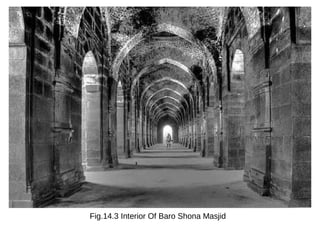
Fig.14.3 Interior Of Baro Shona Masjid
Fig.14.4 View Of Domes In Baro Shona Masjid
Fig.14.5 View Of Elevation Of Baro Shona Masjid
Fig.14.6 Interior of Courtyard IN Baro Shona Masjid
Bibilography
Links And Leads For Information :-
• www.wikipedia.org
• Archnet.org
• m.indianetzone.com
• Islamicarchitexctureinindia.weebly.com
Books Refered :-
• Hiraskar-History Of Architecture
• Percy Brown-Indian And Islamic Architecture
Images:
• Captured
• Google Images
THANK YOU
BY:
SreeVarun R
M.Alekhya
Akhil Manikyam R
Harini
Spurthi G
Anil Kumar J

Islamic architecture

  • 1.
  • 2.
  • 3.
  • 4.
    Provincial Styles OfArchitecture • The Provincial (belonging to some particular province; local ) Style of Architecture encompasses the architectural trends and developments noticed in different provincial capitals in India, but specifically in: • Punjab (1150 – 1325 AD). • Bengal (1203 – 1573 AD). • Gujurat(1300 – 1572 AD). • Jaunpur(1376 – 1479 AD). • Malwa(1405 -1569 AD). • Deccan(1347 – 1617 AD). • Bijapur(1409 – 1656 AD). • Khandesh(1425 – 1650 AD). • Kashmir(1410 onwards).
  • 5.
    Definition Islamic Architecture canbe definied as building traditions of muslim populations of the middle eastand any countries where Islam has been from the 7th century. Types Of Islamic Architecture: • Mosque –Muslim Centre, Place for worship. • Madrasah –Public School. • Hammam-A Structural Design for bathhouse. • Caravanserai-A roadsideinn for travellers. • Casbah/Citadel –A Fortress. • Mausoleum –A Tomb or A Monument.
  • 6.
    Jaunpur (Founded on 1359AD) •Located in the state of Uttar Pradesh • Found on 1359, by Feroz Shah Tughlaq. • Named for Mohammed Bin Tugluq, Whose name was Jauna Khan. • Jaunpur Style of Architecture.
  • 7.
    Jaunpur Style (1360 –1480AD) • Under the rule of the Sharqi Dynasty, Jaunpur became an important centre for Islamic Art and Architecture. • Most Structures Were destoryed by Sikander Lodi of Delhi when he reconquered Janpur, and left only 5 Mosques. • The Style was mainly formed under Sultan Shams-ud-din Ibrahim(1402-1436AD).
  • 8.
    Atala Masjid (15th century, Jaunpur) •Located at Jaunpur, Uttar Pradesh, India. • Was built by Sultan Ibrahim(1402-1436AD), Sharqi Sultan of Jaunpur laid the foundation. • Construction Started in 1377AD. • A Madrasa Named Madrasa Din Dunia is housed in the central complex. • Built on the site of Atala Devi Temple Whose Materials along the materials of other temples were used in construction. • The Mosque consist of a square courtyard of 54m side with Cloisters on 3 sides and the sanctuary on the fourth(western side) • Entire Mosque is of 79m side. • Cloister are spacious being 13m across and dividedinto 5 Aisles. • Cloister rise upto 2 storeys. • Two Aisles of the lower storey are formed into a series of cells with a pillared verandah facing the street to provide accomodationto visitors and merchants. • The 3 entrance gateway, one in the centre of each Cloister with the northern and southern ones are surmounted by domes
  • 9.
    Fig.1.1 Plan OfAtala Masjid
  • 10.
    Fig.1.2 Front ViewOF Atala Masjid
  • 11.
    Fig.1.3 Front FaçadeOF Atala Masjid
  • 12.
    Fig.1.4 Main Pishtaqleading into the Iwan of Atala Masjid
  • 13.
    Fig.1.5 View OfAtala Masjid
  • 14.
    • Located AtJaunpur, Uttar Pradesh, India. • Jaunpur Style of Architecture. • Built By Husain Shah In 1470AD. • Repeats Many features of Atala Masjid on a larger scale. • The Entire structure is raised on a plinth 5-6m in height and approached by steep but imposing flight of steps. • The courtyard is a square of 64m side. • Surrounded by cloisters on three sides and sanctuary on the west. • Cloisters are 2 storey high. • They are two aisles in width. • In centre of each cloister is an entrance hall covered by dome. • In the centre of the scantuary façade is pylon 25m high and 23.5m wide at the base. • The interior consist of the Nave of 12m side. Jami Masjid (14th century, Jaunpur)
  • 15.
    Fig.2.1 Plan OfJami Masjid(Jaunpur)
  • 16.
    Fig.2.2 Western SidePlan of Jami Masjid
  • 17.
    Fig.2.3 View OFJami Masjid (Two Storey Structure)
  • 18.
    Fig.2.4 Front FaçadeOf Jami Masjid
  • 19.
    Fig.2.5 View ofjami Masjid
  • 20.
    Adina Masjid (14th Century, Bengal) •Located at Pandua of Maldah District, West Bengal. • Adina Mosque Ruins Are the largest mosque ruins in the Indian Continent. • Constructed in 1373. • Was built during the Reign of Sikandar Shah. • The design incorporated Bengali, Arab,Persian and Byzantine elements. • It was built with Brick and Stone. • It had a rectrangular hyspostyle structure with an open courtyard. • The Structure measured 172x97m, with several hundred domes. • The mosque’s most prominent feature is its moumental ribbed barrel vault over the central nave. • The prayer hall is five aisles deep, while the north, southand east cloisters around the courtyard consist of triple aisles. • These aisles had 260 pillarsand 387 dombed bays.
  • 21.
    Fig.3.1 Plan ofAdina Masjid
  • 22.
    Fig.3.2 Interior ofAdina Masjid
  • 23.
    Fig.3.3 View OfAdina Masjid from Inside
  • 24.
    Fig.3.4 View OfArched Façade IN Adina Masjid
  • 25.
    Ek Lakhi Mousoleum (14th Century,Bengal) • Located At Malda, West Bengal, India. • Also Known as Mousoleum of Jalauddin Muhammad Shah. • Its said that One Lakh rupees was spent inconstruction hence the name. • The tomb is situated to the south west of Adina Mosque. • The exterior of the building is strengthened by four octangonal towers at the corners, and is opend by four doorways, one each in the middle of each side. • Pointed arches with lintels crowning the doorjams span and the doorways. • The ornamentation of the ek lakhi Masjid consist of braced string- mouldings of the corner towers. • The dome of this mosque, like all other domes of the sultanate Bengal, appears to be covered with a round rim in the form of a hormonica.
  • 26.
    Fig.4.1 Plan OFEk Lakhi Tomb
  • 27.
    Fig.4.2 Front FaçadeOF Ek Lakhi Tomb
  • 28.
    Dakhil Darwaza (15th Century, Bengal) •Located at Gaur, West Bengal, India. • Is a Gateway for a fort. • Also Popularly Known as Salaami Darwaza as Cannons used to be fired from it. • It was erected by Nasiruddin Mahmud Shah. • The Gateway built of brick except the piers between the doorways, which are faced with stone up to the springing of the arches measuring 102.5x22.5m • Consists of a passage 4.5m wide through the middle of the structure. • The height of the gateway was about 14.95m of which the entrance arch is 10.35m.
  • 29.
    Fig.5.1 Plan OfDakhil Darwaza
  • 30.
    Fig.5.2 Front FaçadeOF Dakhil Darwaza
  • 31.
    Fig.5.3 View OFDakhil Darwaza
  • 32.
    Gujarat (Provincial style ofarchitecture 13th century) • Located in western side of India. • Gujarat experienced major Indo-Islamic architectural activites for over 250years starting from 13th century. • The Indo-Islamic style entered Gujarat when the governors appointed by the Khalji Sulatans established themselves in the towns of western seaboards.
  • 33.
    VAVS At Gujarat (alsoknown as Stepwells of Gujarat) • They are one of the unique architectural features of Indian Traditions of rain water harvesting. • Old saying, the wells were built to get the gods to come down from their Abode and sipe water in these stone vavs. • Architecturally, The wells were builtso that they can resist earthquakes of great magnitude. • Mainly built to collect water for weary travellers. • Most of the stepwells were built in the 5th and 19th century. • The ancient city of mohenjo-daro itself had 700 wells in just one section. • Two most famous vavs – Adalaj ni vav – Rani ni vav
  • 34.
    Adalaj ni Vav (alsoknown as Rudabai Stepwell) • Located in Ahmedabad, Gujarat, India. • The stepwell at Adalaj, named after the nearby town. • It is 5 storeys below th ground level and well over 75m in length. • Octagonal in shape. • Surrounded by intricately carved pillars and columns. • Walking down to the deepest end to find water stored in circular well, which is open to sky. • The entrance has staircase leading from three directions to the first landing. • The landings are surrounded by four fabulously carved balconies or Zarokhas. • Walls are carved with intricately carved with Hindu and jain dieties and islamic motifs and flowers. • Built in sandstone in the solanki architectural style.
  • 35.
    Fig.6.1 Plan AndSection Of Adlaj Ni Vav
  • 36.
    Fig.6.2 View ofAdalaj Stepwell
  • 37.
  • 38.
    Fig.6.4 Details ofstone carving at Adalaj Stepwell
  • 39.
    Rani ni Vav (Queen’sstepwell) • Located in Patna, Gujarat, India. • Near the banks of river saraswathi. • Was built in the Complex Maru-Gujara Architectural style, Designed as an inverted temple. • The east facing well is about 64m in length, 20m wide and 27m deep. • A stepped corridor compartmented at regular intervals with ornately carved pillared milti-storeyed pavilion. • There are more than 800 elaborate sculptures in the seven galleries. • Below the vav is a tunnel 30km in length, leading to the town of sidhpur, this tunnel was used by the king to escape during war. • It appears that the walls were built of brick and faced with stone. • From this wall project vertical brackets in pairs, which supported the different galleries of the well shafts. • The Bracketing is arranged in tiers and is richly carved.
  • 40.
    Fig.7.1 Plan andSection Of Rani ni Vav
  • 41.
    Fig.7.2 Sculpture oflord Vishnu on the walls of Rani ki Vav
  • 42.
    Fig.7.3 View Ofrani ki Vav
  • 43.
    Fig.7.4 View OfRani ki vav
  • 44.
    Fig.7.5 Scketch Ofexternal view of Rani ki VAV
  • 45.
    Sarkhej Rouza (Indo-Saracenic stylebuilt in 14th century) • Located in the village of Makarba, Ahmedabad, Gujarat, India. • Is a Mosque and a tomb complex. • Fusion ofboth Muslim and Hindu principles of architecture • Azam and Muazzam were the Architects. • Was Once a prominent centre for sufi culture. • The complex spreads over 72 Acres, surrounded by elaborate gardens on all sides. • Entring the covered eastern gateway on the northern bank of the sarkhej lake, the building stands on the right with a handsome stone pavilion in front of it. • The Mousoleum of Shaikh Ahmed Khattu Ganj Bakhsh, the largest of its kind in gujarat. • The complex is interpreted as being composedof both ‘jism’(body) and ‘ruh’(spirit), giving it the qulalities of a human being.
  • 46.
    Fig.8.1 Plan ofSarkhej Rouza
  • 47.
    Fig.8.2 Ganj Baksh’sTomb within the complex
  • 48.
    Fig.8.3 Outlet ofSarkhej rouza tank
  • 49.
    Teen Darwaza (Indo-Islamic architecture14th century) • Gateway to Bhadra Fort, Ahmedabad, Gujarat, India. • Historical gateway on the east of Bhadra Fort. • The gateway has 3 Arches which leads into a large enclosure, forming the outer courtyard of the palace called Maidan Shah. • A fountain and Raised Terrace in the centre. • The roadway in the central opening is 5m wide and that of each arch is 4m wide. • Has highly decorated butresses on the faces of the piers between the arches. • The height of the Arch is 6m.
  • 50.
    Fig.9.1 Plan ofteen Darwaza
  • 51.
  • 52.
  • 53.
  • 54.
    BIJAPUR (Provincial Style ofArchitecture (1490-1656 AD)) • Location –North Karnataka, India. • Under the Muslim rulers in th Mediveal Period. • First City to experience its Islamic Architecture in the end of 13th century under Allaudin Khilji and later under Bahamani Empire in 1347. • Bijapur was decked and dotted by Adil Shahi dynasty in 15th Century. • Capital Of Adil Shahi Dynasty. • 15th century, greatest period for art and architecture in Bijapur.
  • 55.
    Plan Of Bijapur Fig.10.1Plan of Bijapur
  • 56.
    Style of Architecture •Influenced from the reginoal culture of Turkish origin with that of India culture. • Was also famous for its sculptural elements. • Plastic art was used to decorate the patterns on buildings. • They usedCornice,a characteris architecturalornament which is famous for their remarkable size and projection.
  • 57.
    Architectural Features • Mainfeature was the Dome in buildings of average proportion. • Alomost spherical in shape. • Rises out of a band of conventional petals at its base. • Ornamental finishing srmounted the principal angles of the minartes. • The specific Bijapur curve was fuller in its curveand had four centre. • They used one the most famous pattern, The Arch Spandrils, consisting of vaulted brackt holding a medallion, and above the arch was a foliated finial all singularly graceful. • Sculptures were either carved in stones or moulded in stucco, few elements were hanging lamps, running borders, and interlaced symbols.
  • 58.
    Jami Masjid (Bijapur) • Locatedin Bijapur, Karnataka, India. • Built in the reign of Ail Adil Shah. • Structure covers a rectangular area of 138m X 69m. • A square Courtyard of 43m side. • Square nave wth 12 arches with 22.8m diametre. • Interior Scantury of large hall measuring of 63.4m X 32.6m and is divided into 5 aisles by arches. • The arches intersect at top to form octagonal cornice to support the base of the dome. • The structure was never complete with lack of 2 minarets. • The entrace gate way was added later by Emperor Aurangzeb. • A wide and deep cornice supported on brackets projects above this arcade.
  • 59.
    Fig.11.2 Interior viewof Jami Masjid
  • 60.
    Fig.11.3 Floor Design ForPermorming Namaz Fig.11.4 Overlapping Arches
  • 61.
    Fig.11.5 arched HallFig.11.6 Over Lapping Of Arches
  • 62.
  • 63.
    Fig.11.8 Front FaçadeOf Jami Masjid
  • 64.
    Fig.11.9 Central FountainIn the Courtyard
  • 65.
    Fig.11.10 View OfCourtYard From Terrace OF Jami Masjid
  • 66.
    Fig.11.11 Gateway ORDarwaza Of Jami Masjid
  • 67.
    Fig.11.12 View OFJami Masjid
  • 68.
  • 69.
    Ibrahim Rouza • Locatedin Bijapur, Karnataka, India. • A Mousoleum, situated outside the city walls on the western side. • The mousoleum is 137sq.m, while the tomb building is 35sq.m. • Two Major buildings present wiithin the enclousre of the mousoleum having an oblong terrace 110m long and 46m wide. • Area between the two is occupied by a ornamental central pool and fountain. • In order to achieve symmetry both buildings are haves been balanced in stye in volume. • Tall Minar shaped tirrets rise fromeach corner of the building. • The enomously ornamentedand bracketed upper storey is the crowning feature of the structure with the bulbous tomb. • The entire structure is profuely ornamented, especially the outer wall of which every part is covered with ornamental carving. • The Masonary of the roof was joggle jointe, which meant that the ceiling appeared to float without any apparent support.
  • 70.
    Fig.12.1 Plan OfIbrahim Rouza
  • 71.
    Fig.12.2 Section Oftomb in Ibrahim Rouza
  • 72.
    Fig.12.3 Interior viewof mosque at ibrahim rouza
  • 73.
    Fig.12.4 View ofcorridor in the tomb of ibrahim rouza
  • 74.
    Fig.12.5 Use ofarch and rose window in the corridor in the tomb of ibrahim rouza
  • 75.
    Fig.12.6 Persian Inscriptionon the walls of the tomb at ibrahim Rouza
  • 76.
    Fig.12.7 Central watertank and decorative fountain
  • 77.
    Fig.12.8 View ofTomb from outside the complex Fig.12.9 View of the Mosque from outside the complex
  • 78.
    Fig.12.10 View ofMosque from the tomb at ibrahim Rouza
  • 79.
    Fig.12.11 Oranamental Designat the capitol of a column at the Mosque, Ibrahim Rouza Fig.12.12 Ornamental corbels and stone chains on the mosque at ibrahim rouza
  • 80.
    Fig.12.13 View ofthe tomb from inside the complex
  • 81.
    Fig.12.14 View ofthe tomb from inside the complex
  • 82.
    Fig12.15 View ofthe tomb From Mosque at Ibrahim Rouza
  • 83.
    Fig.12.16 Ornamentation ofcorbels on the entrance gateway
  • 84.
    Fig.12.17 Ornamentation ofcorbels and façade treatment on the mosque
  • 85.
    Fig.12.18 View fromthe entrance
  • 86.
    Fig.12.19 View OfIbrahim Rouza
  • 87.
    Gol Gumbaz • Locatedin Bijapur, Karnataka, India. • Gol Gumbaz is one of the biggest single chamber structures in the world. • The central dome is the second largest in the world. • Its internal diameter is about 38m abd external diameter is 44m • The structure is composed of a cube of 47.5m on each side. • The structure is about 51m high. • The walls are 3m thick. • The walls are 30.5m in height. • The internal measurement is 41m on each side. • Inside the mausoleum hall, isa square podium eth steps on each side. • The real gravesare in the basement, which can be accessed by a staircase below the entrance on the west. • The south door is the main entrance to the tomb.
  • 88.
    Fig.13.1 Plan ofGol Gumbaz
  • 89.
    Fig.13.3 Interior ofgol gumbazFig.13.2 Sectional Elevation
  • 90.
    Fig.13.4 View ofthe minaret at gol gumbaz
  • 91.
    Fig.13.5 View ofthe Whisper Gallery from floor at gol Gumbaz
  • 92.
  • 93.
    Fig.13.7 Lotus petalornamentation on the dome of gol gumbaz
  • 94.
    Fig.13.8 Front FaçadeViewof Gol Gumbaz
  • 95.
    Fig13.9 View ofgol gumbaz
  • 96.
    Baro Shona Masjid (15th century,Gaur) • Also Known As The Great Golden Mosque and Baroduari. • Located in Gour, India. • Completed in 1526. • A gaiganti Rectangluar structure of brick and stone. • It is 52m long by 24m wide and has an 6m high parapet forming a long shallow curve. • The Name means 12 doors but the monument has 11 entrances. • Two Butresses, Four towers and a spacious courtyard of 70m diameter • The building is placed in plain stone and the doors would originally have been framed by mosaics of glazed colored tiles. • The roof was was strewn with 44 hemispherical domes • The domes were gilded and hence the mosque got its name. • These domes are arcaded, half in brick and half in stone. • Eleven Arched entrances of the east open into a long domed verandah formed by wide piers on the east and west sides.
  • 97.
    Fig.14.1 Plan OfBaro Shona Masjid
  • 98.
    Fig.14.2 Front FaçadeOf Baro Shona Masjid
  • 99.
    Fig.14.3 Interior OfBaro Shona Masjid
  • 100.
    Fig.14.4 View OfDomes In Baro Shona Masjid
  • 101.
    Fig.14.5 View OfElevation Of Baro Shona Masjid
  • 102.
    Fig.14.6 Interior ofCourtyard IN Baro Shona Masjid
  • 103.
    Bibilography Links And LeadsFor Information :- • www.wikipedia.org • Archnet.org • m.indianetzone.com • Islamicarchitexctureinindia.weebly.com Books Refered :- • Hiraskar-History Of Architecture • Percy Brown-Indian And Islamic Architecture Images: • Captured • Google Images
  • 104.
    THANK YOU BY: SreeVarun R M.Alekhya AkhilManikyam R Harini Spurthi G Anil Kumar J