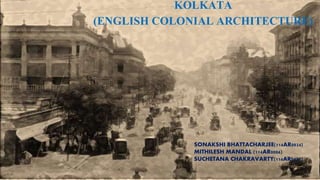
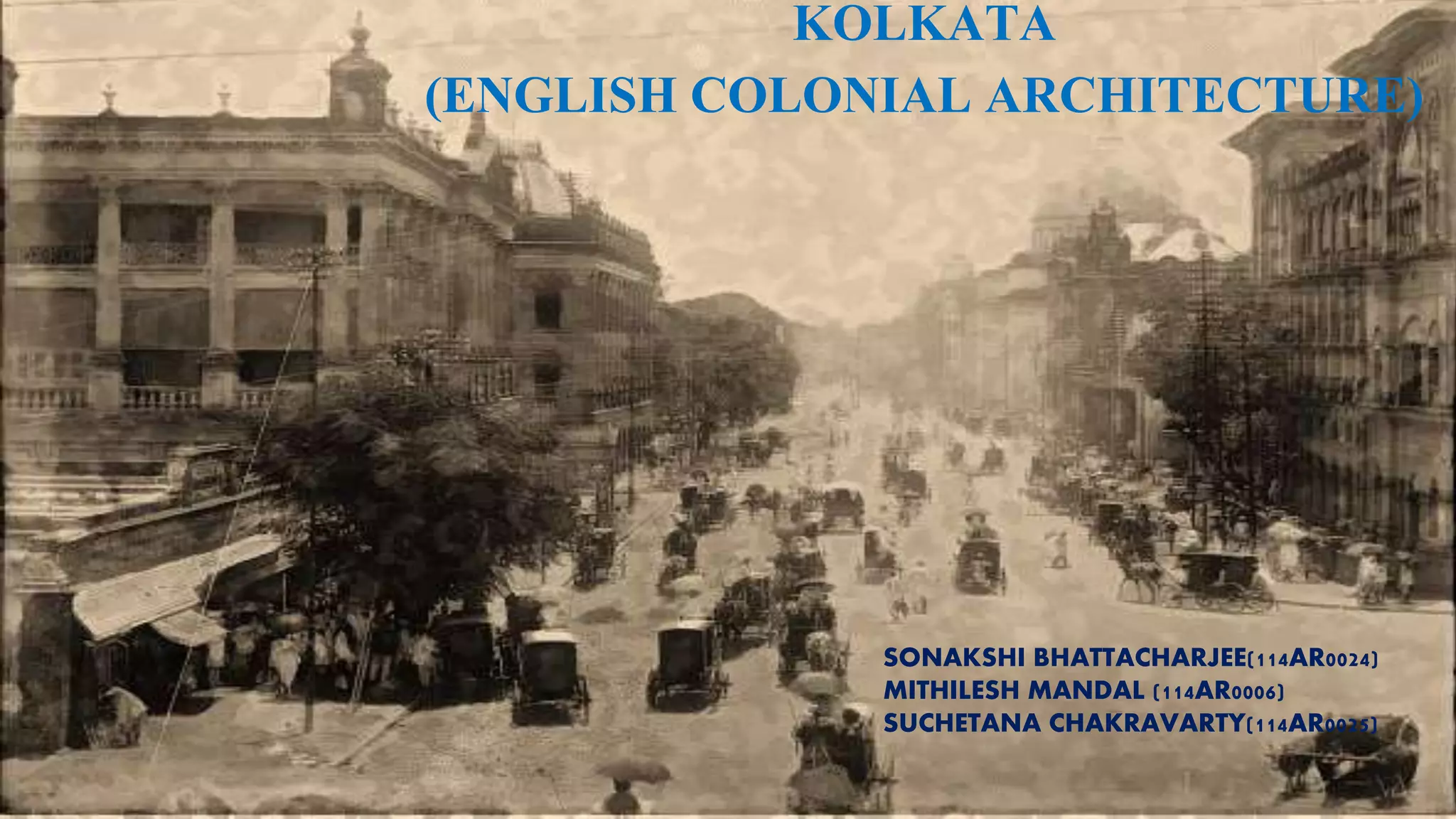
KOLKATA
(ENGLISH COLONIAL ARCHITECTURE)
SONAKSHI BHATTACHARJEE(114AR0024)
MITHILESH MANDAL (114AR0006)
SUCHETANA CHAKRAVARTY(114AR0025)
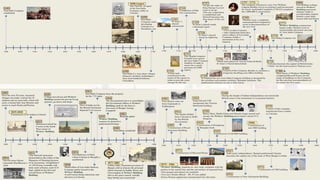
TIMELINE
WRIGHTER’S BUILDING
PLACE –KOLKATA
(1777-1906)
Designed by THOMAS LYON
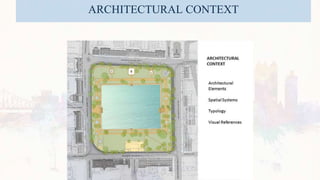
ARCHITECTURAL CONTEXT
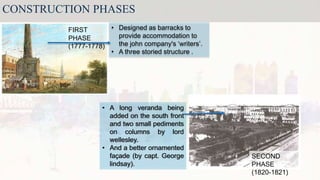
CONSTRUCTION PHASES
FIRST
PHASE
(1777-1778)
SECOND
PHASE
(1820-1821)
• Designed as barracks to
provide accommodation to
the john company's ‘writers’.
• A three storied structure .
• A long veranda being
added on the south front
and two small pediments
on columns by lord
wellesley.
• And a better ornamented
façade (by capt. George
lindsay).
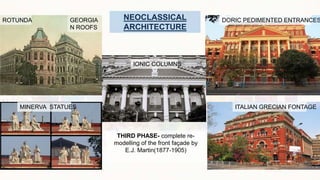
ROTUNDA GEORGIA
N ROOFS
DORIC PEDIMENTED ENTRANCES
MINERVA STATUES
IONIC COLUMNS
ITALIAN GRECIAN FONTAGE
NEOCLASSICAL
ARCHITECTURE
THIRD PHASE- complete re-
modelling of the front façade by
E.J. Martin(1877-1905)
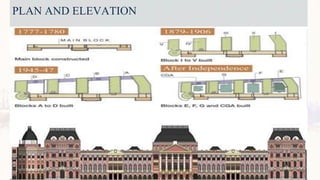
PLAN AND ELEVATION
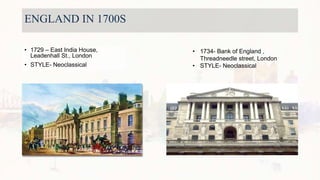
ENGLAND IN 1700S
• 1729 – East India House,
Leadenhall St., London
• STYLE- Neoclassical
• 1734- Bank of England ,
Threadneedle street, London
• STYLE- Neoclassical
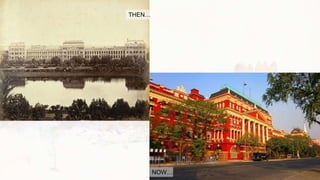
THEN…
NOW…
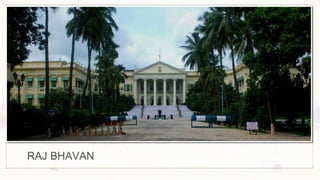
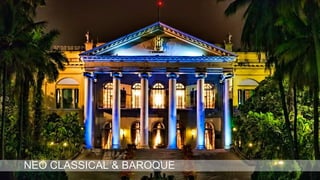
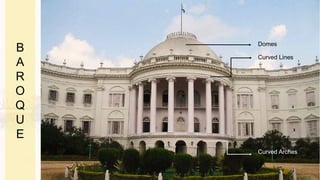
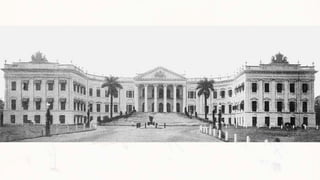
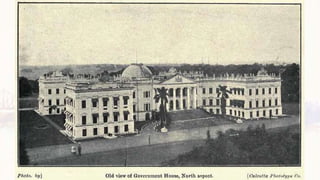
RAJ BHAVAN
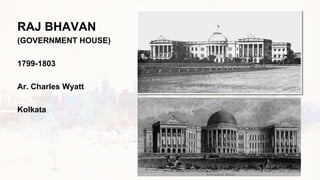
RAJ BHAVAN
(GOVERNMENT HOUSE)
1799-1803
Ar. Charles Wyatt
Kolkata
NEO CLASSICAL & BAROQUE
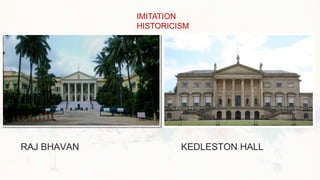
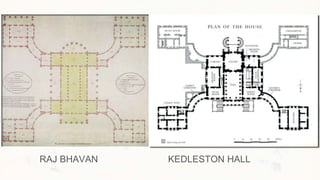
RAJ BHAVAN KEDLESTON HALL
IMITATION
HISTORICISM
RAJ BHAVAN KEDLESTON HALL
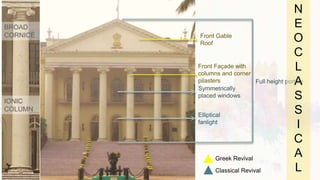
IONIC
COLUMN
Full height portico
Elliptical
fanlight
Symmetrically
placed windows
Front Gable
Roof
Front Façade with
columns and corner
pilasters
Greek Revival
Classical Revival
BROAD
CORNICE
N
E
O
C
L
A
S
S
I
C
A
L
Curved Lines
Curved Arches
Domes
B
A
R
O
Q
U
E
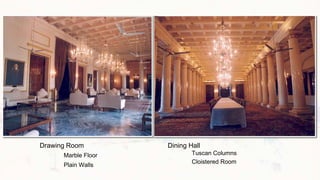
Drawing Room
Marble Floor
Plain Walls
Dining Hall
Tuscan Columns
Cloistered Room
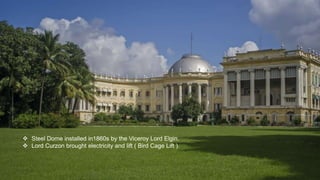
 Steel Dome installed in1860s by the Viceroy Lord Elgin.
 Lord Curzon brought electricity and lift ( Bird Cage Lift ).
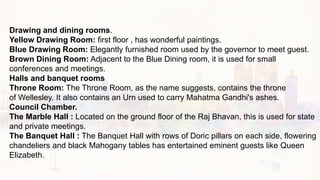
Drawing and dining rooms.
Yellow Drawing Room: first floor , has wonderful paintings.
Blue Drawing Room: Elegantly furnished room used by the governor to meet guest.
Brown Dining Room: Adjacent to the Blue Dining room, it is used for small
conferences and meetings.
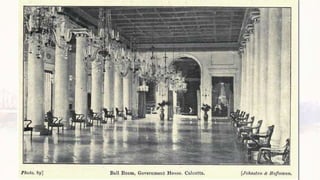
Halls and banquet rooms
Throne Room: The Throne Room, as the name suggests, contains the throne
of Wellesley. It also contains an Urn used to carry Mahatma Gandhi's ashes.
Council Chamber.
The Marble Hall : Located on the ground floor of the Raj Bhavan, this is used for state
and private meetings.
The Banquet Hall : The Banquet Hall with rows of Doric pillars on each side, flowering
chandeliers and black Mahogany tables has entertained eminent guests like Queen
Elizabeth.
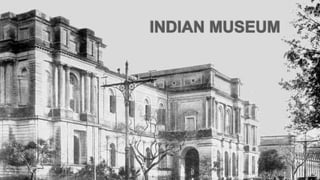
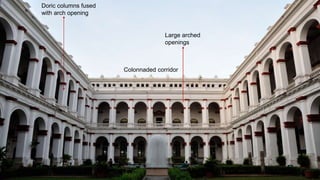
INDIAN MUSEUM
INDIAN MUSEUM
1875
by WALTER L. B. GRANVILLE
KOLKATA
“an Italianate palace ...
around a colonnaded
courtyard” ~ Jan Morris
SOCIO-CULTURAL
• Beginning of a significant epoch initiating the socio-
cultural and scientific achievements of the country.
•
Beginning of modernity and end of medieval era
NEO CLASSICAL
HISTORICISM
ORNAMENTATION
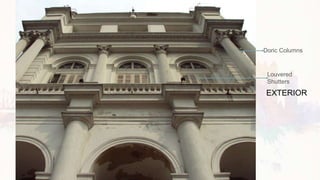
Doric columns fused
with arch opening
Colonnaded corridor
Large arched
openings
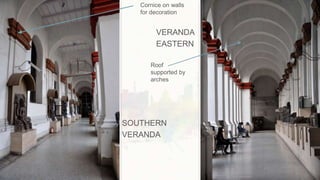
SOUTHERN
VERANDA
VERANDA
EASTERN
Cornice on walls
for decoration
Roof
supported by
arches
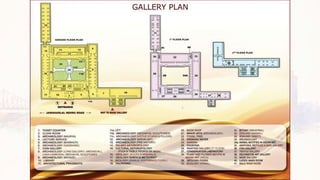
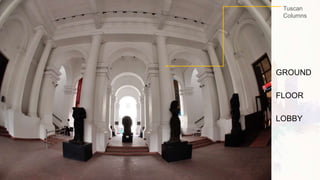
GROUND
FLOOR
LOBBY
Tuscan
Columns
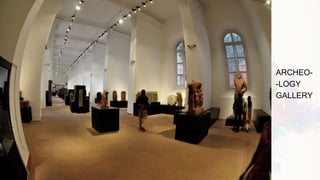
ARCHEO-
-LOGY
GALLERY
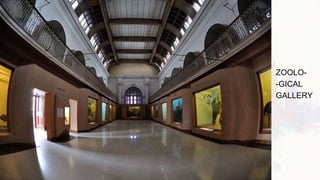
ZOOLO-
-GICAL
GALLERY
EXTERIOR
Louvered
Shutters
Doric Columns
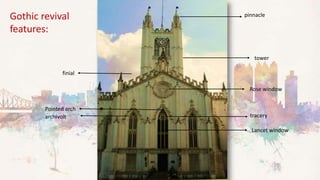
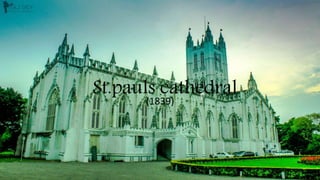
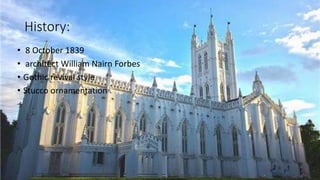
St.pauls cathedral(1839)
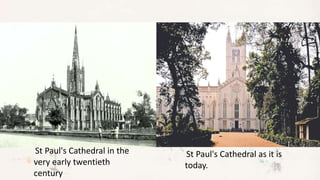
St Paul's Cathedral in the
very early twentieth
century
St Paul's Cathedral as it is
today.
History:
• 8 October 1839
• architect William Nairn Forbes
• Gothic revival style
• Stucco ornamentation
pinnacle
Rose window
Lancet window
tower
finial
Pointed arch
archivolt tracery
Gothic revival
features:
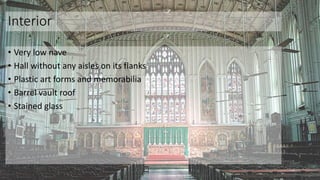
Interior
• Very low nave
• Hall without any aisles on its flanks
• Plastic art forms and memorabilia
• Barrel vault roof
• Stained glass
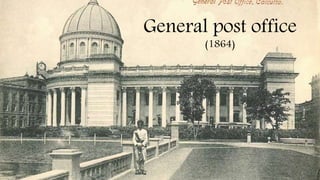
General post office
(1864)
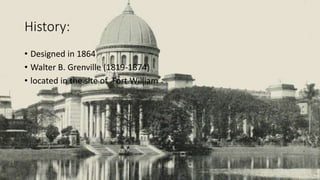
History:
• Designed in 1864
• Walter B. Grenville (1819-1874)
• located in the site of Fort William
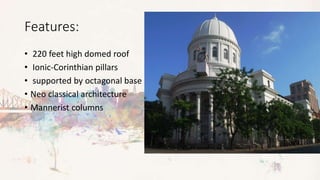
Features:
• 220 feet high domed roof
• Ionic-Corinthian pillars
• supported by octagonal base
• Neo classical architecture
• Mannerist columns
VICTORIA MEMORIAL
PLACE –KOLKATA
(1906-1921)
Designed by WILLIAM EMERSON
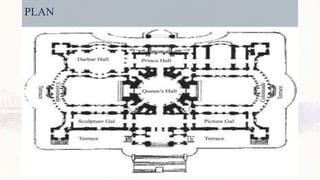
PLAN
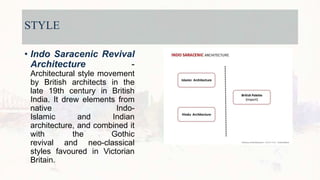
STYLE
• Indo Saracenic Revival
Architecture -
Architectural style movement
by British architects in the
late 19th century in British
India. It drew elements from
native Indo-
Islamic and Indian
architecture, and combined it
with the Gothic
revival and neo-classical
styles favoured in Victorian
Britain.
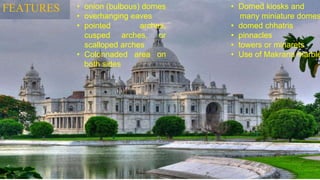
FEATURES • onion (bulbous) domes
• overhanging eaves
• pointed arches,
cusped arches, or
scalloped arches
• Colonnaded area on
both sides
• Domed kiosks and
many miniature domes
• domed chhatris
• pinnacles
• towers or minarets
• Use of Makrana marble
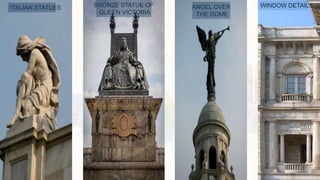
ITALIAN STATUES BRONZE STATUE OF
QUEEN VICTORIA
ANGEL OVER
THE DOME
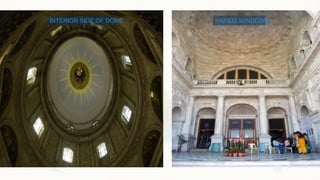
WINDOW DETAILS
INTERIOR SIDE OF DOME HAREM WINDOWS
GARDEN
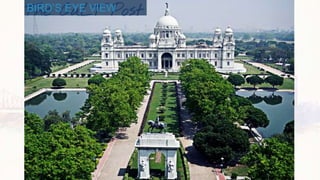
• Total area of 64 acre with the building covering an area of 338sq.Ft by 228 sq.Ft.
• On way to the north gate is a bronze statue of Queen Victoria by Sir George
Frampton.The Queen is seated on her throne, wearing the robes of the Star of
India.
• Approaching the building from the south, visitors pass the King Edward VII
memorial arch with a bronze equestrian statue of the King by Sir Bertram
Mackennal surmounting it and a marble statue of Lord Curzon by F.W. Pomeroy,
R.A.
• There are also other statues of various dignitaries like Lord Bentinck, Governor-
General of India (1828-1835), Lord Ripon (Governor- General of India from 1880
to 1884; the statue of Sir Rajendranath Mookerjee, the pioneer industrialist of
Bengal is on the eastern side.
BIRD’S EYE VIEW
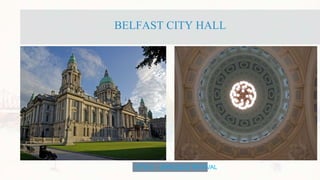
BELFAST CITY HALL
STYLE – BAROQUE REVIVAL
WHY?
• Sense of “rightful self-glorification”, which came to appeal to the
aesthetic sensibilities of continental Europeans and Americans, whose
architects came to astutely incorporate telling indigenous
“Asian exoticism" elements, whilst implementing their own engineering
innovations supporting such elaborate construction, both in India and
abroad, evidence for which can be found to this day in public, private and
government owned buildings.
• Public and government buildings were often rendered on an intentionally
grand scale, reflecting and promoting a notion of an unassailable and
invincible British empire.
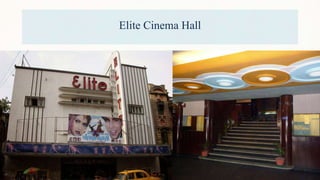
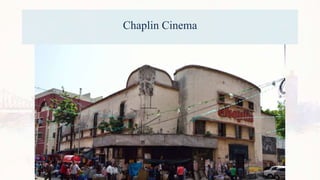
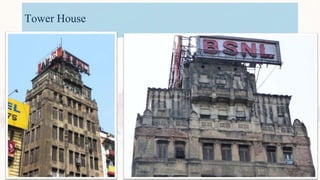
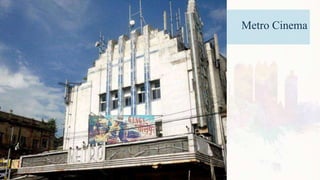
EMERGING ART DECO STRUCTURES
Elite Cinema Hall
Chaplin Cinema
Tower House
Metro Cinema
REFERENCES
• http://rajbhavankolkata.gov.in/html/interior_new.htm
• http://study.com/academy/lesson/baroque-architecture-style-characteristics-features.html
• http://www.slideshare.net/maggiesalgado/baroque-p-pt
• http://www.slideshare.net/raashi77/neoclassical-architecture-late-victorian-era-and-gothic-revival
• https://upload.wikimedia.org/wikipedia/commons/d/dc/Government_House_-_Kolkata_2011-12-18_0188.JPG
• https://upload.wikimedia.org/wikipedia/commons/f/f6/Kedleston_Hall_20080730-04.jpg
• http://indianmuseumtt.org/Plan%20Your%20Visit.php
• http://www.indianmuseumkolkata.org/Architecture%20through%20the%20Ages.php
• https://commons.wikimedia.org/wiki/File:Western_Corridor_-_Ground_Floor_-_Indian_Museum_-
_Kolkata_2014-04-04_4342.JPG
• http://indiaheritagehub.org/2013/12/31/indian-museum-kolkata/
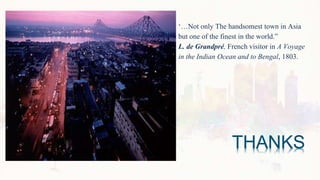
‘…Not only The handsomest town in Asia
but one of the finest in the world.”
L. de Grandpré, French visitor in A Voyage
in the Indian Ocean and to Bengal, 1803.

Kolkata architecture -british period

Editor's Notes

  • #16 The plan comprises a central core with four radiating wings. The state rooms located in the central core are accessed from the outside by a flight of grand steps on the north. On the south is another portico surmounted by a colonnaded verandah with a dome above.  The four wings accommodate the various offices and residential quarters along with four sets of staircases. The plan of the wings allows for a great deal of natural ventilation in the spaces while also permitting views across the gardens. The entire compound is surrounded by a balustraded wall with a grand arched gateways.
  • #26 http://animeshray.com/restoration-of-esplanade-mansions/