
Monuments of
Ellora
Dr. Virag Sontakke
Assistant Professor
A.I.H.C. & Archaeology
Banaras Hindu University, Varanasi
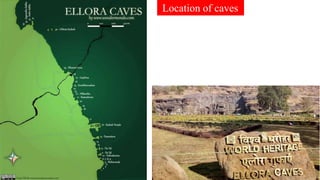
Location
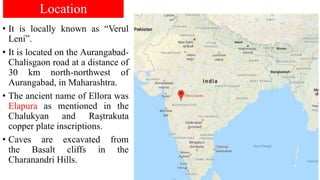
• It is locally known as “Verul
Leni”.
• It is located on the Aurangabad-
Chalisgaon road at a distance of
30 km north-northwest of
Aurangabad, in Maharashtra.
• The ancient name of Ellora was
Elapura as mentioned in the
Chalukyan and Raştrakuta
copper plate inscriptions.
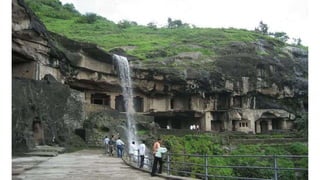
• Caves are excavated from
the Basalt cliffs in the
Charanandri Hills.
Ellora Caves
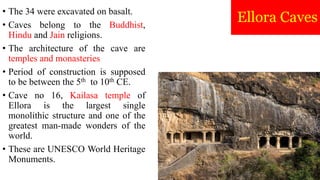
• The 34 were excavated on basalt.
• Caves belong to the Buddhist,
Hindu and Jain religions.
• The architecture of the cave are
temples and monasteries
• Period of construction is supposed
to be between the 5th to 10th CE.
• Cave no 16, Kailasa temple of
Ellora is the largest single
monolithic structure and one of the
greatest man-made wonders of the
world.
• These are UNESCO World Heritage
Monuments.
Why?
• It suggests that the site perhaps played a pivotal role in the
socio-economic or political life of the region.
• Most of the caves in western India were built on or near
ancient trade routes.
• The site was situated in the commercial, region.
• Being on the trade route the site would have economic
importance as well as religious significance.
• Probably, monuments were carved at these places to
popularize a religion.
• Ellora identifies as a sacred centre, related to Shiva.
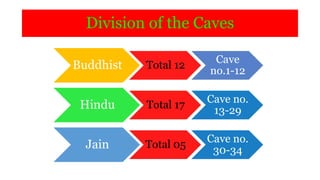
Division of the Caves
Buddhist Total 12
Cave
no.1-12
Hindu Total 17
Cave no.
13-29
Jain Total 05
Cave no.
30-34
Location of caves
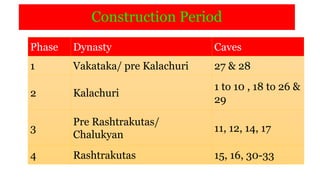
Construction Period
Phase Dynasty Caves
1 Vakataka/ pre Kalachuri 27 & 28
2 Kalachuri
1 to 10 , 18 to 26 &
29
3
Pre Rashtrakutas/
Chalukyan
11, 12, 14, 17
4 Rashtrakutas 15, 16, 30-33
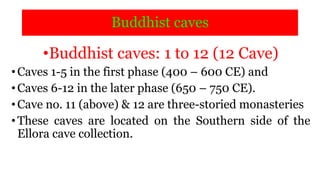
Buddhist caves
•Buddhist caves: 1 to 12 (12 Cave)
•Caves 1-5 in the first phase (400 – 600 CE) and
•Caves 6-12 in the later phase (650 – 750 CE).
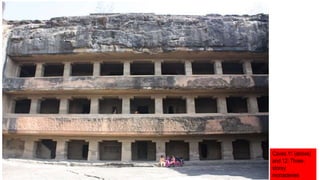
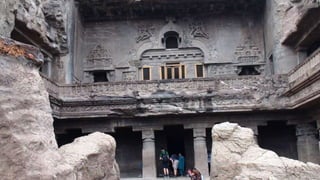
•Cave no. 11 (above) & 12 are three-storied monasteries
•These caves are located on the Southern side of the
Ellora cave collection.
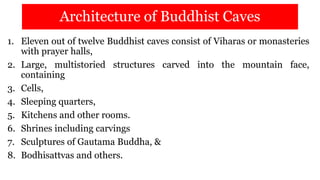
Architecture of Buddhist Caves
1. Eleven out of twelve Buddhist caves consist of Viharas or monasteries
with prayer halls,
2. Large, multistoried structures carved into the mountain face,
containing
3. Cells,
4. Sleeping quarters,
5. Kitchens and other rooms.
6. Shrines including carvings
7. Sculptures of Gautama Buddha, &
8. Bodhisattvas and others.
Cave no 1
Caves 11 (above)
and 12: Three-
storey
monasteries
Plan of Cave No. 5 (Mahawara Cave)
The Vishvakarma Cave
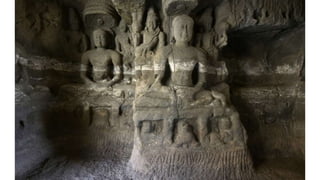
• The most famous of the Buddhist caves is cave 10.
• It is Vihara called the “Vishvakarma Cave”.
• It is also known as the “Carpenter’s Cave” because the artistic finish
gives the rock an appearance of wooden beams.
• Beyond its multistoried entry is Chaityagriha (prayer hall).
• A 15-foot statue of Buddha seated in a preaching pose.
• It has eight subsidiary cells, four in the back wall and four in the right
wall.
• It had a portico in the front with cells.
• It is the only dedicated Chaityagriha amongst the Buddhist group of
Ellora Caves.
• It follows the pattern of construction of caves 19 and 26 of Ajanta.
• It was likely built around 650 CE.
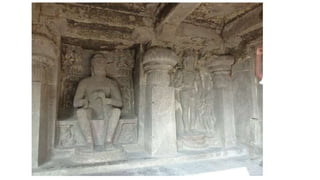
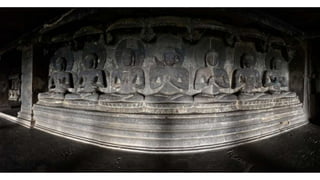
Buddhist Sculptures
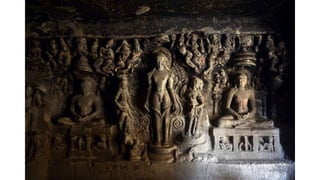
• Twelve Buddhist caves having many images belonging to
Vajrayana Buddhism like Tara, Mahamayuri, Akshobhya,
Avalokiteshwara, Maitrya, Amitabha, etc.
• The shrine Buddha images are big; they are generally guarded
by the images of Padmpani and Vajrapani.
• Buddhist caves are big and are of single, double and triple
storeys.
• Ajanta also has excavated double-storeyed caves but at Ellora,
the triple-storey is a unique achievement.
• All the caves were plastered and painted but nothing visible is
left.
Jaina Caves
• Five caves are dedicated to Jaina Cave no. 30-34
• These caves are separated from the other caves by a distance.
• There are two main caves and two unfinished caves among the five.
• These caves date back to the 9th and 10th centuries and belong to the
Jain sect Digambara.
• Cave 30 is called Chhota Kailash;
• cave 31 is unfinished;
• cave 32 is called the Indra Sabha;
• cave 33 is the Jagannath Sabha and
• cave 34 is a smaller cave that connects to an opening in Cave 33.
• These caves also contain a hall where the monks used to preach.
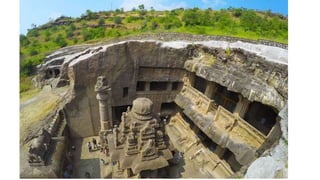
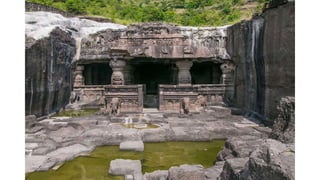
Chota Kailash
• Cave 30 or Chhota Kailash is situated a few meters away from the main
group of Jaina caves.
• This is fine monolithic structure, carved in imitation of the Brahmanical
cave Kailash (Cave 16).
• hence its called as Chota Kailash.
• It is also a monolithic shrine, had a gopura and executed in Dravida
style.
• It is without nandimandapa, elephants or free-standing pillars like
Kailash.
• This cave is left unfinished from outside, while only the interior along
with the icons are finished.
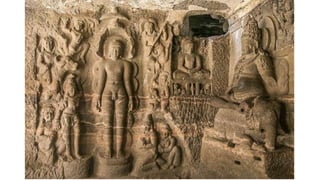
Sculptures
• All the caves have sculptures
• Also had paintings on the ceilings as well, some of which can still be
seen.
• There are prominent sculptures of the Tirthankara like Parsvanatha, as
well as the last Tirthankara Mahavira.
• Image of Bahubali, also called Gomateshwara, son of the first
Tirthankara.
• There are also sculptures of Yakshas and Yakshinis.
• Ambika, Kubera etc.
Brahmanical Caves
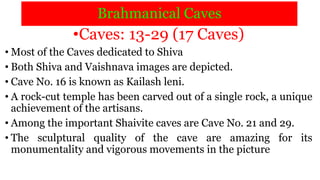
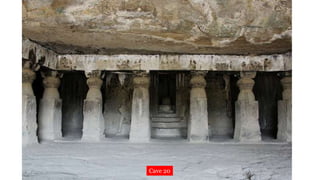
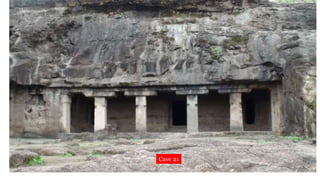
•Caves: 13-29 (17 Caves)
• Most of the Caves dedicated to Shiva
• Both Shiva and Vaishnava images are depicted.
• Cave No. 16 is known as Kailash leni.
• A rock-cut temple has been carved out of a single rock, a unique
achievement of the artisans.
• Among the important Shaivite caves are Cave No. 21 and 29.
• The sculptural quality of the cave are amazing for its
monumentality and vigorous movements in the picture
Architecture
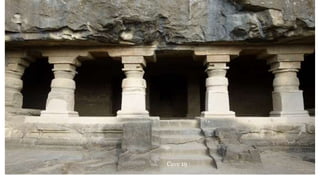
•Construction in the early Hindu caves commenced
before any of the Buddhist or Jaina caves.
•A common feature of these cave temples was a
rock-cut linga at Garbhagruha.
•Garbhagruha shrine is surrounded by the
circumambulation path (parikrama)
An early
19th-century
painting of
Cave 15
Cave 19
Cave 20
Cave 21
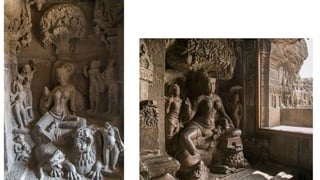
Sculptures
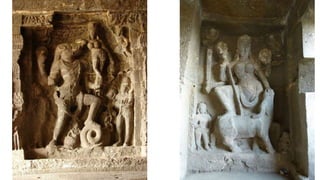
• Sculpture like Ravnanugraha, Andhakasurvadha, Kalyanasundara are
profusely found
• Carvings depicting Parvati and Shiva at leisure, Parvati's wedding to
Shiva, Shiva dancing and Kartikeya (Skanda) have also often found
• Shiva as Gangadhara, Markendeya, Natraja (dancing Shiva),
Andhakasura, Govardhanadhari, Gajendravarada and others
• Whereas among the Vaishnavite themes, the different avatars of
Vishnu are depicted.
• The sculptures at Ellora are monumental.
• The images are heavy and show considerable sophistication in the
handling of sculptural volume.
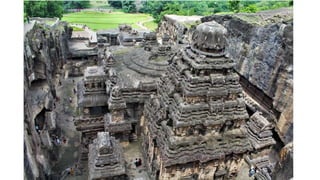
Kailasa Temple
• The most ambitious and impressive of these is Cave 16, the
Kailasa temple.
• Ascribed to Raśtrakutas.
• A chariot-shaped monument dedicated to Shiva.
• It includes
• Garbhgrha,
• Antarala,
• Mandap,
• Nandi shrine,
• Gateway,
• surrounding cloisters, and
• subsidiary shrines.
Plan
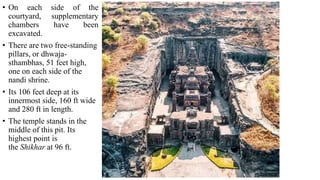
• On each side of the
courtyard, supplementary
chambers have been
excavated.
• There are two free-standing
pillars, or dhwaja-
sthambhas, 51 feet high,
one on each side of the
nandi shrine.
• Its 106 feet deep at its
innermost side, 160 ft wide
and 280 ft in length.
• The temple stands in the
middle of this pit. Its
highest point is
the Shikhar at 96 ft.
Conclusion
•Shaivite and Vaishnavite images, along with, Jain and
Buddhist Caves show the religious harmony of ancient India.
•Show the considerable skill of ancient artists.
•A broad range of typologies and techniques.
•A perfect blend of the architecture of Pallava temples
and Chalukyan temples.
•Presents the zenith of rock-cut architecture
•Ellora caves represent the last phase in the evolution of
rock-cut structural architecture in India.
Thank You

Ellora Caves 16.46.42.pptx

  • 1.
    Monuments of Ellora Dr. ViragSontakke Assistant Professor A.I.H.C. & Archaeology Banaras Hindu University, Varanasi
  • 2.
    Location • It islocally known as “Verul Leni”. • It is located on the Aurangabad- Chalisgaon road at a distance of 30 km north-northwest of Aurangabad, in Maharashtra. • The ancient name of Ellora was Elapura as mentioned in the Chalukyan and Raştrakuta copper plate inscriptions. • Caves are excavated from the Basalt cliffs in the Charanandri Hills.
  • 3.
    Ellora Caves • The34 were excavated on basalt. • Caves belong to the Buddhist, Hindu and Jain religions. • The architecture of the cave are temples and monasteries • Period of construction is supposed to be between the 5th to 10th CE. • Cave no 16, Kailasa temple of Ellora is the largest single monolithic structure and one of the greatest man-made wonders of the world. • These are UNESCO World Heritage Monuments.
  • 4.
    Why? • It suggeststhat the site perhaps played a pivotal role in the socio-economic or political life of the region. • Most of the caves in western India were built on or near ancient trade routes. • The site was situated in the commercial, region. • Being on the trade route the site would have economic importance as well as religious significance. • Probably, monuments were carved at these places to popularize a religion. • Ellora identifies as a sacred centre, related to Shiva.
  • 6.
    Division of theCaves Buddhist Total 12 Cave no.1-12 Hindu Total 17 Cave no. 13-29 Jain Total 05 Cave no. 30-34
  • 7.
  • 9.
    Construction Period Phase DynastyCaves 1 Vakataka/ pre Kalachuri 27 & 28 2 Kalachuri 1 to 10 , 18 to 26 & 29 3 Pre Rashtrakutas/ Chalukyan 11, 12, 14, 17 4 Rashtrakutas 15, 16, 30-33
  • 10.
    Buddhist caves •Buddhist caves:1 to 12 (12 Cave) •Caves 1-5 in the first phase (400 – 600 CE) and •Caves 6-12 in the later phase (650 – 750 CE). •Cave no. 11 (above) & 12 are three-storied monasteries •These caves are located on the Southern side of the Ellora cave collection.
  • 11.
    Architecture of BuddhistCaves 1. Eleven out of twelve Buddhist caves consist of Viharas or monasteries with prayer halls, 2. Large, multistoried structures carved into the mountain face, containing 3. Cells, 4. Sleeping quarters, 5. Kitchens and other rooms. 6. Shrines including carvings 7. Sculptures of Gautama Buddha, & 8. Bodhisattvas and others.
  • 12.
  • 13.
    Caves 11 (above) and12: Three- storey monasteries
  • 14.
    Plan of CaveNo. 5 (Mahawara Cave)
  • 17.
    The Vishvakarma Cave •The most famous of the Buddhist caves is cave 10. • It is Vihara called the “Vishvakarma Cave”. • It is also known as the “Carpenter’s Cave” because the artistic finish gives the rock an appearance of wooden beams. • Beyond its multistoried entry is Chaityagriha (prayer hall). • A 15-foot statue of Buddha seated in a preaching pose. • It has eight subsidiary cells, four in the back wall and four in the right wall. • It had a portico in the front with cells. • It is the only dedicated Chaityagriha amongst the Buddhist group of Ellora Caves. • It follows the pattern of construction of caves 19 and 26 of Ajanta. • It was likely built around 650 CE.
  • 20.
    Buddhist Sculptures • TwelveBuddhist caves having many images belonging to Vajrayana Buddhism like Tara, Mahamayuri, Akshobhya, Avalokiteshwara, Maitrya, Amitabha, etc. • The shrine Buddha images are big; they are generally guarded by the images of Padmpani and Vajrapani. • Buddhist caves are big and are of single, double and triple storeys. • Ajanta also has excavated double-storeyed caves but at Ellora, the triple-storey is a unique achievement. • All the caves were plastered and painted but nothing visible is left.
  • 23.
    Jaina Caves • Fivecaves are dedicated to Jaina Cave no. 30-34 • These caves are separated from the other caves by a distance. • There are two main caves and two unfinished caves among the five. • These caves date back to the 9th and 10th centuries and belong to the Jain sect Digambara. • Cave 30 is called Chhota Kailash; • cave 31 is unfinished; • cave 32 is called the Indra Sabha; • cave 33 is the Jagannath Sabha and • cave 34 is a smaller cave that connects to an opening in Cave 33. • These caves also contain a hall where the monks used to preach.
  • 24.
    Chota Kailash • Cave30 or Chhota Kailash is situated a few meters away from the main group of Jaina caves. • This is fine monolithic structure, carved in imitation of the Brahmanical cave Kailash (Cave 16). • hence its called as Chota Kailash. • It is also a monolithic shrine, had a gopura and executed in Dravida style. • It is without nandimandapa, elephants or free-standing pillars like Kailash. • This cave is left unfinished from outside, while only the interior along with the icons are finished.
  • 31.
    Sculptures • All thecaves have sculptures • Also had paintings on the ceilings as well, some of which can still be seen. • There are prominent sculptures of the Tirthankara like Parsvanatha, as well as the last Tirthankara Mahavira. • Image of Bahubali, also called Gomateshwara, son of the first Tirthankara. • There are also sculptures of Yakshas and Yakshinis. • Ambika, Kubera etc.
  • 36.
    Brahmanical Caves •Caves: 13-29(17 Caves) • Most of the Caves dedicated to Shiva • Both Shiva and Vaishnava images are depicted. • Cave No. 16 is known as Kailash leni. • A rock-cut temple has been carved out of a single rock, a unique achievement of the artisans. • Among the important Shaivite caves are Cave No. 21 and 29. • The sculptural quality of the cave are amazing for its monumentality and vigorous movements in the picture
  • 37.
    Architecture •Construction in theearly Hindu caves commenced before any of the Buddhist or Jaina caves. •A common feature of these cave temples was a rock-cut linga at Garbhagruha. •Garbhagruha shrine is surrounded by the circumambulation path (parikrama)
  • 38.
  • 39.
  • 40.
  • 41.
  • 42.
    Sculptures • Sculpture likeRavnanugraha, Andhakasurvadha, Kalyanasundara are profusely found • Carvings depicting Parvati and Shiva at leisure, Parvati's wedding to Shiva, Shiva dancing and Kartikeya (Skanda) have also often found • Shiva as Gangadhara, Markendeya, Natraja (dancing Shiva), Andhakasura, Govardhanadhari, Gajendravarada and others • Whereas among the Vaishnavite themes, the different avatars of Vishnu are depicted. • The sculptures at Ellora are monumental. • The images are heavy and show considerable sophistication in the handling of sculptural volume.
  • 48.
    Kailasa Temple • Themost ambitious and impressive of these is Cave 16, the Kailasa temple. • Ascribed to Raśtrakutas. • A chariot-shaped monument dedicated to Shiva. • It includes • Garbhgrha, • Antarala, • Mandap, • Nandi shrine, • Gateway, • surrounding cloisters, and • subsidiary shrines.
  • 49.
    Plan • On eachside of the courtyard, supplementary chambers have been excavated. • There are two free-standing pillars, or dhwaja- sthambhas, 51 feet high, one on each side of the nandi shrine. • Its 106 feet deep at its innermost side, 160 ft wide and 280 ft in length. • The temple stands in the middle of this pit. Its highest point is the Shikhar at 96 ft.
  • 50.
    Conclusion •Shaivite and Vaishnaviteimages, along with, Jain and Buddhist Caves show the religious harmony of ancient India. •Show the considerable skill of ancient artists. •A broad range of typologies and techniques. •A perfect blend of the architecture of Pallava temples and Chalukyan temples. •Presents the zenith of rock-cut architecture •Ellora caves represent the last phase in the evolution of rock-cut structural architecture in India.
  • 51.