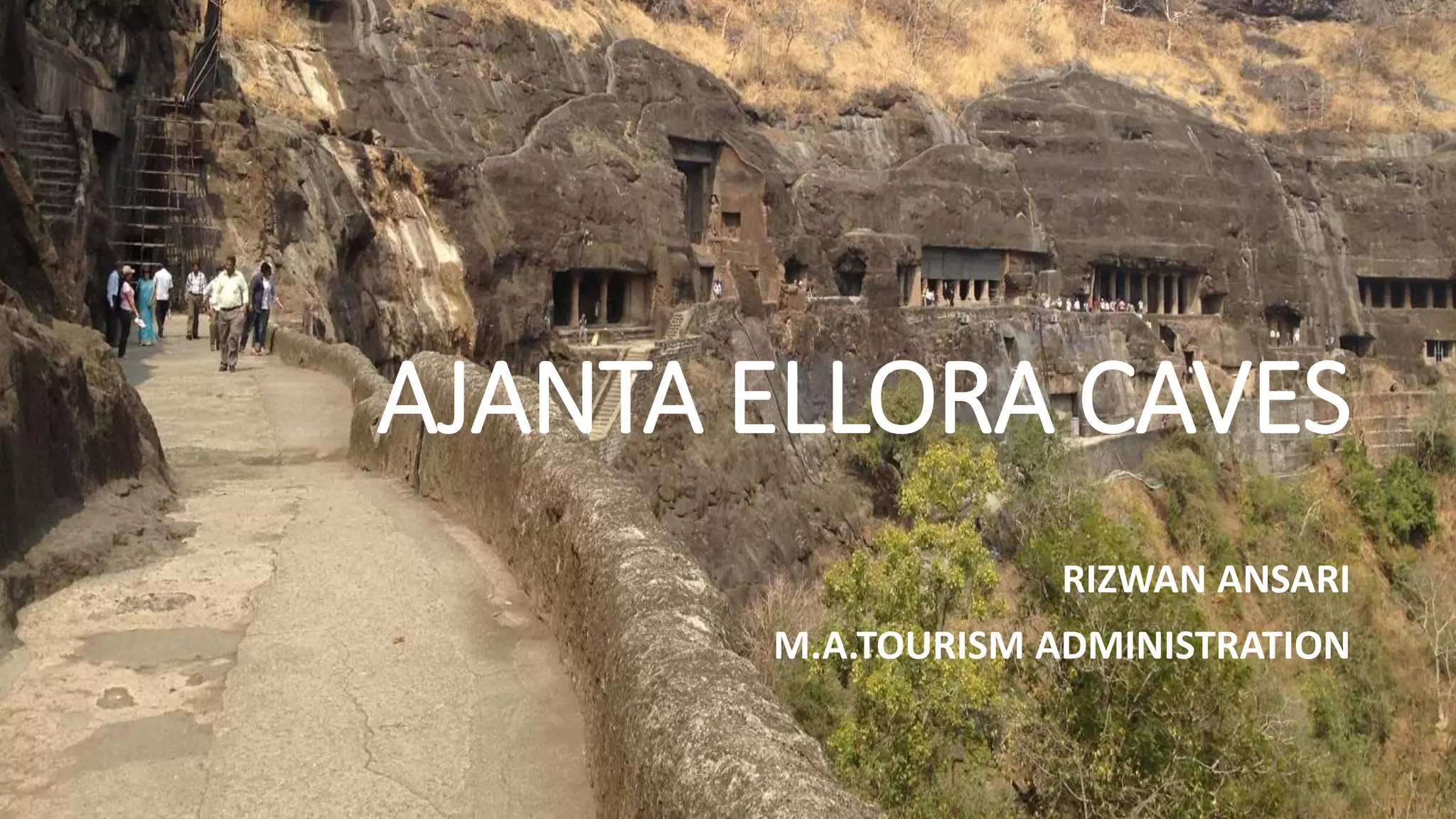





AJANTA ELLORA CAVES 
RIZWAN ANSARI 
M.A.TOURISM ADMINISTRATION
CONTENT 
 ABOUT AJANTA & ELLORA CAVES 
 AJANTA CAVES 
 THE FACADE 
 THE PAINTINGS 
 ELLORA CAVES 
 THE DASHAVATARA 
 OTHER HINDU CAVES 
 THE JAIN CAVES 
 THE INDRA SABHA 
 HOW TO REACH 
 ENTRY FEE AND TIMING
ABOUT AJANTA & ELLORA CAVES 
 Ajanta and nearby Ellora caves are one of 
the most bewildering archaeological 
places in India. 
 Located in the maharashtra, the site is 
about 300 kilometers northeast of 
mumbai, has been designated as world 
heritage site by UNESCO. 
 These caves are not natural but man-made, 
built by cutting huge granite 
hillside. It is said that caves were built by 
Buddhist, Hindu and Jain monks, who 
worshiped and meditated in the caves. 
 Ajanta and Ellora Caves can be visited 
throughout the year but the best time 
would be from June to March.
AJANTA CAVES 
 These historical manmade caves comprise of beautiful paintings on the walls and ceilings that 
depict the life of the Buddha. 
 At Ajanta, the paintings on the walls, illustrate the events in the life of Gautama Buddha.
AJANTA CAVES CONTINUE…… 
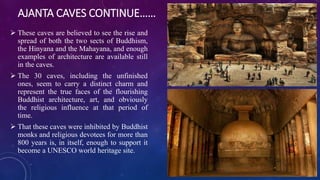
 These caves are believed to see the rise and 
spread of both the two sects of Buddhism, 
the Hinyana and the Mahayana, and enough 
examples of architecture are available still 
in the caves. 
 The 30 caves, including the unfinished 
ones, seem to carry a distinct charm and 
represent the true faces of the flourishing 
Buddhist architecture, art, and obviously 
the religious influence at that period of 
time. 
 That these caves were inhibited by Buddhist 
monks and religious devotees for more than 
800 years is, in itself, enough to support it 
become a UNESCO world heritage site.
 The caves are in the state of Marathas, Maharashtra, 
100 kilometers from the city of Aurangabad. The 
caves are by the river Waghora, in the midst of the 
Sahyadri hills burried by thick forest all around. 
 The Ajanta Caves were discovered by a British 
Captain, John Smith in 1819, while on a hunting 
expedition.
 The Ajanta caves are important mainly to see the fine line of transfer of the Hinyana and the 
Mahayana sect, as for the fact he Hianyana did not worship any god or goddess but they used 
stupas, and other rock forms to represent Buddha. 
 The Ajanta Caves, accidentally discovered by a shooting party in 1829. 
 They are entirely Buddhist and date from about 200 BC to approximately 650 AD. 
 It is of interest to note that the Chinese Buddhist travellers, Hiuen Tsang and Fa Hien, refer to 
Ajanta in accounts of their travels. 
 The caves include both Chaitya (Prayer Halls) and monasteries and have both types of 
architecture and art besides paintings and scriptures, of the two sects Hinyana and Mahayana. 
 The caves are unique in that they combine three forms of art—architecture, sculpture and 
painting. 
 There are beautiful images of nymphs and princesses well portrayed. 
 Caves No. 13, 12, 10, 9 and 8 (according to chronological sequence) belong to the Hinayana 
period.
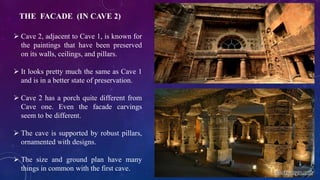
THE FACADE (IN CAVE 2) 
 Cave 2, adjacent to Cave 1, is known for 
the paintings that have been preserved 
on its walls, ceilings, and pillars. 
 It looks pretty much the same as Cave 1 
and is in a better state of preservation. 
 Cave 2 has a porch quite different from 
Cave one. Even the facade carvings 
seem to be different. 
 The cave is supported by robust pillars, 
ornamented with designs. 
 The size and ground plan have many 
things in common with the first cave.
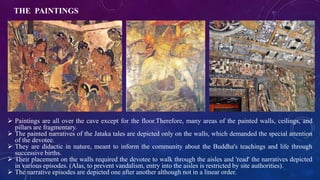
THE PAINTINGS 
 Paintings are all over the cave except for the floor.Therefore, many areas of the painted walls, ceilings, and 
pillars are fragmentary. 
 The painted narratives of the Jataka tales are depicted only on the walls, which demanded the special attention 
of the devotee. 
 They are didactic in nature, meant to inform the community about the Buddha's teachings and life through 
successive births. 
 Their placement on the walls required the devotee to walk through the aisles and 'read' the narratives depicted 
in various episodes. (Alas, to prevent vandalism, entry into the aisles is restricted by site authorities). 
 The narrative episodes are depicted one after another although not in a linear order.
 No. 11, 14, 15, 16, 17, 19, 18, and 
20 and perhaps No. 6 and 7 
belong to a later Mahayana period 
ending approximately AD 580 
No, 1 to 5 and 21 to 29, also 
Mahayana in character, came into 
existence between AD 500 and 
650. 
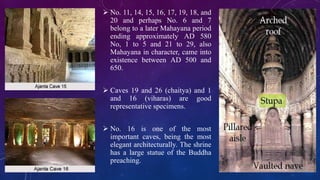
 Caves 19 and 26 (chaitya) and 1 
and 16 (viharas) are good 
representative specimens. 
 No. 16 is one of the most 
important caves, being the most 
elegant architecturally. The shrine 
has a large statue of the Buddha 
preaching.
ELLORA CAVES 
 Ellora has 34 caves with fantastic rock cut 
sculptures,built in the period of 350 AD to 
750AD, Ellora caves came later than Ajanta but 
hold the same mystical charm that is typical of 
these caves. 
 The Andakasuramardana incarnation of lord Shiva 
is special and is a must see for any art lover, as are 
the other important structures, depicting various 
dance forms of Shiva. 
 This cave contains the famous fresco of ‘The 
Dying Princess’. 
 12 Buddhist, 5 Jain and 17 Brahmanical caves 
being located here side by side.Caves depict Lord 
Buddha in various poses. 
 The 17 Hindu Caves embody carvings of the 
Hindu Gods- Shiva, Vishnu, Durga, Parvati and 
animals.
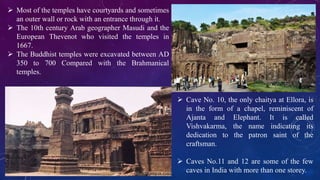
 Most of the temples have courtyards and sometimes 
an outer wall or rock with an entrance through it. 
 The 10th century Arab geographer Masudi and the 
European Thevenot who visited the temples in 
1667. 
 The Buddhist temples were excavated between AD 
350 to 700 Compared with the Brahmanical 
temples. 
 Cave No. 10, the only chaitya at Ellora, is 
in the form of a chapel, reminiscent of 
Ajanta and Elephant. It is called 
Vishvakarma, the name indicating its 
dedication to the patron saint of the 
craftsman. 
 Caves No.11 and 12 are some of the few 
caves in India with more than one storey.
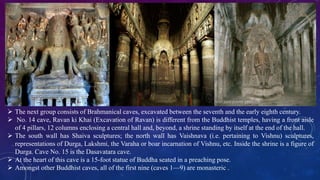
 The next group consists of Brahmanical caves, excavated between the seventh and the early eighth century. 
 No. 14 cave, Ravan ki Khai (Excavation of Ravan) is different from the Buddhist temples, having a front aisle 
of 4 pillars, 12 columns enclosing a central hall and, beyond, a shrine standing by itself at the end of the hall. 
 The south wall has Shaiva sculptures; the north wall has Vaishnava (i.e. pertaining to Vishnu) sculptures, 
representations of Durga, Lakshmi, the Varaha or boar incarnation of Vishnu, etc. Inside the shrine is a figure of 
Durga. Cave No. 15 is the Dasavatara cave. 
 At the heart of this cave is a 15-foot statue of Buddha seated in a preaching pose. 
 Amongst other Buddhist caves, all of the first nine (caves 1—9) are monasteric .
 Cave 1 is a vihara with eight cells, four in the back wall and four in the right wall. It had a 
portico in the front with a cell. 
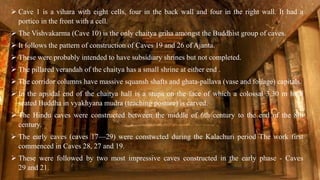
 The Vishvakarma (Cave 10) is the only chaitya griha amongst the Buddhist group of caves. 
 It follows the pattern of construction of Caves 19 and 26 of Ajanta. 
 These were probably intended to have subsidiary shrines but not completed. 
 The pillared verandah of the chaitya has a small shrine at either end . 
 The corridor columns have massive squansh shafts and ghata-pallava (vase and foliage) capitals. 
 In the apsidal end of the chaitya hall is a stupa on the face of which a colossal 3.30 m high 
seated Buddha in vyakhyana mudra (teaching posture) is carved. 
 The Hindu caves were constructed between the middle of 6th century to the end of the 8th 
century. 
 The early caves (caves 17—29) were constwcted during the Kalachuri period The work first 
commenced in Caves 28, 27 and 19. 
 These were followed by two most impressive caves constructed in the early phase - Caves 
29 and 21.
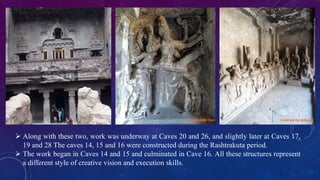
 Along with these two, work was underway at Caves 20 and 26, and slightly later at Caves 17, 
19 and 28 The caves 14, 15 and 16 were constructed during the Rashtrakuta period. 
 The work began in Caves 14 and 15 and culminated in Cave 16. All these structures represent 
a different style of creative vision and execution skills.
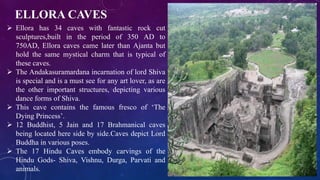
THE KAILASANATHA 
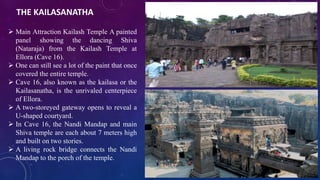
 Main Attraction Kailash Temple A painted 
panel showing the dancing Shiva 
(Nataraja) from the Kailash Temple at 
Ellora (Cave 16). 
 One can still see a lot of the paint that once 
covered the entire temple. 
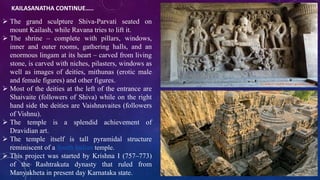
 Cave 16, also known as the kailasa or the 
Kailasanatha, is the unrivaled centerpiece 
of Ellora. 
 A two-storeyed gateway opens to reveal a 
U-shaped courtyard. 
 In Cave 16, the Nandi Mandap and main 
Shiva temple are each about 7 meters high 
and built on two stories. 
 A living rock bridge connects the Nandi 
Mandap to the porch of the temple.
KAILASANATHA CONTINUE….. 
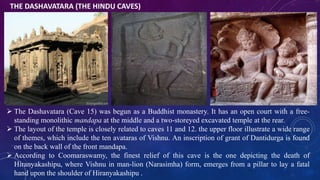
 The grand sculpture Shiva-Parvati seated on 
mount Kailash, while Ravana tries to lift it. 
 The shrine – complete with pillars, windows, 
inner and outer rooms, gathering halls, and an 
enormous lingam at its heart – carved from living 
stone, is carved with niches, pilasters, windows as 
well as images of deities, mithunas (erotic male 
and female figures) and other figures. 
 Most of the deities at the left of the entrance are 
Shaivaite (followers of Shiva) while on the right 
hand side the deities are Vaishnavaites (followers 
of Vishnu). 
 The temple is a splendid achievement of 
Dravidian art. 
 The temple itself is tall pyramidal structure 
reminiscent of a South Indian temple. 
 This project was started by Krishna I (757–773) 
of the Rashtrakuta dynasty that ruled from 
Manyakheta in present day Karnataka state.
THE DASHAVATARA (THE HINDU CAVES) 
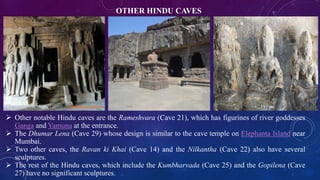
 The Dashavatara (Cave 15) was begun as a Buddhist monastery. It has an open court with a free-standing 
monolithic mandapa at the middle and a two-storeyed excavated temple at the rear. 
 The layout of the temple is closely related to caves 11 and 12. the upper floor illustrate a wide range 
of themes, which include the ten avataras of Vishnu. An inscription of grant of Dantidurga is found 
on the back wall of the front mandapa. 
 According to Coomaraswamy, the finest relief of this cave is the one depicting the death of 
Hiranyakashipu, where Vishnu in man-lion (Narasimha) form, emerges from a pillar to lay a fatal 
hand upon the shoulder of Hiranyakashipu .
OTHER HINDU CAVES 
 Other notable Hindu caves are the Rameshvara (Cave 21), which has figurines of river goddesses 
Ganga and Yamuna at the entrance. 
 The Dhumar Lena (Cave 29) whose design is similar to the cave temple on Elephanta Island near 
Mumbai. 
 Two other caves, the Ravan ki Khai (Cave 14) and the Nilkantha (Cave 22) also have several 
sculptures. 
 The rest of the Hindu caves, which include the Kumbharvada (Cave 25) and the Gopilena (Cave 
27) have no significant sculptures.
THE JAIN CAVES 
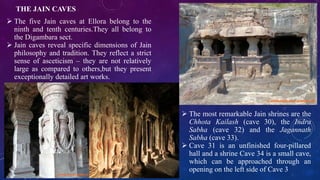
 The five Jain caves at Ellora belong to the 
ninth and tenth centuries.They all belong to 
the Digambara sect. 
 Jain caves reveal specific dimensions of Jain 
philosophy and tradition. They reflect a strict 
sense of asceticism – they are not relatively 
large as compared to others,but they present 
exceptionally detailed art works. 
 The most remarkable Jain shrines are the 
Chhota Kailash (cave 30), the Indra 
Sabha (cave 32) and the Jagannath 
Sabha (cave 33). 
 Cave 31 is an unfinished four-pillared 
hall and a shrine Cave 34 is a small cave, 
which can be approached through an 
opening on the left side of Cave 3
THE INDRA SABHA (JAIN CAVES) 
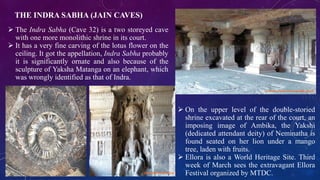
 The Indra Sabha (Cave 32) is a two storeyed cave 
with one more monolithic shrine in its court. 
 It has a very fine carving of the lotus flower on the 
ceiling. It got the appellation, Indra Sabha probably 
it is significantly ornate and also because of the 
sculpture of Yaksha Matanga on an elephant, which 
was wrongly identified as that of Indra. 
 On the upper level of the double-storied 
shrine excavated at the rear of the court, an 
imposing image of Ambika, the Yakshi 
(dedicated attendant deity) of Neminatha is 
found seated on her lion under a mango 
tree, laden with fruits. 
 Ellora is also a World Heritage Site. Third 
week of March sees the extravagant Ellora 
Festival organized by MTDC.
ENTRY FEE OF AJANTA & ELLORA CAVES 
 Citizens of India and visitors of SAARC 
(Bangladesh, Nepal, Bhutan, Sri Lanka, 
Pakistan, Maldives and Afghanistan) and 
BIMSTEC Countries (Bangladesh, Nepal, 
Bhutan, Sri Lanka, Thailand and Myanmar) - Rs. 
10 per head. 
 Others: US $ 5 or Indian Rs. 250/- per head 
 children up to 15 years free 
 A additional fee of Rs.25 is charged if you are 
taking a video camera with you 
TIMING 
 Ajanta Open from 9 A.M. to 5 P.M. 
 Closed on Monday. 
 Ellora Open from sunrise to sunset 
 Closed on Tuesday.
HOW TO GET TO AJANTA & ELLORA CAVES 
 By Air : Aurangabad, 100 kms away is the nearest 
airport. Direct flights available from Delhi, Mumbai, 
Jaipur etc. 
 By Rail : Aurangabad is directly connected by rail with 
the rest of India. There is a direct train from Delhi to 
Aurangabad Distance between Ajanta and Ellora caves is 
100 kilometers and can be done by car in about two 
hours 
 By Road :Well-maintained roads link Ajanta to 
Mumbai,Buses and private taxis also are available in 
many nearby cities for visiting Ajanta and Ellora caves. 
Some tour organizers offer special rates from Mumbai to 
see the caves.From Aurangabad - Ajanta- 100 kms, 
Bombay- 390 kms, Ellora- 32 kms, Nanded- 275 kms, 
Nasik- 224 kms, Pune- 232 kms.
Ajanta ellora caves

Ajanta ellora caves

  • 1.
    AJANTA ELLORA CAVES RIZWAN ANSARI M.A.TOURISM ADMINISTRATION
  • 2.
    CONTENT  ABOUTAJANTA & ELLORA CAVES  AJANTA CAVES  THE FACADE  THE PAINTINGS  ELLORA CAVES  THE DASHAVATARA  OTHER HINDU CAVES  THE JAIN CAVES  THE INDRA SABHA  HOW TO REACH  ENTRY FEE AND TIMING
  • 3.
    ABOUT AJANTA &ELLORA CAVES  Ajanta and nearby Ellora caves are one of the most bewildering archaeological places in India.  Located in the maharashtra, the site is about 300 kilometers northeast of mumbai, has been designated as world heritage site by UNESCO.  These caves are not natural but man-made, built by cutting huge granite hillside. It is said that caves were built by Buddhist, Hindu and Jain monks, who worshiped and meditated in the caves.  Ajanta and Ellora Caves can be visited throughout the year but the best time would be from June to March.
  • 4.
    AJANTA CAVES These historical manmade caves comprise of beautiful paintings on the walls and ceilings that depict the life of the Buddha.  At Ajanta, the paintings on the walls, illustrate the events in the life of Gautama Buddha.
  • 5.
    AJANTA CAVES CONTINUE……  These caves are believed to see the rise and spread of both the two sects of Buddhism, the Hinyana and the Mahayana, and enough examples of architecture are available still in the caves.  The 30 caves, including the unfinished ones, seem to carry a distinct charm and represent the true faces of the flourishing Buddhist architecture, art, and obviously the religious influence at that period of time.  That these caves were inhibited by Buddhist monks and religious devotees for more than 800 years is, in itself, enough to support it become a UNESCO world heritage site.
  • 6.
     The cavesare in the state of Marathas, Maharashtra, 100 kilometers from the city of Aurangabad. The caves are by the river Waghora, in the midst of the Sahyadri hills burried by thick forest all around.  The Ajanta Caves were discovered by a British Captain, John Smith in 1819, while on a hunting expedition.
  • 7.
     The Ajantacaves are important mainly to see the fine line of transfer of the Hinyana and the Mahayana sect, as for the fact he Hianyana did not worship any god or goddess but they used stupas, and other rock forms to represent Buddha.  The Ajanta Caves, accidentally discovered by a shooting party in 1829.  They are entirely Buddhist and date from about 200 BC to approximately 650 AD.  It is of interest to note that the Chinese Buddhist travellers, Hiuen Tsang and Fa Hien, refer to Ajanta in accounts of their travels.  The caves include both Chaitya (Prayer Halls) and monasteries and have both types of architecture and art besides paintings and scriptures, of the two sects Hinyana and Mahayana.  The caves are unique in that they combine three forms of art—architecture, sculpture and painting.  There are beautiful images of nymphs and princesses well portrayed.  Caves No. 13, 12, 10, 9 and 8 (according to chronological sequence) belong to the Hinayana period.
  • 8.
    THE FACADE (INCAVE 2)  Cave 2, adjacent to Cave 1, is known for the paintings that have been preserved on its walls, ceilings, and pillars.  It looks pretty much the same as Cave 1 and is in a better state of preservation.  Cave 2 has a porch quite different from Cave one. Even the facade carvings seem to be different.  The cave is supported by robust pillars, ornamented with designs.  The size and ground plan have many things in common with the first cave.
  • 9.
    THE PAINTINGS Paintings are all over the cave except for the floor.Therefore, many areas of the painted walls, ceilings, and pillars are fragmentary.  The painted narratives of the Jataka tales are depicted only on the walls, which demanded the special attention of the devotee.  They are didactic in nature, meant to inform the community about the Buddha's teachings and life through successive births.  Their placement on the walls required the devotee to walk through the aisles and 'read' the narratives depicted in various episodes. (Alas, to prevent vandalism, entry into the aisles is restricted by site authorities).  The narrative episodes are depicted one after another although not in a linear order.
  • 10.
     No. 11,14, 15, 16, 17, 19, 18, and 20 and perhaps No. 6 and 7 belong to a later Mahayana period ending approximately AD 580 No, 1 to 5 and 21 to 29, also Mahayana in character, came into existence between AD 500 and 650.  Caves 19 and 26 (chaitya) and 1 and 16 (viharas) are good representative specimens.  No. 16 is one of the most important caves, being the most elegant architecturally. The shrine has a large statue of the Buddha preaching.
  • 11.
    ELLORA CAVES Ellora has 34 caves with fantastic rock cut sculptures,built in the period of 350 AD to 750AD, Ellora caves came later than Ajanta but hold the same mystical charm that is typical of these caves.  The Andakasuramardana incarnation of lord Shiva is special and is a must see for any art lover, as are the other important structures, depicting various dance forms of Shiva.  This cave contains the famous fresco of ‘The Dying Princess’.  12 Buddhist, 5 Jain and 17 Brahmanical caves being located here side by side.Caves depict Lord Buddha in various poses.  The 17 Hindu Caves embody carvings of the Hindu Gods- Shiva, Vishnu, Durga, Parvati and animals.
  • 12.
     Most ofthe temples have courtyards and sometimes an outer wall or rock with an entrance through it.  The 10th century Arab geographer Masudi and the European Thevenot who visited the temples in 1667.  The Buddhist temples were excavated between AD 350 to 700 Compared with the Brahmanical temples.  Cave No. 10, the only chaitya at Ellora, is in the form of a chapel, reminiscent of Ajanta and Elephant. It is called Vishvakarma, the name indicating its dedication to the patron saint of the craftsman.  Caves No.11 and 12 are some of the few caves in India with more than one storey.
  • 13.
     The nextgroup consists of Brahmanical caves, excavated between the seventh and the early eighth century.  No. 14 cave, Ravan ki Khai (Excavation of Ravan) is different from the Buddhist temples, having a front aisle of 4 pillars, 12 columns enclosing a central hall and, beyond, a shrine standing by itself at the end of the hall.  The south wall has Shaiva sculptures; the north wall has Vaishnava (i.e. pertaining to Vishnu) sculptures, representations of Durga, Lakshmi, the Varaha or boar incarnation of Vishnu, etc. Inside the shrine is a figure of Durga. Cave No. 15 is the Dasavatara cave.  At the heart of this cave is a 15-foot statue of Buddha seated in a preaching pose.  Amongst other Buddhist caves, all of the first nine (caves 1—9) are monasteric .
  • 14.
     Cave 1is a vihara with eight cells, four in the back wall and four in the right wall. It had a portico in the front with a cell.  The Vishvakarma (Cave 10) is the only chaitya griha amongst the Buddhist group of caves.  It follows the pattern of construction of Caves 19 and 26 of Ajanta.  These were probably intended to have subsidiary shrines but not completed.  The pillared verandah of the chaitya has a small shrine at either end .  The corridor columns have massive squansh shafts and ghata-pallava (vase and foliage) capitals.  In the apsidal end of the chaitya hall is a stupa on the face of which a colossal 3.30 m high seated Buddha in vyakhyana mudra (teaching posture) is carved.  The Hindu caves were constructed between the middle of 6th century to the end of the 8th century.  The early caves (caves 17—29) were constwcted during the Kalachuri period The work first commenced in Caves 28, 27 and 19.  These were followed by two most impressive caves constructed in the early phase - Caves 29 and 21.
  • 15.
     Along withthese two, work was underway at Caves 20 and 26, and slightly later at Caves 17, 19 and 28 The caves 14, 15 and 16 were constructed during the Rashtrakuta period.  The work began in Caves 14 and 15 and culminated in Cave 16. All these structures represent a different style of creative vision and execution skills.
  • 16.
    THE KAILASANATHA Main Attraction Kailash Temple A painted panel showing the dancing Shiva (Nataraja) from the Kailash Temple at Ellora (Cave 16).  One can still see a lot of the paint that once covered the entire temple.  Cave 16, also known as the kailasa or the Kailasanatha, is the unrivaled centerpiece of Ellora.  A two-storeyed gateway opens to reveal a U-shaped courtyard.  In Cave 16, the Nandi Mandap and main Shiva temple are each about 7 meters high and built on two stories.  A living rock bridge connects the Nandi Mandap to the porch of the temple.
  • 17.
    KAILASANATHA CONTINUE….. The grand sculpture Shiva-Parvati seated on mount Kailash, while Ravana tries to lift it.  The shrine – complete with pillars, windows, inner and outer rooms, gathering halls, and an enormous lingam at its heart – carved from living stone, is carved with niches, pilasters, windows as well as images of deities, mithunas (erotic male and female figures) and other figures.  Most of the deities at the left of the entrance are Shaivaite (followers of Shiva) while on the right hand side the deities are Vaishnavaites (followers of Vishnu).  The temple is a splendid achievement of Dravidian art.  The temple itself is tall pyramidal structure reminiscent of a South Indian temple.  This project was started by Krishna I (757–773) of the Rashtrakuta dynasty that ruled from Manyakheta in present day Karnataka state.
  • 18.
    THE DASHAVATARA (THEHINDU CAVES)  The Dashavatara (Cave 15) was begun as a Buddhist monastery. It has an open court with a free-standing monolithic mandapa at the middle and a two-storeyed excavated temple at the rear.  The layout of the temple is closely related to caves 11 and 12. the upper floor illustrate a wide range of themes, which include the ten avataras of Vishnu. An inscription of grant of Dantidurga is found on the back wall of the front mandapa.  According to Coomaraswamy, the finest relief of this cave is the one depicting the death of Hiranyakashipu, where Vishnu in man-lion (Narasimha) form, emerges from a pillar to lay a fatal hand upon the shoulder of Hiranyakashipu .
  • 19.
    OTHER HINDU CAVES  Other notable Hindu caves are the Rameshvara (Cave 21), which has figurines of river goddesses Ganga and Yamuna at the entrance.  The Dhumar Lena (Cave 29) whose design is similar to the cave temple on Elephanta Island near Mumbai.  Two other caves, the Ravan ki Khai (Cave 14) and the Nilkantha (Cave 22) also have several sculptures.  The rest of the Hindu caves, which include the Kumbharvada (Cave 25) and the Gopilena (Cave 27) have no significant sculptures.
  • 20.
    THE JAIN CAVES  The five Jain caves at Ellora belong to the ninth and tenth centuries.They all belong to the Digambara sect.  Jain caves reveal specific dimensions of Jain philosophy and tradition. They reflect a strict sense of asceticism – they are not relatively large as compared to others,but they present exceptionally detailed art works.  The most remarkable Jain shrines are the Chhota Kailash (cave 30), the Indra Sabha (cave 32) and the Jagannath Sabha (cave 33).  Cave 31 is an unfinished four-pillared hall and a shrine Cave 34 is a small cave, which can be approached through an opening on the left side of Cave 3
  • 21.
    THE INDRA SABHA(JAIN CAVES)  The Indra Sabha (Cave 32) is a two storeyed cave with one more monolithic shrine in its court.  It has a very fine carving of the lotus flower on the ceiling. It got the appellation, Indra Sabha probably it is significantly ornate and also because of the sculpture of Yaksha Matanga on an elephant, which was wrongly identified as that of Indra.  On the upper level of the double-storied shrine excavated at the rear of the court, an imposing image of Ambika, the Yakshi (dedicated attendant deity) of Neminatha is found seated on her lion under a mango tree, laden with fruits.  Ellora is also a World Heritage Site. Third week of March sees the extravagant Ellora Festival organized by MTDC.
  • 22.
    ENTRY FEE OFAJANTA & ELLORA CAVES  Citizens of India and visitors of SAARC (Bangladesh, Nepal, Bhutan, Sri Lanka, Pakistan, Maldives and Afghanistan) and BIMSTEC Countries (Bangladesh, Nepal, Bhutan, Sri Lanka, Thailand and Myanmar) - Rs. 10 per head.  Others: US $ 5 or Indian Rs. 250/- per head  children up to 15 years free  A additional fee of Rs.25 is charged if you are taking a video camera with you TIMING  Ajanta Open from 9 A.M. to 5 P.M.  Closed on Monday.  Ellora Open from sunrise to sunset  Closed on Tuesday.
  • 23.
    HOW TO GETTO AJANTA & ELLORA CAVES  By Air : Aurangabad, 100 kms away is the nearest airport. Direct flights available from Delhi, Mumbai, Jaipur etc.  By Rail : Aurangabad is directly connected by rail with the rest of India. There is a direct train from Delhi to Aurangabad Distance between Ajanta and Ellora caves is 100 kilometers and can be done by car in about two hours  By Road :Well-maintained roads link Ajanta to Mumbai,Buses and private taxis also are available in many nearby cities for visiting Ajanta and Ellora caves. Some tour organizers offer special rates from Mumbai to see the caves.From Aurangabad - Ajanta- 100 kms, Bombay- 390 kms, Ellora- 32 kms, Nanded- 275 kms, Nasik- 224 kms, Pune- 232 kms.