Kandariya Mahadev
Temple
Dr. Virag Sontakke
Introduction
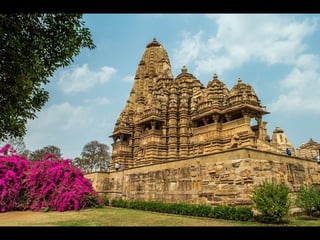
• Kandariya Mahadeva Temple is located in
the Chatarpur district of Madhya Pradesh.
• Constructed by Chandel Dynasty
• Temple complex known as “Khajuraho” due to the
present village.
• Total 22 temples spread in 6 square kilometres
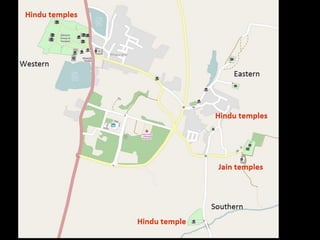
• Temple divided various group (eastern, western and
Southern)
• Kandariya Mahadev situated in Western group.
• It’s a complete specimen and largest in the group
Historical Background
• Chandela were Vassel of Gurjar-Pratihar
• Subsequently defeated Gurjar –Pratihar and become
independent
• Controlled the Bundelkhand known as Jejakbhukti
• Mahoba was once capital the Chnandela dynasty
• Kandariya Mahadev temple was built by of Vidyadhara
ruled from 1003 to 1035 CE .
• Epigraph on the mandapa pilaster of temple, mentioning a
king called Virimda who identified with Vidyadhara.
• Khajurao known as Kharjjuravahaka.
• The site was rediscovered in 1838 by a British officer,
Captain T.S. Burt.
• In original there were about 85 temples, now only 24
survived.
• Temples constructed between (950-1050 CE)
General Features of the Khajuraho Temples
1. Stone: fine grained sand stones (buff, pink, pale yellow)
2. Brought from Panna, east bank of Panna river
3. Temples Belong to Jain, Vaishanava and Shaiva
4. Not huge in size
5. Not inside the compound hall
6. No Courtyard
7. Art & Sculptural Decoration inside too
8. Maximum height: 100 ft
9. Erected upon high plinth (Jagti), open space all around
the temple
10. Axis east-west
11. Some have balconied window in Madapa
12. Rising high from mandapa to garbhagruha
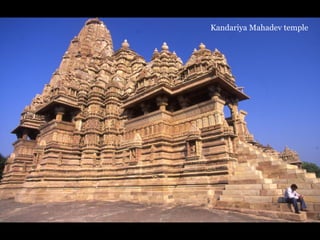
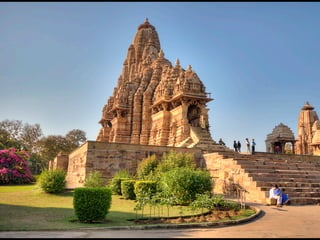
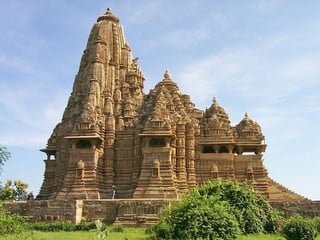
Kandariya Mahadev temple
Kandariya Mahadev Temple
• Dedicated to Shiva
• Kandariya Mahadeva: the Great God of the Cave
• Built on high platform /plinth (4 metres (13 ft)
• Its total height is 116.5 feet above the ground and 88
feet above Jagti.
• Plan & Elevation:
1. Length: 31 metres (102 ft)
2. Width: 20 metres (66 ft)
3. Height (Shikhra): 116.5 feet ,
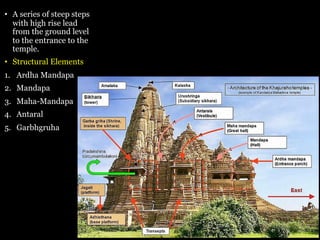
• A series of steep steps
with high rise lead
from the ground level
to the entrance to the
temple.
• Structural Elements
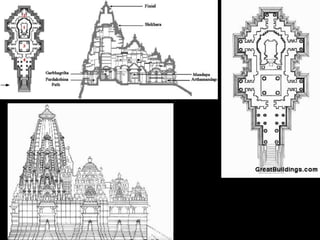
1. Ardha Mandapa
2. Mandapa
3. Maha-Mandapa
4. Antaral
5. Garbhgruha
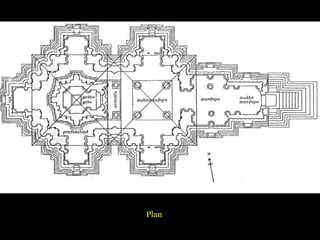
Plan
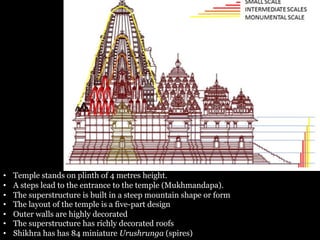
• Temple stands on plinth of 4 metres height.
• A steps lead to the entrance to the temple (Mukhmandapa).
• The superstructure is built in a steep mountain shape or form
• The layout of the temple is a five-part design
• Outer walls are highly decorated
• The superstructure has richly decorated roofs
• Shikhra has has 84 miniature Urushrunga (spires)
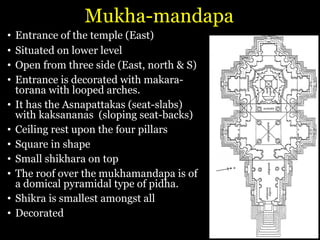
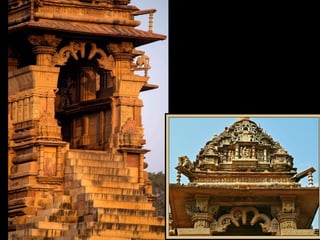
Mukha-mandapa
• Entrance of the temple (East)
• Situated on lower level
• Open from three side (East, north & S)
• Entrance is decorated with makara-
torana with looped arches.
• It has the Asnapattakas (seat-slabs)
with kaksananas (sloping seat-backs)
• Ceiling rest upon the four pillars
• Square in shape
• Small shikhara on top
• The roof over the mukhamandapa is of
a domical pyramidal type of pidha.
• Shikra is smallest amongst all
• Decorated
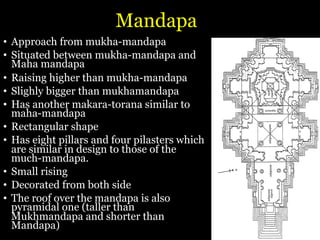
Mandapa
• Approach from mukha-mandapa
• Situated between mukha-mandapa and
Maha mandapa
• Raising higher than mukha-mandapa
• Slighly bigger than mukhamandapa
• Has another makara-torana similar to
maha-mandapa
• Rectangular shape
• Has eight pillars and four pilasters which
are similar in design to those of the
much-mandapa.
• Small rising
• Decorated from both side
• The roof over the mandapa is also
pyramidal one (taller than

Mukhmandapa and shorter than
Mandapa)
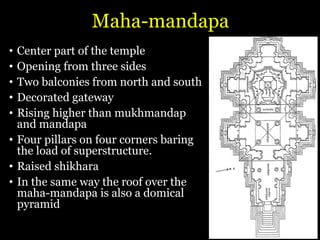
Maha-mandapa
• Center part of the temple
• Opening from three sides
• Two balconies from north and south
• Decorated gateway
• Rising higher than mukhmandap
and mandapa
• Four pillars on four corners baring
the load of superstructure.
• Raised shikhara
• In the same way the roof over the
maha-mandapa is also a domical
pyramid
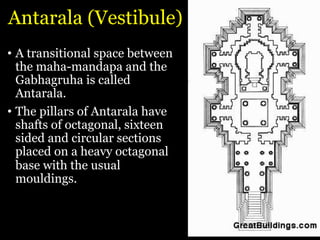
Antarala (Vestibule)
• A transitional space between
the maha-mandapa and the
Gabhagruha is called
Antarala.
• The pillars of Antarala have
shafts of octagonal, sixteen
sided and circular sections
placed on a heavy octagonal
base with the usual
mouldings.
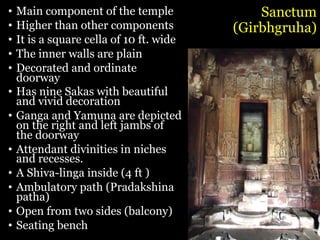
Sanctum
(Girbhgruha)
• Main component of the temple
• Higher than other components
• It is a square cella of 10 ft. wide
• The inner walls are plain
• Decorated and ordinate
doorway
• Has nine Sakas with beautiful
and vivid decoration
• Ganga and Yamuna are depicted
on the right and left jambs of
the doorway
• Attendant divinities in niches
and recesses.
• A Shiva-linga inside (4 ft )
• Ambulatory path (Pradakshina
patha)
• Open from two sides (balcony)
• Seating bench
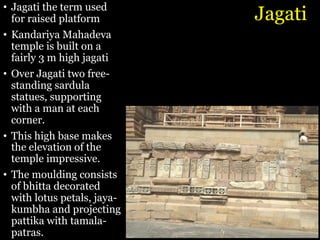
Jagati
• Jagati the term used
for raised platform
• Kandariya Mahadeva
temple is built on a
fairly 3 m high jagati
• Over Jagati two free-
standing sardula
statues, supporting
with a man at each
corner.
• This high base makes
the elevation of the
temple impressive.
• The moulding consists
of bhitta decorated
with lotus petals, jaya-
kumbha and projecting
pattika with tamala-
patras.
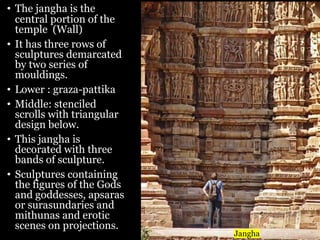
• The jangha is the
central portion of the
temple (Wall)
• It has three rows of
sculptures demarcated
by two series of
mouldings.
• Lower : graza-pattika
• Middle: stenciled
scrolls with triangular
design below.
• This jangha is
decorated with three
bands of sculpture.
• Sculptures containing
the figures of the Gods
and goddesses, apsaras
or surasundaries and
mithunas and erotic
scenes on projections.
Jangha
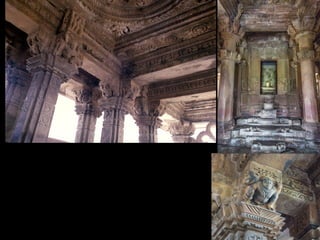
Pillars
• Over decorated
• Pillar capitals are bearing the load and decorated
• Base and middle portion bearing female sculptures (dancing and
various poses)
• These are probably separate part added later on
• Other geometric design
• Specifically vine or scroll motif
• Various figures: Female head and snake body
• The four central pillars of the mahamandapa are of the bhadraka type
resting on a heavy base i.e. kumbhika with the usual mouldings.
• The upper section of the shaft carries capital of the usual design
surmounted
• The upper brackets carry a beam, decorated with stencilled scrolls,
grasa-pattika and a frieze of gandharvas and Vidhyadhara couples
carrying garlands and playing on musical instruments.
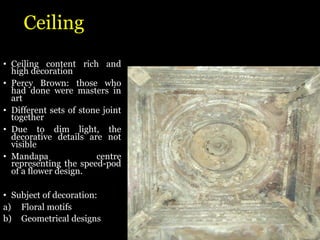
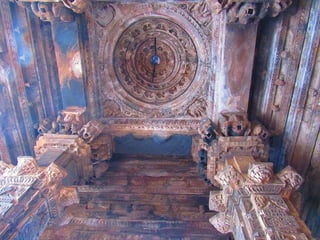
Ceiling
• Ceiling content rich and
high decoration
• Percy Brown: those who
had done were masters in
art
• Different sets of stone joint
together
• Due to dim light, the
decorative details are not
visible
• Mandapa centre
representing the speed-pod
of a flower design.
• Subject of decoration:
a) Floral motifs
b) Geometrical designs
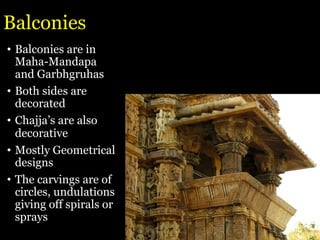
Balconies
• Balconies are in
Maha-Mandapa
and Garbhgruhas
• Both sides are
decorated
• Chajja’s are also
decorative
• Mostly Geometrical
designs
• The carvings are of
circles, undulations
giving off spirals or
sprays
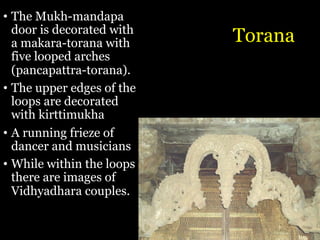
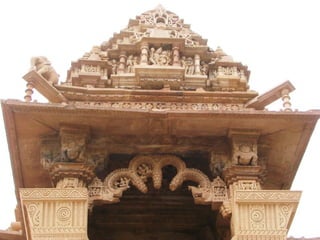
Torana
• The Mukh-mandapa
door is decorated with
a makara-torana with
five looped arches
(pancapattra-torana).
• The upper edges of the
loops are decorated
with kirttimukha
• A running frieze of
dancer and musicians
• While within the loops
there are images of
Vidhyadhara couples.
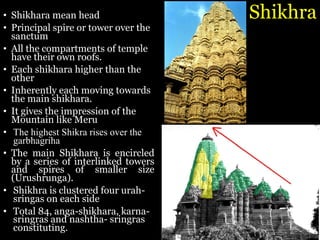
Shikhra
• Shikhara mean head
• Principal spire or tower over the
sanctum
• All the compartments of temple
have their own roofs.
• Each shikhara higher than the
other
• Inherently each moving towards
the main shikhara.
• It gives the impression of the
Mountain like Meru
• The highest Shikra rises over the
garbhagriha
• The main Shikhara is encircled
by a series of interlinked towers
and spires of smaller size
(Urushrunga).
• Shikhra is clustered four urah-
sringas on each side
• Total 84, anga-shikhara, karna-
sringras and nashtha- sringras
constituting.
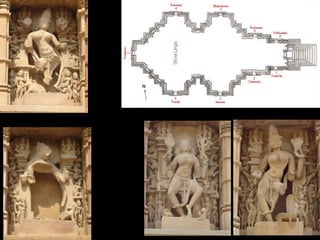
Sculptures
1. Various gods and goddesses
2. Various forms of Shiva, Vishnu, Harihara, Agni, Karthikeya,
Ganesha,
3. Dikpalas, other different gods and goddesses,
4. Surasundaries,
5. Erotic panels and others.
6. Mythical creators
7. Mithunas and female figures
8. Men, women, children's.
9. Animals, birds, pests, insects, reptiles,
10. Trees and flowers
11. Rivers,
12. Palaces, huts, etc,
Alexandar Cunningham, counted 646 sculptures on the exterior
and 226 in the interior of the temple.
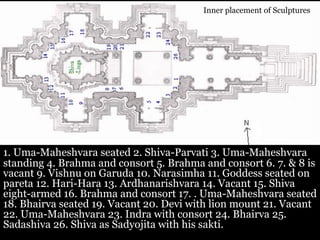
1. Uma-Maheshvara seated 2. Shiva-Parvati 3. Uma-Maheshvara
standing 4. Brahma and consort 5. Brahma and consort 6. 7. & 8 is
vacant 9. Vishnu on Garuda 10. Narasimha 11. Goddess seated on
pareta 12. Hari-Hara 13. Ardhanarishvara 14. Vacant 15. Shiva
eight-armed 16. Brahma and consort 17. . Uma-Maheshvara seated
18. Bhairva seated 19. Vacant 20. Devi with lion mount 21. Vacant
22. Uma-Maheshvara 23. Indra with consort 24. Bhairva 25.
Sadashiva 26. Shiva as Sadyojita with his sakti.
Inner placement of Sculptures
Decoration
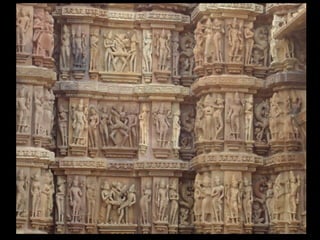
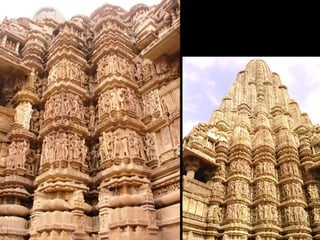
• Temple has high relief carvings of the figurines.
• The exterior surfaces are entirely covered with
sculptures in three vertical layers.
• The figures are fine chiselled,
• strong angular forms and brilliant dark-light patterns.
• Geometric patterns, masks of lions and other uniform
designs are richly decorated.
• Inside and outside the temple elaborately carved
sculptures of gods and goddesses, musicians and
apsaras or nymphs etc.
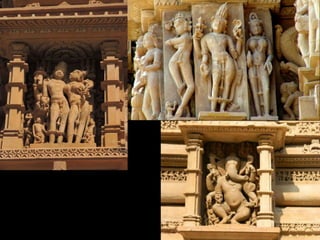
Erotic art
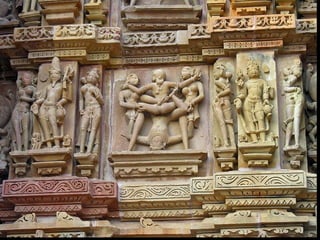
• The Khajuraho temples are famous for their Erotic art.
• From exterior to the interior, the temple has depiction
of full art of eroticism
• The pillars, ceilings, door- jamb of sanctum, row of the
plinth, the row of platform and niche of the
superstructure etc. show such erotic figures.
• These are showing in loving couples, sometimes in
erotic poses.
• Erotic scuptures are located on the walls, between the
Mandapa portion.
Conclusion
• Khajuraho’s temples not only famous for architecture but
also for their extensive erotic sculptures
• Kandariya Mahadeva Temple is artistically and
architecturally the most perfect and finest temple in India.
• Originally it was Panchayatan temple.
• It is considered one of the best examples of temples of
India.
• Most evolved and finished of Chandela’s.
• Kandariya Mahadev temple is the grandest and the temple
architecture has reached its highest stage of excellence
here.
• Decoration like ivory.
Any Questions ?

Kandariya Mahadev Temple

  • 1.
  • 2.
    Introduction • Kandariya MahadevaTemple is located in the Chatarpur district of Madhya Pradesh. • Constructed by Chandel Dynasty • Temple complex known as “Khajuraho” due to the present village. • Total 22 temples spread in 6 square kilometres • Temple divided various group (eastern, western and Southern) • Kandariya Mahadev situated in Western group. • It’s a complete specimen and largest in the group
  • 4.
    Historical Background • Chandelawere Vassel of Gurjar-Pratihar • Subsequently defeated Gurjar –Pratihar and become independent • Controlled the Bundelkhand known as Jejakbhukti • Mahoba was once capital the Chnandela dynasty • Kandariya Mahadev temple was built by of Vidyadhara ruled from 1003 to 1035 CE . • Epigraph on the mandapa pilaster of temple, mentioning a king called Virimda who identified with Vidyadhara. • Khajurao known as Kharjjuravahaka. • The site was rediscovered in 1838 by a British officer, Captain T.S. Burt. • In original there were about 85 temples, now only 24 survived. • Temples constructed between (950-1050 CE)
  • 5.
    General Features ofthe Khajuraho Temples 1. Stone: fine grained sand stones (buff, pink, pale yellow) 2. Brought from Panna, east bank of Panna river 3. Temples Belong to Jain, Vaishanava and Shaiva 4. Not huge in size 5. Not inside the compound hall 6. No Courtyard 7. Art & Sculptural Decoration inside too 8. Maximum height: 100 ft 9. Erected upon high plinth (Jagti), open space all around the temple 10. Axis east-west 11. Some have balconied window in Madapa 12. Rising high from mandapa to garbhagruha
  • 6.
  • 7.
    Kandariya Mahadev Temple •Dedicated to Shiva • Kandariya Mahadeva: the Great God of the Cave • Built on high platform /plinth (4 metres (13 ft) • Its total height is 116.5 feet above the ground and 88 feet above Jagti. • Plan & Elevation: 1. Length: 31 metres (102 ft) 2. Width: 20 metres (66 ft) 3. Height (Shikhra): 116.5 feet ,
  • 8.
    • A seriesof steep steps with high rise lead from the ground level to the entrance to the temple. • Structural Elements 1. Ardha Mandapa 2. Mandapa 3. Maha-Mandapa 4. Antaral 5. Garbhgruha
  • 9.
  • 10.
    • Temple standson plinth of 4 metres height. • A steps lead to the entrance to the temple (Mukhmandapa). • The superstructure is built in a steep mountain shape or form • The layout of the temple is a five-part design • Outer walls are highly decorated • The superstructure has richly decorated roofs • Shikhra has has 84 miniature Urushrunga (spires)
  • 12.
    Mukha-mandapa • Entrance ofthe temple (East) • Situated on lower level • Open from three side (East, north & S) • Entrance is decorated with makara- torana with looped arches. • It has the Asnapattakas (seat-slabs) with kaksananas (sloping seat-backs) • Ceiling rest upon the four pillars • Square in shape • Small shikhara on top • The roof over the mukhamandapa is of a domical pyramidal type of pidha. • Shikra is smallest amongst all • Decorated
  • 14.
    Mandapa • Approach frommukha-mandapa • Situated between mukha-mandapa and Maha mandapa • Raising higher than mukha-mandapa • Slighly bigger than mukhamandapa • Has another makara-torana similar to maha-mandapa • Rectangular shape • Has eight pillars and four pilasters which are similar in design to those of the much-mandapa. • Small rising • Decorated from both side • The roof over the mandapa is also pyramidal one (taller than Mukhmandapa and shorter than Mandapa)
  • 16.
    Maha-mandapa • Center partof the temple • Opening from three sides • Two balconies from north and south • Decorated gateway • Rising higher than mukhmandap and mandapa • Four pillars on four corners baring the load of superstructure. • Raised shikhara • In the same way the roof over the maha-mandapa is also a domical pyramid
  • 17.
    Antarala (Vestibule) • Atransitional space between the maha-mandapa and the Gabhagruha is called Antarala. • The pillars of Antarala have shafts of octagonal, sixteen sided and circular sections placed on a heavy octagonal base with the usual mouldings.
  • 19.
    Sanctum (Girbhgruha) • Main componentof the temple • Higher than other components • It is a square cella of 10 ft. wide • The inner walls are plain • Decorated and ordinate doorway • Has nine Sakas with beautiful and vivid decoration • Ganga and Yamuna are depicted on the right and left jambs of the doorway • Attendant divinities in niches and recesses. • A Shiva-linga inside (4 ft ) • Ambulatory path (Pradakshina patha) • Open from two sides (balcony) • Seating bench
  • 21.
    Jagati • Jagati theterm used for raised platform • Kandariya Mahadeva temple is built on a fairly 3 m high jagati • Over Jagati two free- standing sardula statues, supporting with a man at each corner. • This high base makes the elevation of the temple impressive. • The moulding consists of bhitta decorated with lotus petals, jaya- kumbha and projecting pattika with tamala- patras.
  • 22.
    • The janghais the central portion of the temple (Wall) • It has three rows of sculptures demarcated by two series of mouldings. • Lower : graza-pattika • Middle: stenciled scrolls with triangular design below. • This jangha is decorated with three bands of sculpture. • Sculptures containing the figures of the Gods and goddesses, apsaras or surasundaries and mithunas and erotic scenes on projections. Jangha
  • 23.
    Pillars • Over decorated •Pillar capitals are bearing the load and decorated • Base and middle portion bearing female sculptures (dancing and various poses) • These are probably separate part added later on • Other geometric design • Specifically vine or scroll motif • Various figures: Female head and snake body • The four central pillars of the mahamandapa are of the bhadraka type resting on a heavy base i.e. kumbhika with the usual mouldings. • The upper section of the shaft carries capital of the usual design surmounted • The upper brackets carry a beam, decorated with stencilled scrolls, grasa-pattika and a frieze of gandharvas and Vidhyadhara couples carrying garlands and playing on musical instruments.
  • 25.
    Ceiling • Ceiling contentrich and high decoration • Percy Brown: those who had done were masters in art • Different sets of stone joint together • Due to dim light, the decorative details are not visible • Mandapa centre representing the speed-pod of a flower design. • Subject of decoration: a) Floral motifs b) Geometrical designs
  • 27.
    Balconies • Balconies arein Maha-Mandapa and Garbhgruhas • Both sides are decorated • Chajja’s are also decorative • Mostly Geometrical designs • The carvings are of circles, undulations giving off spirals or sprays
  • 28.
    Torana • The Mukh-mandapa dooris decorated with a makara-torana with five looped arches (pancapattra-torana). • The upper edges of the loops are decorated with kirttimukha • A running frieze of dancer and musicians • While within the loops there are images of Vidhyadhara couples.
  • 30.
    Shikhra • Shikhara meanhead • Principal spire or tower over the sanctum • All the compartments of temple have their own roofs. • Each shikhara higher than the other • Inherently each moving towards the main shikhara. • It gives the impression of the Mountain like Meru • The highest Shikra rises over the garbhagriha • The main Shikhara is encircled by a series of interlinked towers and spires of smaller size (Urushrunga). • Shikhra is clustered four urah- sringas on each side • Total 84, anga-shikhara, karna- sringras and nashtha- sringras constituting.
  • 31.
    Sculptures 1. Various godsand goddesses 2. Various forms of Shiva, Vishnu, Harihara, Agni, Karthikeya, Ganesha, 3. Dikpalas, other different gods and goddesses, 4. Surasundaries, 5. Erotic panels and others. 6. Mythical creators 7. Mithunas and female figures 8. Men, women, children's. 9. Animals, birds, pests, insects, reptiles, 10. Trees and flowers 11. Rivers, 12. Palaces, huts, etc, Alexandar Cunningham, counted 646 sculptures on the exterior and 226 in the interior of the temple.
  • 32.
    1. Uma-Maheshvara seated2. Shiva-Parvati 3. Uma-Maheshvara standing 4. Brahma and consort 5. Brahma and consort 6. 7. & 8 is vacant 9. Vishnu on Garuda 10. Narasimha 11. Goddess seated on pareta 12. Hari-Hara 13. Ardhanarishvara 14. Vacant 15. Shiva eight-armed 16. Brahma and consort 17. . Uma-Maheshvara seated 18. Bhairva seated 19. Vacant 20. Devi with lion mount 21. Vacant 22. Uma-Maheshvara 23. Indra with consort 24. Bhairva 25. Sadashiva 26. Shiva as Sadyojita with his sakti. Inner placement of Sculptures
  • 35.
    Decoration • Temple hashigh relief carvings of the figurines. • The exterior surfaces are entirely covered with sculptures in three vertical layers. • The figures are fine chiselled, • strong angular forms and brilliant dark-light patterns. • Geometric patterns, masks of lions and other uniform designs are richly decorated. • Inside and outside the temple elaborately carved sculptures of gods and goddesses, musicians and apsaras or nymphs etc.
  • 37.
    Erotic art • TheKhajuraho temples are famous for their Erotic art. • From exterior to the interior, the temple has depiction of full art of eroticism • The pillars, ceilings, door- jamb of sanctum, row of the plinth, the row of platform and niche of the superstructure etc. show such erotic figures. • These are showing in loving couples, sometimes in erotic poses. • Erotic scuptures are located on the walls, between the Mandapa portion.
  • 40.
    Conclusion • Khajuraho’s templesnot only famous for architecture but also for their extensive erotic sculptures • Kandariya Mahadeva Temple is artistically and architecturally the most perfect and finest temple in India. • Originally it was Panchayatan temple. • It is considered one of the best examples of temples of India. • Most evolved and finished of Chandela’s. • Kandariya Mahadev temple is the grandest and the temple architecture has reached its highest stage of excellence here. • Decoration like ivory.
  • 41.