ELLORA AND AJANTA
      CAVES
Location
   Country – India
State – Maharashtra
District – Aurangabad
      Caves - 30
AJANTA CAVES (information)
•   AJANTA is world's greatest
    historical monument recognised
    by UNESCO located just 40kms
    from Jalgaon city of Maharashtra,
    India. There are 30 caves in
    Ajanta of which 9, 10, 19, 26 and
    29 are chaitya-grihas and the rest
    are monasteries. These caves
    were discovered in AD 1819 and
    were built up in the earlier 2nd
    century BC-AD. Most of the
    paintings in Ajanta are right from
    2nd century BC-AD and some of
    them about the fifth century AD
    and continued for the next two
    centuries. All paintings shows
    heavy religious influence and
    centre around Buddha,
    Bodhisattvas, incidents from the
    life of Buddha and the Jatakas.
    The paintings are executed on a
    ground of mud-plaster in the
    tempera technique.
CONTENTS
Cave One
Cave Two
The facade (In cave 2)
The porch (In cave 2)
The hall    (In cave 2)
The paintings (In cave 2)
CAVE 1
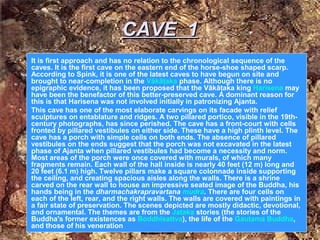
•   It is first approach and has no relation to the chronological sequence of the
    caves. It is the first cave on the eastern end of the horse-shoe shaped scarp.
    According to Spink, it is one of the latest caves to have begun on site and
    brought to near-completion in the Vākāţaka phase. Although there is no
    epigraphic evidence, it has been proposed that the Vākāţaka king Harisena may
    have been the benefactor of this better-preserved cave. A dominant reason for
    this is that Harisena was not involved initially in patronizing Ajanta.
•   This cave has one of the most elaborate carvings on its facade with relief
    sculptures on entablature and ridges. A two pillared portico, visible in the 19th-
    century photographs, has since perished. The cave has a front-court with cells
    fronted by pillared vestibules on either side. These have a high plinth level. The
    cave has a porch with simple cells on both ends. The absence of pillared
    vestibules on the ends suggest that the porch was not excavated in the latest
    phase of Ajanta when pillared vestibules had become a necessity and norm.
    Most areas of the porch were once covered with murals, of which many
    fragments remain. Each wall of the hall inside is nearly 40 feet (12 m) long and
    20 feet (6.1 m) high. Twelve pillars make a square colonnade inside supporting
    the ceiling, and creating spacious aisles along the walls. There is a shrine
    carved on the rear wall to house an impressive seated image of the Buddha, his
    hands being in the dharmachakrapravartana mudra. There are four cells on
    each of the left, rear, and the right walls. The walls are covered with paintings in
    a fair state of preservation. The scenes depicted are mostly didactic, devotional,
    and ornamental. The themes are from the Jataka stories (the stories of the
    Buddha's former existences as Boddhisattva), the life of the Gautama Buddha,
    and those of his veneration
CAVE 2
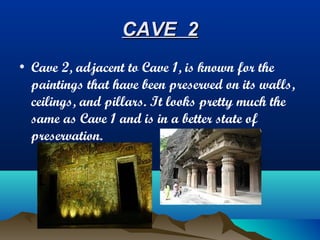
• Cave 2, adjacent to Cave 1, is known for the
  paintings that have been preserved on its walls,
  ceilings, and pillars. It looks pretty much the
  same as Cave 1 and is in a better state of
  preservation.
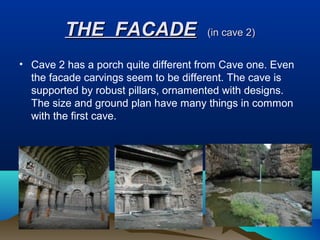
THE FACADE                   (in cave 2)


• Cave 2 has a porch quite different from Cave one. Even
  the facade carvings seem to be different. The cave is
  supported by robust pillars, ornamented with designs.
  The size and ground plan have many things in common
  with the first cave.
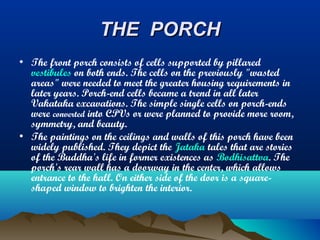
THE PORCH
• The front porch consists of cells supported by pillared
  vestibules on both ends. The cells on the previously "wasted
  areas" were needed to meet the greater housing requirements in
  later years. Porch-end cells became a trend in all later
  Vakataka excavations. The simple single cells on porch-ends
  were converted into CPVs or were planned to provide more room,
  symmetry, and beauty.
• The paintings on the ceilings and walls of this porch have been
  widely published. They depict the Jataka tales that are stories
  of the Buddha's life in former existences as Bodhisattva. The
  porch's rear wall has a doorway in the center, which allows
  entrance to the hall. On either side of the door is a square-
  shaped window to brighten the interior.
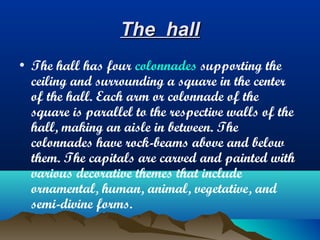
The hall
• The hall has four colonnades supporting the
  ceiling and surrounding a square in the center
  of the hall. Each arm or colonnade of the
  square is parallel to the respective walls of the
  hall, making an aisle in between. The
  colonnades have rock-beams above and below
  them. The capitals are carved and painted with
  various decorative themes that include
  ornamental, human, animal, vegetative, and
  semi-divine forms.
The Paintings
Paintings are all over the cave except for the floor. At
 various places the art work has become eroded due to
 decay and human interference. Therefore, many areas of
 the painted walls, ceilings, and pillars are fragmentary.
 The painted narratives of the Jataka tales are depicted
 only on the walls, which demanded the special attention of
 the devotee. They are didactic in nature, meant to inform
 the community about the Buddha's teachings and life
 through successive births. Their placement on the walls
 required the devotee to walk through the aisles and 'read'
 the narratives depicted in various episodes. (Alas, to
 prevent vandalism, entry into the aisles is restricted by
 site authorities). The narrative episodes are depicted one
 after another although not in a linear order. Their
 identification has been a core area of research since the
 site's rediscovery in 1819 C.E. Dieter Schlingloff's
 identifications have updated our knowledge on the
 subject.
Location
   Country – India
State – Maharashtra
District – Aurangabad
      Caves – 34
Contents


•   The Buddhist caves
    – Cave 1
    – The Vishvakarma
•   The Hindu caves
    – The Kailasanatha
    – The Dashavatara
    – Other Hindu caves
•   The Jain caves
    – The Indra Sabha
    – Other Jain caves
•
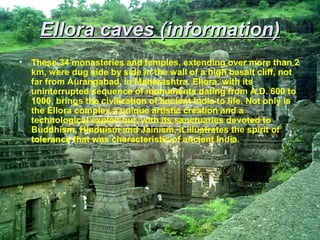
Ellora caves (information)
•   These 34 monasteries and temples, extending over more than 2
    km, were dug side by side in the wall of a high basalt cliff, not
    far from Aurangabad, in Maharashtra. Ellora, with its
    uninterrupted sequence of monuments dating from A.D. 600 to
    1000, brings the civilization of ancient India to life. Not only is
    the Ellora complex a unique artistic creation and a
    technological exploit but, with its sanctuaries devoted to
    Buddhism, Hinduism and Jainism, it illustrates the spirit of
    tolerance that was characteristic of ancient India.
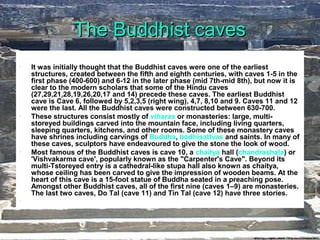
The Buddhist caves
•   It was initially thought that the Buddhist caves were one of the earliest
    structures, created between the fifth and eighth centuries, with caves 1-5 in the
    first phase (400-600) and 6-12 in the later phase (mid 7th-mid 8th), but now it is
    clear to the modern scholars that some of the Hindu caves
    (27,29,21,28,19,26,20,17 and 14) precede these caves. The earliest Buddhist
    cave is Cave 6, followed by 5,2,3,5 (right wing), 4,7, 8,10 and 9. Caves 11 and 12
    were the last. All the Buddhist caves were constructed between 630-700.
•   These structures consist mostly of viharas or monasteries: large, multi-
    storeyed buildings carved into the mountain face, including living quarters,
    sleeping quarters, kitchens, and other rooms. Some of these monastery caves
    have shrines including carvings of Buddha, bodhisattvas and saints. In many of
    these caves, sculptors have endeavoured to give the stone the look of wood.
•   Most famous of the Buddhist caves is cave 10, a chaitya hall (chandrashala) or
    'Vishvakarma cave', popularly known as the "Carpenter's Cave". Beyond its
    multi-Tstoreyed entry is a cathedral-like stupa hall also known as chaitya,
    whose ceiling has been carved to give the impression of wooden beams. At the
    heart of this cave is a 15-foot statue of Buddha seated in a preaching pose.
    Amongst other Buddhist caves, all of the first nine (caves 1–9) are monasteries.
    The last two caves, Do Tal (cave 11) and Tin Tal (cave 12) have three stories.
•
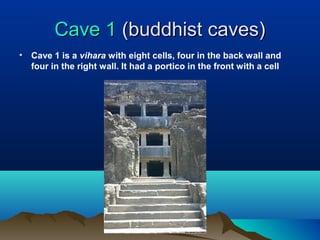
Cave 1 (buddhist caves)
•   Cave 1 is a vihara with eight cells, four in the back wall and
    four in the right wall. It had a portico in the front with a cell
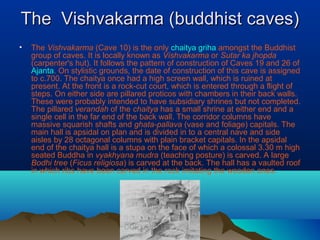
The Vishvakarma (buddhist caves)
•   The Vishvakarma (Cave 10) is the only chaitya griha amongst the Buddhist
    group of caves. It is locally known as Vishvakarma or Sutar ka jhopda
    (carpenter's hut). It follows the pattern of construction of Caves 19 and 26 of
    Ajanta. On stylistic grounds, the date of construction of this cave is assigned
    to c.700. The chaitya once had a high screen wall, which is ruined at
    present. At the front is a rock-cut court, which is entered through a flight of
    steps. On either side are pillared proticos with chambers in their back walls.
    These were probably intended to have subsidiary shrines but not completed.
    The pillared verandah of the chaitya has a small shrine at either end and a
    single cell in the far end of the back wall. The corridor columns have
    massive squarish shafts and ghata-pallava (vase and foliage) capitals. The
    main hall is apsidal on plan and is divided in to a central nave and side
    aisles by 28 octagonal columns with plain bracket capitals. In the apsidal
    end of the chaitya hall is a stupa on the face of which a colossal 3.30 m high
    seated Buddha in vyakhyana mudra (teaching posture) is carved. A large
    Bodhi tree (Ficus religiosa) is carved at the back. The hall has a vaulted roof
    in which ribs have been carved in the rock imitating the wooden ones.
The Hindu caves
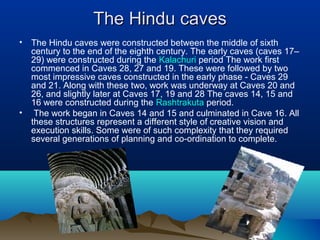
•   The Hindu caves were constructed between the middle of sixth
    century to the end of the eighth century. The early caves (caves 17–
    29) were constructed during the Kalachuri period The work first
    commenced in Caves 28, 27 and 19. These were followed by two
    most impressive caves constructed in the early phase - Caves 29
    and 21. Along with these two, work was underway at Caves 20 and
    26, and slightly later at Caves 17, 19 and 28 The caves 14, 15 and
    16 were constructed during the Rashtrakuta period.
•    The work began in Caves 14 and 15 and culminated in Cave 16. All
    these structures represent a different style of creative vision and
    execution skills. Some were of such complexity that they required
    several generations of planning and co-ordination to complete.
The Kailasanatha (The Hindu caves)
•   Main article: Kailash Temple
•   A painted panel showing the dancing Shiva (Nataraja) from the
    Kailash Temple at Ellora (Cave 16). One can still see a lot of the paint that
    once covered the entire temple.
•   Wall carvings – A scene depicting the wedding of Shiva(four armed
    figure,right) and Parvati (two armed,left).
•   Shiva-Parvati seated on mount Kailash, while Ravana tries to lift it.
•   Cave 16, also known as the Kailasa or the Kailasanatha, is the unrivaled
    centerpiece of Ellora. This is designed to recall Mount Kailash, the abode of
    Lord Shiva – looks like a freestanding, multi-storeyed temple complex, but it
    was carved out of one single rock, and covers an area double the size of
    Parthenon in Athens.[8]
•   All the carvings are done in more than one level. A two-storeyed gateway
    opens to reveal a U-shaped courtyard. The courtyard is edged by columned
    galleries three storeys high. The galleries are punctuated by huge sculpted
    panels, and alcoves containing enormous sculptures of a variety of deities.
    Originally flying bridges of stone connected these galleries to central temple
    structures, but these have fallen.
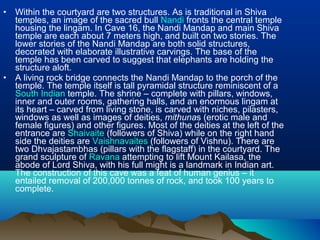
•   Within the courtyard are two structures. As is traditional in Shiva
    temples, an image of the sacred bull Nandi fronts the central temple
    housing the lingam. In Cave 16, the Nandi Mandap and main Shiva
    temple are each about 7 meters high, and built on two stories. The
    lower stories of the Nandi Mandap are both solid structures,
    decorated with elaborate illustrative carvings. The base of the
    temple has been carved to suggest that elephants are holding the
    structure aloft.
•   A living rock bridge connects the Nandi Mandap to the porch of the
    temple. The temple itself is tall pyramidal structure reminiscent of a
    South Indian temple. The shrine – complete with pillars, windows,
    inner and outer rooms, gathering halls, and an enormous lingam at
    its heart – carved from living stone, is carved with niches, pilasters,
    windows as well as images of deities, mithunas (erotic male and
    female figures) and other figures. Most of the deities at the left of the
    entrance are Shaivaite (followers of Shiva) while on the right hand
    side the deities are Vaishnavaites (followers of Vishnu). There are
    two Dhvajastambhas (pillars with the flagstaff) in the courtyard. The
    grand sculpture of Ravana attempting to lift Mount Kailasa, the
    abode of Lord Shiva, with his full might is a landmark in Indian art.
    The construction of this cave was a feat of human genius – it
    entailed removal of 200,000 tonnes of rock, and took 100 years to
    complete.
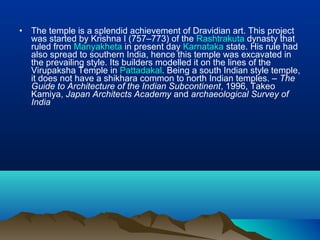
•   The temple is a splendid achievement of Dravidian art. This project
    was started by Krishna I (757–773) of the Rashtrakuta dynasty that
    ruled from Manyakheta in present day Karnataka state. His rule had
    also spread to southern India, hence this temple was excavated in
    the prevailing style. Its builders modelled it on the lines of the
    Virupaksha Temple in Pattadakal. Being a south Indian style temple,
    it does not have a shikhara common to north Indian temples. – The
    Guide to Architecture of the Indian Subcontinent, 1996, Takeo
    Kamiya, Japan Architects Academy and archaeological Survey of
    India
The Dashavatara (The Hindu caves)
•   The Dashavatara (Cave 15) was begun as a
    Buddhist monastery. It has an open court with a
    free-standing monolithic mandapa at the middle
    and a two-storeyed excavated temple at the
    rear. The layout of the temple is closely related
    to caves 11 and 12. Large sculptural panels
    between the wall columns on the upper floor
    illustrate a wide range of themes, which include
    the ten avataras of Vishnu. An inscription of
    grant of Dantidurga is found on the back wall of
    the front mandapa. According to
    Coomaraswamy, the finest relief of this cave is
    the one depicting the death of Hiranyakashipu,
    where Vishnu in man-lion (Narasimha) form,
    emerges from a pillar to lay a fatal hand upon
    the shoulder of Hiranyakashipu
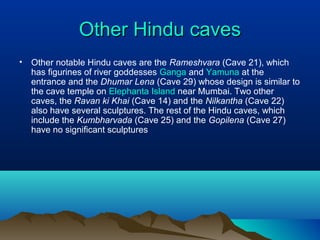
Other Hindu caves
•   Other notable Hindu caves are the Rameshvara (Cave 21), which
    has figurines of river goddesses Ganga and Yamuna at the
    entrance and the Dhumar Lena (Cave 29) whose design is similar to
    the cave temple on Elephanta Island near Mumbai. Two other
    caves, the Ravan ki Khai (Cave 14) and the Nilkantha (Cave 22)
    also have several sculptures. The rest of the Hindu caves, which
    include the Kumbharvada (Cave 25) and the Gopilena (Cave 27)
    have no significant sculptures
The Jain caves
•   The five Jain caves at Ellora belong to the ninth and tenth centuries.
    They all belong to the Digambara sect.[10] Jain caves reveal
    specific dimensions of Jain philosophy and tradition. They reflect a
    strict sense of asceticism – they are not relatively large as
    compared to others, but they present exceptionally detailed art
    works. The most remarkable Jain shrines are the Chhota Kailash
    (cave 30), the Indra Sabha (cave 32) and the Jagannath Sabha
    (cave 33). Cave 31 is an unfinished four-pillared hall and a shrine
    Cave 34 is a small cave, which can be approached through an
    opening on the left side of Cave 3
The Indra Sabha (the Jain caves)
•   The Indra Sabha (Cave 32) is a two storeyed cave with one more
    monolithic shrine in its court. It has a very fine carving of the lotus
    flower on the ceiling. It got the appellation, Indra Sabha probably it is
    significantly ornate and also because of the sculpture of Yaksha
    Matanga on an elephant, which was wrongly identified as that of
    Indra. On the upper level of the double-storied shrine excavated at
    the rear of the court, an imposing image of Ambika, the Yakshi
    (dedicated attendant deity) of Neminatha is found seated on her lion
    under a mango tree, laden with fruits.
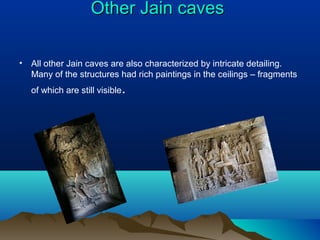
Other Jain caves

•   All other Jain caves are also characterized by intricate detailing.
    Many of the structures had rich paintings in the ceilings – fragments
    of which are still visible   .
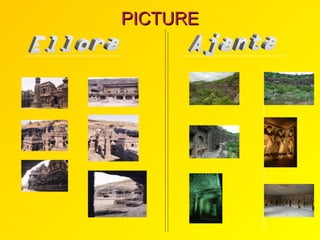
PICTURE
Ajanta and ellora caves

Ajanta and ellora caves

  • 1.
  • 2.
    Location Country – India State – Maharashtra District – Aurangabad Caves - 30
  • 3.
    AJANTA CAVES (information) • AJANTA is world's greatest historical monument recognised by UNESCO located just 40kms from Jalgaon city of Maharashtra, India. There are 30 caves in Ajanta of which 9, 10, 19, 26 and 29 are chaitya-grihas and the rest are monasteries. These caves were discovered in AD 1819 and were built up in the earlier 2nd century BC-AD. Most of the paintings in Ajanta are right from 2nd century BC-AD and some of them about the fifth century AD and continued for the next two centuries. All paintings shows heavy religious influence and centre around Buddha, Bodhisattvas, incidents from the life of Buddha and the Jatakas. The paintings are executed on a ground of mud-plaster in the tempera technique.
  • 4.
    CONTENTS Cave One Cave Two Thefacade (In cave 2) The porch (In cave 2) The hall (In cave 2) The paintings (In cave 2)
  • 5.
    CAVE 1 • It is first approach and has no relation to the chronological sequence of the caves. It is the first cave on the eastern end of the horse-shoe shaped scarp. According to Spink, it is one of the latest caves to have begun on site and brought to near-completion in the Vākāţaka phase. Although there is no epigraphic evidence, it has been proposed that the Vākāţaka king Harisena may have been the benefactor of this better-preserved cave. A dominant reason for this is that Harisena was not involved initially in patronizing Ajanta. • This cave has one of the most elaborate carvings on its facade with relief sculptures on entablature and ridges. A two pillared portico, visible in the 19th- century photographs, has since perished. The cave has a front-court with cells fronted by pillared vestibules on either side. These have a high plinth level. The cave has a porch with simple cells on both ends. The absence of pillared vestibules on the ends suggest that the porch was not excavated in the latest phase of Ajanta when pillared vestibules had become a necessity and norm. Most areas of the porch were once covered with murals, of which many fragments remain. Each wall of the hall inside is nearly 40 feet (12 m) long and 20 feet (6.1 m) high. Twelve pillars make a square colonnade inside supporting the ceiling, and creating spacious aisles along the walls. There is a shrine carved on the rear wall to house an impressive seated image of the Buddha, his hands being in the dharmachakrapravartana mudra. There are four cells on each of the left, rear, and the right walls. The walls are covered with paintings in a fair state of preservation. The scenes depicted are mostly didactic, devotional, and ornamental. The themes are from the Jataka stories (the stories of the Buddha's former existences as Boddhisattva), the life of the Gautama Buddha, and those of his veneration
  • 6.
    CAVE 2 • Cave2, adjacent to Cave 1, is known for the paintings that have been preserved on its walls, ceilings, and pillars. It looks pretty much the same as Cave 1 and is in a better state of preservation.
  • 7.
    THE FACADE (in cave 2) • Cave 2 has a porch quite different from Cave one. Even the facade carvings seem to be different. The cave is supported by robust pillars, ornamented with designs. The size and ground plan have many things in common with the first cave.
  • 8.
    THE PORCH • Thefront porch consists of cells supported by pillared vestibules on both ends. The cells on the previously "wasted areas" were needed to meet the greater housing requirements in later years. Porch-end cells became a trend in all later Vakataka excavations. The simple single cells on porch-ends were converted into CPVs or were planned to provide more room, symmetry, and beauty. • The paintings on the ceilings and walls of this porch have been widely published. They depict the Jataka tales that are stories of the Buddha's life in former existences as Bodhisattva. The porch's rear wall has a doorway in the center, which allows entrance to the hall. On either side of the door is a square- shaped window to brighten the interior.
  • 9.
    The hall • Thehall has four colonnades supporting the ceiling and surrounding a square in the center of the hall. Each arm or colonnade of the square is parallel to the respective walls of the hall, making an aisle in between. The colonnades have rock-beams above and below them. The capitals are carved and painted with various decorative themes that include ornamental, human, animal, vegetative, and semi-divine forms.
  • 10.
    The Paintings Paintings areall over the cave except for the floor. At various places the art work has become eroded due to decay and human interference. Therefore, many areas of the painted walls, ceilings, and pillars are fragmentary. The painted narratives of the Jataka tales are depicted only on the walls, which demanded the special attention of the devotee. They are didactic in nature, meant to inform the community about the Buddha's teachings and life through successive births. Their placement on the walls required the devotee to walk through the aisles and 'read' the narratives depicted in various episodes. (Alas, to prevent vandalism, entry into the aisles is restricted by site authorities). The narrative episodes are depicted one after another although not in a linear order. Their identification has been a core area of research since the site's rediscovery in 1819 C.E. Dieter Schlingloff's identifications have updated our knowledge on the subject.
  • 11.
    Location Country – India State – Maharashtra District – Aurangabad Caves – 34
  • 12.
    Contents • The Buddhist caves – Cave 1 – The Vishvakarma • The Hindu caves – The Kailasanatha – The Dashavatara – Other Hindu caves • The Jain caves – The Indra Sabha – Other Jain caves •
  • 13.
    Ellora caves (information) • These 34 monasteries and temples, extending over more than 2 km, were dug side by side in the wall of a high basalt cliff, not far from Aurangabad, in Maharashtra. Ellora, with its uninterrupted sequence of monuments dating from A.D. 600 to 1000, brings the civilization of ancient India to life. Not only is the Ellora complex a unique artistic creation and a technological exploit but, with its sanctuaries devoted to Buddhism, Hinduism and Jainism, it illustrates the spirit of tolerance that was characteristic of ancient India.
  • 14.
    The Buddhist caves • It was initially thought that the Buddhist caves were one of the earliest structures, created between the fifth and eighth centuries, with caves 1-5 in the first phase (400-600) and 6-12 in the later phase (mid 7th-mid 8th), but now it is clear to the modern scholars that some of the Hindu caves (27,29,21,28,19,26,20,17 and 14) precede these caves. The earliest Buddhist cave is Cave 6, followed by 5,2,3,5 (right wing), 4,7, 8,10 and 9. Caves 11 and 12 were the last. All the Buddhist caves were constructed between 630-700. • These structures consist mostly of viharas or monasteries: large, multi- storeyed buildings carved into the mountain face, including living quarters, sleeping quarters, kitchens, and other rooms. Some of these monastery caves have shrines including carvings of Buddha, bodhisattvas and saints. In many of these caves, sculptors have endeavoured to give the stone the look of wood. • Most famous of the Buddhist caves is cave 10, a chaitya hall (chandrashala) or 'Vishvakarma cave', popularly known as the "Carpenter's Cave". Beyond its multi-Tstoreyed entry is a cathedral-like stupa hall also known as chaitya, whose ceiling has been carved to give the impression of wooden beams. At the heart of this cave is a 15-foot statue of Buddha seated in a preaching pose. Amongst other Buddhist caves, all of the first nine (caves 1–9) are monasteries. The last two caves, Do Tal (cave 11) and Tin Tal (cave 12) have three stories. •
  • 15.
    Cave 1 (buddhistcaves) • Cave 1 is a vihara with eight cells, four in the back wall and four in the right wall. It had a portico in the front with a cell
  • 16.
    The Vishvakarma (buddhistcaves) • The Vishvakarma (Cave 10) is the only chaitya griha amongst the Buddhist group of caves. It is locally known as Vishvakarma or Sutar ka jhopda (carpenter's hut). It follows the pattern of construction of Caves 19 and 26 of Ajanta. On stylistic grounds, the date of construction of this cave is assigned to c.700. The chaitya once had a high screen wall, which is ruined at present. At the front is a rock-cut court, which is entered through a flight of steps. On either side are pillared proticos with chambers in their back walls. These were probably intended to have subsidiary shrines but not completed. The pillared verandah of the chaitya has a small shrine at either end and a single cell in the far end of the back wall. The corridor columns have massive squarish shafts and ghata-pallava (vase and foliage) capitals. The main hall is apsidal on plan and is divided in to a central nave and side aisles by 28 octagonal columns with plain bracket capitals. In the apsidal end of the chaitya hall is a stupa on the face of which a colossal 3.30 m high seated Buddha in vyakhyana mudra (teaching posture) is carved. A large Bodhi tree (Ficus religiosa) is carved at the back. The hall has a vaulted roof in which ribs have been carved in the rock imitating the wooden ones.
  • 17.
    The Hindu caves • The Hindu caves were constructed between the middle of sixth century to the end of the eighth century. The early caves (caves 17– 29) were constructed during the Kalachuri period The work first commenced in Caves 28, 27 and 19. These were followed by two most impressive caves constructed in the early phase - Caves 29 and 21. Along with these two, work was underway at Caves 20 and 26, and slightly later at Caves 17, 19 and 28 The caves 14, 15 and 16 were constructed during the Rashtrakuta period. • The work began in Caves 14 and 15 and culminated in Cave 16. All these structures represent a different style of creative vision and execution skills. Some were of such complexity that they required several generations of planning and co-ordination to complete.
  • 18.
    The Kailasanatha (TheHindu caves) • Main article: Kailash Temple • A painted panel showing the dancing Shiva (Nataraja) from the Kailash Temple at Ellora (Cave 16). One can still see a lot of the paint that once covered the entire temple. • Wall carvings – A scene depicting the wedding of Shiva(four armed figure,right) and Parvati (two armed,left). • Shiva-Parvati seated on mount Kailash, while Ravana tries to lift it. • Cave 16, also known as the Kailasa or the Kailasanatha, is the unrivaled centerpiece of Ellora. This is designed to recall Mount Kailash, the abode of Lord Shiva – looks like a freestanding, multi-storeyed temple complex, but it was carved out of one single rock, and covers an area double the size of Parthenon in Athens.[8] • All the carvings are done in more than one level. A two-storeyed gateway opens to reveal a U-shaped courtyard. The courtyard is edged by columned galleries three storeys high. The galleries are punctuated by huge sculpted panels, and alcoves containing enormous sculptures of a variety of deities. Originally flying bridges of stone connected these galleries to central temple structures, but these have fallen.
  • 19.
    Within the courtyard are two structures. As is traditional in Shiva temples, an image of the sacred bull Nandi fronts the central temple housing the lingam. In Cave 16, the Nandi Mandap and main Shiva temple are each about 7 meters high, and built on two stories. The lower stories of the Nandi Mandap are both solid structures, decorated with elaborate illustrative carvings. The base of the temple has been carved to suggest that elephants are holding the structure aloft. • A living rock bridge connects the Nandi Mandap to the porch of the temple. The temple itself is tall pyramidal structure reminiscent of a South Indian temple. The shrine – complete with pillars, windows, inner and outer rooms, gathering halls, and an enormous lingam at its heart – carved from living stone, is carved with niches, pilasters, windows as well as images of deities, mithunas (erotic male and female figures) and other figures. Most of the deities at the left of the entrance are Shaivaite (followers of Shiva) while on the right hand side the deities are Vaishnavaites (followers of Vishnu). There are two Dhvajastambhas (pillars with the flagstaff) in the courtyard. The grand sculpture of Ravana attempting to lift Mount Kailasa, the abode of Lord Shiva, with his full might is a landmark in Indian art. The construction of this cave was a feat of human genius – it entailed removal of 200,000 tonnes of rock, and took 100 years to complete.
  • 20.
    The temple is a splendid achievement of Dravidian art. This project was started by Krishna I (757–773) of the Rashtrakuta dynasty that ruled from Manyakheta in present day Karnataka state. His rule had also spread to southern India, hence this temple was excavated in the prevailing style. Its builders modelled it on the lines of the Virupaksha Temple in Pattadakal. Being a south Indian style temple, it does not have a shikhara common to north Indian temples. – The Guide to Architecture of the Indian Subcontinent, 1996, Takeo Kamiya, Japan Architects Academy and archaeological Survey of India
  • 21.
    The Dashavatara (TheHindu caves) • The Dashavatara (Cave 15) was begun as a Buddhist monastery. It has an open court with a free-standing monolithic mandapa at the middle and a two-storeyed excavated temple at the rear. The layout of the temple is closely related to caves 11 and 12. Large sculptural panels between the wall columns on the upper floor illustrate a wide range of themes, which include the ten avataras of Vishnu. An inscription of grant of Dantidurga is found on the back wall of the front mandapa. According to Coomaraswamy, the finest relief of this cave is the one depicting the death of Hiranyakashipu, where Vishnu in man-lion (Narasimha) form, emerges from a pillar to lay a fatal hand upon the shoulder of Hiranyakashipu
  • 22.
    Other Hindu caves • Other notable Hindu caves are the Rameshvara (Cave 21), which has figurines of river goddesses Ganga and Yamuna at the entrance and the Dhumar Lena (Cave 29) whose design is similar to the cave temple on Elephanta Island near Mumbai. Two other caves, the Ravan ki Khai (Cave 14) and the Nilkantha (Cave 22) also have several sculptures. The rest of the Hindu caves, which include the Kumbharvada (Cave 25) and the Gopilena (Cave 27) have no significant sculptures
  • 23.
    The Jain caves • The five Jain caves at Ellora belong to the ninth and tenth centuries. They all belong to the Digambara sect.[10] Jain caves reveal specific dimensions of Jain philosophy and tradition. They reflect a strict sense of asceticism – they are not relatively large as compared to others, but they present exceptionally detailed art works. The most remarkable Jain shrines are the Chhota Kailash (cave 30), the Indra Sabha (cave 32) and the Jagannath Sabha (cave 33). Cave 31 is an unfinished four-pillared hall and a shrine Cave 34 is a small cave, which can be approached through an opening on the left side of Cave 3
  • 24.
    The Indra Sabha(the Jain caves) • The Indra Sabha (Cave 32) is a two storeyed cave with one more monolithic shrine in its court. It has a very fine carving of the lotus flower on the ceiling. It got the appellation, Indra Sabha probably it is significantly ornate and also because of the sculpture of Yaksha Matanga on an elephant, which was wrongly identified as that of Indra. On the upper level of the double-storied shrine excavated at the rear of the court, an imposing image of Ambika, the Yakshi (dedicated attendant deity) of Neminatha is found seated on her lion under a mango tree, laden with fruits.
  • 25.
    Other Jain caves • All other Jain caves are also characterized by intricate detailing. Many of the structures had rich paintings in the ceilings – fragments of which are still visible .
  • 26.