RIMSHA FAROOQ (BBS153009)
ELIZA (Enzyme Linked Immunosorbent
Assay)
Presented to: Dr. Marriam Bakhtiar
DATE: 21-10-2018
–
– Definition
Why known as
History of ELIZA
Basic term
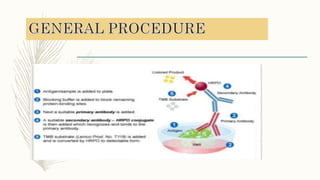
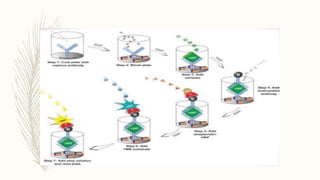
General procedure
Reagent used
Equipment
Principle of Elisa
Types of Elisa
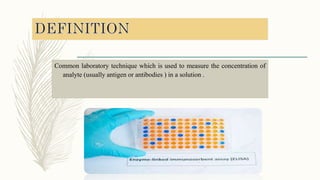
Common laboratory technique which is used to measure the concentration of
analyte (usually antigen or antibodies ) in a solution .
• Antigen/Antibody of interest is absorbed on to plastic surface (sorbent).
• Antigen is recoganized by specific antibody(Immuno).
• Recoganised by second antibody (Immuno)which has enzyme attached (Enzyme
linked ).
• Substrate react with enzyme to produce product , usually coloured
• Based on basic immunology response
• Lock and Key concept
• Enzyme conjugate substrate
• Bound to secondary antibody that binds with the antibody –antigen complex
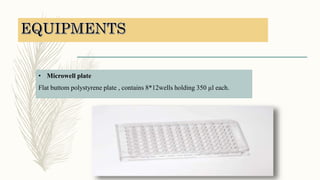
• Microwell plate
Flat buttom polystyrene plate , contains 8*12wells holding 350 µl each.
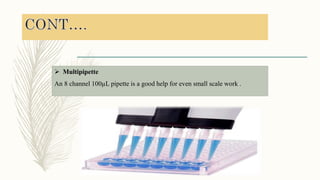
 Multipipette
An 8 channel 100µL pipette is a good help for even small scale work .
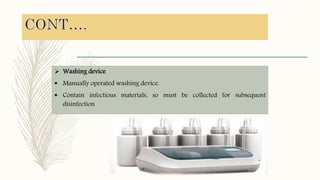
 Washing device
 Manually operated washing device.
 Contain infectious materials, so must be collected for subsequent
disinfection
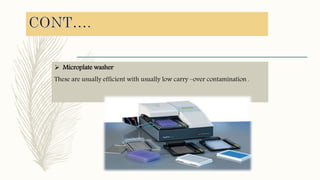
 Microplate washer
These are usually efficient with usually low carry –over contamination .
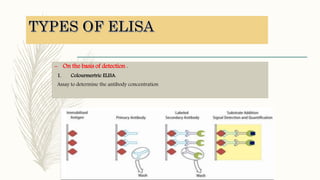
– On the basis of detection :
1. Colourmertric ELISA:
Assay to determine the antibody concentration
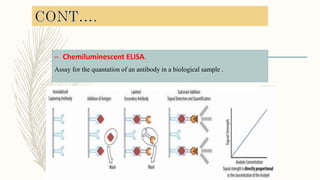
– Chemiluminescent ELISA.
Assay for the quantation of an antibody in a biological sample .
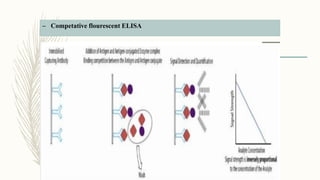
– Competative flourescent ELISA
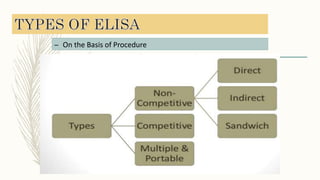
– On the Basis of Procedure
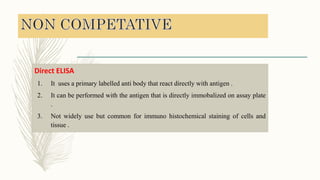
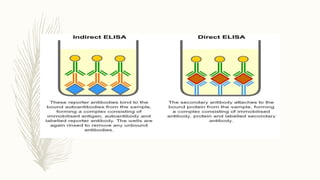
Direct ELISA
1. It uses a primary labelled anti body that react directly with antigen .
2. It can be performed with the antigen that is directly immobalized on assay plate
.
3. Not widely use but common for immuno histochemical staining of cells and
tissue .
– Indirect ELISA
1. Utilized a primary un labeled antibody in conjunction with a labeled
secondary antibody .
2. Secondary antibody has a specificity for primary antibody .
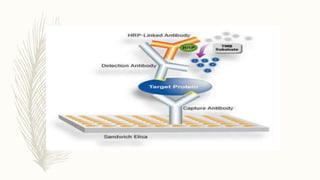
– Sandwich ELISA
1. Antigen like serum proteins ,hormones, tumor markers may be determined .
2. Antigens in the sample bind with the captured antibody and become immobalized.
3. The antibody of the enzyme conjugate bind with the immobilized antigen to form a
sandwich of Ab –Ag-Ab/enzymes bound to microwell.
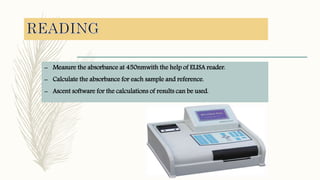
– Measure the absorbance at 450nmwith the help of ELISA reader.
– Calculate the absorbance for each sample and reference.
– Ascent software for the calculations of results can be used.
– Easy to perform and quick procedure .
– Equipment is widely available .
– It can be used to variety of infections .
– It can be used on most type of biological samples like plasma, serum ,urine, cell
extracts.
– It is highly specific and sensitive .
– Reagents are cheap and have a long shelve life .
– No radiation hazards occurduring labeling or disposal of waste.
– Kits are not cheap.
– Enzymes activity may be affected by plasma membrane constituents.
– Very specific toparticular antigen but won´t recoganized other antigen .
– Results may not be absolute .
– Antibody must be available.
– Concent´ration may be unclear
– Detection of antibodies in blood sample for past exposure to disease e.g lymph
disease , HIV , bird flu.
– Detection of antigen e.g prgency hormones ,drug allergens , mad cow disease .
– Disease outbreak – Tracking the spread of disease e.g HIV, birf flu common cold.
– Serum antibody co0ncentration.
– Detecting potential food allergens ( milk , peanut, walnuts ,eggs and almonds ).
• Gen. procedure of ELISA by DAKO A/S Produktionsvej 42. DK-2600
Glostrup Denmark, www.dako.com
• ELISA -A to Z .....from introduction to practice by Katsumi
WAKABAYASHI, Ph.D , Prof. Emer. Gunma University. .
• www.ncbi.nlm.nih.gov/pubmed/25926946.
Elisa(enzyme linked immunosorbent assay)

Elisa(enzyme linked immunosorbent assay)

  • 1.
    RIMSHA FAROOQ (BBS153009) ELIZA(Enzyme Linked Immunosorbent Assay) Presented to: Dr. Marriam Bakhtiar DATE: 21-10-2018
  • 2.
    – – Definition Why knownas History of ELIZA Basic term General procedure Reagent used Equipment Principle of Elisa Types of Elisa
  • 3.
    Common laboratory techniquewhich is used to measure the concentration of analyte (usually antigen or antibodies ) in a solution .
  • 4.
    • Antigen/Antibody ofinterest is absorbed on to plastic surface (sorbent). • Antigen is recoganized by specific antibody(Immuno). • Recoganised by second antibody (Immuno)which has enzyme attached (Enzyme linked ). • Substrate react with enzyme to produce product , usually coloured
  • 6.
    • Based onbasic immunology response • Lock and Key concept • Enzyme conjugate substrate • Bound to secondary antibody that binds with the antibody –antigen complex
  • 7.
    • Microwell plate Flatbuttom polystyrene plate , contains 8*12wells holding 350 µl each.
  • 8.
     Multipipette An 8channel 100µL pipette is a good help for even small scale work .
  • 9.
     Washing device Manually operated washing device.  Contain infectious materials, so must be collected for subsequent disinfection
  • 10.
     Microplate washer Theseare usually efficient with usually low carry –over contamination .
  • 14.
    – On thebasis of detection : 1. Colourmertric ELISA: Assay to determine the antibody concentration
  • 15.
    – Chemiluminescent ELISA. Assayfor the quantation of an antibody in a biological sample .
  • 16.
  • 17.
    – On theBasis of Procedure
  • 18.
    Direct ELISA 1. Ituses a primary labelled anti body that react directly with antigen . 2. It can be performed with the antigen that is directly immobalized on assay plate . 3. Not widely use but common for immuno histochemical staining of cells and tissue .
  • 19.
    – Indirect ELISA 1.Utilized a primary un labeled antibody in conjunction with a labeled secondary antibody . 2. Secondary antibody has a specificity for primary antibody .
  • 21.
    – Sandwich ELISA 1.Antigen like serum proteins ,hormones, tumor markers may be determined . 2. Antigens in the sample bind with the captured antibody and become immobalized. 3. The antibody of the enzyme conjugate bind with the immobilized antigen to form a sandwich of Ab –Ag-Ab/enzymes bound to microwell.
  • 23.
    – Measure theabsorbance at 450nmwith the help of ELISA reader. – Calculate the absorbance for each sample and reference. – Ascent software for the calculations of results can be used.
  • 25.
    – Easy toperform and quick procedure . – Equipment is widely available . – It can be used to variety of infections . – It can be used on most type of biological samples like plasma, serum ,urine, cell extracts. – It is highly specific and sensitive . – Reagents are cheap and have a long shelve life . – No radiation hazards occurduring labeling or disposal of waste.
  • 26.
    – Kits arenot cheap. – Enzymes activity may be affected by plasma membrane constituents. – Very specific toparticular antigen but won´t recoganized other antigen .
  • 27.
    – Results maynot be absolute . – Antibody must be available. – Concent´ration may be unclear
  • 28.
    – Detection ofantibodies in blood sample for past exposure to disease e.g lymph disease , HIV , bird flu. – Detection of antigen e.g prgency hormones ,drug allergens , mad cow disease . – Disease outbreak – Tracking the spread of disease e.g HIV, birf flu common cold. – Serum antibody co0ncentration. – Detecting potential food allergens ( milk , peanut, walnuts ,eggs and almonds ).
  • 29.
    • Gen. procedureof ELISA by DAKO A/S Produktionsvej 42. DK-2600 Glostrup Denmark, www.dako.com • ELISA -A to Z .....from introduction to practice by Katsumi WAKABAYASHI, Ph.D , Prof. Emer. Gunma University. . • www.ncbi.nlm.nih.gov/pubmed/25926946.