CLASS-BMLT 3RD YEAR
SUBJECT- INSTRUMENTATION
Submitted By:
Md Shams Tabrez
ď‚— AutoAnalyzer is an automated analyzer using a
special flow technique named "continuous flow
analysis (CFA)" first made by the Technicon
Corporation.
ď‚— The Technicon AutoAnalyzer II is the world's best
known and most successful Continuous Flow
Automated Analyzer, and the instrument that most
EPA methods reference.
ď‚— The AutoAnalyzer SFA instrument was invented
1957 by Leonard Skeggs, PhD and commercialized
by Jack Whitehead's Technicon® Corporation. The
first applications were for clinical analysis, but
methods for industrial analysis soon followed.
ď‚— There are five parts of auto-Analyger.
ď‚—
ď‚— The sample - It foled the sample a plastic or glass cups.
ď‚—
ď‚— The pump - The pump poush the fluid a sample forward.It can
be won’t at low an high speed.
ď‚—
ď‚— Mixing chamber - In mixing chamber sample mixed with
reagent by the vibration.
ď‚—
ď‚— Incubater bath - In incubator chamber contain are incubate at
37 c° or c°.
ď‚—
ď‚— CLINICAL ANALYSIS
ď‚— AutoAnalyzers were used mainly for routine
repetitive medical laboratory analyses, but they had
been replaced during the last years more and more
by discrete working systems which allow lower
reagent consumption.
ď‚— INDUSTRIAL ANALYSIS
ď‚— The first industrial applications - mainly for water,
soil extracts and fertilizer - used the same hardware
and techniques as clinical methods,
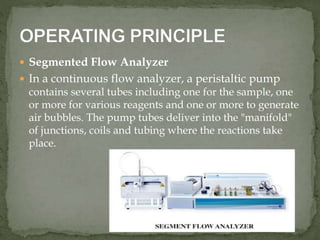
ď‚— Segmented Flow Analyzer
ď‚— In a continuous flow analyzer, a peristaltic pump
contains several tubes including one for the sample, one
or more for various reagents and one or more to generate
air bubbles. The pump tubes deliver into the "manifold"
of junctions, coils and tubing where the reactions take
place.
ď‚— Flow Injection Analyzer
ď‚— Flow Injection Analysis (FIA), conceived in 1975 by
Ruzicka and Hansen, has been described in over
16,000 scientific papers[1] and almost 20 monographs.
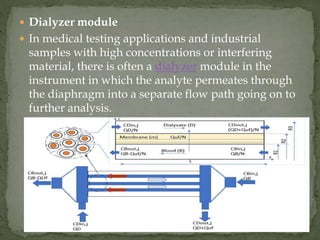
ď‚— Dialyzer module
ď‚— In medical testing applications and industrial
samples with high concentrations or interfering
material, there is often a dialyzer module in the
instrument in which the analyte permeates through
the diaphragm into a separate flow path going on to
further analysis.
ď‚— Recording Of Results
ď‚— Previously a chart recorder and more recently a data
logger or personal computer records the detector
output as a function of time so that each sample
output appears as a peak whose height depends on
the analyte level in the sample.
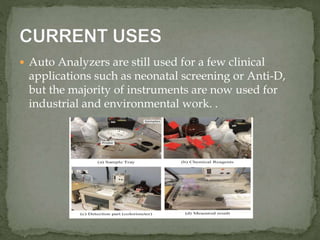
ď‚— Auto Analyzers are still used for a few clinical
applications such as neonatal screening or Anti-D,
but the majority of instruments are now used for
industrial and environmental work. .
ď‚— Technicon published method sheets for a wide range
of analyses and a few of these are listed below. These
were for the AutoAnalyzer I, which was rather like a
Meccano set and could be assembled by the user.
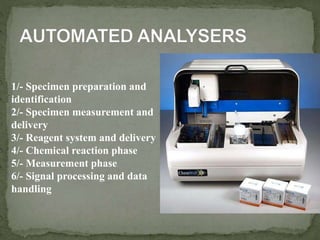
1/- Specimen preparation and
identification
2/- Specimen measurement and
delivery
3/- Reagent system and delivery
4/- Chemical reaction phase
5/- Measurement phase
6/- Signal processing and data
handling
ď‚— -Increase the number of tests performed by one
individual in a given time period (short turn around
time)….speeds up the result
ď‚— Human factor is decreased during the mechanical
and repetitive part of an assay as labor is an
expensive commodity in Medical laboratories.
ď‚— Disadvantages:
ď‚— -The machine does not allow test selection; all tests
must be performed even if not requested.
ď‚— -The machine must run continuously even when
there are no tests.
ď‚— A centrifuge works by using the principal of
sedimentation. Under the influence of gravitation
force , substance separate according to their density.
ď‚— -Automation will continue to evolve.
ď‚— -System integration and miniaturization with more
technologically advanced computer power will
persist to accommodate more portable analyzers for
more precise testing.
ď‚— -Automated analyzers will have artificial intelligence
where by the computer will “think” or make
decisions if sufficiently programmed with infinite
scenarios of data.
ď‚— Basic equipment for photometric measurement.
ď‚— Based on the measurement of a coloured compounds
in solution.
ď‚— Suitable for majority of chemistries.

Automatic And Semi Automatic Analyser Biochemistry

  • 1.
    CLASS-BMLT 3RD YEAR SUBJECT-INSTRUMENTATION Submitted By: Md Shams Tabrez
  • 3.
    ď‚— AutoAnalyzer isan automated analyzer using a special flow technique named "continuous flow analysis (CFA)" first made by the Technicon Corporation. ď‚— The Technicon AutoAnalyzer II is the world's best known and most successful Continuous Flow Automated Analyzer, and the instrument that most EPA methods reference.
  • 4.
     The AutoAnalyzerSFA instrument was invented 1957 by Leonard Skeggs, PhD and commercialized by Jack Whitehead's Technicon® Corporation. The first applications were for clinical analysis, but methods for industrial analysis soon followed.
  • 5.
     There arefive parts of auto-Analyger.   The sample - It foled the sample a plastic or glass cups.   The pump - The pump poush the fluid a sample forward.It can be won’t at low an high speed.   Mixing chamber - In mixing chamber sample mixed with reagent by the vibration.   Incubater bath - In incubator chamber contain are incubate at 37 c° or c°. 
  • 6.
    ď‚— CLINICAL ANALYSIS ď‚—AutoAnalyzers were used mainly for routine repetitive medical laboratory analyses, but they had been replaced during the last years more and more by discrete working systems which allow lower reagent consumption. ď‚— INDUSTRIAL ANALYSIS ď‚— The first industrial applications - mainly for water, soil extracts and fertilizer - used the same hardware and techniques as clinical methods,
  • 7.
    ď‚— Segmented FlowAnalyzer ď‚— In a continuous flow analyzer, a peristaltic pump contains several tubes including one for the sample, one or more for various reagents and one or more to generate air bubbles. The pump tubes deliver into the "manifold" of junctions, coils and tubing where the reactions take place.
  • 8.
    ď‚— Flow InjectionAnalyzer ď‚— Flow Injection Analysis (FIA), conceived in 1975 by Ruzicka and Hansen, has been described in over 16,000 scientific papers[1] and almost 20 monographs.
  • 9.
    ď‚— Dialyzer module ď‚—In medical testing applications and industrial samples with high concentrations or interfering material, there is often a dialyzer module in the instrument in which the analyte permeates through the diaphragm into a separate flow path going on to further analysis.
  • 10.
    ď‚— Recording OfResults ď‚— Previously a chart recorder and more recently a data logger or personal computer records the detector output as a function of time so that each sample output appears as a peak whose height depends on the analyte level in the sample.
  • 11.
    ď‚— Auto Analyzersare still used for a few clinical applications such as neonatal screening or Anti-D, but the majority of instruments are now used for industrial and environmental work. .
  • 12.
    ď‚— Technicon publishedmethod sheets for a wide range of analyses and a few of these are listed below. These were for the AutoAnalyzer I, which was rather like a Meccano set and could be assembled by the user.
  • 13.
    1/- Specimen preparationand identification 2/- Specimen measurement and delivery 3/- Reagent system and delivery 4/- Chemical reaction phase 5/- Measurement phase 6/- Signal processing and data handling
  • 14.
     -Increase thenumber of tests performed by one individual in a given time period (short turn around time)….speeds up the result  Human factor is decreased during the mechanical and repetitive part of an assay as labor is an expensive commodity in Medical laboratories.  Disadvantages:  -The machine does not allow test selection; all tests must be performed even if not requested.  -The machine must run continuously even when there are no tests.
  • 15.
    ď‚— A centrifugeworks by using the principal of sedimentation. Under the influence of gravitation force , substance separate according to their density.
  • 16.
     -Automation willcontinue to evolve.  -System integration and miniaturization with more technologically advanced computer power will persist to accommodate more portable analyzers for more precise testing.  -Automated analyzers will have artificial intelligence where by the computer will “think” or make decisions if sufficiently programmed with infinite scenarios of data.
  • 18.
    ď‚— Basic equipmentfor photometric measurement. ď‚— Based on the measurement of a coloured compounds in solution. ď‚— Suitable for majority of chemistries.