ELISA
Nudrat Nadeem
Lecturer
ISRA University
Definition:
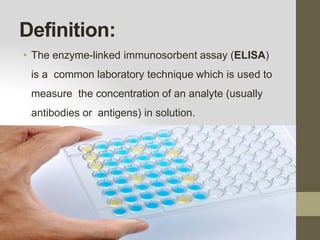
• The enzyme-linked immunosorbent assay (ELISA)
is a common laboratory technique which is used to
measure the concentration of an analyte (usually
antibodies or antigens) in solution.
n
Basic Terms:
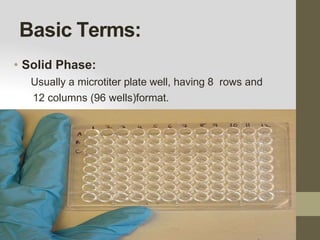
• Solid Phase:
Usually a microtiter plate well, having 8 rows and
12 columns (96 wells)format.
Basic Terms:
• Adsorption:
The process of adding an antigen/antibody, diluted in
buffer, so it attaches to the solid phase on incubation.
• Washing:
The simple flooding & emptying of wells with a
buffered solution to separate bound from un-bound
reagents in ELISA.
Basic Terms:
• Antigen:
Any molecule that elicits the production of antibodies
when introduced into body.
• Antibodies:
Proteins produced in response to antigenic stimuli.
• Enzyme conjugate:
An enzyme that is attached irreversibly to an antibody.
e.g: Horse-redish peroxidase (HRPO).
Basic Terms:
• Chromogen:
A chemical alters color as a result of an enzyme
interaction with substrate (color reaction used as
signal) e.g Trimethyl benzidine (TMB).
• Stopping:
The process of stopping the action of an enzyme
on a substrate.
• Reading:
Spectrophotometric measurement of color developed
in ELISA.
Principle of ELISA:
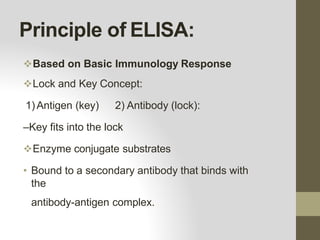
Based on Basic Immunology Response
Lock and Key Concept:
1) Antigen (key) 2) Antibody (lock):
–Key fits into the lock
Enzyme conjugate substrates
• Bound to a secondary antibody that binds with
the
antibody-antigen complex.
Equipment:
1) Microwell
Plate: Flat
bottom
polystyrene
plate,
contains 8 x
12 wells.
Equipment:
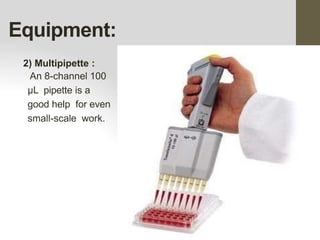
2) Multipipette :
An 8-channel 100
μL pipette is a
good help for even
small-scale work.
Equipment:
3) Washing Device:
• manually operated washing devices.
• may be of use particularly when there is a risk that the
samples tested in ELISA contain infectious material, so
must be collected for subsequent disinfection.
Equipment:
4) Microplate
washer:
• These are very
efficient with
unusually low carry-
over contamination.
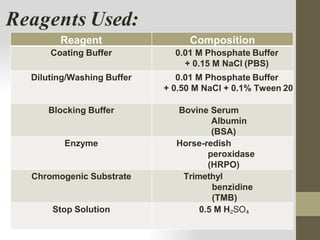
Reagents Used:
Reagent Composition
Coating Buffer 0.01 M Phosphate Buffer
+ 0.15 M NaCl (PBS)
Diluting/Washing Buffer 0.01 M Phosphate Buffer
+ 0.50 M NaCl + 0.1% Tween 20
Blocking Buffer Bovine Serum
Albumin
(BSA)
Enzyme Horse-redish
peroxidase
(HRPO)
Chromogenic Substrate Trimethyl
benzidine
(TMB)
Stop Solution 0.5 M H₂SO₄
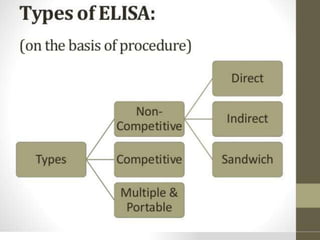
Non-Competitive:
1) Direct ELISA:
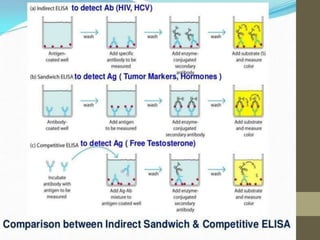
• It uses a primary labeled anti-body that react
directly with the antigen.
• It can be performed with the antigen that is
directly immobilized on assay plate.
• Not widely used but common for immuno-
histochemical
staining of cells & tissues.
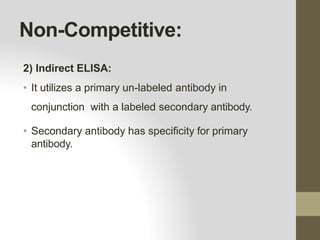
Non-Competitive:
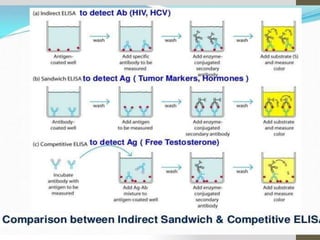
2) Indirect ELISA:
• It utilizes a primary un-labeled antibody in
conjunction with a labeled secondary antibody.
• Secondary antibody has specificity for primary
antibody.
Non-Competitive:
3) Sandwich ELISA:
• Antigens like Tumor markers, hormones, serum
proteins may be determined.
• Antigens in the sample bind with the capture
antibody & become immobilized.
• The antibody of the enzyme conjugate bind with
the immobilized antigen to form a sandwich of
Ab-Ag-Ab/ enzyme bound to microwell.
Competitive:
• Antibody coated microwell.
• Serum antigen & labeled antigen added together ....
Competition
• Ab-Ag enzyme complex bound is inversely related to the conc.
of antigen present in sample.
• Increased serum antigen results in reduced binding of
Ag- enzyme conjugate with the antibody producing less
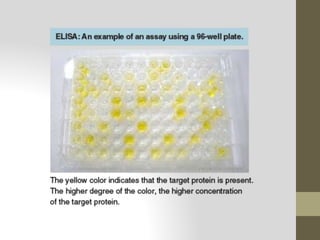
enzyme activity & (yellow) color formation.
• Used to determine small molecules like T₃ , T₄ & Progesterone.
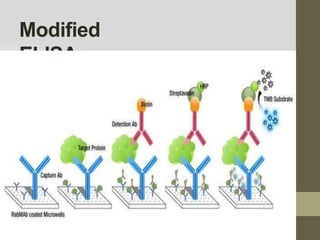
Modified ELISA:
• Enzyme interfere with Ag-Ab interaction.
• Second antibody is often labeled with a very small
molecular substance, biotin (MW=244.31), and a specific
binding protein for biotin, avidin is conjugated with enzyme
such as HRP.
Modified
ELISA:
Reading:
• Measure the absorbance at 450nm with the help of
ELISA plate reader.
• Calculate the absorbance for each sample and
reference.
• Ascent software for the calculation of results can be
used.
Advantages of ELISA:
• Reagents are relatively cheap & ‘ve long shelf life.
• It is highly specific & sensitive.
• No radiation hazards occur during labeling or
disposal of waste.
• Easy to perform & quick procedures.
• Equipment is widely available.
• It can be used to a variety of infections.
• It can be used on most type of biological samples like
plasma,
serum, urine, cell extracts.
Disadvantages of ELISA:
• Measurement of enzyme activity can be more
complex than the measurement of activity of
some type of radioisotopes.
• Enzyme activity may be affected by plasma
constituents.
• Kits are not cheap.
• Very specific to particular antigen but won’t
recognize other antigens.
• False positive/ negative possible, especially with
mutated/ altered antigen.
Limitations
:
• Results may not be absolute.
• Antibody must be available(poor producer,
interference).
• Concentration may be unclear.
• False positive possible (Ab already present).
• False negative possible.
Thank
You

Elisa and Its types

  • 1.
  • 2.
    Definition: • The enzyme-linkedimmunosorbent assay (ELISA) is a common laboratory technique which is used to measure the concentration of an analyte (usually antibodies or antigens) in solution.
  • 4.
  • 5.
    Basic Terms: • SolidPhase: Usually a microtiter plate well, having 8 rows and 12 columns (96 wells)format.
  • 6.
    Basic Terms: • Adsorption: Theprocess of adding an antigen/antibody, diluted in buffer, so it attaches to the solid phase on incubation. • Washing: The simple flooding & emptying of wells with a buffered solution to separate bound from un-bound reagents in ELISA.
  • 7.
    Basic Terms: • Antigen: Anymolecule that elicits the production of antibodies when introduced into body. • Antibodies: Proteins produced in response to antigenic stimuli. • Enzyme conjugate: An enzyme that is attached irreversibly to an antibody. e.g: Horse-redish peroxidase (HRPO).
  • 8.
    Basic Terms: • Chromogen: Achemical alters color as a result of an enzyme interaction with substrate (color reaction used as signal) e.g Trimethyl benzidine (TMB). • Stopping: The process of stopping the action of an enzyme on a substrate. • Reading: Spectrophotometric measurement of color developed in ELISA.
  • 9.
    Principle of ELISA: Basedon Basic Immunology Response Lock and Key Concept: 1) Antigen (key) 2) Antibody (lock): –Key fits into the lock Enzyme conjugate substrates • Bound to a secondary antibody that binds with the antibody-antigen complex.
  • 11.
  • 12.
    Equipment: 2) Multipipette : An8-channel 100 μL pipette is a good help for even small-scale work.
  • 13.
    Equipment: 3) Washing Device: •manually operated washing devices. • may be of use particularly when there is a risk that the samples tested in ELISA contain infectious material, so must be collected for subsequent disinfection.
  • 14.
    Equipment: 4) Microplate washer: • Theseare very efficient with unusually low carry- over contamination.
  • 15.
    Reagents Used: Reagent Composition CoatingBuffer 0.01 M Phosphate Buffer + 0.15 M NaCl (PBS) Diluting/Washing Buffer 0.01 M Phosphate Buffer + 0.50 M NaCl + 0.1% Tween 20 Blocking Buffer Bovine Serum Albumin (BSA) Enzyme Horse-redish peroxidase (HRPO) Chromogenic Substrate Trimethyl benzidine (TMB) Stop Solution 0.5 M H₂SO₄
  • 17.
    Non-Competitive: 1) Direct ELISA: •It uses a primary labeled anti-body that react directly with the antigen. • It can be performed with the antigen that is directly immobilized on assay plate. • Not widely used but common for immuno- histochemical staining of cells & tissues.
  • 18.
    Non-Competitive: 2) Indirect ELISA: •It utilizes a primary un-labeled antibody in conjunction with a labeled secondary antibody. • Secondary antibody has specificity for primary antibody.
  • 20.
    Non-Competitive: 3) Sandwich ELISA: •Antigens like Tumor markers, hormones, serum proteins may be determined. • Antigens in the sample bind with the capture antibody & become immobilized. • The antibody of the enzyme conjugate bind with the immobilized antigen to form a sandwich of Ab-Ag-Ab/ enzyme bound to microwell.
  • 22.
    Competitive: • Antibody coatedmicrowell. • Serum antigen & labeled antigen added together .... Competition • Ab-Ag enzyme complex bound is inversely related to the conc. of antigen present in sample. • Increased serum antigen results in reduced binding of Ag- enzyme conjugate with the antibody producing less enzyme activity & (yellow) color formation. • Used to determine small molecules like T₃ , T₄ & Progesterone.
  • 26.
    Modified ELISA: • Enzymeinterfere with Ag-Ab interaction. • Second antibody is often labeled with a very small molecular substance, biotin (MW=244.31), and a specific binding protein for biotin, avidin is conjugated with enzyme such as HRP.
  • 27.
  • 28.
    Reading: • Measure theabsorbance at 450nm with the help of ELISA plate reader. • Calculate the absorbance for each sample and reference. • Ascent software for the calculation of results can be used.
  • 30.
    Advantages of ELISA: •Reagents are relatively cheap & ‘ve long shelf life. • It is highly specific & sensitive. • No radiation hazards occur during labeling or disposal of waste. • Easy to perform & quick procedures. • Equipment is widely available. • It can be used to a variety of infections. • It can be used on most type of biological samples like plasma, serum, urine, cell extracts.
  • 31.
    Disadvantages of ELISA: •Measurement of enzyme activity can be more complex than the measurement of activity of some type of radioisotopes. • Enzyme activity may be affected by plasma constituents. • Kits are not cheap. • Very specific to particular antigen but won’t recognize other antigens. • False positive/ negative possible, especially with mutated/ altered antigen.
  • 32.
    Limitations : • Results maynot be absolute. • Antibody must be available(poor producer, interference). • Concentration may be unclear. • False positive possible (Ab already present). • False negative possible.
  • 33.