Iram Shaheen
 Define elimination pattern.
 Discuss common problems of elimination.
 Identify nursing interventions for common
problems of fecal elimination.
 Discuss common problems of urinary
elimination.
 Identify nursing intervention for common urinary
problems.
 Discuss factors that can alter urinary function.
 Discuss nursing process for a patient with altered
elimination pattern.
 Elimination pattern:
The ability to get rid of waste products from the
body.
Elimination pattern describe the regulation ,control,
and removal of by - products and waste in the body.
The term usually refers to the movement of feces or
urine and sweat from the body.
 Definition:
“The ability to get ride of wastes from
the body”. OR
“The explosion of waste from body is
known as elimination”.
 Elimination pattern describe the regulation, control
and removal of body products and wastes in the
body. The term usually refers to the movement of
feces or urine and sweat from the body.
 It is also known as defecation. Bowel elimination is
a natural process critical to human functioning in
which body excretes waste products of digestion. It
is a essential component of healthy body
functioning. OR
 Defecation (bowel elimination) is the act of
expelling feces (stool) from the body. To do so, all
structures of gastrointestinal tract, especially the
components of the large intestine must function in
the coordinated manner.
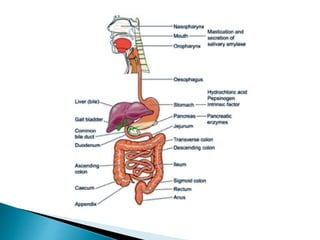
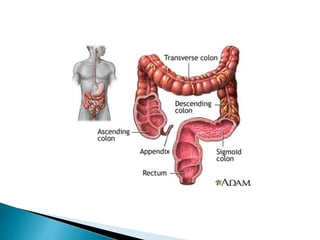
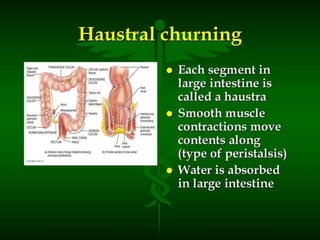
 Large intestine (colon) is about 125-150cm long. It
has seven parts: cecum, ascending, transverse, and
descending, sigmoid colon, rectum and anus.
 The colon forms pouches called haustra (haustrum
is singular).
 The large intestine is a muscular tube lined with
mucous membrane.
 The muscles are circular and longitudinal to
facilitate peristaltic movements.
 Haustral churning: involves back and forth
movement of chyme within the colon.
 Colon peristalsis: is relatively sluggish movement
of the chyme along the colon.
 Mass peristalsis: is powerful muscular movement
along the colon.
 Defecation is initiated by two reflexes.
1. When feces enter the rectum, its distention gives
signal to mesenteric plexus to initiate peristaltic
movements in the descending, sigmoid colon and
the rectum.
2. The internal sphincter in the anus relaxes and
defecation occurs by opening the external
sphincter.
Feces (healthy people):
 Soft, brown, moist, and firmed.
 Distinct odor.
Factors affecting the odor and appearance:
 Certain foods.
 Medications.
 Illness or infection.
 Black: tarry stool may indicate of bleeding
from upper gastrointestinal tract or drug.
 Red: may indicate of bleeding from lower
gastrointestinal tract.
 Pale: may indicate to mal absorption.
 Green: may indicate intestinal infections.
 Dry hard: dehydration decreases intestinal
motility.
 Pus: bacterial infection.
 Diarrhea: liquid watery stools. Deals with the
consistency and frequency.
 Constipation: less then 3 time/week or what ever
is less then the pt. regular pattern of elimination.
 Incontinence: inability to control fecal discharge
through anal sphincter. Involuntary passage of
stool.
 Fecal impaction: mass of hardened feces in
rectum recognized by seepage.
 Flatulence: gas, abdominal distention and pain.
 Usual pattern: how often, when.
 Change in bowels: blood, mucus.
 Aids to eliminate: laxatives enemas.
 Current problems: food related, meds.
 Physical, emotional, artificial orifices,
hemorrhoids (abnormally distended veins)
colostomy.
 Inspection: observe contour of abdomen and
note visible peristalsis.
 Auscultation: listen for bowel sounds in all
quadrants.
 Percussion: resonant or tympany over hollow
organs, dullness over intestinal obstruction.
 Palpation: feel for masses, tenderness etc.
 Emotional anxiety
 Failure to heed defecation reflex
 Lack of time and privacy
 High carbohydrates, high fat diet
 Reduce fluid intake
 Immobility and inactivity
 Overuse of cathartics, narcotic, analgesic
 Inability to squat because of immobility ,
musculoskeletal deformity, pain during
defecation
 Encourage intake of fluids and foods
 Eating small amount of bland foods
 Encourage the ingestion of foods or fluids
containing potassium since diarrhea can lead
to great potassium losses.
 Avoid excessively hot or cold fluids and
highly spicy foods and high fiber foods that
can aggravate diarrhea.
 Increase fluid intake. Instruct the patient to
dink fruit juices.
 Include fiber in the diet with foods.
 Administration of laxatives
 Administration of enema.
 Education/counseling/habit training
 Diet( fiber,lactose,fructose)
 Reduce caffeine intake
 Anal hygiene/skin care
 Digital removal of stool
 Give balanced meals
 Note time of incontinence
 Toilet patient 30 to 60 min before usual time
of incontinence
 Begin bowel training program
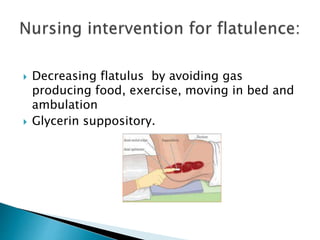
 Decreasing flatulus by avoiding gas
producing food, exercise, moving in bed and
ambulation
 Glycerin suppository.
 Promotion of regular bowel habits.
 Promoting of normal defecation
 Digital removal of stool
 Maintenance of proper food and fluid intake
 Promotion of regular exercise.
 Promotion of comfort
 Cathartics/laxatives: drugs that induce emptying of
the intestine. Habitual use of laxatives lead to
constipation and irreg. frequency.
 Enemas: solution introduced into lower bowel by
way of rectum for the purpose of removing feces.
 Suppositories: bullet shaped substance inserted
into the rectum beyond the anal sphincter where it
melts to aid in elimination.
 Digital removal: with prolonged retention of feces,
fecal impaction occurs preventing passage of
normal stool. Liquid fecal seepage around hard
stool can occur. Oil retention enemas is given prior
to digital removal to soften stool.
 Kidneys are pairs of organ.
 Shape: bean shaped
 Size: 11 cm long, 6cm wide, 3cm thick.
 Weight: 150gm.
 Location: the kidneys lies on the posterior
abdominal wall one on each side of the
vertebral column.
 Position: it is situated at T12 to L3.
 The urinary system consist of organs that
produce and excrete urine form the body
 Urine contains waste mostly excess water
salts and nitrogen compounds.
 Primary organs are the kidneys
 Normal adult bladder can store up to 0.5 l or
500ml.
 Also responsible for regulating blood volume,
and blood pressure,.
 Regulates electrolytes.
 The formation of urine has three processes
filtration, reabsorption and tubular secretions
 Urine consist of 95% water and 5% solid
substances.
 The need to urinate is usually felt at 300 to
350ml of urine in the bladder.
 Typically 1000 to 1500ml is voided daily.
 Micturition, voiding and urination all refers to
the process of emptying the bladder.
 Stretch receptors , special sensory nerve
endings in the bladder wall that is stimulated
when the pressure is felt from the collection
of urine .
 Adult range is 250 to 450 ml of urine ,
children: 50 to 200ml of urine
 Growth and development
 Psychosocial factors
 Fluid and food intake
 Medications
 Muscle tone and activity
 Pathological conditions
 Surgical and diagnostic procedure
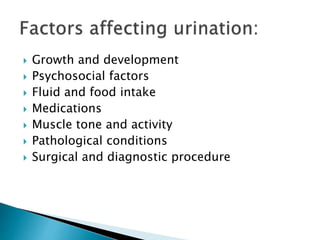
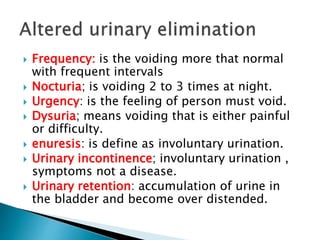
 Frequency: is the voiding more that normal
with frequent intervals
 Nocturia; is voiding 2 to 3 times at night.
 Urgency: is the feeling of person must void.
 Dysuria; means voiding that is either painful
or difficulty.
 enuresis: is define as involuntary urination.
 Urinary incontinence; involuntary urination ,
symptoms not a disease.
 Urinary retention: accumulation of urine in
the bladder and become over distended.
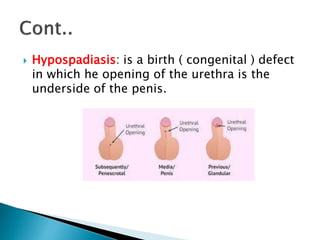
 Hypospadiasis: is a birth ( congenital ) defect
in which he opening of the urethra is the
underside of the penis.
 Determine normal voiding pattern and
frequency.
 Appearance of urine
 Recent changes
 Past or current problems with urination
burning, urgency etc.
 Presence of an ostomy.
 Factors influencing elimination pattern.
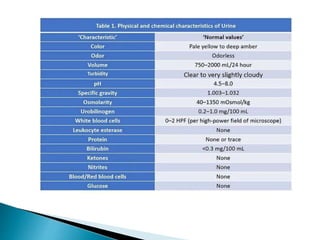
 Color; transparent
 Normal kidney produce urine at the rate of 40
to 60ml/hour or 1500 to 2000 ml/day.
 Sterility; no microorganisms present.
 Glucose; not present
 Blood; not present
 Epithelial cells; not present.
 Measuring urine output.
 Collecting urine specimen.
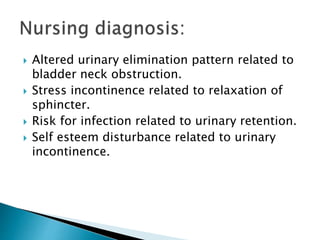
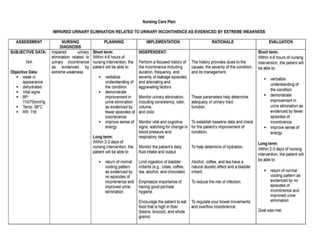
 Altered urinary elimination pattern related to
bladder neck obstruction.
 Stress incontinence related to relaxation of
sphincter.
 Risk for infection related to urinary retention.
 Self esteem disturbance related to urinary
incontinence.
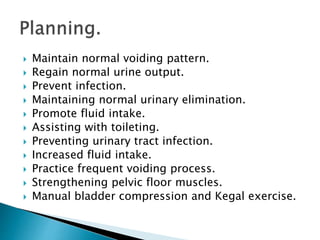
 Maintain normal voiding pattern.
 Regain normal urine output.
 Prevent infection.
 Maintaining normal urinary elimination.
 Promote fluid intake.
 Assisting with toileting.
 Preventing urinary tract infection.
 Increased fluid intake.
 Practice frequent voiding process.
 Strengthening pelvic floor muscles.
 Manual bladder compression and Kegal exercise.
 Bladder training: requires that the client
postpone voiding, resist or inhibit the sensation
urgency, and void according to a timetable rather
than according to the urge to void. The goal is
lengthen the intervals between urination to
collect the client's habit of frequent urination.
 Habit training: also referred to as time voiding or
scheduled toileting. There is no attempt to
motivate the client to delay voiding is the urge to
occurs.
 Prompt voiding: supplements the habit training
by encouraging the client to use the toilet and
reminding the client when to void.
 Pelvic muscle exercises' (PME).
 Referred to as perennial muscle tightening or
Kegel’s exercises.
 Strengthening pubococcygeal muscles and
can increase the incontinent female’s ability
to start and stop the stream of urine.
 Positive reinforcements.
 Maintaining skin integrity.
 Applying external urinary devices.
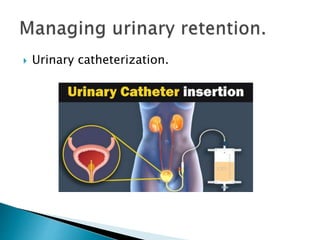
 Urinary catheterization.
concept of elimination-2.pptx

concept of elimination-2.pptx

  • 1.
  • 2.
     Define eliminationpattern.  Discuss common problems of elimination.  Identify nursing interventions for common problems of fecal elimination.  Discuss common problems of urinary elimination.  Identify nursing intervention for common urinary problems.  Discuss factors that can alter urinary function.  Discuss nursing process for a patient with altered elimination pattern.
  • 4.
     Elimination pattern: Theability to get rid of waste products from the body. Elimination pattern describe the regulation ,control, and removal of by - products and waste in the body. The term usually refers to the movement of feces or urine and sweat from the body.
  • 5.
     Definition: “The abilityto get ride of wastes from the body”. OR “The explosion of waste from body is known as elimination”.  Elimination pattern describe the regulation, control and removal of body products and wastes in the body. The term usually refers to the movement of feces or urine and sweat from the body.
  • 6.
     It isalso known as defecation. Bowel elimination is a natural process critical to human functioning in which body excretes waste products of digestion. It is a essential component of healthy body functioning. OR  Defecation (bowel elimination) is the act of expelling feces (stool) from the body. To do so, all structures of gastrointestinal tract, especially the components of the large intestine must function in the coordinated manner.
  • 7.
     Large intestine(colon) is about 125-150cm long. It has seven parts: cecum, ascending, transverse, and descending, sigmoid colon, rectum and anus.  The colon forms pouches called haustra (haustrum is singular).  The large intestine is a muscular tube lined with mucous membrane.  The muscles are circular and longitudinal to facilitate peristaltic movements.
  • 9.
     Haustral churning:involves back and forth movement of chyme within the colon.  Colon peristalsis: is relatively sluggish movement of the chyme along the colon.  Mass peristalsis: is powerful muscular movement along the colon.
  • 11.
     Defecation isinitiated by two reflexes. 1. When feces enter the rectum, its distention gives signal to mesenteric plexus to initiate peristaltic movements in the descending, sigmoid colon and the rectum. 2. The internal sphincter in the anus relaxes and defecation occurs by opening the external sphincter.
  • 12.
    Feces (healthy people): Soft, brown, moist, and firmed.  Distinct odor. Factors affecting the odor and appearance:  Certain foods.  Medications.  Illness or infection.
  • 13.
     Black: tarrystool may indicate of bleeding from upper gastrointestinal tract or drug.  Red: may indicate of bleeding from lower gastrointestinal tract.  Pale: may indicate to mal absorption.  Green: may indicate intestinal infections.  Dry hard: dehydration decreases intestinal motility.  Pus: bacterial infection.
  • 14.
     Diarrhea: liquidwatery stools. Deals with the consistency and frequency.  Constipation: less then 3 time/week or what ever is less then the pt. regular pattern of elimination.  Incontinence: inability to control fecal discharge through anal sphincter. Involuntary passage of stool.  Fecal impaction: mass of hardened feces in rectum recognized by seepage.  Flatulence: gas, abdominal distention and pain.
  • 15.
     Usual pattern:how often, when.  Change in bowels: blood, mucus.  Aids to eliminate: laxatives enemas.  Current problems: food related, meds.  Physical, emotional, artificial orifices, hemorrhoids (abnormally distended veins) colostomy.
  • 16.
     Inspection: observecontour of abdomen and note visible peristalsis.  Auscultation: listen for bowel sounds in all quadrants.  Percussion: resonant or tympany over hollow organs, dullness over intestinal obstruction.  Palpation: feel for masses, tenderness etc.
  • 17.
     Emotional anxiety Failure to heed defecation reflex  Lack of time and privacy  High carbohydrates, high fat diet  Reduce fluid intake  Immobility and inactivity  Overuse of cathartics, narcotic, analgesic  Inability to squat because of immobility , musculoskeletal deformity, pain during defecation
  • 18.
     Encourage intakeof fluids and foods  Eating small amount of bland foods  Encourage the ingestion of foods or fluids containing potassium since diarrhea can lead to great potassium losses.  Avoid excessively hot or cold fluids and highly spicy foods and high fiber foods that can aggravate diarrhea.
  • 19.
     Increase fluidintake. Instruct the patient to dink fruit juices.  Include fiber in the diet with foods.  Administration of laxatives  Administration of enema.
  • 20.
     Education/counseling/habit training Diet( fiber,lactose,fructose)  Reduce caffeine intake  Anal hygiene/skin care  Digital removal of stool
  • 21.
     Give balancedmeals  Note time of incontinence  Toilet patient 30 to 60 min before usual time of incontinence  Begin bowel training program
  • 22.
     Decreasing flatulusby avoiding gas producing food, exercise, moving in bed and ambulation  Glycerin suppository.
  • 23.
     Promotion ofregular bowel habits.  Promoting of normal defecation  Digital removal of stool  Maintenance of proper food and fluid intake  Promotion of regular exercise.  Promotion of comfort
  • 24.
     Cathartics/laxatives: drugsthat induce emptying of the intestine. Habitual use of laxatives lead to constipation and irreg. frequency.  Enemas: solution introduced into lower bowel by way of rectum for the purpose of removing feces.  Suppositories: bullet shaped substance inserted into the rectum beyond the anal sphincter where it melts to aid in elimination.  Digital removal: with prolonged retention of feces, fecal impaction occurs preventing passage of normal stool. Liquid fecal seepage around hard stool can occur. Oil retention enemas is given prior to digital removal to soften stool.
  • 25.
     Kidneys arepairs of organ.  Shape: bean shaped  Size: 11 cm long, 6cm wide, 3cm thick.  Weight: 150gm.  Location: the kidneys lies on the posterior abdominal wall one on each side of the vertebral column.  Position: it is situated at T12 to L3.
  • 26.
     The urinarysystem consist of organs that produce and excrete urine form the body  Urine contains waste mostly excess water salts and nitrogen compounds.  Primary organs are the kidneys  Normal adult bladder can store up to 0.5 l or 500ml.  Also responsible for regulating blood volume, and blood pressure,.  Regulates electrolytes.
  • 27.
     The formationof urine has three processes filtration, reabsorption and tubular secretions  Urine consist of 95% water and 5% solid substances.  The need to urinate is usually felt at 300 to 350ml of urine in the bladder.  Typically 1000 to 1500ml is voided daily.
  • 28.
     Micturition, voidingand urination all refers to the process of emptying the bladder.  Stretch receptors , special sensory nerve endings in the bladder wall that is stimulated when the pressure is felt from the collection of urine .  Adult range is 250 to 450 ml of urine , children: 50 to 200ml of urine
  • 29.
     Growth anddevelopment  Psychosocial factors  Fluid and food intake  Medications  Muscle tone and activity  Pathological conditions  Surgical and diagnostic procedure
  • 30.
     Frequency: isthe voiding more that normal with frequent intervals  Nocturia; is voiding 2 to 3 times at night.  Urgency: is the feeling of person must void.  Dysuria; means voiding that is either painful or difficulty.  enuresis: is define as involuntary urination.  Urinary incontinence; involuntary urination , symptoms not a disease.  Urinary retention: accumulation of urine in the bladder and become over distended.
  • 31.
     Hypospadiasis: isa birth ( congenital ) defect in which he opening of the urethra is the underside of the penis.
  • 32.
     Determine normalvoiding pattern and frequency.  Appearance of urine  Recent changes  Past or current problems with urination burning, urgency etc.  Presence of an ostomy.  Factors influencing elimination pattern.
  • 33.
     Color; transparent Normal kidney produce urine at the rate of 40 to 60ml/hour or 1500 to 2000 ml/day.  Sterility; no microorganisms present.  Glucose; not present  Blood; not present  Epithelial cells; not present.  Measuring urine output.  Collecting urine specimen.
  • 35.
     Altered urinaryelimination pattern related to bladder neck obstruction.  Stress incontinence related to relaxation of sphincter.  Risk for infection related to urinary retention.  Self esteem disturbance related to urinary incontinence.
  • 36.
     Maintain normalvoiding pattern.  Regain normal urine output.  Prevent infection.  Maintaining normal urinary elimination.  Promote fluid intake.  Assisting with toileting.  Preventing urinary tract infection.  Increased fluid intake.  Practice frequent voiding process.  Strengthening pelvic floor muscles.  Manual bladder compression and Kegal exercise.
  • 37.
     Bladder training:requires that the client postpone voiding, resist or inhibit the sensation urgency, and void according to a timetable rather than according to the urge to void. The goal is lengthen the intervals between urination to collect the client's habit of frequent urination.  Habit training: also referred to as time voiding or scheduled toileting. There is no attempt to motivate the client to delay voiding is the urge to occurs.  Prompt voiding: supplements the habit training by encouraging the client to use the toilet and reminding the client when to void.
  • 38.
     Pelvic muscleexercises' (PME).  Referred to as perennial muscle tightening or Kegel’s exercises.  Strengthening pubococcygeal muscles and can increase the incontinent female’s ability to start and stop the stream of urine.  Positive reinforcements.  Maintaining skin integrity.  Applying external urinary devices.
  • 39.