www.tektronix.com/optical25
SDH Network Elements
Terminal Multiplexer
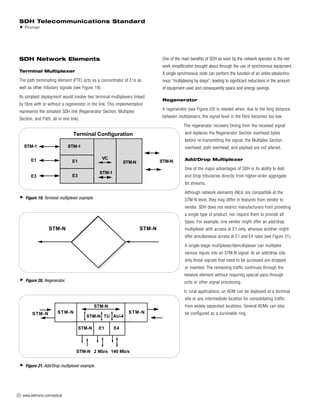
The path terminating element (PTE) acts as a concentrator of E1s as
well as other tributary signals (see Figure 19).
Its simplest deployment would involve two terminal multiplexers linked
by fibre with or without a regenerator in the link. This implementation
represents the simplest SDH link (Regenerator Section, Multiplex
Section, and Path, all in one link).
One of the main benefits of SDH as seen by the network operator is the net-
work simplification brought about through the use of synchronous equipment.
A single synchronous node can perform the function of an entire plesiochro-
nous “multiplexing by steps”, leading to significant reductions in the amount
of equipment used and consequently space and energy savings.
Regenerator
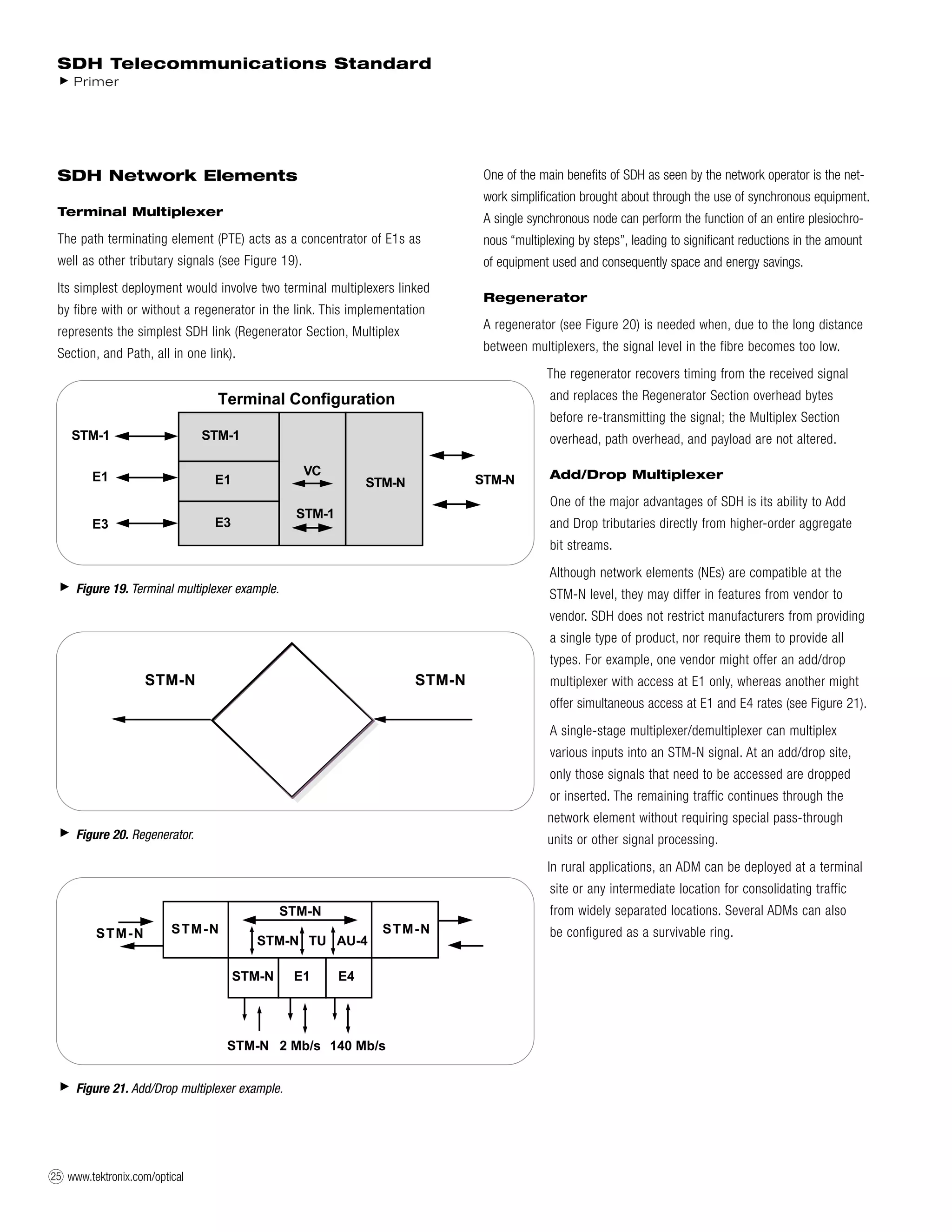
A regenerator (see Figure 20) is needed when, due to the long distance
between multiplexers, the signal level in the fibre becomes too low.
The regenerator recovers timing from the received signal
and replaces the Regenerator Section overhead bytes
before re-transmitting the signal; the Multiplex Section
overhead, path overhead, and payload are not altered.
Add/Drop Multiplexer
One of the major advantages of SDH is its ability to Add
and Drop tributaries directly from higher-order aggregate
bit streams.
Although network elements (NEs) are compatible at the
STM-N level, they may differ in features from vendor to
vendor. SDH does not restrict manufacturers from providing
a single type of product, nor require them to provide all
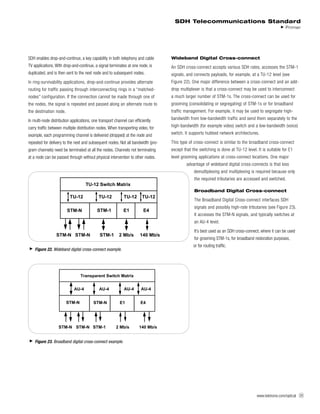
types. For example, one vendor might offer an add/drop
multiplexer with access at E1 only, whereas another might
offer simultaneous access at E1 and E4 rates (see Figure 21).
A single-stage multiplexer/demultiplexer can multiplex
various inputs into an STM-N signal. At an add/drop site,
only those signals that need to be accessed are dropped
or inserted. The remaining traffic continues through the
network element without requiring special pass-through
units or other signal processing.
In rural applications, an ADM can be deployed at a terminal
site or any intermediate location for consolidating traffic
from widely separated locations. Several ADMs can also
be configured as a survivable ring.
SDH Telecommunications Standard
Primer
Figure 19. Terminal multiplexer example.
E1
E3
STM-N
VC
STM-1
E1
E3
STM-N
STM-1
Terminal Configuration
STM-1
Figure 20. Regenerator.
STM-NSTM-N
Figure 21. Add/Drop multiplexer example.
STM-N
STM-N
STM-N E1 E4
2 Mb/s 140 Mb/s
AU-4TU
STM-NSTM-N
STM-N
STM-N
www.tektronix.com/optical 26
SDH enables drop-and-continue, a key capability in both telephony and cable
TV applications. With drop-and-continue, a signal terminates at one node, is
duplicated, and is then sent to the next node and to subsequent nodes.
In ring-survivability applications, drop-and-continue provides alternate
routing for traffic passing through interconnecting rings in a “matched-
nodes” configuration. If the connection cannot be made through one of
the nodes, the signal is repeated and passed along an alternate route to
the destination node.
In multi-node distribution applications, one transport channel can efficiently
carry traffic between multiple distribution nodes. When transporting video, for
example, each programming channel is delivered (dropped) at the node and
repeated for delivery to the next and subsequent nodes. Not all bandwidth (pro-
gram channels) need be terminated at all the nodes. Channels not terminating
at a node can be passed through without physical intervention to other nodes.
Wideband Digital Cross-connect
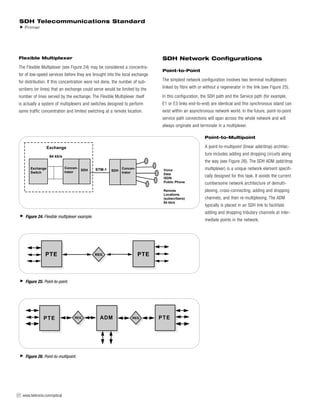
An SDH cross-connect accepts various SDH rates, accesses the STM-1
signals, and connects payloads, for example, at a TU-12 level (see
Figure 22). One major difference between a cross-connect and an add-
drop multiplexer is that a cross-connect may be used to interconnect
a much larger number of STM-1s. The cross-connect can be used for
grooming (consolidating or segregating) of STM-1s or for broadband
traffic management. For example, it may be used to segregate high-
bandwidth from low-bandwidth traffic and send them separately to the
high-bandwidth (for example video) switch and a low-bandwidth (voice)
switch. It supports hubbed network architectures.
This type of cross-connect is similar to the broadband cross-connect
except that the switching is done at TU-12 level. It is suitable for E1
level grooming applications at cross-connect locations. One major
advantage of wideband digital cross-connects is that less
demultiplexing and multiplexing is required because only
the required tributaries are accessed and switched.
Broadband Digital Cross-connect
The Broadband Digital Cross-connect interfaces SDH
signals and possibly high-rate tributaries (see Figure 23).
It accesses the STM-N signals, and typically switches at
an AU-4 level.
It’s best used as an SDH cross-connect, where it can be used
for grooming STM-1s, for broadband restoration purposes,
or for routing traffic.
SDH Telecommunications Standard
Primer
Figure 22. Wideband digital cross-connect example.
STM-1 2 Mb/s 140 Mb/sSTM-NSTM-N
STM-1 E1 E4STM-N
TU-12TU-12TU-12TU-12
TU-12 Switch Matrix
Figure 23. Broadband digital cross-connect example.
140 Mb/sSTM-N
STM-N E1 E4STM-N
AU-4AU-4
Transparent Switch Matrix
STM-N STM-1 2 Mb/s
AU-4 AU-4
www.tektronix.com/optical27
Flexible Multiplexer
The Flexible Multiplexer (see Figure 24) may be considered a concentra-
tor of low-speed services before they are brought into the local exchange
for distribution. If this concentration were not done, the number of sub-
scribers (or lines) that an exchange could serve would be limited by the
number of lines served by the exchange. The Flexible Multiplexer itself
is actually a system of multiplexers and switches designed to perform
some traffic concentration and limited switching at a remote location.
SDH Network Configurations
Point-to-Point
The simplest network configuration involves two terminal multiplexers
linked by fibre with or without a regenerator in the link (see Figure 25).
In this configuration, the SDH path and the Service path (for example,
E1 or E3 links end-to-end) are identical and this synchronous island can
exist within an asynchronous network world. In the future, point-to-point
service path connections will span across the whole network and will
always originate and terminate in a multiplexer.
Point-to-Multipoint
A point-to-multipoint (linear add/drop) architec-
ture includes adding and dropping circuits along
the way (see Figure 26). The SDH ADM (add/drop
multiplexer) is a unique network element specifi-
cally designed for this task. It avoids the current
cumbersome network architecture of demulti-
plexing, cross-connecting, adding and dropping
channels, and then re-multiplexing. The ADM
typically is placed in an SDH link to facilitate
adding and dropping tributary channels at inter-
mediate points in the network.
SDH Telecommunications Standard
Primer
Figure 25. Point-to-point.
PTEPTE REG
Figure 26. Point-to-multipoint.
REGPTE ADM PTEREG
Figure 24. Flexible multiplexer example.
Exchange
Switch
64 kb/s
STM-1
Remote
Locations
(subscribers)
64 kb/s
SDH
Concen-
trator SDH
Concen-
trator
Exchange
Voice
Data
ISDN
Public Phone

Elements

  • 1.
    www.tektronix.com/optical25 SDH Network Elements TerminalMultiplexer The path terminating element (PTE) acts as a concentrator of E1s as well as other tributary signals (see Figure 19). Its simplest deployment would involve two terminal multiplexers linked by fibre with or without a regenerator in the link. This implementation represents the simplest SDH link (Regenerator Section, Multiplex Section, and Path, all in one link). One of the main benefits of SDH as seen by the network operator is the net- work simplification brought about through the use of synchronous equipment. A single synchronous node can perform the function of an entire plesiochro- nous “multiplexing by steps”, leading to significant reductions in the amount of equipment used and consequently space and energy savings. Regenerator A regenerator (see Figure 20) is needed when, due to the long distance between multiplexers, the signal level in the fibre becomes too low. The regenerator recovers timing from the received signal and replaces the Regenerator Section overhead bytes before re-transmitting the signal; the Multiplex Section overhead, path overhead, and payload are not altered. Add/Drop Multiplexer One of the major advantages of SDH is its ability to Add and Drop tributaries directly from higher-order aggregate bit streams. Although network elements (NEs) are compatible at the STM-N level, they may differ in features from vendor to vendor. SDH does not restrict manufacturers from providing a single type of product, nor require them to provide all types. For example, one vendor might offer an add/drop multiplexer with access at E1 only, whereas another might offer simultaneous access at E1 and E4 rates (see Figure 21). A single-stage multiplexer/demultiplexer can multiplex various inputs into an STM-N signal. At an add/drop site, only those signals that need to be accessed are dropped or inserted. The remaining traffic continues through the network element without requiring special pass-through units or other signal processing. In rural applications, an ADM can be deployed at a terminal site or any intermediate location for consolidating traffic from widely separated locations. Several ADMs can also be configured as a survivable ring. SDH Telecommunications Standard Primer Figure 19. Terminal multiplexer example. E1 E3 STM-N VC STM-1 E1 E3 STM-N STM-1 Terminal Configuration STM-1 Figure 20. Regenerator. STM-NSTM-N Figure 21. Add/Drop multiplexer example. STM-N STM-N STM-N E1 E4 2 Mb/s 140 Mb/s AU-4TU STM-NSTM-N STM-N STM-N
  • 2.
    www.tektronix.com/optical 26 SDH enablesdrop-and-continue, a key capability in both telephony and cable TV applications. With drop-and-continue, a signal terminates at one node, is duplicated, and is then sent to the next node and to subsequent nodes. In ring-survivability applications, drop-and-continue provides alternate routing for traffic passing through interconnecting rings in a “matched- nodes” configuration. If the connection cannot be made through one of the nodes, the signal is repeated and passed along an alternate route to the destination node. In multi-node distribution applications, one transport channel can efficiently carry traffic between multiple distribution nodes. When transporting video, for example, each programming channel is delivered (dropped) at the node and repeated for delivery to the next and subsequent nodes. Not all bandwidth (pro- gram channels) need be terminated at all the nodes. Channels not terminating at a node can be passed through without physical intervention to other nodes. Wideband Digital Cross-connect An SDH cross-connect accepts various SDH rates, accesses the STM-1 signals, and connects payloads, for example, at a TU-12 level (see Figure 22). One major difference between a cross-connect and an add- drop multiplexer is that a cross-connect may be used to interconnect a much larger number of STM-1s. The cross-connect can be used for grooming (consolidating or segregating) of STM-1s or for broadband traffic management. For example, it may be used to segregate high- bandwidth from low-bandwidth traffic and send them separately to the high-bandwidth (for example video) switch and a low-bandwidth (voice) switch. It supports hubbed network architectures. This type of cross-connect is similar to the broadband cross-connect except that the switching is done at TU-12 level. It is suitable for E1 level grooming applications at cross-connect locations. One major advantage of wideband digital cross-connects is that less demultiplexing and multiplexing is required because only the required tributaries are accessed and switched. Broadband Digital Cross-connect The Broadband Digital Cross-connect interfaces SDH signals and possibly high-rate tributaries (see Figure 23). It accesses the STM-N signals, and typically switches at an AU-4 level. It’s best used as an SDH cross-connect, where it can be used for grooming STM-1s, for broadband restoration purposes, or for routing traffic. SDH Telecommunications Standard Primer Figure 22. Wideband digital cross-connect example. STM-1 2 Mb/s 140 Mb/sSTM-NSTM-N STM-1 E1 E4STM-N TU-12TU-12TU-12TU-12 TU-12 Switch Matrix Figure 23. Broadband digital cross-connect example. 140 Mb/sSTM-N STM-N E1 E4STM-N AU-4AU-4 Transparent Switch Matrix STM-N STM-1 2 Mb/s AU-4 AU-4
  • 3.
    www.tektronix.com/optical27 Flexible Multiplexer The FlexibleMultiplexer (see Figure 24) may be considered a concentra- tor of low-speed services before they are brought into the local exchange for distribution. If this concentration were not done, the number of sub- scribers (or lines) that an exchange could serve would be limited by the number of lines served by the exchange. The Flexible Multiplexer itself is actually a system of multiplexers and switches designed to perform some traffic concentration and limited switching at a remote location. SDH Network Configurations Point-to-Point The simplest network configuration involves two terminal multiplexers linked by fibre with or without a regenerator in the link (see Figure 25). In this configuration, the SDH path and the Service path (for example, E1 or E3 links end-to-end) are identical and this synchronous island can exist within an asynchronous network world. In the future, point-to-point service path connections will span across the whole network and will always originate and terminate in a multiplexer. Point-to-Multipoint A point-to-multipoint (linear add/drop) architec- ture includes adding and dropping circuits along the way (see Figure 26). The SDH ADM (add/drop multiplexer) is a unique network element specifi- cally designed for this task. It avoids the current cumbersome network architecture of demulti- plexing, cross-connecting, adding and dropping channels, and then re-multiplexing. The ADM typically is placed in an SDH link to facilitate adding and dropping tributary channels at inter- mediate points in the network. SDH Telecommunications Standard Primer Figure 25. Point-to-point. PTEPTE REG Figure 26. Point-to-multipoint. REGPTE ADM PTEREG Figure 24. Flexible multiplexer example. Exchange Switch 64 kb/s STM-1 Remote Locations (subscribers) 64 kb/s SDH Concen- trator SDH Concen- trator Exchange Voice Data ISDN Public Phone