



1
2
Transmission network consist of the following major transmission
technologies:
 Optical fiber communication link
 Microwave communication link
3
Transmission Network link
4
Transmission Protocol
SDH (Synchronous Digital Hierarchy)
PDH ( Plesiochronus Digital Hierarchy)
Both optical fiber and microwave communication
link support PDH and SDH link
Overview of Synchronous Digital
Hierarchy (SDH) Transmission
Network
5
 ---- It stands for Synchronous Digital Hierarchy
 ---- It is a transmission protocol
 ---- It defines frame structure, multiplexing method, digital rates
hierarchy and interface code pattern
 ---- It needs for a system to process increasing amounts of information
 ---- It is a new standard that allows mixing equipment from different
suppliers
6
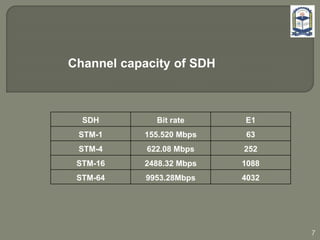
Channel capacity of SDH
SDH Bit rate E1
STM-1 155.520 Mbps 63
STM-4 622.08 Mbps 252
STM-16 2488.32 Mbps 1088
STM-64 9953.28Mbps 4032
7
Overview of PDH ( Plesiochronus
Digital Hierarchy) Transmission
Network
8
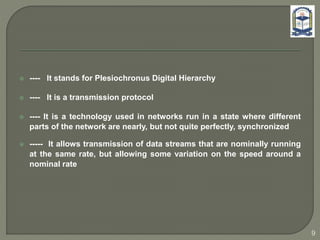
 ---- It stands for Plesiochronus Digital Hierarchy
 ---- It is a transmission protocol
 ---- It is a technology used in networks run in a state where different
parts of the network are nearly, but not quite perfectly, synchronized
 ----- It allows transmission of data streams that are nominally running
at the same rate, but allowing some variation on the speed around a
nominal rate
9
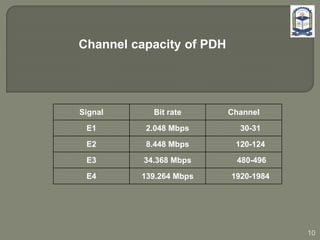
Signal Bit rate Channel
E1 2.048 Mbps 30-31
E2 8.448 Mbps 120-124
E3 34.368 Mbps 480-496
E4 139.264 Mbps 1920-1984
Channel capacity of PDH
10
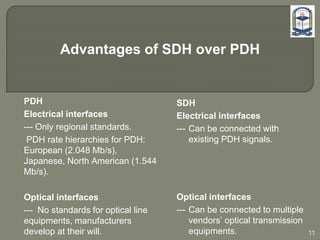
Advantages of SDH over PDH
PDH
Electrical interfaces
--- Only regional standards.
PDH rate hierarchies for PDH:
European (2.048 Mb/s),
Japanese, North American (1.544
Mb/s).
Optical interfaces
--- No standards for optical line
equipments, manufacturers
develop at their will.
SDH
Electrical interfaces
--- Can be connected with
existing PDH signals.
Optical interfaces
--- Can be connected to multiple
vendors’ optical transmission
equipments. 11
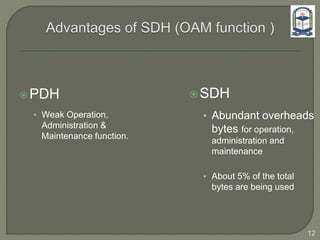
PDH
• Weak Operation,
Administration &
Maintenance function.
12
SDH
• Abundant overheads
bytes for operation,
administration and
maintenance
• About 5% of the total
bytes are being used
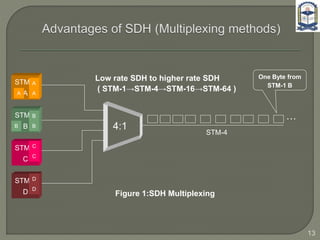
Low rate SDH to higher rate SDH
( STM-1→STM-4→STM-16→STM-64 )
4:1
STM-1
A
STM-1
B
STM-1
C
STM-1
D
A
B
D
C
B
A
D
C
B
A
…
STM-4
One Byte from
STM-1 B
13
Figure 1:SDH Multiplexing
14
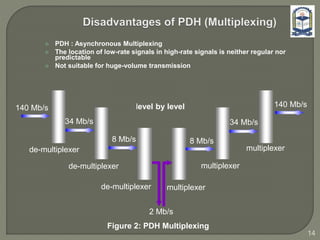
 PDH : Asynchronous Multiplexing
 The location of low-rate signals in high-rate signals is neither regular nor
predictable
 Not suitable for huge-volume transmission
140 Mb/s
34 Mb/s 34 Mb/s
8 Mb/s 8 Mb/s
2 Mb/s
140 Mb/s
de-multiplexer
de-multiplexer
de-multiplexer multiplexer
multiplexer
multiplexer
level by level
Figure 2: PDH Multiplexing
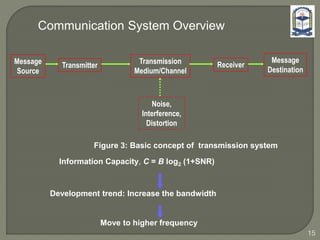
Communication System Overview
Message
Source
Transmitter Transmission
Medium/Channel
Receiver
Message
Destination
Noise,
Interference,
Distortion
Information Capacity, C = B log2 (1+SNR)
Development trend: Increase the bandwidth
Move to higher frequency
Figure 3: Basic concept of transmission system
15
16
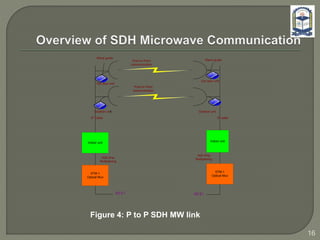
Indoor unit Indoor unit
STM-1
Optical Mux
STM-1
Optical Mux
63 E1
Add drop
Multiplexing
Add drop
Multiplexing
63 E1
Outdoor unit Outdoor unit
Out door unit
Out door unit
Point to Point
communication
Point to Point
communication
IF cableIF Cable
Wave guide
Wave guide
Figure 4: P to P SDH MW link
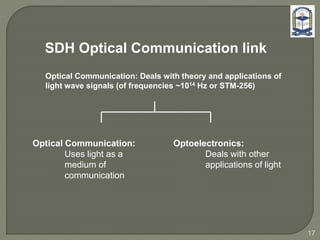
SDH Optical Communication link
Optical Communication: Deals with theory and applications of
light wave signals (of frequencies ~1014 Hz or STM-256)
Optical Communication:
Uses light as a
medium of
communication
Optoelectronics:
Deals with other
applications of light
17
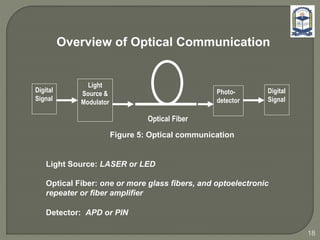
Overview of Optical Communication
Light Source: LASER or LED
Digital
Signal
Light
Source &
Modulator
Photo-
detector
Digital
Signal
Optical Fiber
Optical Fiber: one or more glass fibers, and optoelectronic
repeater or fiber amplifier
Detector: APD or PIN
Figure 5: Optical communication
18
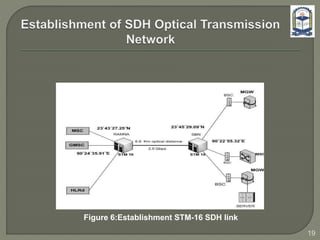
19
Figure 6:Establishment STM-16 SDH link
 ---- To be newly connection Ramna to SBN for GMSC, MSC,, BSC,
MGW etc. HLR
 ---- It is requirements STM-16 (2.5 Gbps) SDH link.
 ---- For STM-16 link the only physical media is suitable is Single mode
optical fiber cable. Hence Single Mode G.652 fiber is selected between
those sites and has been installed
20
 ---- Synchronous digital hierarchy (SDH) refer to a group of fiber-
optic transmission rates that can transport digital signals with
different capacities.
 ---- STM-16 SDH Multiplexer is cost-effective and compact STM-16
SDH multiplexer equipment designed to manage and derive
services from the optical core to access
 ---- Microwave SDH link does not support STM-16 (2.5 Gbps).
21
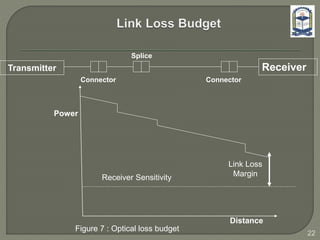
Transmitter Receiver
Connector
Splice
Connector
Power
Distance
Receiver Sensitivity
Link Loss
Margin
Figure 7 : Optical loss budget
22
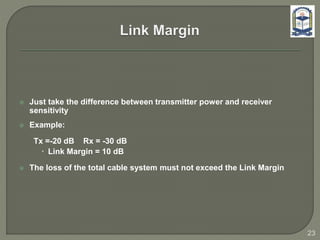
 Just take the difference between transmitter power and receiver
sensitivity
 Example:
Tx =-20 dB Rx = -30 dB
 Link Margin = 10 dB
 The loss of the total cable system must not exceed the Link Margin
23
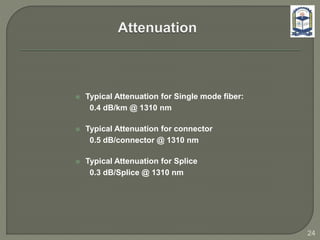
 Typical Attenuation for Single mode fiber:
0.4 dB/km @ 1310 nm
 Typical Attenuation for connector
0.5 dB/connector @ 1310 nm
 Typical Attenuation for Splice
0.3 dB/Splice @ 1310 nm
24
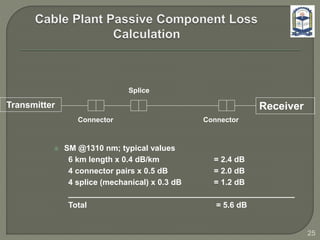
 SM @1310 nm; typical values
6 km length x 0.4 dB/km = 2.4 dB
4 connector pairs x 0.5 dB = 2.0 dB
4 splice (mechanical) x 0.3 dB = 1.2 dB
___________________________________________________
Total = 5.6 dB
Transmitter Receiver
Connector
Splice
Connector
25
 ----Determining Cabinet Positions
 ---- Marking Installation Hole Positions
 ---- Installing Supports and Slide Rails
 ---- Adjusting Support Height
 ---- Fasten all bolts. Assembling Supports
and Slide Rails
 --- Installing Floor Holder Fixing Components
 --- Installing Insulation Plates
Figure 8: Mux cabinet
26
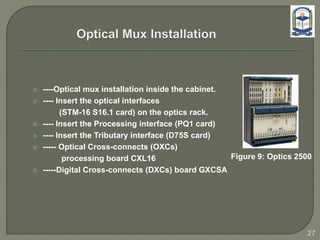
 ----Optical mux installation inside the cabinet.
 ---- Insert the optical interfaces
(STM-16 S16.1 card) on the optics rack.
 ---- Insert the Processing interface (PQ1 card)
 ---- Insert the Tributary interface (D75S card)
 ----- Optical Cross-connects (OXCs)
processing board CXL16
 -----Digital Cross-connects (DXCs) board GXCSA
Figure 9: Optics 2500
27
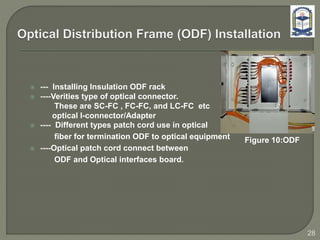
 --- Installing Insulation ODF rack
 ----Verities type of optical connector.
These are SC-FC , FC-FC, and LC-FC etc
optical I-connector/Adapter
 ---- Different types patch cord use in optical
fiber for termination ODF to optical equipment
 ----Optical patch cord connect between
ODF and Optical interfaces board.
Figure 10:ODF
28
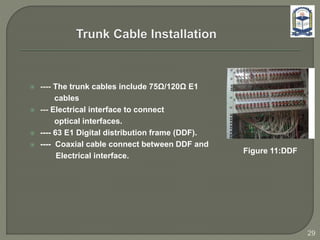
 ---- The trunk cables include 75Ω/120Ω E1
cables
 --- Electrical interface to connect
optical interfaces.
 ---- 63 E1 Digital distribution frame (DDF).
 ---- Coaxial cable connect between DDF and
Electrical interface.
Figure 11:DDF
29
 ---- The labels are affixed to the DC cables
that provide power for the cabinets
 ---- the protection grounding cables, including
the –48V, PGND, and BGND cables
 --- The labels for DC power cables are affixed
to one side of the identification plates on cable ties
Figure 12:DC Power
(1) (2)
TO:
A01 -48V2
B08
TO:
B03 -48V2
30
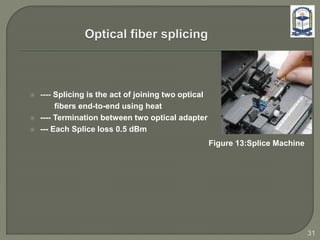
 ---- Splicing is the act of joining two optical
fibers end-to-end using heat
 ---- Termination between two optical adapter
 --- Each Splice loss 0.5 dBm
Figure 13:Splice Machine
31
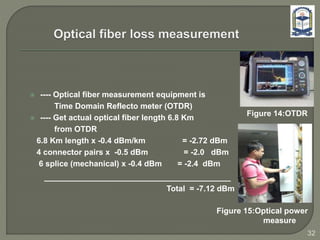
 ---- Optical fiber measurement equipment is
Time Domain Reflecto meter (OTDR)
 ---- Get actual optical fiber length 6.8 Km
from OTDR
6.8 Km length x -0.4 dBm/km = -2.72 dBm
4 connector pairs x -0.5 dBm = -2.0 dBm
6 splice (mechanical) x -0.4 dBm = -2.4 dBm
__________________________________________
Total = -7.12 dBm
Figure 14:OTDR
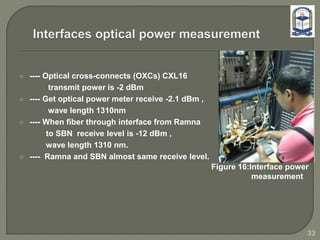
Figure 15:Optical power
measure
32
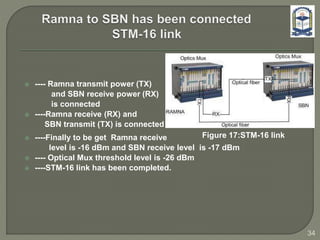
 ---- Optical cross-connects (OXCs) CXL16
transmit power is -2 dBm
 ---- Get optical power meter receive -2.1 dBm ,
wave length 1310nm
 ---- When fiber through interface from Ramna
to SBN receive level is -12 dBm ,
wave length 1310 nm.
 ---- Ramna and SBN almost same receive level.
Figure 16:Interface power
measurement
33
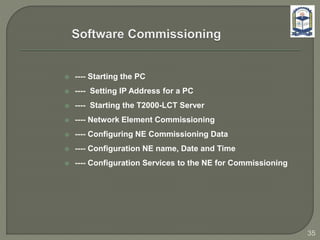
 ---- Ramna transmit power (TX)
and SBN receive power (RX)
is connected
 ----Ramna receive (RX) and
SBN transmit (TX) is connected
 ----Finally to be get Ramna receive
level is -16 dBm and SBN receive level is -17 dBm
 ---- Optical Mux threshold level is -26 dBm
 ----STM-16 link has been completed.
Figure 17:STM-16 link
34
 ---- Starting the PC
 ---- Setting IP Address for a PC
 ---- Starting the T2000-LCT Server
 ---- Network Element Commissioning
 ---- Configuring NE Commissioning Data
 ---- Configuration NE name, Date and Time
 ---- Configuration Services to the NE for Commissioning
35
 ---- Testing Fiber Connection
 ---- Testing connection of Cables to interfaces
 ---- Testing Optical Fiber Jumper Connection
 ---- Testing Specifications of Optical Interfaces
 ---- Testing Received Optical power of an optical interface Board
36
37
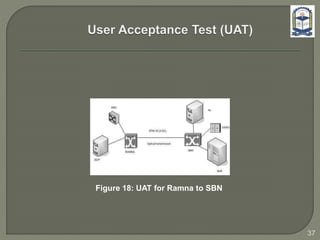
Figure 18: UAT for Ramna to SBN
 ---- Management Function by LCT.
 ---- Order wire Phone Test
 ---- Power Supply Environment Test
 ---- Optical Power Test
 ---- Bit Error Rate Test
 ---- ON/OFF Test.
 ---- alarms (Critical, Major and Minor etc.).
 ---- Check of BOQ.
 ---- Visual checking of interconnection cables.
 ---- Checking of Overall Installation.
 ---- Checking of Physical Connection of Power.
 ---- Continuity test of each & every E1 between the stations.
 ---- Cable runs.
 ---- DDF and DDF cabling.
 ---- of Physical Connection of Earthling of the equipments
38
 ---- STM-16 SDH link has been completed from Ramna to SBN
 ---- Optical Cross connects (OXCs) and Digital cross-connects
(DXCs) are to be completed
 ---- Both site Ramna and SBN optical receive level are correct
 ---- Optical receive level were some problem, when optical to be
installed
 ---- Get difference between optical fiber link budget loss and
calculating optical measurement loss
 ---- Finally STM-16 (2.5 Gbps) SDH link is ok.
39
Thank you
40

Thesis of sdh

  • 1.
  • 2.
  • 3.
    Transmission network consistof the following major transmission technologies:  Optical fiber communication link  Microwave communication link 3 Transmission Network link
  • 4.
    4 Transmission Protocol SDH (SynchronousDigital Hierarchy) PDH ( Plesiochronus Digital Hierarchy) Both optical fiber and microwave communication link support PDH and SDH link
  • 5.
    Overview of SynchronousDigital Hierarchy (SDH) Transmission Network 5
  • 6.
     ---- Itstands for Synchronous Digital Hierarchy  ---- It is a transmission protocol  ---- It defines frame structure, multiplexing method, digital rates hierarchy and interface code pattern  ---- It needs for a system to process increasing amounts of information  ---- It is a new standard that allows mixing equipment from different suppliers 6
  • 7.
    Channel capacity ofSDH SDH Bit rate E1 STM-1 155.520 Mbps 63 STM-4 622.08 Mbps 252 STM-16 2488.32 Mbps 1088 STM-64 9953.28Mbps 4032 7
  • 8.
    Overview of PDH( Plesiochronus Digital Hierarchy) Transmission Network 8
  • 9.
     ---- Itstands for Plesiochronus Digital Hierarchy  ---- It is a transmission protocol  ---- It is a technology used in networks run in a state where different parts of the network are nearly, but not quite perfectly, synchronized  ----- It allows transmission of data streams that are nominally running at the same rate, but allowing some variation on the speed around a nominal rate 9
  • 10.
    Signal Bit rateChannel E1 2.048 Mbps 30-31 E2 8.448 Mbps 120-124 E3 34.368 Mbps 480-496 E4 139.264 Mbps 1920-1984 Channel capacity of PDH 10
  • 11.
    Advantages of SDHover PDH PDH Electrical interfaces --- Only regional standards. PDH rate hierarchies for PDH: European (2.048 Mb/s), Japanese, North American (1.544 Mb/s). Optical interfaces --- No standards for optical line equipments, manufacturers develop at their will. SDH Electrical interfaces --- Can be connected with existing PDH signals. Optical interfaces --- Can be connected to multiple vendors’ optical transmission equipments. 11
  • 12.
    PDH • Weak Operation, Administration& Maintenance function. 12 SDH • Abundant overheads bytes for operation, administration and maintenance • About 5% of the total bytes are being used
  • 13.
    Low rate SDHto higher rate SDH ( STM-1→STM-4→STM-16→STM-64 ) 4:1 STM-1 A STM-1 B STM-1 C STM-1 D A B D C B A D C B A … STM-4 One Byte from STM-1 B 13 Figure 1:SDH Multiplexing
  • 14.
    14  PDH :Asynchronous Multiplexing  The location of low-rate signals in high-rate signals is neither regular nor predictable  Not suitable for huge-volume transmission 140 Mb/s 34 Mb/s 34 Mb/s 8 Mb/s 8 Mb/s 2 Mb/s 140 Mb/s de-multiplexer de-multiplexer de-multiplexer multiplexer multiplexer multiplexer level by level Figure 2: PDH Multiplexing
  • 15.
    Communication System Overview Message Source TransmitterTransmission Medium/Channel Receiver Message Destination Noise, Interference, Distortion Information Capacity, C = B log2 (1+SNR) Development trend: Increase the bandwidth Move to higher frequency Figure 3: Basic concept of transmission system 15
  • 16.
    16 Indoor unit Indoorunit STM-1 Optical Mux STM-1 Optical Mux 63 E1 Add drop Multiplexing Add drop Multiplexing 63 E1 Outdoor unit Outdoor unit Out door unit Out door unit Point to Point communication Point to Point communication IF cableIF Cable Wave guide Wave guide Figure 4: P to P SDH MW link
  • 17.
    SDH Optical Communicationlink Optical Communication: Deals with theory and applications of light wave signals (of frequencies ~1014 Hz or STM-256) Optical Communication: Uses light as a medium of communication Optoelectronics: Deals with other applications of light 17
  • 18.
    Overview of OpticalCommunication Light Source: LASER or LED Digital Signal Light Source & Modulator Photo- detector Digital Signal Optical Fiber Optical Fiber: one or more glass fibers, and optoelectronic repeater or fiber amplifier Detector: APD or PIN Figure 5: Optical communication 18
  • 19.
  • 20.
     ---- Tobe newly connection Ramna to SBN for GMSC, MSC,, BSC, MGW etc. HLR  ---- It is requirements STM-16 (2.5 Gbps) SDH link.  ---- For STM-16 link the only physical media is suitable is Single mode optical fiber cable. Hence Single Mode G.652 fiber is selected between those sites and has been installed 20
  • 21.
     ---- Synchronousdigital hierarchy (SDH) refer to a group of fiber- optic transmission rates that can transport digital signals with different capacities.  ---- STM-16 SDH Multiplexer is cost-effective and compact STM-16 SDH multiplexer equipment designed to manage and derive services from the optical core to access  ---- Microwave SDH link does not support STM-16 (2.5 Gbps). 21
  • 22.
  • 23.
     Just takethe difference between transmitter power and receiver sensitivity  Example: Tx =-20 dB Rx = -30 dB  Link Margin = 10 dB  The loss of the total cable system must not exceed the Link Margin 23
  • 24.
     Typical Attenuationfor Single mode fiber: 0.4 dB/km @ 1310 nm  Typical Attenuation for connector 0.5 dB/connector @ 1310 nm  Typical Attenuation for Splice 0.3 dB/Splice @ 1310 nm 24
  • 25.
     SM @1310nm; typical values 6 km length x 0.4 dB/km = 2.4 dB 4 connector pairs x 0.5 dB = 2.0 dB 4 splice (mechanical) x 0.3 dB = 1.2 dB ___________________________________________________ Total = 5.6 dB Transmitter Receiver Connector Splice Connector 25
  • 26.
     ----Determining CabinetPositions  ---- Marking Installation Hole Positions  ---- Installing Supports and Slide Rails  ---- Adjusting Support Height  ---- Fasten all bolts. Assembling Supports and Slide Rails  --- Installing Floor Holder Fixing Components  --- Installing Insulation Plates Figure 8: Mux cabinet 26
  • 27.
     ----Optical muxinstallation inside the cabinet.  ---- Insert the optical interfaces (STM-16 S16.1 card) on the optics rack.  ---- Insert the Processing interface (PQ1 card)  ---- Insert the Tributary interface (D75S card)  ----- Optical Cross-connects (OXCs) processing board CXL16  -----Digital Cross-connects (DXCs) board GXCSA Figure 9: Optics 2500 27
  • 28.
     --- InstallingInsulation ODF rack  ----Verities type of optical connector. These are SC-FC , FC-FC, and LC-FC etc optical I-connector/Adapter  ---- Different types patch cord use in optical fiber for termination ODF to optical equipment  ----Optical patch cord connect between ODF and Optical interfaces board. Figure 10:ODF 28
  • 29.
     ---- Thetrunk cables include 75Ω/120Ω E1 cables  --- Electrical interface to connect optical interfaces.  ---- 63 E1 Digital distribution frame (DDF).  ---- Coaxial cable connect between DDF and Electrical interface. Figure 11:DDF 29
  • 30.
     ---- Thelabels are affixed to the DC cables that provide power for the cabinets  ---- the protection grounding cables, including the –48V, PGND, and BGND cables  --- The labels for DC power cables are affixed to one side of the identification plates on cable ties Figure 12:DC Power (1) (2) TO: A01 -48V2 B08 TO: B03 -48V2 30
  • 31.
     ---- Splicingis the act of joining two optical fibers end-to-end using heat  ---- Termination between two optical adapter  --- Each Splice loss 0.5 dBm Figure 13:Splice Machine 31
  • 32.
     ---- Opticalfiber measurement equipment is Time Domain Reflecto meter (OTDR)  ---- Get actual optical fiber length 6.8 Km from OTDR 6.8 Km length x -0.4 dBm/km = -2.72 dBm 4 connector pairs x -0.5 dBm = -2.0 dBm 6 splice (mechanical) x -0.4 dBm = -2.4 dBm __________________________________________ Total = -7.12 dBm Figure 14:OTDR Figure 15:Optical power measure 32
  • 33.
     ---- Opticalcross-connects (OXCs) CXL16 transmit power is -2 dBm  ---- Get optical power meter receive -2.1 dBm , wave length 1310nm  ---- When fiber through interface from Ramna to SBN receive level is -12 dBm , wave length 1310 nm.  ---- Ramna and SBN almost same receive level. Figure 16:Interface power measurement 33
  • 34.
     ---- Ramnatransmit power (TX) and SBN receive power (RX) is connected  ----Ramna receive (RX) and SBN transmit (TX) is connected  ----Finally to be get Ramna receive level is -16 dBm and SBN receive level is -17 dBm  ---- Optical Mux threshold level is -26 dBm  ----STM-16 link has been completed. Figure 17:STM-16 link 34
  • 35.
     ---- Startingthe PC  ---- Setting IP Address for a PC  ---- Starting the T2000-LCT Server  ---- Network Element Commissioning  ---- Configuring NE Commissioning Data  ---- Configuration NE name, Date and Time  ---- Configuration Services to the NE for Commissioning 35
  • 36.
     ---- TestingFiber Connection  ---- Testing connection of Cables to interfaces  ---- Testing Optical Fiber Jumper Connection  ---- Testing Specifications of Optical Interfaces  ---- Testing Received Optical power of an optical interface Board 36
  • 37.
    37 Figure 18: UATfor Ramna to SBN
  • 38.
     ---- ManagementFunction by LCT.  ---- Order wire Phone Test  ---- Power Supply Environment Test  ---- Optical Power Test  ---- Bit Error Rate Test  ---- ON/OFF Test.  ---- alarms (Critical, Major and Minor etc.).  ---- Check of BOQ.  ---- Visual checking of interconnection cables.  ---- Checking of Overall Installation.  ---- Checking of Physical Connection of Power.  ---- Continuity test of each & every E1 between the stations.  ---- Cable runs.  ---- DDF and DDF cabling.  ---- of Physical Connection of Earthling of the equipments 38
  • 39.
     ---- STM-16SDH link has been completed from Ramna to SBN  ---- Optical Cross connects (OXCs) and Digital cross-connects (DXCs) are to be completed  ---- Both site Ramna and SBN optical receive level are correct  ---- Optical receive level were some problem, when optical to be installed  ---- Get difference between optical fiber link budget loss and calculating optical measurement loss  ---- Finally STM-16 (2.5 Gbps) SDH link is ok. 39
  • 40.

Editor's Notes