1
TTC
Expect
Excellence
TheFundamentalsofSDH
Overview
Recent global changes in government structures
and resulting economic pressures, increased competi-
tion and growing private networks have forced telecom-
munications service providers throughout the world to
increase their operating efficiency. Long-established
analogtransmissionsystemsthatprovedinadequatewere
gradually replaced by digital communications networks.
In many countries, digital transmission networks were
developed based upon standards collectively known to-
day as the Plesiochronous Digital Hierarchy (PDH).
Although it has numerous advantages over ana-
log, PDH has some shortcomings: provisioning circuits
can be labor-intensive and time-consuming, automation
and centralized control capabilities of telecommunica-
tion networks are limited, and upgrading to emerging
services can be cumbersome. A major disadvantage is
that standards exist for electrical line interfaces at PDH
rates, but there is no standard for optical line equipment
at any PDH rate, which is specific to each manufacturer.
This means that fiber optic transmission equipment from
one manufacturer may not be able to interface with other
manufacturers’ equipment. As a result, service provid-
ers are often required to select a single vendor for
deployment in areas of the network, and are locked
into using the network control and monitoring capa-
bilities of that vendor.
Reconfiguring PDH networks can be difficult and
labor-intensive - resulting in costly, time-consuming
modifications to the network whenever new services are
introduced or when more bandwidth is required. The
situationwasparticularlydifficultinNorthAmerica,where
aplesiochronoussystem(T-Carrier)wasinplace. Utiliz-
ingthetechnologicaladvancesandassociatedreductions
in cost since plesiochronous systems were introduced,
Bellcore (the research affiliate of the Bell operating
companies in the United States) proposed a new trans-
mission hierarchy in 1985. Bellcore’s major goal was to
create a synchronous system with an optical interface
compatible with multiple vendors, but the standardiza-
tion also included a flexible frame structure capable of
handling either existing or new signals and also numer-
ous facilities built into the signal overhead for embedded
operations, administration, maintenance and provision-
ing(OAM&P)purposes. Thenewtransmissionhierarchy
wasnamedSynchronousOpticalNetwork(SONET). The
International Telecommunication Union (ITU) estab-
lished an international standard based on the SONET
specifications, known as the Synchronous Digital Hier-
archy (SDH), in 1988.
The SDH specifications define optical interfaces
that allow transmission of lower-rate (e.g., PDH) signals
at a common synchronous rate. A benefit of SDH is that
it allows multiple vendors’ optical transmission equip-
ment to be compatible in the same span. SDH also
enablesdynamicdrop-and-insertcapabilitiesonthepay-
load; PDH operators would have to demultiplex and
remultiplex the higher-rate signal, causing delays and
requiring additional hardware. Since the overhead is
relatively independent of the payload, SDH easily inte-
grates new services, such as Asynchronous Transfer
Mode(ATM)andFiberDistributedDataInterface(FDDI),
along with existing European 2, 34, and 140 Mbit/s PDH
signals, and North American 1.5, 6.3, and 45 Mbit/s
signals. In 1990, the European Telecommunications
Standards Institute (ETSI) selected a subset of the origi-
nalSDHspecificationasthestandardforusebymembers
of the European Union (EU). This subset, now used by
many countries outside the EU, is known as theETSI SDH
specification. ETSI SDH establishes a common multi-
plexing route for European countries. ETSI SDH differs
from the full SDH specification in that ETSI SDH is more
restricted in the available multiplexing/demultiplexing
options for transporting European and North American
plesiochronous signals. References to SDH in this docu-
ment are exclusively the ETSI SDH subset.
The Fundamentals
of SDH
2
TTC
Expect
Excellence
TheFundamentalsofSDH
SDH Multiplexing
SDH multiplexing combines low-speed digital signals such as 2, 34, and 140 Mbit/s signals with required
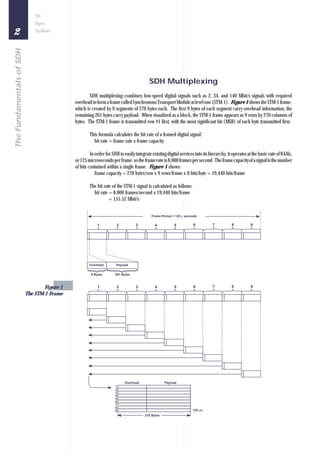
overheadtoformaframecalledSynchronousTransportModuleatlevelone(STM-1). Figure1showstheSTM-1frame,
which is created by 9 segments of 270 bytes each. The first 9 bytes of each segment carry overhead information; the
remaining 261 bytes carry payload. When visualized as a block, the STM-1 frame appears as 9 rows by 270 columns of
bytes. The STM-1 frame is transmitted row #1 first, with the most significant bit (MSB) of each byte transmitted first.
This formula calculates the bit rate of a framed digital signal:
bit rate = frame rate x frame capacity
InorderforSDHtoeasilyintegrateexistingdigitalservicesintoitshierarchy,itoperatesatthebasicrateof8kHz,
or125microsecondsperframe,sotheframerateis8,000framespersecond. Theframecapacityofasignalisthenumber
of bits contained within a single frame. Figure 1 shows:
frame capacity = 270 bytes/row x 9 rows/frame x 8 bits/byte = 19,440 bits/frame
The bit rate of the STM-1 signal is calculated as follows:
bit rate = 8,000 frames/second x 19,440 bits/frame
= 155.52 Mbit/s
Figure 1
The STM-1 Frame
1 2 43 5 6 7 8 9
1
2
3
4
5
6
7
8
9
Overhead Payload
125 µs
270 Bytes
1 2 43 5 6 7 8 9
Overhead Payload
9 Bytes 261 Bytes
Frame Period = 125 µ seconds
3
TTC
Expect
Excellence
TheFundamentalsofSDH
The SDH Frame
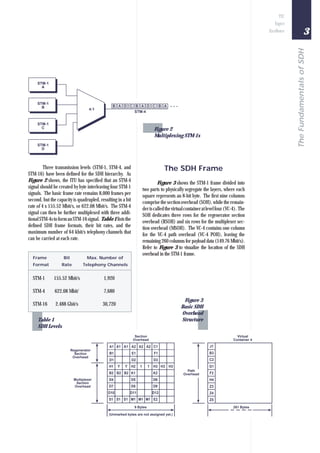
Figure 3 shows the STM-1 frame divided into
two parts to physically segregate the layers, where each
square represents an 8-bit byte. The first nine columns
comprisethesectionoverhead(SOH),whiletheremain-
deriscalledthevirtualcontaineratlevelfour(VC-4). The
SOH dedicates three rows for the regenerator section
overhead (RSOH) and six rows for the multiplexer sec-
tion overhead (MSOH). The VC-4 contains one column
for the VC-4 path overhead (VC-4 POH), leaving the
remaining 260 columns for payload data (149.76 Mbit/s).
Refer to Figure 3 to visualize the location of the SDH
overhead in the STM-1 frame.
Figure 2
Multiplexing STM-1s
Table 1
SDH Levels
A1
B1
D1
B2
D4
D7
D10
S1 S1
Multiplexer
Section
Overhead
J1
B3
C2
G1
F2
H4
Z3
Z4
Z5
B2
A1
S1
B2
A1 A2
E1
D2
K1
D5
D8
D11
M1
A2
M1
A2
M1
C1
F1
D3
K2
D6
D9
D12
E2
H1 Y Y H2 H31 1 H3 H3
Regenerator
Section
Overhead
(Unmarked bytes are not assigned yet.)
Path
Overhead
261 Bytes
Virtual
Container 4
Section
Overhead
9 Bytes
Figure 3
Basic SDH
Overhead
Structure
Three transmission levels (STM-1, STM-4, and
STM-16) have been defined for the SDH hierarchy. As
Figure 2 shows, the ITU has specified that an STM-4
signal should be created by byte interleaving four STM-1
signals. The basic frame rate remains 8,000 frames per
second, but the capacity is quadrupled, resulting in a bit
rate of 4 x 155.52 Mbit/s, or 622.08 Mbit/s. The STM-4
signal can then be further multiplexed with three addi-
tionalSTM-4stoformanSTM-16signal. Table1liststhe
defined SDH frame formats, their bit rates, and the
maximum number of 64 kbit/s telephony channels that
can be carried at each rate.
Frame Bit Max. Number of
Format Rate Telephony Channels
STM-1 155.52 Mbit/s 1,920
STM-4 622.08 Mbit/ 7,680
STM-16 2.488 Gbit/s 30,720
STM-1
A
STM-1
B
STM-1
C
STM-1
D
STM-4
B A D C B A D C B A . . .
4:1

Sdh technology

  • 1.
    1 TTC Expect Excellence TheFundamentalsofSDH Overview Recent global changesin government structures and resulting economic pressures, increased competi- tion and growing private networks have forced telecom- munications service providers throughout the world to increase their operating efficiency. Long-established analogtransmissionsystemsthatprovedinadequatewere gradually replaced by digital communications networks. In many countries, digital transmission networks were developed based upon standards collectively known to- day as the Plesiochronous Digital Hierarchy (PDH). Although it has numerous advantages over ana- log, PDH has some shortcomings: provisioning circuits can be labor-intensive and time-consuming, automation and centralized control capabilities of telecommunica- tion networks are limited, and upgrading to emerging services can be cumbersome. A major disadvantage is that standards exist for electrical line interfaces at PDH rates, but there is no standard for optical line equipment at any PDH rate, which is specific to each manufacturer. This means that fiber optic transmission equipment from one manufacturer may not be able to interface with other manufacturers’ equipment. As a result, service provid- ers are often required to select a single vendor for deployment in areas of the network, and are locked into using the network control and monitoring capa- bilities of that vendor. Reconfiguring PDH networks can be difficult and labor-intensive - resulting in costly, time-consuming modifications to the network whenever new services are introduced or when more bandwidth is required. The situationwasparticularlydifficultinNorthAmerica,where aplesiochronoussystem(T-Carrier)wasinplace. Utiliz- ingthetechnologicaladvancesandassociatedreductions in cost since plesiochronous systems were introduced, Bellcore (the research affiliate of the Bell operating companies in the United States) proposed a new trans- mission hierarchy in 1985. Bellcore’s major goal was to create a synchronous system with an optical interface compatible with multiple vendors, but the standardiza- tion also included a flexible frame structure capable of handling either existing or new signals and also numer- ous facilities built into the signal overhead for embedded operations, administration, maintenance and provision- ing(OAM&P)purposes. Thenewtransmissionhierarchy wasnamedSynchronousOpticalNetwork(SONET). The International Telecommunication Union (ITU) estab- lished an international standard based on the SONET specifications, known as the Synchronous Digital Hier- archy (SDH), in 1988. The SDH specifications define optical interfaces that allow transmission of lower-rate (e.g., PDH) signals at a common synchronous rate. A benefit of SDH is that it allows multiple vendors’ optical transmission equip- ment to be compatible in the same span. SDH also enablesdynamicdrop-and-insertcapabilitiesonthepay- load; PDH operators would have to demultiplex and remultiplex the higher-rate signal, causing delays and requiring additional hardware. Since the overhead is relatively independent of the payload, SDH easily inte- grates new services, such as Asynchronous Transfer Mode(ATM)andFiberDistributedDataInterface(FDDI), along with existing European 2, 34, and 140 Mbit/s PDH signals, and North American 1.5, 6.3, and 45 Mbit/s signals. In 1990, the European Telecommunications Standards Institute (ETSI) selected a subset of the origi- nalSDHspecificationasthestandardforusebymembers of the European Union (EU). This subset, now used by many countries outside the EU, is known as theETSI SDH specification. ETSI SDH establishes a common multi- plexing route for European countries. ETSI SDH differs from the full SDH specification in that ETSI SDH is more restricted in the available multiplexing/demultiplexing options for transporting European and North American plesiochronous signals. References to SDH in this docu- ment are exclusively the ETSI SDH subset. The Fundamentals of SDH
  • 2.
    2 TTC Expect Excellence TheFundamentalsofSDH SDH Multiplexing SDH multiplexingcombines low-speed digital signals such as 2, 34, and 140 Mbit/s signals with required overheadtoformaframecalledSynchronousTransportModuleatlevelone(STM-1). Figure1showstheSTM-1frame, which is created by 9 segments of 270 bytes each. The first 9 bytes of each segment carry overhead information; the remaining 261 bytes carry payload. When visualized as a block, the STM-1 frame appears as 9 rows by 270 columns of bytes. The STM-1 frame is transmitted row #1 first, with the most significant bit (MSB) of each byte transmitted first. This formula calculates the bit rate of a framed digital signal: bit rate = frame rate x frame capacity InorderforSDHtoeasilyintegrateexistingdigitalservicesintoitshierarchy,itoperatesatthebasicrateof8kHz, or125microsecondsperframe,sotheframerateis8,000framespersecond. Theframecapacityofasignalisthenumber of bits contained within a single frame. Figure 1 shows: frame capacity = 270 bytes/row x 9 rows/frame x 8 bits/byte = 19,440 bits/frame The bit rate of the STM-1 signal is calculated as follows: bit rate = 8,000 frames/second x 19,440 bits/frame = 155.52 Mbit/s Figure 1 The STM-1 Frame 1 2 43 5 6 7 8 9 1 2 3 4 5 6 7 8 9 Overhead Payload 125 µs 270 Bytes 1 2 43 5 6 7 8 9 Overhead Payload 9 Bytes 261 Bytes Frame Period = 125 µ seconds
  • 3.
    3 TTC Expect Excellence TheFundamentalsofSDH The SDH Frame Figure3 shows the STM-1 frame divided into two parts to physically segregate the layers, where each square represents an 8-bit byte. The first nine columns comprisethesectionoverhead(SOH),whiletheremain- deriscalledthevirtualcontaineratlevelfour(VC-4). The SOH dedicates three rows for the regenerator section overhead (RSOH) and six rows for the multiplexer sec- tion overhead (MSOH). The VC-4 contains one column for the VC-4 path overhead (VC-4 POH), leaving the remaining 260 columns for payload data (149.76 Mbit/s). Refer to Figure 3 to visualize the location of the SDH overhead in the STM-1 frame. Figure 2 Multiplexing STM-1s Table 1 SDH Levels A1 B1 D1 B2 D4 D7 D10 S1 S1 Multiplexer Section Overhead J1 B3 C2 G1 F2 H4 Z3 Z4 Z5 B2 A1 S1 B2 A1 A2 E1 D2 K1 D5 D8 D11 M1 A2 M1 A2 M1 C1 F1 D3 K2 D6 D9 D12 E2 H1 Y Y H2 H31 1 H3 H3 Regenerator Section Overhead (Unmarked bytes are not assigned yet.) Path Overhead 261 Bytes Virtual Container 4 Section Overhead 9 Bytes Figure 3 Basic SDH Overhead Structure Three transmission levels (STM-1, STM-4, and STM-16) have been defined for the SDH hierarchy. As Figure 2 shows, the ITU has specified that an STM-4 signal should be created by byte interleaving four STM-1 signals. The basic frame rate remains 8,000 frames per second, but the capacity is quadrupled, resulting in a bit rate of 4 x 155.52 Mbit/s, or 622.08 Mbit/s. The STM-4 signal can then be further multiplexed with three addi- tionalSTM-4stoformanSTM-16signal. Table1liststhe defined SDH frame formats, their bit rates, and the maximum number of 64 kbit/s telephony channels that can be carried at each rate. Frame Bit Max. Number of Format Rate Telephony Channels STM-1 155.52 Mbit/s 1,920 STM-4 622.08 Mbit/ 7,680 STM-16 2.488 Gbit/s 30,720 STM-1 A STM-1 B STM-1 C STM-1 D STM-4 B A D C B A D C B A . . . 4:1