VEENA.V.S 
PHYSICAL SCIENCE 
GCTE
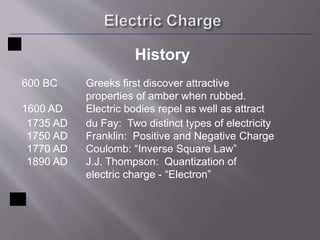
History 
600 BC Greeks first discover attractive 
properties of amber when rubbed. 
1600 AD Electric bodies repel as well as attract 
1735 AD du Fay: Two distinct types of electricity 
1750 AD Franklin: Positive and Negative Charge 
1770 AD Coulomb: “Inverse Square Law” 
1890 AD J.J. Thompson: Quantization of 
electric charge - “Electron”
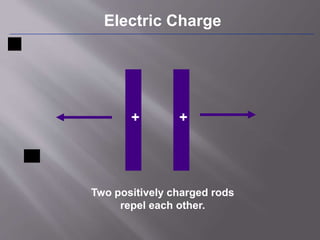
Electric Charge 
+ + 
Two positively charged rods 
repel each other.
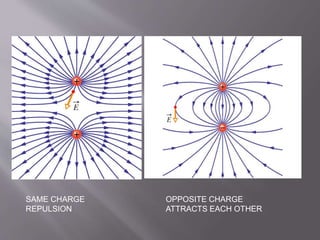
SAME CHARGE 
REPULSION 
OPPOSITE CHARGE 
ATTRACTS EACH OTHER
Electric Charge 
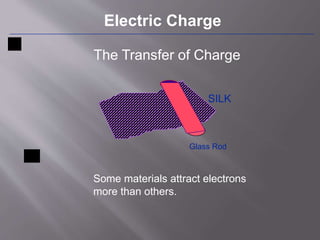
The Transfer of Charge 
SILK 
Glass Rod 
Some materials attract electrons 
more than others.
Electric Charge 
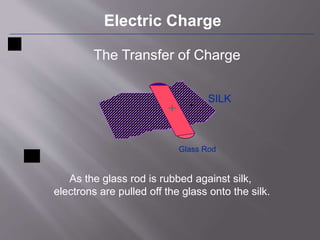
The Transfer of Charge 
SILK 
+ - 
Glass Rod 
As the glass rod is rubbed against silk, 
electrons are pulled off the glass onto the silk.
Electric Charge 
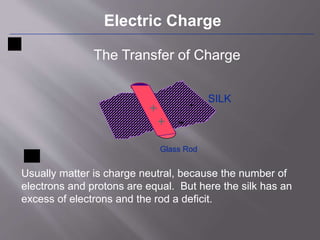
The Transfer of Charge 
SILK 
+ - 
+ 
- 
Glass Rod 
Usually matter is charge neutral, because the number of 
electrons and protons are equal. But here the silk has an 
excess of electrons and the rod a deficit.
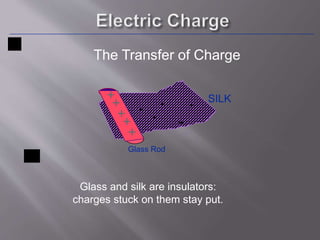
The Transfer of Charge 
SILK 
- - - 
- 
Glass Rod 
- 
+ 
+ 
+ 
+ 
+ 
Glass and silk are insulators: 
charges stuck on them stay put.
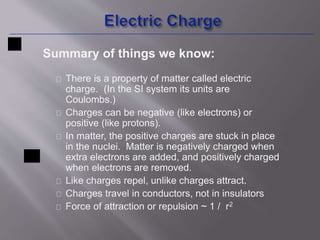
Summary of things we know: 
There is a property of matter called electric 
charge. (In the SI system its units are 
Coulombs.) 
Charges can be negative (like electrons) or 
positive (like protons). 
In matter, the positive charges are stuck in place 
in the nuclei. Matter is negatively charged when 
extra electrons are added, and positively charged 
when electrons are removed. 
Like charges repel, unlike charges attract. 
Charges travel in conductors, not in insulators 
Force of attraction or repulsion ~ 1 / r2
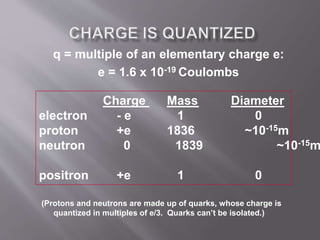
q = multiple of an elementary charge e: 
e = 1.6 x 10⁻¹⁹ Coulombs 
Charge Mass Diameter 
electron - e 1 0 
proton +e 1836 ~10-15m 
neutron 0 1839 ~10-15m 
positron +e 1 0 
(Protons and neutrons are made up of quarks, whose charge is 
quantized in multiples of e/3. Quarks can’t be isolated.)

Electric charge

  • 1.
  • 2.
    History 600 BCGreeks first discover attractive properties of amber when rubbed. 1600 AD Electric bodies repel as well as attract 1735 AD du Fay: Two distinct types of electricity 1750 AD Franklin: Positive and Negative Charge 1770 AD Coulomb: “Inverse Square Law” 1890 AD J.J. Thompson: Quantization of electric charge - “Electron”
  • 3.
    Electric Charge ++ Two positively charged rods repel each other.
  • 4.
    SAME CHARGE REPULSION OPPOSITE CHARGE ATTRACTS EACH OTHER
  • 5.
    Electric Charge TheTransfer of Charge SILK Glass Rod Some materials attract electrons more than others.
  • 6.
    Electric Charge TheTransfer of Charge SILK + - Glass Rod As the glass rod is rubbed against silk, electrons are pulled off the glass onto the silk.
  • 7.
    Electric Charge TheTransfer of Charge SILK + - + - Glass Rod Usually matter is charge neutral, because the number of electrons and protons are equal. But here the silk has an excess of electrons and the rod a deficit.
  • 8.
    The Transfer ofCharge SILK - - - - Glass Rod - + + + + + Glass and silk are insulators: charges stuck on them stay put.
  • 9.
    Summary of thingswe know: There is a property of matter called electric charge. (In the SI system its units are Coulombs.) Charges can be negative (like electrons) or positive (like protons). In matter, the positive charges are stuck in place in the nuclei. Matter is negatively charged when extra electrons are added, and positively charged when electrons are removed. Like charges repel, unlike charges attract. Charges travel in conductors, not in insulators Force of attraction or repulsion ~ 1 / r2
  • 10.
    q = multipleof an elementary charge e: e = 1.6 x 10⁻¹⁹ Coulombs Charge Mass Diameter electron - e 1 0 proton +e 1836 ~10-15m neutron 0 1839 ~10-15m positron +e 1 0 (Protons and neutrons are made up of quarks, whose charge is quantized in multiples of e/3. Quarks can’t be isolated.)

Editor's Notes