
ANALYSING
ELECTROMAGNETISM
INDUCTION
ELECTROMAGNETISM INDUCTION
THE PRODUCTION OF AN ELECTRIC
CURRENT BY A CHANGING MAGNETISM
FIELD IS CALLED ELECTROMAGNETISM
INDUCTION
THE INDUCED CURRENT IS PRODUCED
ONLY WHEN THERE IS RELATIVE MOTION
BETWEEN THE CONDUCTOR/COIL AND
THE MAGNETISM FIELD LINES.
THE INDUCED CURRENT IS PRODUCED
WHEN
a) A conductor cuts across a magnetism flux
b) There is a change in magnetism flux linking a
coil or a circuit
RELATIVE MOTION
 There is a relative motion between two
objects if the two objects are getting closer or
futher apart
 When two objects are moving at the same
speed in same direction, there is no relative
motion because the distance between the
two objects does not change
INDUCED CURRENT AND INDUCED
ELECTROMOTIVE FORCE
 Electromotive force is required to drive the current in a
closed circuit.
 Induced electromotive force(induced e.m.f.) is produced
between the end of the moving conductor or the solenoid.
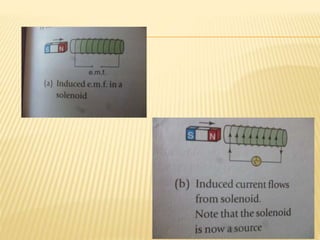
 When galvanometer is connected to form a closed circuit,
the pointer of the galvanometer moves when the magnet is
moved back and forth inside the solenoid.(refer to figure 1)
 The induced e.m.f. ois responsible for driveng the current
flow in the closed circuit through the galvanometer. The
greater the induced e.m.f. is the greater the induced current.
 the magnitude of the induced e.m.f. and direction of the
induced current can be detemined by application of the laws
of electromagnetism induction.
LAWS OF ELECTROMAGNETISM INDUCTION
 There are 2 principal laws of
electromagnetism induction:
a) Faraday’s law
b) Lenz’s law
LENZ’S LAW
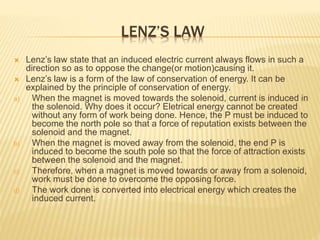
 Lenz’s law state that an induced electric current always flows in such a
direction so as to oppose the change(or motion)causing it.
 Lenz’s law is a form of the law of conservation of energy. It can be
explained by the principle of conservation of energy.
a) When the magnet is moved towards the solenoid, current is induced in
the solenoid. Why does it occur? Eletrical energy cannot be created
without any form of work being done. Hence, the P must be induced to
become the north pole so that a force of reputation exists between the
solenoid and the magnet.
b) When the magnet is moved away from the solenoid, the end P is
induced to become the south pole so that the force of attraction exists
between the solenoid and the magnet.
c) Therefore, when a magnet is moved towards or away from a solenoid,
work must be done to overcome the opposing force.
d) The work done is converted into electrical energy which creates the
induced current.
FARADAY’S LAWS
 Faraday’s law states that the magnitude of the
induced e.m.f. is directly proportional to the rate
of change of magnetism flux linkage in solenoid
or the rate at which a conductor cuts through
the magnetism flux.
 The induced e.m.f. increases when the rate of
change of flux increases. hence., the induced
current is increased when
 The induced e.m.f. increases when the number
of turns increases because an e.m.f. is induced
in each turn of wire.
FLAMING’S RIGTH-HAND RULE(DINAMO RULE)
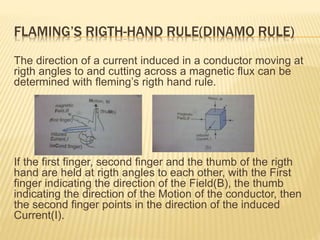
The direction of a current induced in a conductor moving at
rigth angles to and cutting across a magnetic flux can be
determined with fleming’s rigth hand rule.
If the first finger, second finger and the thumb of the rigth
hand are held at rigth angles to each other, with the First
finger indicating the direction of the Field(B), the thumb
indicating the direction of the Motion of the conductor, then
the second finger points in the direction of the induced
Current(I).
Applicationof
electromagnetiismionduction
Direct Current Generator
and Alternatives Current
Generator
Operating Principle of a
Direct Current Generator
Operating Principle of an
Alternatives Current
Generator
Moving Coil Microphone
DIRECT CURRENT GENERATOR AND ALTERNATIVES CURRENT GENERATOR
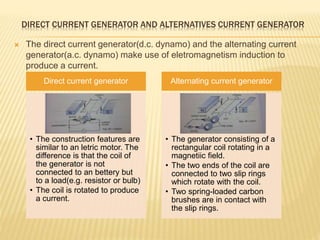
 The direct current generator(d.c. dynamo) and the alternating current
generator(a.c. dynamo) make use of eletromagnetism induction to
produce a current.
Direct current generator
• The construction features are
similar to an letric motor. The
difference is that the coil of
the generator is not
connected to an bettery but
to a load(e.g. resistor or bulb)
• The coil is rotated to produce
a current.
Alternating current generator
• The generator consisting of a
rectangular coil rotating in a
magnetiic field.
• The two ends of the coil are
connected to two slip rings
which rotate with the coil.
• Two spring-loaded carbon
brushes are in contact with
the slip rings.
CREATED BY:
PROF DR. SYAFIQ
WAHAB
DR. PUTRA
DR. KHAIRUN
DR. AMIRA
DR. SYAMIERA

Electromagnetism

  • 2.
  • 3.
    ELECTROMAGNETISM INDUCTION THE PRODUCTIONOF AN ELECTRIC CURRENT BY A CHANGING MAGNETISM FIELD IS CALLED ELECTROMAGNETISM INDUCTION THE INDUCED CURRENT IS PRODUCED ONLY WHEN THERE IS RELATIVE MOTION BETWEEN THE CONDUCTOR/COIL AND THE MAGNETISM FIELD LINES. THE INDUCED CURRENT IS PRODUCED WHEN a) A conductor cuts across a magnetism flux b) There is a change in magnetism flux linking a coil or a circuit
  • 4.
    RELATIVE MOTION  Thereis a relative motion between two objects if the two objects are getting closer or futher apart  When two objects are moving at the same speed in same direction, there is no relative motion because the distance between the two objects does not change
  • 5.
    INDUCED CURRENT ANDINDUCED ELECTROMOTIVE FORCE  Electromotive force is required to drive the current in a closed circuit.  Induced electromotive force(induced e.m.f.) is produced between the end of the moving conductor or the solenoid.  When galvanometer is connected to form a closed circuit, the pointer of the galvanometer moves when the magnet is moved back and forth inside the solenoid.(refer to figure 1)  The induced e.m.f. ois responsible for driveng the current flow in the closed circuit through the galvanometer. The greater the induced e.m.f. is the greater the induced current.  the magnitude of the induced e.m.f. and direction of the induced current can be detemined by application of the laws of electromagnetism induction.
  • 7.
    LAWS OF ELECTROMAGNETISMINDUCTION  There are 2 principal laws of electromagnetism induction: a) Faraday’s law b) Lenz’s law
  • 8.
    LENZ’S LAW  Lenz’slaw state that an induced electric current always flows in such a direction so as to oppose the change(or motion)causing it.  Lenz’s law is a form of the law of conservation of energy. It can be explained by the principle of conservation of energy. a) When the magnet is moved towards the solenoid, current is induced in the solenoid. Why does it occur? Eletrical energy cannot be created without any form of work being done. Hence, the P must be induced to become the north pole so that a force of reputation exists between the solenoid and the magnet. b) When the magnet is moved away from the solenoid, the end P is induced to become the south pole so that the force of attraction exists between the solenoid and the magnet. c) Therefore, when a magnet is moved towards or away from a solenoid, work must be done to overcome the opposing force. d) The work done is converted into electrical energy which creates the induced current.
  • 9.
    FARADAY’S LAWS  Faraday’slaw states that the magnitude of the induced e.m.f. is directly proportional to the rate of change of magnetism flux linkage in solenoid or the rate at which a conductor cuts through the magnetism flux.  The induced e.m.f. increases when the rate of change of flux increases. hence., the induced current is increased when  The induced e.m.f. increases when the number of turns increases because an e.m.f. is induced in each turn of wire.
  • 10.
    FLAMING’S RIGTH-HAND RULE(DINAMORULE) The direction of a current induced in a conductor moving at rigth angles to and cutting across a magnetic flux can be determined with fleming’s rigth hand rule. If the first finger, second finger and the thumb of the rigth hand are held at rigth angles to each other, with the First finger indicating the direction of the Field(B), the thumb indicating the direction of the Motion of the conductor, then the second finger points in the direction of the induced Current(I).
  • 11.
    Applicationof electromagnetiismionduction Direct Current Generator andAlternatives Current Generator Operating Principle of a Direct Current Generator Operating Principle of an Alternatives Current Generator Moving Coil Microphone
  • 12.
    DIRECT CURRENT GENERATORAND ALTERNATIVES CURRENT GENERATOR  The direct current generator(d.c. dynamo) and the alternating current generator(a.c. dynamo) make use of eletromagnetism induction to produce a current. Direct current generator • The construction features are similar to an letric motor. The difference is that the coil of the generator is not connected to an bettery but to a load(e.g. resistor or bulb) • The coil is rotated to produce a current. Alternating current generator • The generator consisting of a rectangular coil rotating in a magnetiic field. • The two ends of the coil are connected to two slip rings which rotate with the coil. • Two spring-loaded carbon brushes are in contact with the slip rings.
  • 13.
    CREATED BY: PROF DR.SYAFIQ WAHAB DR. PUTRA DR. KHAIRUN DR. AMIRA DR. SYAMIERA