Newton’s 3 rd  Law of Motion
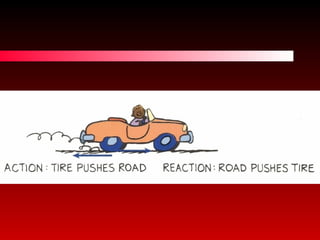
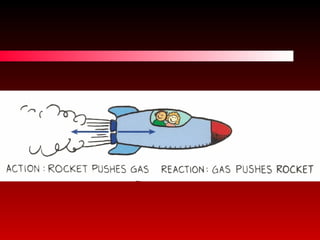
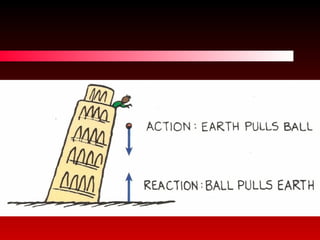
A.  Forces Forces never act alone, but instead as pairs Interaction (inter – between)  An action between objects where each object exerts an equal & opposite force on the other.


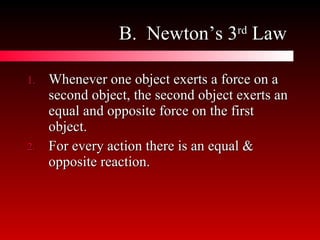
B.  Newton’s 3 rd  Law  Whenever one object exerts a force on a second object, the second object exerts an equal and opposite force on the first object. For every action there is an equal & opposite reaction.
C.  Action/Reaction of Different Masses
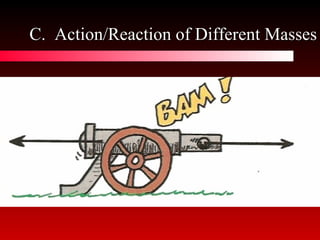
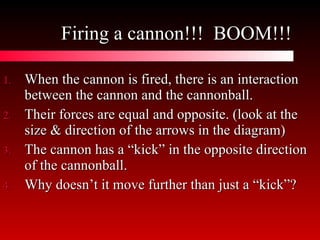
Firing a cannon!!!  BOOM!!! When the cannon is fired, there is an interaction between the cannon and the cannonball. Their forces are equal and opposite. (look at the size & direction of the arrows in the diagram) The cannon has a “kick” in the opposite direction of the cannonball. Why doesn’t it move further than just a “kick”?
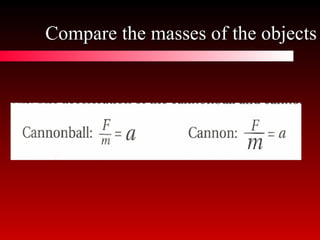
Compare the masses of the objects
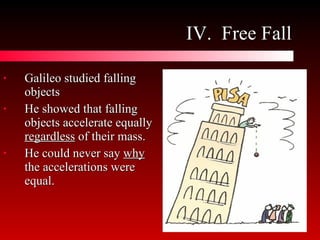
IV.  Free Fall Galileo studied falling objects He showed that falling objects accelerate equally  regardless  of their mass. He could never say  why  the accelerations were equal.
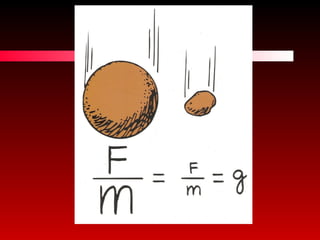
Apply this to Newton’s 2 nd  Law Remember, mass & weight are proportional. i.e. a 2kg cat weighs twice as much as a 1kg cat Using Newton’s 2 nd  law we consider mass 2x as much force acting on 2x as much mass will produce the same acceleration as a smaller force acting on a smaller mass The ration of force to mass stays the same no matter the size of the object.
 
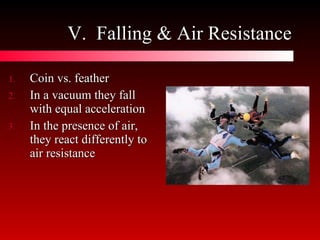
V.  Falling & Air Resistance Coin vs. feather In a vacuum they fall with equal acceleration In the presence of air, they react differently to air resistance
Air resistance diminishes the net forces acting on the object The net forces decrease very little for the coin, but a lot for the feather. The air resistance builds up quickly and  cancels the weight force of the feather.
When the air resistance = weight, the net force is zero. Fnet = 0, there is no acceleration Terminal velocity  – the speed at which the acceleration of a falling object is zero because friction balances the weight. A heavier object will attain a greater terminal velocity than a lighter object. It appears to fall faster.

Newton’s 3rd law of motion

  • 1.
    Newton’s 3 rd Law of Motion
  • 2.
    A. ForcesForces never act alone, but instead as pairs Interaction (inter – between) An action between objects where each object exerts an equal & opposite force on the other.
  • 3.
  • 4.
  • 5.
  • 6.
    B. Newton’s3 rd Law Whenever one object exerts a force on a second object, the second object exerts an equal and opposite force on the first object. For every action there is an equal & opposite reaction.
  • 7.
    C. Action/Reactionof Different Masses
  • 8.
    Firing a cannon!!! BOOM!!! When the cannon is fired, there is an interaction between the cannon and the cannonball. Their forces are equal and opposite. (look at the size & direction of the arrows in the diagram) The cannon has a “kick” in the opposite direction of the cannonball. Why doesn’t it move further than just a “kick”?
  • 9.
    Compare the massesof the objects
  • 10.
    IV. FreeFall Galileo studied falling objects He showed that falling objects accelerate equally regardless of their mass. He could never say why the accelerations were equal.
  • 11.
    Apply this toNewton’s 2 nd Law Remember, mass & weight are proportional. i.e. a 2kg cat weighs twice as much as a 1kg cat Using Newton’s 2 nd law we consider mass 2x as much force acting on 2x as much mass will produce the same acceleration as a smaller force acting on a smaller mass The ration of force to mass stays the same no matter the size of the object.
  • 12.
  • 13.
    V. Falling& Air Resistance Coin vs. feather In a vacuum they fall with equal acceleration In the presence of air, they react differently to air resistance
  • 14.
    Air resistance diminishesthe net forces acting on the object The net forces decrease very little for the coin, but a lot for the feather. The air resistance builds up quickly and cancels the weight force of the feather.
  • 15.
    When the airresistance = weight, the net force is zero. Fnet = 0, there is no acceleration Terminal velocity – the speed at which the acceleration of a falling object is zero because friction balances the weight. A heavier object will attain a greater terminal velocity than a lighter object. It appears to fall faster.