Lectures on Medical Biophysics Department of Biophysics, Medical Faculty,  Masaryk University in Brno
Medical Devices: Introduction Lectures on Medical Biophysics Department of Biophysics, Medical Faculty,  Masaryk University in Brno
Medical  Biophysics In Medical biophysics we will be dealing with the physical principles of biomedical methods and devices and their interactions with the human body - which makes them useful in health care, including patient and user safety aspects and healthcare quality issues.   The physical processes in living organisms   and  the effects of physical factors on them are important as background information.
Links Natural sciences (physics, chemistry and biochemistry, biology) Morphological disciplines Physiology and pathological physiology Clinical disciplines (almost all!)
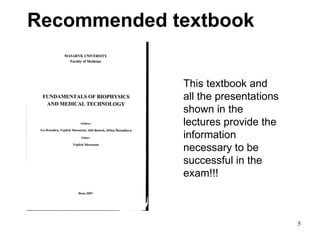
Recommended textbook   This textbook and all the presentations shown in the lectures provide the  information necessary to be successful in the exam !!!
How to study? Studying medical biophysics, there is no problem with the amount of knowledge which is necessary to master, but with understanding the physical principles and their application. Memorisation without understanding will not be sufficient to have a success at the exam.
Medical Devices : Introduction
What is a Medical Device? “ any instrument, apparatus, appliance, material or other article, whether used alone or in combination, including the software necessary for its proper application intended by the manufacturer to be used on human beings for the purpose of: diagnosis, prevention, monitoring, treatment or alleviation of disease, diagnosis, monitoring, treatment, or alleviation of or compensation for an injury or handicap, investigation, replacement or modification of the anatomy or of a physiological process, control of conception and which does not achieve its principal intended action in or on the human body by pharmacological, immunological or metabolic means, but which may be assisted in its function by such means.” (MDD Article 1(2a))
The EU Medical Device Directives The Medical Devices Directive (MDD) (93/42/EEC,  OJ L169 p0001-0043) : from bandages, tongue depressors, thermometers  to contact lenses, stethoscopes, splints, first-aid kits, breathalysers, heart valves and imaging equipment The In-Vitro  Diagnostic  Medical Devices Directive (IVDD) (98/79/EC OJ L331 p0001-0037): reagents, control standards, test-kits, equipment … intended for the  in-vitro  examination of human specimens e.g. blood grouping reagents, pregnancy test kits, Hepatitis B test kits The Active Implantable Medical Devices Directive (AIMDD) (90/385/EEC OJ L189 p0017-0036):  active  (i.e. include an energy source) implants or partial implants e.g. heart pacemakers Most countries have transposed these directives into a single national legislation (e.g. UK Medical Devices Regulations 2002)
HealthCare Activities Prevention Diagnosis Curative (therapeutic) Rehabilitation Palliative care (when cure is not possible)
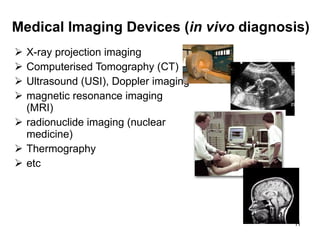
Medical Imaging Devices ( in vivo  diagnosis) X-ray projection imaging Computerised Tomography (CT) Ultrasound (USI), Doppler imaging magnetic resonance imaging (MRI) radionuclide imaging (nuclear medicine) Thermography etc
Theoretical background: Ionising radiation (origin, measurement, interactions with matter), properties of atoms and nucleus, radioactivity, basic terms of acoustics, electromagnetic spectrum… . Medical Imaging Devices ( in vivo  diagnosis)
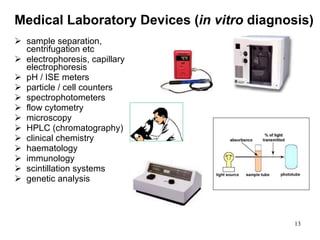
Medical Laboratory Devices ( in vitro  diagnosis) sample separation, centrifugation etc electrophoresis, capillary electrophoresis  pH / ISE meters  particle / cell counters spectrophotometers  flow cytometry  microscopy HPLC (chromatography) clinical chemistry haematology immunology s cintillation systems genetic analysis
Theoretical background: Structure of biopolymers, properties of water and electrolytes, electric properties of living matter, galvanic cell, sedimentation of particles, dosimetry, light absorption…  Medical Laboratory Devices ( in vitro  diagnosis)
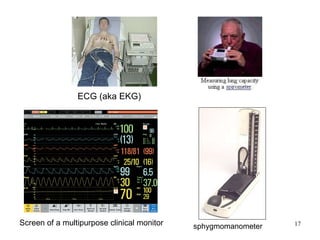
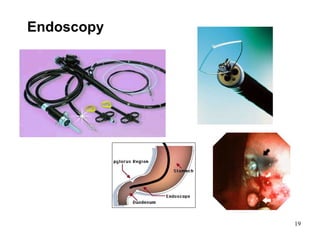
Physiological Measurement Devices  ( in vivo  diagnosis) Instruments for measuring physical and  chemical variables  in vivo T hermometers  C ardiovascular physiology: blood pressure monitors, flowmeters, pulsed Doppler US systems E lectrophysiology: ECG, EEG, EMG A udiology and ophthalmology R espiratory physiology: spirometers, pulse oximetry, impedance pneumograph…. E ndoscopes
Physiological Measurement Devices  ( in vivo  diagnosis) Theoretical background Introduction to thermodynamics, basic laws of hydrodynamics, origin of bioelectric potentials, properties of sound and light, ear and hearing, eye and vision, mechanical properties of living matter…
Screen of a multipurpose clinical monitor ECG (aka EKG) sphygmomanometer
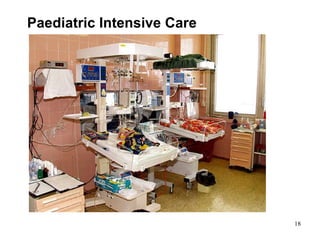
Paediatric Intensive Care
Endoscopy
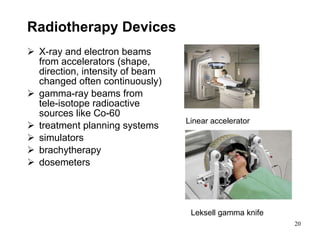
Radiotherapy Devices X-ray and electron beams from accelerators   (shape, direction, intensity of beam changed  often  continuously) gamma-ray beams from tele-isotope radioactive sources  like  Co-60 treatment planning systems  simulators brachytherapy dosemeters Linear accelerator Leksell gamma knife
Radiotherapy Devices Theoretical background: Ionising radiation (origin, measurement, interactions with matter), properties of atom nucleus, radioactivity, biological effects of ionising radiation, dosimetry….
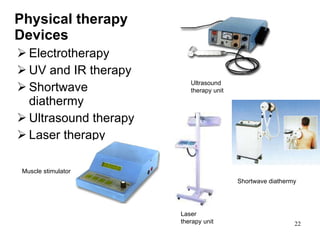
Physical therapy Devices Electrotherapy UV and IR therapy Shortwave diathermy Ultrasound therapy Laser therapy Muscle stimulator Laser therapy unit Ultrasound therapy unit Shortwave diathermy
Physiotherapy Devices Theoretical background Biological interactions of ultrasound, electromagnetic fields, electric current, infrared, visible and ultraviolet light,  laser principle….
POC (Point of Care) Devices A ddress clinicians’ requirements for rapid access to information to support critical care decisions Advances in microelectronics and biosensor tools have brought technology to the bedside in a miniaturized form.  Examples: Performing blood tests at the patient's side rather than in a central laboratory portable ultrasound imaging devices
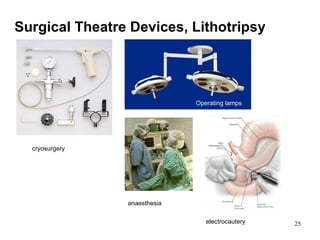
Surgical Theatre Devices , Lithotripsy Operating lamps anaesthesia electrocautery cryosurgery
Surgical Theatre Devices , Lithotripsy Theoretical background Biological interactions of ultrasound, electromagnetic fields, electric current, infrared, visible and ultraviolet light, laser principle, low temperatures, acoustic shock waves…
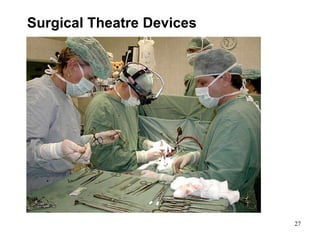
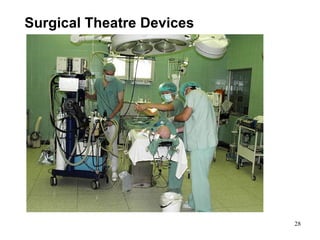
Surgical Theatre Devices
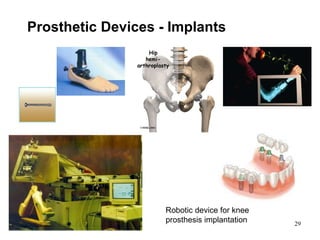
Prosthetic Devices  - Implants Robotic device for knee prosthesis implantation
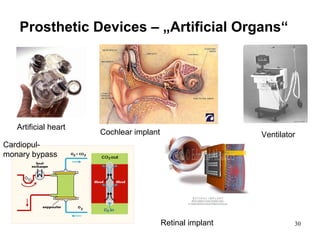
Prosthetic Devices – „Artificial Organs“ Artificial heart Cochlear implant Retinal implant Ventilator Cardiopul-monary bypass
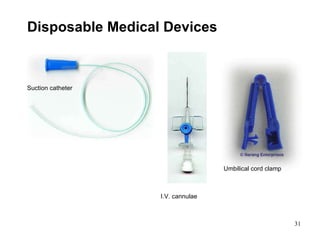
Disposable Medical Devices Suction catheter Umbilical cord clamp I.V. cannulae
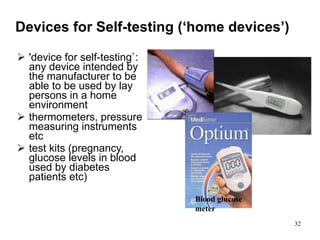
Devices for Self-testing (‘home devices’) 'device for self-testing`:   any device intended by the manufacturer to be able to be used by lay persons in a home environment thermometers, pressure measuring instruments etc test kits (pregnancy, glucose levels in blood used by diabetes patients etc) Blood glucose meter
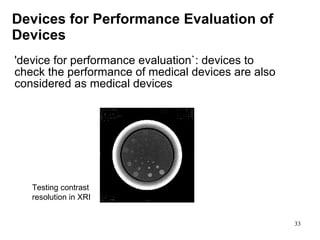
Devices for Performance Evaluation of Devices 'device for performance evaluation`: devices to check the performance of medical devices are also considered as medical devices Testing contrast resolution in XRI
What is the Purpose of this Course? Create awareness that medical devices should be used effectively and safely (reduce patient, occupational and others’ risk to a minimum) Use medical devices in a professional and scientific manner Appreciate uses of medical devices in the clinical areas and in research Have an idea of the devices used in other professions
Some Competences for Users of Medical Devices What is expected the doctor does with or knows about the device State the specific diagnostic, therapeutic etc outcomes expected when using the device Explain the physics principles underpinning the functioning of the device and the device use protocols  Describe the structure of commercially available devices including user option settings and controls Identify possible health hazards (e.g. mechanical, electrical, radiation etc) to patient, self and colleagues Describe measurable objective device performance indicators which are directly related to device effectiveness or safety
Cont ... Demonstrates  a level of capability in the use of the device that ensures the required level of effectiveness whilst minimising risk to patient, self and others Explains limitations of the device and contraindications for use Describes the impact on effectiveness and risk arising from device malfunction or inappropriate user protocol  Demonstrates timely device malfunction recognition and local procedures for reporting such faults Demonstrates skill in preventive maintenance and quality control including calibration of the device appropriate for users  Demonstrates an awareness that a device should be checked before use and in the case of re-usable devices left in a condition for subsequent use Demonstrates adherence to International, European, National and local legislation and/or regulations regarding the use of the device
Presentation design: Lucie Morns t einová Last revision:  June  200 9 Authors:  Carmel J. Caruana, Vojtěch Mornstein Language revision:   Carmel J. Caruana

Introduction fin

  • 1.
    Lectures on MedicalBiophysics Department of Biophysics, Medical Faculty, Masaryk University in Brno
  • 2.
    Medical Devices: IntroductionLectures on Medical Biophysics Department of Biophysics, Medical Faculty, Masaryk University in Brno
  • 3.
    Medical BiophysicsIn Medical biophysics we will be dealing with the physical principles of biomedical methods and devices and their interactions with the human body - which makes them useful in health care, including patient and user safety aspects and healthcare quality issues. The physical processes in living organisms and the effects of physical factors on them are important as background information.
  • 4.
    Links Natural sciences(physics, chemistry and biochemistry, biology) Morphological disciplines Physiology and pathological physiology Clinical disciplines (almost all!)
  • 5.
    Recommended textbook This textbook and all the presentations shown in the lectures provide the information necessary to be successful in the exam !!!
  • 6.
    How to study?Studying medical biophysics, there is no problem with the amount of knowledge which is necessary to master, but with understanding the physical principles and their application. Memorisation without understanding will not be sufficient to have a success at the exam.
  • 7.
    Medical Devices :Introduction
  • 8.
    What is aMedical Device? “ any instrument, apparatus, appliance, material or other article, whether used alone or in combination, including the software necessary for its proper application intended by the manufacturer to be used on human beings for the purpose of: diagnosis, prevention, monitoring, treatment or alleviation of disease, diagnosis, monitoring, treatment, or alleviation of or compensation for an injury or handicap, investigation, replacement or modification of the anatomy or of a physiological process, control of conception and which does not achieve its principal intended action in or on the human body by pharmacological, immunological or metabolic means, but which may be assisted in its function by such means.” (MDD Article 1(2a))
  • 9.
    The EU MedicalDevice Directives The Medical Devices Directive (MDD) (93/42/EEC, OJ L169 p0001-0043) : from bandages, tongue depressors, thermometers to contact lenses, stethoscopes, splints, first-aid kits, breathalysers, heart valves and imaging equipment The In-Vitro Diagnostic Medical Devices Directive (IVDD) (98/79/EC OJ L331 p0001-0037): reagents, control standards, test-kits, equipment … intended for the in-vitro examination of human specimens e.g. blood grouping reagents, pregnancy test kits, Hepatitis B test kits The Active Implantable Medical Devices Directive (AIMDD) (90/385/EEC OJ L189 p0017-0036): active (i.e. include an energy source) implants or partial implants e.g. heart pacemakers Most countries have transposed these directives into a single national legislation (e.g. UK Medical Devices Regulations 2002)
  • 10.
    HealthCare Activities PreventionDiagnosis Curative (therapeutic) Rehabilitation Palliative care (when cure is not possible)
  • 11.
    Medical Imaging Devices( in vivo diagnosis) X-ray projection imaging Computerised Tomography (CT) Ultrasound (USI), Doppler imaging magnetic resonance imaging (MRI) radionuclide imaging (nuclear medicine) Thermography etc
  • 12.
    Theoretical background: Ionisingradiation (origin, measurement, interactions with matter), properties of atoms and nucleus, radioactivity, basic terms of acoustics, electromagnetic spectrum… . Medical Imaging Devices ( in vivo diagnosis)
  • 13.
    Medical Laboratory Devices( in vitro diagnosis) sample separation, centrifugation etc electrophoresis, capillary electrophoresis pH / ISE meters particle / cell counters spectrophotometers flow cytometry microscopy HPLC (chromatography) clinical chemistry haematology immunology s cintillation systems genetic analysis
  • 14.
    Theoretical background: Structureof biopolymers, properties of water and electrolytes, electric properties of living matter, galvanic cell, sedimentation of particles, dosimetry, light absorption… Medical Laboratory Devices ( in vitro diagnosis)
  • 15.
    Physiological Measurement Devices ( in vivo diagnosis) Instruments for measuring physical and chemical variables in vivo T hermometers C ardiovascular physiology: blood pressure monitors, flowmeters, pulsed Doppler US systems E lectrophysiology: ECG, EEG, EMG A udiology and ophthalmology R espiratory physiology: spirometers, pulse oximetry, impedance pneumograph…. E ndoscopes
  • 16.
    Physiological Measurement Devices ( in vivo diagnosis) Theoretical background Introduction to thermodynamics, basic laws of hydrodynamics, origin of bioelectric potentials, properties of sound and light, ear and hearing, eye and vision, mechanical properties of living matter…
  • 17.
    Screen of amultipurpose clinical monitor ECG (aka EKG) sphygmomanometer
  • 18.
  • 19.
  • 20.
    Radiotherapy Devices X-rayand electron beams from accelerators (shape, direction, intensity of beam changed often continuously) gamma-ray beams from tele-isotope radioactive sources like Co-60 treatment planning systems simulators brachytherapy dosemeters Linear accelerator Leksell gamma knife
  • 21.
    Radiotherapy Devices Theoreticalbackground: Ionising radiation (origin, measurement, interactions with matter), properties of atom nucleus, radioactivity, biological effects of ionising radiation, dosimetry….
  • 22.
    Physical therapy DevicesElectrotherapy UV and IR therapy Shortwave diathermy Ultrasound therapy Laser therapy Muscle stimulator Laser therapy unit Ultrasound therapy unit Shortwave diathermy
  • 23.
    Physiotherapy Devices Theoreticalbackground Biological interactions of ultrasound, electromagnetic fields, electric current, infrared, visible and ultraviolet light, laser principle….
  • 24.
    POC (Point ofCare) Devices A ddress clinicians’ requirements for rapid access to information to support critical care decisions Advances in microelectronics and biosensor tools have brought technology to the bedside in a miniaturized form. Examples: Performing blood tests at the patient's side rather than in a central laboratory portable ultrasound imaging devices
  • 25.
    Surgical Theatre Devices, Lithotripsy Operating lamps anaesthesia electrocautery cryosurgery
  • 26.
    Surgical Theatre Devices, Lithotripsy Theoretical background Biological interactions of ultrasound, electromagnetic fields, electric current, infrared, visible and ultraviolet light, laser principle, low temperatures, acoustic shock waves…
  • 27.
  • 28.
  • 29.
    Prosthetic Devices - Implants Robotic device for knee prosthesis implantation
  • 30.
    Prosthetic Devices –„Artificial Organs“ Artificial heart Cochlear implant Retinal implant Ventilator Cardiopul-monary bypass
  • 31.
    Disposable Medical DevicesSuction catheter Umbilical cord clamp I.V. cannulae
  • 32.
    Devices for Self-testing(‘home devices’) 'device for self-testing`: any device intended by the manufacturer to be able to be used by lay persons in a home environment thermometers, pressure measuring instruments etc test kits (pregnancy, glucose levels in blood used by diabetes patients etc) Blood glucose meter
  • 33.
    Devices for PerformanceEvaluation of Devices 'device for performance evaluation`: devices to check the performance of medical devices are also considered as medical devices Testing contrast resolution in XRI
  • 34.
    What is thePurpose of this Course? Create awareness that medical devices should be used effectively and safely (reduce patient, occupational and others’ risk to a minimum) Use medical devices in a professional and scientific manner Appreciate uses of medical devices in the clinical areas and in research Have an idea of the devices used in other professions
  • 35.
    Some Competences forUsers of Medical Devices What is expected the doctor does with or knows about the device State the specific diagnostic, therapeutic etc outcomes expected when using the device Explain the physics principles underpinning the functioning of the device and the device use protocols Describe the structure of commercially available devices including user option settings and controls Identify possible health hazards (e.g. mechanical, electrical, radiation etc) to patient, self and colleagues Describe measurable objective device performance indicators which are directly related to device effectiveness or safety
  • 36.
    Cont ... Demonstrates a level of capability in the use of the device that ensures the required level of effectiveness whilst minimising risk to patient, self and others Explains limitations of the device and contraindications for use Describes the impact on effectiveness and risk arising from device malfunction or inappropriate user protocol Demonstrates timely device malfunction recognition and local procedures for reporting such faults Demonstrates skill in preventive maintenance and quality control including calibration of the device appropriate for users Demonstrates an awareness that a device should be checked before use and in the case of re-usable devices left in a condition for subsequent use Demonstrates adherence to International, European, National and local legislation and/or regulations regarding the use of the device
  • 37.
    Presentation design: LucieMorns t einová Last revision: June 200 9 Authors: Carmel J. Caruana, Vojtěch Mornstein Language revision: Carmel J. Caruana