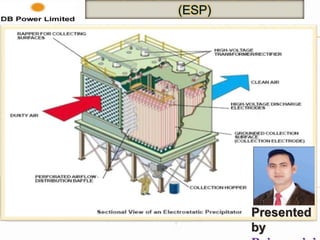
Presented
by
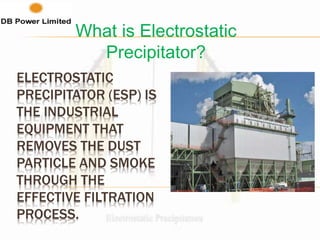
ELECTROSTATIC
PRECIPITATOR (ESP) IS
THE INDUSTRIAL
EQUIPMENT THAT
REMOVES THE DUST
PARTICLE AND SMOKE
THROUGH THE
EFFECTIVE FILTRATION
PROCESS.
What is Electrostatic
Precipitator?
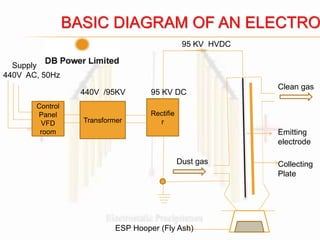
Control
Panel
VFD
room
Rectifie
r
95 KV HVDC
BASIC DIAGRAM OF AN ELECTRO
Supply
440V AC, 50Hz
Dust gas
Clean gas
ESP Hooper (Fly Ash)
Emitting
electrode
Collecting
Plate
440V /95KV
Transformer
95 KV DC
ESP
-AESP-
A
ESP-
B
M
M M
M
M
M
M
M
M
MM
M
MM
MM
ESP-
C
ESP-D
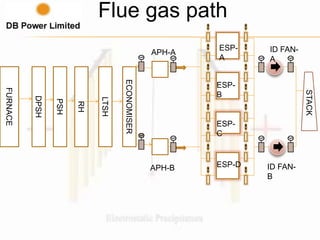
FURNACE
DPSH
PSH
RH
LTSH
ECONOMISER
STACK
APH-A
APH-B
ID FAN-
A
ID FAN-
B
Flue gas path
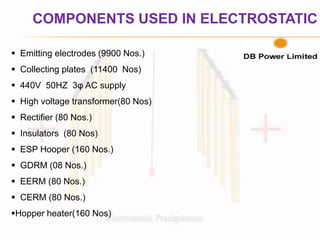
COMPONENTS USED IN ELECTROSTATIC
 Emitting electrodes (9900 Nos.)
 Collecting plates (11400 Nos)
 440V 50HZ 3φ AC supply
 High voltage transformer(80 Nos)
 Rectifier (80 Nos.)
 Insulators (80 Nos)
 ESP Hooper (160 Nos.)
 GDRM (08 Nos.)
 EERM (80 Nos.)
 CERM (80 Nos.)
Hopper heater(160 Nos)
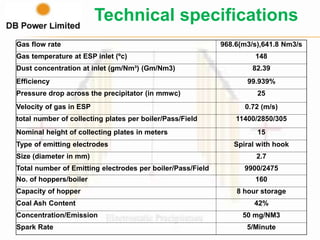
Gas flow rate 968.6(m3/s),641.8 Nm3/s
Gas temperature at ESP inlet (ºc) 148
Dust concentration at inlet (gm/Nm³) (Gm/Nm3) 82.39
Efficiency 99.939%
Pressure drop across the precipitator (in mmwc) 25
Velocity of gas in ESP 0.72 (m/s)
total number of collecting plates per boiler/Pass/Field 11400/2850/305
Nominal height of collecting plates in meters 15
Type of emitting electrodes Spiral with hook
Size (diameter in mm) 2.7
Total number of Emitting electrodes per boiler/Pass/Field 9900/2475
No. of hoppers/boiler 160
Capacity of hopper 8 hour storage
Coal Ash Content 42%
Concentration/Emission 50 mg/NM3
Spark Rate 5/Minute
Technical specifications
Aspect Ratio
The aspect ratio, which relates the length of an ESP to its height, is an important factor in
reducing rapping loss (dust reentrainment). When particles are rapped from the electrodes, the gas flow
carries the collected dust forward through the ESP until the dust reaches the hopper. Although the amount of
time it takes for rapped particles to settle in the hoppers is short (a matter of seconds), a large amount of
"collected dust" can be reentrained in the gas flow and carried out of the ESP if the total effective length of
the plates in the ESP is small compared to their effective height.
For example, the time required for dust to fall from the top of a 9.1-m plate (30-ft plate) is several seconds.
Effective plate lengths must be at least 10.7 to 12.2 m (35 to 40 ft) to prevent a large amount of "collected
dust" from being carried out of the ESP before reaching the hopper.
Impacts of Flue Gas temperatures: - The operation of precipitator at
gas temperature below
a. acid due point ( < 120°C) results in :
b. Failure of emitting electrodes due to stress corrosion cracking.
c. Corrosion of terminals.
d. Collection of wet ash on the electrodes leads to formation of hard- to- rap
layers of ash.
e. Difficulty in removal of wet ash from the hoppers.
Specific Collection Area
The specific collection area (SCA) is defined as the ratio of collection surface area to
the
gas flow rate into the collector. It is an important determinant of collection efficiency.
Charge Ratio
The duty cycle or the charge ratio is defined as the ratio of the
number of on cycle to the sum of the on and off cycle
The charge ratio can be varies in the range 1:1 to 1:159, which is necessitated to tackle the
high
resistivity of fly ash encountered in precipitators in India.At higher charge ratios the base
voltage reduces to very low values. The provision of base charging is made during some of
the skipped half cycles there by avoiding the effect of low voltage. A facility is provided for
the measurement of peak and valley voltages of the charging signal. A high peak voltage
increases the effective migration velocity and thus increases the collection efficiencies.
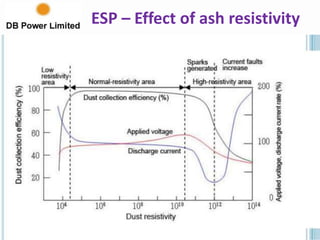
BACK CORONA :
A term that signifies that the ash layer on the collector surface has reached a level of
RESISTIVITY that produces a flow of positive IONS back towards the negative high voltage
discharge electrode. Most commonly observed back corona conditions result in SPARKOVER
and a reduction of POWER INPUT.
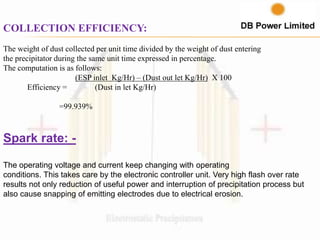
COLLECTION EFFICIENCY:
The weight of dust collected per unit time divided by the weight of dust entering
the precipitator during the same unit time expressed in percentage.
The computation is as follows:
(ESP inlet Kg/Hr) – (Dust out let Kg/Hr) X 100
Efficiency = (Dust in let Kg/Hr)
=99.939%
Spark rate: -
The operating voltage and current keep changing with operating
conditions. This takes care by the electronic controller unit. Very high flash over rate
results not only reduction of useful power and interruption of precipitation process but
also cause snapping of emitting electrodes due to electrical erosion.
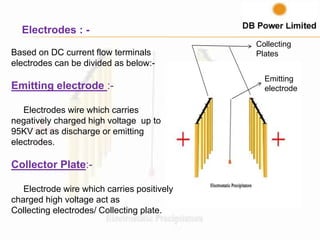
Electrodes : -
Based on DC current flow terminals
electrodes can be divided as below:-
Emitting electrode :-
Electrodes wire which carries
negatively charged high voltage up to
95KV act as discharge or emitting
electrodes.
Collector Plate:-
Electrode wire which carries positively
charged high voltage act as
Collecting electrodes/ Collecting plate.
Collecting
Plates
Emitting
electrode
11
ESP – Working Principle
The precipitation process involves 4 main
functions :
Corona generation
Particle charging
Particle collection
Removal of particles
12
ESP – Working Principle
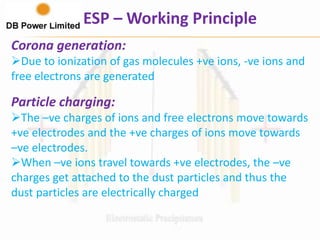
Corona generation:
Due to ionization of gas molecules +ve ions, -ve ions and
free electrons are generated
Particle charging:
The –ve charges of ions and free electrons move towards
+ve electrodes and the +ve charges of ions move towards
–ve electrodes.
When –ve ions travel towards +ve electrodes, the –ve
charges get attached to the dust particles and thus the
dust particles are electrically charged
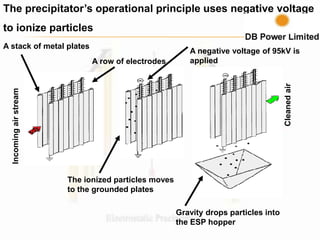
A row of electrodes
A stack of metal plates
Gravity drops particles into
the ESP hopper
The ionized particles moves
to the grounded plates
Incomingairstream
Cleanedair
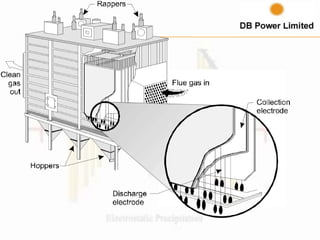
The precipitator’s operational principle uses negative voltage
to ionize particles
A negative voltage of 95kV is
applied
WORKING OF ELECTROSTATIC PRECIPITATOR
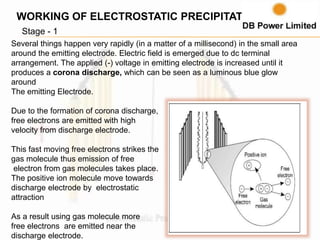
Several things happen very rapidly (in a matter of a millisecond) in the small area
around the emitting electrode. Electric field is emerged due to dc terminal
arrangement. The applied (-) voltage in emitting electrode is increased until it
produces a corona discharge, which can be seen as a luminous blue glow
around
The emitting Electrode.
Due to the formation of corona discharge,
free electrons are emitted with high
velocity from discharge electrode.
This fast moving free electrons strikes the
gas molecule thus emission of free
electron from gas molecules takes place.
The positive ion molecule move towards
discharge electrode by electrostatic
attraction
As a result using gas molecule more
free electrons are emitted near the
discharge electrode.
Stage - 1
Stage - 2
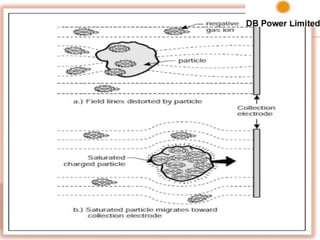
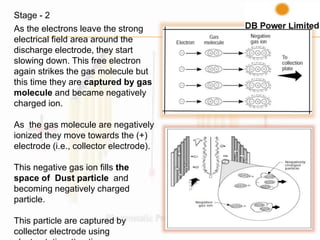
As the electrons leave the strong
electrical field area around the
discharge electrode, they start
slowing down. This free electron
again strikes the gas molecule but
this time they are captured by gas
molecule and became negatively
charged ion.
As the gas molecule are negatively
ionized they move towards the (+)
electrode (i.e., collector electrode).
This negative gas ion fills the
space of Dust particle and
becoming negatively charged
particle.
This particle are captured by
collector electrode using
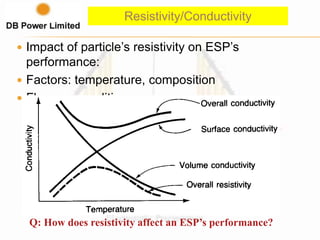
Resistivity/Conductivity
 Impact of particle’s resistivity on ESP’s
performance:
 Factors: temperature, composition
 Flue gas conditions
Q: How does resistivity affect an ESP’s performance?
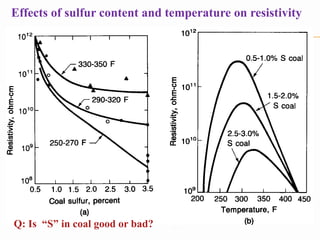
Effects of sulfur content and temperature on resistivity
Q: Is “S” in coal good or bad?
20
ESP – Effect of ash resistivity
ADVANTAGES OF ELECTROSTATIC
PRECIPITATOR
•Removes tiny dust particle
•Effective for high dust loaded gas
•Dust is collected in dry form and can be
disposed dry or in wet form
•Low cost
•Easy maintenance
•Controls Air Pollution and save environment
22
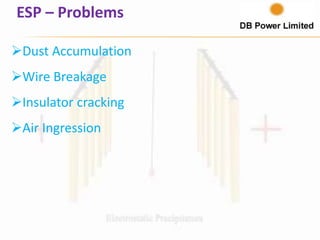
ESP – Problems
Dust Accumulation
Wire Breakage
Insulator cracking
Air Ingression
Electrostatic  precipitator  by rajeev saini

Electrostatic precipitator by rajeev saini

  • 1.
  • 2.
    ELECTROSTATIC PRECIPITATOR (ESP) IS THEINDUSTRIAL EQUIPMENT THAT REMOVES THE DUST PARTICLE AND SMOKE THROUGH THE EFFECTIVE FILTRATION PROCESS. What is Electrostatic Precipitator?
  • 3.
    Control Panel VFD room Rectifie r 95 KV HVDC BASICDIAGRAM OF AN ELECTRO Supply 440V AC, 50Hz Dust gas Clean gas ESP Hooper (Fly Ash) Emitting electrode Collecting Plate 440V /95KV Transformer 95 KV DC
  • 4.
  • 5.
    COMPONENTS USED INELECTROSTATIC  Emitting electrodes (9900 Nos.)  Collecting plates (11400 Nos)  440V 50HZ 3φ AC supply  High voltage transformer(80 Nos)  Rectifier (80 Nos.)  Insulators (80 Nos)  ESP Hooper (160 Nos.)  GDRM (08 Nos.)  EERM (80 Nos.)  CERM (80 Nos.) Hopper heater(160 Nos)
  • 6.
    Gas flow rate968.6(m3/s),641.8 Nm3/s Gas temperature at ESP inlet (ºc) 148 Dust concentration at inlet (gm/Nm³) (Gm/Nm3) 82.39 Efficiency 99.939% Pressure drop across the precipitator (in mmwc) 25 Velocity of gas in ESP 0.72 (m/s) total number of collecting plates per boiler/Pass/Field 11400/2850/305 Nominal height of collecting plates in meters 15 Type of emitting electrodes Spiral with hook Size (diameter in mm) 2.7 Total number of Emitting electrodes per boiler/Pass/Field 9900/2475 No. of hoppers/boiler 160 Capacity of hopper 8 hour storage Coal Ash Content 42% Concentration/Emission 50 mg/NM3 Spark Rate 5/Minute Technical specifications
  • 7.
    Aspect Ratio The aspectratio, which relates the length of an ESP to its height, is an important factor in reducing rapping loss (dust reentrainment). When particles are rapped from the electrodes, the gas flow carries the collected dust forward through the ESP until the dust reaches the hopper. Although the amount of time it takes for rapped particles to settle in the hoppers is short (a matter of seconds), a large amount of "collected dust" can be reentrained in the gas flow and carried out of the ESP if the total effective length of the plates in the ESP is small compared to their effective height. For example, the time required for dust to fall from the top of a 9.1-m plate (30-ft plate) is several seconds. Effective plate lengths must be at least 10.7 to 12.2 m (35 to 40 ft) to prevent a large amount of "collected dust" from being carried out of the ESP before reaching the hopper. Impacts of Flue Gas temperatures: - The operation of precipitator at gas temperature below a. acid due point ( < 120°C) results in : b. Failure of emitting electrodes due to stress corrosion cracking. c. Corrosion of terminals. d. Collection of wet ash on the electrodes leads to formation of hard- to- rap layers of ash. e. Difficulty in removal of wet ash from the hoppers.
  • 8.
    Specific Collection Area Thespecific collection area (SCA) is defined as the ratio of collection surface area to the gas flow rate into the collector. It is an important determinant of collection efficiency. Charge Ratio The duty cycle or the charge ratio is defined as the ratio of the number of on cycle to the sum of the on and off cycle The charge ratio can be varies in the range 1:1 to 1:159, which is necessitated to tackle the high resistivity of fly ash encountered in precipitators in India.At higher charge ratios the base voltage reduces to very low values. The provision of base charging is made during some of the skipped half cycles there by avoiding the effect of low voltage. A facility is provided for the measurement of peak and valley voltages of the charging signal. A high peak voltage increases the effective migration velocity and thus increases the collection efficiencies. BACK CORONA : A term that signifies that the ash layer on the collector surface has reached a level of RESISTIVITY that produces a flow of positive IONS back towards the negative high voltage discharge electrode. Most commonly observed back corona conditions result in SPARKOVER and a reduction of POWER INPUT.
  • 9.
    COLLECTION EFFICIENCY: The weightof dust collected per unit time divided by the weight of dust entering the precipitator during the same unit time expressed in percentage. The computation is as follows: (ESP inlet Kg/Hr) – (Dust out let Kg/Hr) X 100 Efficiency = (Dust in let Kg/Hr) =99.939% Spark rate: - The operating voltage and current keep changing with operating conditions. This takes care by the electronic controller unit. Very high flash over rate results not only reduction of useful power and interruption of precipitation process but also cause snapping of emitting electrodes due to electrical erosion.
  • 10.
    Electrodes : - Basedon DC current flow terminals electrodes can be divided as below:- Emitting electrode :- Electrodes wire which carries negatively charged high voltage up to 95KV act as discharge or emitting electrodes. Collector Plate:- Electrode wire which carries positively charged high voltage act as Collecting electrodes/ Collecting plate. Collecting Plates Emitting electrode
  • 11.
    11 ESP – WorkingPrinciple The precipitation process involves 4 main functions : Corona generation Particle charging Particle collection Removal of particles
  • 12.
    12 ESP – WorkingPrinciple Corona generation: Due to ionization of gas molecules +ve ions, -ve ions and free electrons are generated Particle charging: The –ve charges of ions and free electrons move towards +ve electrodes and the +ve charges of ions move towards –ve electrodes. When –ve ions travel towards +ve electrodes, the –ve charges get attached to the dust particles and thus the dust particles are electrically charged
  • 13.
    A row ofelectrodes A stack of metal plates Gravity drops particles into the ESP hopper The ionized particles moves to the grounded plates Incomingairstream Cleanedair The precipitator’s operational principle uses negative voltage to ionize particles A negative voltage of 95kV is applied
  • 14.
    WORKING OF ELECTROSTATICPRECIPITATOR Several things happen very rapidly (in a matter of a millisecond) in the small area around the emitting electrode. Electric field is emerged due to dc terminal arrangement. The applied (-) voltage in emitting electrode is increased until it produces a corona discharge, which can be seen as a luminous blue glow around The emitting Electrode. Due to the formation of corona discharge, free electrons are emitted with high velocity from discharge electrode. This fast moving free electrons strikes the gas molecule thus emission of free electron from gas molecules takes place. The positive ion molecule move towards discharge electrode by electrostatic attraction As a result using gas molecule more free electrons are emitted near the discharge electrode. Stage - 1
  • 17.
    Stage - 2 Asthe electrons leave the strong electrical field area around the discharge electrode, they start slowing down. This free electron again strikes the gas molecule but this time they are captured by gas molecule and became negatively charged ion. As the gas molecule are negatively ionized they move towards the (+) electrode (i.e., collector electrode). This negative gas ion fills the space of Dust particle and becoming negatively charged particle. This particle are captured by collector electrode using
  • 18.
    Resistivity/Conductivity  Impact ofparticle’s resistivity on ESP’s performance:  Factors: temperature, composition  Flue gas conditions Q: How does resistivity affect an ESP’s performance?
  • 19.
    Effects of sulfurcontent and temperature on resistivity Q: Is “S” in coal good or bad?
  • 20.
    20 ESP – Effectof ash resistivity
  • 21.
    ADVANTAGES OF ELECTROSTATIC PRECIPITATOR •Removestiny dust particle •Effective for high dust loaded gas •Dust is collected in dry form and can be disposed dry or in wet form •Low cost •Easy maintenance •Controls Air Pollution and save environment
  • 22.
    22 ESP – Problems DustAccumulation Wire Breakage Insulator cracking Air Ingression