Chemicals Emission ToAtmosphere
Petrol / Diesel driven motor vehicles produce
high levels of Carbon Dioxide (CO2) / Carbon
Monoxide (CO), major source of Hydrocarbon
(HC) and Nitrogen oxides (NOx). Fuel
combustion in stationary sources is the
dominant source of Carbon Dioxide (CO2) and
Sulfur Dioxide (SO2)
4.
Sulfur Dioxide &Carbon Dioxide
Sulfur Dioxide (SO2) – Sulfur dioxide is
produced by combustion of sulfur-
containing fuels, such as coal and fueloils.
Carbon Dioxide (CO2) – This is one of the
major gas pollutants in the atmosphere.
Major sources of CO2 are due to burning
of fossil fuels and deforestation.
5.
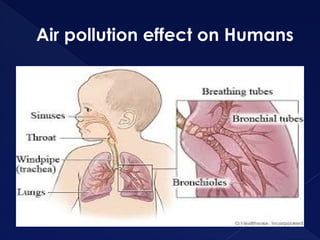
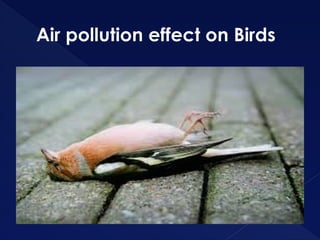
Effect of dustemission
Emission of smoke dust and
chemicals from manufacturing
industries causes serious health
effects on humans, animals,birds
and all living things.
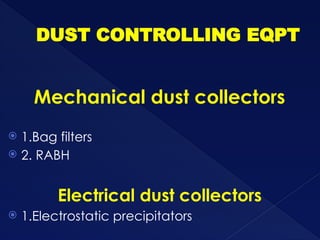
How to controldust emission
Now a days the dust emission in
industries are controlled by
using different types of dust
controlling equipment's and
these are working with high
performance.
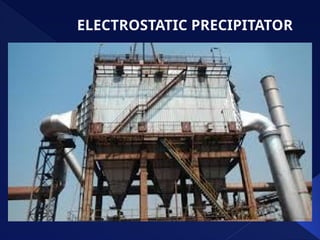
WHAT IS ESP
Anelectrostatic precipitator
(ESP) is an industrial
equipment that removes
dust particles from a flowing
gas using the force of an
electro static attraction.
15.
Applications of ESP
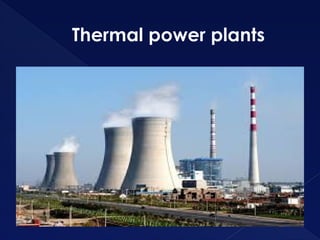
ESPUsed for industrial dust collecting
purpose ,Some of the industries are
Thermal Power plants
Cement plants
Working principle ofESP
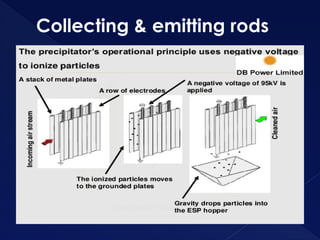
The main working principle of Electrostatic
Precipitator is
Dust particles charging
Collecting
Dropping
&
removing
19.
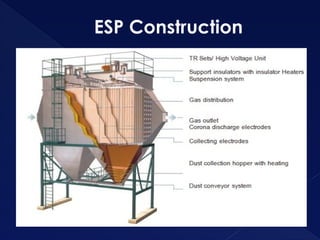
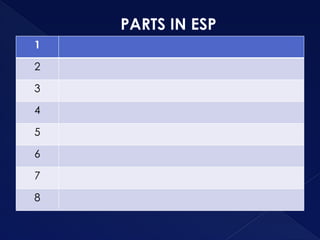
MAIN PARTS INESP
1.Electrical transformers
2.Rectifiers
3.Gas distribution screen
4.Collecting plates
5.Emitting electrodes
6.Rapping system
7.Dust collecting hopper
8.Dust discharge unit
HOW DOES ITWORKS
Electrostatic precipitators use electrostatic
forces to separate dust particles from
exhaust gases in industrial processes. A
number of high-voltage negative charged
direct-current discharge electrodes are
placed between positive charged
collecting plates. The contaminated gas
passes through the passage between the
collecting plates, and the particles
become negative charged and adhere
to the collection electrodes.
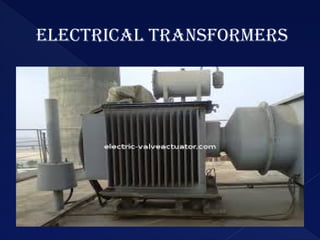
Electrical Transformer
Transformer isused for to step
up or step down the voltage as
per design of Electrostatic
Precipitator.
In ESP we use step up
transformers for to increase the
voltage from 415v to 6.6kv
24.
Rectifiers
Rectifiers are usedfor to convert
the given AC supply into DC
supply.
In ESP the input supply is AC but we
need DC Current to charge the
electrodes to create electro static
field (corona).
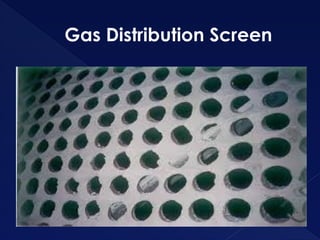
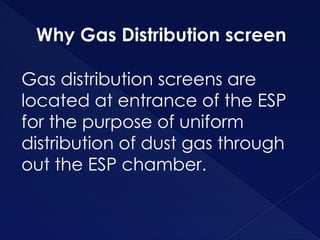
Why Gas Distributionscreen
Gas distribution screens are
located at entrance of the ESP
for the purpose of uniform
distribution of dust gas through
out the ESP chamber.
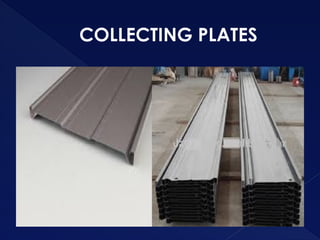
COLLECTING PLATE
Collecting plateshave positive
charge in ESP field and the
negative charge dust particles are
attracted towards collecting plate.
These collected dust particle are
removed from the collecting plate
by rapping mechanism.
29.
COLLECTING PLATE
The upperedges of the collecting
plates are hung on hooks provided
on the roof and bottom is fixed with
shock bar. The collecting plates are
made of cold rolled carbon steel
material with 1.5 mm thick.
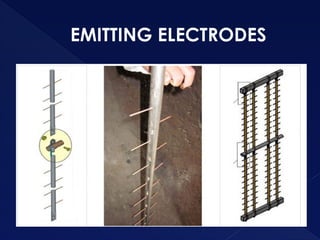
EMITTING ELECTRODES
EmittingElectrodes, also knows as
Discharge Electrodes is the heart
of the ESP. These are High Voltage
internal and ionizes the gases and
creates the electrical field.
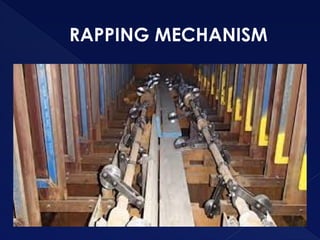
RAPPING SYSTEM
Rapping isone of the operation in ESP.
It removes deposited (collected) dust
particles from collecting plates and also
from emitting electrodes.
35.
USE OF RAPPINGOPERATION
By removing the dust coating from
collecting plates we can increase
the collecting efficiency.
By removing the dust from emitting
electrodes ,it discharge high
electric field.
36.
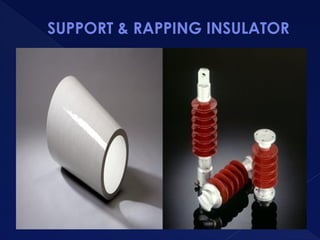
INSULATORS
insulators are widelyused in various
electrodes in order to insulate them from
high voltage.
1.SUPPORT INSULATORS
2.RAPPING INSULATORS
SUPPORT INSULATORS
Cylindrical orconical support
insulators are used for the
suspension of the collecting
electrodes and to provide
insulation to the ESP housing.
39.
RAPPING INSULATORS
Rapper insulatorsare used to remove
the accumulated dust on the collecting
electrodes by hammer rapping (Dry
type ESP) into a hopper below the
electrodes. The rapper insulators
provide insulation to the hammer
rapping motor while the mechanical
force is transferred.
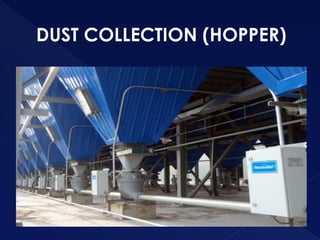
HOPPERS
Hoppers arearranged at bottom side of
the ESP Body and these are attached to
ESP body. While at the time of rapping
operation the deposited dust is dropped
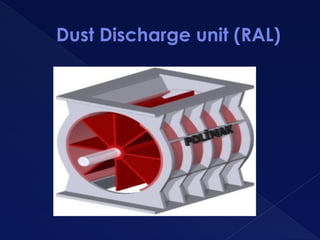
into collecting hoppers from there it was
removed by RAL.
Spark Reaction
When thevoltage applied to the electrostatic
precipitator field is too high for the conditions at
the time, a spark over will occur. Detrimentally high
amounts of current can occur during a spark over
if not properly controlled, which could damage
the fields. A voltage controller will monitor the
primary and secondary voltage and current of the
circuit, and detect a spark over condition. Once
detected, the power applied to the field will be
immediately cut off or reduced, which will stop the
spark. After a short amount of time the power will
be ramped back up, and the process will start
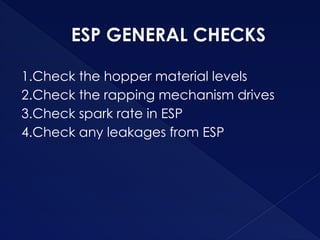
ESP GENERAL CHECKS
1.Checkthe hopper material levels
2.Check the rapping mechanism drives
3.Check spark rate in ESP
4.Check any leakages from ESP
46.
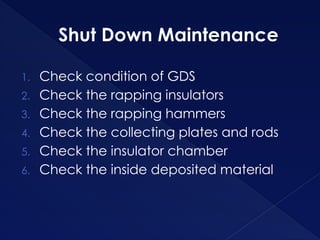
Shut Down Maintenance
1.Check condition of GDS
2. Check the rapping insulators
3. Check the rapping hammers
4. Check the collecting plates and rods
5. Check the insulator chamber
6. Check the inside deposited material
47.
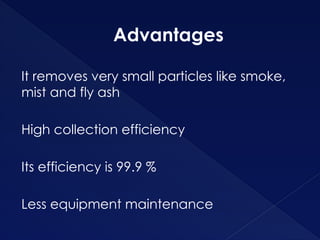
Advantages
It removes verysmall particles like smoke,
mist and fly ash
High collection efficiency
Its efficiency is 99.9 %
Less equipment maintenance






![ESP (STEAG) - Session 1 Part 2_ppt [Read-Only] [Compatibility Mode].pdf](https://cdn.slidesharecdn.com/ss_thumbnails/espsteag-session1part2pptread-onlycompatibilitymode-250605064152-25f30eb4-thumbnail.jpg?width=640&height=640&fit=bounds)


