KAMCO ENGINEERING PVT LTD
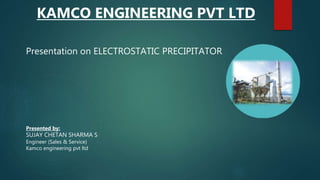
Presentation on ELECTROSTATIC PRECIPITATOR
Presented by:
SUJAY CHETAN SHARMA S
Engineer (Sales & Service)
Kamco engineering pvt ltd
INTRODUCTION
An electrostatic
precipitator is a large,
industrial emission- control
unit. It is designed to trap
and remove dust particles
from the exhaust gas.
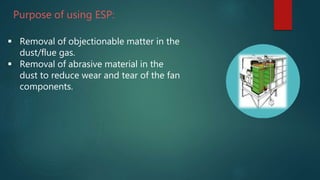
Purpose of using ESP:
 Removal of objectionable matter in the
dust/flue gas.
 Removal of abrasive material in the
dust to reduce wear and tear of the fan
components.
Construction:
Electrode wires which
carries negatively charged
high voltage DC (between
20 to 80 KV) act as
discharge or emitting
electrodes.
The cross section of the
wire may be round ,
square, or further
complicated to increase
the local electrical field
and thus the corona
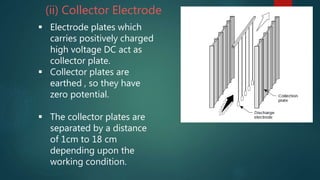
(ii) Collector Electrode
 Electrode plates which
carries positively charged
high voltage DC act as
collector plate.
 Collector plates are
earthed , so they have
zero potential.
 The collector plates are
separated by a distance
of 1cm to 18 cm
depending upon the
working condition.
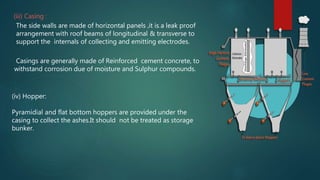
(iii) Casing :
The side walls are made of horizontal panels ,it is. a leak proof
arrangement with roof beams of longitudinal & transverse to
support the internals of collecting and emitting electrodes.
Casings are generally made of Reinforced cement concrete, to
withstand corrosion due of moisture and Sulphur compounds.
(iv) Hopper:
Pyramidial and flat bottom hoppers are provided under the
casing to collect the ashes.It should not be treated as storage
bunker.
Working Principle:
The precipitation process
involves 4 main functions:
(i) Corona generation
(ii) Particle charging
(iii) Particle collection
(iv) Removal of particles
Corona generation
When high voltage is applied in the charging electrodes ,a
blue luminous glow called “Corona “ is generated around
the electrode.
And it causes ionisation of gas molecules , due to which
+ve ions, -ve ions , and free electrons are generated.
Particle charging:
When –ve ions travel towards +ve electrodes (Collecting Plate)
,the –ve charges get attached to the dust particles, and thus the
dust particles are electrically charged.
Particle collection:
The –vely charged particles get attracted towards the +vely
charged collecting electrodes and form a layer on the surface of
the electrode.
Similarly the +vely charged particles are deposited on the
discharging electrode.
Removal of particles:
But this is merely of 10% of the total deposited material.
The deposited particles forms a layer on the electrodes, and after
certain time interval they are removed from the electrodes by
mechanisms depending upon the type of ESP.
Ash particles are collected in the hopper , and from there they are
transported to somewhere else.
Types of ESP
(i) Dry-type ESP
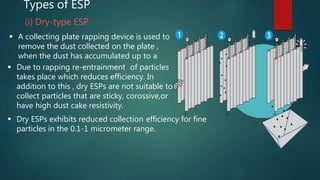
 A collecting plate rapping device is used to
remove the dust collected on the plate ,
when the dust has accumulated up to a
 Due to rapping re-entrainment of particles
takes place which reduces efficiency. In
addition to this , dry ESPs are not suitable to
collect particles that are sticky, corossive,or
have high dust cake resistivity.
 Dry ESPs exhibits reduced collection efficiency for fine
particles in the 0.1-1 micrometer range.
(ii) Wet-type ESP
to
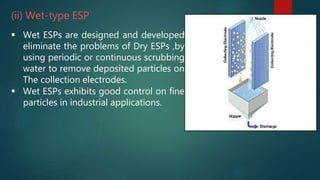
 Wet ESPs are designed and developed
eliminate the problems of Dry ESPs ,by
using periodic or continuous scrubbing
water to remove deposited particles on
The collection electrodes.
 Wet ESPs exhibits good control on fine
particles in industrial applications.
Performance of ESP
The basic formula describing ESP performance is
Deutsch-Anderson equation , giving the outlet dust
concentration (Cout), as function of inlet
concentration(Cin) , gas flow volumetric rate (Q),and
precipitator collecting area (A)
Cout =Cin.exp(-wA/Q)
Where, w=effective migration velocity of particle.
It’s a function of several variables ,including particle size
distribution ,ash composition,flue gas temperature etc
Advantages of ESP:
(i) This is more effective to remove small particles
like smoke ,mist, fly ash. Unlike Cyclone separator
which is not efficient in removal of fine particles
(particles smaller than 5 micron).It’s range of dust
removal is sufficiently large (0.01 micron to 1.0
micron
(ii) ESP’s are durable, cost effective and easy to
operate.
(iii) ESPs have very high efficiency i.e more than 99%
(iv)Generally ESPs operate at a temperature range of 363K-
573K. But in case of ultra-fine particles it can be operated at a
higher temperature range of 623K-673K or higher.
Disadvantages of ESP:
(i) DC is not available with modern plants , therefore considerable
electrical equipment is necessary to convert low voltage (400V) AC
to high voltage (60KV) DC ,this increases the capital required for
the s
(iei)t-Tuhpe.running charges are also high as the amount of power
required for charging is considerably large.
(iii)The equipment is complex, requires equipment transport and
maintenance of high level is required.
(iv)Because of closeness of the charged plates and
high potential used ,it is necessary to protect the
entire collector from sparking by providing a fine
mesh before the ionising chamber.
Conclusion:
As one of the principle source of energy ,Coal is important because
of its stability of supply and relatively low cost .
However, any greenhouse gases emitted during the combustion of
coal must be reduced in order that coal can continue to be used in
CO2 constrained future.
The problem of air pollution from particulate emission has recently
shifted from micro meter to nano meter range .As particle size
decreases the potential for chemical and catalytic effects on human
health dramatically increases.
 So , despite of its high capital investment ESP is the necessity of
present and the hope for the future.
THANKING YOU

ESP PPT.pptx

  • 1.
    KAMCO ENGINEERING PVTLTD Presentation on ELECTROSTATIC PRECIPITATOR Presented by: SUJAY CHETAN SHARMA S Engineer (Sales & Service) Kamco engineering pvt ltd
  • 2.
    INTRODUCTION An electrostatic precipitator isa large, industrial emission- control unit. It is designed to trap and remove dust particles from the exhaust gas.
  • 3.
    Purpose of usingESP:  Removal of objectionable matter in the dust/flue gas.  Removal of abrasive material in the dust to reduce wear and tear of the fan components.
  • 4.
    Construction: Electrode wires which carriesnegatively charged high voltage DC (between 20 to 80 KV) act as discharge or emitting electrodes. The cross section of the wire may be round , square, or further complicated to increase the local electrical field and thus the corona
  • 5.
    (ii) Collector Electrode Electrode plates which carries positively charged high voltage DC act as collector plate.  Collector plates are earthed , so they have zero potential.  The collector plates are separated by a distance of 1cm to 18 cm depending upon the working condition.
  • 6.
    (iii) Casing : Theside walls are made of horizontal panels ,it is. a leak proof arrangement with roof beams of longitudinal & transverse to support the internals of collecting and emitting electrodes. Casings are generally made of Reinforced cement concrete, to withstand corrosion due of moisture and Sulphur compounds. (iv) Hopper: Pyramidial and flat bottom hoppers are provided under the casing to collect the ashes.It should not be treated as storage bunker.
  • 7.
    Working Principle: The precipitationprocess involves 4 main functions: (i) Corona generation (ii) Particle charging (iii) Particle collection (iv) Removal of particles
  • 8.
    Corona generation When highvoltage is applied in the charging electrodes ,a blue luminous glow called “Corona “ is generated around the electrode. And it causes ionisation of gas molecules , due to which +ve ions, -ve ions , and free electrons are generated. Particle charging: When –ve ions travel towards +ve electrodes (Collecting Plate) ,the –ve charges get attached to the dust particles, and thus the dust particles are electrically charged.
  • 9.
    Particle collection: The –velycharged particles get attracted towards the +vely charged collecting electrodes and form a layer on the surface of the electrode. Similarly the +vely charged particles are deposited on the discharging electrode. Removal of particles: But this is merely of 10% of the total deposited material. The deposited particles forms a layer on the electrodes, and after certain time interval they are removed from the electrodes by mechanisms depending upon the type of ESP. Ash particles are collected in the hopper , and from there they are transported to somewhere else.
  • 10.
    Types of ESP (i)Dry-type ESP  A collecting plate rapping device is used to remove the dust collected on the plate , when the dust has accumulated up to a  Due to rapping re-entrainment of particles takes place which reduces efficiency. In addition to this , dry ESPs are not suitable to collect particles that are sticky, corossive,or have high dust cake resistivity.  Dry ESPs exhibits reduced collection efficiency for fine particles in the 0.1-1 micrometer range.
  • 11.
    (ii) Wet-type ESP to Wet ESPs are designed and developed eliminate the problems of Dry ESPs ,by using periodic or continuous scrubbing water to remove deposited particles on The collection electrodes.  Wet ESPs exhibits good control on fine particles in industrial applications.
  • 12.
    Performance of ESP Thebasic formula describing ESP performance is Deutsch-Anderson equation , giving the outlet dust concentration (Cout), as function of inlet concentration(Cin) , gas flow volumetric rate (Q),and precipitator collecting area (A) Cout =Cin.exp(-wA/Q) Where, w=effective migration velocity of particle. It’s a function of several variables ,including particle size distribution ,ash composition,flue gas temperature etc
  • 13.
    Advantages of ESP: (i)This is more effective to remove small particles like smoke ,mist, fly ash. Unlike Cyclone separator which is not efficient in removal of fine particles (particles smaller than 5 micron).It’s range of dust removal is sufficiently large (0.01 micron to 1.0 micron (ii) ESP’s are durable, cost effective and easy to operate. (iii) ESPs have very high efficiency i.e more than 99% (iv)Generally ESPs operate at a temperature range of 363K- 573K. But in case of ultra-fine particles it can be operated at a higher temperature range of 623K-673K or higher.
  • 14.
    Disadvantages of ESP: (i)DC is not available with modern plants , therefore considerable electrical equipment is necessary to convert low voltage (400V) AC to high voltage (60KV) DC ,this increases the capital required for the s (iei)t-Tuhpe.running charges are also high as the amount of power required for charging is considerably large. (iii)The equipment is complex, requires equipment transport and maintenance of high level is required. (iv)Because of closeness of the charged plates and high potential used ,it is necessary to protect the entire collector from sparking by providing a fine mesh before the ionising chamber.
  • 15.
    Conclusion: As one ofthe principle source of energy ,Coal is important because of its stability of supply and relatively low cost . However, any greenhouse gases emitted during the combustion of coal must be reduced in order that coal can continue to be used in CO2 constrained future. The problem of air pollution from particulate emission has recently shifted from micro meter to nano meter range .As particle size decreases the potential for chemical and catalytic effects on human health dramatically increases.  So , despite of its high capital investment ESP is the necessity of present and the hope for the future.
  • 16.