

Prepared by:-
Gaurav
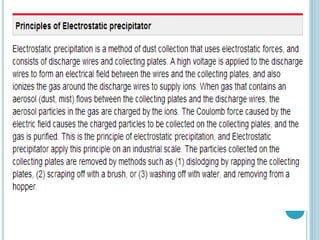
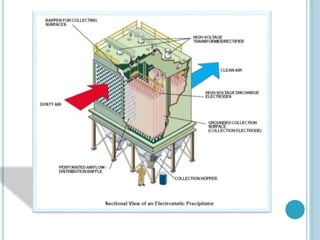
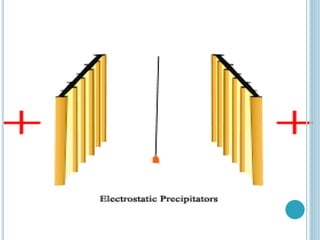
Electrostatic precipitator (ESP)- PRINCIPLE :-
An electrostatic precipitator (ESP) is a device that
removes dust particles from a flowing gas (such as air) using
force of an induced electrostatic attraction (i.e. like charges
repel; unlike charges attract)
Electrostatic precipitators are highly efficient filtration devices
that allow flow of gases through device, and can easily
remove fine particulate matter such as dust and smoke from
air stream.
environment protection has become a crucial problem and
the authorities are requested to set increasingly more
stringent limits , one of which is the emissions from the
industrial plants of solid particulate and other gaseous
pollutants.
ELECTROSTATIC PRECIPITATOR
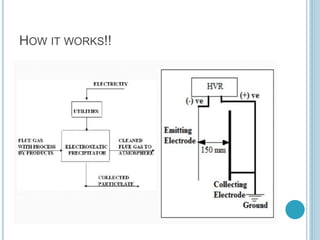
HOW IT WORKS!!
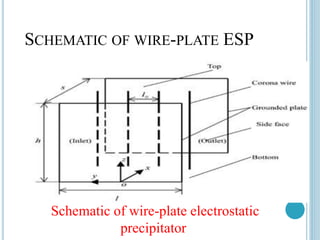
SCHEMATIC OF WIRE-PLATE ESP
Schematic of wire-plate electrostatic
precipitator
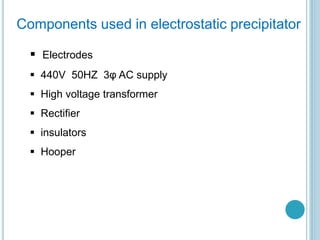
Components used in electrostatic precipitator
 Electrodes
 440V 50HZ 3φ AC supply
 High voltage transformer
 Rectifier
 insulators
 Hooper
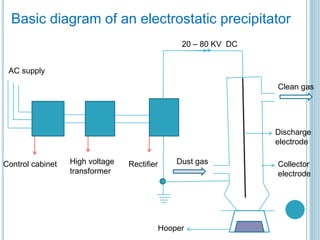
20 – 80 KV DC
Basic diagram of an electrostatic precipitator
AC supply
Control cabinet High voltage
transformer
Rectifier Dust gas
Clean gas
Hooper
Discharge
electrode
Collector
electrode
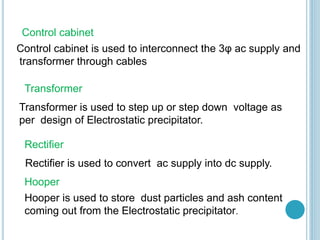
Control cabinet
Control cabinet is used to interconnect the 3φ ac supply and
transformer through cables
Transformer
Transformer is used to step up or step down voltage as
per design of Electrostatic precipitator.
Rectifier
Rectifier is used to convert ac supply into dc supply.
Hooper
Hooper is used to store dust particles and ash content
coming out from the Electrostatic precipitator.
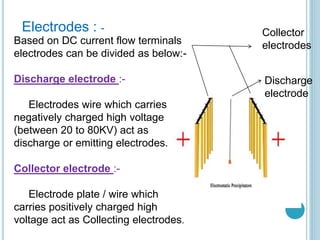
Electrodes : -
Based on DC current flow terminals
electrodes can be divided as below:-
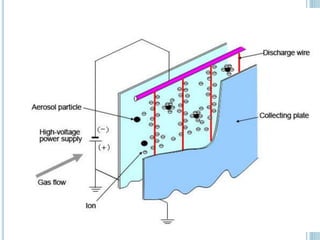
Discharge electrode :-
Electrodes wire which carries
negatively charged high voltage
(between 20 to 80KV) act as
discharge or emitting electrodes.
Collector electrode :-
Electrode plate / wire which
carries positively charged high
voltage act as Collecting electrodes.
Collector
electrodes
Discharge
electrode
Processes of electrostatic precipitator are in three main
stages:
particle charging,
transport
collection.
Main process of ESP
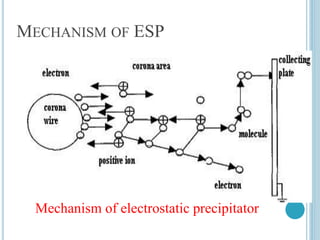
MECHANISM OF ESP
Mechanism of electrostatic precipitator
WORKING OF ELECTROSTATIC
PRECIPITATOR
Several things happen very rapidly (in a matter of a
millisecond) in the small area around the discharge
electrode.
Electric field is emerged due to dc terminal
arrangement. The applied (-) voltage in discharge electrode
is increased until it produces a corona discharge, which
can be seen as a luminous blue glow around discharge
Electrode.
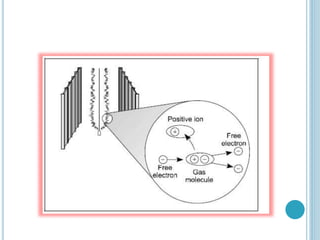
Due to the formation of corona discharge, free electrons
are emitted with high velocity from discharge electrode.
Stage - 1
 This fast moving free electrons strikes gas molecule
thus emission of free electron from gas molecules takes
place.
 The positive ion molecule move towards discharge
electrode by electrostatic attraction
 As a result with gas molecule more free electrons are
emitted near the discharge electrode.
Stage - 2
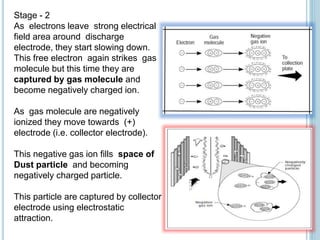
As electrons leave strong electrical
field area around discharge
electrode, they start slowing down.
This free electron again strikes gas
molecule but this time they are
captured by gas molecule and
become negatively charged ion.
As gas molecule are negatively
ionized they move towards (+)
electrode (i.e. collector electrode).
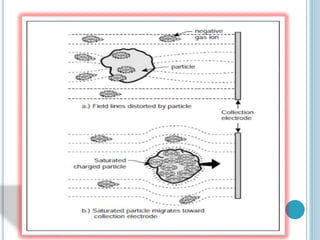
This negative gas ion fills space of
Dust particle and becoming
negatively charged particle.
This particle are captured by collector
electrode using electrostatic
attraction.
ESP (Electrostatic precipitator)

ESP (Electrostatic precipitator)

  • 1.
  • 2.
    Electrostatic precipitator (ESP)-PRINCIPLE :- An electrostatic precipitator (ESP) is a device that removes dust particles from a flowing gas (such as air) using force of an induced electrostatic attraction (i.e. like charges repel; unlike charges attract) Electrostatic precipitators are highly efficient filtration devices that allow flow of gases through device, and can easily remove fine particulate matter such as dust and smoke from air stream.
  • 4.
    environment protection hasbecome a crucial problem and the authorities are requested to set increasingly more stringent limits , one of which is the emissions from the industrial plants of solid particulate and other gaseous pollutants. ELECTROSTATIC PRECIPITATOR
  • 5.
  • 8.
    SCHEMATIC OF WIRE-PLATEESP Schematic of wire-plate electrostatic precipitator
  • 10.
    Components used inelectrostatic precipitator  Electrodes  440V 50HZ 3φ AC supply  High voltage transformer  Rectifier  insulators  Hooper
  • 11.
    20 – 80KV DC Basic diagram of an electrostatic precipitator AC supply Control cabinet High voltage transformer Rectifier Dust gas Clean gas Hooper Discharge electrode Collector electrode
  • 12.
    Control cabinet Control cabinetis used to interconnect the 3φ ac supply and transformer through cables Transformer Transformer is used to step up or step down voltage as per design of Electrostatic precipitator. Rectifier Rectifier is used to convert ac supply into dc supply. Hooper Hooper is used to store dust particles and ash content coming out from the Electrostatic precipitator.
  • 13.
    Electrodes : - Basedon DC current flow terminals electrodes can be divided as below:- Discharge electrode :- Electrodes wire which carries negatively charged high voltage (between 20 to 80KV) act as discharge or emitting electrodes. Collector electrode :- Electrode plate / wire which carries positively charged high voltage act as Collecting electrodes. Collector electrodes Discharge electrode
  • 14.
    Processes of electrostaticprecipitator are in three main stages: particle charging, transport collection. Main process of ESP
  • 15.
    MECHANISM OF ESP Mechanismof electrostatic precipitator
  • 16.
    WORKING OF ELECTROSTATIC PRECIPITATOR Severalthings happen very rapidly (in a matter of a millisecond) in the small area around the discharge electrode. Electric field is emerged due to dc terminal arrangement. The applied (-) voltage in discharge electrode is increased until it produces a corona discharge, which can be seen as a luminous blue glow around discharge Electrode. Due to the formation of corona discharge, free electrons are emitted with high velocity from discharge electrode. Stage - 1
  • 17.
     This fastmoving free electrons strikes gas molecule thus emission of free electron from gas molecules takes place.  The positive ion molecule move towards discharge electrode by electrostatic attraction  As a result with gas molecule more free electrons are emitted near the discharge electrode.
  • 19.
    Stage - 2 Aselectrons leave strong electrical field area around discharge electrode, they start slowing down. This free electron again strikes gas molecule but this time they are captured by gas molecule and become negatively charged ion. As gas molecule are negatively ionized they move towards (+) electrode (i.e. collector electrode). This negative gas ion fills space of Dust particle and becoming negatively charged particle. This particle are captured by collector electrode using electrostatic attraction.