Electronic Distance Measurement (EDM)
1. Introduction to EDM:
1. Definition and history
2. Basic principles of operation
2. Types of EDM Instruments:
• Total stations
• Theodolites with EDM capabilities
• Handheld laser distance meters
3. Working Principles:
• Phase comparison method
• Time-of-flight method
• Frequency modulation method
4. Applications of EDM:
• Surveying and mapping
• Construction and engineering
• Geographical Information Systems (GIS)
5. Advantages of EDM:
• High accuracy and precision
• Efficiency and speed
• Long-range capabilities
• Reduced human error
6. Limitations and Challenges:
• Environmental factors affecting measurements
• Calibration and maintenance of instruments
• Cost considerations
7. Practical Demonstrations:
• Setting up and using EDM instruments
• Conducting field measurements
• Data recording and analysis
Methods for distance measurement
1. DDM or Direct distance measurement - This is mainly done by chaining or
taping.
2. ODM or Optical distance measurement - This measurement is conducted
by tachometry, horizontal subtense method or telemetric method. These are
carried out with the help of optical wedge attachments.
3. EDM or Electromagnetic distance measurement
Why EDM?
Traditional distance measurement techniques, such as using chains, tapes, or optical methods,
have several issues that can be effectively addressed by Electronic Distance Measurement (EDM):
1. Human Error: Manual methods are prone to human errors, such as incorrect reading or recording of
measurements. EDM reduces these errors by automating the measurement process.
2. Physical Obstacles: Chains and tapes require a clear line of sight and physical contact with the
ground, which can be challenging in rough or obstructed terrains. EDM can measure distances
without physical contact, making it suitable for difficult environments.
3. Time-Consuming: Traditional methods are labor-intensive and time-consuming, especially over long
distances. EDM significantly speeds up the process, allowing for quicker data collection.
4. Accuracy: Chains and tapes can stretch or sag, leading to inaccurate measurements. EDM provides
highly accurate measurements, often within millimeters, regardless of distance.
5. Environmental Factors: Temperature, humidity, and wind can affect the accuracy of manual
measurements. EDM instruments can compensate for these factors, ensuring consistent accuracy.
6. Range Limitations: Traditional methods are limited in range and are not practical for very long
distances. EDM can measure distances over several kilometers, making it ideal for large-scale
projects.
By addressing these issues, EDM enhances the efficiency, accuracy, and reliability of distance
measurements in various fields such as surveying, construction, and engineering.
Are you considering using EDM for a specific project or just exploring its benefits?
Why EDM?
Electronic Distance Measurement (EDM) is essential for several reasons:
1. Accuracy: EDM provides highly accurate distance measurements,
which are crucial for tasks like surveying, construction, and
engineering.
2. Efficiency: It significantly speeds up the measurement process
compared to traditional methods like chains or tapes.
3. Long Range: EDM can measure distances over long ranges, sometimes
up to 100 kilometers, making it suitable for large-scale projects.
4. Reduced Errors: The electronic nature of EDM reduces human errors
that are common with manual measurement methods.
5. Versatility: EDM instruments can measure both horizontal and vertical
distances, and some advanced devices can also measure angles.
These benefits make EDM a revolutionary technology in fields that require
precise and efficient distance measurements.
Definition of EDM
Electronic Distance Measurement (EDM) refers
to the use of electronic devices to measure
distances accurately and efficiently. These
devices use electromagnetic waves, typically
light or radio waves, to determine the distance
between two points. The principle involves
sending a signal from the instrument to a
reflector and measuring the time it takes for the
signal to return.
History of EDM
1. Early Developments:
– The concept of using electromagnetic waves for distance
measurement dates back to the early 20th
century. Initial experiments
involved radio waves, but these were limited by their accuracy and
range.
2. Introduction of Light Waves:
– In the mid-20th
century, the use of light waves, particularly infrared
and laser, revolutionized EDM. These waves provided higher accuracy
and longer range compared to radio waves.
3. First EDM Instruments:
– The first practical EDM instruments were developed in the 1950s and
1960s. These early devices were bulky and required significant power,
but they laid the groundwork for modern EDM technology.
History of EDM
4. Advancements in Technology:
– Over the decades, advancements in electronics, optics, and computing
have significantly improved EDM instruments. Modern devices are
more compact, accurate, and user-friendly. They often integrate with
other surveying tools like total stations and GPS.
5. Current State:
– Today, EDM is a standard tool in surveying, construction, and
engineering. Instruments like total stations combine EDM with angle
measurement, providing comprehensive data for various applications.
Key Milestones
– 1950s: Introduction of the first practical EDM
instruments.
– 1960s-1970s: Development of more accurate and
portable devices using light waves.
– 1980s-1990s: Integration of EDM with other
surveying technologies, such as total stations.
– 2000s-Present: Continuous improvements in
accuracy, range, and ease of use, along with
integration with digital data collection and
processing systems.
Practical Applications
– Surveying: Creating accurate maps and land
surveys.
– Construction: Site layout, building measurements,
and infrastructure projects.
– Engineering: Precise measurements for design and
analysis.
Basic Principles of Operation of EDM
Electronic Distance Measurement (EDM) operates on the
principle of using electromagnetic waves to measure distances.
Here are the key principles:
1. Transmission and Reflection:
• An EDM instrument emits an electromagnetic wave, usually a laser or infrared light,
towards a target.
• The wave travels to the target and is reflected back to the instrument.
2. Time Measurement:
• The instrument measures the time it takes for the wave to travel to the target and
back. This time is known as the “time of flight.”
• The distance is calculated based on the speed of the wave (which is the speed of
light for laser-based EDM) and the measured time.
3. Phase Comparison:
• Some EDM instruments use phase comparison methods. They compare the phase
of the emitted wave with the phase of the reflected wave.
• The phase difference is proportional to the distance between the instrument and
the target.
Basic Principles of Operation of EDM
4. Frequency Modulation:
• In frequency modulation methods, the frequency of the emitted wave is varied.
• The instrument measures the frequency shift of the reflected wave to determine
the distance.
5. Compensation for Environmental Factors:
• EDM instruments often include sensors to measure temperature, pressure, and
humidity.
• These environmental factors can affect the speed of the electromagnetic wave, so
the instrument compensates for them to ensure accurate measurements.
Basic Principles of Operation of EDM
Principle of EDM
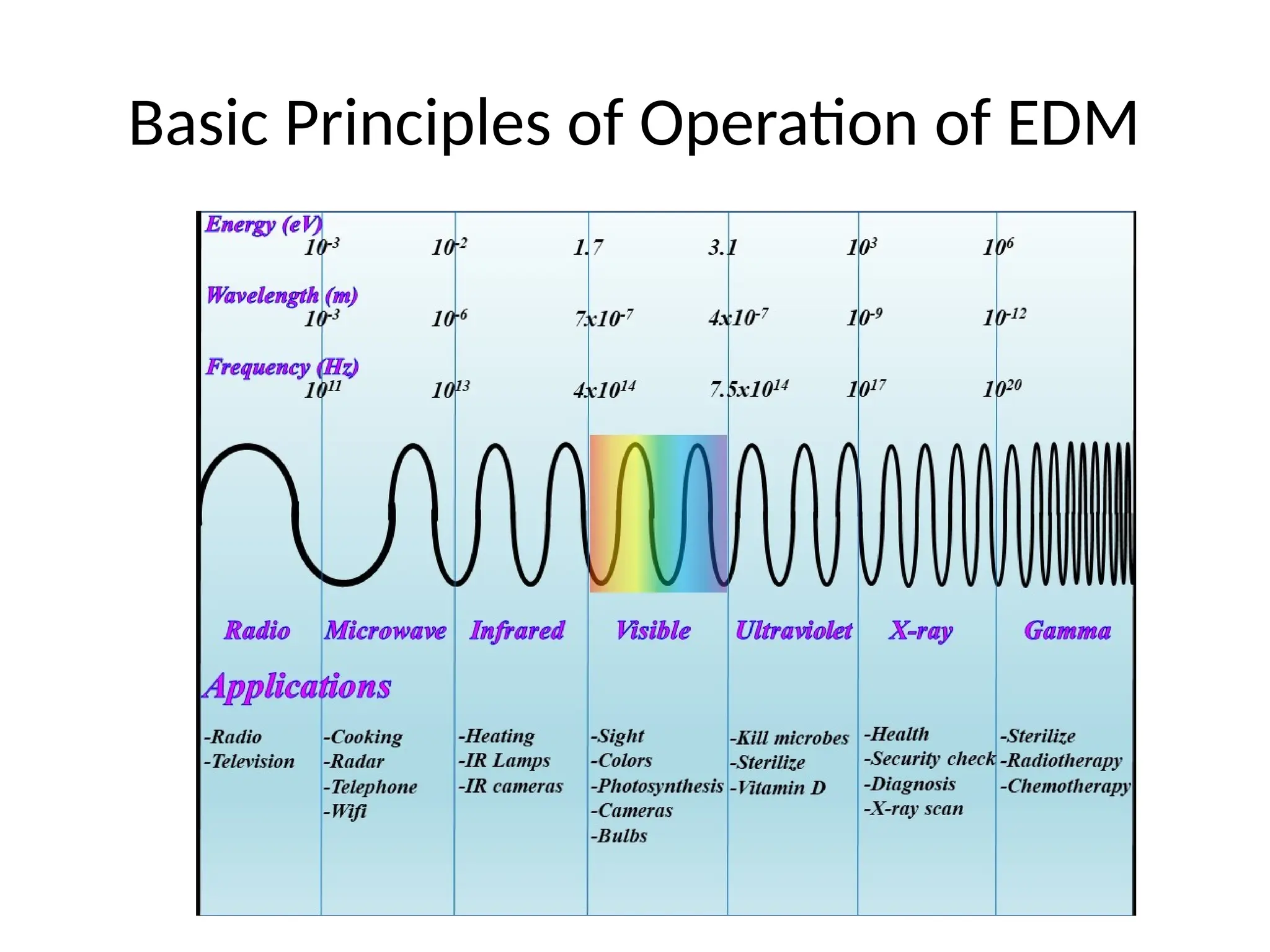
Among these waves microwaves, infrared waves and visible light
waves are useful for the distance measurement.
It is essential to know the fundamental principle behind EDM to work
with it. The electromagnetic waves propagate through the
atmosphere based on the equation:
v = f  = 1/T 
f=1/T: (T-Time in seconds)
Where
v is the velocity of electromagnetic energy in meters per second
(m/sec)
f is the modulated frequency in hertz (Hz)
Steps in EDM Measurement
1. Setup:
• The EDM instrument is set up at a known point.
• The target (reflector) is placed at the point to be measured.
2. Measurement:
• The instrument emits the electromagnetic wave towards the target.
• The wave is reflected back to the instrument.
3. Calculation:
• The instrument measures the time of flight or phase difference.
• It calculates the distance based on the measured time or phase
difference and compensates for any environmental factors.
4. Recording:
• The measured distance is recorded electronically, reducing the chance
of human error.
Steps in EDM Measurement
– Ray AB is the survey line to me measured, having a length of D.
– The EDM equipment is placed at ends A and B. A transmitter is
placed at A and a receiver is placed at B.
– The transmitter lets propagation of electromagnetic waves towards
B. A timer is also placed. At the instant of transmission of wave
from A the timer at 8 starts and stops at the instant of reception of
incoming wave at B.
– This enable us to know the transit time for the wave from the point
A to B.
– From the transit time and known velocity, the distance can be
easily measured. Now to solve the problem arise due to difficulty in
starting the timer at B, a reflector can be placed as shown below
instead of a receiver at B.
Steps in EDM Measurement
Measurement of distance with EDM and a Reflector
• As explained let the waves get transmitted from A and reflected
from B. If the received signal is out of phase by a measure then
equivalent distance is:
d= Δ (  / 360 )
• Thus, the distance, D = ½ [n  + Δ (  / 360 )]
where n is the integral number of wavelength, in the double
path
Practical Considerations
– Accuracy: EDM instruments can achieve millimeter-level
accuracy.
– Range: Depending on the instrument, EDM can measure
distances from a few meters to several kilometers.
– Speed: Measurements are quick, often taking just a few
seconds.
By understanding these principles, students can
appreciate how EDM provides accurate and efficient
distance measurements, making it a valuable tool in
surveying, construction, and engineering.
Types of EDM Instruments:
– Microwave Instruments
– Infrared Wave Instruments
– Light Wave Instruments
– Laser Distance Meter
– Total Station
– Global Positioning System (GPS)
Microwave Instruments in EDM
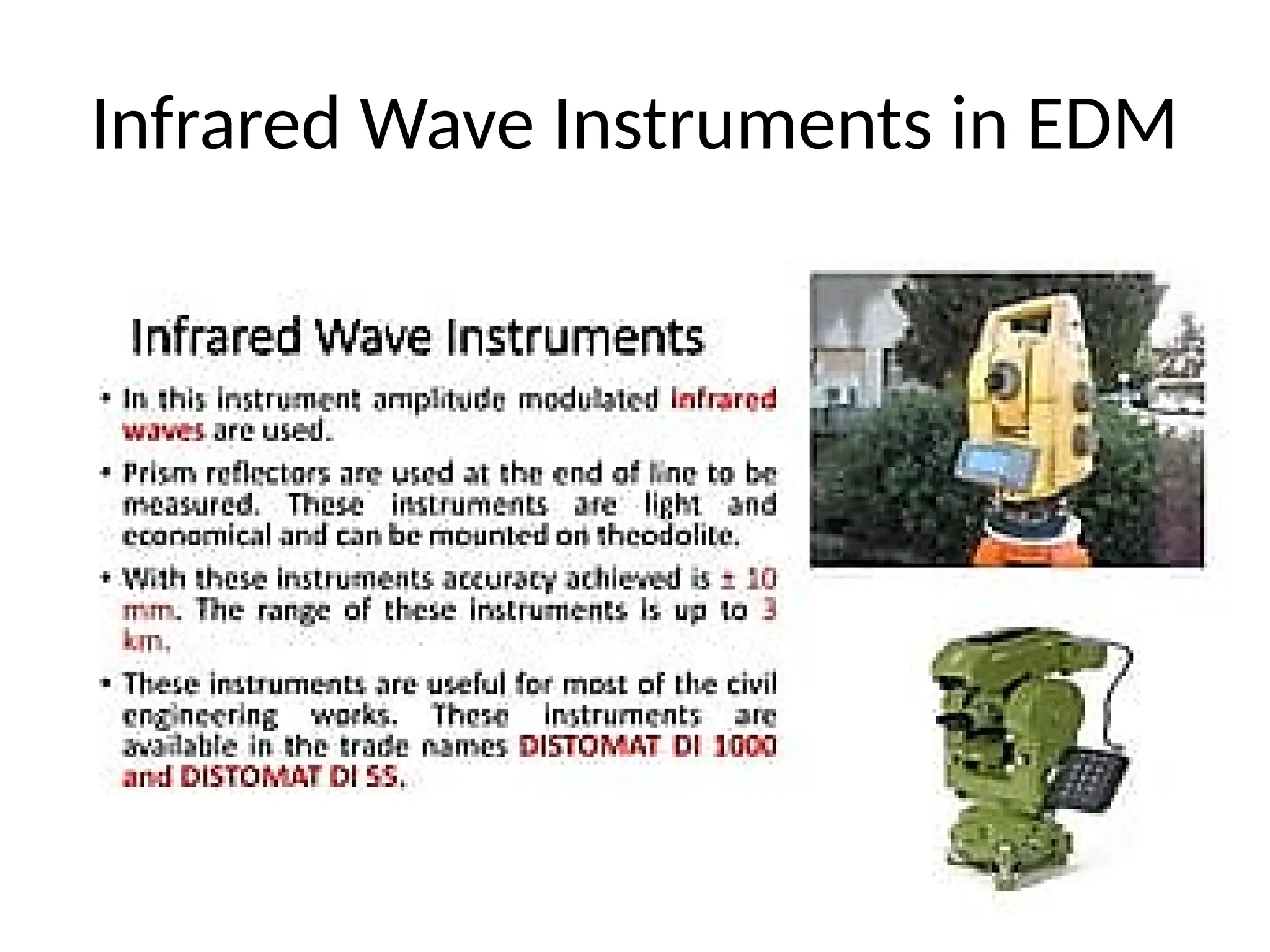
Infrared Wave Instruments in EDM
Infrared Wave Instruments are a type of Electronic Distance Measurement
(EDM) device that use infrared wave to measure distances. Here are some key
points about these instruments:
Working Principle
– Amplitude Modulation: Infrared wave instruments typically use
amplitude-modulated infrared light. The instrument emits an infrared
beam towards a target, usually a prism reflector.
– Reflection and Return: The infrared beam is reflected back to the
instrument by the prism. The instrument then measures the time it
takes for the beam to travel to the target and back.
– Distance Calculation: The distance is calculated based on the speed of
light and the measured time of flight. Some instruments may also use
phase comparison methods to enhance accuracy1
.
Infrared Wave Instruments in EDM
Features
– Light and Economical: These instruments are generally lightweight
and cost-effective, making them accessible for various applications.
– Mounting: They can be easily mounted on theodolites, which are
instruments used for measuring horizontal and vertical angles.
– Accuracy: Infrared wave instruments can achieve an accuracy of
approximately ±10 mm, which is suitable for many surveying and
construction tasks.
– Range: The typical range of these instruments is up to 3 kilometers,
making them useful for medium to long-distance measurements.
Applications
– Surveying: Used for land surveying to measure distances between
points accurately.
– Construction: Helps in site layout and ensuring precise measurements
for building projects.
– Engineering: Used in various engineering applications where accurate
distance measurements are crucial.
Infrared Wave Instruments in EDM
Limitations
– Environmental Sensitivity: Infrared measurements can be affected by
environmental factors such as fog, rain, and dust, which may scatter
the infrared beam.
– Reflector Dependency: Requires a clear line of sight to the reflector,
which can be a limitation in obstructed areas.
EDM instruments that operate based on the principles of infrared waves:
1. Leica DISTO Series
2. Topcon GTS Series
3. Trimble S Series
4. Sokkia SET Series
5. Nikon NPL Series
Light Wave Instruments in EDM
Light Wave Instruments are a type of Electronic Distance Measurement
(EDM) device that use visible or near-visible light waves to measure distances.
Here are some key points about these instruments:
Working Principle
– Modulated Light Waves: These instruments rely on the propagation of
modulated light waves. The light waves are typically in the visible or
near-visible spectrum.
– Transmission and Reflection: The instrument emits a modulated light
wave towards a target, usually a prism reflector. The light wave is
reflected back to the instrument.
– Phase Comparison: The instrument measures the phase difference
between the emitted and reflected light waves. This phase difference
is used to calculate the distance.
Light Wave Instruments in EDM
Features
– Accuracy: Light wave instruments can achieve high accuracy, typically
ranging from 0.5 mm to 5 mm per kilometer of distance1
.
– Range: These instruments can measure distances up to 3 kilometers
during the day and up to 2.5 kilometers at night1
.
– Geodimeter: One of the first light wave instruments, known as the
Geodimeter, was developed in Sweden. It set the standard for modern
light wave EDM instruments1
.
Applications
– Surveying: Used extensively in land surveying to measure distances
between points with high precision.
– Construction: Helps in site layout and ensuring accurate
measurements for building projects.
– Engineering: Used in various engineering applications where precise
distance measurements are crucial.
Light Wave Instruments in EDM
Advantages
– High Precision: Light wave instruments provide very precise
measurements, making them suitable for detailed surveying and
engineering tasks.
– Non-Contact Measurement: These instruments do not require
physical contact with the target, which is beneficial in rough or
inaccessible terrains.
– Speed and Efficiency: They offer quick measurements, saving time
compared to traditional methods.
Limitations
– Environmental Sensitivity: Measurements can be affected by
environmental factors such as fog, rain, and dust, which may scatter
the light waves.
– Line of Sight: Requires a clear line of sight to the reflector, which can
be a limitation in obstructed areas.
Light Wave Instruments in EDM
EDM instruments that operate based on the principles of light waves:
1. Leica Geosystems Geodimeter
2. Trimble S Series Total Stations
3. Topcon GPT Series
4. Sokkia SET Series
5. Nikon Nivo Series
Laser Distance Meter
A Laser Distance Meter is a type of Electronic Distance Measurement
(EDM) device that uses laser technology to measure distances accurately
and efficiently. Here are the key aspects of Laser Distance Meters:
Working Principle
– Laser Emission: The device emits a laser beam towards a target. The laser is
typically in the visible or near-visible spectrum, often red or infrared.
– Time of Flight: The device measures the time it takes for the laser beam to
travel to the target and reflect back to the instrument. This is known as the
“time of flight” method.
– Distance Calculation: The distance is calculated based on the speed of light
and the measured time of flight. Some devices may also use phase
comparison methods to enhance accuracy.
Laser Distance Meter
Features
– Portability: Laser Distance Meters are compact and portable, making
them easy to carry and use in various environments.
– Accuracy: These devices can achieve high accuracy, often within
millimeters, making them suitable for precise measurements.
– Range: Depending on the model, Laser Distance Meters can measure
distances from a few centimeters to several hundred meters.
– Ease of Use: They are user-friendly, with simple point-and-click
operation and digital displays for easy reading of measurements.
Applications
– Construction: Used for site layout, measuring distances between
points, and ensuring accurate measurements for building projects.
– Interior Design: Ideal for measuring room dimensions, furniture
placement, and other interior design tasks.
– Surveying: Used in land surveying for quick and accurate distance
measurements.
– DIY Projects: Popular among DIY enthusiasts for home improvement
projects, such as measuring spaces for new furniture or renovations.
Laser Distance Meter
Limitations
– Environmental Sensitivity: Measurements can be
affected by environmental factors such as fog, rain, and
dust, which may scatter the laser beam.
– Reflective Surfaces: The accuracy of measurements can
be impacted by highly reflective or transparent surfaces.
– Range Limitations: While they are effective for short to
medium distances, Laser Distance Meters may not be
suitable for very long-range measurements compared to
other EDM instruments.
Total Station
A Total Station is a versatile and advanced type of Electronic
Distance Measurement (EDM) instrument that combines several
functionalities into one device. Here are the key aspects of Total
Stations:
Definition and Components
– Combination of Instruments: A Total Station integrates an electronic
theodolite (for measuring angles), an EDM device (for measuring
distances), and a computer or data collector for processing and
storing data.
– Components: It typically includes a telescope, electronic distance
meter, angle measurement system, and a microprocessor for data
processing.
Total Station
Working Principle
– Distance Measurement: The EDM unit in a Total Station uses laser or
electromagnetic waves to measure the distance between the
instrument and the target point. It emits a beam towards the target
and measures the time it takes for the beam to return.
– Angle Measurement: The electronic theodolite measures both
horizontal and vertical angles using electro-optical scanning of digital
bar-codes etched on rotating glass cylinders or discs.
– Data Processing: The onboard computer processes the measured
distances and angles to calculate precise coordinates of the target
point. This data can be stored and transferred to other devices for
further analysis.
Total Station
Features
– High Accuracy: Total Stations provide highly accurate measurements,
often within millimeters.
– Versatility: They can measure distances, angles, and elevations,
making them suitable for a wide range of applications.
– Data Storage: The onboard computer allows for the storage and
processing of large amounts of data, which can be easily transferred to
other devices.
– Robotic Total Stations: Some advanced models are motorized and can
be controlled remotely, reducing the need for an assistant.
Applications
– Surveying: Widely used in land surveying for creating detailed maps
and conducting topographic surveys.
– Construction: Essential for site layout, building measurements, and
ensuring the accuracy of construction projects.
– Engineering: Used in various engineering applications, including
infrastructure development and monitoring.
Total Station
Advantages
– Efficiency: Combines multiple measurement functions into one device,
saving time and effort.
– Precision: Provides highly accurate measurements, essential for
detailed surveying and engineering tasks.
– Data Integration: Facilitates easy integration of measurement data
with other software tools, such as CAD and GIS.
Limitations
– Cost: High-end Total Stations can be expensive, which might be a
consideration for some projects.
– Complexity: Requires training and expertise to operate effectively.
– Environmental Sensitivity: Measurements can be affected by
environmental factors such as weather conditions and obstacles.
Global Positioning System (GPS) in EDM
The Global Positioning System (GPS) is a satellite-based navigation system
that provides location and time information anywhere on or near the Earth,
where there is an unobstructed line of sight to four or more GPS satellites.
While GPS is primarily known for navigation, it is also a powerful tool for
Electronic Distance Measurement (EDM).
Working Principle
– Satellite Signals: GPS works by receiving signals from a network of
satellites orbiting the Earth. Each satellite transmits a signal that
includes the satellite’s location and the exact time the signal was sent.
– Distance Calculation: The GPS receiver calculates the distance to each
satellite based on the time it takes for the signal to travel from the
satellite to the receiver. This is known as the “time of flight” method.
– Triangulation: By measuring the distance to at least four satellites, the
GPS receiver can determine its exact position (latitude, longitude, and
altitude) through a process called triangulation.
Global Positioning System (GPS) in EDM
Features
– High Accuracy: Modern GPS systems can achieve accuracy within a
few centimeters to a few meters, depending on the quality of the
receiver and the correction methods used.
– Global Coverage: GPS provides global coverage, making it suitable for
use anywhere in the world.
– Real-Time Data: GPS can provide real-time position and distance data,
which is valuable for dynamic applications.
Applications in EDM
– Surveying: GPS is widely used in land surveying to measure distances
and determine precise locations. It is especially useful for large-scale
surveys and in areas where traditional methods are impractical.
– Construction: In construction, GPS is used for site layout, machine
control, and monitoring the progress of projects.
– Geodetic Measurements: GPS is used for geodetic measurements,
which involve determining the precise shape and size of the Earth and
the location of points on its surface.
Global Positioning System (GPS) in EDM
Advantages
– Efficiency: GPS allows for quick and efficient data collection over large
areas, reducing the time and labor required for traditional surveying
methods.
– Versatility: It can be used in various environments, including urban,
rural, and remote areas.
– Integration: GPS data can be easily integrated with other surveying
and mapping tools, such as GIS and CAD software.
Limitations
– Signal Obstruction: GPS signals can be obstructed by buildings, trees,
and other obstacles, which can affect accuracy.
– Environmental Factors: Atmospheric conditions, such as ionospheric
and tropospheric delays, can impact the accuracy of GPS
measurements.
– Initial Cost: High-precision GPS equipment can be expensive, although
the cost has been decreasing over time.
Working Principles:
– Phase comparison method
Phase Comparison Method in EDM
The Phase Comparison Method is a widely used technique in
Electronic Distance Measurement (EDM) instruments. This method
involves comparing the phase of the transmitted signal with the
phase of the received signal to determine the distance. Here’s a
detailed explanation of how it works:
Basic Principle
– Modulated Signal: The EDM instrument emits a continuous wave
signal that is modulated at a specific frequency. This signal travels to
the target and is reflected back to the instrument.
– Phase Shift: As the signal travels to the target and back, it undergoes
a phase shift. The phase shift is directly proportional to the distance
traveled by the signal.
Phase Comparison Method in EDM
Steps in Phase Comparison Method
1. Transmission: The EDM instrument generates and transmits a modulated
electromagnetic wave (usually light or infrared) towards the target.
2. Reflection: The wave hits the target (often a prism reflector) and is reflected
back to the instrument.
3. Reception: The instrument receives the reflected wave and compares its
phase with the phase of the transmitted wave.
4. Phase Difference Measurement: The instrument measures the phase
difference between the transmitted and received waves. This phase difference
is used to calculate the distance.
Mathematical Representation
– Phase Difference (): The phase difference between the transmitted and
received signals is given by:
where (d) is the distance to the target and () is the wavelength of the
modulated signal.
– Distance Calculation: The distance (d) can be calculated as:
Phase Comparison Method in EDM
Advantages
– High Accuracy: The phase comparison method provides high accuracy, often
within millimeters, making it suitable for precise measurements.
– Efficiency: It allows for quick and efficient distance measurements, saving time
compared to traditional methods.
– Long Range: This method can be used to measure long distances, depending on
the power of the transmitted signal and the sensitivity of the receiver.
Limitations
– Environmental Factors: The accuracy of phase comparison can be affected by
environmental factors such as temperature, humidity, and atmospheric pressure.
– Complexity: The method requires precise instrumentation and calibration to
ensure accurate measurements.
– Signal Interference: Interference from other signals or obstacles can affect the
accuracy of the phase measurement.
Time-of-Flight Method in EDM
The Time-of-Flight (ToF) Method is a fundamental technique used in
Electronic Distance Measurement (EDM) instruments. This method involves
measuring the time it takes for a light or radio wave to travel to a target and
back to the instrument. Here’s a detailed explanation of how it works:
Basic Principle
– Pulse Emission: The EDM instrument emits a short pulse of
electromagnetic energy, typically a laser or infrared light.
– Travel to Target: The pulse travels to the target, which is usually a
reflector or a specific point on the object being measured.
– Reflection and Return: The pulse is reflected back to the instrument
from the target.
– Time Measurement: The instrument measures the time taken for the
pulse to travel to the target and back. This is known as the “time of
flight.”
Time-of-Flight Method in EDM
Steps in the Time-of-Flight Method
1. Pulse Generation: The EDM instrument generates a short, intense
pulse of light or radio wave.
2. Transmission: The pulse is transmitted towards the target.
3. Reflection: The pulse hits the target and is reflected back to the
instrument.
4. Reception: The instrument receives the reflected pulse.
5. Time Measurement: The instrument measures the time interval (t)
between the emission of the pulse and the reception of the reflected
pulse.
6. Distance Calculation: The distance ( d ) to the target is calculated
using the formula:
d=c Δt​/ 2
⋅
where ( c ) is the speed of light (approximately ( 3 x 10⁸
) meters
per second).
Time-of-Flight Method in EDM
Advantages
– Direct Measurement: The ToF method provides a direct measurement of distance, making it
straightforward and easy to understand.
– High Speed: This method allows for rapid distance measurements, which is useful in dynamic
environments.
– Versatility: It can be used for a wide range of distances, from very short to very long ranges.
Limitations
– Accuracy: The accuracy of the ToF method can be affected by the resolution of the time
measurement. High precision requires very accurate time measurement capabilities.
– Environmental Factors: Atmospheric conditions such as temperature, humidity, and pressure
can affect the speed of light and, consequently, the accuracy of the distance measurement.
– Signal Interference: The presence of obstacles or other reflective surfaces can cause multiple
reflections, leading to errors in the measurement.
Applications
– Surveying: Used in land surveying to measure distances between points accurately.
– Construction: Helps in site layout and ensuring precise measurements for building projects.
– Industrial Automation: Used in various industrial applications for distance and position
measurements.
– Consumer Electronics: Commonly found in devices like laser rangefinders and some advanced
cameras for autofocus and depth sensing.
– Frequency modulation method
Frequency Modulation Method in EDM
The Frequency Modulation (FM) Method is another technique used in
Electronic Distance Measurement (EDM) instruments. This method involves
modulating the frequency of the transmitted signal and measuring the
frequency shift upon its return to determine the distance. Here’s a detailed
explanation of how it works:
Basic Principle
– Frequency Modulation: The EDM instrument emits a continuous wave signal
whose frequency is modulated over time. This means the frequency of the
signal changes in a known pattern.
– Transmission and Reflection: The modulated signal travels to the target and is
reflected back to the instrument.
– Frequency Shift Measurement: The instrument measures the frequency shift
(or difference) between the transmitted and received signals. This frequency
shift is directly related to the distance traveled by the signal.
Frequency Modulation Method in EDM
Steps in the Frequency Modulation Method
1. Signal Generation: The EDM instrument generates a continuous wave
signal with a frequency that varies in a known pattern (e.g., linearly
increasing or decreasing).
2. Transmission: The modulated signal is transmitted towards the target.
3. Reflection: The signal hits the target and is reflected back to the
instrument.
4. Reception: The instrument receives the reflected signal.
5. Frequency Shift Measurement: The instrument measures the
frequency shift between the transmitted and received signals. This
shift occurs because the signal travels a certain distance to the target
and back.
6. Distance Calculation: The distance ( d ) to the target is calculated
using the formula:
d = (c Δf)/ (2 Δf
⋅ ⋅ m)​
where ( c ) is the speed of light, (Δf ) is the measured frequency
shift, and (Δf ) is the modulation frequency.
Frequency Modulation Method in EDM
Advantages
– High Accuracy: The FM method provides high accuracy, often within millimeters, making
it suitable for precise measurements.
– Long Range: This method can be used to measure long distances, depending on the
power of the transmitted signal and the sensitivity of the receiver.
– Robustness: The FM method is less affected by environmental factors such as
temperature and humidity compared to other methods.
Limitations
– Complexity: The method requires precise instrumentation and calibration to ensure
accurate measurements.
– Signal Interference: Interference from other signals or obstacles can affect the accuracy
of the frequency measurement.
– Cost: Instruments using the FM method can be more expensive due to the complexity of
the technology.
Applications
– Surveying: Used in land surveying to measure distances between points accurately.
– Construction: Helps in site layout and ensuring precise measurements for building
projects.
– Industrial Automation: Used in various industrial applications for distance and position
measurements.

Electronic Distance Measurement (EDM) for Surveying

  • 1.
    Electronic Distance Measurement(EDM) 1. Introduction to EDM: 1. Definition and history 2. Basic principles of operation 2. Types of EDM Instruments: • Total stations • Theodolites with EDM capabilities • Handheld laser distance meters 3. Working Principles: • Phase comparison method • Time-of-flight method • Frequency modulation method 4. Applications of EDM: • Surveying and mapping • Construction and engineering • Geographical Information Systems (GIS) 5. Advantages of EDM: • High accuracy and precision • Efficiency and speed • Long-range capabilities • Reduced human error 6. Limitations and Challenges: • Environmental factors affecting measurements • Calibration and maintenance of instruments • Cost considerations 7. Practical Demonstrations: • Setting up and using EDM instruments • Conducting field measurements • Data recording and analysis
  • 2.
    Methods for distancemeasurement Methods for distance measurement 1. DDM or Direct distance measurement - This is mainly done by chaining or taping. 2. ODM or Optical distance measurement - This measurement is conducted by tachometry, horizontal subtense method or telemetric method. These are carried out with the help of optical wedge attachments. 3. EDM or Electromagnetic distance measurement
  • 3.
    Why EDM? Traditional distancemeasurement techniques, such as using chains, tapes, or optical methods, have several issues that can be effectively addressed by Electronic Distance Measurement (EDM): 1. Human Error: Manual methods are prone to human errors, such as incorrect reading or recording of measurements. EDM reduces these errors by automating the measurement process. 2. Physical Obstacles: Chains and tapes require a clear line of sight and physical contact with the ground, which can be challenging in rough or obstructed terrains. EDM can measure distances without physical contact, making it suitable for difficult environments. 3. Time-Consuming: Traditional methods are labor-intensive and time-consuming, especially over long distances. EDM significantly speeds up the process, allowing for quicker data collection. 4. Accuracy: Chains and tapes can stretch or sag, leading to inaccurate measurements. EDM provides highly accurate measurements, often within millimeters, regardless of distance. 5. Environmental Factors: Temperature, humidity, and wind can affect the accuracy of manual measurements. EDM instruments can compensate for these factors, ensuring consistent accuracy. 6. Range Limitations: Traditional methods are limited in range and are not practical for very long distances. EDM can measure distances over several kilometers, making it ideal for large-scale projects. By addressing these issues, EDM enhances the efficiency, accuracy, and reliability of distance measurements in various fields such as surveying, construction, and engineering. Are you considering using EDM for a specific project or just exploring its benefits?
  • 4.
    Why EDM? Electronic DistanceMeasurement (EDM) is essential for several reasons: 1. Accuracy: EDM provides highly accurate distance measurements, which are crucial for tasks like surveying, construction, and engineering. 2. Efficiency: It significantly speeds up the measurement process compared to traditional methods like chains or tapes. 3. Long Range: EDM can measure distances over long ranges, sometimes up to 100 kilometers, making it suitable for large-scale projects. 4. Reduced Errors: The electronic nature of EDM reduces human errors that are common with manual measurement methods. 5. Versatility: EDM instruments can measure both horizontal and vertical distances, and some advanced devices can also measure angles. These benefits make EDM a revolutionary technology in fields that require precise and efficient distance measurements.
  • 5.
    Definition of EDM ElectronicDistance Measurement (EDM) refers to the use of electronic devices to measure distances accurately and efficiently. These devices use electromagnetic waves, typically light or radio waves, to determine the distance between two points. The principle involves sending a signal from the instrument to a reflector and measuring the time it takes for the signal to return.
  • 6.
    History of EDM 1.Early Developments: – The concept of using electromagnetic waves for distance measurement dates back to the early 20th century. Initial experiments involved radio waves, but these were limited by their accuracy and range. 2. Introduction of Light Waves: – In the mid-20th century, the use of light waves, particularly infrared and laser, revolutionized EDM. These waves provided higher accuracy and longer range compared to radio waves. 3. First EDM Instruments: – The first practical EDM instruments were developed in the 1950s and 1960s. These early devices were bulky and required significant power, but they laid the groundwork for modern EDM technology.
  • 7.
    History of EDM 4.Advancements in Technology: – Over the decades, advancements in electronics, optics, and computing have significantly improved EDM instruments. Modern devices are more compact, accurate, and user-friendly. They often integrate with other surveying tools like total stations and GPS. 5. Current State: – Today, EDM is a standard tool in surveying, construction, and engineering. Instruments like total stations combine EDM with angle measurement, providing comprehensive data for various applications.
  • 8.
    Key Milestones – 1950s:Introduction of the first practical EDM instruments. – 1960s-1970s: Development of more accurate and portable devices using light waves. – 1980s-1990s: Integration of EDM with other surveying technologies, such as total stations. – 2000s-Present: Continuous improvements in accuracy, range, and ease of use, along with integration with digital data collection and processing systems.
  • 9.
    Practical Applications – Surveying:Creating accurate maps and land surveys. – Construction: Site layout, building measurements, and infrastructure projects. – Engineering: Precise measurements for design and analysis.
  • 10.
    Basic Principles ofOperation of EDM Electronic Distance Measurement (EDM) operates on the principle of using electromagnetic waves to measure distances. Here are the key principles: 1. Transmission and Reflection: • An EDM instrument emits an electromagnetic wave, usually a laser or infrared light, towards a target. • The wave travels to the target and is reflected back to the instrument. 2. Time Measurement: • The instrument measures the time it takes for the wave to travel to the target and back. This time is known as the “time of flight.” • The distance is calculated based on the speed of the wave (which is the speed of light for laser-based EDM) and the measured time. 3. Phase Comparison: • Some EDM instruments use phase comparison methods. They compare the phase of the emitted wave with the phase of the reflected wave. • The phase difference is proportional to the distance between the instrument and the target.
  • 11.
    Basic Principles ofOperation of EDM 4. Frequency Modulation: • In frequency modulation methods, the frequency of the emitted wave is varied. • The instrument measures the frequency shift of the reflected wave to determine the distance. 5. Compensation for Environmental Factors: • EDM instruments often include sensors to measure temperature, pressure, and humidity. • These environmental factors can affect the speed of the electromagnetic wave, so the instrument compensates for them to ensure accurate measurements.
  • 12.
    Basic Principles ofOperation of EDM
  • 13.
    Basic Principles ofOperation of EDM Principle of EDM Among these waves microwaves, infrared waves and visible light waves are useful for the distance measurement. It is essential to know the fundamental principle behind EDM to work with it. The electromagnetic waves propagate through the atmosphere based on the equation: v = f  = 1/T  f=1/T: (T-Time in seconds) Where v is the velocity of electromagnetic energy in meters per second (m/sec) f is the modulated frequency in hertz (Hz)
  • 14.
    Steps in EDMMeasurement 1. Setup: • The EDM instrument is set up at a known point. • The target (reflector) is placed at the point to be measured. 2. Measurement: • The instrument emits the electromagnetic wave towards the target. • The wave is reflected back to the instrument. 3. Calculation: • The instrument measures the time of flight or phase difference. • It calculates the distance based on the measured time or phase difference and compensates for any environmental factors. 4. Recording: • The measured distance is recorded electronically, reducing the chance of human error.
  • 15.
    Steps in EDMMeasurement – Ray AB is the survey line to me measured, having a length of D. – The EDM equipment is placed at ends A and B. A transmitter is placed at A and a receiver is placed at B. – The transmitter lets propagation of electromagnetic waves towards B. A timer is also placed. At the instant of transmission of wave from A the timer at 8 starts and stops at the instant of reception of incoming wave at B. – This enable us to know the transit time for the wave from the point A to B. – From the transit time and known velocity, the distance can be easily measured. Now to solve the problem arise due to difficulty in starting the timer at B, a reflector can be placed as shown below instead of a receiver at B.
  • 16.
    Steps in EDMMeasurement Measurement of distance with EDM and a Reflector • As explained let the waves get transmitted from A and reflected from B. If the received signal is out of phase by a measure then equivalent distance is: d= Δ (  / 360 ) • Thus, the distance, D = ½ [n  + Δ (  / 360 )] where n is the integral number of wavelength, in the double path
  • 17.
    Practical Considerations – Accuracy:EDM instruments can achieve millimeter-level accuracy. – Range: Depending on the instrument, EDM can measure distances from a few meters to several kilometers. – Speed: Measurements are quick, often taking just a few seconds. By understanding these principles, students can appreciate how EDM provides accurate and efficient distance measurements, making it a valuable tool in surveying, construction, and engineering.
  • 18.
    Types of EDMInstruments: – Microwave Instruments – Infrared Wave Instruments – Light Wave Instruments – Laser Distance Meter – Total Station – Global Positioning System (GPS)
  • 19.
  • 20.
  • 21.
    Infrared Wave Instrumentsin EDM Infrared Wave Instruments are a type of Electronic Distance Measurement (EDM) device that use infrared wave to measure distances. Here are some key points about these instruments: Working Principle – Amplitude Modulation: Infrared wave instruments typically use amplitude-modulated infrared light. The instrument emits an infrared beam towards a target, usually a prism reflector. – Reflection and Return: The infrared beam is reflected back to the instrument by the prism. The instrument then measures the time it takes for the beam to travel to the target and back. – Distance Calculation: The distance is calculated based on the speed of light and the measured time of flight. Some instruments may also use phase comparison methods to enhance accuracy1 .
  • 22.
    Infrared Wave Instrumentsin EDM Features – Light and Economical: These instruments are generally lightweight and cost-effective, making them accessible for various applications. – Mounting: They can be easily mounted on theodolites, which are instruments used for measuring horizontal and vertical angles. – Accuracy: Infrared wave instruments can achieve an accuracy of approximately ±10 mm, which is suitable for many surveying and construction tasks. – Range: The typical range of these instruments is up to 3 kilometers, making them useful for medium to long-distance measurements. Applications – Surveying: Used for land surveying to measure distances between points accurately. – Construction: Helps in site layout and ensuring precise measurements for building projects. – Engineering: Used in various engineering applications where accurate distance measurements are crucial.
  • 23.
    Infrared Wave Instrumentsin EDM Limitations – Environmental Sensitivity: Infrared measurements can be affected by environmental factors such as fog, rain, and dust, which may scatter the infrared beam. – Reflector Dependency: Requires a clear line of sight to the reflector, which can be a limitation in obstructed areas. EDM instruments that operate based on the principles of infrared waves: 1. Leica DISTO Series 2. Topcon GTS Series 3. Trimble S Series 4. Sokkia SET Series 5. Nikon NPL Series
  • 24.
  • 25.
    Light Wave Instrumentsin EDM Light Wave Instruments are a type of Electronic Distance Measurement (EDM) device that use visible or near-visible light waves to measure distances. Here are some key points about these instruments: Working Principle – Modulated Light Waves: These instruments rely on the propagation of modulated light waves. The light waves are typically in the visible or near-visible spectrum. – Transmission and Reflection: The instrument emits a modulated light wave towards a target, usually a prism reflector. The light wave is reflected back to the instrument. – Phase Comparison: The instrument measures the phase difference between the emitted and reflected light waves. This phase difference is used to calculate the distance.
  • 26.
    Light Wave Instrumentsin EDM Features – Accuracy: Light wave instruments can achieve high accuracy, typically ranging from 0.5 mm to 5 mm per kilometer of distance1 . – Range: These instruments can measure distances up to 3 kilometers during the day and up to 2.5 kilometers at night1 . – Geodimeter: One of the first light wave instruments, known as the Geodimeter, was developed in Sweden. It set the standard for modern light wave EDM instruments1 . Applications – Surveying: Used extensively in land surveying to measure distances between points with high precision. – Construction: Helps in site layout and ensuring accurate measurements for building projects. – Engineering: Used in various engineering applications where precise distance measurements are crucial.
  • 27.
    Light Wave Instrumentsin EDM Advantages – High Precision: Light wave instruments provide very precise measurements, making them suitable for detailed surveying and engineering tasks. – Non-Contact Measurement: These instruments do not require physical contact with the target, which is beneficial in rough or inaccessible terrains. – Speed and Efficiency: They offer quick measurements, saving time compared to traditional methods. Limitations – Environmental Sensitivity: Measurements can be affected by environmental factors such as fog, rain, and dust, which may scatter the light waves. – Line of Sight: Requires a clear line of sight to the reflector, which can be a limitation in obstructed areas.
  • 28.
    Light Wave Instrumentsin EDM EDM instruments that operate based on the principles of light waves: 1. Leica Geosystems Geodimeter 2. Trimble S Series Total Stations 3. Topcon GPT Series 4. Sokkia SET Series 5. Nikon Nivo Series
  • 29.
    Laser Distance Meter ALaser Distance Meter is a type of Electronic Distance Measurement (EDM) device that uses laser technology to measure distances accurately and efficiently. Here are the key aspects of Laser Distance Meters: Working Principle – Laser Emission: The device emits a laser beam towards a target. The laser is typically in the visible or near-visible spectrum, often red or infrared. – Time of Flight: The device measures the time it takes for the laser beam to travel to the target and reflect back to the instrument. This is known as the “time of flight” method. – Distance Calculation: The distance is calculated based on the speed of light and the measured time of flight. Some devices may also use phase comparison methods to enhance accuracy.
  • 30.
    Laser Distance Meter Features –Portability: Laser Distance Meters are compact and portable, making them easy to carry and use in various environments. – Accuracy: These devices can achieve high accuracy, often within millimeters, making them suitable for precise measurements. – Range: Depending on the model, Laser Distance Meters can measure distances from a few centimeters to several hundred meters. – Ease of Use: They are user-friendly, with simple point-and-click operation and digital displays for easy reading of measurements. Applications – Construction: Used for site layout, measuring distances between points, and ensuring accurate measurements for building projects. – Interior Design: Ideal for measuring room dimensions, furniture placement, and other interior design tasks. – Surveying: Used in land surveying for quick and accurate distance measurements. – DIY Projects: Popular among DIY enthusiasts for home improvement projects, such as measuring spaces for new furniture or renovations.
  • 31.
    Laser Distance Meter Limitations –Environmental Sensitivity: Measurements can be affected by environmental factors such as fog, rain, and dust, which may scatter the laser beam. – Reflective Surfaces: The accuracy of measurements can be impacted by highly reflective or transparent surfaces. – Range Limitations: While they are effective for short to medium distances, Laser Distance Meters may not be suitable for very long-range measurements compared to other EDM instruments.
  • 32.
    Total Station A TotalStation is a versatile and advanced type of Electronic Distance Measurement (EDM) instrument that combines several functionalities into one device. Here are the key aspects of Total Stations: Definition and Components – Combination of Instruments: A Total Station integrates an electronic theodolite (for measuring angles), an EDM device (for measuring distances), and a computer or data collector for processing and storing data. – Components: It typically includes a telescope, electronic distance meter, angle measurement system, and a microprocessor for data processing.
  • 33.
    Total Station Working Principle –Distance Measurement: The EDM unit in a Total Station uses laser or electromagnetic waves to measure the distance between the instrument and the target point. It emits a beam towards the target and measures the time it takes for the beam to return. – Angle Measurement: The electronic theodolite measures both horizontal and vertical angles using electro-optical scanning of digital bar-codes etched on rotating glass cylinders or discs. – Data Processing: The onboard computer processes the measured distances and angles to calculate precise coordinates of the target point. This data can be stored and transferred to other devices for further analysis.
  • 34.
    Total Station Features – HighAccuracy: Total Stations provide highly accurate measurements, often within millimeters. – Versatility: They can measure distances, angles, and elevations, making them suitable for a wide range of applications. – Data Storage: The onboard computer allows for the storage and processing of large amounts of data, which can be easily transferred to other devices. – Robotic Total Stations: Some advanced models are motorized and can be controlled remotely, reducing the need for an assistant. Applications – Surveying: Widely used in land surveying for creating detailed maps and conducting topographic surveys. – Construction: Essential for site layout, building measurements, and ensuring the accuracy of construction projects. – Engineering: Used in various engineering applications, including infrastructure development and monitoring.
  • 35.
    Total Station Advantages – Efficiency:Combines multiple measurement functions into one device, saving time and effort. – Precision: Provides highly accurate measurements, essential for detailed surveying and engineering tasks. – Data Integration: Facilitates easy integration of measurement data with other software tools, such as CAD and GIS. Limitations – Cost: High-end Total Stations can be expensive, which might be a consideration for some projects. – Complexity: Requires training and expertise to operate effectively. – Environmental Sensitivity: Measurements can be affected by environmental factors such as weather conditions and obstacles.
  • 36.
    Global Positioning System(GPS) in EDM The Global Positioning System (GPS) is a satellite-based navigation system that provides location and time information anywhere on or near the Earth, where there is an unobstructed line of sight to four or more GPS satellites. While GPS is primarily known for navigation, it is also a powerful tool for Electronic Distance Measurement (EDM). Working Principle – Satellite Signals: GPS works by receiving signals from a network of satellites orbiting the Earth. Each satellite transmits a signal that includes the satellite’s location and the exact time the signal was sent. – Distance Calculation: The GPS receiver calculates the distance to each satellite based on the time it takes for the signal to travel from the satellite to the receiver. This is known as the “time of flight” method. – Triangulation: By measuring the distance to at least four satellites, the GPS receiver can determine its exact position (latitude, longitude, and altitude) through a process called triangulation.
  • 37.
    Global Positioning System(GPS) in EDM Features – High Accuracy: Modern GPS systems can achieve accuracy within a few centimeters to a few meters, depending on the quality of the receiver and the correction methods used. – Global Coverage: GPS provides global coverage, making it suitable for use anywhere in the world. – Real-Time Data: GPS can provide real-time position and distance data, which is valuable for dynamic applications. Applications in EDM – Surveying: GPS is widely used in land surveying to measure distances and determine precise locations. It is especially useful for large-scale surveys and in areas where traditional methods are impractical. – Construction: In construction, GPS is used for site layout, machine control, and monitoring the progress of projects. – Geodetic Measurements: GPS is used for geodetic measurements, which involve determining the precise shape and size of the Earth and the location of points on its surface.
  • 38.
    Global Positioning System(GPS) in EDM Advantages – Efficiency: GPS allows for quick and efficient data collection over large areas, reducing the time and labor required for traditional surveying methods. – Versatility: It can be used in various environments, including urban, rural, and remote areas. – Integration: GPS data can be easily integrated with other surveying and mapping tools, such as GIS and CAD software. Limitations – Signal Obstruction: GPS signals can be obstructed by buildings, trees, and other obstacles, which can affect accuracy. – Environmental Factors: Atmospheric conditions, such as ionospheric and tropospheric delays, can impact the accuracy of GPS measurements. – Initial Cost: High-precision GPS equipment can be expensive, although the cost has been decreasing over time. Working Principles: – Phase comparison method
  • 39.
    Phase Comparison Methodin EDM The Phase Comparison Method is a widely used technique in Electronic Distance Measurement (EDM) instruments. This method involves comparing the phase of the transmitted signal with the phase of the received signal to determine the distance. Here’s a detailed explanation of how it works: Basic Principle – Modulated Signal: The EDM instrument emits a continuous wave signal that is modulated at a specific frequency. This signal travels to the target and is reflected back to the instrument. – Phase Shift: As the signal travels to the target and back, it undergoes a phase shift. The phase shift is directly proportional to the distance traveled by the signal.
  • 40.
    Phase Comparison Methodin EDM Steps in Phase Comparison Method 1. Transmission: The EDM instrument generates and transmits a modulated electromagnetic wave (usually light or infrared) towards the target. 2. Reflection: The wave hits the target (often a prism reflector) and is reflected back to the instrument. 3. Reception: The instrument receives the reflected wave and compares its phase with the phase of the transmitted wave. 4. Phase Difference Measurement: The instrument measures the phase difference between the transmitted and received waves. This phase difference is used to calculate the distance. Mathematical Representation – Phase Difference (): The phase difference between the transmitted and received signals is given by: where (d) is the distance to the target and () is the wavelength of the modulated signal. – Distance Calculation: The distance (d) can be calculated as:
  • 41.
    Phase Comparison Methodin EDM Advantages – High Accuracy: The phase comparison method provides high accuracy, often within millimeters, making it suitable for precise measurements. – Efficiency: It allows for quick and efficient distance measurements, saving time compared to traditional methods. – Long Range: This method can be used to measure long distances, depending on the power of the transmitted signal and the sensitivity of the receiver. Limitations – Environmental Factors: The accuracy of phase comparison can be affected by environmental factors such as temperature, humidity, and atmospheric pressure. – Complexity: The method requires precise instrumentation and calibration to ensure accurate measurements. – Signal Interference: Interference from other signals or obstacles can affect the accuracy of the phase measurement.
  • 42.
    Time-of-Flight Method inEDM The Time-of-Flight (ToF) Method is a fundamental technique used in Electronic Distance Measurement (EDM) instruments. This method involves measuring the time it takes for a light or radio wave to travel to a target and back to the instrument. Here’s a detailed explanation of how it works: Basic Principle – Pulse Emission: The EDM instrument emits a short pulse of electromagnetic energy, typically a laser or infrared light. – Travel to Target: The pulse travels to the target, which is usually a reflector or a specific point on the object being measured. – Reflection and Return: The pulse is reflected back to the instrument from the target. – Time Measurement: The instrument measures the time taken for the pulse to travel to the target and back. This is known as the “time of flight.”
  • 43.
    Time-of-Flight Method inEDM Steps in the Time-of-Flight Method 1. Pulse Generation: The EDM instrument generates a short, intense pulse of light or radio wave. 2. Transmission: The pulse is transmitted towards the target. 3. Reflection: The pulse hits the target and is reflected back to the instrument. 4. Reception: The instrument receives the reflected pulse. 5. Time Measurement: The instrument measures the time interval (t) between the emission of the pulse and the reception of the reflected pulse. 6. Distance Calculation: The distance ( d ) to the target is calculated using the formula: d=c Δt​/ 2 ⋅ where ( c ) is the speed of light (approximately ( 3 x 10⁸ ) meters per second).
  • 44.
    Time-of-Flight Method inEDM Advantages – Direct Measurement: The ToF method provides a direct measurement of distance, making it straightforward and easy to understand. – High Speed: This method allows for rapid distance measurements, which is useful in dynamic environments. – Versatility: It can be used for a wide range of distances, from very short to very long ranges. Limitations – Accuracy: The accuracy of the ToF method can be affected by the resolution of the time measurement. High precision requires very accurate time measurement capabilities. – Environmental Factors: Atmospheric conditions such as temperature, humidity, and pressure can affect the speed of light and, consequently, the accuracy of the distance measurement. – Signal Interference: The presence of obstacles or other reflective surfaces can cause multiple reflections, leading to errors in the measurement. Applications – Surveying: Used in land surveying to measure distances between points accurately. – Construction: Helps in site layout and ensuring precise measurements for building projects. – Industrial Automation: Used in various industrial applications for distance and position measurements. – Consumer Electronics: Commonly found in devices like laser rangefinders and some advanced cameras for autofocus and depth sensing. – Frequency modulation method
  • 45.
    Frequency Modulation Methodin EDM The Frequency Modulation (FM) Method is another technique used in Electronic Distance Measurement (EDM) instruments. This method involves modulating the frequency of the transmitted signal and measuring the frequency shift upon its return to determine the distance. Here’s a detailed explanation of how it works: Basic Principle – Frequency Modulation: The EDM instrument emits a continuous wave signal whose frequency is modulated over time. This means the frequency of the signal changes in a known pattern. – Transmission and Reflection: The modulated signal travels to the target and is reflected back to the instrument. – Frequency Shift Measurement: The instrument measures the frequency shift (or difference) between the transmitted and received signals. This frequency shift is directly related to the distance traveled by the signal.
  • 46.
    Frequency Modulation Methodin EDM Steps in the Frequency Modulation Method 1. Signal Generation: The EDM instrument generates a continuous wave signal with a frequency that varies in a known pattern (e.g., linearly increasing or decreasing). 2. Transmission: The modulated signal is transmitted towards the target. 3. Reflection: The signal hits the target and is reflected back to the instrument. 4. Reception: The instrument receives the reflected signal. 5. Frequency Shift Measurement: The instrument measures the frequency shift between the transmitted and received signals. This shift occurs because the signal travels a certain distance to the target and back. 6. Distance Calculation: The distance ( d ) to the target is calculated using the formula: d = (c Δf)/ (2 Δf ⋅ ⋅ m)​ where ( c ) is the speed of light, (Δf ) is the measured frequency shift, and (Δf ) is the modulation frequency.
  • 47.
    Frequency Modulation Methodin EDM Advantages – High Accuracy: The FM method provides high accuracy, often within millimeters, making it suitable for precise measurements. – Long Range: This method can be used to measure long distances, depending on the power of the transmitted signal and the sensitivity of the receiver. – Robustness: The FM method is less affected by environmental factors such as temperature and humidity compared to other methods. Limitations – Complexity: The method requires precise instrumentation and calibration to ensure accurate measurements. – Signal Interference: Interference from other signals or obstacles can affect the accuracy of the frequency measurement. – Cost: Instruments using the FM method can be more expensive due to the complexity of the technology. Applications – Surveying: Used in land surveying to measure distances between points accurately. – Construction: Helps in site layout and ensuring precise measurements for building projects. – Industrial Automation: Used in various industrial applications for distance and position measurements.