Electrochemistry
Part - I
Electrochemistry
Electrochemistry is the study of production of electricity from the energy
released during a spontaneous chemical reaction and the use of electrical
energy to bring about non-spontaneous chemical transformations.
Electrochemical cells
A spontaneous chemical process is the one which can take place on its own and
in such a process the Gibb’s energy of the system decreases. It is this energy
that gets converted to electrical energy. The reverse process is also possible in
which we can make non-spontaneous processes occur by supplying external
energy in the form of electrical energy. These inter conversions are carried out
in equipment's called Electrochemical Cells.
Types
Electrochemical Cells are of two types:
1. Galvanic Cells
Converts chemical energy into electrical energy
2. Electrolytic Cells
Converts electrical energy into chemical energy.
1. Galvanic cell
Cell energy is extracted from a spontaneous chemical process or reaction and it
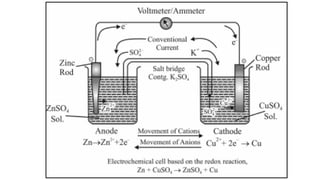
is converted to electric current. For example, Daniel Cell is a Galvanic Cell in
which Zinc and Copper are used for the redox reaction to take place.
Zn(s)+ Cu2+
(aq) → Zn2+
(aq) + Cu(s)
Oxidation Half : Zn (s) →Zn2+
(aq) + 2e–
Reduction Half : Cu2+
(aq) + 2e– → Cu(s)
Zn is the reducing agent and Cu2+ is the oxidizing agent. The half cells are also
known as Electrodes. The oxidation half is known as Anode and the reduction
half is called Cathode. Electrons flow from anode to cathode in the external
circuit. Anode is assigned negative polarity and cathode is assigned positive
polarity. In Daniel Cell, Zn acts as the anode and Cu acts as the cathode.
Electrolytic cell
These electrodes are dipped in and electrolytic solution containing cations and
anions. On supplying current the ions move towards electrodes of opposite
polarity and simultaneous reduction and oxidation takes place.
Preferential Discharge of ions
Where there are more than one cation or anion the process of discharge
becomes competitive in nature. Discharge of any ion requires energy and in
case of several ions being present the discharge of that ion will take place first
which requires the energy.
Electrode potential
It may be defined as the tendency of an element, when it is placed in contact
with its own ions to either lose or gain electrons and in turn become positively
or negatively charged.
The electrode potential will be named as oxidation or reduction potential
depending upon whether oxidation or reduction has taken place.
M(S) 𝑅𝑒𝑑𝑢𝑐𝑡𝑖𝑜𝑛 𝑂𝑥𝑖𝑑𝑎𝑡𝑖𝑜𝑛
Mn+
(aq) + ne-
Characteristics
(a) Both oxidation and reduction potentials are equal in magnitude but
opposite in sign.
(b) It is not a thermodynamic property, so values of E are not additive.
Standard electrode potential (EO)
It may be defined as the electrode potential of an electrode determined relative
to standard hydrogen electrode under standard conditions. The standard
conditions taken are
1. 1M concentration of each ion in the solution.
2. A temperature of 298 K.
3. 1 bar pressure for each gas.
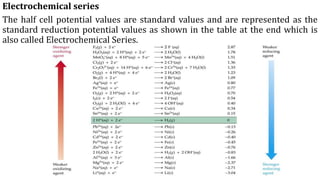
Electrochemical series
The half cell potential values are standard values and are represented as the
standard reduction potential values as shown in the table at the end which is
also called Electrochemical Series.
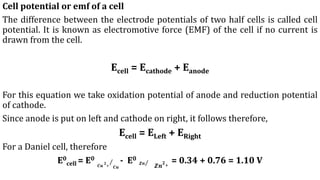
Cell potential or emf of a cell
The difference between the electrode potentials of two half cells is called cell
potential. It is known as electromotive force (EMF) of the cell if no current is
drawn from the cell.
Ecell = Ecathode + Eanode
For this equation we take oxidation potential of anode and reduction potential
of cathode.
Since anode is put on left and cathode on right, it follows therefore,
Ecell = ELeft + ERight
For a Daniel cell, therefore
E0
cell = E0
Τ
𝑪𝒖
𝟐
+ 𝑪𝒖
- E0
Τ
𝒁𝒏
𝒁𝒏
𝟐
+
= 0.34 + 0.76 = 1.10 V
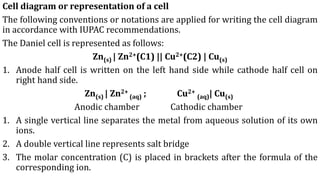
Cell diagram or representation of a cell
The following conventions or notations are applied for writing the cell diagram
in accordance with IUPAC recommendations.
The Daniel cell is represented as follows:
Zn(s) | Zn2+(C1) || Cu2+(C2) | Cu(s)
1. Anode half cell is written on the left hand side while cathode half cell on
right hand side.
Zn(s) | Zn2+
(aq) ; Cu2+
(aq)| Cu(s)
Anodic chamber Cathodic chamber
1. A single vertical line separates the metal from aqueous solution of its own
ions.
2. A double vertical line represents salt bridge
3. The molar concentration (C) is placed in brackets after the formula of the
corresponding ion.
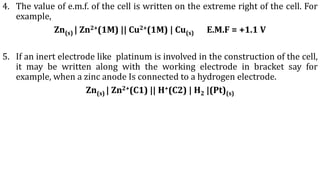
4. The value of e.m.f. of the cell is written on the extreme right of the cell. For
example,
Zn(s) | Zn2+(1M) || Cu2+(1M) | Cu(s) E.M.F = +1.1 V
5. If an inert electrode like platinum is involved in the construction of the cell,
it may be written along with the working electrode in bracket say for
example, when a zinc anode Is connected to a hydrogen electrode.
Zn(s) | Zn2+(C1) || H+(C2) | H2 |(Pt)(s)
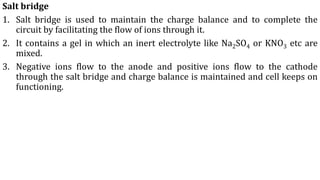
Salt bridge
1. Salt bridge is used to maintain the charge balance and to complete the
circuit by facilitating the flow of ions through it.
2. It contains a gel in which an inert electrolyte like Na2SO4 or KNO3 etc are
mixed.
3. Negative ions flow to the anode and positive ions flow to the cathode
through the salt bridge and charge balance is maintained and cell keeps on
functioning.
Spontaneity of a reaction
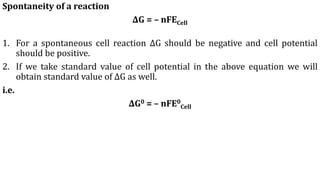
∆G = – nFECell
1. For a spontaneous cell reaction ΔG should be negative and cell potential
should be positive.
2. If we take standard value of cell potential in the above equation we will
obtain standard value of ΔG as well.
i.e.
∆G0 = – nFE0
Cell
Types of electrodes
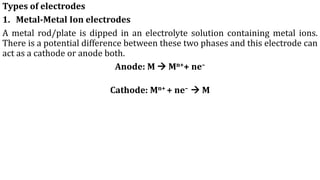
1. Metal-Metal Ion electrodes
A metal rod/plate is dipped in an electrolyte solution containing metal ions.
There is a potential difference between these two phases and this electrode can
act as a cathode or anode both.
Anode: M → Mn++ ne–
Cathode: Mn+ + ne– → M
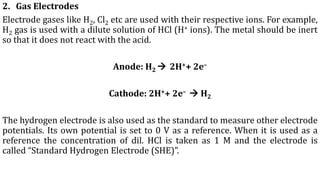
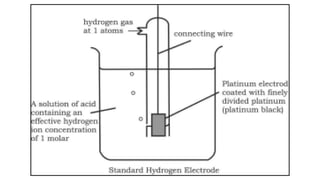
2. Gas Electrodes
Electrode gases like H2, Cl2 etc are used with their respective ions. For example,
H2 gas is used with a dilute solution of HCl (H+ ions). The metal should be inert
so that it does not react with the acid.
Anode: H2 → 2H++ 2e–
Cathode: 2H++ 2e– → H2
The hydrogen electrode is also used as the standard to measure other electrode
potentials. Its own potential is set to 0 V as a reference. When it is used as a
reference the concentration of dil. HCl is taken as 1 M and the electrode is
called “Standard Hydrogen Electrode (SHE)”.
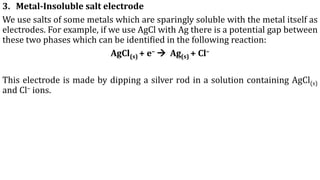
3. Metal-Insoluble salt electrode
We use salts of some metals which are sparingly soluble with the metal itself as
electrodes. For example, if we use AgCl with Ag there is a potential gap between
these two phases which can be identified in the following reaction:
AgCl(s) + e– → Ag(s) + Cl–
This electrode is made by dipping a silver rod in a solution containing AgCl(s)
and Cl– ions.
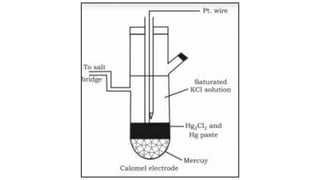
4. Calomel Electrode
Mercury is used with two other phases, one is a calomel paste (Hg2Cl2) and
electrolyte containing Cl– ions.
Cathode :
Hg2Cl2(s) + 2e– → 2Hg(l) + 2Cl–
(aq)
Anode :
2Hg(l) + 2Cl–(aq) → Hg2Cl2(s) + 2e–
This electrode is also used as another standard to measure other potentials. Its
standard form is also called Standard Calomel Electrode (SCE).
5. Redox Electrode
In these electrodes two different oxidation states of the same metal are used in
the same half cell. For example, Fe2+ and Fe3+ are dissolved in the same
container and an inert electrode of platinum is used for the electron transfer.
Following reactions can take place:
Anode: Fe2+ → Fe3+ + e–
Cathode: Fe3+ + e– → Fe2+

presentation_electrochemistry_part_i_1651145702_423484.pdf

  • 1.
  • 2.
    Electrochemistry Electrochemistry is thestudy of production of electricity from the energy released during a spontaneous chemical reaction and the use of electrical energy to bring about non-spontaneous chemical transformations. Electrochemical cells A spontaneous chemical process is the one which can take place on its own and in such a process the Gibb’s energy of the system decreases. It is this energy that gets converted to electrical energy. The reverse process is also possible in which we can make non-spontaneous processes occur by supplying external energy in the form of electrical energy. These inter conversions are carried out in equipment's called Electrochemical Cells.
  • 3.
    Types Electrochemical Cells areof two types: 1. Galvanic Cells Converts chemical energy into electrical energy 2. Electrolytic Cells Converts electrical energy into chemical energy.
  • 4.
    1. Galvanic cell Cellenergy is extracted from a spontaneous chemical process or reaction and it is converted to electric current. For example, Daniel Cell is a Galvanic Cell in which Zinc and Copper are used for the redox reaction to take place. Zn(s)+ Cu2+ (aq) → Zn2+ (aq) + Cu(s) Oxidation Half : Zn (s) →Zn2+ (aq) + 2e– Reduction Half : Cu2+ (aq) + 2e– → Cu(s) Zn is the reducing agent and Cu2+ is the oxidizing agent. The half cells are also known as Electrodes. The oxidation half is known as Anode and the reduction half is called Cathode. Electrons flow from anode to cathode in the external circuit. Anode is assigned negative polarity and cathode is assigned positive polarity. In Daniel Cell, Zn acts as the anode and Cu acts as the cathode.
  • 5.
    Electrolytic cell These electrodesare dipped in and electrolytic solution containing cations and anions. On supplying current the ions move towards electrodes of opposite polarity and simultaneous reduction and oxidation takes place. Preferential Discharge of ions Where there are more than one cation or anion the process of discharge becomes competitive in nature. Discharge of any ion requires energy and in case of several ions being present the discharge of that ion will take place first which requires the energy.
  • 6.
    Electrode potential It maybe defined as the tendency of an element, when it is placed in contact with its own ions to either lose or gain electrons and in turn become positively or negatively charged. The electrode potential will be named as oxidation or reduction potential depending upon whether oxidation or reduction has taken place. M(S) 𝑅𝑒𝑑𝑢𝑐𝑡𝑖𝑜𝑛 𝑂𝑥𝑖𝑑𝑎𝑡𝑖𝑜𝑛 Mn+ (aq) + ne- Characteristics (a) Both oxidation and reduction potentials are equal in magnitude but opposite in sign. (b) It is not a thermodynamic property, so values of E are not additive.
  • 7.
    Standard electrode potential(EO) It may be defined as the electrode potential of an electrode determined relative to standard hydrogen electrode under standard conditions. The standard conditions taken are 1. 1M concentration of each ion in the solution. 2. A temperature of 298 K. 3. 1 bar pressure for each gas.
  • 8.
    Electrochemical series The halfcell potential values are standard values and are represented as the standard reduction potential values as shown in the table at the end which is also called Electrochemical Series.
  • 9.
    Cell potential oremf of a cell The difference between the electrode potentials of two half cells is called cell potential. It is known as electromotive force (EMF) of the cell if no current is drawn from the cell. Ecell = Ecathode + Eanode For this equation we take oxidation potential of anode and reduction potential of cathode. Since anode is put on left and cathode on right, it follows therefore, Ecell = ELeft + ERight For a Daniel cell, therefore E0 cell = E0 Τ 𝑪𝒖 𝟐 + 𝑪𝒖 - E0 Τ 𝒁𝒏 𝒁𝒏 𝟐 + = 0.34 + 0.76 = 1.10 V
  • 10.
    Cell diagram orrepresentation of a cell The following conventions or notations are applied for writing the cell diagram in accordance with IUPAC recommendations. The Daniel cell is represented as follows: Zn(s) | Zn2+(C1) || Cu2+(C2) | Cu(s) 1. Anode half cell is written on the left hand side while cathode half cell on right hand side. Zn(s) | Zn2+ (aq) ; Cu2+ (aq)| Cu(s) Anodic chamber Cathodic chamber 1. A single vertical line separates the metal from aqueous solution of its own ions. 2. A double vertical line represents salt bridge 3. The molar concentration (C) is placed in brackets after the formula of the corresponding ion.
  • 11.
    4. The valueof e.m.f. of the cell is written on the extreme right of the cell. For example, Zn(s) | Zn2+(1M) || Cu2+(1M) | Cu(s) E.M.F = +1.1 V 5. If an inert electrode like platinum is involved in the construction of the cell, it may be written along with the working electrode in bracket say for example, when a zinc anode Is connected to a hydrogen electrode. Zn(s) | Zn2+(C1) || H+(C2) | H2 |(Pt)(s)
  • 12.
    Salt bridge 1. Saltbridge is used to maintain the charge balance and to complete the circuit by facilitating the flow of ions through it. 2. It contains a gel in which an inert electrolyte like Na2SO4 or KNO3 etc are mixed. 3. Negative ions flow to the anode and positive ions flow to the cathode through the salt bridge and charge balance is maintained and cell keeps on functioning.
  • 14.
    Spontaneity of areaction ∆G = – nFECell 1. For a spontaneous cell reaction ΔG should be negative and cell potential should be positive. 2. If we take standard value of cell potential in the above equation we will obtain standard value of ΔG as well. i.e. ∆G0 = – nFE0 Cell
  • 15.
    Types of electrodes 1.Metal-Metal Ion electrodes A metal rod/plate is dipped in an electrolyte solution containing metal ions. There is a potential difference between these two phases and this electrode can act as a cathode or anode both. Anode: M → Mn++ ne– Cathode: Mn+ + ne– → M
  • 16.
    2. Gas Electrodes Electrodegases like H2, Cl2 etc are used with their respective ions. For example, H2 gas is used with a dilute solution of HCl (H+ ions). The metal should be inert so that it does not react with the acid. Anode: H2 → 2H++ 2e– Cathode: 2H++ 2e– → H2 The hydrogen electrode is also used as the standard to measure other electrode potentials. Its own potential is set to 0 V as a reference. When it is used as a reference the concentration of dil. HCl is taken as 1 M and the electrode is called “Standard Hydrogen Electrode (SHE)”.
  • 18.
    3. Metal-Insoluble saltelectrode We use salts of some metals which are sparingly soluble with the metal itself as electrodes. For example, if we use AgCl with Ag there is a potential gap between these two phases which can be identified in the following reaction: AgCl(s) + e– → Ag(s) + Cl– This electrode is made by dipping a silver rod in a solution containing AgCl(s) and Cl– ions.
  • 19.
    4. Calomel Electrode Mercuryis used with two other phases, one is a calomel paste (Hg2Cl2) and electrolyte containing Cl– ions. Cathode : Hg2Cl2(s) + 2e– → 2Hg(l) + 2Cl– (aq) Anode : 2Hg(l) + 2Cl–(aq) → Hg2Cl2(s) + 2e– This electrode is also used as another standard to measure other potentials. Its standard form is also called Standard Calomel Electrode (SCE).
  • 21.
    5. Redox Electrode Inthese electrodes two different oxidation states of the same metal are used in the same half cell. For example, Fe2+ and Fe3+ are dissolved in the same container and an inert electrode of platinum is used for the electron transfer. Following reactions can take place: Anode: Fe2+ → Fe3+ + e– Cathode: Fe3+ + e– → Fe2+