Electrochemistry
Contents
• Introduction
• Oxidation numbers
• Galvanic cells
• Standard reduction potentials
• Cell potential, electrical work, and free energy
• Dependence of cell potential on concentration
• Batteries
• Corrosion
• Electrolysis
Oxidation-Reduction Reactions
2Mg (s) + O2 (g) 2MgO (s)
2Mg 2Mg2+
+ 4e- Oxidation half-reaction (lose e-
)
O2 + 4e-
2O2- Reduction half-reaction (gain e-
)
2Mg + O2 + 4e-
2Mg2+
+ 2O2-
+ 4e-
2Mg + O2 2MgO
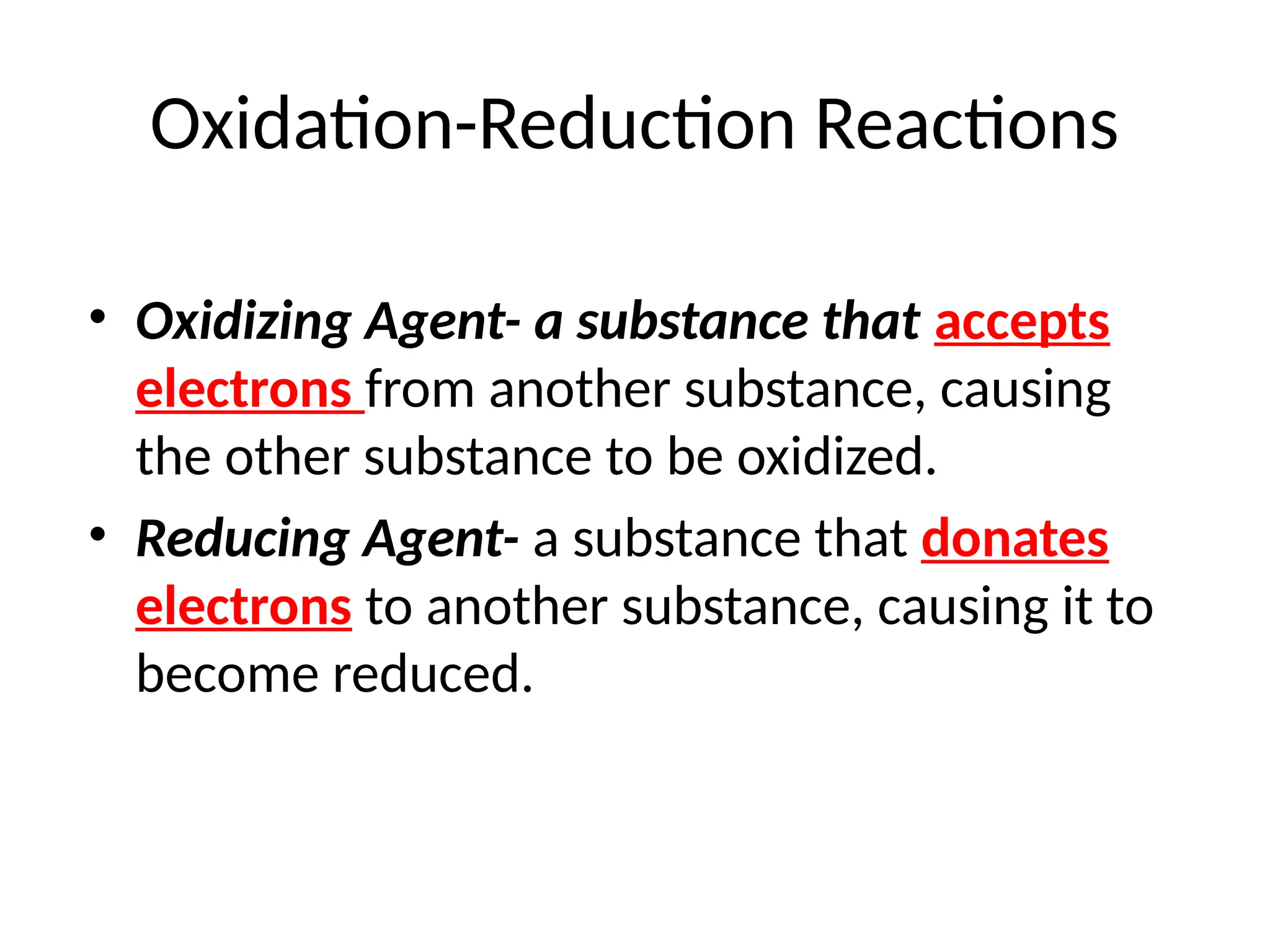
Oxidation-Reduction Reactions
• Oxidizing Agent- a substance that accepts
electrons from another substance, causing
the other substance to be oxidized.
• Reducing Agent- a substance that donates
electrons to another substance, causing it to
become reduced.
Oxidation-Reduction Reactions
Zn (s) + CuSO4 (aq) ZnSO4 (aq) + Cu (s)
Zn Zn2+
+ 2e-
Zn is oxidized
Zn is the reducing agent
Cu2+
+ 2e-
Cu Cu2+
is reduced
Cu2+
is the oxidizing agent
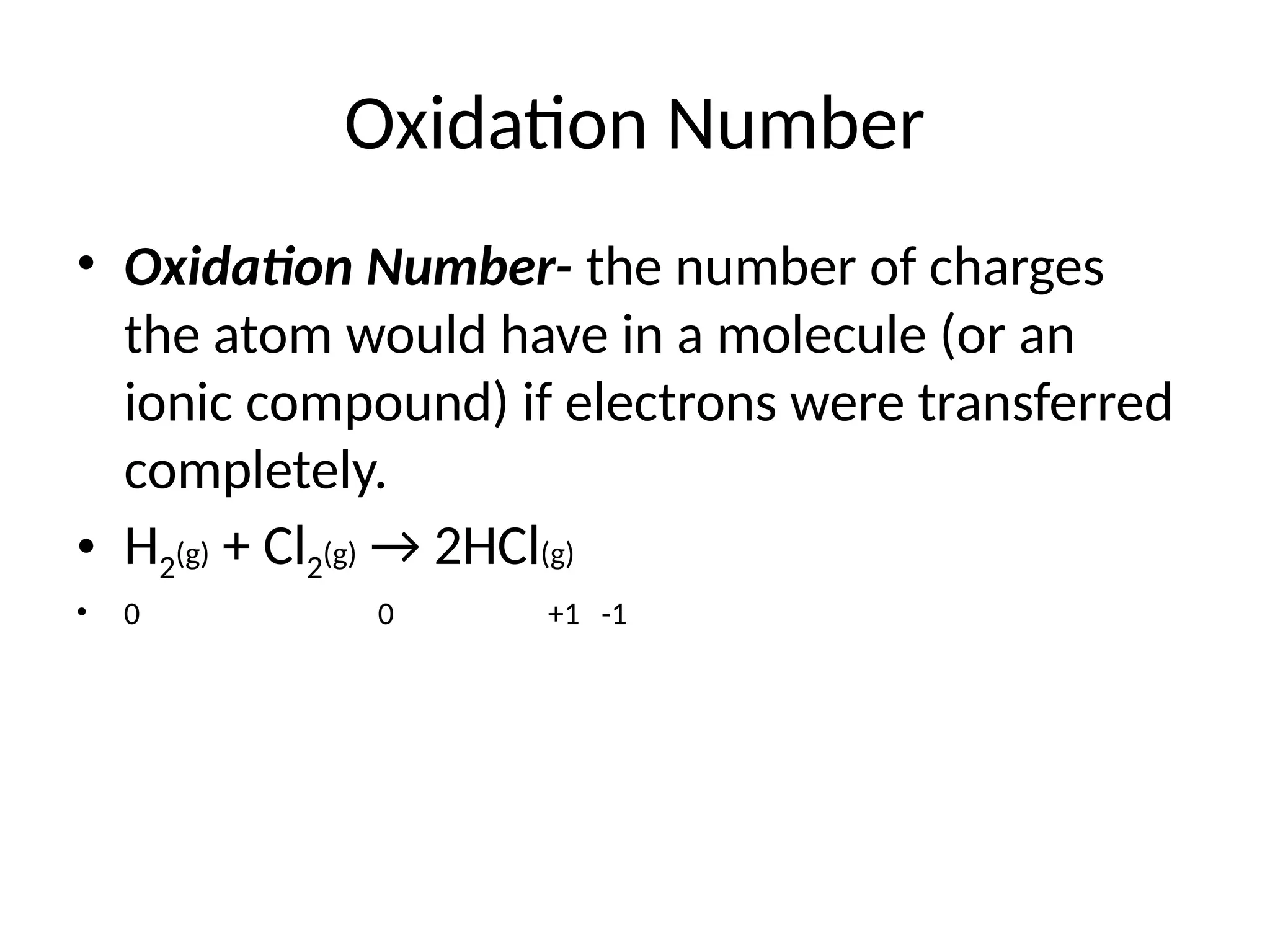
Oxidation Number
• Oxidation Number- the number of charges
the atom would have in a molecule (or an
ionic compound) if electrons were transferred
completely.
• H2(g) + Cl2(g) → 2HCl(g)
• 0 0 +1 -1
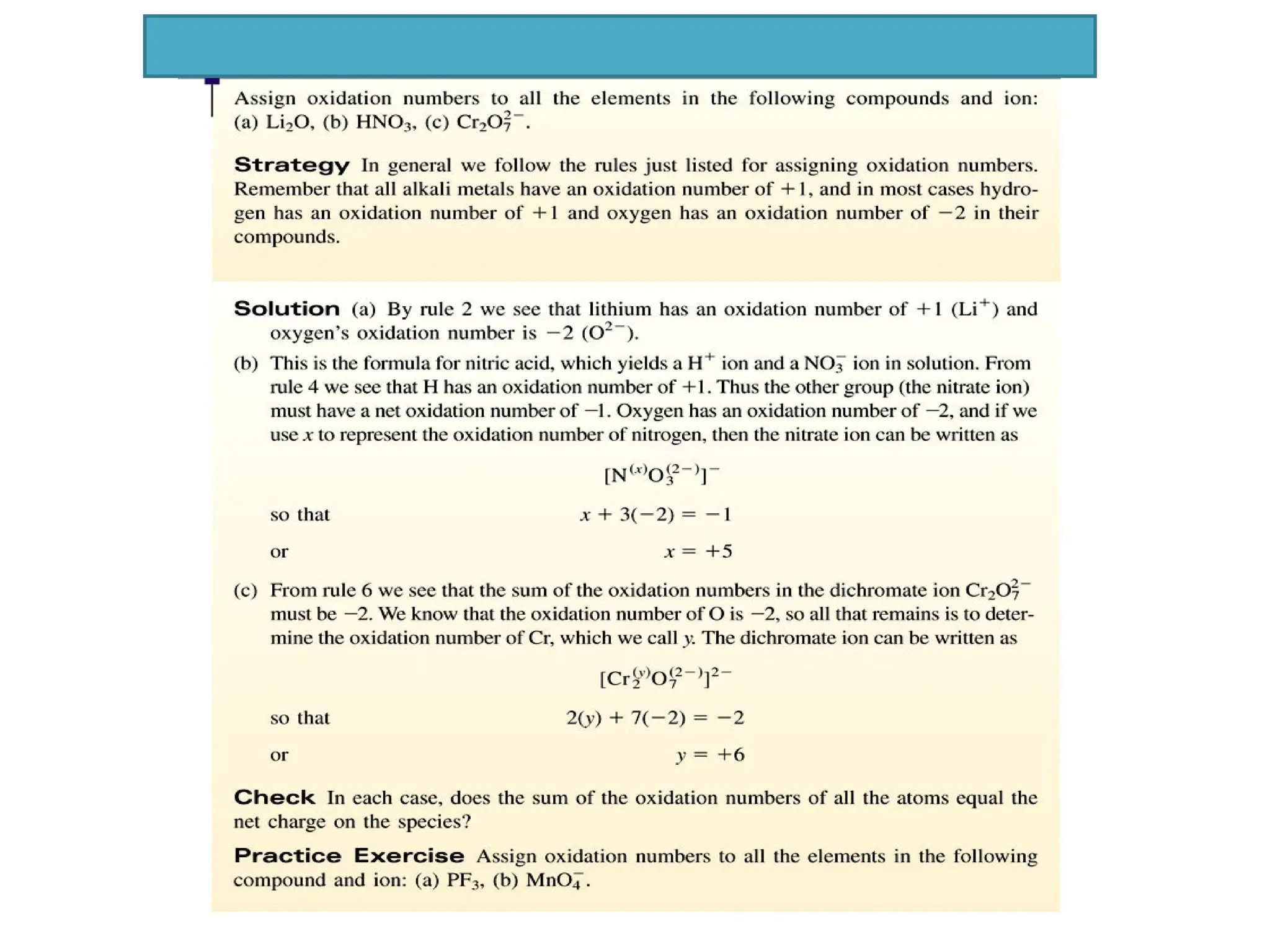
Assigning Oxidation Numbers
1. Free elements (uncombined state) have an
oxidation number of zero.
Na, Be, K, Pb, H2, O2, P4 = 0
2. In monatomic ions, the oxidation number is equal
to the charge on the ion.
Li+
, Li = +1; Fe3+
, Fe = +3; O2-
, O = -2
3. The oxidation number of oxygen is usually –2. In
H2O2 and O2
2-
it is –1.
Assigning Oxidation Numbers
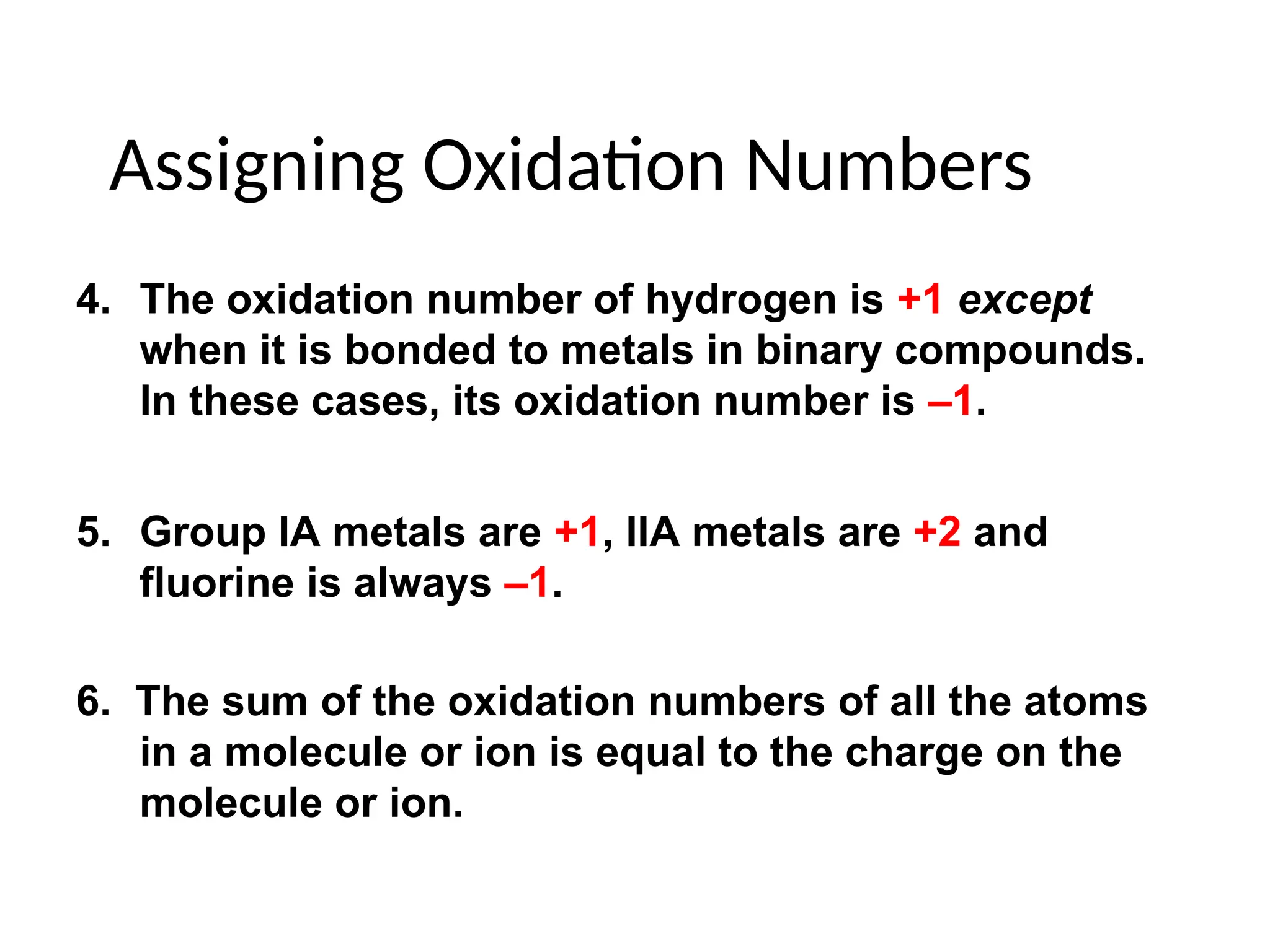
4. The oxidation number of hydrogen is +1 except
when it is bonded to metals in binary compounds.
In these cases, its oxidation number is –1.
5. Group IA metals are +1, IIA metals are +2 and
fluorine is always –1.
6. The sum of the oxidation numbers of all the atoms
in a molecule or ion is equal to the charge on the
molecule or ion.
Assigning Oxidation Numbers
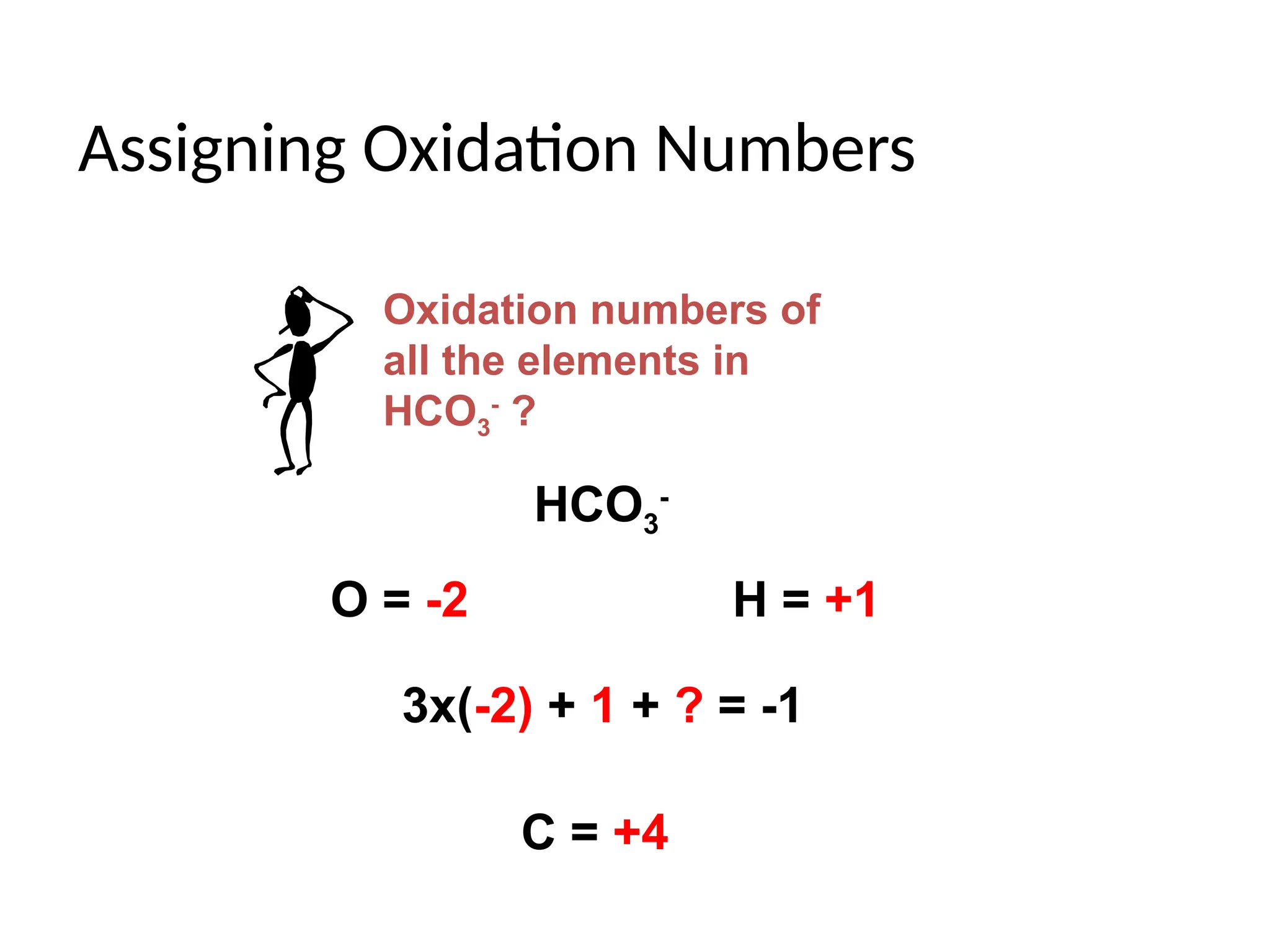
Oxidation numbers of
all the elements in
HCO3
-
?
HCO3
-
O = -2 H = +1
3x(-2) + 1 + ? = -1
C = +4
Assigning Oxidation Numbers
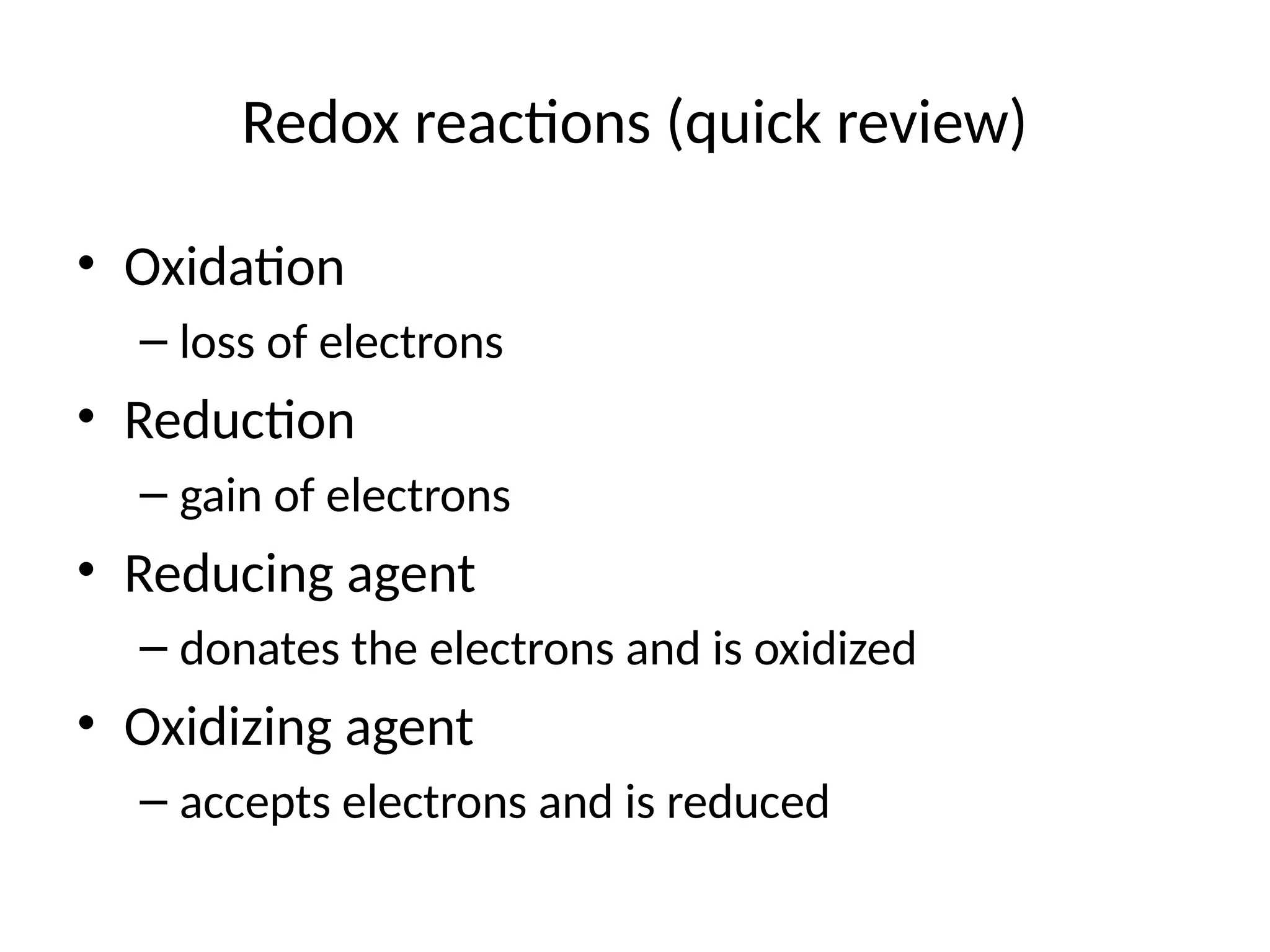
Redox reactions (quick review)
• Oxidation
– loss of electrons
• Reduction
– gain of electrons
• Reducing agent
– donates the electrons and is oxidized
• Oxidizing agent
– accepts electrons and is reduced
Redox Reactions
• Direct redox reaction
– Oxidizing and reducing agents are mixed together
CuSO4(a
q) (Cu2+
)
Zn rod
Direct Redox Reaction
CuSO4(a
q) (Cu2+
)
Zn rod
Deposit of
Cu metal
forms
Direct Redox Reaction
Redox Reactions
• Direct redox reaction
– Oxidizing and reducing agents are mixed together
• Indirect redox reaction
– Oxidizing and reducing agents are separated but
connected electrically
• Example
– Zn and Cu2+
can be reacted indirectly
– Basis for electrochemistry
– Electrochemical cell
Electrochemical Cells
• Voltaic Cell
– cell in which a spontaneous redox reaction
generates electricity
– chemical energy  electrical energy
Electrochemical Cells
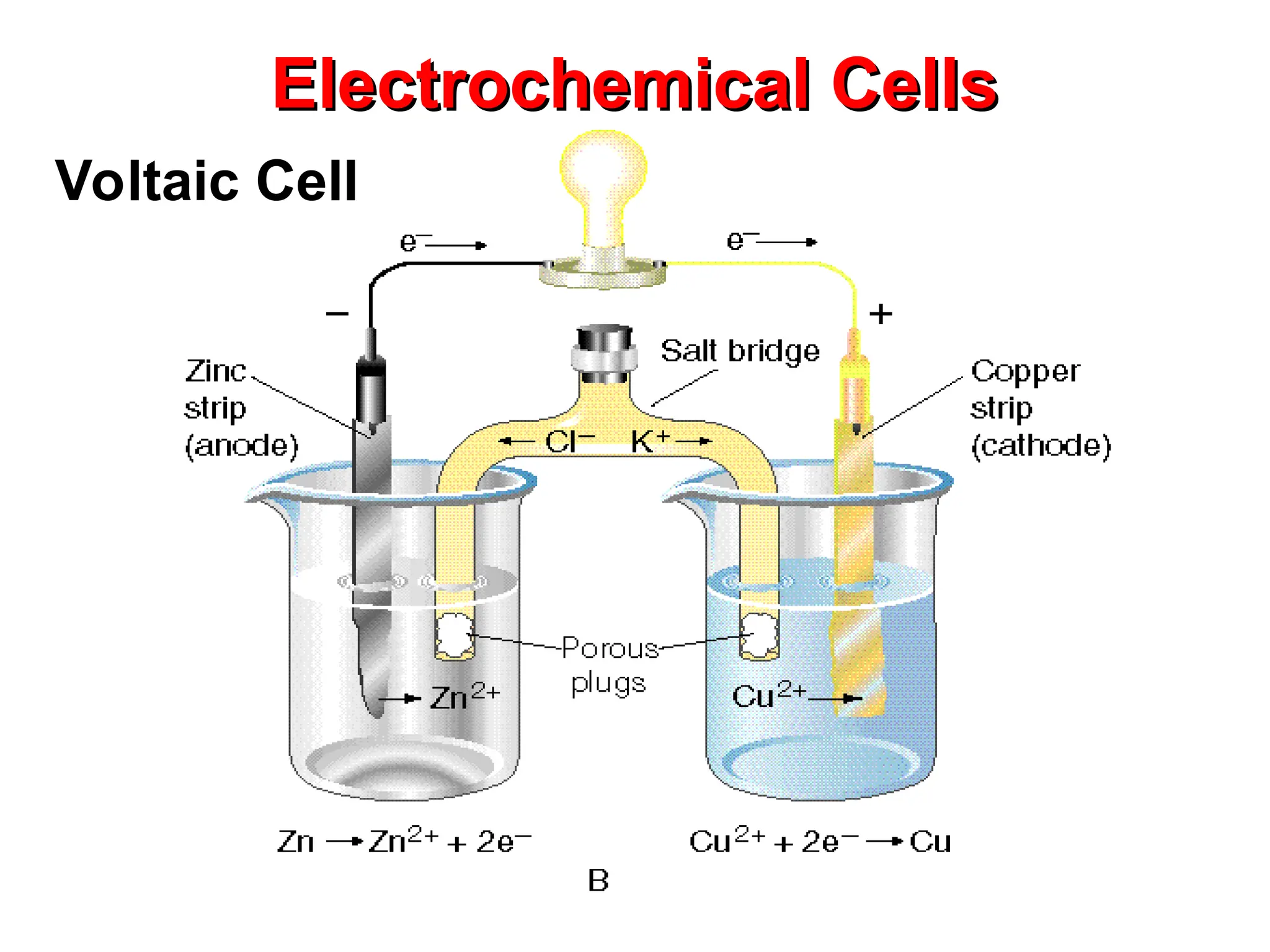
Generally, salts like KCl, KNO3, etc. are used. The seturated
solutions of these electrolytes are prepared in agar agar jelly
or gelatin. The jelly keeps the electrolyte in semi-solid
phase and thus prevents mixing.
The important functions of the salt bridge are:
a) Salt bridge completes the electrical circuit.
b) Salt bridge maintains electrical neutrality of two half cell
solution.
The accumulation of charges in the two half cells (accumulation
of extra positive charge in the solution around the anode
according to the realizing of Zn2+
in excess and
accumulation of extra negative charge in the solution
around the catode due to excess of SO4
2-
) is prevented by
using salt bridge, which provides a passage for the flow of
the charge in the internal circuit.
Voltaic Cell
Electrochemical Cells
• Electrolytic Cell
– electrochemical cell in which an electric current
drives a nonspontaneous redox reaction
– electrical energy  chemical energy
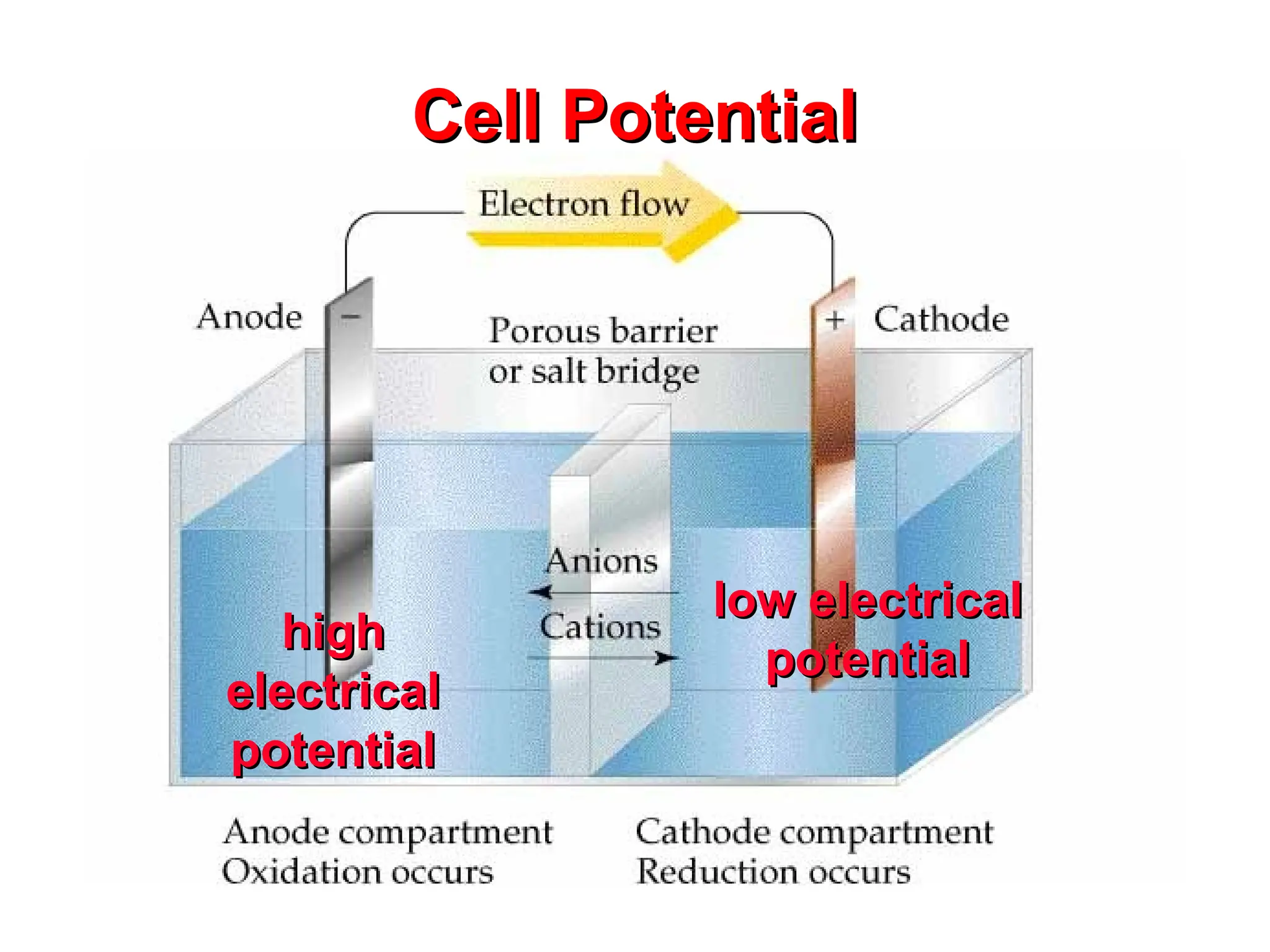
high
high
electrical
electrical
potential
potential
low electrical
low electrical
potential
potential
Cell Potential
Cell Potential
Cell Potential
Ecell = Ecathode - Eanode = Eredn - Eox
E°cell = E°cathode - E°anode = E°redn - E°ox
(
Ecathode and Eanode are reduction potentials by definition
).
Cell Potential
• E°cell = E°cathode - E°anode = E°redn - E°ox
– Ecell can be measured
• Absolute Ecathode and Eanode values cannot
• Reference electrode
– has arbitrarily assigned E
– used to measure relative Ecathode and Eanode for half-
cell reactions
• Standard hydrogen electrode (S.H.E.)
– conventional reference electrode
Oxidation reduction reactions
• Oxidation reduction reactions
involve a transfer of electrons.
• Oxidation Involves Loss of electrons
– Increase in the oxidation number
• Reduction Involves Gain electrons
– Decrease in the oxidation number
Galvanic Cells
• Thus a Galvanic cell is a device in which a
chemical energy is changed to electrical
energy
• The electrochemical reactions occur at the
interface between electrode and solution
where the electron transfer occurs
• Anode: the electrode compartment at
which oxidation occurs
• Cathode: the electrode compartment at
which reduction occurs
Cell Potential
• Oxidizing agent pulls
pulls the electrons
• Reducing agent pushes the electrons
• The total push or pull (“driving force”) is
called the cell potential, Ecell
• Also called the electromotive force (emf)
• Unit is the volt(V)
= 1 joule of work/coulomb of charge
• Measured with a voltmeter
Measuring the cell potential
• Can we measure the total cell potential??
• A galvanic cell is made where one of the two
electrodes is a reference electrode whose
potential is known.
• Standard hydrogen electrode (H+
= 1M
and the H2 (g) is at 1 atm) is used as a
reference electrode and its potential was assigned
to be zero at 25 0
C.
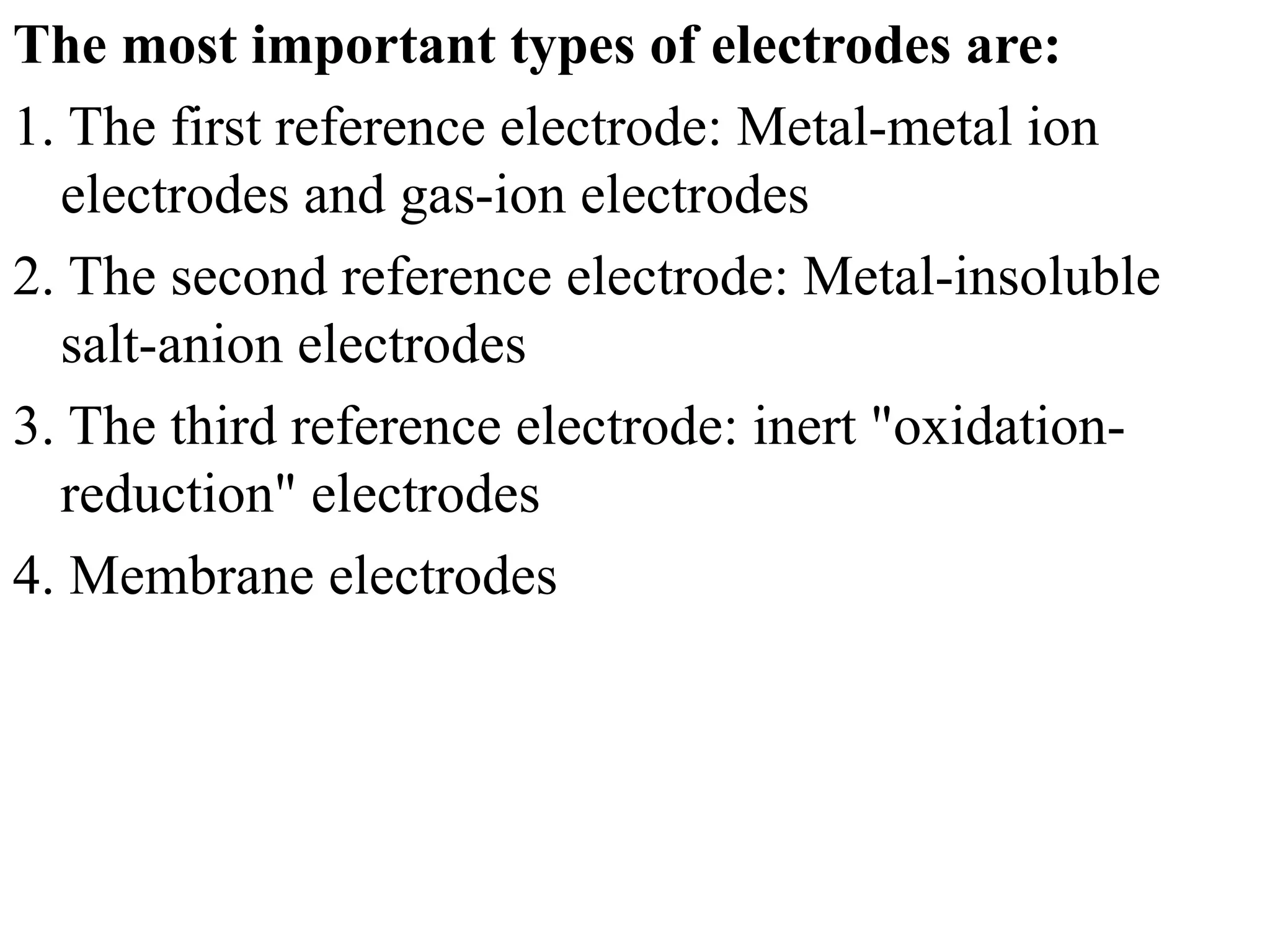
The most important types of electrodes are:
1. The first reference electrode: Metal-metal ion
electrodes and gas-ion electrodes
2. The second reference electrode: Metal-insoluble
salt-anion electrodes
3. The third reference electrode: inert "oxidation-
reduction" electrodes
4. Membrane electrodes
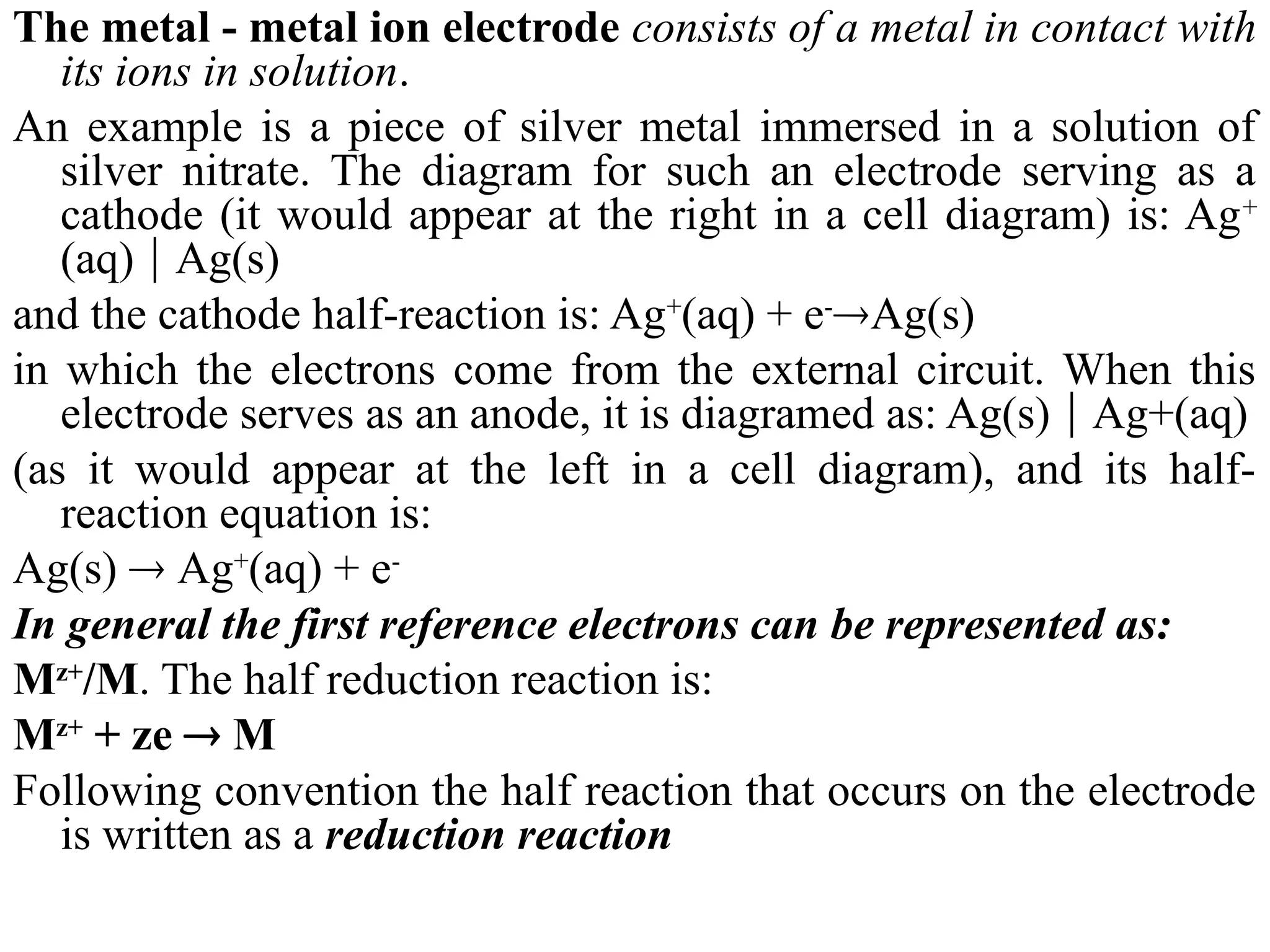
The metal - metal ion electrode consists of а metal in contact with
its ions in solution.
An example is а piece of silver metal immersed in а solution of
silver nitrate. The diagram for such an electrode serving as а
cathode (it would appear at the right in а cell diagram) is: Ag+
(aq)  Ag(s)
and the cathode half-reaction is: Ag+
(aq) + e-
Ag(s)
in which the electrons соmе from the external circuit. When this
electrode serves as an anode, it is diagramed as: Ag(s)  Ag+(aq)
(as it would appear at the left in а cell diagram), and its half-
reaction equation is:
Ag(s)  Ag+
(aq) + е-
In general the first reference electrons can be represented as:
Mz+
/M. The half reduction reaction is:
Mz+
+ ze  M
Following convention the half reaction that occurs on the electrode
is written as a reduction reaction
2. In the metal-insoluble salt-anion electrode, а metal is in
contact with one of its insoluble salts and also with а
solution containing the anion of the salt.
An example is the so-called silver - silver chloride electrode,
written as а cathode as:
Cl-
(aq)  AgCl(s)  Ag(s)
for which the cathode half-reaction is:
AgCl (s) + е-
 Ag(s) + Cl- (aq)
EAg,AgCl | Cl- = E0
Ag+/AgCl - 0.059 lg aCl-
E0
Ag+/AgCl = 0,2224
A
0
a
log
n
0.059
E 

 z
E
Silver - silver chloride electrode
Ag, is covered by the layer of nonsoluble AgCl
КCl solution
KCl, AgCl | Ag
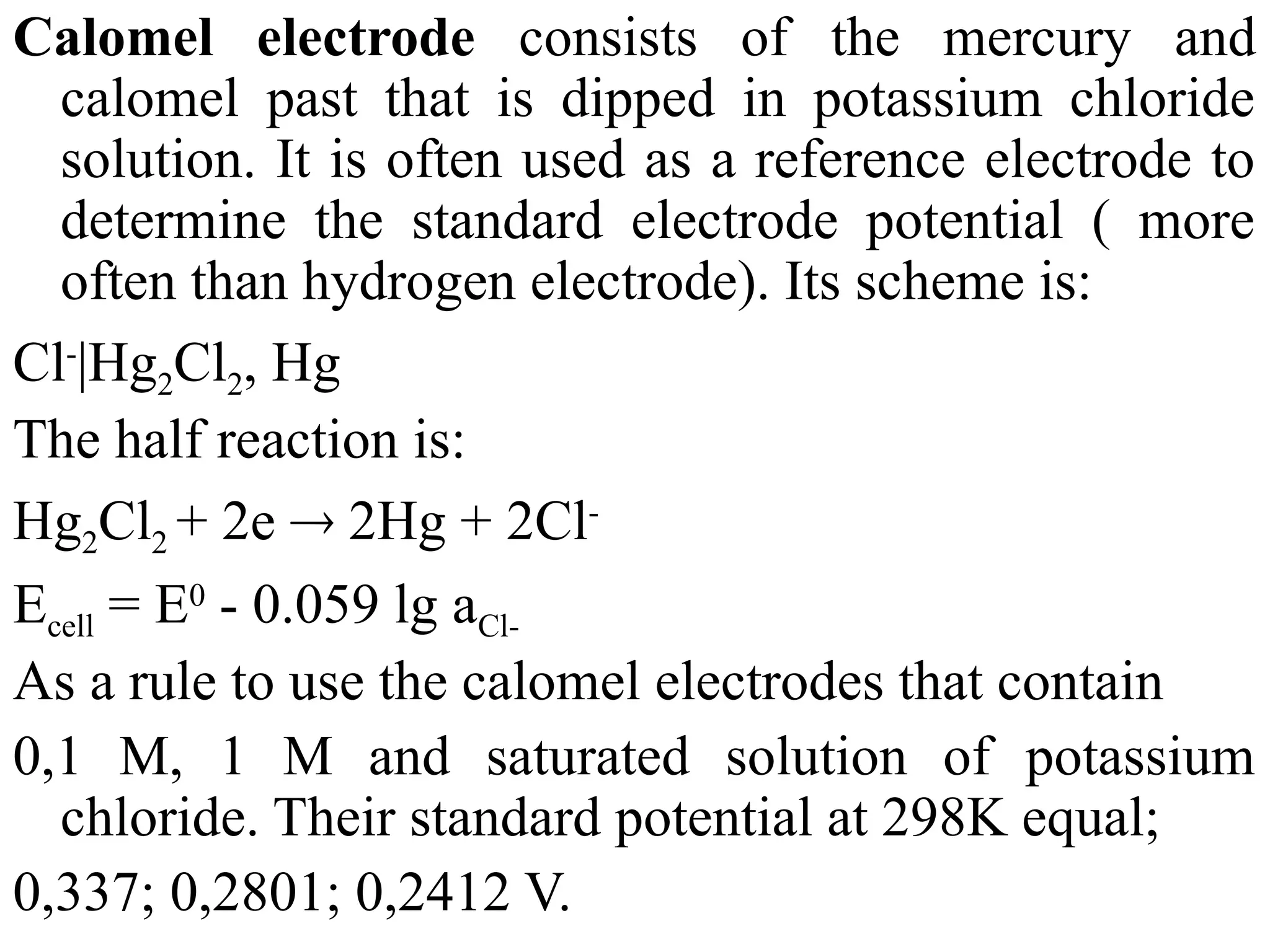
Calomel electrode consists of the mercury and
calomel past that is dipped in potassium chloride
solution. It is often used as a reference electrode to
determine the standard electrode potential ( more
often than hydrogen electrode). Its scheme is:
Cl-
|Hg2Cl2, Hg
The half reaction is:
Hg2Cl2 + 2e  2Hg + 2Cl-
Ecell = E0
- 0.059 lg aCl-
As a rule to use the calomel electrodes that contain
0,1 M, 1 M and saturated solution of potassium
chloride. Their standard potential at 298K equal;
0,337; 0,2801; 0,2412 V.
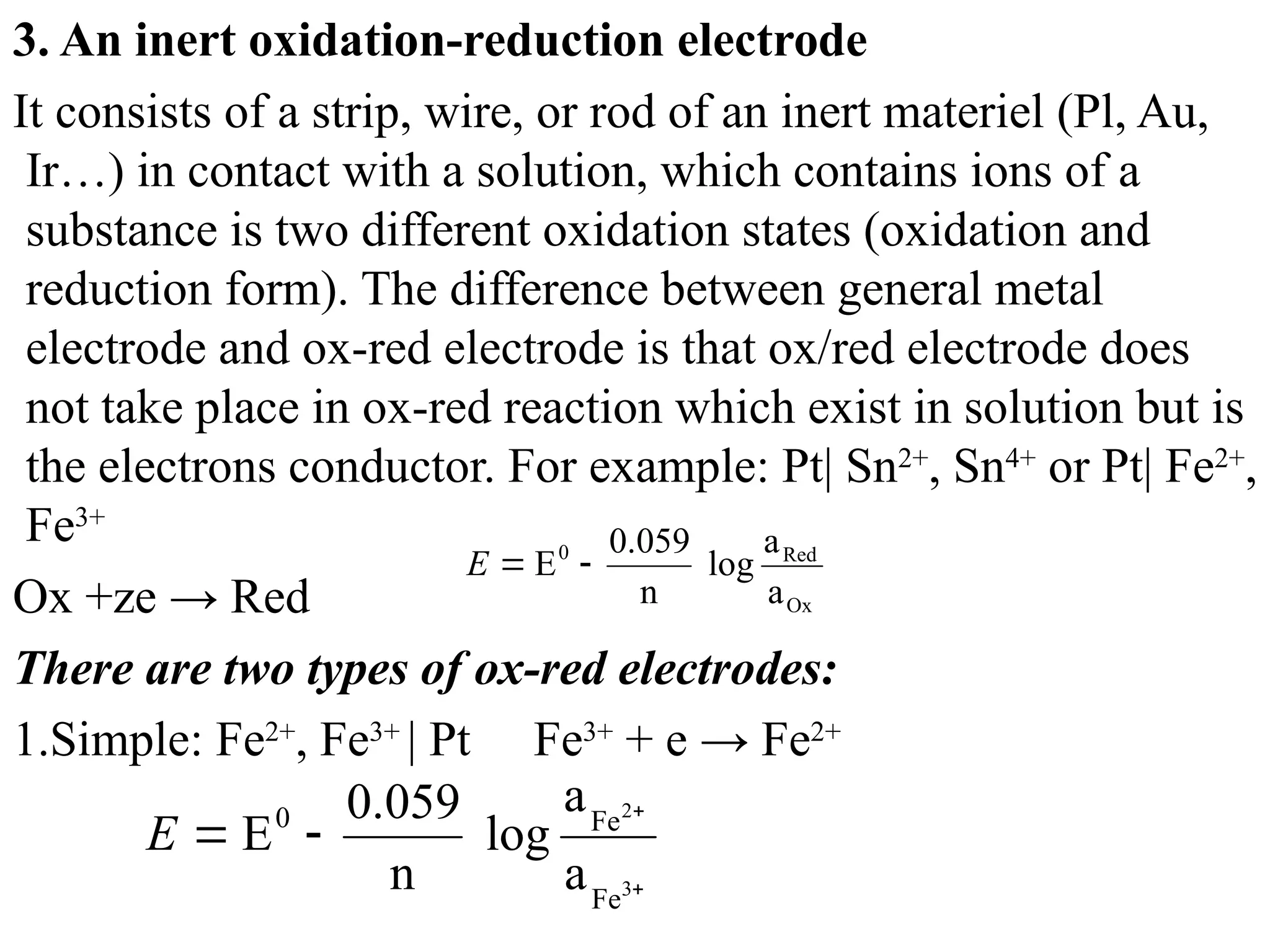
3. An inert oxidation-reduction electrode
It consists of а strip, wire, or rod of an inert materiel (Pl, Au,
Ir…) in contact with а solution, which contains ions of а
substance is two different oxidation states (oxidation and
reduction form). The difference between general metal
electrode and ox-red electrode is that ox/red electrode does
not take place in ox-red reaction which exist in solution but is
the electrons conductor. For example: Pt| Sn2+
, Sn4+
or Pt| Fe2+
,
Fe3+
Ox +ze → Red
There are two types of ox-red electrodes:
1.Simple: Fe2+
, Fe3+
| Pt Fe3+
+ e → Fe2+
Ox
Red
0
a
a
log
n
0.059
E 

E




3
2
Fe
Fe
0
a
a
log
n
0.059
E
E
Scheme of ox-red electrode
(
(the third reference electrode)
the third reference electrode)
Pt
FeCl3 + FeCl2
Fe3+
, Fe2+
| Pt
Fe3+
+ e = Fe2+





 

2
3
2
3
2
3 lg
059
.
0
0
/
/
Fe
Fe
Fe
Fe
Fe
Fe
a
a
E
E
2. Complex ox-red electrode there is changing the charge and
the composition of the ions
Mn2+
, MnO4
-
, H+
| Pt MnO4
-
+ 8H+
+5e→Mn2+
+4H2O
Example is quinonhydrone electrode.
It is prepared by the platinum strip or wire which is contained
in the glass tube. The electrode is dipped in the solution
with unknown pH that is needed to determine and to add
some quinonhydrone’s crystalls in this solution.
Quinonhydrone is a crystalline product which consists of
quinone (benzoquinone) С6Н4О2 and hydroquinone
C6H4(OH)2. It is less solubility in water and decomposes
into quinone and hydroquinone in the solution. In the
saturated solution equal molar mixture of quinone and
hydroquinone is formed.
Quinonhydrone electrode
(
(the third reference electrode
the third reference electrode)
)


 H
cell a
E
E lg
059
.
0
0
С6Н4О2, С6Н4(ОН)2, H+
| Pt
С6Н4О2 + 2Н+
+ 2е = С6Н4(ОН)2




Н
O
H
C
OH
H
C
cell
а
а
a
E
E 2
)
(
0
2
4
6
2
4
6
lg
2
059
.
0
Including that the activity of
quinone and hydroquinone is
equal in the seturated solution,
we have
we have
Quinonhydrone
The scheme of quinonhydrone cell with one
electrolyte
electrolyte
Pt, Н2 | quinhydr, H+
| KCl | KCl,Hg2Cl2| Hg
Ecell = E quinhydr - Ecalomel
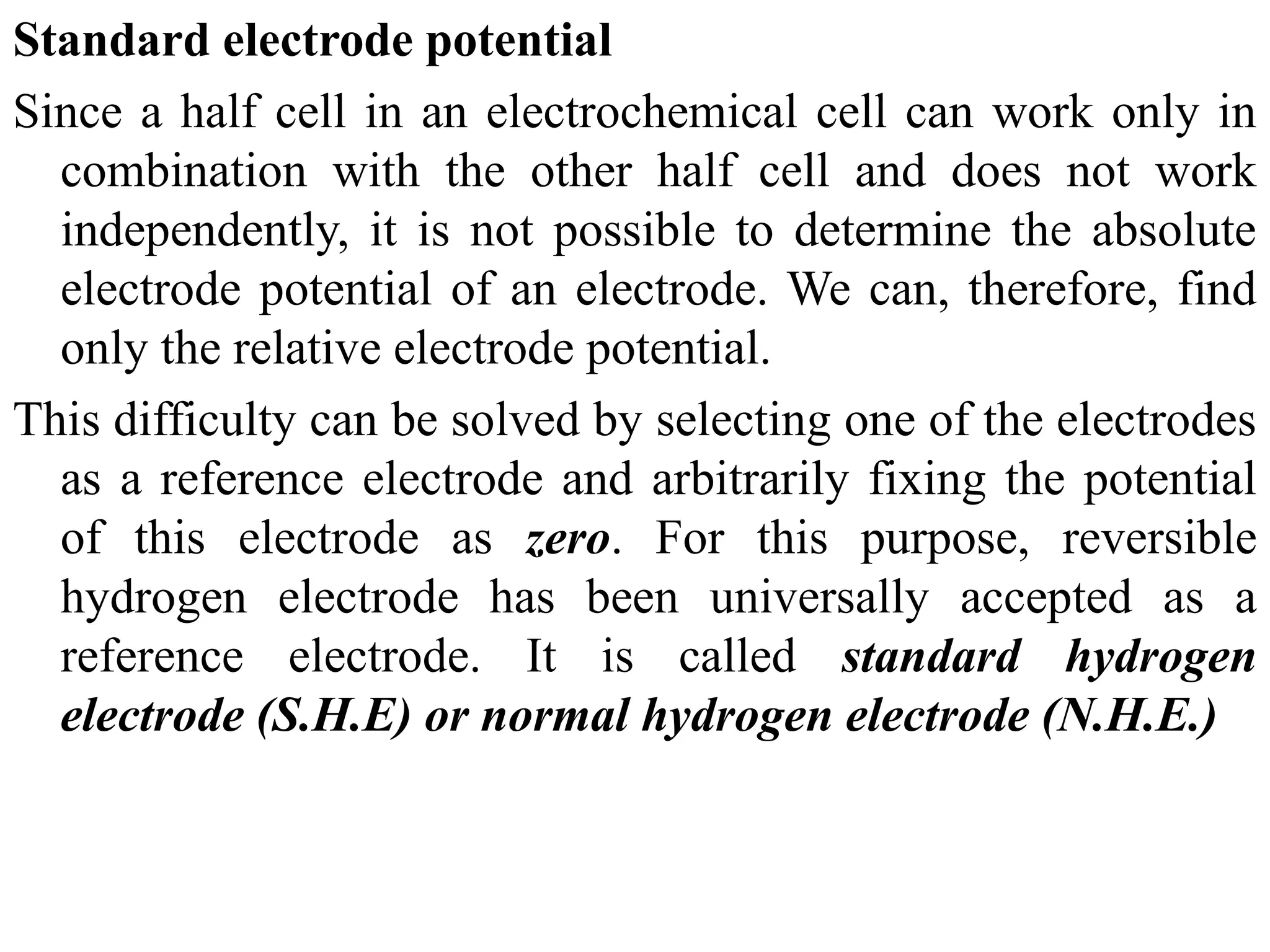
Standard electrode potential
Since a half cell in an electrochemical cell can work only in
combination with the other half cell and does not work
independently, it is not possible to determine the absolute
electrode potential of an electrode. We can, therefore, find
only the relative electrode potential.
This difficulty can be solved by selecting one of the electrodes
as a reference electrode and arbitrarily fixing the potential
of this electrode as zero. For this purpose, reversible
hydrogen electrode has been universally accepted as a
reference electrode. It is called standard hydrogen
electrode (S.H.E) or normal hydrogen electrode (N.H.E.)
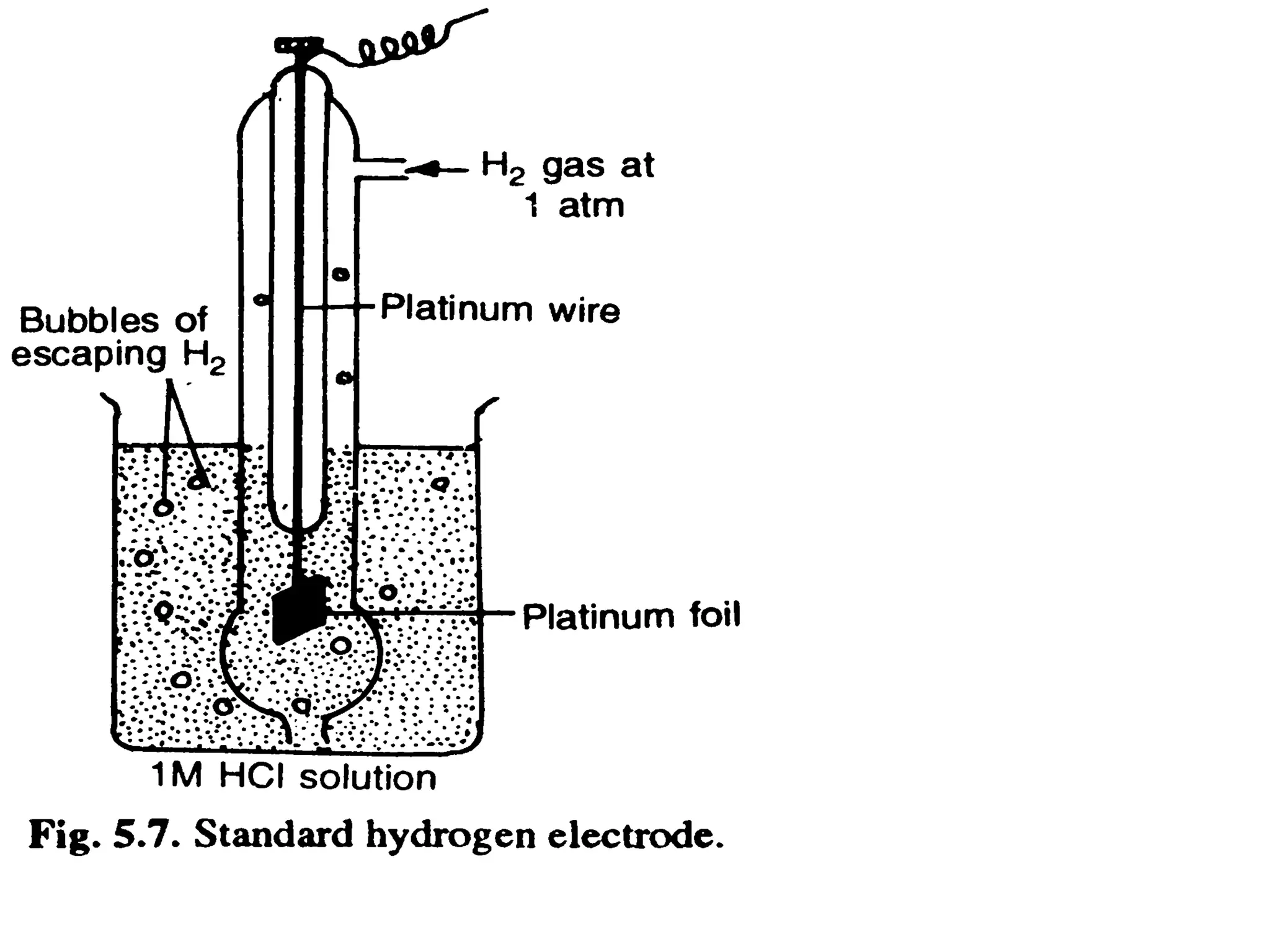
Standard hydrogen electrode. It consists of platinum
wire sealed in a glass tube and has a platinum foil
attached to it. The foil is coated with finely divided
platinum and acts as platinum electrode. It is dipped
into an acid solution containing H+
ions in 1 M
concentration (1M HCl). Pure hydrogen gas at 1
atmospheric pressure is constantly bubbled into
solution at constant temperature of 298K. The
surface of the foil acts as a site for the reaction.
The electrode potential of an electrode can be
determined by connecting this half cell with a
standard hydrogen electrode. The electrode
potential of the standard hydrogen electrode is taken
as zero.
The electrode potential of a metal electrode as
determined with respect to a standard or normal
hydrogen electrode is called standard electrode
potential (E0
). Standard electrode potentials are
always associated with the reduction occurring at
the electrodes.
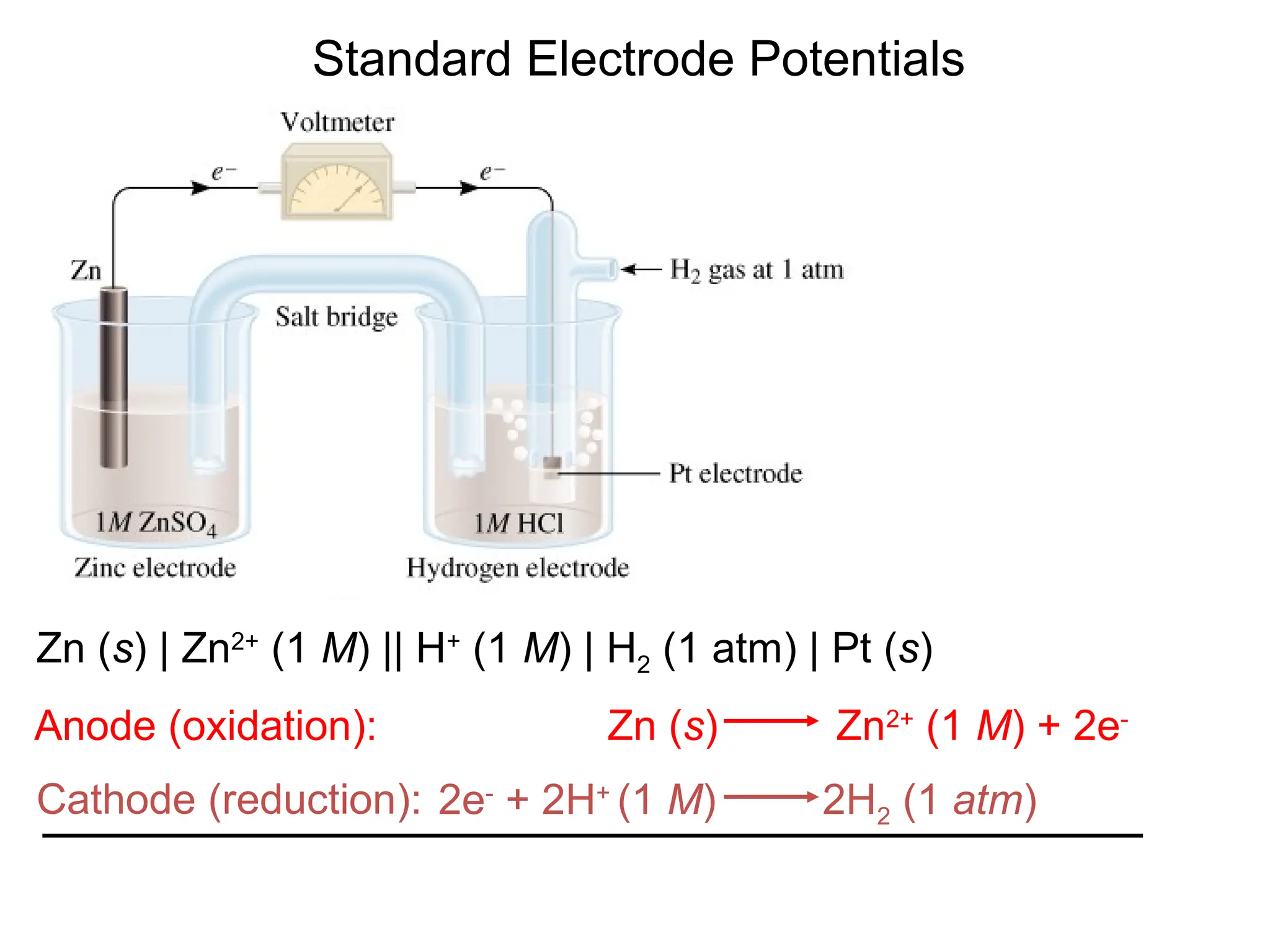
Standard Electrode Potentials
Zn (s) | Zn2+
(1 M) || H+
(1 M) | H2 (1 atm) | Pt (s)
2e-
+ 2H+
(1 M) 2H2 (1 atm)
Zn (s) Zn2+
(1 M) + 2e-
Anode (oxidation):
Cathode (reduction):
Standard Reduction Potentials, E
• The E values corresponding to reduction half-
reactions with all solutes at 1M and all gases at 1
atm.
• Ecan be measured by making a galvanic cell in
which one of the two electrodes is the Standard
Hydrogen electrode, SHE, whose E0 V
• The total potential of this cell can be measured
experimentally
• However, the individual electrode potential can
not be measured experimentally.
Why?
• If the cathode compartment of the cell is SHE, then the
half reaction would be
2H+
+ 2e
 H2 (g); Eo
= 0V
• And the anode compartment is Zn metal in Zn2+
, (1 M)
then the half reaction would be
Zn Zn2+
+ 2e
• The total cell potential measured experimentally was
found to be + 0.76 V
• Thus, +0.76 V was obtained as a result of this
calculation:
Eº cell = EºZn Zn
2+
+ Eº H
+
H2
0.76 V 0.76 V 0 V
Standard Reduction Potentials
• The E values corresponding to reduction half-
reactions with all solutes at 1M and all gases at
1 atm. can be determined by making them half
cells where the other half is the SHE.
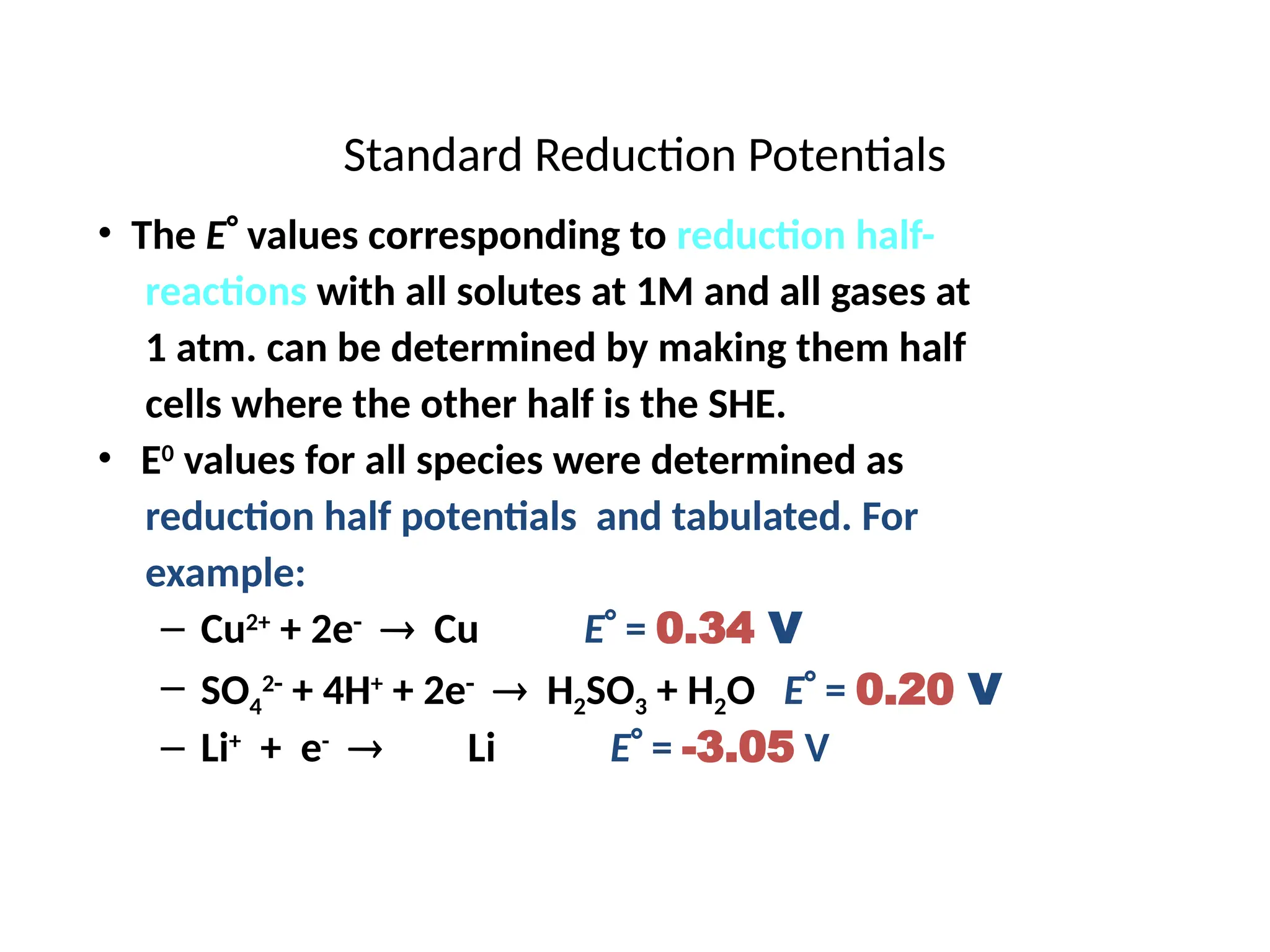
• E0
values for all species were determined as
reduction half potentials and tabulated. For
example:
– Cu2+
+ 2e
 Cu E = 0.34 V
– SO4
2
+ 4H+
+ 2e
 H2SO3 + H2O E = 0.20 V
– Li+
+ e-
Li E = -3.05 V
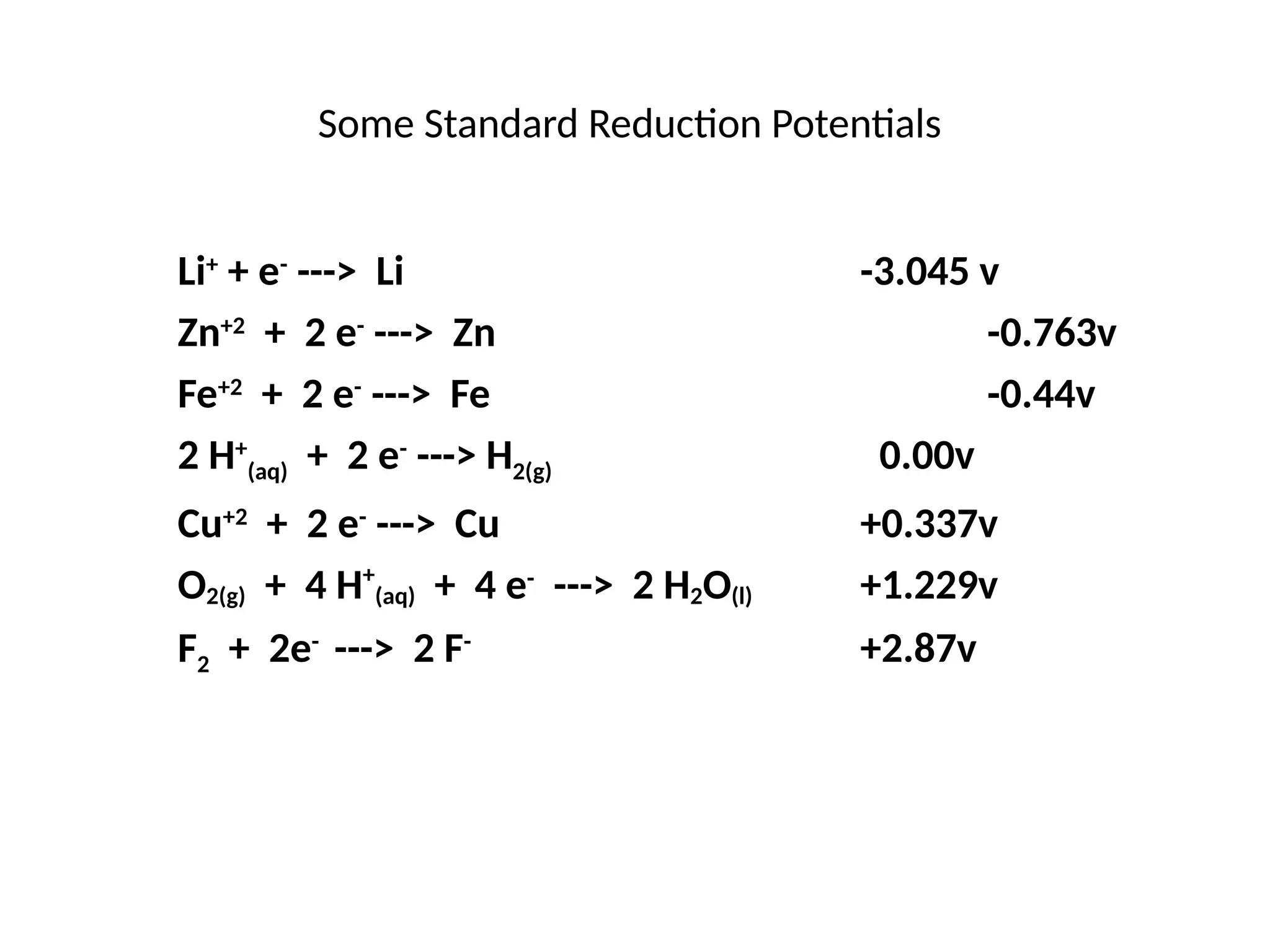
Some Standard Reduction Potentials
Li+
+ e-
---> Li -3.045 v
Zn+2
+ 2 e-
---> Zn -0.763v
Fe+2
+ 2 e-
---> Fe -0.44v
2 H+
(aq) + 2 e-
---> H2(g) 0.00v
Cu+2
+ 2 e-
---> Cu +0.337v
O2(g) + 4 H+
(aq) + 4 e-
---> 2 H2O(l) +1.229v
F2 + 2e-
---> 2 F-
+2.87v
Standard Reduction Potentials at 25°C
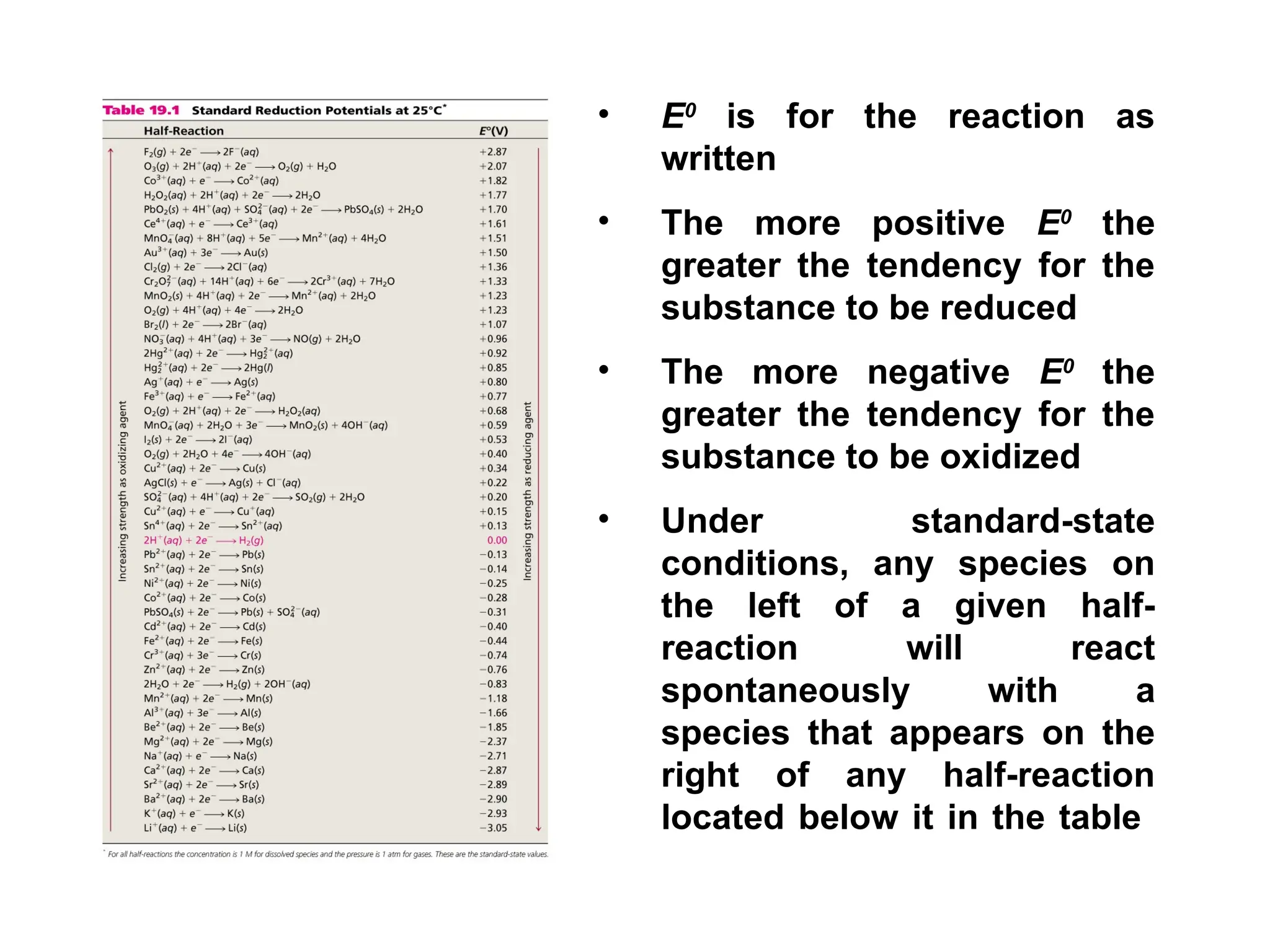
• E0
is for the reaction as
written
• The more positive E0
the
greater the tendency for the
substance to be reduced
• The more negative E0
the
greater the tendency for the
substance to be oxidized
• Under standard-state
conditions, any species on
the left of a given half-
reaction will react
spontaneously with a
species that appears on the
right of any half-reaction
located below it in the table
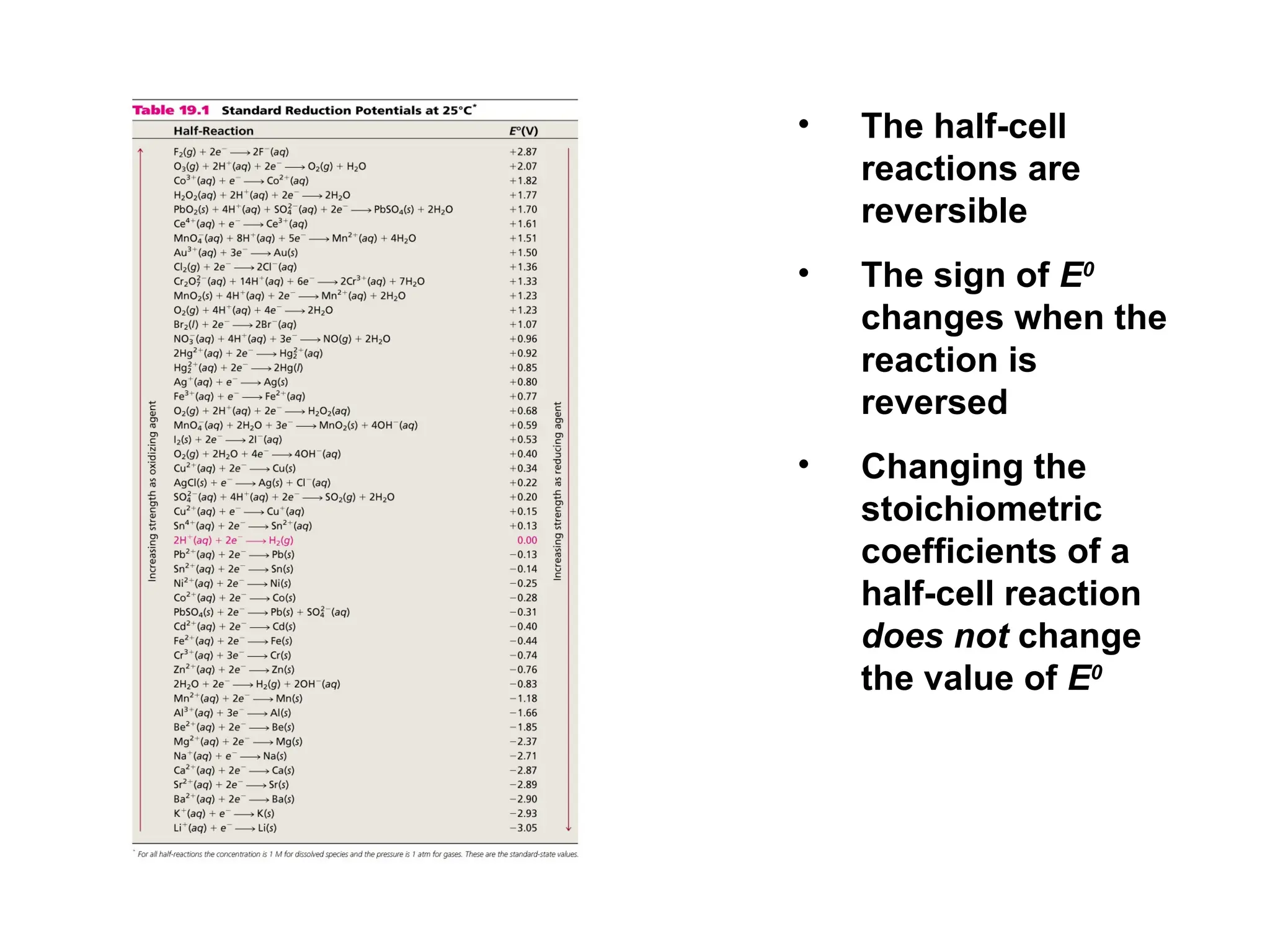
• The half-cell
reactions are
reversible
• The sign of E0
changes when the
reaction is
reversed
• Changing the
stoichiometric
coefficients of a
half-cell reaction
does not change
the value of E0
Can Sn reduce Zn2+
under standard-state conditions?
•How do we find the answer?
•Look up the Eº values in in the table of reduction
potentials
•Which reactions in the table will reduce Zn2+
(aq)?
Zn+2
+ 2 e-
---> Zn(s) -0.763v
Sn+2
+ 2 e-
---> Sn -0.143v
Look up the Eº values in in the table of reduction potentials
Standard cell potential
• Zn(s) + Cu+2
(aq) Zn+2
(aq) + Cu(s)
• The total standard cell potential is the sum of the
potential at each electrode.
• Eº cell = EºZn Zn
2+
+ Eº Cu
+2
Cu
• We can look up reduction potentials in a
table.
• One of the reactions must be reversed, in
order to change its sign.
Standard Cell Potential
• Determine the cell potential for a galvanic cell based on
the redox reaction.
• Cu(s) + Fe+3
(aq) Cu+2
(aq) + Fe+2
(aq)
• Fe+3
(aq)+ e-
 Fe+2
(aq) Eº = 0.77 V 
• Cu+2
(aq)+2e-
Cu(s) Eº = 0.34 V
• Cu(s) Cu+2
(aq)+2e-
Eº = -0.34 V
• 2Fe+3
(aq)+ 2e-
 2Fe+2
(aq) Eº = 0.77 V 
• Eo
cell = Eo
Fe
3+
Eo
Fe
2+
+ Eo
CuEo
Cu
2+
• Eo
cell = 0.77 + (-0.34) = o.43 V
• The total reaction:
Cu(s) Cu+2
(aq)+2e-
Eº = -0.34 V
2Fe+3
(aq)+ 2e-
 2Fe+2
(aq) Eº = 0.77 V 
Cu(s) + 2Fe+3
(aq) Cu2
+ + 2Fe2+
Eºcell = +0.43 V
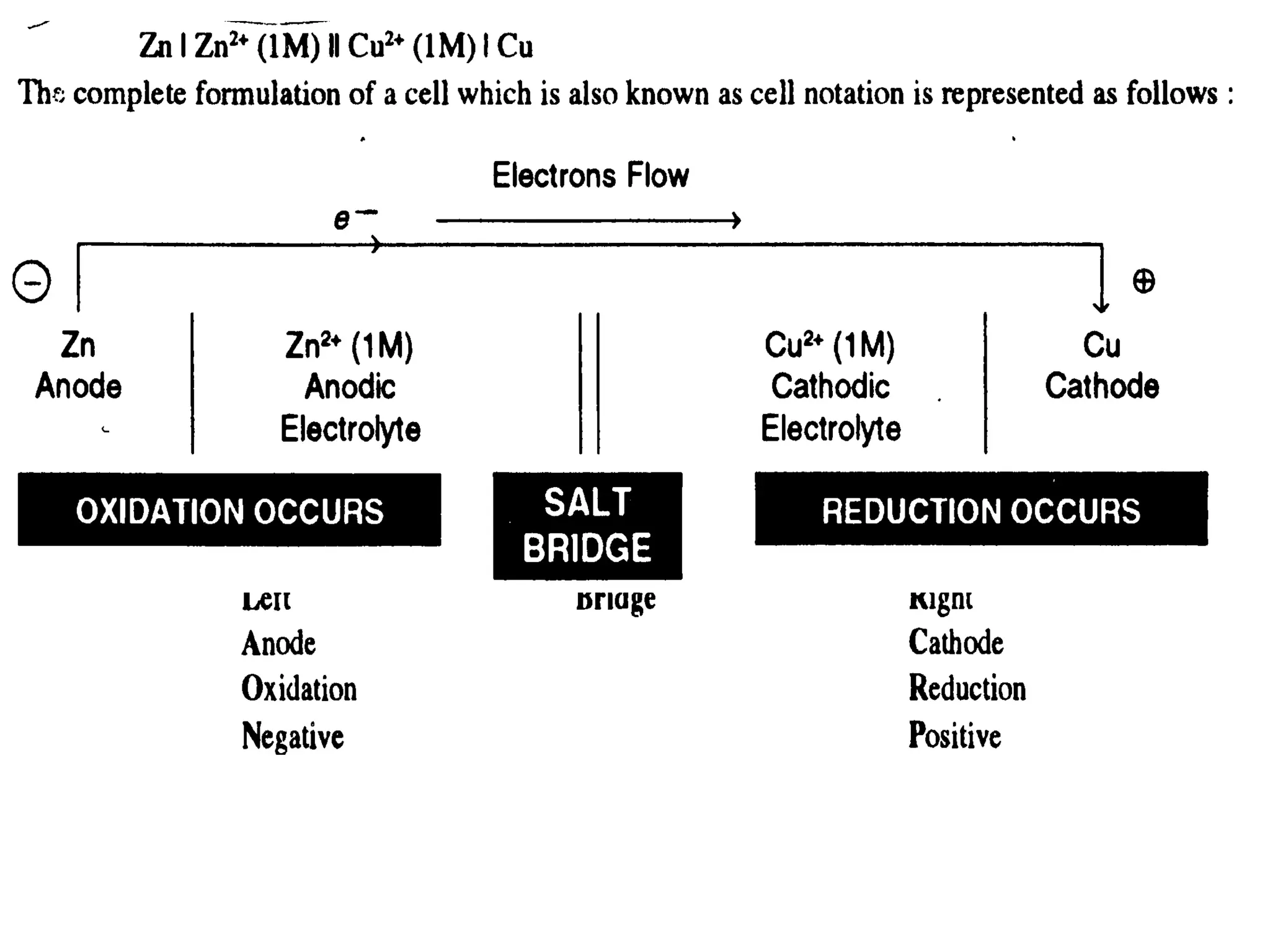
Line Notation
• SolidAqueousAqueoussolid
• Anode on the leftCathode on the right
• Single line different phases.
• Double line porous disk or salt bridge.
Zn(s)Zn2
+(aq)Cu2+
Cu
• If all the substances on one side are aqueous, a
platinum electrode is indicated.
• For the last reaction
• Cu(s)Cu+2
(aq)Fe+2
(aq),Fe+3
(aq)Pt(s)
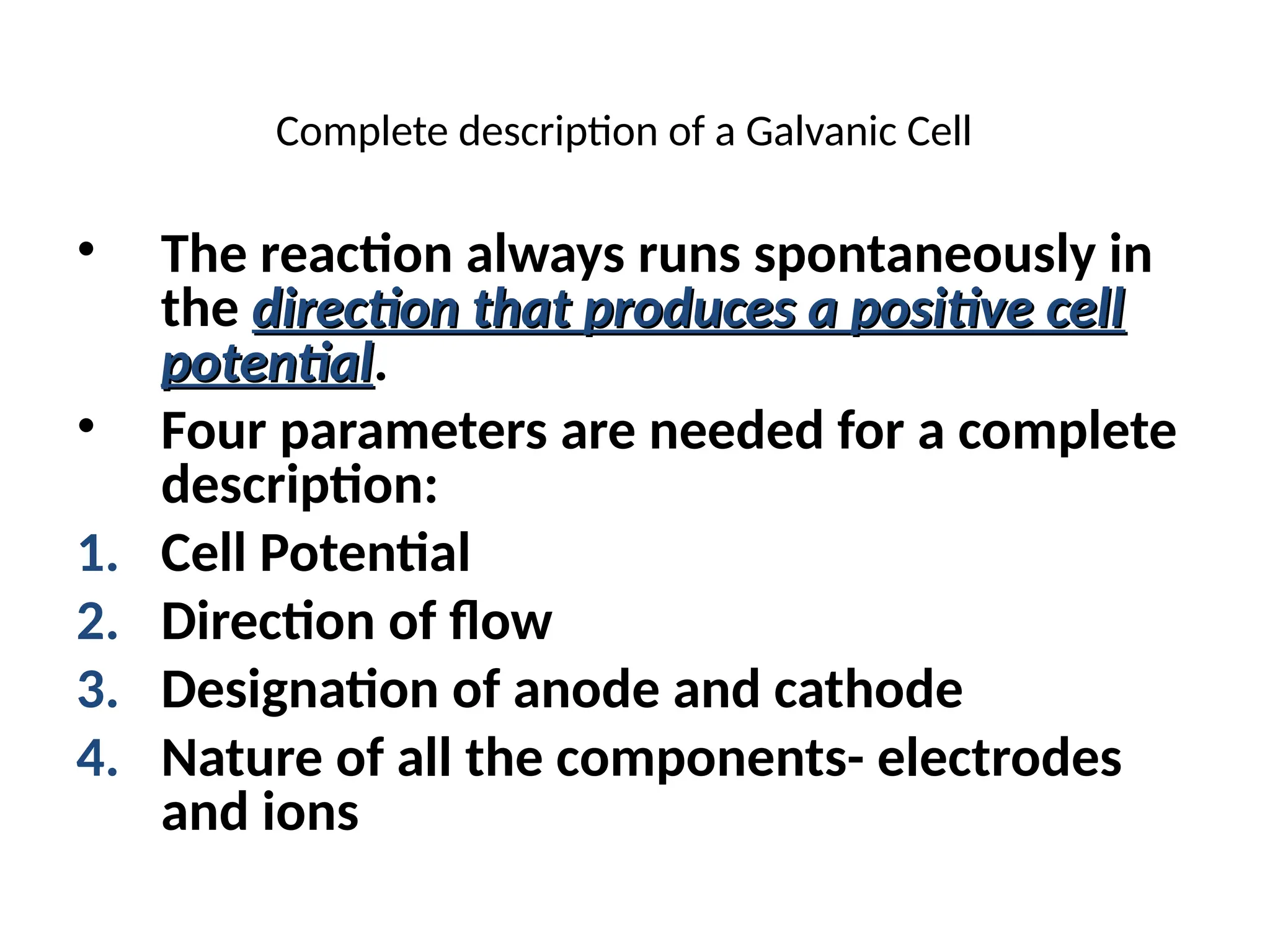
Complete description of a Galvanic Cell
• The reaction always runs spontaneously in
the direction that produces a positive cell
direction that produces a positive cell
potential
potential.
• Four parameters are needed for a complete
description:
1. Cell Potential
2. Direction of flow
3. Designation of anode and cathode
4. Nature of all the components- electrodes
and ions
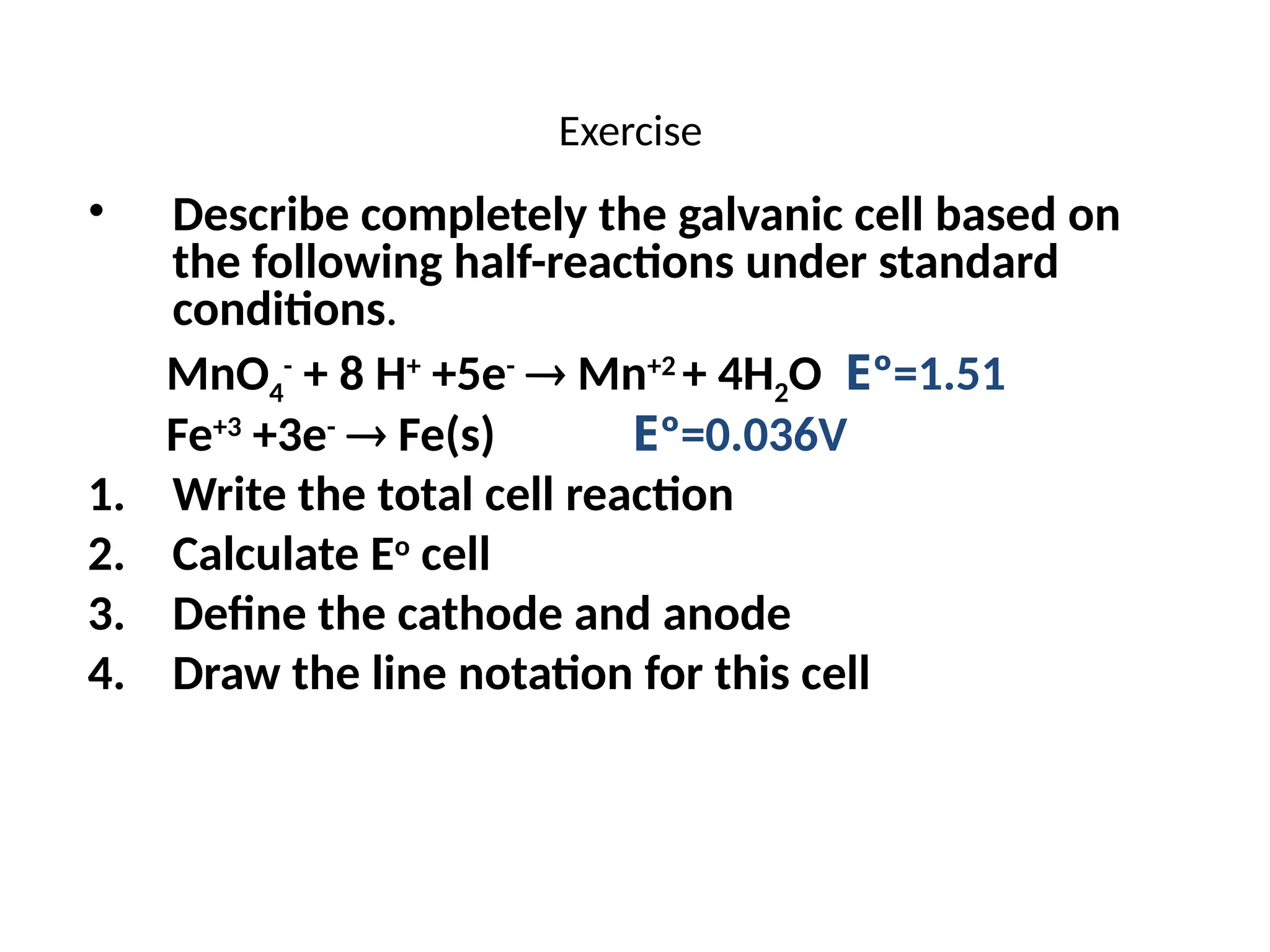
Exercise
• Describe completely the galvanic cell based on
the following half-reactions under standard
conditions.
MnO4
-
+ 8 H+
+5e-
 Mn+2
+ 4H2O Eº=1.51
Fe+3
+3e-
 Fe(s) Eº=0.036V
1. Write the total cell reaction
2. Calculate Eo
cell
3. Define the cathode and anode
4. Draw the line notation for this cell
Potential, Work, G and spontaneity
• Gº = -nFE º
• if E º > 0, then Gº < 0 spontaneous
• if E º < 0, then Gº > 0 nonspontaneous
• In fact, the reverse process is spontaneous.
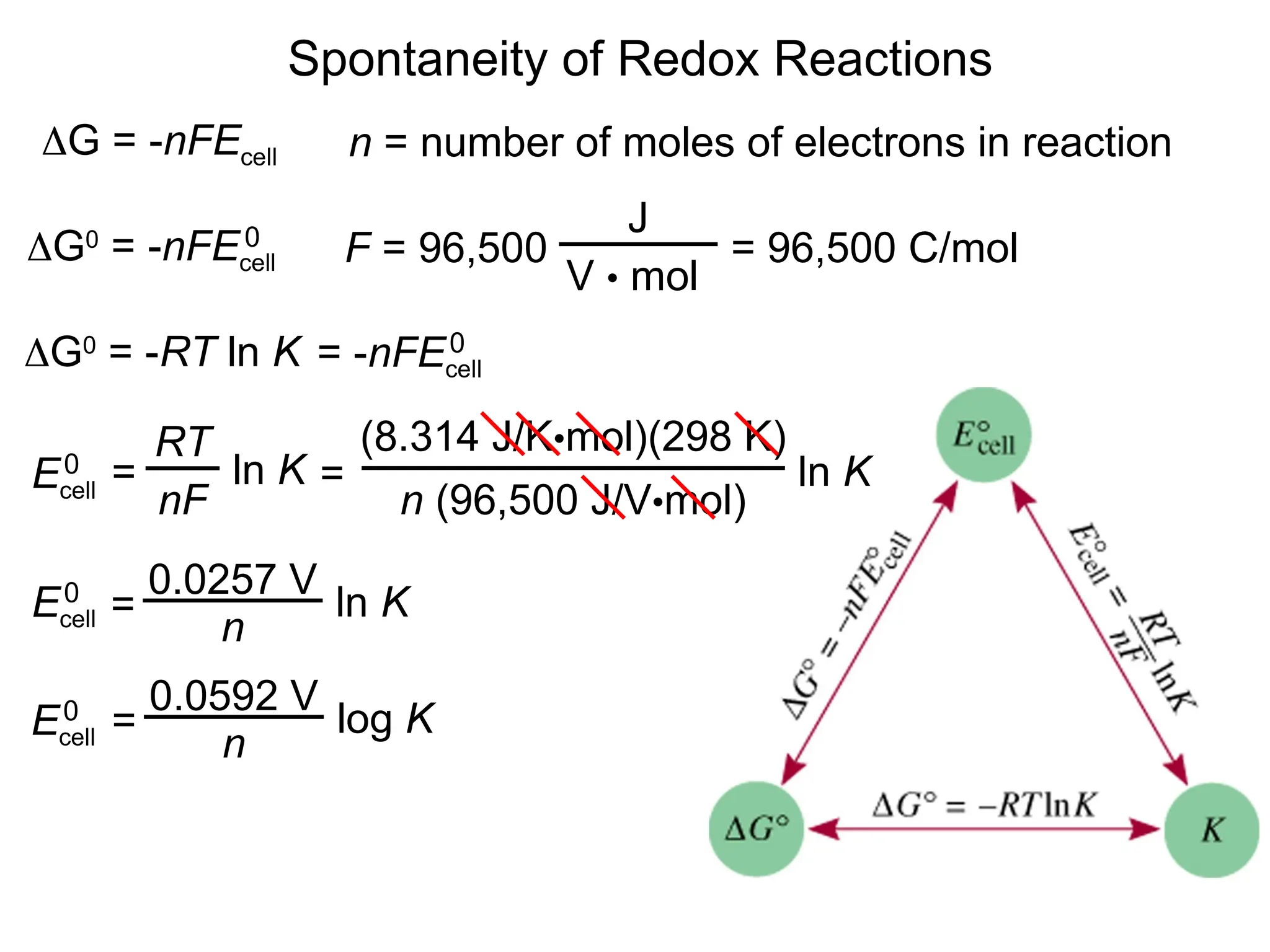
Spontaneity of Redox Reactions
G = -nFEcell
G0
= -nFEcell
0
n = number of moles of electrons in reaction
F = 96,500
J
V • mol
= 96,500 C/mol
G0
= -RT ln K = -nFEcell
0
Ecell
0 =
RT
nF
ln K
(8.314 J/K•mol)(298 K)
n (96,500 J/V•mol)
ln K
=
=
0.0257 V
n
ln K
Ecell
0
=
0.0592 V
n
log K
Ecell
0
Spontaneity of Redox Reactions
If you know one, you can
calculate the other…
If you know K, you can
calculate Eº and Gº
If you know Eº, you can
calculate Gº
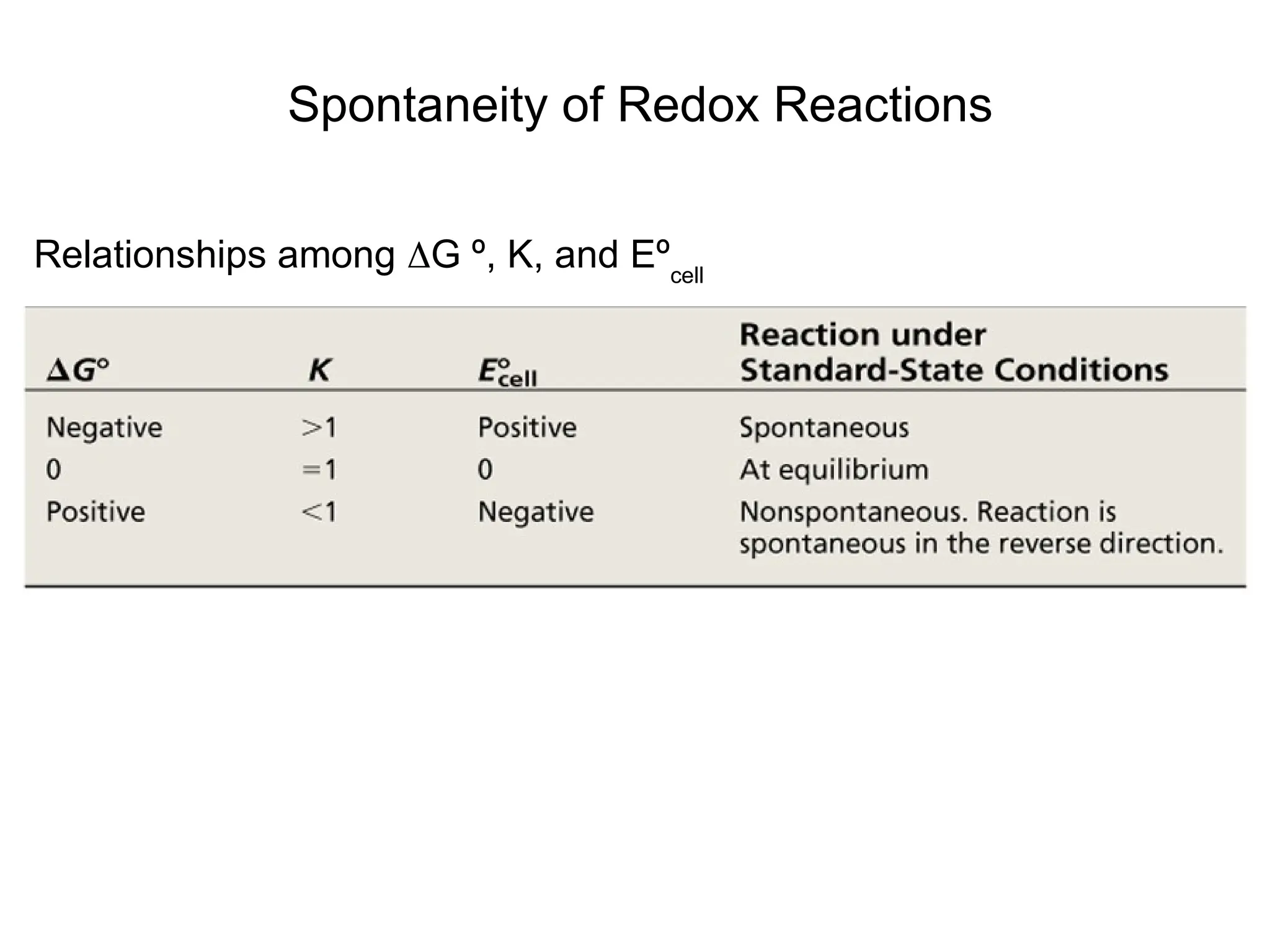
Spontaneity of Redox Reactions
Relationships among G º, K, and Eºcell
2(3e-
+ Al3+
Al)
3 (Mg Mg2+
+ 2e-
)
Oxidation:
Reduction:
Calculate G0
for the following reaction at 250
C.
2Al3+
(aq) + 3Mg(s) 2Al(s) + 3Mg+2
(aq)
n = ?
G0
= -nFEcell
0
E0
= Ered + Eox
cell
0 0
G0
= -nFEcell
0 = ___ X (96,500 J/V mol) X ___ V
G0
= _______ kJ/mol
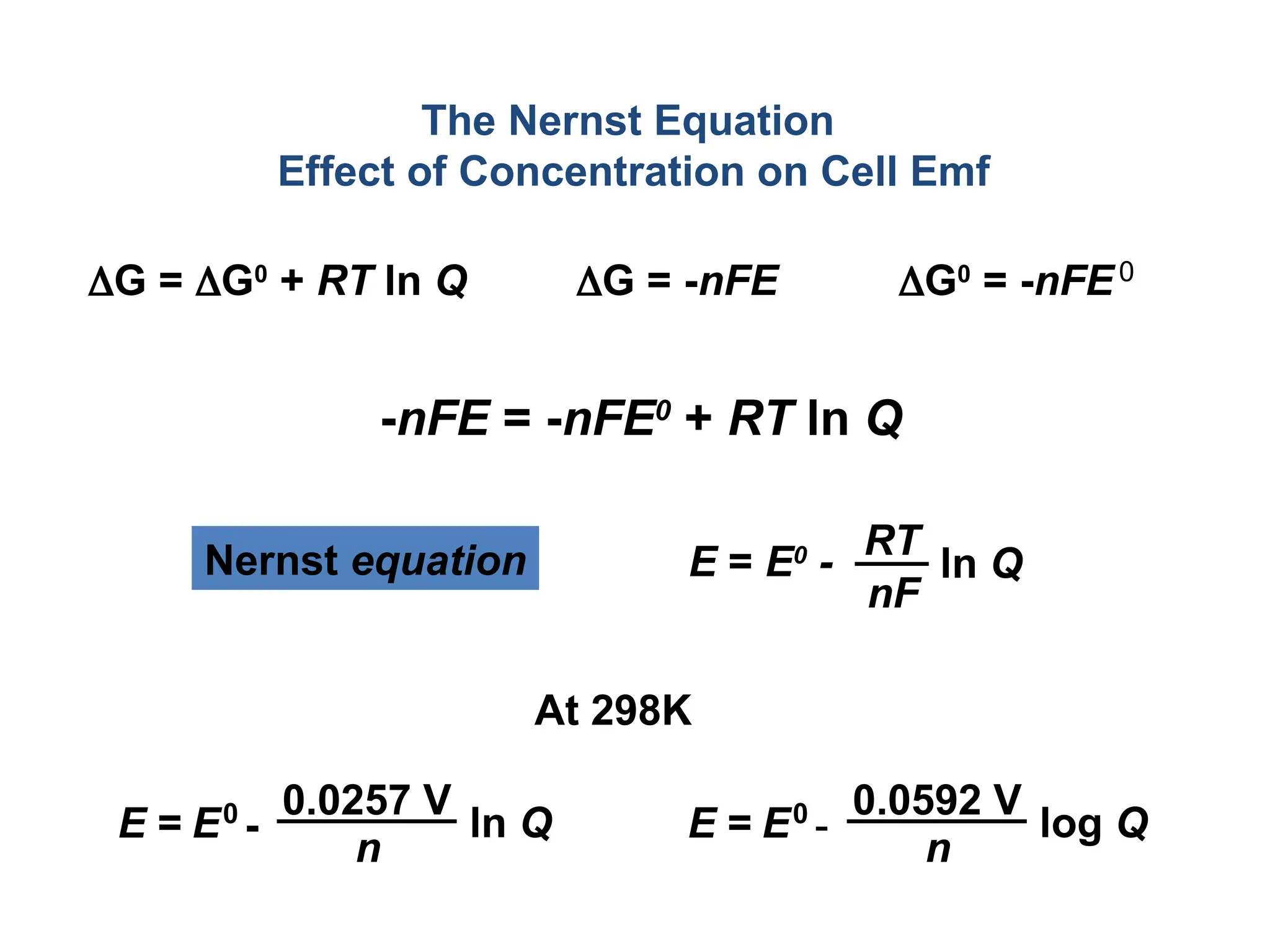
The Nernst Equation
Effect of Concentration on Cell Emf
G = G0
+ RT ln Q G = -nFE G0
= -nFE0
-nFE = -nFE0
+ RT ln Q
E = E0
- ln Q
RT
nF
Nernst equation
At 298K
-
0.0257 V
n
ln Q
E0
E = -
0.0592 V
n
log Q
E0
E =
The Nernst Equation
• As reactions proceed concentrations of
products increase and reactants decrease.
• When equilibrium is reached
Q = K ; Ecell = 0
and G = 0 (the cell no longer has
the ability to do work)
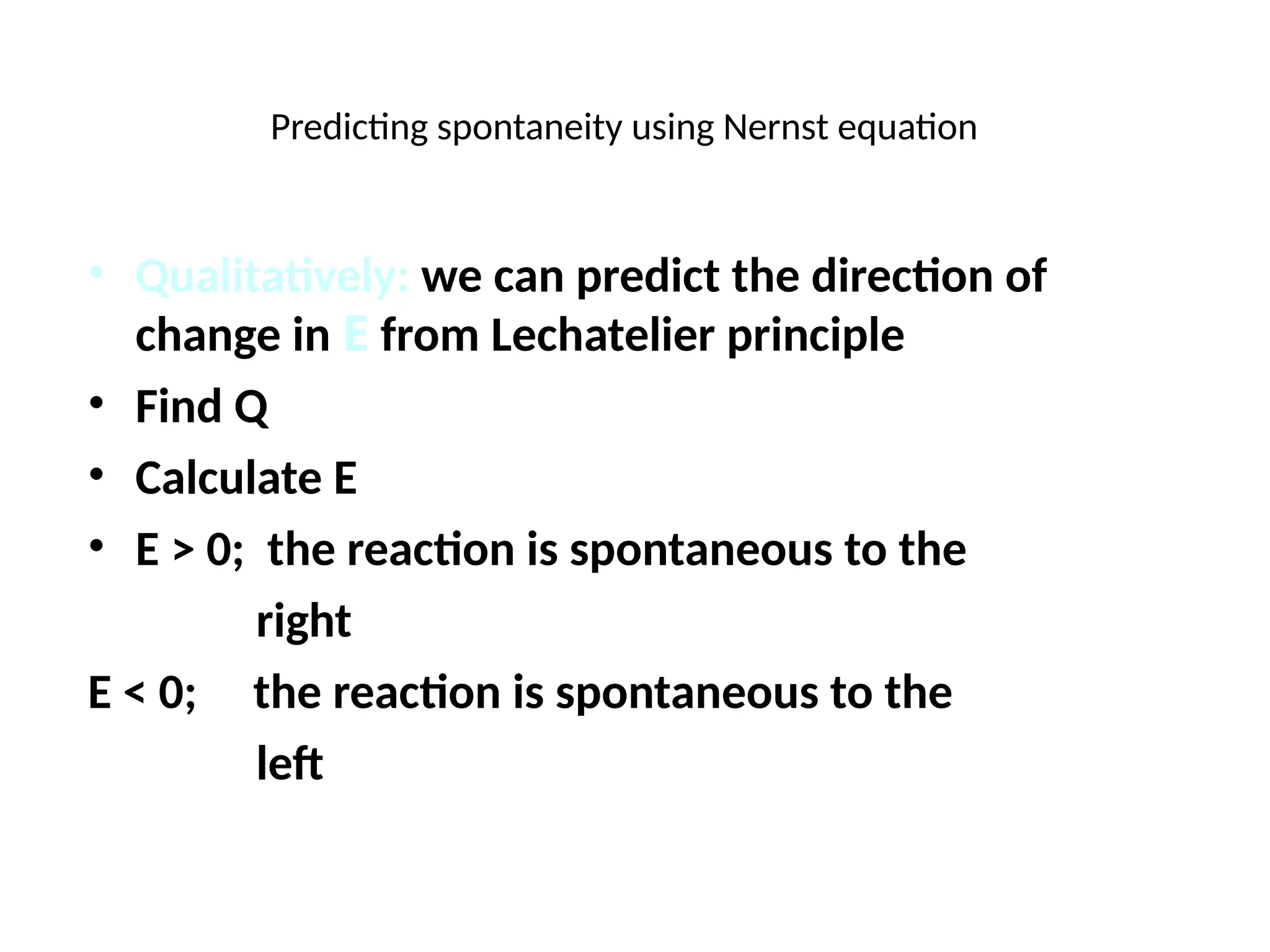
Predicting spontaneity using Nernst equation
• Qualitatively: we can predict the direction of
change in E from Lechatelier principle
• Find Q
• Calculate E
• E > 0; the reaction is spontaneous to the
right
E < 0; the reaction is spontaneous to the
left
Will the following reaction occur spontaneously at 250
C if
[Fe2+
] = 0.60 M and [Cd2+
] = 0.010 M?
Fe2+
(aq) + Cd (s) Fe (s) + Cd2+
(aq)
2e-
+ Fe2+
2Fe
Cd Cd2+
+ 2e-
Oxidation:
Reduction:
n = 2
E0
= -0.44 + (+0.40)
E0
= -0.04 V
E0
= EFe /Fe + ECd /Cd 2+
0 0
2+
-
0.0257 V
n
ln Q
E0
E =
-
0.0257 V
2
ln
-0.04 V
E =
0.010
0.60
E = ____________
E ___ 0 ________________
Exercise
• Determine the cell potential at 25o
C for the following cell,
given that
• 2Al(s) + 3Mn+2
(aq)  2Al+3
(aq) + 3Mn(s)
[Mn2+
] = 0.50 M; [Al3+
]=1.50 M; E0
cell = 0.4
• Always we have to figure out n from the balanced
equation
2(Al(s)
+
 Al+3
(aq) + 3e-
)
3(Mn+2
(aq) + 2e-
 Mn(s))
n = 6
-
0.0592 V
n
log Q
E0
E =
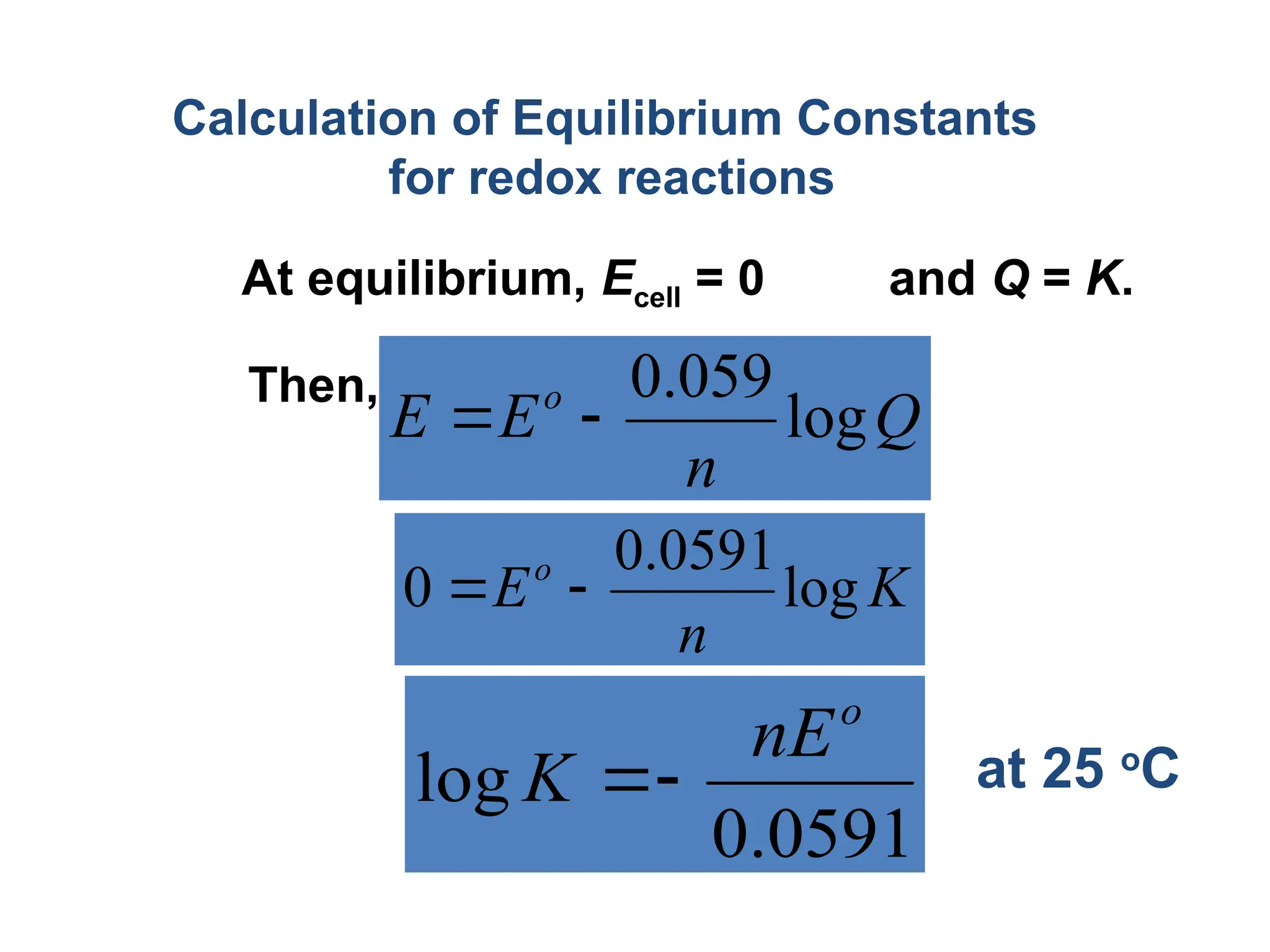
Calculation of Equilibrium Constants
for redox reactions
At equilibrium, Ecell = 0 and Q = K.
Q
n
E
E o
log
059
.
0


Then,
K
n
Eo
log
0591
.
0
0 

0591
.
0
log
o
nE
K 
 at 25 o
C
2e-
+ Fe2+
Fe
2Ag 2Ag+
+ 2e-
Oxidation:
Reduction:
What is the equilibrium constant for the following reaction
at 250
C? Fe2+
(aq) + 2Ag (s) Fe (s) + 2Ag+
(aq)
=
0.0257 V
n
ln K
Ecell
0
E0
= -0.44 –0.80= -1.24 V
E0
= -1.24 V 0.0257 V
x n
E0
cell
exp
K =
n = ___
0.0257 V
x 2
-1.24 V
= exp
K = ________________
E0
= EFe /Fe+ EAg /Ag
0 0
2+ +
Concentration Cell: both compartments contain same
components but at different concentrations
Half cell potential are not
identical
Because the Ag+
Conc.
On both sides are not
same
Eright > Eleft
• To make them equal, [Ag+
]
On both sides should same
• Electrons move from left to
right
Batteries
Batteries
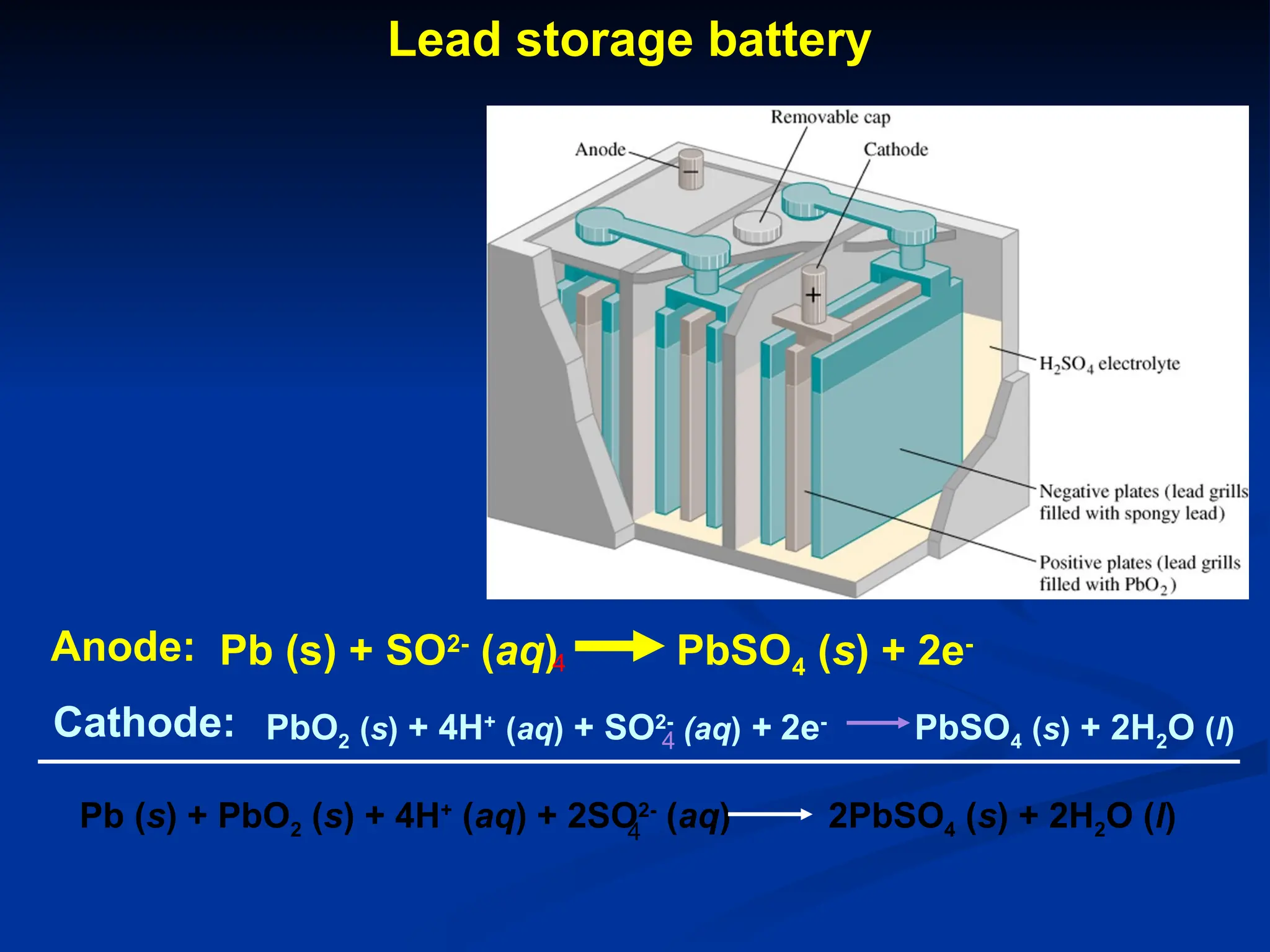
Lead-Storage Battery
 A 12 V car battery consists of 6 cathode/anode
A 12 V car battery consists of 6 cathode/anode
pairs each producing 2 V.
 Cathode
Cathode:
: PbO
PbO2
2 on a metal grid in sulfuric acid:
on a metal grid in sulfuric acid:
PbO
PbO2
2(
(s
s) + SO
) + SO4
4
2-
2-
(
(aq
aq) + 4H
) + 4H+
+
(
(aq
aq) + 2e
) + 2e-
-


PbSO
PbSO4
4(
(s
s) + 2H
) + 2H2
2O(
O(l
l)
)
 Anode: Pb:
Anode: Pb:
Pb(
Pb(s
s) + SO
) + SO4
4
2-
2-
(
(aq
aq)
) 
 PbSO
PbSO4
4(
(s
s) + 2e
) + 2e-
-
Batteries are Galvanic Cells
Anode:
Cathode:
Lead storage battery
PbO2 (s) + 4H+
(aq) + SO2-
(aq) + 2e-
PbSO4 (s) + 2H2O (l)
4
Pb (s) + SO2-
(aq) PbSO4 (s) + 2e-
4
Pb (s) + PbO2 (s) + 4H+
(aq) + 2SO2-
(aq) 2PbSO4 (s) + 2H2O (l)
4
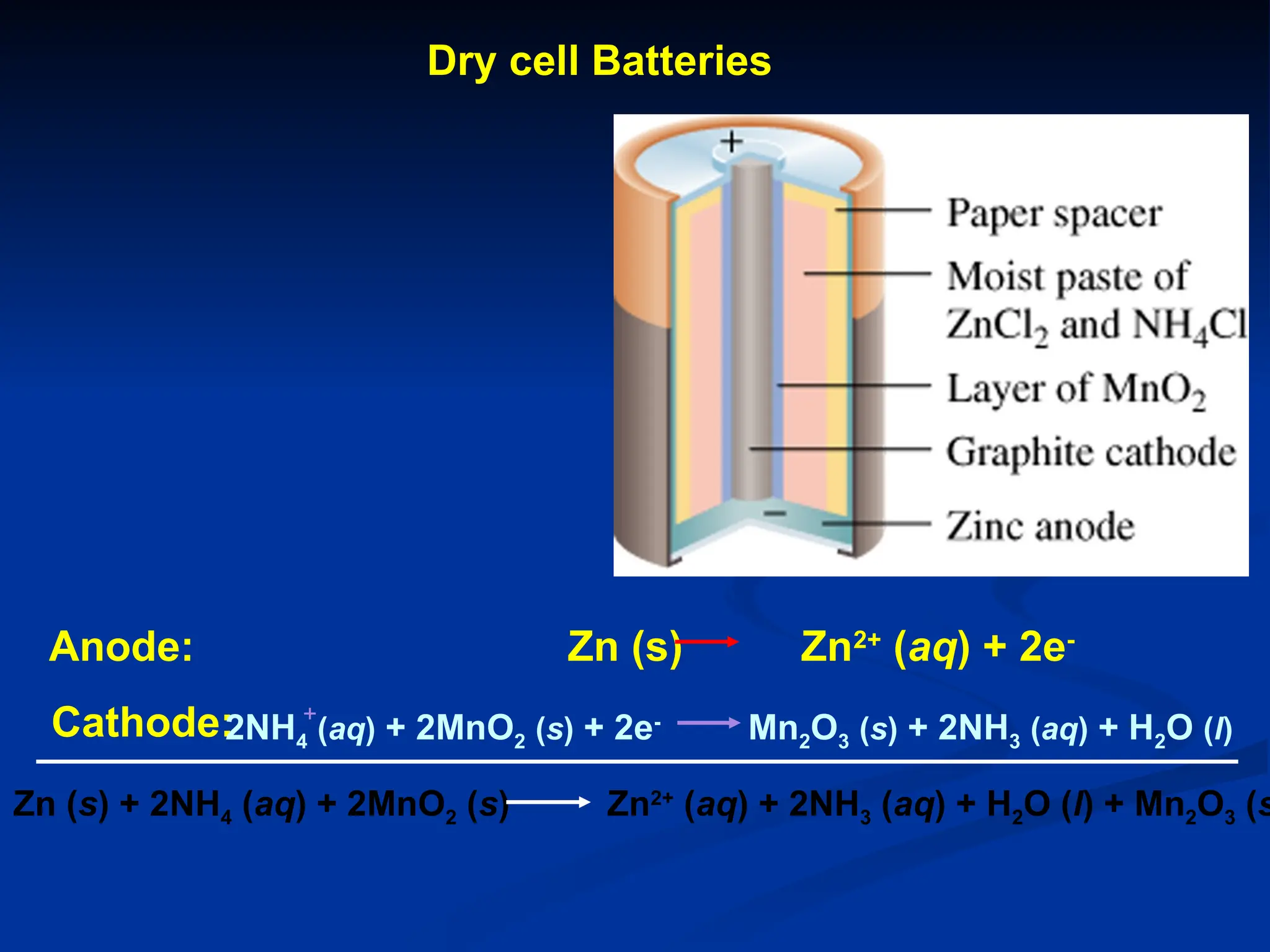
Dry cell Batteries
Zn (s) Zn2+
(aq) + 2e-
Anode:
Cathode:
2NH4 (aq) + 2MnO2 (s) + 2e-
Mn2O3 (s) + 2NH3 (aq) + H2O (l)
+
Zn (s) + 2NH4 (aq) + 2MnO2 (s) Zn2+
(aq) + 2NH3 (aq) + H2O (l) + Mn2O3 (s
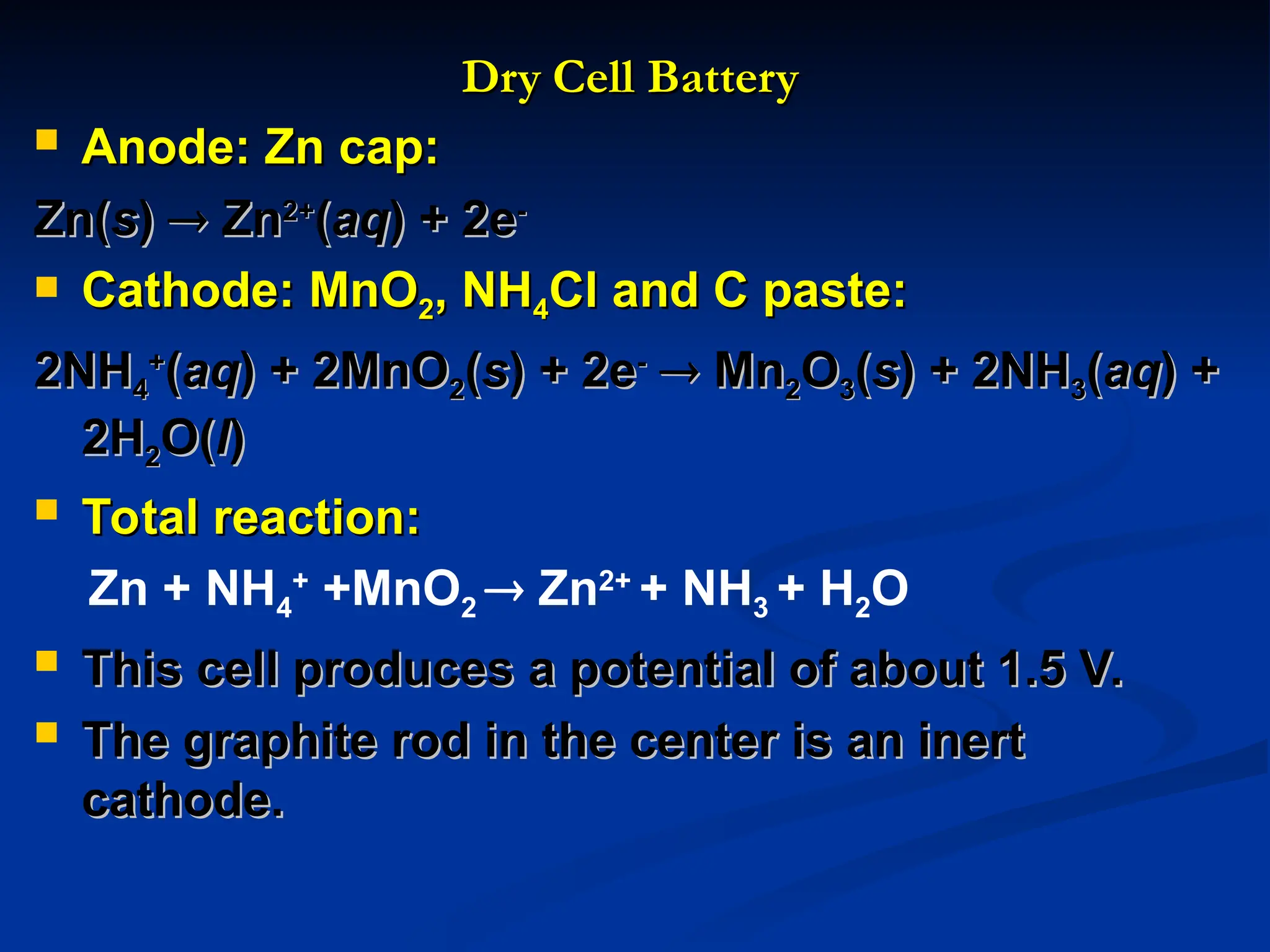
Dry Cell Battery
Dry Cell Battery
 Anode: Zn cap:
Anode: Zn cap:
Zn(
Zn(s
s)
) 
 Zn
Zn2+
2+
(
(aq
aq) + 2e
) + 2e-
-
 Cathode: MnO
Cathode: MnO2
2, NH
, NH4
4Cl and C paste:
Cl and C paste:
2NH
2NH4
4
+
+
(
(aq
aq) + 2MnO
) + 2MnO2
2(
(s
s) + 2e
) + 2e-
-

 Mn
Mn2
2O
O3
3(
(s
s) + 2NH
) + 2NH3
3(
(aq
aq) +
) +
2H
2H2
2O(
O(l
l)
)
 Total reaction:
Total reaction:
Zn + NH4
+
+MnO2  Zn2+
+ NH3 + H2O
 This cell produces a potential of about 1.5 V.
This cell produces a potential of about 1.5 V.
 The graphite rod in the center is an inert
The graphite rod in the center is an inert
cathode.
cathode.
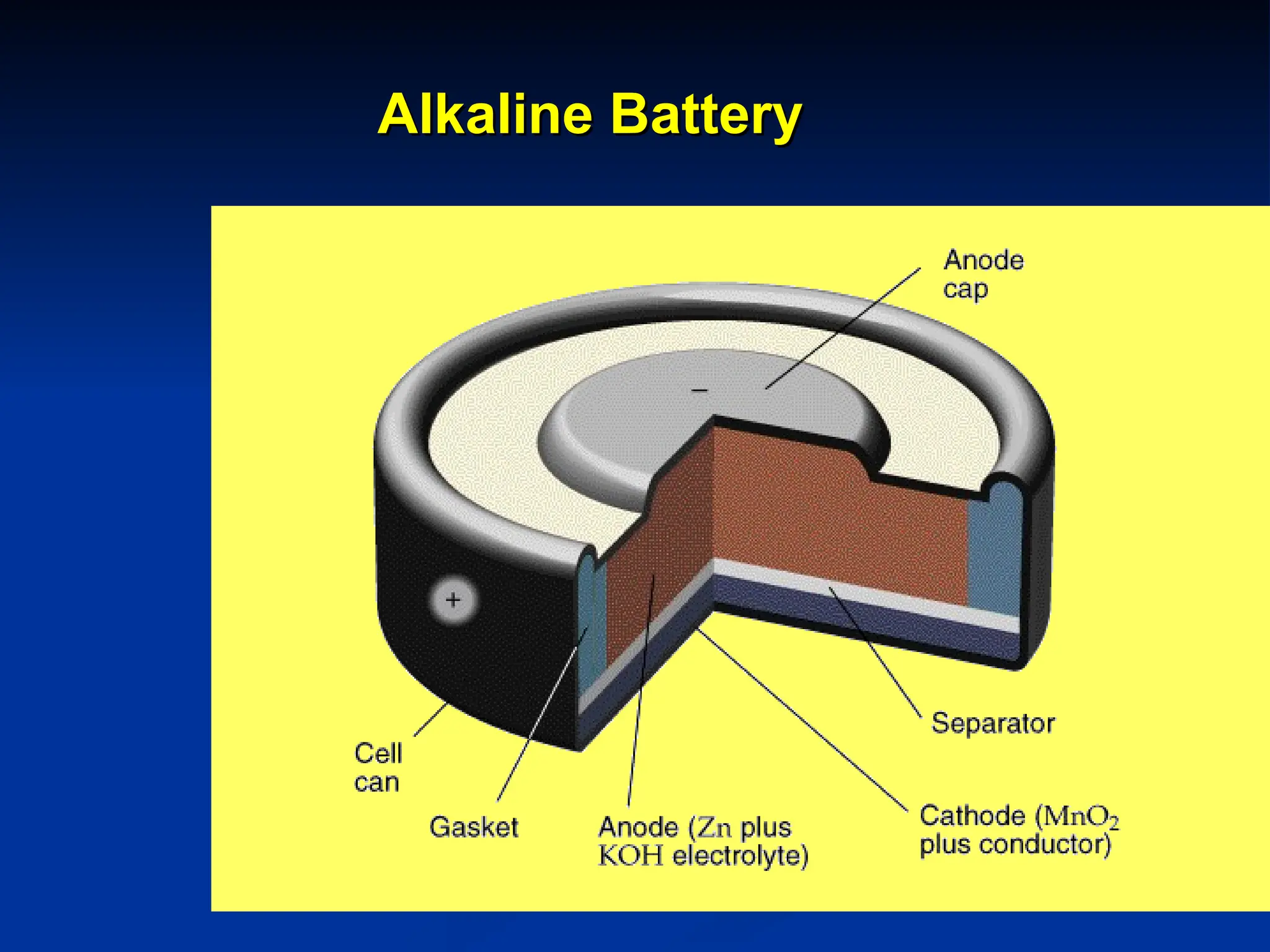
For an alkaline battery, NH
For an alkaline battery, NH4
4Cl is replaced with
Cl is replaced with
KOH.
KOH.
Anode: oxidation of Zn
Anode: oxidation of Zn
Zn(
Zn(s
s) + 2OH
) + 2OH-
-

 ZnO + H
ZnO + H2
2O + 2e
O + 2e-
-
Cathode: reduction of MnO
Cathode: reduction of MnO2
2.
.
2MnO2 + H
H2
2O + 2e
O + 2e-
-

 Mn2O3 + 2OH-
• Total reaction
Zn(s) + 2 MnO2(s) ---> ZnO(s) + Mn2O3(s)
It lasts longer because Zn anode corrodes
It lasts longer because Zn anode corrodes
less rapidly than under acidic conditions.
Alkaline Cell Battery
Alkaline Battery
Alkaline Battery
Fuel Cells
A fuel cell is a galvanic cell that requires a continuous
supply of reactants to keep functioning
Anode:
Cathode: O2 (g) + 2H2O (l) + 4e-
4OH-
(aq)
2H2 (g) + 4OH-
(aq) 4H2O (l) + 4e-
2H2 (g) + O2 (g) 2H2O (l)
Corrosion
• Rusting - spontaneous oxidation of metals.
• Most metals used for structural purposes have reduction
potentials that are less positive than O2 . (They are readily
oxidized by O2)
• Fe+2
+2e-
 Fe Eº= - 0.44 V
• O2 + 2H2O + 4e-
4OH-
Eº= 0.40 V
• When a cell is formed from these two half reactions a cell
with +ve potential will be obtained
• Au, Pt, Cu, Ag are difficult to be oxidized (noble metals)
• Most metals are readily oxidized by O2 however, this
process develops a thin oxide coating that protect the
internal atoms from being further oxidized.
• Al
Al that has Eo
= -1,7V is easily oxidized. Thus, it is used for
making the body of the airplane.
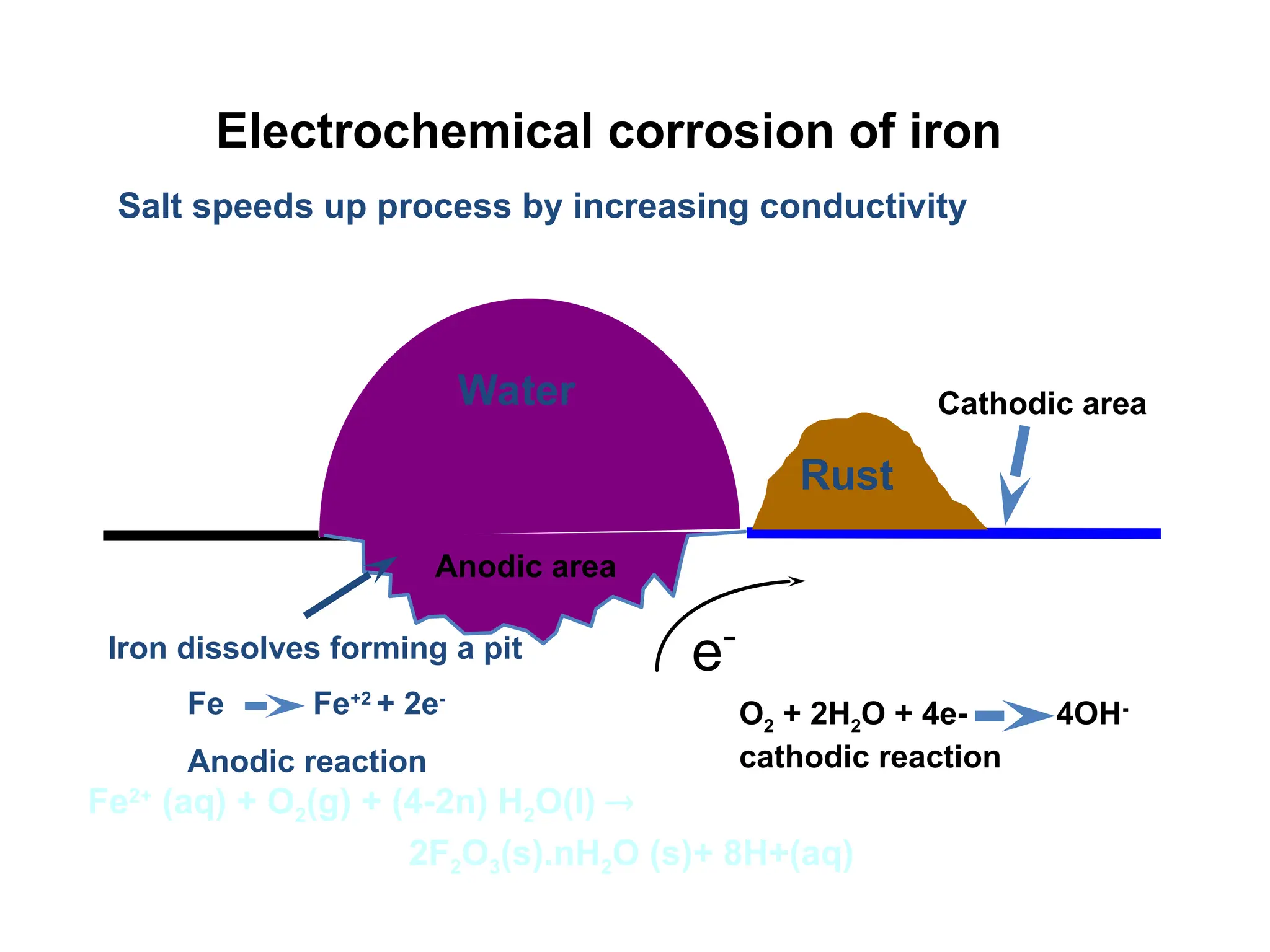
Water
Rust
Iron dissolves forming a pit e-
Salt speeds up process by increasing conductivity
Anodic area
Cathodic area
Fe Fe+2
+ 2e-
Anodic reaction
O2 + 2H2O + 4e- 4OH-
cathodic reaction
Electrochemical corrosion of iron
Fe2+
(aq) + O2(g) + (4-2n) H2O(l) 
2F2O3(s).nH2O (s)+ 8H+(aq)
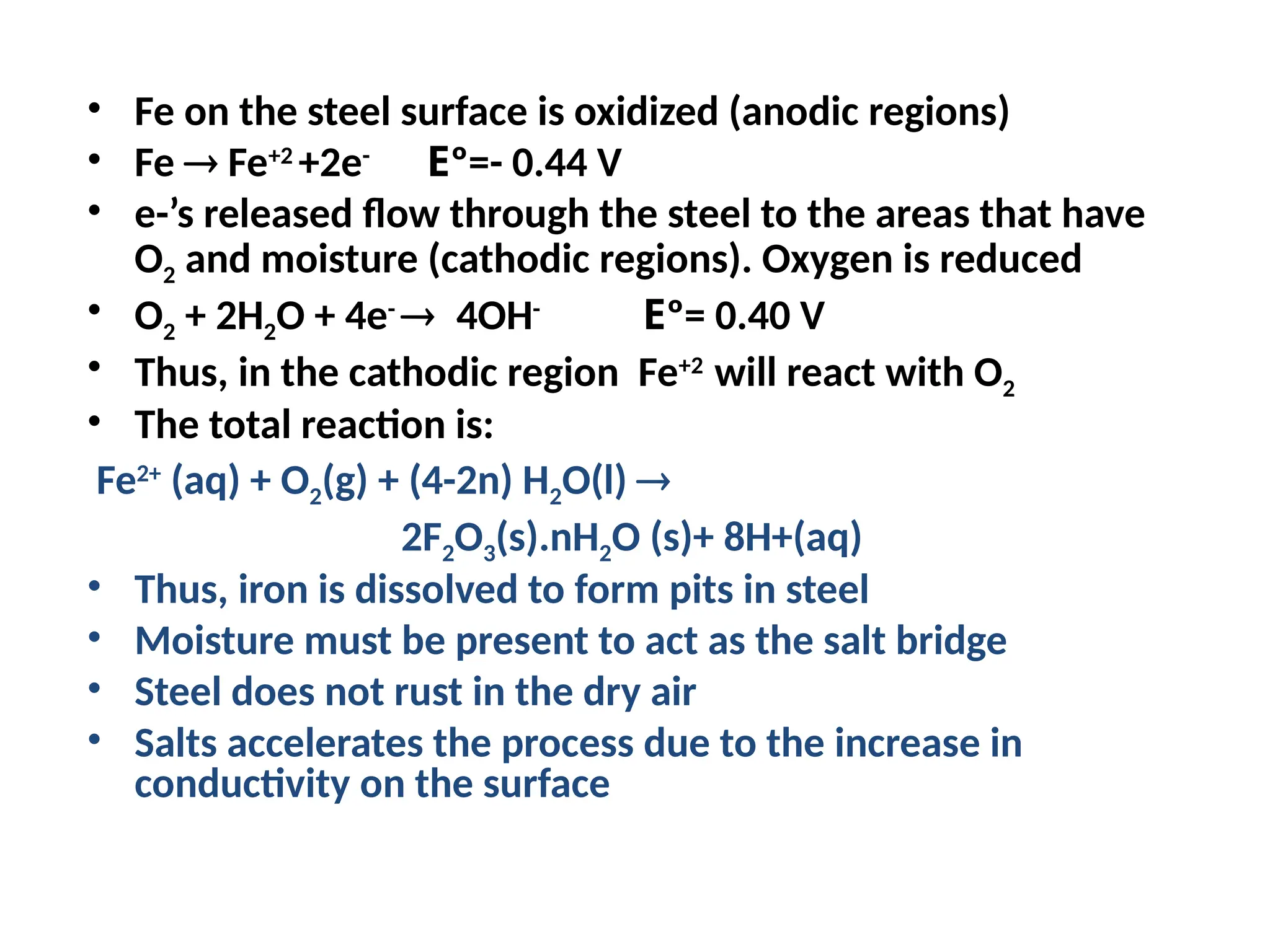
• Fe on the steel surface is oxidized (anodic regions)
• Fe  Fe+2
+2e-
Eº=- 0.44 V
• e-’s released flow through the steel to the areas that have
O2 and moisture (cathodic regions). Oxygen is reduced
• O2 + 2H2O + 4e-
4OH-
Eº= 0.40 V
• Thus, in the cathodic region Fe+2
will react with O2
• The total reaction is:
Fe2+
(aq) + O2(g) + (4-2n) H2O(l) 
2F2O3(s).nH2O (s)+ 8H+(aq)
• Thus, iron is dissolved to form pits in steel
• Moisture must be present to act as the salt bridge
• Steel does not rust in the dry air
• Salts accelerates the process due to the increase in
conductivity on the surface
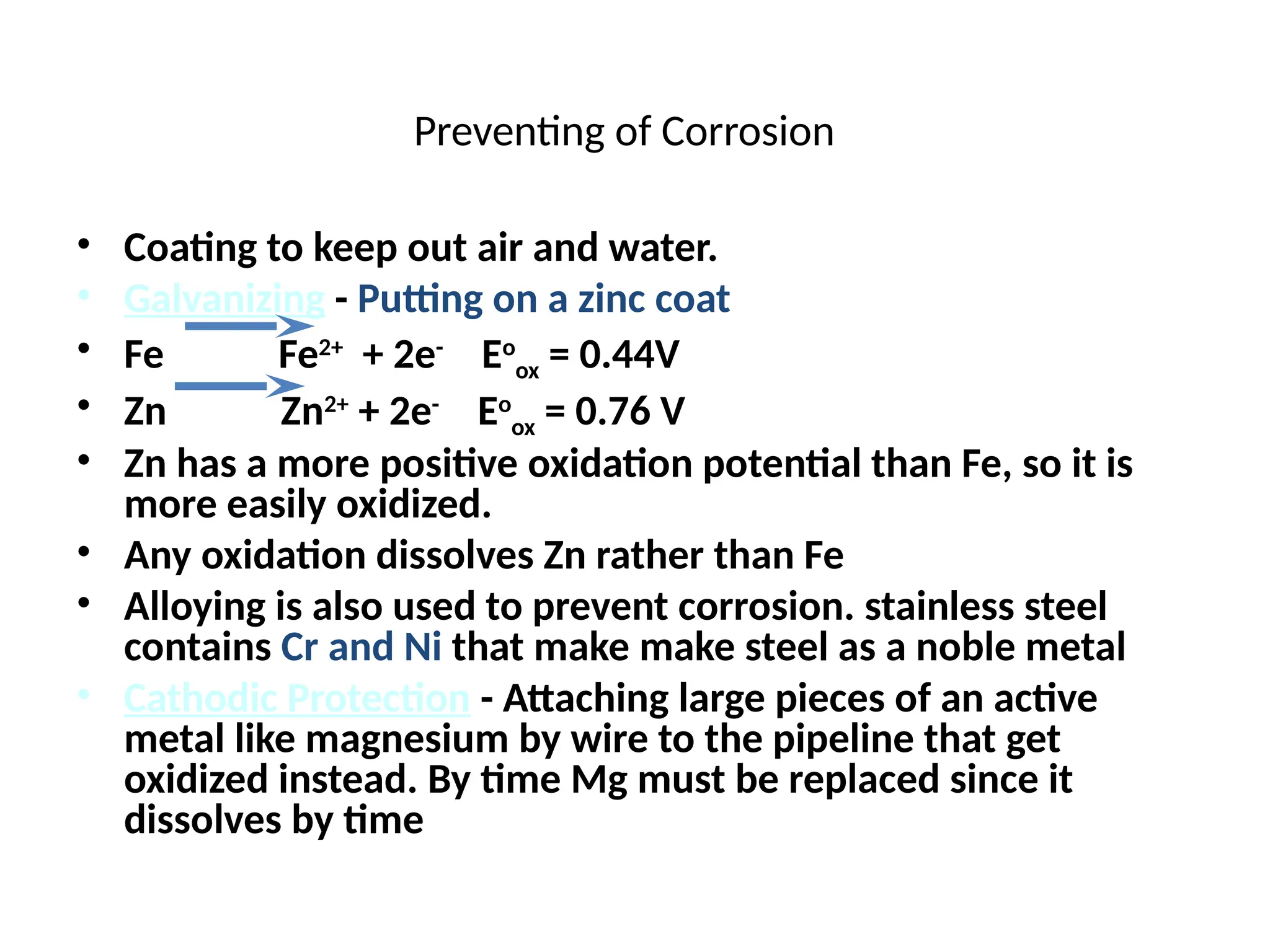
Preventing of Corrosion
• Coating to keep out air and water.
• Galvanizing - Putting on a zinc coat
• Fe Fe2+
+ 2e-
Eo
ox = 0.44V
• Zn Zn2+
+ 2e-
Eo
ox = 0.76 V
• Zn has a more positive oxidation potential than Fe, so it is
more easily oxidized.
• Any oxidation dissolves Zn rather than Fe
• Alloying is also used to prevent corrosion. stainless steel
contains Cr and Ni that make make steel as a noble metal
• Cathodic Protection - Attaching large pieces of an active
metal like magnesium by wire to the pipeline that get
oxidized instead. By time Mg must be replaced since it
dissolves by time
Cathodic Protection of an Underground Pipe
Cathodic Protection of an Iron Storage Tank
If you wished to electroplate an object, you might ask yourself the
following questions:
How can I determine how much metal is being plated?
How long should I leave the object being plated in the
electroplating cell?
What size electric current should be used?
Faraday’s Laws of Electrolysis
Michael Faraday was a 19th century English chemist.
His studies yielded two laws relating amount of electric current
and the chemicals produced by the current or used to produce it.
These laws enable us to:
Work out the amount of energy required to discharge a metal ion
and place it out on an object or
To calculate the amount of metal produced in an electrolytic cell.
Faraday’s Laws of Electrolysis
The mass of metal produced at the cathode is directly
proportional to the quantity of electricity passed through the cell
m  Q
Electric charge, Q, is measured using the unit coulomb.
The electric charge passing through a cell may be calculated from
measurements of the current, I, through the cell and the time, t,
for which the current flows.
Charge (coulombs) = current (amps) x time (seconds)
Q = I t
Faraday’s Laws of Electrolysis – First Law
In order to produce one mole of metal, one two or three moles
of electrons must be consumed.
Faraday found that there was a certain charge associated with
one mole of electrons.
This amount of charge is now called the Faraday and is
equivalent to 96 487 (96 500) Coulomb.
1 Faraday = 96 500 Coulomb
Faraday’s Laws of Electrolysis – Second Law
In order to produce one mole of metal, one two or three moles
of electrons must be consumed.
Ag+
(aq), Cu2+
(aq) and Cr3+
(aq) require 1, 2 and 3 moles of
electrons for discharge.
The quantity of electricity required will be:
Amount of charge = no. of moles of metal ions x charge
on an ion x 1 Faraday
Q = n z F and Q = I t
I t = n z F
Faraday’s Laws of Electrolysis – Second Law
1. Calculate the number of mole of copper produced in an electrolytic
cell if a current of 5.0 A at a voltage of 6.0 V flows through a
solution of copper ions for 10 minutes.
2. Calculate the time taken to deposit 1.00 g of copper onto an object
that is placed in a solution of copper nitrate, Cu(NO3)2, and has a
current of 2.50 A flowing through it.
3. In an operating Hall-Héroult cell, a current of 150 000 A is used at
5.0 V. Calculate the mass of aluminium that would be produced if
this cell operates continuously for 1 day.
4. The electrolysis of a solution of chromium ions using a current of
2.2 A for 25 minutes produced 0.60 g of chromium. Calculate the
charge on the chromium ion.
5. Calculate the masses of metal produced when 600 Faraday of
charge is used to reduce the ions of aluminium, silver and zinc.
Faraday’s Laws of Electrolysis – Questions
1. n (Cu) = I t / z F
n (Cu) = 5.0 x 10 x 60 / 2 x 96 500
n (Cu) = 1.6 x 10⁻²
mol
That is, 1.6 x 10⁻²
mole of copper would be produced
2. t = n (Cu) z F / I
t = (1.00 / 63.5) x 2 x 96 500 / 2.5
t = 1216 seconds
That is, it takes 20 minutes 15 seconds to deposit 1.00 g of copper
3. n (Al) = I t / z F
n (Al) = 150 000 x 24 x 60 x 60 / 3 x 96 500
n (Al) = 44 767 mol
m (Al) = 44 767 x 27 = 1 208 705 g
That is, 1.2 tonne of aluminium is produced per day
Faraday’s Laws of Electrolysis – Solutions
4. z (Cr) = I t / n F
z (Cr) = 2.2 x 25 x 60 / (0.60 / 52) x 96 500
z (Cr) = 2.96
As the charge on an ion is a small integer, it must be 3+.
The ion is Cr3+
.
5. Q = m z F / M
As Q = 600 F, then m = 600 M / z
m (Al) = 600 x 27 / 3 = 5400 g
m (Ag) = 600 x 107.9 / 1 = 64 740 g
m (Zn) = 600 x 65.4 / 2 = 19 620 g
The same 600 F of charge would produce different masses of these
metals; 5.4 kg of Al, nearly 20 kg of Zn and almost 65 kg of Ag.
Faraday’s Laws of Electrolysis – Solutions
Corrosion Kinetics
• Up to this point, we have dealt with
the thermodynamics of corrosion, i.e.
which combinations of conditions
results in anodic and cathodic regions
under equilibrium
• Corrosion does not occur under
equilibrium conditions
• Of interest is the corrosion kinetics,
i.e. the rate at which a metal corrodes
• For each atom of a metal that
participates in the oxidation reaction,
n electrons need to get transported
away
• The weight of a metal that is lost due
to corrosion is given by Faraday’s law
• M  Mn+
+ ne-
w = weight loss during corrosion (or weight
gain during electroplating)
I = current in amps = iA
i = current density
A = area of corroding surface
t = time in seconds
M = atomic mass g/mole
n = number of electrons involved in the
corrosion reaction
F = Faraday’s constant
= 96,500 C/mol
nF
ItM
w 
Polarization
• In an electrochemical half cell the
metal atoms are in a state of
equilibrium with its ions in solution
– There is an equilibrium exchange
current density i0 associated with
the transfer of electrons at the
standard emf potential E0 (or V0
)
of the half cell
• There is an i0 and E0 associated with
the anodic and cathodic reactions
• However, potential differences
cannot be maintained in a conductive
metal, such as Zn
• There is a displacement of the
electrode potentials and currents
from points A and B to C
• This displacement of electrode
potentials is called polarization
Point A: -0.763V, 10-7
A/cm2
Point B: 0V, 10-10
A/cm2
Point C: ~-0.5V, 10-4
A/cm2
icorr = 10-4
A/cm2
is used in
CPR calculations
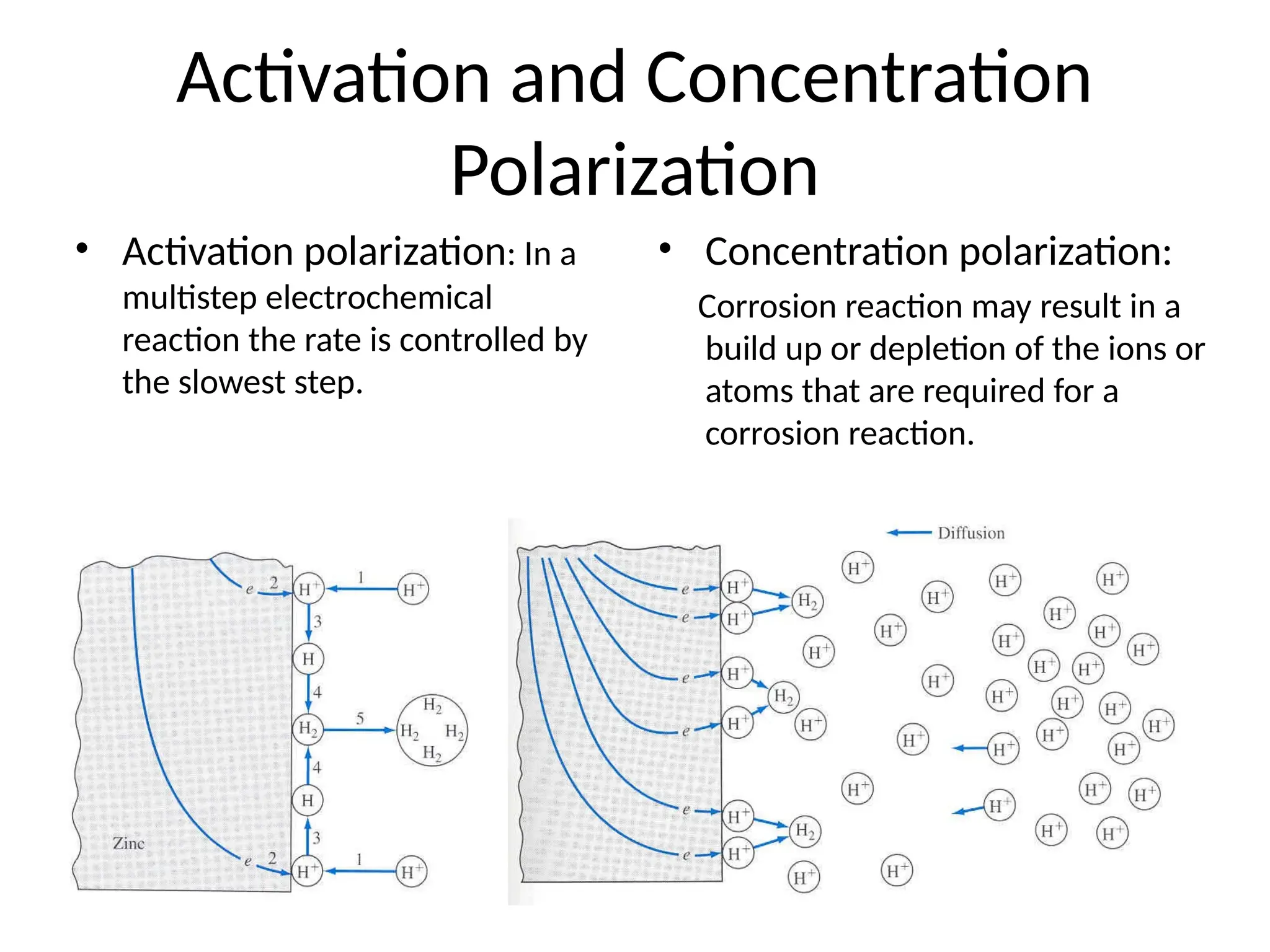
Activation and Concentration
Polarization
• Activation polarization: In a
multistep electrochemical
reaction the rate is controlled by
the slowest step.
• Concentration polarization:
Corrosion reaction may result in a
build up or depletion of the ions or
atoms that are required for a
corrosion reaction.
Passivation
• Passivation is the loss of chemical reactivity in
presence of a environmental condition.
– The formation of surface layer of reaction products that inhibit further reaction
• Oxide film theory: A passive film of reaction
products acts as a diffusion barrier.
• Adsorption theory: Passive metals are covered by
chemisorbed films of oxygen.
• Examples: Stainless steel, nickel alloys, titanium and
aluminum alloys passivate in certain environments
Polarization Curve for Passivation
• Initially, the potential of the metal increases with current density, i.e. the metal
undergoes active corrosion
• When potential reaches Epp the primary passive potential, current density
decreases, i.e., the corrosion rate also decreases
• In order to make the metal active again, there may need to be an externally
applied potential
Galvanic Series
• The Standard emf series gives the
relative oxidation or reduction
behavior under standard
conditions.
• The Galvanic series ranks
materials on the basis of
corrosion behavior in sea water
Types of Corrosion
• Though the basic corrosion mechanism is the same, i.e. the oxidation of a
metal due to transfer of electrons, conditions under which the process
occurs can be vastly different, and has lead to the classification of corrosion
into the following types:
– Uniform
– Galvanic
– Crevice
– Pitting
– Inter-granular
– Selective leaching
– Erosion/cavitation
– Stress corrosion
– Fretting
Types of Corrosion
• Uniform or general corrosion
– Most common in terms of
weight loss and destruction,
but also the easiest to control
• Galvanic or two metal corrosion
– When dissimilar metals are in
contact
– Very sensitive to the relative
areas of the anodic and
cathodic regions
– If the anodic region is small,
then corrosion can be rapid
and deep
– Tin coating of steel in “tin” cans
• If the coating is scratched, the
underlying steel rusts quickly
– Zinc coating of steel by galvanizing
• If the coating is scratched, the
galvanic cell results in corrosion
of the coating, but due to large
surface area of Zn, the CPR of
the Zn coating is relatively low
Types of Corrosion
Crevice Corrosion
• Localized electrochemical corrosion
in crevices and under shielded
surfaces where stagnant solutions
can exist.
• Occurs under valve gaskets, rivets
and bolts in alloy systems like steel,
titanium and copper alloys.
Anode: M  M+ + e-
Cathode:O2 + 2H2O + 4e-
 4OH-
• As the solution is stagnant, oxygen is
used up and not replaced.
• Chloride ions migrate to the crevice
to balance positive charge and form
metal hydroxide and free acid that
causes corrosion
Rivet holes
Types of Corrosion
• Pitting
– Initiates at non-uniformities in
composition
– Growth of pit involves dissolution of
metal in pit maintaining high acidity
at the bottom.
– Anodic reaction at the bottom and
cathodic reaction at the metal
surface.
– At the bottom of the pit
MCl + H2O  M(OH) + H+
+ Cl-
– The presence of H+
at the bottom of
the pit pulls more M into solution
– Some metals (stainless steel) have
better resistance than others
(titanium).
Types of Corrosion
• Intergranular corrosion
– Localized corrosion at and/or adjacent to highly reactive grain
boundaries resulting in disintegration.
– When stainless steels are heated to or cooled through sensitizing
temperature range (500-800C) chromium carbide precipitate along
grain boundaries.
– When exposed to corrosive environment, the region next to grain
boundaries become anodic and corrode.
Types of Corrosion
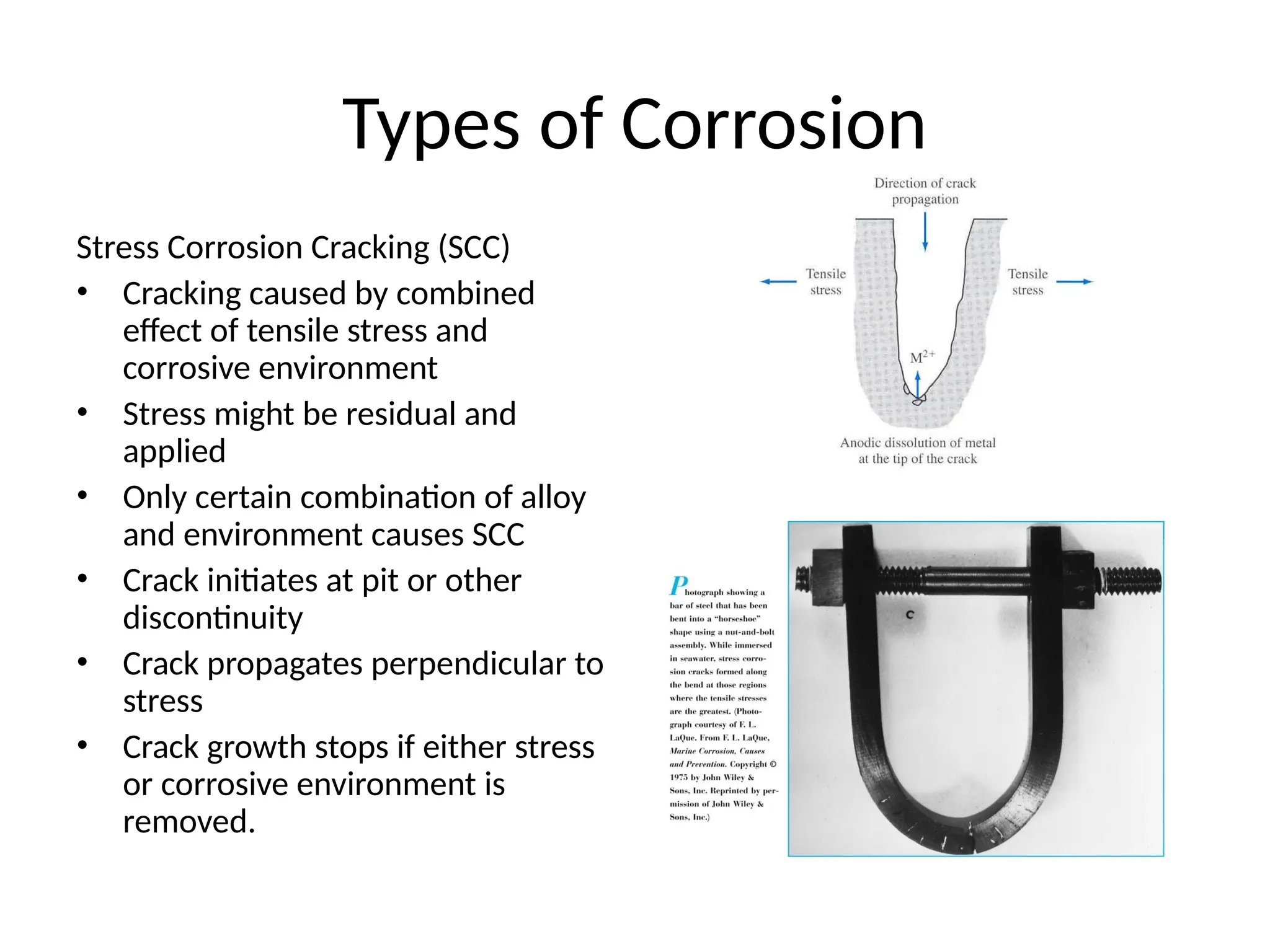
Stress Corrosion Cracking (SCC)
• Cracking caused by combined
effect of tensile stress and
corrosive environment
• Stress might be residual and
applied
• Only certain combination of alloy
and environment causes SCC
• Crack initiates at pit or other
discontinuity
• Crack propagates perpendicular to
stress
• Crack growth stops if either stress
or corrosive environment is
removed.
Types of Corrosion
Erosion corrosion
• Acceleration in rate of corrosion due
to relative motion between corrosive
fluid and surface.
• Pits, grooves, valleys appear on
surface in direction of flow.
• Corrosion is due to abrasive action
and removal of protective film.
Cavitation damage
• Caused by collapse of air bubbles or
vapor filled cavities in a liquid near
metal surface.
• Rapidly collapsing air bubbles
produce very high pressure (60,000
PSI) and damage the surface.
• Occurs at metal surface when high
velocity flow and pressure are
present.
Types of Corrosion
Selective leaching:
• Selective removal of one element of alloy by corrosion
• Example: Dezincification or selective removal of zinc from
copper and brasses
• Weakens the alloy as single metal might not have same
strength as the alloy
Fretting corrosion
• Occurs at interface between materials under load subjected to
vibration and sliding
• Metal fragments get oxidized and act as abrasives between the
surfaces
Corrosion Control
Corrosion
• It is the degradation of a material due to a reaction with its
environment.
OR
• Process of Distruction of the material through chemical or
electrochemical attack by its environment.
• Slow process
• Measured in weight loss per unit time.
Classification:
1. Dry or Chemical Corrosion
2. Wet or Electrochemical corrosion
1.Dry or Chemical Corrosion
- Occurs due to chemical attack of by the environment such as dry gas.
- Occurs due to high temperature and without liquid phase.
• It is of two types:
a) Oxidation corrosion b) Corrosion by gases
(a)Oxidation Corrosion:
- It is due to direct attack of oxygen on metals.
- Oxygen molecules are attracted to the surface by Vander Wall Force
Mechanism:-
1. When temp increases the metal undergoes oxidation and losses e-
2M → 2M+n
+ 2ne-
Metal Ion
2. Electron are gained by the oxygen molecules forms oxide ions
nO2 + 4ne-
→ 2n O2-
Oxide Ion
3. Scale of metal oxide formed
2M + nO2 → 2M + 2n O2-
Metal Oxide
• Stable Corrosion: -Aluminium, Tin, Lead, Copper
• Non-stable corrosion:- Silver, Gold, Platinum
• Pilling – Bed Worth Ratio
Ratio of volume of oxide formed to the
volume of metal consumed.
(b)Corrosion by Gases
Carbon di-oxide, Chlorine, Hydrogen Sulphide, Sulphur di-oxide, Flourine
- Depends on chemical affinity b/w metal and the gas.
2. Wet or Electrochemical Corrosion
• Occurs when aqueous solution or liquid electrolytes are present
• Wet corrosion takes place in environments where the relative
humidity exceeds 60 %.
• Wet corrosion is most efficient in waters containing salts, such as
NaCl (e.g. marine conditions), due to the high conductivity of the
solution.
Mechanism Of Electrochemical Corrosion
Anodic Reaction:
Dissolution of metal takes place.
• As result metal ions are formed with the liberation of free electrons.
M ↔ M+n
+ e-
Metal Ion
Cathodic Reaction
(i) Hydrogen Evolution :- Occurs usually in acidic medium
2H+
+ 2e-
↔ H2 (g)
(ii) Oxygen Absorption :- occurs when solution is aerated sufficiently.
O2+ 4H+
+ 4e-
↔ 2H2O (In acidic medium)
O2+ 4H+
+ 4e-
↔ 4OH-
(In basic medium)
Forms of Corrosion:
(a)Galvanic Corrosion:- When two different metals are present in
contact with each other in conducting medium e.g. Electrolyte
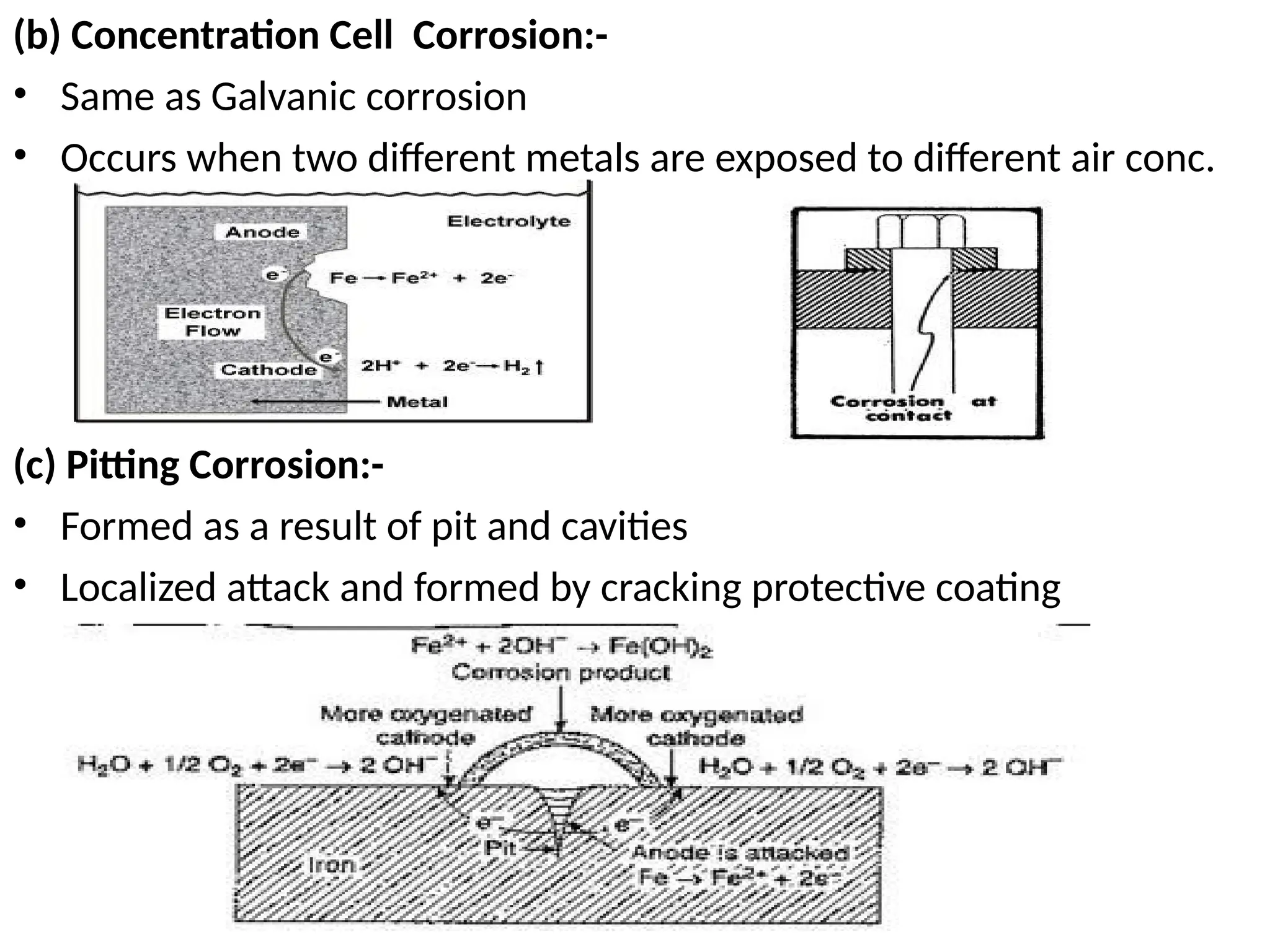
(b) Concentration Cell Corrosion:-
• Same as Galvanic corrosion
• Occurs when two different metals are exposed to different air conc.
(c) Pitting Corrosion:-
• Formed as a result of pit and cavities
• Localized attack and formed by cracking protective coating
(d) Stress Corrosion:
• Occurs in the presence of tensile stress and corrosive environment
• E.g. brass get corrode in traces of ammonia.
Factors Affecting Corrosion
1. Nature of the Metal 2. Nature of the environment.
1. Nature of Metal
(i) Position in Galvanic Series:
If two metals are present in in electrolyte,
the metal with less reduction potential undergoes corrosion.
- Greater the difference faster the corrosion.
(ii) Over Voltage:
Due to high evolution of hydrogen, the rate is slow.
(iii) Area and Distance:
When anodic metal area is smaller than cathodic
area, rate of corrosion at anode is higher because of demand of
electron by cathodic area.
(iv) Physical and Mechanical properties of Metal:
(a)Pure metals are more corrosion resistant.
(b)Smaller grain size metal have high solubility and corrosion.
(c)Uniform distribution of stress on metal reduces rate of corrosion.
(d)Passive metals shows higher corrosion resistance because of
formation of protective oxide film on their surface.
(e)Polycrystalline forms are more sensitive.
2. Nature of Environment
(i) Temperature: directly proportional
(ii)Humidity: faster in humid conditions
(iii)pH : If less than 7 rate is high. Al, Zn, Sn, Pb, and Fe are affected by
both acid and bases.
(iv)Impurities and Suspended Particles: When these will get dissolved
in moisture, provides electrolyte for conductivity and hence corrosion
increases.
Corrosion Control:
1. Selection of metal and alloy:
- Using pure and noble metals
- Practically not possible because of low strength of pure metal
- Use of metal alloys which are homogeneous
2. Proper design of metal:
(i) Minimal contact with medium
(ii)Prevention from moisture
(iii)Adequate ventilation and drainage
(iv)Welding
(v)Avoid cervices b/w adjacent parts
(vi)Bend should be smooth
(vii)Bimetallic contacts should be avoided
(viii)Paint cathodic portion
(ix)Prevent uneven stress
3. Cathodic Protection:
Force the metal to be protected to behave like cathode.
(i) Sacrificial anodic protection:
- Metal to be protected from corrosion connected to more anodic
metal
- Commonly used metals Mg, Zn, Al and their alloys
(ii)Impressed current method:
- Direct current is applied in opposite direction to nullify the corrosion
current
- Converts the corroding metal from anode to cathode.
4. Modifying Environment
(i) Eliminating dissolved oxygen:
- De-aeration
- By using chemical substances like sodium sulphite and hydrazine.
Also called Deactivation.
(ii)Reducing Moisture:
- Dehumidification by using silica gels
(iii)Reducing Acidity:
- Neutralizing the acidic environment by adding lime, NaOH, Ammonia
- Commonly used in refineries
5. Protective coating:
- Application of coating
- Coating material should be chemically inert under particular temp
and pressure.
6. Use of corrosion Inhibitor
(i) Anodic Inhibitor:
- These are oxygen and oxidizing agent.
- They combine the anodic metal forming an oxide film which reduce
corrosion
(ii)Cathodic Protection:
- Organic inhibitors like amines, mercaptans, urea and thiourea
reduces the H ion diffusion by adsorption
- Mercury, arsenic and antimony deposits films at cathodic area which
raise the hydrogen over volume.
- Eliminating Oxygen from the medium by adding sodium sulphate and
hydrazine.
Protective Coating
Surface preparation for Coating:
1. Cleaning:
- To prepare for suitable condition
- Removing contaminants to prevent detrimental reaction product
- E.g. de-greasing, sand blasting, vapour degreasing, pickling and
alkaline cleaning.
2. Solvent Cleaning:
- Must be non-inflammable and nontoxic
- Trichloro trifluoroethane which has low toxicity are costlier
- Vapour de-greasing is economical and advantageous because of
continuous cleaning with small quantities of solvent.
3. Electrolyte Pickling:
- Provides better and rapid cleaning by increasing hydrogen evolution
resulting in agitation and blasting action
- Sand blasting is mechanical cleaning.
4. Alkaline Cleaning:
- Cheaper and less hazardous
- Used in conjunction with surface active (wetting) agent
- Ability depends on pH, rapidly decreases below 8.5
- Other abilities are rinsability, detergent properties, sequestering,
wetting etc.
5. Acid Cleaning
- Acid such as HCl, H2SO4, H3PO4 is very effective.
- 5-10% H2SO4 and HCl used to remove inorganic contaminants.
- Pickling are performed at high temp. (60 C)
̊
- Is effective for removal of grease, oil , dirt and rust.
Methods of Application of Metallic Coating
1. Hot Dipping:
- Metal is kept in molten state and base metal is dipped into it.
- Used for producing a coating of low M.P
- E.G. Tinning (Tin coating on Iron)
- Process is followed by cooling the coating through a palm oil to
prevent oxidation of tin plate to its oxide.
- Palm oil layer is removed by alkaline cleansing agent.
2. Metal Cladding:
- The surface to be protected is sandwiched between two layers of the
coating metals and pressed between rollers.
- E.g. Alclad Sheeting– Plate of duralumin is sandwiched between
99.5%pure aluminum
3. Electro Plating:
- Pure metal is made as cathode and base metal as anode.
- Electrochemically coat metal is deposited on base metal.
- This metal gives smooth, fine and uniform coating
- It depends on
(i) Temperature (ii) Current density (iii) Electrolyte Concentration
(iv)Nature of base metal (v) Time
4. Electroless Plating:
- Nobel metal is deposited catalytically on less noble metal by using
reducing agent without using electrical energy.
- Advantage over Electro plating
(i) More economical since no electricity required
(ii)Irregular shape can be plated uniformly
(iii)Plating on plastics can also be done
5. Metal Spraying:
- Coating is applied by means of spraying device
- E.g. Aluminum is plated in this way on Aircrafts.
Chemical Conversion Coating
• These are formed on metal surface by chemical reaction b/w metal
surface and inorganic salt solution
• Coating base metal is converted into one of the resultant protective
film.
• These films are insoluble, adherent, crystalline or amorphous in
nature.
• Can be done in 3 ways
1. Phosphate coating
2. Chromate coating
3. Anodized coating
1. Phosphate Coating
- Produced by chemical reaction b/w base metal and aq. H3PO4, Zn or
Fe or Mn Phosphate
- Phosphate coating are applied Iron, Steel, and Zinc
- Film formed on base metal after coating consist of Zn-Fe, Mn-Fe
Phosphates.
2. Chromate Coating
- Produced by dipping the base metal in Potassium chromate (acidic)
followed by immersion in neutral chromate bath.
- Resulting film consist of trivalent and hexavalent chromium.
- Used as base for paints, lacquers and enamels.
3. Anodized Coating
- Formed by anodic oxidation process
- This is produced on non-ferrous metals like Al, Zn, Mg
- In this method base metal is made as anode
- Process is carried out by passing moderate direct current through a
bath in which the metal is suspended as anode.
- Coating are formed as a result of Progressive oxidation starting at
surface of base metal.

Physical Oxidation numbers Galvanic cells.ppt

  • 1.
  • 2.
    Contents • Introduction • Oxidationnumbers • Galvanic cells • Standard reduction potentials • Cell potential, electrical work, and free energy • Dependence of cell potential on concentration • Batteries • Corrosion • Electrolysis
  • 3.
    Oxidation-Reduction Reactions 2Mg (s)+ O2 (g) 2MgO (s) 2Mg 2Mg2+ + 4e- Oxidation half-reaction (lose e- ) O2 + 4e- 2O2- Reduction half-reaction (gain e- ) 2Mg + O2 + 4e- 2Mg2+ + 2O2- + 4e- 2Mg + O2 2MgO
  • 4.
    Oxidation-Reduction Reactions • OxidizingAgent- a substance that accepts electrons from another substance, causing the other substance to be oxidized. • Reducing Agent- a substance that donates electrons to another substance, causing it to become reduced.
  • 5.
    Oxidation-Reduction Reactions Zn (s)+ CuSO4 (aq) ZnSO4 (aq) + Cu (s) Zn Zn2+ + 2e- Zn is oxidized Zn is the reducing agent Cu2+ + 2e- Cu Cu2+ is reduced Cu2+ is the oxidizing agent
  • 6.
    Oxidation Number • OxidationNumber- the number of charges the atom would have in a molecule (or an ionic compound) if electrons were transferred completely. • H2(g) + Cl2(g) → 2HCl(g) • 0 0 +1 -1
  • 7.
    Assigning Oxidation Numbers 1.Free elements (uncombined state) have an oxidation number of zero. Na, Be, K, Pb, H2, O2, P4 = 0 2. In monatomic ions, the oxidation number is equal to the charge on the ion. Li+ , Li = +1; Fe3+ , Fe = +3; O2- , O = -2 3. The oxidation number of oxygen is usually –2. In H2O2 and O2 2- it is –1.
  • 8.
    Assigning Oxidation Numbers 4.The oxidation number of hydrogen is +1 except when it is bonded to metals in binary compounds. In these cases, its oxidation number is –1. 5. Group IA metals are +1, IIA metals are +2 and fluorine is always –1. 6. The sum of the oxidation numbers of all the atoms in a molecule or ion is equal to the charge on the molecule or ion.
  • 9.
    Assigning Oxidation Numbers Oxidationnumbers of all the elements in HCO3 - ? HCO3 - O = -2 H = +1 3x(-2) + 1 + ? = -1 C = +4
  • 11.
  • 12.
    Redox reactions (quickreview) • Oxidation – loss of electrons • Reduction – gain of electrons • Reducing agent – donates the electrons and is oxidized • Oxidizing agent – accepts electrons and is reduced
  • 13.
    Redox Reactions • Directredox reaction – Oxidizing and reducing agents are mixed together
  • 14.
    CuSO4(a q) (Cu2+ ) Zn rod DirectRedox Reaction Direct Redox Reaction
  • 15.
    CuSO4(a q) (Cu2+ ) Zn rod Depositof Cu metal forms Direct Redox Reaction Direct Redox Reaction
  • 16.
    Redox Reactions • Directredox reaction – Oxidizing and reducing agents are mixed together • Indirect redox reaction – Oxidizing and reducing agents are separated but connected electrically • Example – Zn and Cu2+ can be reacted indirectly – Basis for electrochemistry – Electrochemical cell
  • 17.
  • 18.
    Electrochemical Cells • VoltaicCell – cell in which a spontaneous redox reaction generates electricity – chemical energy  electrical energy
  • 19.
  • 20.
    Generally, salts likeKCl, KNO3, etc. are used. The seturated solutions of these electrolytes are prepared in agar agar jelly or gelatin. The jelly keeps the electrolyte in semi-solid phase and thus prevents mixing. The important functions of the salt bridge are: a) Salt bridge completes the electrical circuit. b) Salt bridge maintains electrical neutrality of two half cell solution. The accumulation of charges in the two half cells (accumulation of extra positive charge in the solution around the anode according to the realizing of Zn2+ in excess and accumulation of extra negative charge in the solution around the catode due to excess of SO4 2- ) is prevented by using salt bridge, which provides a passage for the flow of the charge in the internal circuit.
  • 21.
  • 22.
    Electrochemical Cells • ElectrolyticCell – electrochemical cell in which an electric current drives a nonspontaneous redox reaction – electrical energy  chemical energy
  • 23.
  • 24.
    Cell Potential Ecell =Ecathode - Eanode = Eredn - Eox E°cell = E°cathode - E°anode = E°redn - E°ox ( Ecathode and Eanode are reduction potentials by definition ).
  • 25.
    Cell Potential • E°cell= E°cathode - E°anode = E°redn - E°ox – Ecell can be measured • Absolute Ecathode and Eanode values cannot • Reference electrode – has arbitrarily assigned E – used to measure relative Ecathode and Eanode for half- cell reactions • Standard hydrogen electrode (S.H.E.) – conventional reference electrode
  • 26.
    Oxidation reduction reactions •Oxidation reduction reactions involve a transfer of electrons. • Oxidation Involves Loss of electrons – Increase in the oxidation number • Reduction Involves Gain electrons – Decrease in the oxidation number Galvanic Cells
  • 27.
    • Thus aGalvanic cell is a device in which a chemical energy is changed to electrical energy • The electrochemical reactions occur at the interface between electrode and solution where the electron transfer occurs • Anode: the electrode compartment at which oxidation occurs • Cathode: the electrode compartment at which reduction occurs
  • 28.
    Cell Potential • Oxidizingagent pulls pulls the electrons • Reducing agent pushes the electrons • The total push or pull (“driving force”) is called the cell potential, Ecell • Also called the electromotive force (emf) • Unit is the volt(V) = 1 joule of work/coulomb of charge • Measured with a voltmeter
  • 29.
    Measuring the cellpotential • Can we measure the total cell potential?? • A galvanic cell is made where one of the two electrodes is a reference electrode whose potential is known. • Standard hydrogen electrode (H+ = 1M and the H2 (g) is at 1 atm) is used as a reference electrode and its potential was assigned to be zero at 25 0 C.
  • 30.
    The most importanttypes of electrodes are: 1. The first reference electrode: Metal-metal ion electrodes and gas-ion electrodes 2. The second reference electrode: Metal-insoluble salt-anion electrodes 3. The third reference electrode: inert "oxidation- reduction" electrodes 4. Membrane electrodes
  • 31.
    The metal -metal ion electrode consists of а metal in contact with its ions in solution. An example is а piece of silver metal immersed in а solution of silver nitrate. The diagram for such an electrode serving as а cathode (it would appear at the right in а cell diagram) is: Ag+ (aq)  Ag(s) and the cathode half-reaction is: Ag+ (aq) + e- Ag(s) in which the electrons соmе from the external circuit. When this electrode serves as an anode, it is diagramed as: Ag(s)  Ag+(aq) (as it would appear at the left in а cell diagram), and its half- reaction equation is: Ag(s)  Ag+ (aq) + е- In general the first reference electrons can be represented as: Mz+ /M. The half reduction reaction is: Mz+ + ze  M Following convention the half reaction that occurs on the electrode is written as a reduction reaction
  • 32.
    2. In themetal-insoluble salt-anion electrode, а metal is in contact with one of its insoluble salts and also with а solution containing the anion of the salt. An example is the so-called silver - silver chloride electrode, written as а cathode as: Cl- (aq)  AgCl(s)  Ag(s) for which the cathode half-reaction is: AgCl (s) + е-  Ag(s) + Cl- (aq) EAg,AgCl | Cl- = E0 Ag+/AgCl - 0.059 lg aCl- E0 Ag+/AgCl = 0,2224 A 0 a log n 0.059 E    z E
  • 33.
    Silver - silverchloride electrode Ag, is covered by the layer of nonsoluble AgCl КCl solution KCl, AgCl | Ag
  • 34.
    Calomel electrode consistsof the mercury and calomel past that is dipped in potassium chloride solution. It is often used as a reference electrode to determine the standard electrode potential ( more often than hydrogen electrode). Its scheme is: Cl- |Hg2Cl2, Hg The half reaction is: Hg2Cl2 + 2e  2Hg + 2Cl- Ecell = E0 - 0.059 lg aCl- As a rule to use the calomel electrodes that contain 0,1 M, 1 M and saturated solution of potassium chloride. Their standard potential at 298K equal; 0,337; 0,2801; 0,2412 V.
  • 35.
    3. An inertoxidation-reduction electrode It consists of а strip, wire, or rod of an inert materiel (Pl, Au, Ir…) in contact with а solution, which contains ions of а substance is two different oxidation states (oxidation and reduction form). The difference between general metal electrode and ox-red electrode is that ox/red electrode does not take place in ox-red reaction which exist in solution but is the electrons conductor. For example: Pt| Sn2+ , Sn4+ or Pt| Fe2+ , Fe3+ Ox +ze → Red There are two types of ox-red electrodes: 1.Simple: Fe2+ , Fe3+ | Pt Fe3+ + e → Fe2+ Ox Red 0 a a log n 0.059 E   E     3 2 Fe Fe 0 a a log n 0.059 E E
  • 36.
    Scheme of ox-redelectrode Scheme of ox-red electrode ( (the third reference electrode) the third reference electrode) Pt FeCl3 + FeCl2 Fe3+ , Fe2+ | Pt Fe3+ + e = Fe2+         2 3 2 3 2 3 lg 059 . 0 0 / / Fe Fe Fe Fe Fe Fe a a E E
  • 37.
    2. Complex ox-redelectrode there is changing the charge and the composition of the ions Mn2+ , MnO4 - , H+ | Pt MnO4 - + 8H+ +5e→Mn2+ +4H2O Example is quinonhydrone electrode. It is prepared by the platinum strip or wire which is contained in the glass tube. The electrode is dipped in the solution with unknown pH that is needed to determine and to add some quinonhydrone’s crystalls in this solution. Quinonhydrone is a crystalline product which consists of quinone (benzoquinone) С6Н4О2 and hydroquinone C6H4(OH)2. It is less solubility in water and decomposes into quinone and hydroquinone in the solution. In the saturated solution equal molar mixture of quinone and hydroquinone is formed.
  • 38.
    Quinonhydrone electrode ( (the thirdreference electrode the third reference electrode) )    H cell a E E lg 059 . 0 0 С6Н4О2, С6Н4(ОН)2, H+ | Pt С6Н4О2 + 2Н+ + 2е = С6Н4(ОН)2     Н O H C OH H C cell а а a E E 2 ) ( 0 2 4 6 2 4 6 lg 2 059 . 0 Including that the activity of Including that the activity of quinone and hydroquinone is quinone and hydroquinone is equal in the seturated solution, equal in the seturated solution, we have we have Quinonhydrone
  • 39.
    The scheme ofquinonhydrone cell with one The scheme of quinonhydrone cell with one electrolyte electrolyte Pt, Н2 | quinhydr, H+ | KCl | KCl,Hg2Cl2| Hg Ecell = E quinhydr - Ecalomel
  • 40.
    Standard electrode potential Sincea half cell in an electrochemical cell can work only in combination with the other half cell and does not work independently, it is not possible to determine the absolute electrode potential of an electrode. We can, therefore, find only the relative electrode potential. This difficulty can be solved by selecting one of the electrodes as a reference electrode and arbitrarily fixing the potential of this electrode as zero. For this purpose, reversible hydrogen electrode has been universally accepted as a reference electrode. It is called standard hydrogen electrode (S.H.E) or normal hydrogen electrode (N.H.E.)
  • 41.
    Standard hydrogen electrode.It consists of platinum wire sealed in a glass tube and has a platinum foil attached to it. The foil is coated with finely divided platinum and acts as platinum electrode. It is dipped into an acid solution containing H+ ions in 1 M concentration (1M HCl). Pure hydrogen gas at 1 atmospheric pressure is constantly bubbled into solution at constant temperature of 298K. The surface of the foil acts as a site for the reaction.
  • 43.
    The electrode potentialof an electrode can be determined by connecting this half cell with a standard hydrogen electrode. The electrode potential of the standard hydrogen electrode is taken as zero. The electrode potential of a metal electrode as determined with respect to a standard or normal hydrogen electrode is called standard electrode potential (E0 ). Standard electrode potentials are always associated with the reduction occurring at the electrodes.
  • 44.
    Standard Electrode Potentials Zn(s) | Zn2+ (1 M) || H+ (1 M) | H2 (1 atm) | Pt (s) 2e- + 2H+ (1 M) 2H2 (1 atm) Zn (s) Zn2+ (1 M) + 2e- Anode (oxidation): Cathode (reduction):
  • 45.
    Standard Reduction Potentials,E • The E values corresponding to reduction half- reactions with all solutes at 1M and all gases at 1 atm. • Ecan be measured by making a galvanic cell in which one of the two electrodes is the Standard Hydrogen electrode, SHE, whose E0 V • The total potential of this cell can be measured experimentally • However, the individual electrode potential can not be measured experimentally. Why?
  • 46.
    • If thecathode compartment of the cell is SHE, then the half reaction would be 2H+ + 2e  H2 (g); Eo = 0V • And the anode compartment is Zn metal in Zn2+ , (1 M) then the half reaction would be Zn Zn2+ + 2e • The total cell potential measured experimentally was found to be + 0.76 V • Thus, +0.76 V was obtained as a result of this calculation: Eº cell = EºZn Zn 2+ + Eº H + H2 0.76 V 0.76 V 0 V
  • 47.
    Standard Reduction Potentials •The E values corresponding to reduction half- reactions with all solutes at 1M and all gases at 1 atm. can be determined by making them half cells where the other half is the SHE. • E0 values for all species were determined as reduction half potentials and tabulated. For example: – Cu2+ + 2e  Cu E = 0.34 V – SO4 2 + 4H+ + 2e  H2SO3 + H2O E = 0.20 V – Li+ + e- Li E = -3.05 V
  • 48.
    Some Standard ReductionPotentials Li+ + e- ---> Li -3.045 v Zn+2 + 2 e- ---> Zn -0.763v Fe+2 + 2 e- ---> Fe -0.44v 2 H+ (aq) + 2 e- ---> H2(g) 0.00v Cu+2 + 2 e- ---> Cu +0.337v O2(g) + 4 H+ (aq) + 4 e- ---> 2 H2O(l) +1.229v F2 + 2e- ---> 2 F- +2.87v
  • 49.
  • 50.
    • E0 is forthe reaction as written • The more positive E0 the greater the tendency for the substance to be reduced • The more negative E0 the greater the tendency for the substance to be oxidized • Under standard-state conditions, any species on the left of a given half- reaction will react spontaneously with a species that appears on the right of any half-reaction located below it in the table
  • 51.
    • The half-cell reactionsare reversible • The sign of E0 changes when the reaction is reversed • Changing the stoichiometric coefficients of a half-cell reaction does not change the value of E0
  • 52.
    Can Sn reduceZn2+ under standard-state conditions? •How do we find the answer? •Look up the Eº values in in the table of reduction potentials •Which reactions in the table will reduce Zn2+ (aq)? Zn+2 + 2 e- ---> Zn(s) -0.763v Sn+2 + 2 e- ---> Sn -0.143v Look up the Eº values in in the table of reduction potentials
  • 53.
    Standard cell potential •Zn(s) + Cu+2 (aq) Zn+2 (aq) + Cu(s) • The total standard cell potential is the sum of the potential at each electrode. • Eº cell = EºZn Zn 2+ + Eº Cu +2 Cu • We can look up reduction potentials in a table. • One of the reactions must be reversed, in order to change its sign.
  • 54.
    Standard Cell Potential •Determine the cell potential for a galvanic cell based on the redox reaction. • Cu(s) + Fe+3 (aq) Cu+2 (aq) + Fe+2 (aq) • Fe+3 (aq)+ e-  Fe+2 (aq) Eº = 0.77 V  • Cu+2 (aq)+2e- Cu(s) Eº = 0.34 V • Cu(s) Cu+2 (aq)+2e- Eº = -0.34 V • 2Fe+3 (aq)+ 2e-  2Fe+2 (aq) Eº = 0.77 V  • Eo cell = Eo Fe 3+ Eo Fe 2+ + Eo CuEo Cu 2+ • Eo cell = 0.77 + (-0.34) = o.43 V
  • 55.
    • The totalreaction: Cu(s) Cu+2 (aq)+2e- Eº = -0.34 V 2Fe+3 (aq)+ 2e-  2Fe+2 (aq) Eº = 0.77 V  Cu(s) + 2Fe+3 (aq) Cu2 + + 2Fe2+ Eºcell = +0.43 V
  • 56.
    Line Notation • SolidAqueousAqueoussolid •Anode on the leftCathode on the right • Single line different phases. • Double line porous disk or salt bridge. Zn(s)Zn2 +(aq)Cu2+ Cu • If all the substances on one side are aqueous, a platinum electrode is indicated. • For the last reaction • Cu(s)Cu+2 (aq)Fe+2 (aq),Fe+3 (aq)Pt(s)
  • 58.
    Complete description ofa Galvanic Cell • The reaction always runs spontaneously in the direction that produces a positive cell direction that produces a positive cell potential potential. • Four parameters are needed for a complete description: 1. Cell Potential 2. Direction of flow 3. Designation of anode and cathode 4. Nature of all the components- electrodes and ions
  • 59.
    Exercise • Describe completelythe galvanic cell based on the following half-reactions under standard conditions. MnO4 - + 8 H+ +5e-  Mn+2 + 4H2O Eº=1.51 Fe+3 +3e-  Fe(s) Eº=0.036V 1. Write the total cell reaction 2. Calculate Eo cell 3. Define the cathode and anode 4. Draw the line notation for this cell
  • 60.
    Potential, Work, Gand spontaneity • Gº = -nFE º • if E º > 0, then Gº < 0 spontaneous • if E º < 0, then Gº > 0 nonspontaneous • In fact, the reverse process is spontaneous.
  • 61.
    Spontaneity of RedoxReactions G = -nFEcell G0 = -nFEcell 0 n = number of moles of electrons in reaction F = 96,500 J V • mol = 96,500 C/mol G0 = -RT ln K = -nFEcell 0 Ecell 0 = RT nF ln K (8.314 J/K•mol)(298 K) n (96,500 J/V•mol) ln K = = 0.0257 V n ln K Ecell 0 = 0.0592 V n log K Ecell 0
  • 62.
    Spontaneity of RedoxReactions If you know one, you can calculate the other… If you know K, you can calculate Eº and Gº If you know Eº, you can calculate Gº
  • 63.
    Spontaneity of RedoxReactions Relationships among G º, K, and Eºcell
  • 64.
    2(3e- + Al3+ Al) 3 (MgMg2+ + 2e- ) Oxidation: Reduction: Calculate G0 for the following reaction at 250 C. 2Al3+ (aq) + 3Mg(s) 2Al(s) + 3Mg+2 (aq) n = ? G0 = -nFEcell 0 E0 = Ered + Eox cell 0 0 G0 = -nFEcell 0 = ___ X (96,500 J/V mol) X ___ V G0 = _______ kJ/mol
  • 65.
    The Nernst Equation Effectof Concentration on Cell Emf G = G0 + RT ln Q G = -nFE G0 = -nFE0 -nFE = -nFE0 + RT ln Q E = E0 - ln Q RT nF Nernst equation At 298K - 0.0257 V n ln Q E0 E = - 0.0592 V n log Q E0 E =
  • 66.
    The Nernst Equation •As reactions proceed concentrations of products increase and reactants decrease. • When equilibrium is reached Q = K ; Ecell = 0 and G = 0 (the cell no longer has the ability to do work)
  • 67.
    Predicting spontaneity usingNernst equation • Qualitatively: we can predict the direction of change in E from Lechatelier principle • Find Q • Calculate E • E > 0; the reaction is spontaneous to the right E < 0; the reaction is spontaneous to the left
  • 68.
    Will the followingreaction occur spontaneously at 250 C if [Fe2+ ] = 0.60 M and [Cd2+ ] = 0.010 M? Fe2+ (aq) + Cd (s) Fe (s) + Cd2+ (aq) 2e- + Fe2+ 2Fe Cd Cd2+ + 2e- Oxidation: Reduction: n = 2 E0 = -0.44 + (+0.40) E0 = -0.04 V E0 = EFe /Fe + ECd /Cd 2+ 0 0 2+ - 0.0257 V n ln Q E0 E = - 0.0257 V 2 ln -0.04 V E = 0.010 0.60 E = ____________ E ___ 0 ________________
  • 69.
    Exercise • Determine thecell potential at 25o C for the following cell, given that • 2Al(s) + 3Mn+2 (aq)  2Al+3 (aq) + 3Mn(s) [Mn2+ ] = 0.50 M; [Al3+ ]=1.50 M; E0 cell = 0.4 • Always we have to figure out n from the balanced equation 2(Al(s) +  Al+3 (aq) + 3e- ) 3(Mn+2 (aq) + 2e-  Mn(s)) n = 6 - 0.0592 V n log Q E0 E =
  • 70.
    Calculation of EquilibriumConstants for redox reactions At equilibrium, Ecell = 0 and Q = K. Q n E E o log 059 . 0   Then, K n Eo log 0591 . 0 0   0591 . 0 log o nE K   at 25 o C
  • 71.
    2e- + Fe2+ Fe 2Ag 2Ag+ +2e- Oxidation: Reduction: What is the equilibrium constant for the following reaction at 250 C? Fe2+ (aq) + 2Ag (s) Fe (s) + 2Ag+ (aq) = 0.0257 V n ln K Ecell 0 E0 = -0.44 –0.80= -1.24 V E0 = -1.24 V 0.0257 V x n E0 cell exp K = n = ___ 0.0257 V x 2 -1.24 V = exp K = ________________ E0 = EFe /Fe+ EAg /Ag 0 0 2+ +
  • 72.
    Concentration Cell: bothcompartments contain same components but at different concentrations Half cell potential are not identical Because the Ag+ Conc. On both sides are not same Eright > Eleft • To make them equal, [Ag+ ] On both sides should same • Electrons move from left to right
  • 73.
    Batteries Batteries Lead-Storage Battery Lead-Storage Battery A 12 V car battery consists of 6 cathode/anode A 12 V car battery consists of 6 cathode/anode pairs each producing 2 V. pairs each producing 2 V.  Cathode Cathode: : PbO PbO2 2 on a metal grid in sulfuric acid: on a metal grid in sulfuric acid: PbO PbO2 2( (s s) + SO ) + SO4 4 2- 2- ( (aq aq) + 4H ) + 4H+ + ( (aq aq) + 2e ) + 2e- -   PbSO PbSO4 4( (s s) + 2H ) + 2H2 2O( O(l l) )  Anode: Pb: Anode: Pb: Pb( Pb(s s) + SO ) + SO4 4 2- 2- ( (aq aq) )   PbSO PbSO4 4( (s s) + 2e ) + 2e- - Batteries are Galvanic Cells
  • 74.
    Anode: Cathode: Lead storage battery PbO2(s) + 4H+ (aq) + SO2- (aq) + 2e- PbSO4 (s) + 2H2O (l) 4 Pb (s) + SO2- (aq) PbSO4 (s) + 2e- 4 Pb (s) + PbO2 (s) + 4H+ (aq) + 2SO2- (aq) 2PbSO4 (s) + 2H2O (l) 4
  • 75.
    Dry cell Batteries Zn(s) Zn2+ (aq) + 2e- Anode: Cathode: 2NH4 (aq) + 2MnO2 (s) + 2e- Mn2O3 (s) + 2NH3 (aq) + H2O (l) + Zn (s) + 2NH4 (aq) + 2MnO2 (s) Zn2+ (aq) + 2NH3 (aq) + H2O (l) + Mn2O3 (s
  • 76.
    Dry Cell Battery DryCell Battery  Anode: Zn cap: Anode: Zn cap: Zn( Zn(s s) )   Zn Zn2+ 2+ ( (aq aq) + 2e ) + 2e- -  Cathode: MnO Cathode: MnO2 2, NH , NH4 4Cl and C paste: Cl and C paste: 2NH 2NH4 4 + + ( (aq aq) + 2MnO ) + 2MnO2 2( (s s) + 2e ) + 2e- -   Mn Mn2 2O O3 3( (s s) + 2NH ) + 2NH3 3( (aq aq) + ) + 2H 2H2 2O( O(l l) )  Total reaction: Total reaction: Zn + NH4 + +MnO2  Zn2+ + NH3 + H2O  This cell produces a potential of about 1.5 V. This cell produces a potential of about 1.5 V.  The graphite rod in the center is an inert The graphite rod in the center is an inert cathode. cathode.
  • 77.
    For an alkalinebattery, NH For an alkaline battery, NH4 4Cl is replaced with Cl is replaced with KOH. KOH. Anode: oxidation of Zn Anode: oxidation of Zn Zn( Zn(s s) + 2OH ) + 2OH- -   ZnO + H ZnO + H2 2O + 2e O + 2e- - Cathode: reduction of MnO Cathode: reduction of MnO2 2. . 2MnO2 + H H2 2O + 2e O + 2e- -   Mn2O3 + 2OH- • Total reaction Zn(s) + 2 MnO2(s) ---> ZnO(s) + Mn2O3(s) It lasts longer because Zn anode corrodes It lasts longer because Zn anode corrodes less rapidly than under acidic conditions. less rapidly than under acidic conditions. Alkaline Cell Battery Alkaline Cell Battery
  • 78.
  • 79.
    Fuel Cells A fuelcell is a galvanic cell that requires a continuous supply of reactants to keep functioning Anode: Cathode: O2 (g) + 2H2O (l) + 4e- 4OH- (aq) 2H2 (g) + 4OH- (aq) 4H2O (l) + 4e- 2H2 (g) + O2 (g) 2H2O (l)
  • 80.
    Corrosion • Rusting -spontaneous oxidation of metals. • Most metals used for structural purposes have reduction potentials that are less positive than O2 . (They are readily oxidized by O2) • Fe+2 +2e-  Fe Eº= - 0.44 V • O2 + 2H2O + 4e- 4OH- Eº= 0.40 V • When a cell is formed from these two half reactions a cell with +ve potential will be obtained • Au, Pt, Cu, Ag are difficult to be oxidized (noble metals) • Most metals are readily oxidized by O2 however, this process develops a thin oxide coating that protect the internal atoms from being further oxidized. • Al Al that has Eo = -1,7V is easily oxidized. Thus, it is used for making the body of the airplane.
  • 81.
    Water Rust Iron dissolves forminga pit e- Salt speeds up process by increasing conductivity Anodic area Cathodic area Fe Fe+2 + 2e- Anodic reaction O2 + 2H2O + 4e- 4OH- cathodic reaction Electrochemical corrosion of iron Fe2+ (aq) + O2(g) + (4-2n) H2O(l)  2F2O3(s).nH2O (s)+ 8H+(aq)
  • 82.
    • Fe onthe steel surface is oxidized (anodic regions) • Fe  Fe+2 +2e- Eº=- 0.44 V • e-’s released flow through the steel to the areas that have O2 and moisture (cathodic regions). Oxygen is reduced • O2 + 2H2O + 4e- 4OH- Eº= 0.40 V • Thus, in the cathodic region Fe+2 will react with O2 • The total reaction is: Fe2+ (aq) + O2(g) + (4-2n) H2O(l)  2F2O3(s).nH2O (s)+ 8H+(aq) • Thus, iron is dissolved to form pits in steel • Moisture must be present to act as the salt bridge • Steel does not rust in the dry air • Salts accelerates the process due to the increase in conductivity on the surface
  • 83.
    Preventing of Corrosion •Coating to keep out air and water. • Galvanizing - Putting on a zinc coat • Fe Fe2+ + 2e- Eo ox = 0.44V • Zn Zn2+ + 2e- Eo ox = 0.76 V • Zn has a more positive oxidation potential than Fe, so it is more easily oxidized. • Any oxidation dissolves Zn rather than Fe • Alloying is also used to prevent corrosion. stainless steel contains Cr and Ni that make make steel as a noble metal • Cathodic Protection - Attaching large pieces of an active metal like magnesium by wire to the pipeline that get oxidized instead. By time Mg must be replaced since it dissolves by time
  • 84.
    Cathodic Protection ofan Underground Pipe
  • 85.
    Cathodic Protection ofan Iron Storage Tank
  • 86.
    If you wishedto electroplate an object, you might ask yourself the following questions: How can I determine how much metal is being plated? How long should I leave the object being plated in the electroplating cell? What size electric current should be used? Faraday’s Laws of Electrolysis Faraday’s Laws of Electrolysis
  • 87.
    Michael Faraday wasa 19th century English chemist. His studies yielded two laws relating amount of electric current and the chemicals produced by the current or used to produce it. These laws enable us to: Work out the amount of energy required to discharge a metal ion and place it out on an object or To calculate the amount of metal produced in an electrolytic cell. Faraday’s Laws of Electrolysis Faraday’s Laws of Electrolysis
  • 88.
    The mass ofmetal produced at the cathode is directly proportional to the quantity of electricity passed through the cell m  Q Electric charge, Q, is measured using the unit coulomb. The electric charge passing through a cell may be calculated from measurements of the current, I, through the cell and the time, t, for which the current flows. Charge (coulombs) = current (amps) x time (seconds) Q = I t Faraday’s Laws of Electrolysis – First Law Faraday’s Laws of Electrolysis – First Law
  • 89.
    In order toproduce one mole of metal, one two or three moles of electrons must be consumed. Faraday found that there was a certain charge associated with one mole of electrons. This amount of charge is now called the Faraday and is equivalent to 96 487 (96 500) Coulomb. 1 Faraday = 96 500 Coulomb Faraday’s Laws of Electrolysis – Second Law Faraday’s Laws of Electrolysis – Second Law
  • 90.
    In order toproduce one mole of metal, one two or three moles of electrons must be consumed. Ag+ (aq), Cu2+ (aq) and Cr3+ (aq) require 1, 2 and 3 moles of electrons for discharge. The quantity of electricity required will be: Amount of charge = no. of moles of metal ions x charge on an ion x 1 Faraday Q = n z F and Q = I t I t = n z F Faraday’s Laws of Electrolysis – Second Law Faraday’s Laws of Electrolysis – Second Law
  • 91.
    1. Calculate thenumber of mole of copper produced in an electrolytic cell if a current of 5.0 A at a voltage of 6.0 V flows through a solution of copper ions for 10 minutes. 2. Calculate the time taken to deposit 1.00 g of copper onto an object that is placed in a solution of copper nitrate, Cu(NO3)2, and has a current of 2.50 A flowing through it. 3. In an operating Hall-Héroult cell, a current of 150 000 A is used at 5.0 V. Calculate the mass of aluminium that would be produced if this cell operates continuously for 1 day. 4. The electrolysis of a solution of chromium ions using a current of 2.2 A for 25 minutes produced 0.60 g of chromium. Calculate the charge on the chromium ion. 5. Calculate the masses of metal produced when 600 Faraday of charge is used to reduce the ions of aluminium, silver and zinc. Faraday’s Laws of Electrolysis – Questions Faraday’s Laws of Electrolysis – Questions
  • 92.
    1. n (Cu)= I t / z F n (Cu) = 5.0 x 10 x 60 / 2 x 96 500 n (Cu) = 1.6 x 10⁻² mol That is, 1.6 x 10⁻² mole of copper would be produced 2. t = n (Cu) z F / I t = (1.00 / 63.5) x 2 x 96 500 / 2.5 t = 1216 seconds That is, it takes 20 minutes 15 seconds to deposit 1.00 g of copper 3. n (Al) = I t / z F n (Al) = 150 000 x 24 x 60 x 60 / 3 x 96 500 n (Al) = 44 767 mol m (Al) = 44 767 x 27 = 1 208 705 g That is, 1.2 tonne of aluminium is produced per day Faraday’s Laws of Electrolysis – Solutions Faraday’s Laws of Electrolysis – Solutions
  • 93.
    4. z (Cr)= I t / n F z (Cr) = 2.2 x 25 x 60 / (0.60 / 52) x 96 500 z (Cr) = 2.96 As the charge on an ion is a small integer, it must be 3+. The ion is Cr3+ . 5. Q = m z F / M As Q = 600 F, then m = 600 M / z m (Al) = 600 x 27 / 3 = 5400 g m (Ag) = 600 x 107.9 / 1 = 64 740 g m (Zn) = 600 x 65.4 / 2 = 19 620 g The same 600 F of charge would produce different masses of these metals; 5.4 kg of Al, nearly 20 kg of Zn and almost 65 kg of Ag. Faraday’s Laws of Electrolysis – Solutions Faraday’s Laws of Electrolysis – Solutions
  • 94.
    Corrosion Kinetics • Upto this point, we have dealt with the thermodynamics of corrosion, i.e. which combinations of conditions results in anodic and cathodic regions under equilibrium • Corrosion does not occur under equilibrium conditions • Of interest is the corrosion kinetics, i.e. the rate at which a metal corrodes • For each atom of a metal that participates in the oxidation reaction, n electrons need to get transported away • The weight of a metal that is lost due to corrosion is given by Faraday’s law • M  Mn+ + ne- w = weight loss during corrosion (or weight gain during electroplating) I = current in amps = iA i = current density A = area of corroding surface t = time in seconds M = atomic mass g/mole n = number of electrons involved in the corrosion reaction F = Faraday’s constant = 96,500 C/mol nF ItM w 
  • 95.
    Polarization • In anelectrochemical half cell the metal atoms are in a state of equilibrium with its ions in solution – There is an equilibrium exchange current density i0 associated with the transfer of electrons at the standard emf potential E0 (or V0 ) of the half cell • There is an i0 and E0 associated with the anodic and cathodic reactions • However, potential differences cannot be maintained in a conductive metal, such as Zn • There is a displacement of the electrode potentials and currents from points A and B to C • This displacement of electrode potentials is called polarization Point A: -0.763V, 10-7 A/cm2 Point B: 0V, 10-10 A/cm2 Point C: ~-0.5V, 10-4 A/cm2 icorr = 10-4 A/cm2 is used in CPR calculations
  • 96.
    Activation and Concentration Polarization •Activation polarization: In a multistep electrochemical reaction the rate is controlled by the slowest step. • Concentration polarization: Corrosion reaction may result in a build up or depletion of the ions or atoms that are required for a corrosion reaction.
  • 97.
    Passivation • Passivation isthe loss of chemical reactivity in presence of a environmental condition. – The formation of surface layer of reaction products that inhibit further reaction • Oxide film theory: A passive film of reaction products acts as a diffusion barrier. • Adsorption theory: Passive metals are covered by chemisorbed films of oxygen. • Examples: Stainless steel, nickel alloys, titanium and aluminum alloys passivate in certain environments
  • 98.
    Polarization Curve forPassivation • Initially, the potential of the metal increases with current density, i.e. the metal undergoes active corrosion • When potential reaches Epp the primary passive potential, current density decreases, i.e., the corrosion rate also decreases • In order to make the metal active again, there may need to be an externally applied potential
  • 99.
    Galvanic Series • TheStandard emf series gives the relative oxidation or reduction behavior under standard conditions. • The Galvanic series ranks materials on the basis of corrosion behavior in sea water
  • 100.
    Types of Corrosion •Though the basic corrosion mechanism is the same, i.e. the oxidation of a metal due to transfer of electrons, conditions under which the process occurs can be vastly different, and has lead to the classification of corrosion into the following types: – Uniform – Galvanic – Crevice – Pitting – Inter-granular – Selective leaching – Erosion/cavitation – Stress corrosion – Fretting
  • 101.
    Types of Corrosion •Uniform or general corrosion – Most common in terms of weight loss and destruction, but also the easiest to control • Galvanic or two metal corrosion – When dissimilar metals are in contact – Very sensitive to the relative areas of the anodic and cathodic regions – If the anodic region is small, then corrosion can be rapid and deep – Tin coating of steel in “tin” cans • If the coating is scratched, the underlying steel rusts quickly – Zinc coating of steel by galvanizing • If the coating is scratched, the galvanic cell results in corrosion of the coating, but due to large surface area of Zn, the CPR of the Zn coating is relatively low
  • 102.
    Types of Corrosion CreviceCorrosion • Localized electrochemical corrosion in crevices and under shielded surfaces where stagnant solutions can exist. • Occurs under valve gaskets, rivets and bolts in alloy systems like steel, titanium and copper alloys. Anode: M  M+ + e- Cathode:O2 + 2H2O + 4e-  4OH- • As the solution is stagnant, oxygen is used up and not replaced. • Chloride ions migrate to the crevice to balance positive charge and form metal hydroxide and free acid that causes corrosion Rivet holes
  • 103.
    Types of Corrosion •Pitting – Initiates at non-uniformities in composition – Growth of pit involves dissolution of metal in pit maintaining high acidity at the bottom. – Anodic reaction at the bottom and cathodic reaction at the metal surface. – At the bottom of the pit MCl + H2O  M(OH) + H+ + Cl- – The presence of H+ at the bottom of the pit pulls more M into solution – Some metals (stainless steel) have better resistance than others (titanium).
  • 104.
    Types of Corrosion •Intergranular corrosion – Localized corrosion at and/or adjacent to highly reactive grain boundaries resulting in disintegration. – When stainless steels are heated to or cooled through sensitizing temperature range (500-800C) chromium carbide precipitate along grain boundaries. – When exposed to corrosive environment, the region next to grain boundaries become anodic and corrode.
  • 105.
    Types of Corrosion StressCorrosion Cracking (SCC) • Cracking caused by combined effect of tensile stress and corrosive environment • Stress might be residual and applied • Only certain combination of alloy and environment causes SCC • Crack initiates at pit or other discontinuity • Crack propagates perpendicular to stress • Crack growth stops if either stress or corrosive environment is removed.
  • 106.
    Types of Corrosion Erosioncorrosion • Acceleration in rate of corrosion due to relative motion between corrosive fluid and surface. • Pits, grooves, valleys appear on surface in direction of flow. • Corrosion is due to abrasive action and removal of protective film. Cavitation damage • Caused by collapse of air bubbles or vapor filled cavities in a liquid near metal surface. • Rapidly collapsing air bubbles produce very high pressure (60,000 PSI) and damage the surface. • Occurs at metal surface when high velocity flow and pressure are present.
  • 107.
    Types of Corrosion Selectiveleaching: • Selective removal of one element of alloy by corrosion • Example: Dezincification or selective removal of zinc from copper and brasses • Weakens the alloy as single metal might not have same strength as the alloy Fretting corrosion • Occurs at interface between materials under load subjected to vibration and sliding • Metal fragments get oxidized and act as abrasives between the surfaces
  • 108.
  • 110.
    Corrosion • It isthe degradation of a material due to a reaction with its environment. OR • Process of Distruction of the material through chemical or electrochemical attack by its environment. • Slow process • Measured in weight loss per unit time. Classification: 1. Dry or Chemical Corrosion 2. Wet or Electrochemical corrosion 1.Dry or Chemical Corrosion - Occurs due to chemical attack of by the environment such as dry gas. - Occurs due to high temperature and without liquid phase.
  • 111.
    • It isof two types: a) Oxidation corrosion b) Corrosion by gases (a)Oxidation Corrosion: - It is due to direct attack of oxygen on metals. - Oxygen molecules are attracted to the surface by Vander Wall Force Mechanism:- 1. When temp increases the metal undergoes oxidation and losses e- 2M → 2M+n + 2ne- Metal Ion 2. Electron are gained by the oxygen molecules forms oxide ions nO2 + 4ne- → 2n O2- Oxide Ion 3. Scale of metal oxide formed 2M + nO2 → 2M + 2n O2- Metal Oxide
  • 112.
    • Stable Corrosion:-Aluminium, Tin, Lead, Copper • Non-stable corrosion:- Silver, Gold, Platinum • Pilling – Bed Worth Ratio Ratio of volume of oxide formed to the volume of metal consumed. (b)Corrosion by Gases Carbon di-oxide, Chlorine, Hydrogen Sulphide, Sulphur di-oxide, Flourine - Depends on chemical affinity b/w metal and the gas. 2. Wet or Electrochemical Corrosion • Occurs when aqueous solution or liquid electrolytes are present • Wet corrosion takes place in environments where the relative humidity exceeds 60 %. • Wet corrosion is most efficient in waters containing salts, such as NaCl (e.g. marine conditions), due to the high conductivity of the solution.
  • 113.
    Mechanism Of ElectrochemicalCorrosion Anodic Reaction: Dissolution of metal takes place. • As result metal ions are formed with the liberation of free electrons. M ↔ M+n + e- Metal Ion
  • 114.
    Cathodic Reaction (i) HydrogenEvolution :- Occurs usually in acidic medium 2H+ + 2e- ↔ H2 (g) (ii) Oxygen Absorption :- occurs when solution is aerated sufficiently. O2+ 4H+ + 4e- ↔ 2H2O (In acidic medium) O2+ 4H+ + 4e- ↔ 4OH- (In basic medium) Forms of Corrosion: (a)Galvanic Corrosion:- When two different metals are present in contact with each other in conducting medium e.g. Electrolyte
  • 115.
    (b) Concentration CellCorrosion:- • Same as Galvanic corrosion • Occurs when two different metals are exposed to different air conc. (c) Pitting Corrosion:- • Formed as a result of pit and cavities • Localized attack and formed by cracking protective coating
  • 116.
    (d) Stress Corrosion: •Occurs in the presence of tensile stress and corrosive environment • E.g. brass get corrode in traces of ammonia.
  • 117.
    Factors Affecting Corrosion 1.Nature of the Metal 2. Nature of the environment. 1. Nature of Metal (i) Position in Galvanic Series: If two metals are present in in electrolyte, the metal with less reduction potential undergoes corrosion. - Greater the difference faster the corrosion. (ii) Over Voltage: Due to high evolution of hydrogen, the rate is slow. (iii) Area and Distance: When anodic metal area is smaller than cathodic area, rate of corrosion at anode is higher because of demand of electron by cathodic area.
  • 118.
    (iv) Physical andMechanical properties of Metal: (a)Pure metals are more corrosion resistant. (b)Smaller grain size metal have high solubility and corrosion. (c)Uniform distribution of stress on metal reduces rate of corrosion. (d)Passive metals shows higher corrosion resistance because of formation of protective oxide film on their surface. (e)Polycrystalline forms are more sensitive. 2. Nature of Environment (i) Temperature: directly proportional (ii)Humidity: faster in humid conditions (iii)pH : If less than 7 rate is high. Al, Zn, Sn, Pb, and Fe are affected by both acid and bases. (iv)Impurities and Suspended Particles: When these will get dissolved in moisture, provides electrolyte for conductivity and hence corrosion increases.
  • 119.
    Corrosion Control: 1. Selectionof metal and alloy: - Using pure and noble metals - Practically not possible because of low strength of pure metal - Use of metal alloys which are homogeneous 2. Proper design of metal: (i) Minimal contact with medium (ii)Prevention from moisture (iii)Adequate ventilation and drainage (iv)Welding (v)Avoid cervices b/w adjacent parts (vi)Bend should be smooth (vii)Bimetallic contacts should be avoided (viii)Paint cathodic portion (ix)Prevent uneven stress
  • 120.
    3. Cathodic Protection: Forcethe metal to be protected to behave like cathode. (i) Sacrificial anodic protection: - Metal to be protected from corrosion connected to more anodic metal - Commonly used metals Mg, Zn, Al and their alloys (ii)Impressed current method: - Direct current is applied in opposite direction to nullify the corrosion current - Converts the corroding metal from anode to cathode.
  • 121.
    4. Modifying Environment (i)Eliminating dissolved oxygen: - De-aeration - By using chemical substances like sodium sulphite and hydrazine. Also called Deactivation. (ii)Reducing Moisture: - Dehumidification by using silica gels (iii)Reducing Acidity: - Neutralizing the acidic environment by adding lime, NaOH, Ammonia - Commonly used in refineries 5. Protective coating: - Application of coating - Coating material should be chemically inert under particular temp and pressure.
  • 122.
    6. Use ofcorrosion Inhibitor (i) Anodic Inhibitor: - These are oxygen and oxidizing agent. - They combine the anodic metal forming an oxide film which reduce corrosion (ii)Cathodic Protection: - Organic inhibitors like amines, mercaptans, urea and thiourea reduces the H ion diffusion by adsorption - Mercury, arsenic and antimony deposits films at cathodic area which raise the hydrogen over volume. - Eliminating Oxygen from the medium by adding sodium sulphate and hydrazine.
  • 124.
    Protective Coating Surface preparationfor Coating: 1. Cleaning: - To prepare for suitable condition - Removing contaminants to prevent detrimental reaction product - E.g. de-greasing, sand blasting, vapour degreasing, pickling and alkaline cleaning. 2. Solvent Cleaning: - Must be non-inflammable and nontoxic - Trichloro trifluoroethane which has low toxicity are costlier - Vapour de-greasing is economical and advantageous because of continuous cleaning with small quantities of solvent. 3. Electrolyte Pickling: - Provides better and rapid cleaning by increasing hydrogen evolution resulting in agitation and blasting action - Sand blasting is mechanical cleaning.
  • 125.
    4. Alkaline Cleaning: -Cheaper and less hazardous - Used in conjunction with surface active (wetting) agent - Ability depends on pH, rapidly decreases below 8.5 - Other abilities are rinsability, detergent properties, sequestering, wetting etc. 5. Acid Cleaning - Acid such as HCl, H2SO4, H3PO4 is very effective. - 5-10% H2SO4 and HCl used to remove inorganic contaminants. - Pickling are performed at high temp. (60 C) ̊ - Is effective for removal of grease, oil , dirt and rust.
  • 126.
    Methods of Applicationof Metallic Coating 1. Hot Dipping: - Metal is kept in molten state and base metal is dipped into it. - Used for producing a coating of low M.P - E.G. Tinning (Tin coating on Iron) - Process is followed by cooling the coating through a palm oil to prevent oxidation of tin plate to its oxide. - Palm oil layer is removed by alkaline cleansing agent. 2. Metal Cladding: - The surface to be protected is sandwiched between two layers of the coating metals and pressed between rollers. - E.g. Alclad Sheeting– Plate of duralumin is sandwiched between 99.5%pure aluminum
  • 127.
    3. Electro Plating: -Pure metal is made as cathode and base metal as anode. - Electrochemically coat metal is deposited on base metal. - This metal gives smooth, fine and uniform coating - It depends on (i) Temperature (ii) Current density (iii) Electrolyte Concentration (iv)Nature of base metal (v) Time 4. Electroless Plating: - Nobel metal is deposited catalytically on less noble metal by using reducing agent without using electrical energy. - Advantage over Electro plating (i) More economical since no electricity required (ii)Irregular shape can be plated uniformly (iii)Plating on plastics can also be done
  • 128.
    5. Metal Spraying: -Coating is applied by means of spraying device - E.g. Aluminum is plated in this way on Aircrafts. Chemical Conversion Coating • These are formed on metal surface by chemical reaction b/w metal surface and inorganic salt solution • Coating base metal is converted into one of the resultant protective film. • These films are insoluble, adherent, crystalline or amorphous in nature. • Can be done in 3 ways 1. Phosphate coating 2. Chromate coating 3. Anodized coating
  • 129.
    1. Phosphate Coating -Produced by chemical reaction b/w base metal and aq. H3PO4, Zn or Fe or Mn Phosphate - Phosphate coating are applied Iron, Steel, and Zinc - Film formed on base metal after coating consist of Zn-Fe, Mn-Fe Phosphates. 2. Chromate Coating - Produced by dipping the base metal in Potassium chromate (acidic) followed by immersion in neutral chromate bath. - Resulting film consist of trivalent and hexavalent chromium. - Used as base for paints, lacquers and enamels.
  • 130.
    3. Anodized Coating -Formed by anodic oxidation process - This is produced on non-ferrous metals like Al, Zn, Mg - In this method base metal is made as anode - Process is carried out by passing moderate direct current through a bath in which the metal is suspended as anode. - Coating are formed as a result of Progressive oxidation starting at surface of base metal.

Editor's Notes

  • #3 Your first oxidation half reaction involves the loss of electrons from magnesium. The second oxidation reaction involves oxygen gaining electrons. The overall equation includes the reactants and products from both equations, including the electrons transferred. The net equation removes any spectator ions/compounds/electrons.
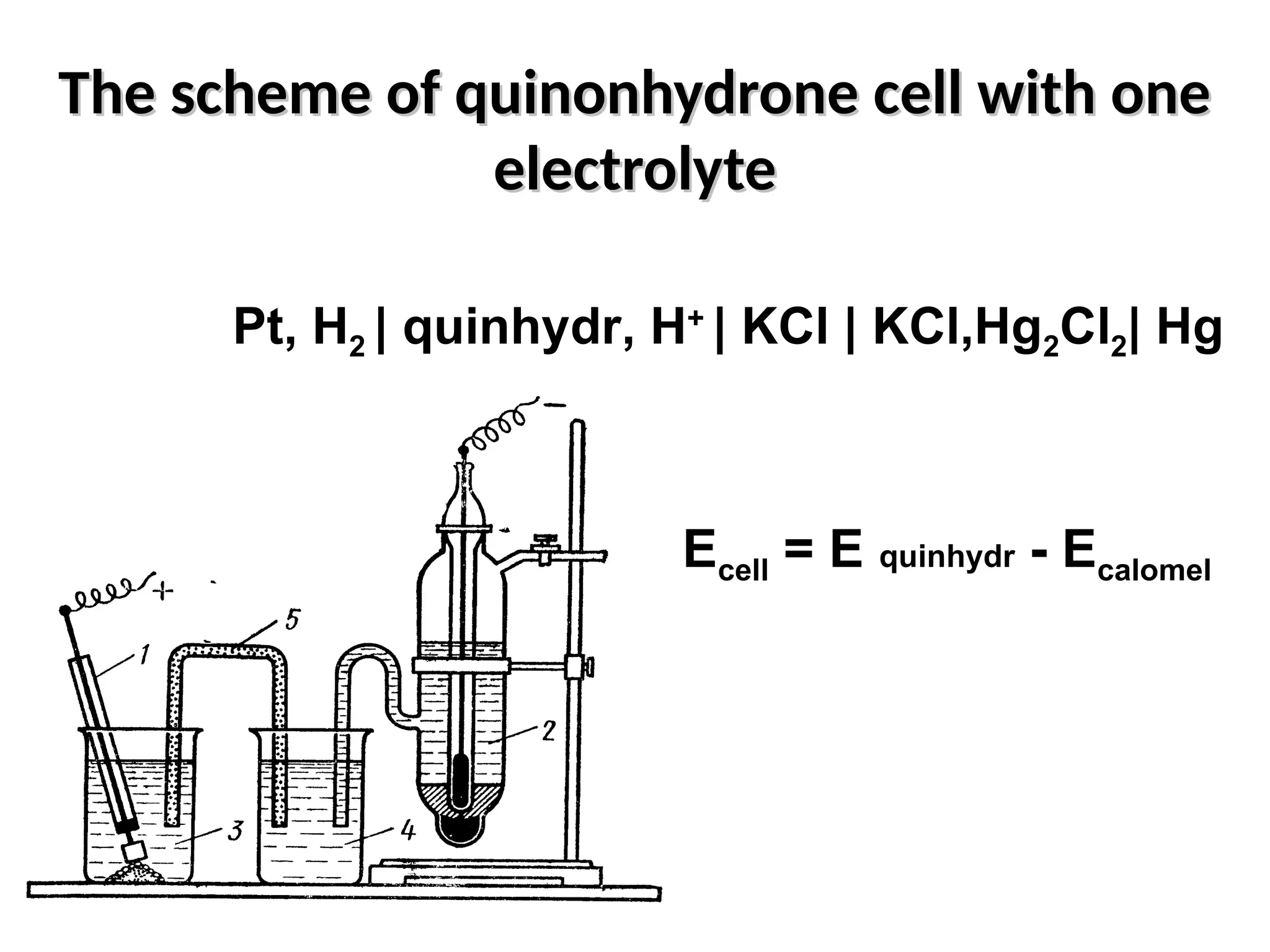
  • #4 Looking at the last example with magnesium oxide, which substance is the oxidizing agent and which is the reducing agent? Oxidizing- oxygen Reducing- magnesium Note that the extent of oxidation must be equal to the extent of reduction in a redox reaction. The number of electrons lost by a reducing agent must be equal to the number of electrons gained by an oxidizing agent.
  • #5 Where do you need to start with this type of reaction? You need to know what the participating metals are and what their respective ionic forms are. Zinc and copper For zinc to be able to combine with so42-, zinc needs to be in its ionic form. Since so42- already has a -2 charge, we know that zinc has to have a +2 charge to combine with this compound. If zinc has a +2 charge, then that means it has lost 2 electrons. Write out the equation. Copper is in a compound with and we know from the same rational as the zinc portion of the experiment, that copper has to have a +2 charge. So we are starting with a Cu2+ ion and moving towards making a copper solid product. To have a copper solid, we can not have a charged copper molecule. TO remove the 2+ charge, copper has to gain two electrons to achieve this. Write the equation. Combine both equations and then write the net equation. Identify the oxidation half reaction and the reduction half reaction.
  • #6 Although in most cases we can look at an equation and visualize a transfer of electrons, this is not always the case. There are some reactions where two smaller compounds form a larger compound and there is no transfer of electrons. Ex: HCl and SO2. In these cases, we look at each compound’s oxidation number. For HCl, the oxidation #s of H2 and Cl2 are 0 and in HCl, H = +1 and Cl = -1. Notice that there is a small “transfer” of electrons here. For simplicity, we will say that transfer is occurring. Also notice that the charges on the HCl are equal to 0 to make a net 0 charge on both sides of the equation.
  • #7 Assigning oxidation numbers to compounds makes it easier for us to see which participants in the reaction are oxidized and reduced. To assign oxidation numbers, we follow the following rules.
  • #8 4.) LiH, NaH. 5.) Look at the periodic table. F and other halogens are always going to be negative. Mg2+, Ba2+. 6.) Add the total of the ox. Numbers in a compound to get the total ox. #.