

Electrochemical Machining
BASIC CONCEPT WITH SOME INTERESTING
INFORMATION
Content
• Principle
• History & Early Development
• Electroplating
• Electrochemical Machining
• Advantages
• Limitations
• Applications
• Process Parameters
• References
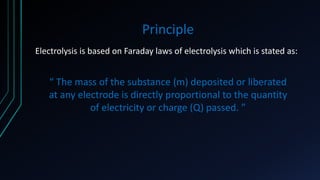
Principle
Electrolysis is based on Faraday laws of electrolysis which is stated as:
“ The mass of the substance (m) deposited or liberated
at any electrode is directly proportional to the quantity
of electricity or charge (Q) passed. ”
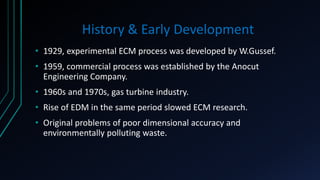
History & Early Development
• 1929, experimental ECM process was developed by W.Gussef.
• 1959, commercial process was established by the Anocut
Engineering Company.
• 1960s and 1970s, gas turbine industry.
• Rise of EDM in the same period slowed ECM research.
• Original problems of poor dimensional accuracy and
environmentally polluting waste.
Electroplating
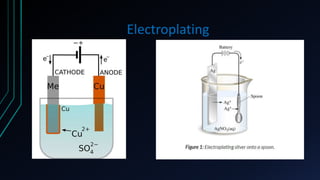
• Plating one metal onto another by hydrolysis.
• Decorative purposes or to prevent corrosion of a metal.
• Copper plating, Silver plating, and Chromium plating.
• Manufacturers to use inexpensive metals such as steel or zinc.
• Account for appearance, protection, and other properties.
• The surface can be a metal or even plastic.
Electroplating
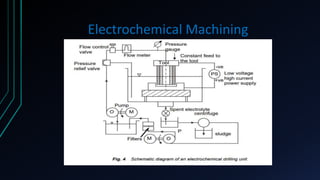
Electrochemical Machining
• Removing metal by an electrochemical process.
• Normally used for mass production.
• Can cut small or odd-shaped angles, intricate contours or cavities in
hard and exotic metals.
• Titanium aluminides, Inconel, Waspaloy, and high nickel, cobalt, and
rhenium alloys.
• A very small value of the order of 0.25 mm for satisfactory metal
removal rates.
• Electrolyte needs to be pumped at high pressures (0.7 – 3.0 MPa).
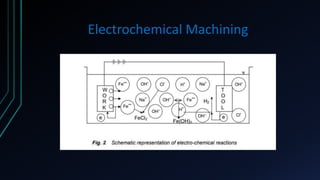
Electrochemical Machining
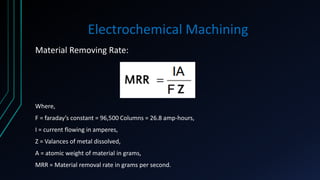
Material Removing Rate:
Where,
F = faraday’s constant = 96,500 Columns = 26.8 amp-hours,
I = current flowing in amperes,
Z = Valances of metal dissolved,
A = atomic weight of material in grams,
MRR = Material removal rate in grams per second.
Electrochemical Machining
Advantages
• Complex, concave curvature components can be produced easily by
using convex and concave tools.
• Tool wear is zero, same tool can be used for producing infinite
number of components.
• No direct contact between tool and work material so there are no
forces, residual stresses.
• The surface finish produced is excellent.
Limitations
• Out of all the unconventional machining methods, electro chemical
machining requires high specific cutting energy.
• Sharp edges and corners are not possible to produce.
• Work material must be electrically conducting.
• Generally preferable for producing contours only.
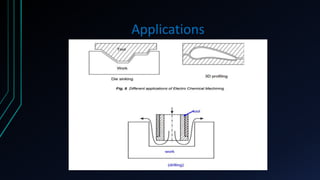
Applications
• Die sinking
• Profiling and contouring
• Trepanning
• Grinding
• Drilling
• Micro-machining
Applications
Process Parameters
References
• http://nptel.ac.in/courses/112105127/pdf/LM-38.pdf
• https://me-mechanicalengineering.com/electro-chemical-
machining-ecm/
• https://www.youtube.com/watch?v=3X24S7Kd0Q0
• https://en.wikipedia.org/wiki/Electrochemical_machining
• https://en.wikipedia.org/wiki/Electroplating
Thank you
Any Question?
“He who does not ask Remain a Fool Forever”

ElectroChemical Machining ( ECM )

  • 1.
    Electrochemical Machining BASIC CONCEPTWITH SOME INTERESTING INFORMATION
  • 2.
    Content • Principle • History& Early Development • Electroplating • Electrochemical Machining • Advantages • Limitations • Applications • Process Parameters • References
  • 3.
    Principle Electrolysis is basedon Faraday laws of electrolysis which is stated as: “ The mass of the substance (m) deposited or liberated at any electrode is directly proportional to the quantity of electricity or charge (Q) passed. ”
  • 4.
    History & EarlyDevelopment • 1929, experimental ECM process was developed by W.Gussef. • 1959, commercial process was established by the Anocut Engineering Company. • 1960s and 1970s, gas turbine industry. • Rise of EDM in the same period slowed ECM research. • Original problems of poor dimensional accuracy and environmentally polluting waste.
  • 5.
    Electroplating • Plating onemetal onto another by hydrolysis. • Decorative purposes or to prevent corrosion of a metal. • Copper plating, Silver plating, and Chromium plating. • Manufacturers to use inexpensive metals such as steel or zinc. • Account for appearance, protection, and other properties. • The surface can be a metal or even plastic.
  • 6.
  • 7.
    Electrochemical Machining • Removingmetal by an electrochemical process. • Normally used for mass production. • Can cut small or odd-shaped angles, intricate contours or cavities in hard and exotic metals. • Titanium aluminides, Inconel, Waspaloy, and high nickel, cobalt, and rhenium alloys. • A very small value of the order of 0.25 mm for satisfactory metal removal rates. • Electrolyte needs to be pumped at high pressures (0.7 – 3.0 MPa).
  • 8.
  • 9.
  • 10.
    Electrochemical Machining Material RemovingRate: Where, F = faraday’s constant = 96,500 Columns = 26.8 amp-hours, I = current flowing in amperes, Z = Valances of metal dissolved, A = atomic weight of material in grams, MRR = Material removal rate in grams per second.
  • 11.
  • 12.
    Advantages • Complex, concavecurvature components can be produced easily by using convex and concave tools. • Tool wear is zero, same tool can be used for producing infinite number of components. • No direct contact between tool and work material so there are no forces, residual stresses. • The surface finish produced is excellent.
  • 13.
    Limitations • Out ofall the unconventional machining methods, electro chemical machining requires high specific cutting energy. • Sharp edges and corners are not possible to produce. • Work material must be electrically conducting. • Generally preferable for producing contours only.
  • 14.
    Applications • Die sinking •Profiling and contouring • Trepanning • Grinding • Drilling • Micro-machining
  • 15.
  • 16.
  • 17.
    References • http://nptel.ac.in/courses/112105127/pdf/LM-38.pdf • https://me-mechanicalengineering.com/electro-chemical- machining-ecm/ •https://www.youtube.com/watch?v=3X24S7Kd0Q0 • https://en.wikipedia.org/wiki/Electrochemical_machining • https://en.wikipedia.org/wiki/Electroplating
  • 18.
    Thank you Any Question? “Hewho does not ask Remain a Fool Forever”