Chemical
Machining
The detail overview on how chemical machining removes
material to produce high quality parts and its different
processes
Content
• Definition & History
• Types of Chemical Machining
• Chemistry of Chemical Machining
• Masking Methods
• Etching Process
• Chemical Machining Processes
Definition & History
• It’s a non-traditional method
• Strong Chemical etchant
• After World War II
• Aircraft Industry
Types of Chemical Machining
• Chemical Milling
• Chemical Blanking
• Chemical Engraving
• Photochemical Machining
*use same mechanism to remove material
Chemistry of Chemical Machining
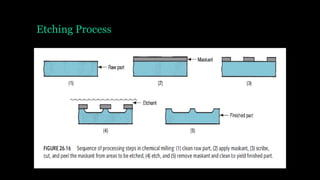
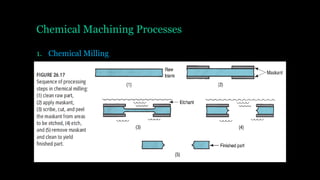
• Cleaning
• Masking
• Etching
• Demasking
*CM consist several steps with its unique sequence
Chemistry of Chemical Machining
• Cleaning:
It is the first step in which we clean material from any other pollutants
• Masking:
The protective layer is applied to the material which is resistive to our etchant*
• Etching:
This is the material removal step, converts work material into salt, wash the part
to stop further process
• Demasking:
The maskant is remove from the part
*(strong acid)
Masking Methods
Maskant material includes neoprene, polyvinylchloride, polyethylene
and other polymers. Masking can be achieved by any of following
three methods
1. Cut and Peel:
Apply maskant over entire part by dipping, spraying or painting, maskant
thickness (0.025 to 0.125 mm). After hardened maskant remove by hand using
scribing knife, usually with a template. It is used on large work parts and low
production where accuracy is not a critical factor. Maximum tolerance we can
achieved by it is (±0.125 mm).
Masking Methods
2. Photographic Resist:
Uses photographic techniques to perform the masking step. The masking
material contain photosensitive chemicals. Negative image of the desired areas to
be etched. Maskant can be remove through photographic developing techniques.
This process is normally applied where small parts are produced in high
quantities and close tolerance are required. Tolerance closer than (±0.0125 mm)
can be held.
Masking Methods
3. Screen Resist:
The maskant is applied by the means of silk screening method. In this maskant
is painted on the work part surface through a silk or steel mesh. Stencil protects the
area.
The screen resist method is generally used in applications that are between the
other two masking methods in terms of accuracy, part size and production
quantities. Tolerance of (±0.075 mm) can be achieved with this masking method.
Etching Process
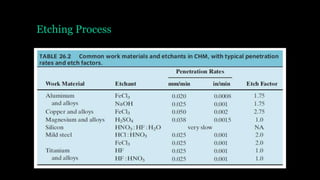
• Etchant depends on work material, desired depth, rate of material removal and
surface finish requirements
• Etchant must also be matched with the type of maskant
• Material removal rate is CHM are generally indicated as penetration rates
(mm/min)
• The penetration rate is unaffected by surface area
• Depth of cut in CHM is 12.5 mm for aircrafts panels made out of metal plates
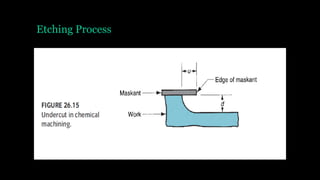
• There is also undercut
• Etch factor : Fe = d/u
Etching Process
Etching Process
Etching Process
Chemical Machining Processes
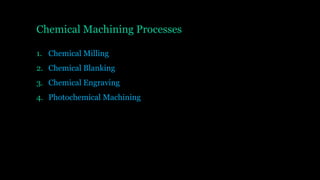
1. Chemical Milling
2. Chemical Blanking
3. Chemical Engraving
4. Photochemical Machining
Chemical Machining Processes
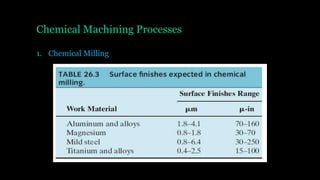
1. Chemical Milling
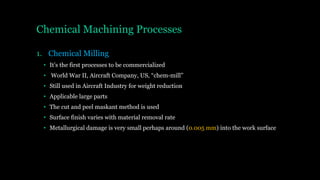
• It’s the first processes to be commercialized
• World War II, Aircraft Company, US, “chem-mill”
• Still used in Aircraft Industry for weight reduction
• Applicable large parts
• The cut and peel maskant method is used
• Surface finish varies with material removal rate
• Metallurgical damage is very small perhaps around (0.005 mm) into the work surface
Chemical Machining Processes
1. Chemical Milling
Chemical Machining Processes
1. Chemical Milling
Chemical Machining Processes
2. Chemical Blanking
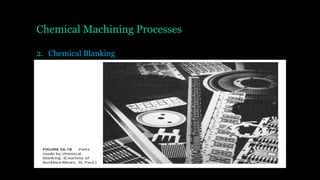
• Uses Chemical erosion to cut very thin sheet metal parts – down to (0.025 mm)
• Conventional or punch die methods does not work
• Damage sheet metal, tool cost will be high
• Parts produce by this method is burr free
• Photoresist or Screen resist method
• For small or intricate we use photo resist
• Tolerance closes ±0.0025 mm can be held
• In screen resist the masking procedure provide accurate registration between two sides
• Limited to thin or intricate pattern, maximum stock thickness 0.75 mm
• Hardened and brittle materials can be processed
Chemical Machining Processes
2. Chemical Blanking
Chemical Machining Processes
3. Chemical Engraving
• Name plates and other flat panels
• Lettering and Artwork on other sides
• Either recessed or raised lettering
• Masking is done by either Photoresist or Screen Resist
• Except filling operation follows etching
• To apply paint ant other coating in recessed area
• The effect is to highlight the pattern
Chemical Machining Processes
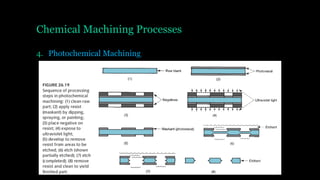
4. Photochemical Machining
• Photoresist method of masking is used
• Applied to Chemical Blanking and Chemical Engraving when these metods use
Photographic resist method
• Used for close tolerance and intricate patterns
• Used in electronic industry to produce intricate circuit design
• There are various to photographically expose the desired image onto the resist
• Photoresist materials is sensitive to ultraviolet light
• No need to carry out procedure in the dark room
• In this procedure etch factor is known as anisotrophy
Chemical Machining Processes
4. Photochemical Machining
References
Thank you
Any Question
“He who does not ask
Remain a Fool Forever”

Chemical Machining Process and its Types.

  • 1.
    Chemical Machining The detail overviewon how chemical machining removes material to produce high quality parts and its different processes
  • 2.
    Content • Definition &History • Types of Chemical Machining • Chemistry of Chemical Machining • Masking Methods • Etching Process • Chemical Machining Processes
  • 3.
    Definition & History •It’s a non-traditional method • Strong Chemical etchant • After World War II • Aircraft Industry
  • 4.
    Types of ChemicalMachining • Chemical Milling • Chemical Blanking • Chemical Engraving • Photochemical Machining *use same mechanism to remove material
  • 5.
    Chemistry of ChemicalMachining • Cleaning • Masking • Etching • Demasking *CM consist several steps with its unique sequence
  • 6.
    Chemistry of ChemicalMachining • Cleaning: It is the first step in which we clean material from any other pollutants • Masking: The protective layer is applied to the material which is resistive to our etchant* • Etching: This is the material removal step, converts work material into salt, wash the part to stop further process • Demasking: The maskant is remove from the part *(strong acid)
  • 7.
    Masking Methods Maskant materialincludes neoprene, polyvinylchloride, polyethylene and other polymers. Masking can be achieved by any of following three methods 1. Cut and Peel: Apply maskant over entire part by dipping, spraying or painting, maskant thickness (0.025 to 0.125 mm). After hardened maskant remove by hand using scribing knife, usually with a template. It is used on large work parts and low production where accuracy is not a critical factor. Maximum tolerance we can achieved by it is (±0.125 mm).
  • 8.
    Masking Methods 2. PhotographicResist: Uses photographic techniques to perform the masking step. The masking material contain photosensitive chemicals. Negative image of the desired areas to be etched. Maskant can be remove through photographic developing techniques. This process is normally applied where small parts are produced in high quantities and close tolerance are required. Tolerance closer than (±0.0125 mm) can be held.
  • 9.
    Masking Methods 3. ScreenResist: The maskant is applied by the means of silk screening method. In this maskant is painted on the work part surface through a silk or steel mesh. Stencil protects the area. The screen resist method is generally used in applications that are between the other two masking methods in terms of accuracy, part size and production quantities. Tolerance of (±0.075 mm) can be achieved with this masking method.
  • 10.
    Etching Process • Etchantdepends on work material, desired depth, rate of material removal and surface finish requirements • Etchant must also be matched with the type of maskant • Material removal rate is CHM are generally indicated as penetration rates (mm/min) • The penetration rate is unaffected by surface area • Depth of cut in CHM is 12.5 mm for aircrafts panels made out of metal plates • There is also undercut • Etch factor : Fe = d/u
  • 11.
  • 12.
  • 13.
  • 14.
    Chemical Machining Processes 1.Chemical Milling 2. Chemical Blanking 3. Chemical Engraving 4. Photochemical Machining
  • 15.
    Chemical Machining Processes 1.Chemical Milling • It’s the first processes to be commercialized • World War II, Aircraft Company, US, “chem-mill” • Still used in Aircraft Industry for weight reduction • Applicable large parts • The cut and peel maskant method is used • Surface finish varies with material removal rate • Metallurgical damage is very small perhaps around (0.005 mm) into the work surface
  • 16.
  • 17.
  • 18.
    Chemical Machining Processes 2.Chemical Blanking • Uses Chemical erosion to cut very thin sheet metal parts – down to (0.025 mm) • Conventional or punch die methods does not work • Damage sheet metal, tool cost will be high • Parts produce by this method is burr free • Photoresist or Screen resist method • For small or intricate we use photo resist • Tolerance closes ±0.0025 mm can be held • In screen resist the masking procedure provide accurate registration between two sides • Limited to thin or intricate pattern, maximum stock thickness 0.75 mm • Hardened and brittle materials can be processed
  • 19.
  • 20.
    Chemical Machining Processes 3.Chemical Engraving • Name plates and other flat panels • Lettering and Artwork on other sides • Either recessed or raised lettering • Masking is done by either Photoresist or Screen Resist • Except filling operation follows etching • To apply paint ant other coating in recessed area • The effect is to highlight the pattern
  • 21.
    Chemical Machining Processes 4.Photochemical Machining • Photoresist method of masking is used • Applied to Chemical Blanking and Chemical Engraving when these metods use Photographic resist method • Used for close tolerance and intricate patterns • Used in electronic industry to produce intricate circuit design • There are various to photographically expose the desired image onto the resist • Photoresist materials is sensitive to ultraviolet light • No need to carry out procedure in the dark room • In this procedure etch factor is known as anisotrophy
  • 22.
    Chemical Machining Processes 4.Photochemical Machining
  • 24.
  • 25.
    Thank you Any Question “Hewho does not ask Remain a Fool Forever”