1
Training Session on Energy
Equipment
Electric Motors
Presentation from the
“Energy Efficiency Guide for Industry in Asia”
www.energyefficiencyasia.org
2
© UNEP 2006
Training Agenda: Electric Motors
Introduction
Types of electric motors
Assessment of electric motors
Energy efficiency opportunities
3
© UNEP 2006
Introduction
• Electromechanical device that converts
electrical energy to mechanical energy
• Mechanical energy used to e.g.
• Rotate pump impeller, fan, blower
• Drive compressors
• Lift materials
• Motors in industry: 70% of electrical
load
What is an Electric Motor?
4
© UNEP 2006
Introduction
How Does an Electric Motor Work?
(Nave, 2005)
1
2
3
4
5
© UNEP 2006
Introduction
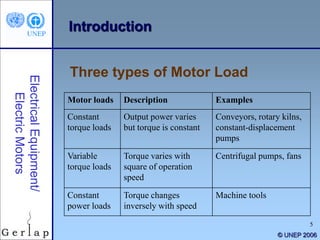
Three types of Motor Load
Motor loads Description Examples
Constant
torque loads
Output power varies
but torque is constant
Conveyors, rotary kilns,
constant-displacement
pumps
Variable
torque loads
Torque varies with
square of operation
speed
Centrifugal pumps, fans
Constant
power loads
Torque changes
inversely with speed
Machine tools
6
© UNEP 2006
Training Agenda: Electric Motors
Introduction
Types of electric motors
Assessment of electric motors
Energy efficiency opportunities
7
© UNEP 2006
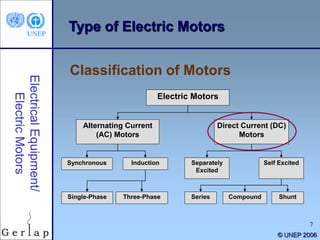
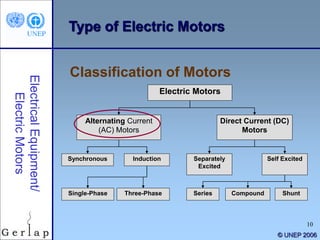
Type of Electric Motors
Classification of Motors
Electric Motors
Alternating Current
(AC) Motors
Direct Current (DC)
Motors
Synchronous Induction
Three-Phase
Single-Phase
Self Excited
Separately
Excited
Series Shunt
Compound
8
© UNEP 2006
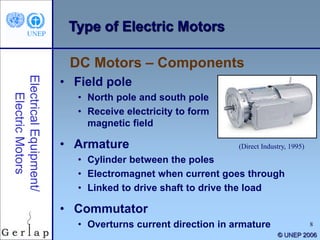
Type of Electric Motors
• Field pole
• North pole and south pole
• Receive electricity to form
magnetic field
• Armature
• Cylinder between the poles
• Electromagnet when current goes through
• Linked to drive shaft to drive the load
• Commutator
• Overturns current direction in armature
DC Motors – Components
(Direct Industry, 1995)
9
© UNEP 2006
Type of Electric Motors
• Speed control without impact power
supply quality
• Changing armature voltage
• Changing field current
• Restricted use
• Few low/medium speed applications
• Clean, non-hazardous areas
• Expensive compared to AC motors
DC motors
10
© UNEP 2006
Type of Electric Motors
Classification of Motors
Electric Motors
Alternating Current
(AC) Motors
Direct Current (DC)
Motors
Synchronous Induction
Three-Phase
Single-Phase
Self Excited
Separately
Excited
Series Shunt
Compound
11
© UNEP 2006
Type of Electric Motors
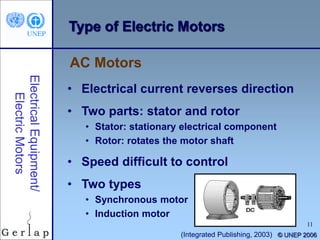
• Electrical current reverses direction
• Two parts: stator and rotor
• Stator: stationary electrical component
• Rotor: rotates the motor shaft
• Speed difficult to control
• Two types
• Synchronous motor
• Induction motor
AC Motors
(Integrated Publishing, 2003)
12
© UNEP 2006
Type of Electric Motors
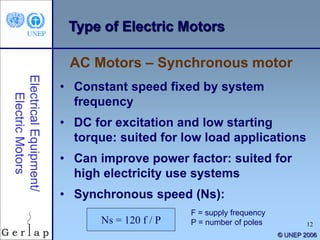
• Constant speed fixed by system
frequency
• DC for excitation and low starting
torque: suited for low load applications
• Can improve power factor: suited for
high electricity use systems
• Synchronous speed (Ns):
AC Motors – Synchronous motor
Ns = 120 f / P
F = supply frequency
P = number of poles
13
© UNEP 2006
Type of Electric Motors
• Most common motors in industry
• Advantages:
• Simple design
• Inexpensive
• High power to weight ratio
• Easy to maintain
• Direct connection to AC power source
AC Motors – Induction motor
14
© UNEP 2006
Type of Electric Motors
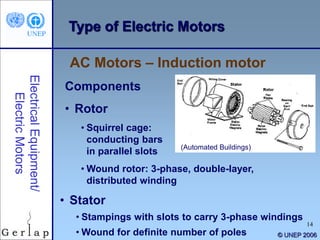
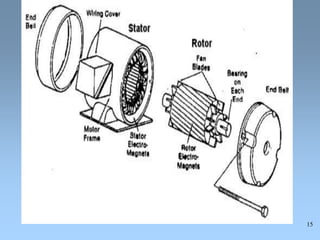
Components
• Rotor
• Squirrel cage:
conducting bars
in parallel slots
• Wound rotor: 3-phase, double-layer,
distributed winding
AC Motors – Induction motor
• Stator
• Stampings with slots to carry 3-phase windings
• Wound for definite number of poles
(Automated Buildings)
15
16
© UNEP 2006
Type of Electric Motors
AC Motors – Induction motor
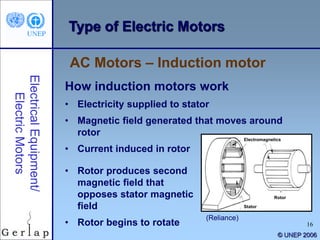
How induction motors work
• Electricity supplied to stator
• Magnetic field generated that moves around
rotor
• Current induced in rotor
Electromagnetics
Stator
Rotor
• Rotor produces second
magnetic field that
opposes stator magnetic
field
• Rotor begins to rotate
(Reliance)
17
© UNEP 2006
Type of Electric Motors
AC Motors – Induction motor
• Single-phase induction motor
• One stator winding
• Single-phase power supply
• Squirrel cage rotor
• Require device to start motor
• 3 to 4 HP applications
• Household appliances: fans, washing
machines, dryers
18
© UNEP 2006
Type of Electric Motors
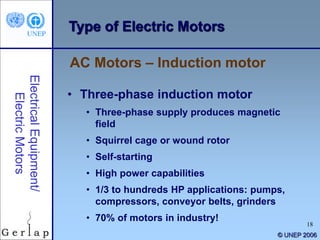
AC Motors – Induction motor
• Three-phase induction motor
• Three-phase supply produces magnetic
field
• Squirrel cage or wound rotor
• Self-starting
• High power capabilities
• 1/3 to hundreds HP applications: pumps,
compressors, conveyor belts, grinders
• 70% of motors in industry!
19
© UNEP 2006
Type of Electric Motors
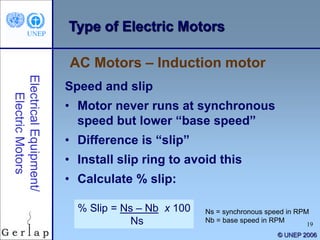
AC Motors – Induction motor
Speed and slip
• Motor never runs at synchronous
speed but lower “base speed”
• Difference is “slip”
• Install slip ring to avoid this
• Calculate % slip:
% Slip = Ns – Nb x 100
Ns
Ns = synchronous speed in RPM
Nb = base speed in RPM
20
© UNEP 2006
Assessment of Electric Motors
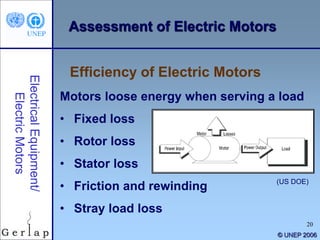
Motors loose energy when serving a load
• Fixed loss
• Rotor loss
• Stator loss
• Friction and rewinding
• Stray load loss
Efficiency of Electric Motors
(US DOE)
21
© UNEP 2006
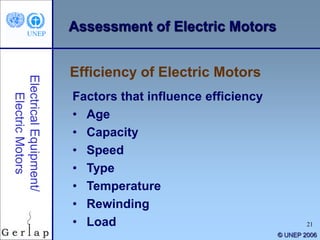
Factors that influence efficiency
• Age
• Capacity
• Speed
• Type
• Temperature
• Rewinding
• Load
Efficiency of Electric Motors
Assessment of Electric Motors
22
Training Session on Energy
Equipment
Electric Motors
THANK YOU
FOR YOUR ATTENTION
© UNEP 2006


Electrical motors 4to medio.ppt

  • 1.
    1 Training Session onEnergy Equipment Electric Motors Presentation from the “Energy Efficiency Guide for Industry in Asia” www.energyefficiencyasia.org
  • 2.
    2 © UNEP 2006 TrainingAgenda: Electric Motors Introduction Types of electric motors Assessment of electric motors Energy efficiency opportunities
  • 3.
    3 © UNEP 2006 Introduction •Electromechanical device that converts electrical energy to mechanical energy • Mechanical energy used to e.g. • Rotate pump impeller, fan, blower • Drive compressors • Lift materials • Motors in industry: 70% of electrical load What is an Electric Motor?
  • 4.
    4 © UNEP 2006 Introduction HowDoes an Electric Motor Work? (Nave, 2005) 1 2 3 4
  • 5.
    5 © UNEP 2006 Introduction Threetypes of Motor Load Motor loads Description Examples Constant torque loads Output power varies but torque is constant Conveyors, rotary kilns, constant-displacement pumps Variable torque loads Torque varies with square of operation speed Centrifugal pumps, fans Constant power loads Torque changes inversely with speed Machine tools
  • 6.
    6 © UNEP 2006 TrainingAgenda: Electric Motors Introduction Types of electric motors Assessment of electric motors Energy efficiency opportunities
  • 7.
    7 © UNEP 2006 Typeof Electric Motors Classification of Motors Electric Motors Alternating Current (AC) Motors Direct Current (DC) Motors Synchronous Induction Three-Phase Single-Phase Self Excited Separately Excited Series Shunt Compound
  • 8.
    8 © UNEP 2006 Typeof Electric Motors • Field pole • North pole and south pole • Receive electricity to form magnetic field • Armature • Cylinder between the poles • Electromagnet when current goes through • Linked to drive shaft to drive the load • Commutator • Overturns current direction in armature DC Motors – Components (Direct Industry, 1995)
  • 9.
    9 © UNEP 2006 Typeof Electric Motors • Speed control without impact power supply quality • Changing armature voltage • Changing field current • Restricted use • Few low/medium speed applications • Clean, non-hazardous areas • Expensive compared to AC motors DC motors
  • 10.
    10 © UNEP 2006 Typeof Electric Motors Classification of Motors Electric Motors Alternating Current (AC) Motors Direct Current (DC) Motors Synchronous Induction Three-Phase Single-Phase Self Excited Separately Excited Series Shunt Compound
  • 11.
    11 © UNEP 2006 Typeof Electric Motors • Electrical current reverses direction • Two parts: stator and rotor • Stator: stationary electrical component • Rotor: rotates the motor shaft • Speed difficult to control • Two types • Synchronous motor • Induction motor AC Motors (Integrated Publishing, 2003)
  • 12.
    12 © UNEP 2006 Typeof Electric Motors • Constant speed fixed by system frequency • DC for excitation and low starting torque: suited for low load applications • Can improve power factor: suited for high electricity use systems • Synchronous speed (Ns): AC Motors – Synchronous motor Ns = 120 f / P F = supply frequency P = number of poles
  • 13.
    13 © UNEP 2006 Typeof Electric Motors • Most common motors in industry • Advantages: • Simple design • Inexpensive • High power to weight ratio • Easy to maintain • Direct connection to AC power source AC Motors – Induction motor
  • 14.
    14 © UNEP 2006 Typeof Electric Motors Components • Rotor • Squirrel cage: conducting bars in parallel slots • Wound rotor: 3-phase, double-layer, distributed winding AC Motors – Induction motor • Stator • Stampings with slots to carry 3-phase windings • Wound for definite number of poles (Automated Buildings)
  • 15.
  • 16.
    16 © UNEP 2006 Typeof Electric Motors AC Motors – Induction motor How induction motors work • Electricity supplied to stator • Magnetic field generated that moves around rotor • Current induced in rotor Electromagnetics Stator Rotor • Rotor produces second magnetic field that opposes stator magnetic field • Rotor begins to rotate (Reliance)
  • 17.
    17 © UNEP 2006 Typeof Electric Motors AC Motors – Induction motor • Single-phase induction motor • One stator winding • Single-phase power supply • Squirrel cage rotor • Require device to start motor • 3 to 4 HP applications • Household appliances: fans, washing machines, dryers
  • 18.
    18 © UNEP 2006 Typeof Electric Motors AC Motors – Induction motor • Three-phase induction motor • Three-phase supply produces magnetic field • Squirrel cage or wound rotor • Self-starting • High power capabilities • 1/3 to hundreds HP applications: pumps, compressors, conveyor belts, grinders • 70% of motors in industry!
  • 19.
    19 © UNEP 2006 Typeof Electric Motors AC Motors – Induction motor Speed and slip • Motor never runs at synchronous speed but lower “base speed” • Difference is “slip” • Install slip ring to avoid this • Calculate % slip: % Slip = Ns – Nb x 100 Ns Ns = synchronous speed in RPM Nb = base speed in RPM
  • 20.
    20 © UNEP 2006 Assessmentof Electric Motors Motors loose energy when serving a load • Fixed loss • Rotor loss • Stator loss • Friction and rewinding • Stray load loss Efficiency of Electric Motors (US DOE)
  • 21.
    21 © UNEP 2006 Factorsthat influence efficiency • Age • Capacity • Speed • Type • Temperature • Rewinding • Load Efficiency of Electric Motors Assessment of Electric Motors
  • 22.
    22 Training Session onEnergy Equipment Electric Motors THANK YOU FOR YOUR ATTENTION © UNEP 2006 