WORKING OF ELECTRIC MOTOR,
TYPES AND CONSTRUCTION
VIKAS KUMAR
(BSH-2018-775)
ELECTRIC MOTOR
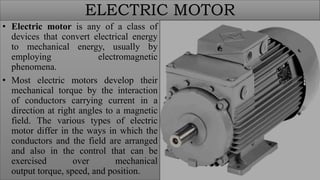
• Electric motor is any of a class of
devices that convert electrical energy
to mechanical energy, usually by
employing electromagnetic
phenomena.
• Most electric motors develop their
mechanical torque by the interaction
of conductors carrying current in a
direction at right angles to a magnetic
field. The various types of electric
motor differ in the ways in which the
conductors and the field are arranged
and also in the control that can be
exercised over mechanical
output torque, speed, and position.
CONSTRUCTION OF ELECTRIC MOTOR
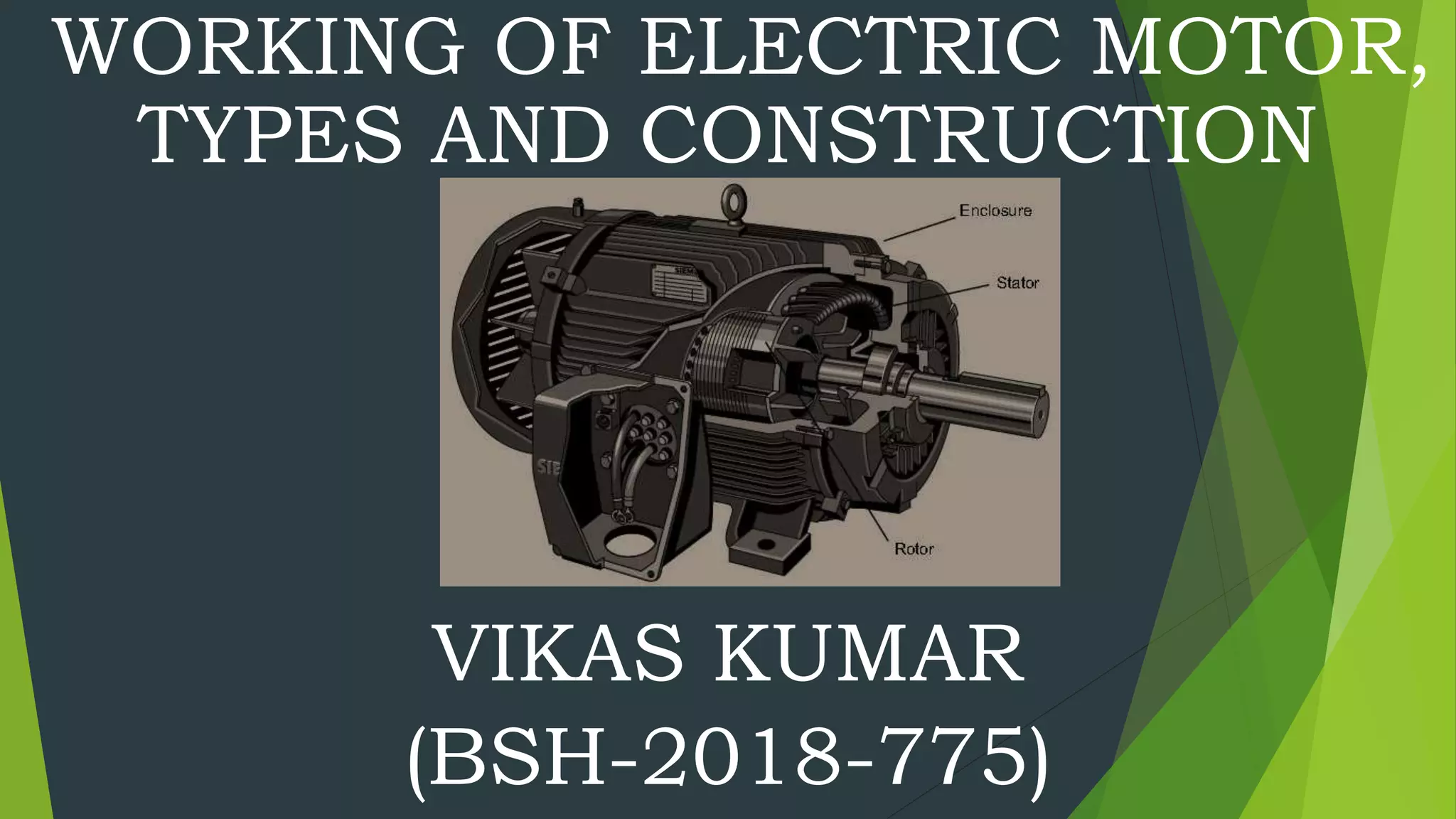
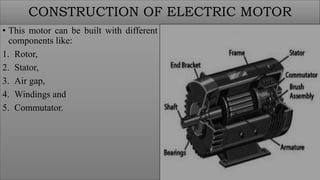
• This motor can be built with different
components like:
1. Rotor,
2. Stator,
3. Air gap,
4. Windings and
5. Commutator.
CONSTRUCTION OF ELECTRIC MOTOR
CONTD…
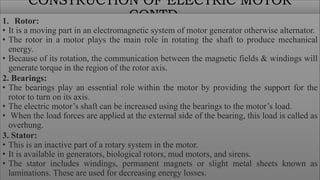
1. Rotor:
• It is a moving part in an electromagnetic system of motor generator otherwise alternator.
• The rotor in a motor plays the main role in rotating the shaft to produce mechanical
energy.
• Because of its rotation, the communication between the magnetic fields & windings will
generate torque in the region of the rotor axis.
2. Bearings:
• The bearings play an essential role within the motor by providing the support for the
rotor to turn on its axis.
• The electric motor’s shaft can be increased using the bearings to the motor’s load.
• When the load forces are applied at the external side of the bearing, this load is called as
overhung.
3. Stator:
• This is an inactive part of a rotary system in the motor.
• It is available in generators, biological rotors, mud motors, and sirens.
• The stator includes windings, permanent magnets or slight metal sheets known as
laminations. These are used for decreasing energy losses.
4. Air Gap:
• The gap between the rotor and the stator in the motor is known as the air gap.
• It is the main source of the low power factor in the motor.
• When the space between the rotor & stator increases, then magnetizing current
will also be increased.
5. Windings:
• Windings are nothing but wires that are placed within the coils.
• In the motor, the copper winding is commonly used material as they carry
electrical load properly.
6. Commutator:
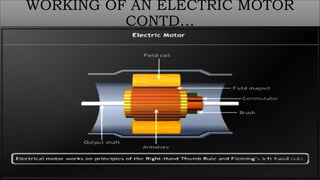
• A commutator is one kind of rotating electrical switch and it reverses the direction
of current flow among the rotor & the exterior circuit.
CONSTRUCTION OF ELECTRIC MOTOR
CONTD…
.
WORKING OF AN ELECTRIC MOTOR
CONTD..
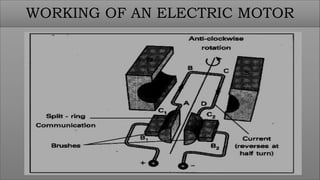
• When electric current is passed into the rectangular coil, this current produces a magnetic field around
the coil.
• The magnetic field of horse shoe-type magnet then interacts with the magnetic field of the coil and
causes the coil to rotate continuously.
• If ABCD is in horizontal position current from battery enters the coil through brush B1, and commutator
half ring C. The current flows in the direction ABCD
and leaves via ring and brush B2.
• The direction of current is from A to B, the direction of current is from C to D. The force on side AB of
the coil is in the downward direction. Whereas the force on the side CD of the coil is in the upward
direction. ABCD rotate in anti-clockwise direction.
• While rotating when the coil reaches vertical position then the brushes B1 and B2 will touch the gap
between the commutator rings and current to the coil is cut off. But the coil does not stop rotating
because it has already gained momentum.
• The coil CD comes on the left side and AB comes to the right side. Again they come in contact with
brush B1 Current direction is reversed.
• The reversing of current in the coil is repeated after every half rotation due to which the coil continue to
rotate as long as current from the batter is passed through it. The rotating shaft of electric motor can
drive a large number of machines which are connected to it.
WORKING OF AN ELECTRIC MOTOR
CONTD…
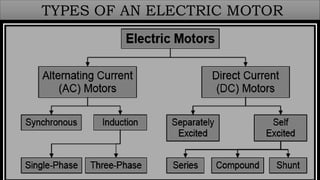
TYPES OF AN ELECTRIC MOTOR
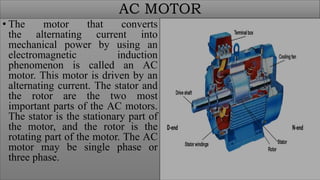
AC MOTOR
• The motor that converts
the alternating current into
mechanical power by using an
electromagnetic induction
phenomenon is called an AC
motor. This motor is driven by an
alternating current. The stator and
the rotor are the two most
important parts of the AC motors.
The stator is the stationary part of
the motor, and the rotor is the
rotating part of the motor. The AC
motor may be single phase or
three phase.
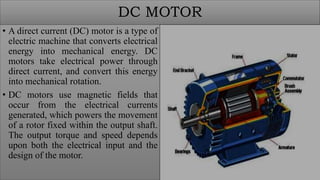
DC MOTOR
• A direct current (DC) motor is a type of
electric machine that converts electrical
energy into mechanical energy. DC
motors take electrical power through
direct current, and convert this energy
into mechanical rotation.
• DC motors use magnetic fields that
occur from the electrical currents
generated, which powers the movement
of a rotor fixed within the output shaft.
The output torque and speed depends
upon both the electrical input and the
design of the motor.
THANK
YOU

ELECTRIC MOTOR.pptx

  • 1.
    WORKING OF ELECTRICMOTOR, TYPES AND CONSTRUCTION VIKAS KUMAR (BSH-2018-775)
  • 2.
    ELECTRIC MOTOR • Electricmotor is any of a class of devices that convert electrical energy to mechanical energy, usually by employing electromagnetic phenomena. • Most electric motors develop their mechanical torque by the interaction of conductors carrying current in a direction at right angles to a magnetic field. The various types of electric motor differ in the ways in which the conductors and the field are arranged and also in the control that can be exercised over mechanical output torque, speed, and position.
  • 3.
    CONSTRUCTION OF ELECTRICMOTOR • This motor can be built with different components like: 1. Rotor, 2. Stator, 3. Air gap, 4. Windings and 5. Commutator.
  • 4.
    CONSTRUCTION OF ELECTRICMOTOR CONTD… 1. Rotor: • It is a moving part in an electromagnetic system of motor generator otherwise alternator. • The rotor in a motor plays the main role in rotating the shaft to produce mechanical energy. • Because of its rotation, the communication between the magnetic fields & windings will generate torque in the region of the rotor axis. 2. Bearings: • The bearings play an essential role within the motor by providing the support for the rotor to turn on its axis. • The electric motor’s shaft can be increased using the bearings to the motor’s load. • When the load forces are applied at the external side of the bearing, this load is called as overhung. 3. Stator: • This is an inactive part of a rotary system in the motor. • It is available in generators, biological rotors, mud motors, and sirens. • The stator includes windings, permanent magnets or slight metal sheets known as laminations. These are used for decreasing energy losses.
  • 5.
    4. Air Gap: •The gap between the rotor and the stator in the motor is known as the air gap. • It is the main source of the low power factor in the motor. • When the space between the rotor & stator increases, then magnetizing current will also be increased. 5. Windings: • Windings are nothing but wires that are placed within the coils. • In the motor, the copper winding is commonly used material as they carry electrical load properly. 6. Commutator: • A commutator is one kind of rotating electrical switch and it reverses the direction of current flow among the rotor & the exterior circuit. CONSTRUCTION OF ELECTRIC MOTOR CONTD… .
  • 6.
    WORKING OF ANELECTRIC MOTOR
  • 7.
    WORKING OF ANELECTRIC MOTOR CONTD.. • When electric current is passed into the rectangular coil, this current produces a magnetic field around the coil. • The magnetic field of horse shoe-type magnet then interacts with the magnetic field of the coil and causes the coil to rotate continuously. • If ABCD is in horizontal position current from battery enters the coil through brush B1, and commutator half ring C. The current flows in the direction ABCD and leaves via ring and brush B2. • The direction of current is from A to B, the direction of current is from C to D. The force on side AB of the coil is in the downward direction. Whereas the force on the side CD of the coil is in the upward direction. ABCD rotate in anti-clockwise direction. • While rotating when the coil reaches vertical position then the brushes B1 and B2 will touch the gap between the commutator rings and current to the coil is cut off. But the coil does not stop rotating because it has already gained momentum. • The coil CD comes on the left side and AB comes to the right side. Again they come in contact with brush B1 Current direction is reversed. • The reversing of current in the coil is repeated after every half rotation due to which the coil continue to rotate as long as current from the batter is passed through it. The rotating shaft of electric motor can drive a large number of machines which are connected to it.
  • 8.
    WORKING OF ANELECTRIC MOTOR CONTD…
  • 9.
    TYPES OF ANELECTRIC MOTOR
  • 10.
    AC MOTOR • Themotor that converts the alternating current into mechanical power by using an electromagnetic induction phenomenon is called an AC motor. This motor is driven by an alternating current. The stator and the rotor are the two most important parts of the AC motors. The stator is the stationary part of the motor, and the rotor is the rotating part of the motor. The AC motor may be single phase or three phase.
  • 11.
    DC MOTOR • Adirect current (DC) motor is a type of electric machine that converts electrical energy into mechanical energy. DC motors take electrical power through direct current, and convert this energy into mechanical rotation. • DC motors use magnetic fields that occur from the electrical currents generated, which powers the movement of a rotor fixed within the output shaft. The output torque and speed depends upon both the electrical input and the design of the motor.
  • 12.