Electric Motors

Electric Motors
Electric Motors

Introduction
Types of electric motors
Assessment of electric motors
Energy efficiency opportunities
Selecting Electric Motors
Introduction
What is an Electric Motor?
• Electromechanical device that converts
electrical energy to mechanical energy
• Mechanical energy used to e.g.
• Rotate pump impeller, fan, blower
• Drive compressors
• Lift materials

• Motors in industry: 70% of electrical
load
Introduction
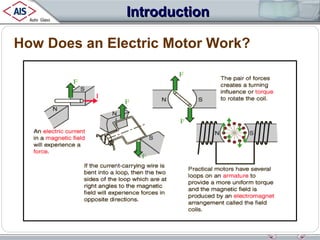
How Does an Electric Motor Work?
Introduction
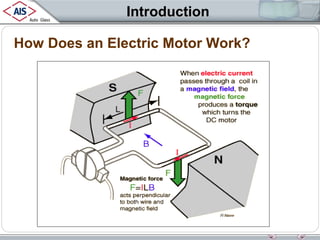
How Does an Electric Motor Work?
Introduction
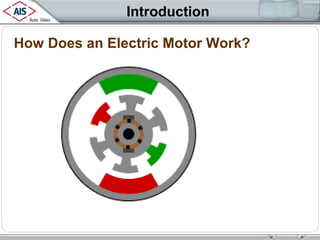
How Does an Electric Motor Work?
Introduction
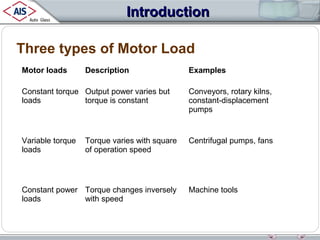
Three types of Motor Load
Motor loads

Description

Examples

Constant torque Output power varies but
loads
torque is constant

Conveyors, rotary kilns,
constant-displacement
pumps

Variable torque
loads

Centrifugal pumps, fans

Torque varies with square
of operation speed

Constant power Torque changes inversely
loads
with speed

Machine tools
Type of Electric Motors
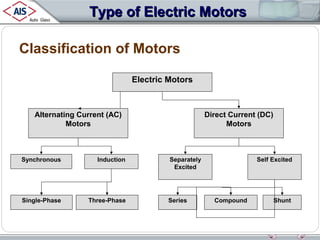
Classification of Motors
Electric Motors

Alternating Current (AC)
Motors

Synchronous

Induction

Single-Phase

Three-Phase

Direct Current (DC)
Motors

Separately
Excited

Series

Self Excited

Compound

Shunt
Type of Electric Motors
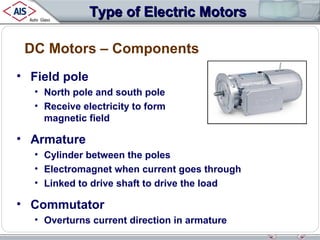
DC Motors – Components
• Field pole
• North pole and south pole
• Receive electricity to form
magnetic field

• Armature
• Cylinder between the poles
• Electromagnet when current goes through
• Linked to drive shaft to drive the load

• Commutator
• Overturns current direction in armature
Type of Electric Motors
DC motors
• Speed control without impact power
supply quality
• Changing armature voltage
• Changing field current

• Restricted use
• Few low/medium speed applications
• Clean, non-hazardous areas

• Expensive compared to AC motors
Type of Electric Motors
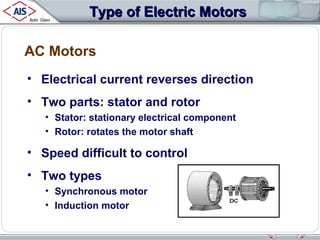
AC Motors
• Electrical current reverses direction
• Two parts: stator and rotor
• Stator: stationary electrical component
• Rotor: rotates the motor shaft

• Speed difficult to control
• Two types
• Synchronous motor
• Induction motor
Type of Electric Motors
AC Motors – Synchronous motor
• Constant speed fixed by system
frequency
• DC for excitation and low starting
torque: suited for low load applications
• Can improve power factor: suited for
high electricity use systems
• Synchronous speed (Ns):
Ns = 120 f / P

F = supply frequency
P = number of poles
Type of Electric Motors
AC Motors – Induction motor
• Most common motors in industry
• Advantages:
• Simple design
• Inexpensive
• High power to weight ratio
• Easy to maintain
• Direct connection to AC power source
Type of Electric Motors
AC Motors – Induction motor
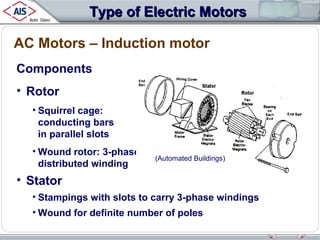
Components
• Rotor
• Squirrel cage:
conducting bars
in parallel slots
• Wound rotor: 3-phase, double-layer,
(Automated Buildings)
distributed winding

• Stator
• Stampings with slots to carry 3-phase windings
• Wound for definite number of poles
Type of Electric Motors
AC Motors – Induction motor
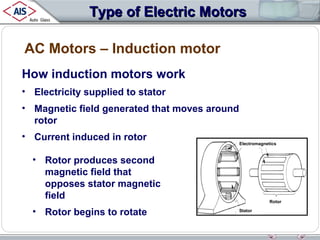
How induction motors work
• Electricity supplied to stator
• Magnetic field generated that moves around
rotor
• Current induced in rotor

Electromagnetics

• Rotor produces second
magnetic field that
opposes stator magnetic
field
• Rotor begins to rotate

Rotor
Stator
Type of Electric Motors
AC Motors – Induction motor
• Single-phase induction motor
• One stator winding
• Single-phase power supply
• Squirrel cage rotor
• Require device to start motor
• 3 to 4 HP applications
• Household appliances: fans, washing
machines, dryers
Type of Electric Motors
AC Motors – Induction motor
• Three-phase induction motor
• Three-phase supply produces magnetic
field
• Squirrel cage or wound rotor
• Self-starting
• High power capabilities
• 1/3 to hundreds HP applications: pumps,
compressors, conveyor belts, grinders
• 70% of motors in industry!
Type of Electric Motors
AC Motors – Induction motor
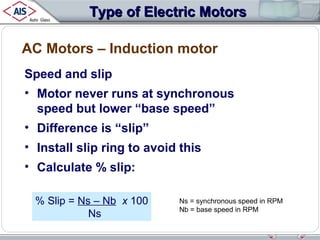
Speed and slip
• Motor never runs at synchronous
speed but lower “base speed”
• Difference is “slip”
• Install slip ring to avoid this
• Calculate % slip:
% Slip = Ns – Nb x 100
Ns

Ns = synchronous speed in RPM
Nb = base speed in RPM
Assessment of Electric Motors
Efficiency of Electric Motors
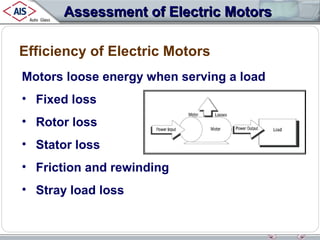
Motors loose energy when serving a load
• Fixed loss
• Rotor loss
• Stator loss
• Friction and rewinding
• Stray load loss
Assessment of Electric Motors
Efficiency of Electric Motors
Factors that influence efficiency
• Age
• Capacity
• Speed
• Type
• Temperature
• Rewinding
• Load
Assessment of Electric Motors
Efficiency of Electric Motors
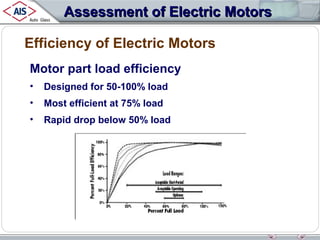
Motor part load efficiency
•

Designed for 50-100% load

•

Most efficient at 75% load

•

Rapid drop below 50% load
Assessment of Electric Motors
Motor Load
• Motor load is indicator of efficiency
• Equation to determine load:
Load =
η
HP
Load
Pi

Pi x η HP x 0.7457
= Motor operating efficiency in %
= Nameplate rated horse power
= Output power as a % of rated power
= Three phase power in kW
Assessment of Electric Motors
Motor Load
Three methods for individual motors
• Input power measurement
• Ratio input power and rate power at 100%
loading

• Line current measurement
• Compare measured amperage with rated
amperage

• Slip method
• Compare slip at operation with slip at full
load
Assessment of Electric Motors
Motor Load
Input power measurement
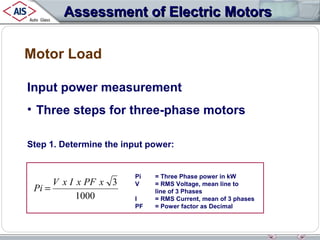
• Three steps for three-phase motors
Step 1. Determine the input power:

Pi =

V x I x PF x 3
1000

Pi
V
I
PF

= Three Phase power in kW
= RMS Voltage, mean line to
line of 3 Phases
= RMS Current, mean of 3 phases
= Power factor as Decimal
Assessment of Electric Motors
Motor Load
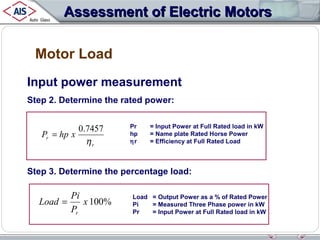
Input power measurement
Step 2. Determine the rated power:

0.7457
Pr = hp x
ηr

Pr
hp
ηr

= Input Power at Full Rated load in kW
= Name plate Rated Horse Power
= Efficiency at Full Rated Load

Step 3. Determine the percentage load:

Pi
Load =
x 100%
Pr

Load = Output Power as a % of Rated Power
Pi
= Measured Three Phase power in kW
Pr
= Input Power at Full Rated load in kW
Assessment of Electric Motors

Motor Load
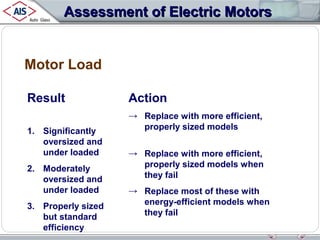
Result
1. Significantly
oversized and
under loaded
2. Moderately
oversized and
under loaded
3. Properly sized
but standard
efficiency

Action
→ Replace with more efficient,
properly sized models
→ Replace with more efficient,
properly sized models when
they fail
→ Replace most of these with
energy-efficient models when
they fail
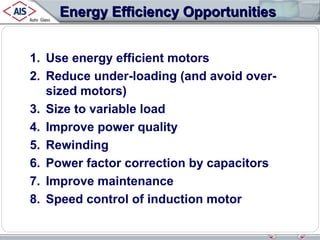
Energy Efficiency Opportunities
1. Use energy efficient motors
2. Reduce under-loading (and avoid oversized motors)
3. Size to variable load
4. Improve power quality
5. Rewinding
6. Power factor correction by capacitors
7. Improve maintenance
8. Speed control of induction motor
Energy Efficiency Opportunities
Use Energy Efficient Motors
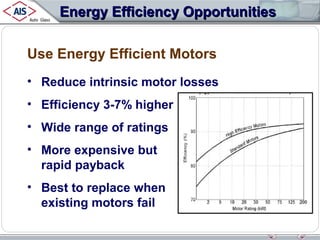
• Reduce intrinsic motor losses
• Efficiency 3-7% higher
• Wide range of ratings
• More expensive but
rapid payback
• Best to replace when
existing motors fail
Energy Efficiency Opportunities
Use Energy Efficient Motors
Power Loss Area

Efficiency Improvement

1. Fixed loss (iron)

Use of thinner gauge, lower loss core steel reduces eddy
current losses. Longer core adds more steel to the design,
which reduces losses due to lower operating flux densities.

2. Stator I2R

Use of more copper & larger conductors increases cross
sectional area of stator windings. This lower resistance (R)
of the windings & reduces losses due to current flow (I)

3 Rotor I2R

Use of larger rotor conductor bars increases size of cross
section, lowering conductor resistance (R) & losses due to
current flow (I)

4 Friction & Winding

Use of low loss fan design reduces losses due to air
movement

5. Stray Load Loss

Use of optimized design & strict quality control procedures
minimizes stray load losses
Energy Efficiency Opportunities
2. Reduce Under-loading
• Reasons for under-loading
• Large safety factor when selecting motor
• Under-utilization of equipment
• Maintain outputs at desired level even at low
input voltages
• High starting torque is required

• Consequences of under-loading
• Increased motor losses
• Reduced motor efficiency
• Reduced power factor
Energy Efficiency Opportunities
2. Reduce Under-loading
• Replace with smaller motor
• If motor operates at <50%
• Not if motor operates at 60-70%

• Operate in star mode
• If motors consistently operate at <40%
• Inexpensive and effective
• Motor electrically downsized by wire
reconfiguration
• Motor speed and voltage reduction but
unchanged performance
ve
tor’
ve
d

Energy Efficiency Opportunities
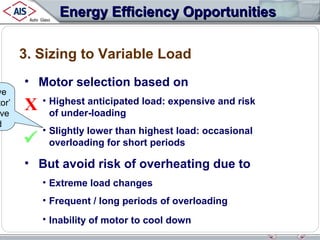
3. Sizing to Variable Load
• Motor selection based on

X • Highest anticipated load: expensive and risk
of under-loading


• Slightly lower than highest load: occasional
overloading for short periods

• But avoid risk of overheating due to
• Extreme load changes
• Frequent / long periods of overloading
• Inability of motor to cool down
Energy Efficiency Opportunities
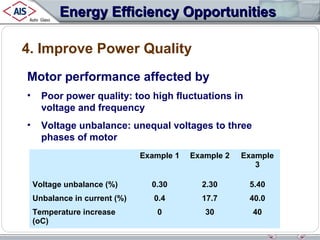
4. Improve Power Quality
Motor performance affected by
•

Poor power quality: too high fluctuations in
voltage and frequency

•

Voltage unbalance: unequal voltages to three
phases of motor
Example 1

Example 2

Example
3

Voltage unbalance (%)

0.30

2.30

5.40

Unbalance in current (%)

0.4

17.7

40.0

0

30

40

Temperature increase
(oC)
Energy Efficiency Opportunities
4. Improve Power Quality
Keep voltage unbalance within 1%
• Balance single phase loads equally
among three phases
• Segregate single phase loads and
feed them into separate
line/transformer
Energy Efficiency Opportunities
5. Rewinding
• Rewinding: sometimes 50% of motors
• Can reduce motor efficiency
• Maintain efficiency after rewinding by
• Using qualified/certified firm
• Maintain original motor design
• Replace 40HP, >15 year old motors instead of
rewinding
• Buy new motor if costs are less than 50-65%
of rewinding costs
Energy Efficiency Opportunities
6. Improve Power Factor (PF)
• Use capacitors for induction motors
• Benefits of improved PF
• Reduced kVA
• Reduced losses
• Improved voltage regulation
• Increased efficiency of plant electrical system

• Capacitor size not >90% of no-load
kVAR of motor
Energy Efficiency Opportunities
7. Maintenance
Checklist to maintain motor efficiency
• Inspect motors regularly for wear, dirt/dust
• Checking motor loads for over/under loading
• Lubricate appropriately
• Check alignment of motor and equipment
• Ensure supply wiring and terminal box and
properly sized and installed
• Provide adequate ventilation
Energy Efficiency Opportunities
8. Speed Control of Induction Motor
• Multi-speed motors
• Limited speed control: 2 – 4 fixed speeds

• Wound rotor motor drives
• Specifically constructed motor
• Variable resistors to control torque
performance
• >300 HP most common
Energy Efficiency Opportunities
8. Speed Control of Induction Motor
• Variable speed drives (VSDs)
• Also called inverters
• Several kW to 750 kW
• Change speed of induction motors
• Can be installed in existing system
• Reduce electricity by >50% in fans and pumps
• Convert 50Hz incoming power to variable
frequency and voltage: change speed
• Three types
Energy Efficiency Opportunities
8. Speed Control of Induction Motor
Direct Current Drives
• Oldest form of electrical speed control
• Consists of
• DC motor: field windings and armature
• Controller: regulates DC voltage to armature
that controls motor speed
• Tacho-generator: gives feedback signal to
controlled
Selecting Electric Motors
What Size Motor to Select
• How much power is needed
• How much electrical power is available
• Do you have enough capacity in service entrance
panel (breaker box)
Selecting Electric Motors
Power Supply
• Single Phase, 115 or 230 volts
– limited to 7 1/2 hp
– most farms and homes
– many motors will run on 115 or 230 volts
Selecting Electric Motors
Power Supply
• 3-Phase, 208, 230 or more volts
–
–
–
–
–
–

4 wires in power line
up to 1,000 hp
little or no light flickering
cost less
last longer
pay extra to install 3-phase power lines
Selecting Electric Motors
Service Entrance Capacity
• SEP must have about 3 times more amperage
capacity than the amp rating on the nameplate of
the motor
– for extra amps for starting the motor
– if motor is 20 amps, SEP must be at least 60
amps

• May need a separate SEP
Selecting Electric Motors
What Motor Speed to Select
•
•
•
•

Determine speed of equipment
Speed is in RPM’s
Most common: 1750
If different speed is needed, use pulley, gear, or
chains to convert
Selecting Electric Motors
Motor Duty
• Motor Duty = amount of time the motor is
operating under full load, and how much time it is
stopped
• Continuous Duty: constant full load for over 60
minutes at a time
• Intermittent Duty: fully loaded for 5, 15, 30, or 60
minutes
Selecting Electric Motors
Starting Loads
• Easy Starting Loads:
–
–
–
–

Shaded Pole Induction
Split Phase
Permanent-Split, Capacitor-Induction
Soft-Start
Selecting Electric Motors
Starting Loads
• Difficult Starting Loads
–
–
–
–
–
–

Capacitor-Start, Induction-Run
Repulsion-Start, Induction-Run
Capacitor-Start, Capacitor-Run
Three-Phase, General-Purpose
Perkey Concept: use tractor PTO to start
Repulsion-Start, Capacitor-Run
Selecting Electric Motors
Other Factors to Consider
• Direction of Rotation
• Cost
• Maintenance
– motors with brushes cause radio interference
– repulsion-start interferes at starting
– motors with brushes require more maintenance
Bearing Types
• Sleeve Bearings: brass, bronze or tin lined
cylinder
• Ball Bearings: round steel balls surround the
shaft in a special cage
Mounting Position
• Sleeve Bearings: parallel to floor
– may need to rotate end shield to prevent oil from
running out of reservoir

• Ball Bearing: any position
Mounting Base
• Rigid (fixed to frame)
• Rigid (adjustable screws)
• Sliding Rails
Energy Efficiency Opportunities

THANK YOU
FOR YOUR ATTENTION

20620041 electrical-motors

  • 1.
  • 2.
    Electric Motors Introduction Types ofelectric motors Assessment of electric motors Energy efficiency opportunities Selecting Electric Motors
  • 3.
    Introduction What is anElectric Motor? • Electromechanical device that converts electrical energy to mechanical energy • Mechanical energy used to e.g. • Rotate pump impeller, fan, blower • Drive compressors • Lift materials • Motors in industry: 70% of electrical load
  • 4.
    Introduction How Does anElectric Motor Work?
  • 5.
    Introduction How Does anElectric Motor Work?
  • 6.
    Introduction How Does anElectric Motor Work?
  • 7.
    Introduction Three types ofMotor Load Motor loads Description Examples Constant torque Output power varies but loads torque is constant Conveyors, rotary kilns, constant-displacement pumps Variable torque loads Centrifugal pumps, fans Torque varies with square of operation speed Constant power Torque changes inversely loads with speed Machine tools
  • 8.
    Type of ElectricMotors Classification of Motors Electric Motors Alternating Current (AC) Motors Synchronous Induction Single-Phase Three-Phase Direct Current (DC) Motors Separately Excited Series Self Excited Compound Shunt
  • 9.
    Type of ElectricMotors DC Motors – Components • Field pole • North pole and south pole • Receive electricity to form magnetic field • Armature • Cylinder between the poles • Electromagnet when current goes through • Linked to drive shaft to drive the load • Commutator • Overturns current direction in armature
  • 10.
    Type of ElectricMotors DC motors • Speed control without impact power supply quality • Changing armature voltage • Changing field current • Restricted use • Few low/medium speed applications • Clean, non-hazardous areas • Expensive compared to AC motors
  • 11.
    Type of ElectricMotors AC Motors • Electrical current reverses direction • Two parts: stator and rotor • Stator: stationary electrical component • Rotor: rotates the motor shaft • Speed difficult to control • Two types • Synchronous motor • Induction motor
  • 12.
    Type of ElectricMotors AC Motors – Synchronous motor • Constant speed fixed by system frequency • DC for excitation and low starting torque: suited for low load applications • Can improve power factor: suited for high electricity use systems • Synchronous speed (Ns): Ns = 120 f / P F = supply frequency P = number of poles
  • 13.
    Type of ElectricMotors AC Motors – Induction motor • Most common motors in industry • Advantages: • Simple design • Inexpensive • High power to weight ratio • Easy to maintain • Direct connection to AC power source
  • 14.
    Type of ElectricMotors AC Motors – Induction motor Components • Rotor • Squirrel cage: conducting bars in parallel slots • Wound rotor: 3-phase, double-layer, (Automated Buildings) distributed winding • Stator • Stampings with slots to carry 3-phase windings • Wound for definite number of poles
  • 15.
    Type of ElectricMotors AC Motors – Induction motor How induction motors work • Electricity supplied to stator • Magnetic field generated that moves around rotor • Current induced in rotor Electromagnetics • Rotor produces second magnetic field that opposes stator magnetic field • Rotor begins to rotate Rotor Stator
  • 16.
    Type of ElectricMotors AC Motors – Induction motor • Single-phase induction motor • One stator winding • Single-phase power supply • Squirrel cage rotor • Require device to start motor • 3 to 4 HP applications • Household appliances: fans, washing machines, dryers
  • 17.
    Type of ElectricMotors AC Motors – Induction motor • Three-phase induction motor • Three-phase supply produces magnetic field • Squirrel cage or wound rotor • Self-starting • High power capabilities • 1/3 to hundreds HP applications: pumps, compressors, conveyor belts, grinders • 70% of motors in industry!
  • 18.
    Type of ElectricMotors AC Motors – Induction motor Speed and slip • Motor never runs at synchronous speed but lower “base speed” • Difference is “slip” • Install slip ring to avoid this • Calculate % slip: % Slip = Ns – Nb x 100 Ns Ns = synchronous speed in RPM Nb = base speed in RPM
  • 19.
    Assessment of ElectricMotors Efficiency of Electric Motors Motors loose energy when serving a load • Fixed loss • Rotor loss • Stator loss • Friction and rewinding • Stray load loss
  • 20.
    Assessment of ElectricMotors Efficiency of Electric Motors Factors that influence efficiency • Age • Capacity • Speed • Type • Temperature • Rewinding • Load
  • 21.
    Assessment of ElectricMotors Efficiency of Electric Motors Motor part load efficiency • Designed for 50-100% load • Most efficient at 75% load • Rapid drop below 50% load
  • 22.
    Assessment of ElectricMotors Motor Load • Motor load is indicator of efficiency • Equation to determine load: Load = η HP Load Pi Pi x η HP x 0.7457 = Motor operating efficiency in % = Nameplate rated horse power = Output power as a % of rated power = Three phase power in kW
  • 23.
    Assessment of ElectricMotors Motor Load Three methods for individual motors • Input power measurement • Ratio input power and rate power at 100% loading • Line current measurement • Compare measured amperage with rated amperage • Slip method • Compare slip at operation with slip at full load
  • 24.
    Assessment of ElectricMotors Motor Load Input power measurement • Three steps for three-phase motors Step 1. Determine the input power: Pi = V x I x PF x 3 1000 Pi V I PF = Three Phase power in kW = RMS Voltage, mean line to line of 3 Phases = RMS Current, mean of 3 phases = Power factor as Decimal
  • 25.
    Assessment of ElectricMotors Motor Load Input power measurement Step 2. Determine the rated power: 0.7457 Pr = hp x ηr Pr hp ηr = Input Power at Full Rated load in kW = Name plate Rated Horse Power = Efficiency at Full Rated Load Step 3. Determine the percentage load: Pi Load = x 100% Pr Load = Output Power as a % of Rated Power Pi = Measured Three Phase power in kW Pr = Input Power at Full Rated load in kW
  • 26.
    Assessment of ElectricMotors Motor Load Result 1. Significantly oversized and under loaded 2. Moderately oversized and under loaded 3. Properly sized but standard efficiency Action → Replace with more efficient, properly sized models → Replace with more efficient, properly sized models when they fail → Replace most of these with energy-efficient models when they fail
  • 27.
    Energy Efficiency Opportunities 1.Use energy efficient motors 2. Reduce under-loading (and avoid oversized motors) 3. Size to variable load 4. Improve power quality 5. Rewinding 6. Power factor correction by capacitors 7. Improve maintenance 8. Speed control of induction motor
  • 28.
    Energy Efficiency Opportunities UseEnergy Efficient Motors • Reduce intrinsic motor losses • Efficiency 3-7% higher • Wide range of ratings • More expensive but rapid payback • Best to replace when existing motors fail
  • 29.
    Energy Efficiency Opportunities UseEnergy Efficient Motors Power Loss Area Efficiency Improvement 1. Fixed loss (iron) Use of thinner gauge, lower loss core steel reduces eddy current losses. Longer core adds more steel to the design, which reduces losses due to lower operating flux densities. 2. Stator I2R Use of more copper & larger conductors increases cross sectional area of stator windings. This lower resistance (R) of the windings & reduces losses due to current flow (I) 3 Rotor I2R Use of larger rotor conductor bars increases size of cross section, lowering conductor resistance (R) & losses due to current flow (I) 4 Friction & Winding Use of low loss fan design reduces losses due to air movement 5. Stray Load Loss Use of optimized design & strict quality control procedures minimizes stray load losses
  • 30.
    Energy Efficiency Opportunities 2.Reduce Under-loading • Reasons for under-loading • Large safety factor when selecting motor • Under-utilization of equipment • Maintain outputs at desired level even at low input voltages • High starting torque is required • Consequences of under-loading • Increased motor losses • Reduced motor efficiency • Reduced power factor
  • 31.
    Energy Efficiency Opportunities 2.Reduce Under-loading • Replace with smaller motor • If motor operates at <50% • Not if motor operates at 60-70% • Operate in star mode • If motors consistently operate at <40% • Inexpensive and effective • Motor electrically downsized by wire reconfiguration • Motor speed and voltage reduction but unchanged performance
  • 32.
    ve tor’ ve d Energy Efficiency Opportunities 3.Sizing to Variable Load • Motor selection based on X • Highest anticipated load: expensive and risk of under-loading  • Slightly lower than highest load: occasional overloading for short periods • But avoid risk of overheating due to • Extreme load changes • Frequent / long periods of overloading • Inability of motor to cool down
  • 33.
    Energy Efficiency Opportunities 4.Improve Power Quality Motor performance affected by • Poor power quality: too high fluctuations in voltage and frequency • Voltage unbalance: unequal voltages to three phases of motor Example 1 Example 2 Example 3 Voltage unbalance (%) 0.30 2.30 5.40 Unbalance in current (%) 0.4 17.7 40.0 0 30 40 Temperature increase (oC)
  • 34.
    Energy Efficiency Opportunities 4.Improve Power Quality Keep voltage unbalance within 1% • Balance single phase loads equally among three phases • Segregate single phase loads and feed them into separate line/transformer
  • 35.
    Energy Efficiency Opportunities 5.Rewinding • Rewinding: sometimes 50% of motors • Can reduce motor efficiency • Maintain efficiency after rewinding by • Using qualified/certified firm • Maintain original motor design • Replace 40HP, >15 year old motors instead of rewinding • Buy new motor if costs are less than 50-65% of rewinding costs
  • 36.
    Energy Efficiency Opportunities 6.Improve Power Factor (PF) • Use capacitors for induction motors • Benefits of improved PF • Reduced kVA • Reduced losses • Improved voltage regulation • Increased efficiency of plant electrical system • Capacitor size not >90% of no-load kVAR of motor
  • 37.
    Energy Efficiency Opportunities 7.Maintenance Checklist to maintain motor efficiency • Inspect motors regularly for wear, dirt/dust • Checking motor loads for over/under loading • Lubricate appropriately • Check alignment of motor and equipment • Ensure supply wiring and terminal box and properly sized and installed • Provide adequate ventilation
  • 38.
    Energy Efficiency Opportunities 8.Speed Control of Induction Motor • Multi-speed motors • Limited speed control: 2 – 4 fixed speeds • Wound rotor motor drives • Specifically constructed motor • Variable resistors to control torque performance • >300 HP most common
  • 39.
    Energy Efficiency Opportunities 8.Speed Control of Induction Motor • Variable speed drives (VSDs) • Also called inverters • Several kW to 750 kW • Change speed of induction motors • Can be installed in existing system • Reduce electricity by >50% in fans and pumps • Convert 50Hz incoming power to variable frequency and voltage: change speed • Three types
  • 40.
    Energy Efficiency Opportunities 8.Speed Control of Induction Motor Direct Current Drives • Oldest form of electrical speed control • Consists of • DC motor: field windings and armature • Controller: regulates DC voltage to armature that controls motor speed • Tacho-generator: gives feedback signal to controlled
  • 41.
    Selecting Electric Motors WhatSize Motor to Select • How much power is needed • How much electrical power is available • Do you have enough capacity in service entrance panel (breaker box)
  • 42.
    Selecting Electric Motors PowerSupply • Single Phase, 115 or 230 volts – limited to 7 1/2 hp – most farms and homes – many motors will run on 115 or 230 volts
  • 43.
    Selecting Electric Motors PowerSupply • 3-Phase, 208, 230 or more volts – – – – – – 4 wires in power line up to 1,000 hp little or no light flickering cost less last longer pay extra to install 3-phase power lines
  • 44.
    Selecting Electric Motors ServiceEntrance Capacity • SEP must have about 3 times more amperage capacity than the amp rating on the nameplate of the motor – for extra amps for starting the motor – if motor is 20 amps, SEP must be at least 60 amps • May need a separate SEP
  • 45.
    Selecting Electric Motors WhatMotor Speed to Select • • • • Determine speed of equipment Speed is in RPM’s Most common: 1750 If different speed is needed, use pulley, gear, or chains to convert
  • 46.
    Selecting Electric Motors MotorDuty • Motor Duty = amount of time the motor is operating under full load, and how much time it is stopped • Continuous Duty: constant full load for over 60 minutes at a time • Intermittent Duty: fully loaded for 5, 15, 30, or 60 minutes
  • 47.
    Selecting Electric Motors StartingLoads • Easy Starting Loads: – – – – Shaded Pole Induction Split Phase Permanent-Split, Capacitor-Induction Soft-Start
  • 48.
    Selecting Electric Motors StartingLoads • Difficult Starting Loads – – – – – – Capacitor-Start, Induction-Run Repulsion-Start, Induction-Run Capacitor-Start, Capacitor-Run Three-Phase, General-Purpose Perkey Concept: use tractor PTO to start Repulsion-Start, Capacitor-Run
  • 49.
    Selecting Electric Motors OtherFactors to Consider • Direction of Rotation • Cost • Maintenance – motors with brushes cause radio interference – repulsion-start interferes at starting – motors with brushes require more maintenance
  • 50.
    Bearing Types • SleeveBearings: brass, bronze or tin lined cylinder • Ball Bearings: round steel balls surround the shaft in a special cage
  • 51.
    Mounting Position • SleeveBearings: parallel to floor – may need to rotate end shield to prevent oil from running out of reservoir • Ball Bearing: any position
  • 52.
    Mounting Base • Rigid(fixed to frame) • Rigid (adjustable screws) • Sliding Rails
  • 53.