 Now we shall try to explain some observable events on the
earth’s surface from an understanding of the earth’s interior.
 We would like to emphasize, however that scientists did not
necessarily arrive at these explanations in the same manner.
 In fact, they used the knowledge gained from studies of these
phenomena to build a model of the earth’s structure.
Do you want to know about
Earth’s Magnetism?
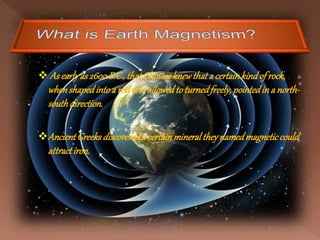
 As earlyas 2600B.C., thatChineseknewthat a certainkindof rock,
whenshapedintoa rodandallowedtoturnedfreely, pointedina north-
southdirection.
AncientGreeksdiscovereda certainmineraltheynamedmagneticcould
attractiron.
 1100A.D. thefreelyturningmagnethadbecomea standardfornavigation.
 1400A.D. sailorsknewthattheneedle-shapedmagnet, nowcalleda
compass, didnot alwayspointexactlyto thenorthpole.
 It sometimespointeda littleto theeastor a littleto westof north.
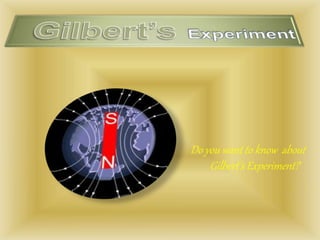
Do you want to know about
Gilbert’s Experiment?
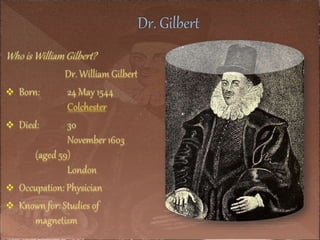
 William Gilbert, also known as Gilberd, (24 May 1544 – 30 November
1603) was an English physician, physicist and natural philosopher. He
was an early Copernican, and passionately rejected both the prevailing
Aristotelian philosophy and the Scholastic method of university
teaching. He is remembered today largely for his book De Magnete
(1600), and is credited as one of the originators of the term electricity.
He is regarded by some as the father of electrical engineering or
electricity and magnetism.[1] While today he is generally referred to as
William Gilbert, he also went under the name of William Gilberd. The
latter was used in his and his father's epitaph, the records of the town
of Colchester, and in the Biographical Memoir in De Magnete, as well as
in the name of The Gilberd School in Colchester, named after Gilbert.
A unit of magnetomotive force, also known as magnetic potential, was
named the gilbert in his honour.
 In 1600WilliamGilbertpublisheda bookentitledDe Magnete
whereinheexplainedthebehaviorof themagneticrock.
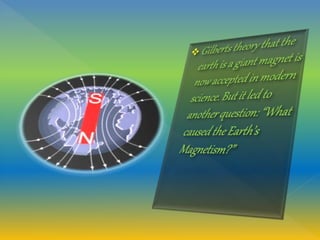
 He proposedtheearthitselfwasa hugesphericalmagnetwithits
polessituatedalmostat thegeographicpoles.
 Gilbertdiscoveredthatwhena compassis heldoverdifferentpointsof
a sphericalmagnet,it behavesinaboutthesamewayas it doeswhenit
heldat differentpartsof theearth.
 Thus,heconcludedthattheearthis a MAGNET.
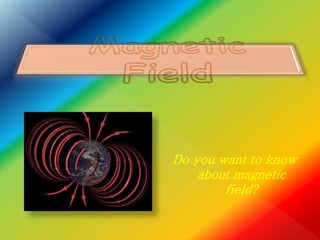
 As a magnet,theearthis surroundedby a magneticfieldwhoselinesof
forcemeetat the
magneticpoles.
 Compassandthemagnetactuallyalignthemselvesto the lineof
themagneticforce.
 Thisalignmentmakesthecompasspointnorth-south.
 It’sbecausetheearth’smagneticpolesarenotlocatedexactlyat
thegeographicpoles.
 At presentthemagneticnorthpoleislocatedat 75°Nlatitudeand
100°Wlongitude.
 Magneticsouthpoleisat 66°Slatitudeand140°Elongitude.
 Magneticnorthpoleisonlyabout1900kmawayfromthe
geographicnorthpole—a distanceslightlylessthan0.05%of
theearth’scircumference.
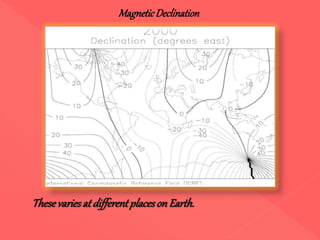
 Theanglebywhicha compassneedleturnsslightlyawayfromthe
geographicnorthpole, whethereastor westof it, iscalled the
magneticdeclination.
Thesevariesatdifferentplaceson Earth.
MagneticDeclination
 Endof thecompassor magnetthatpointsnorthis calledthe
northseekingpoleor N-pole.
 Oppositepolesattracts.
 Therefore,thenorthseekingpolemustbethesouthpoleof the
compassor magnet.
 Endthatpointsthesouthisthesouthseekingpole, o t theS-pole.
 Southseekingpole is actuallythenorthpoleof thecompassor magnet.
 Thus,whena compassis placedneara magnet,thenorth-seekingpole
of thecompassis attractedtothesouth-seekingpole,or theS-poleof
themagnet.
 Horizontalcompassis freetoturnarounda verticalaxisanda
horizontalplane.
 However,if a compasswerefreetoturnaroundinall directionsit
shouldnotonlypointnorth-southbutalso tilttoonesidesoalongas it
is notat themagneticequator.
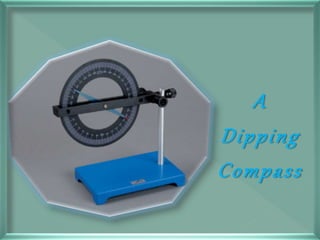
 A compassconstructedspecificallyto allowtiltingis calledtilting
or dippingcompass.
 It turnson a horizontalaxisandon a verticalplane.
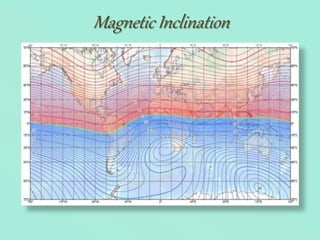
 Theangleformedbetweenthedippingneedleandthehorizontal
planeis calledthemagneticinclination.
A
Dipping
Compass
Magnetic Inclination
Do you want to know
about magnetic
field?
 A magnetic field is a mathematical description of
the magnetic influence of electric currents and
magnetic materials. The magnetic field at any
given point is specified by both a direction and a
magnitude (or strength); as such it is a vector
field The magnetic field is most commonly
defined in terms of the Lorentz force it exerts on
moving electric charges. There are two separate
but closely related fields to which the name
'magnetic field' can refer: a magnetic B field and
a magnetic H field.
 The simplest theory on the origin of the
earth’s magnetism is that the center of the
earth is one huge permanent magnet made
of iron and nickel.
 Earth’s core consists mainly of these two
mainly materials, these theory seems
acceptable at first.
 Laboratory studies show that iron loses its
magnetism at 770°C and nickel at 358°C.
 Another hypothesis was proposed by P.M.S.
Blackett, an English physicist.
 He claimed that the magnetism of the sun, the
stars and the earth was caused by their rotation.
 He set out to prove his theory by developing a
highly sensitive instrument for measuring
magnetism, the magnetometer.
 Blackett failed, however, to prove his theory.
 His report entitled “Negative Experiment”,
became widely acclaimed because of the full
description of the method he used and the
precise measurements he made.
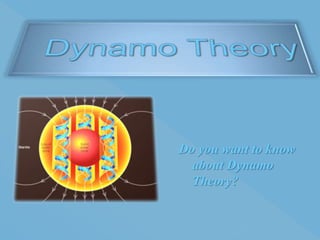
Do you want to know
about Dynamo
Theory?
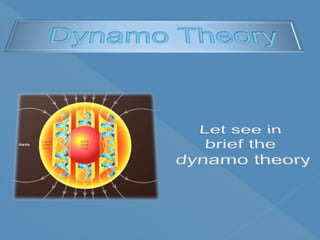
 Walter Elsasser and Edward Bullard
developed a hypothesis that presented the
earth as an electromagnet rather than a
permanent magnet.
 They attributed the earth’s magnetism to
electric current produced in the earth’s
interior, which in turn is continually produced
by the movement of the liquid outer core.
 The inner and outer core move with different
speeds.
 It is this difference in speed that is the
source of magnetism.
 This is known as the Dynamo Theory.
 1940’s, scientists became interested in
paleomagnetism, or the history of the
earth’s magnetism.
 Development of instruments for
measuring magnetism in rocks together
with the refinements made in the
techniques for establishing rock ages
greatly aided scientists in their study of
fossil magnets.
 These are bits of magnetic materials (iron) in rocks
which have preserved the magnetism of the earth at
the time the rocks were formed.
 Many rocks contain iron-bearing minerals which are
naturally magnetic.
 Studies of rocks in one place but which were formed
at different geologic times reveal varying magnetic
directions and strengths.
 One interpretation states the earth is fixed and it
is the magnetic poles which are shifting in
position.
 Another interpretation is that the magnetic
poles are fixed and it is the whole earth that
moves with respect to these poles.
 A third interpretation is that the magnetic poles
are fixed only the upper layers of the earth are
shifting about.
 Fossil rocks also distinguish between the north
and the south pole.
 There is a strong evidence that the poles of the
earth’s field have reversed many times in the
past.
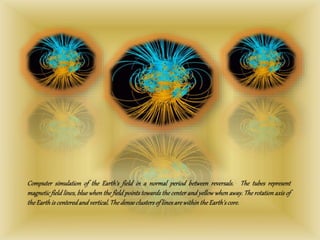
 The dynamo theory presents one possible
explanation: the direction of the magnetic field
is influenced by the direction of the movement of
molten iron in the core.
Earth's magnetism

Earth's magnetism

  • 2.
     Now weshall try to explain some observable events on the earth’s surface from an understanding of the earth’s interior.  We would like to emphasize, however that scientists did not necessarily arrive at these explanations in the same manner.  In fact, they used the knowledge gained from studies of these phenomena to build a model of the earth’s structure.
  • 3.
    Do you wantto know about Earth’s Magnetism?
  • 4.
     As earlyas2600B.C., thatChineseknewthat a certainkindof rock, whenshapedintoa rodandallowedtoturnedfreely, pointedina north- southdirection. AncientGreeksdiscovereda certainmineraltheynamedmagneticcould attractiron.
  • 5.
     1100A.D. thefreelyturningmagnethadbecomeastandardfornavigation.  1400A.D. sailorsknewthattheneedle-shapedmagnet, nowcalleda compass, didnot alwayspointexactlyto thenorthpole.  It sometimespointeda littleto theeastor a littleto westof north.
  • 6.
    Do you wantto know about Gilbert’s Experiment?
  • 8.
     William Gilbert,also known as Gilberd, (24 May 1544 – 30 November 1603) was an English physician, physicist and natural philosopher. He was an early Copernican, and passionately rejected both the prevailing Aristotelian philosophy and the Scholastic method of university teaching. He is remembered today largely for his book De Magnete (1600), and is credited as one of the originators of the term electricity. He is regarded by some as the father of electrical engineering or electricity and magnetism.[1] While today he is generally referred to as William Gilbert, he also went under the name of William Gilberd. The latter was used in his and his father's epitaph, the records of the town of Colchester, and in the Biographical Memoir in De Magnete, as well as in the name of The Gilberd School in Colchester, named after Gilbert. A unit of magnetomotive force, also known as magnetic potential, was named the gilbert in his honour.
  • 9.
     In 1600WilliamGilbertpublishedabookentitledDe Magnete whereinheexplainedthebehaviorof themagneticrock.  He proposedtheearthitselfwasa hugesphericalmagnetwithits polessituatedalmostat thegeographicpoles.
  • 10.
     Gilbertdiscoveredthatwhena compassisheldoverdifferentpointsof a sphericalmagnet,it behavesinaboutthesamewayas it doeswhenit heldat differentpartsof theearth.  Thus,heconcludedthattheearthis a MAGNET.  As a magnet,theearthis surroundedby a magneticfieldwhoselinesof forcemeetat the magneticpoles.
  • 12.
     Compassandthemagnetactuallyalignthemselvesto thelineof themagneticforce.  Thisalignmentmakesthecompasspointnorth-south.  It’sbecausetheearth’smagneticpolesarenotlocatedexactlyat thegeographicpoles.  At presentthemagneticnorthpoleislocatedat 75°Nlatitudeand 100°Wlongitude.
  • 13.
     Magneticsouthpoleisat 66°Slatitudeand140°Elongitude. Magneticnorthpoleisonlyabout1900kmawayfromthe geographicnorthpole—a distanceslightlylessthan0.05%of theearth’scircumference.  Theanglebywhicha compassneedleturnsslightlyawayfromthe geographicnorthpole, whethereastor westof it, iscalled the magneticdeclination.
  • 14.
  • 15.
     Endof thecompassormagnetthatpointsnorthis calledthe northseekingpoleor N-pole.  Oppositepolesattracts.  Therefore,thenorthseekingpolemustbethesouthpoleof the compassor magnet.  Endthatpointsthesouthisthesouthseekingpole, o t theS-pole.
  • 16.
     Southseekingpole isactuallythenorthpoleof thecompassor magnet.  Thus,whena compassis placedneara magnet,thenorth-seekingpole of thecompassis attractedtothesouth-seekingpole,or theS-poleof themagnet.  Horizontalcompassis freetoturnarounda verticalaxisanda horizontalplane.  However,if a compasswerefreetoturnaroundinall directionsit shouldnotonlypointnorth-southbutalso tilttoonesidesoalongas it is notat themagneticequator.
  • 17.
     A compassconstructedspecificallytoallowtiltingis calledtilting or dippingcompass.  It turnson a horizontalaxisandon a verticalplane.  Theangleformedbetweenthedippingneedleandthehorizontal planeis calledthemagneticinclination.
  • 18.
  • 19.
  • 21.
    Do you wantto know about magnetic field?
  • 22.
     A magneticfield is a mathematical description of the magnetic influence of electric currents and magnetic materials. The magnetic field at any given point is specified by both a direction and a magnitude (or strength); as such it is a vector field The magnetic field is most commonly defined in terms of the Lorentz force it exerts on moving electric charges. There are two separate but closely related fields to which the name 'magnetic field' can refer: a magnetic B field and a magnetic H field.
  • 26.
     The simplesttheory on the origin of the earth’s magnetism is that the center of the earth is one huge permanent magnet made of iron and nickel.  Earth’s core consists mainly of these two mainly materials, these theory seems acceptable at first.  Laboratory studies show that iron loses its magnetism at 770°C and nickel at 358°C.
  • 28.
     Another hypothesiswas proposed by P.M.S. Blackett, an English physicist.  He claimed that the magnetism of the sun, the stars and the earth was caused by their rotation.  He set out to prove his theory by developing a highly sensitive instrument for measuring magnetism, the magnetometer.
  • 29.
     Blackett failed,however, to prove his theory.  His report entitled “Negative Experiment”, became widely acclaimed because of the full description of the method he used and the precise measurements he made.
  • 31.
    Do you wantto know about Dynamo Theory?
  • 32.
     Walter Elsasserand Edward Bullard developed a hypothesis that presented the earth as an electromagnet rather than a permanent magnet.  They attributed the earth’s magnetism to electric current produced in the earth’s interior, which in turn is continually produced by the movement of the liquid outer core.
  • 33.
     The innerand outer core move with different speeds.  It is this difference in speed that is the source of magnetism.  This is known as the Dynamo Theory.
  • 37.
     1940’s, scientistsbecame interested in paleomagnetism, or the history of the earth’s magnetism.  Development of instruments for measuring magnetism in rocks together with the refinements made in the techniques for establishing rock ages greatly aided scientists in their study of fossil magnets.
  • 38.
     These arebits of magnetic materials (iron) in rocks which have preserved the magnetism of the earth at the time the rocks were formed.  Many rocks contain iron-bearing minerals which are naturally magnetic.  Studies of rocks in one place but which were formed at different geologic times reveal varying magnetic directions and strengths.
  • 39.
     One interpretationstates the earth is fixed and it is the magnetic poles which are shifting in position.  Another interpretation is that the magnetic poles are fixed and it is the whole earth that moves with respect to these poles.  A third interpretation is that the magnetic poles are fixed only the upper layers of the earth are shifting about.
  • 40.
     Fossil rocksalso distinguish between the north and the south pole.  There is a strong evidence that the poles of the earth’s field have reversed many times in the past.  The dynamo theory presents one possible explanation: the direction of the magnetic field is influenced by the direction of the movement of molten iron in the core.