Lecture 7
•Review:
•Circuit techniques to date
•Overview of Nodal and Mesh analysis
•Nodal Analysis
•Related educational modules:
–Sections 1.6.0, 1.6.1
Circuit analysis methods introduced so far
• Voltage-current relations:
• Ohm’s Law
• Kirchoff’s Current Law (KCL)
• Kirchoff’s Voltage Law (KVL)
• Circuit Reduction
• But circuit reduction is just a way of applying Ohm’s Law,
KCL, and KVL to simplify the analysis by reducing the
number of unknowns!
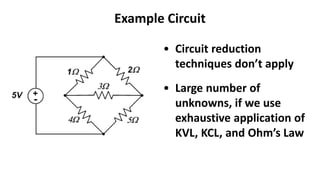
Example Circuit
• Circuit reduction
techniques don’t apply
• Large number of
unknowns, if we use
exhaustive application of
KVL, KCL, and Ohm’s Law
Two new analysis techniques
• Next:
• Nodal Analysis
• Mesh Analysis
• Nodal analysis and mesh analysis provide rigorous
ways to define a (relatively small) set of unknowns
and write the circuit governing equations in terms
of these unknowns
Nodal analysis – overview
• Identify independent nodes
• The voltages at these nodes are the node voltages
• Use Ohm’s Law to write KCL at each independent node
in terms of the node voltages
• Solve these equations to determine the node voltages
• Any desired circuit parameter can be determined from
the node voltages
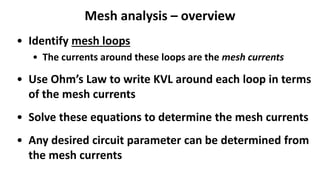
Mesh analysis – overview
• Identify mesh loops
• The currents around these loops are the mesh currents
• Use Ohm’s Law to write KVL around each loop in terms
of the mesh currents
• Solve these equations to determine the mesh currents
• Any desired circuit parameter can be determined from
the mesh currents
Important observation
• Nodal analysis and mesh analysis are not
fundamentally “new” analysis techniques
• We are still applying KVL, KCL, and Ohm’s Law!
• Nodal and mesh analysis simply allow us to identify a
reduced set of unknowns which completely characterize
the circuit  we can write and solve fewer equations to
simplify our analysis!
Nodal Analysis
• We will illustrate the nodal analysis technique in
the context of an example circuit:
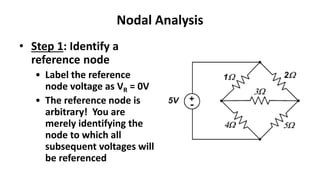
Nodal Analysis
• Step 1: Identify a
reference node
• Label the reference
node voltage as VR = 0V
• The reference node is
arbitrary! You are
merely identifying the
node to which all
subsequent voltages will
be referenced
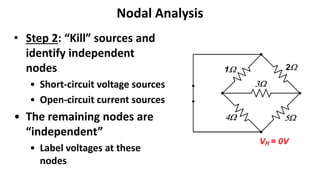
Nodal Analysis
• Step 2: “Kill” sources and
identify independent
nodes
• Short-circuit voltage sources
• Open-circuit current sources
• The remaining nodes are
“independent”
• Label voltages at these
nodes
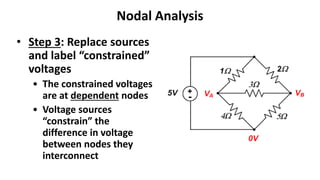
Nodal Analysis
• Step 3: Replace sources
and label “constrained”
voltages
• The constrained voltages
are at dependent nodes
• Voltage sources
“constrain” the
difference in voltage
between nodes they
interconnect
Nodal Analysis
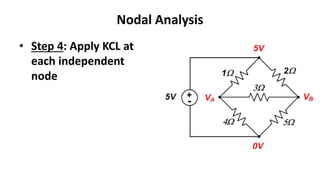
• Step 4: Apply KCL at
each independent
node
•
Nodal Analysis
• Step 5: Use Ohm’s Law
to write the KCL
equations in terms of
node voltages
–
Nodal Analysis
• Step 5: continued
Nodal Analysis
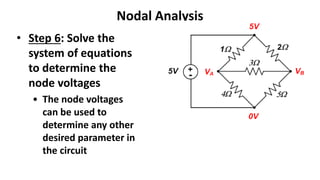
• Step 6: Solve the
system of equations
to determine the
node voltages
• The node voltages
can be used to
determine any other
desired parameter in
the circuit
Nodal Analysis – checking results
• Checking results in step 5:
• In general, in the equation for node “X”, the
multiplicative factor on the node voltage VX will be the
sum of the conductances at node “X”
• The multiplicative factors on all other node voltages in
the equation will be the negative of the conductances
between node “X” and the respective node voltage
Nodal Analysis – checking results
Nodal Analysis – shortcuts
• It is common to combine steps 4 and 5
• Apply KCL and Ohm’s Law simultaneously
• You can, if you wish, choose your current directions
independently each time you apply KCL
• For example, you can assume that all currents are leaving
the node, each time you apply KCL
Shortcuts applied to our example
• • Previous Results:
Nodal analysis – example 2
• Use nodal analysis to find i in the circuit below
Example 2 – continued
Example 2 – What if we mis-identify independent
nodes?
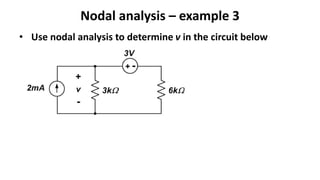
Nodal analysis – example 3
• Use nodal analysis to determine v in the circuit below
Example 3 – Alternate reference node
Lecture7.ppt

Lecture7.ppt

  • 1.
    Lecture 7 •Review: •Circuit techniquesto date •Overview of Nodal and Mesh analysis •Nodal Analysis •Related educational modules: –Sections 1.6.0, 1.6.1
  • 2.
    Circuit analysis methodsintroduced so far • Voltage-current relations: • Ohm’s Law • Kirchoff’s Current Law (KCL) • Kirchoff’s Voltage Law (KVL) • Circuit Reduction • But circuit reduction is just a way of applying Ohm’s Law, KCL, and KVL to simplify the analysis by reducing the number of unknowns!
  • 3.
    Example Circuit • Circuitreduction techniques don’t apply • Large number of unknowns, if we use exhaustive application of KVL, KCL, and Ohm’s Law
  • 4.
    Two new analysistechniques • Next: • Nodal Analysis • Mesh Analysis • Nodal analysis and mesh analysis provide rigorous ways to define a (relatively small) set of unknowns and write the circuit governing equations in terms of these unknowns
  • 5.
    Nodal analysis –overview • Identify independent nodes • The voltages at these nodes are the node voltages • Use Ohm’s Law to write KCL at each independent node in terms of the node voltages • Solve these equations to determine the node voltages • Any desired circuit parameter can be determined from the node voltages
  • 6.
    Mesh analysis –overview • Identify mesh loops • The currents around these loops are the mesh currents • Use Ohm’s Law to write KVL around each loop in terms of the mesh currents • Solve these equations to determine the mesh currents • Any desired circuit parameter can be determined from the mesh currents
  • 7.
    Important observation • Nodalanalysis and mesh analysis are not fundamentally “new” analysis techniques • We are still applying KVL, KCL, and Ohm’s Law! • Nodal and mesh analysis simply allow us to identify a reduced set of unknowns which completely characterize the circuit  we can write and solve fewer equations to simplify our analysis!
  • 8.
    Nodal Analysis • Wewill illustrate the nodal analysis technique in the context of an example circuit:
  • 9.
    Nodal Analysis • Step1: Identify a reference node • Label the reference node voltage as VR = 0V • The reference node is arbitrary! You are merely identifying the node to which all subsequent voltages will be referenced
  • 10.
    Nodal Analysis • Step2: “Kill” sources and identify independent nodes • Short-circuit voltage sources • Open-circuit current sources • The remaining nodes are “independent” • Label voltages at these nodes
  • 11.
    Nodal Analysis • Step3: Replace sources and label “constrained” voltages • The constrained voltages are at dependent nodes • Voltage sources “constrain” the difference in voltage between nodes they interconnect
  • 12.
    Nodal Analysis • Step4: Apply KCL at each independent node •
  • 13.
    Nodal Analysis • Step5: Use Ohm’s Law to write the KCL equations in terms of node voltages –
  • 14.
  • 15.
    Nodal Analysis • Step6: Solve the system of equations to determine the node voltages • The node voltages can be used to determine any other desired parameter in the circuit
  • 16.
    Nodal Analysis –checking results • Checking results in step 5: • In general, in the equation for node “X”, the multiplicative factor on the node voltage VX will be the sum of the conductances at node “X” • The multiplicative factors on all other node voltages in the equation will be the negative of the conductances between node “X” and the respective node voltage
  • 17.
    Nodal Analysis –checking results
  • 18.
    Nodal Analysis –shortcuts • It is common to combine steps 4 and 5 • Apply KCL and Ohm’s Law simultaneously • You can, if you wish, choose your current directions independently each time you apply KCL • For example, you can assume that all currents are leaving the node, each time you apply KCL
  • 19.
    Shortcuts applied toour example • • Previous Results:
  • 20.
    Nodal analysis –example 2 • Use nodal analysis to find i in the circuit below
  • 21.
    Example 2 –continued
  • 22.
    Example 2 –What if we mis-identify independent nodes?
  • 23.
    Nodal analysis –example 3 • Use nodal analysis to determine v in the circuit below
  • 24.
    Example 3 –Alternate reference node