Nodal Analysis


      EE602      1
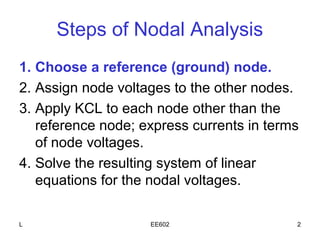
Steps of Nodal Analysis
1. Choose a reference (ground) node.
2. Assign node voltages to the other nodes.
3. Apply KCL to each node other than the
   reference node; express currents in terms
   of node voltages.
4. Solve the resulting system of linear
   equations for the nodal voltages.

L                   EE602                  2
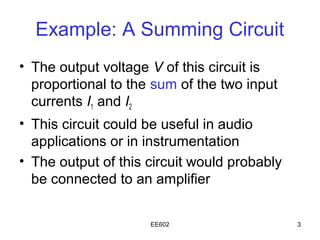
Example: A Summing Circuit
• The output voltage V of this circuit is
  proportional to the sum of the two input
  currents I1 and I2
• This circuit could be useful in audio
  applications or in instrumentation
• The output of this circuit would probably
  be connected to an amplifier


                     EE602                    3
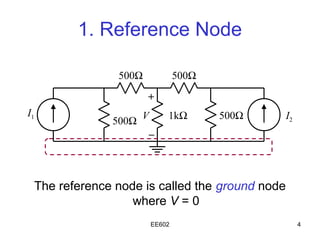
1. Reference Node

               500Ω           500Ω

                      +
I1
              500Ω V      1kΩ        500Ω       I2
                    –


 The reference node is called the ground node
                  where V = 0
                      EE602                          4
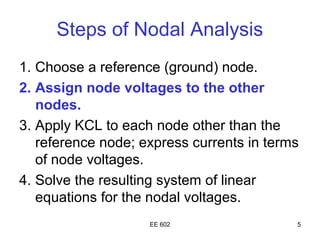
Steps of Nodal Analysis
1. Choose a reference (ground) node.
2. Assign node voltages to the other
   nodes.
3. Apply KCL to each node other than the
   reference node; express currents in terms
   of node voltages.
4. Solve the resulting system of linear
   equations for the nodal voltages.
                    EE 602                 5
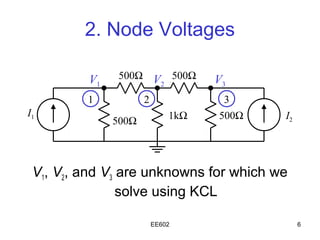
2. Node Voltages

         V1    500Ω V 500Ω         V3
                     2

         1           2              3
I1                           1kΩ   500Ω   I2
              500Ω


 V1, V2, and V3 are unknowns for which we
                solve using KCL

                         EE602                 6
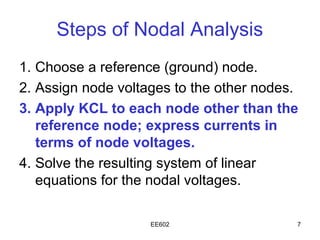
Steps of Nodal Analysis
1. Choose a reference (ground) node.
2. Assign node voltages to the other nodes.
3. Apply KCL to each node other than the
   reference node; express currents in
   terms of node voltages.
4. Solve the resulting system of linear
   equations for the nodal voltages.

                    EE602                 7
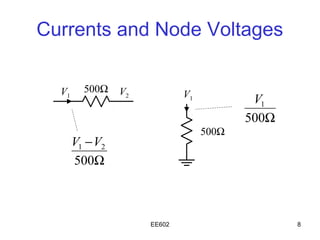
Currents and Node Voltages


  V1     500Ω    V2           V1
                                           V1
                                          500Ω
                                   500Ω
       V1 − V2
       500Ω


                      EE602                      8
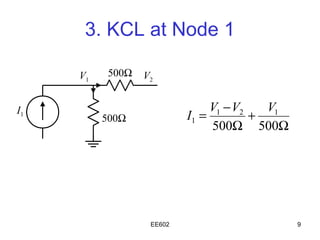
3. KCL at Node 1

     V1    500Ω   V2


I1                              V1 − V2   V1
          500Ω             I1 =         +
                                500Ω 500Ω


                   EE602                       9
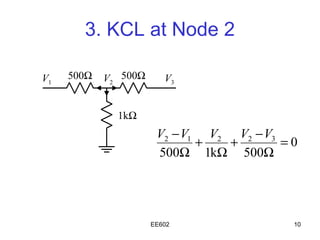
3. KCL at Node 2

V1   500Ω   V2 500Ω      V3


              1kΩ
                       V2 − V1 V2 V2 − V3
                              +  +        =0
                       500Ω 1kΩ 500Ω


                      EE602                10
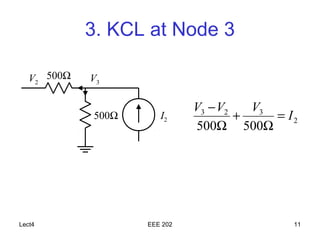
3. KCL at Node 3

   V2 500Ω   V3

                              V3 − V2   V3
             500Ω      I2             +    = I2
                              500Ω 500Ω


Lect4               EEE 202                   11
Steps of Nodal Analysis
1. Choose a reference (ground) node.
2. Assign node voltages to the other nodes.
3. Apply KCL to each node other than the
   reference node; express currents in terms
   of node voltages.
4. Solve the resulting system of linear
   equations for the nodal voltages.

                    EE602                  12
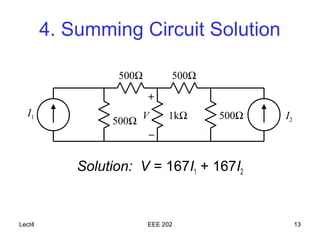
4. Summing Circuit Solution

                  500Ω         500Ω

                         +
  I1
                 500Ω V       1kΩ     500Ω   I2
                       –


            Solution: V = 167I1 + 167I2


Lect4                    EEE 202                  13
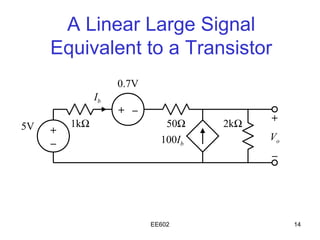
A Linear Large Signal
     Equivalent to a Transistor
                    0.7V
               Ib
                    + –
                                           +
5V       1kΩ                  50Ω    2kΩ
     +
                             100Ib         Vo
     –
                                           –


                           EE602                14
Steps of Nodal Analysis
1. Choose a reference (ground) node.
2. Assign node voltages to the other nodes.
3. Apply KCL to each node other than the
   reference node; express currents in terms
   of node voltages.
4. Solve the resulting system of linear
   equations for the nodal voltages.

                    EE602                  15
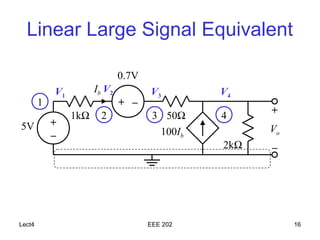
Linear Large Signal Equivalent

                                0.7V
            V1         Ib V 2          V3        V4
        1                       + –
                         2              3 50Ω    4     +
                 1kΩ
5V          +
                                         100Ib         Vo
            –
                                                 2kΩ   –


Lect4                                  EEE 202              16
Steps of Nodal Analysis
1. Choose a reference (ground) node.
2. Assign node voltages to the other nodes.
3. Apply KCL to each node other than the
   reference node; express currents in terms
   of node voltages.
4. Solve the resulting system of linear
   equations for the nodal voltages.

                    EE602                  17
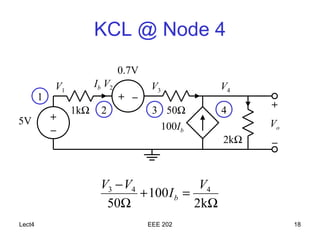
KCL @ Node 4
                               0.7V
            V1         Ib V2          V3           V4
        1                      + –
                        2              3 50Ω       4     +
                 1kΩ
5V          +
                                        100Ib            Vo
            –
                                                   2kΩ   –


                        V3 − V4              V4
                                + 100 I b =
                         50Ω                2 kΩ
Lect4                                 EEE 202                 18
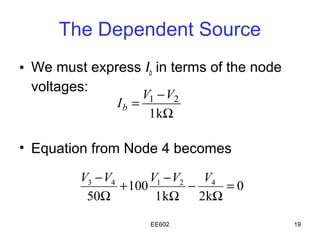
The Dependent Source
• We must express Ib in terms of the node
  voltages:
                    V1 − V2
               Ib =
                     1 kΩ

• Equation from Node 4 becomes

         V3 − V4       V1 − V2   V4
                 + 100         −    =0
          50Ω           1 kΩ 2kΩ
                     EE602                  19
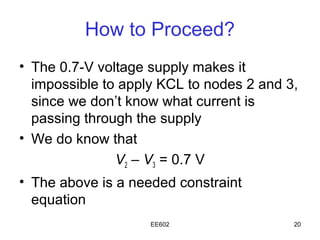
How to Proceed?
• The 0.7-V voltage supply makes it
  impossible to apply KCL to nodes 2 and 3,
  since we don’t know what current is
  passing through the supply
• We do know that
               V2 – V3 = 0.7 V
• The above is a needed constraint
  equation
                    EE602                 20
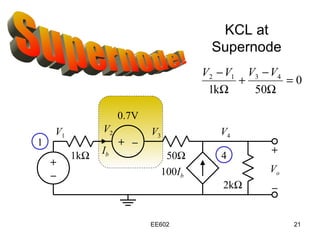
KCL at
                                         Supernode
                                        V2 − V1 V3 − V4
                                               +        =0
                                         1kΩ     50Ω

                    0.7V
    V1         V2          V3              V4
1                   + –
               Ib                          4        +
         1kΩ                     50Ω
    +
                                100Ib               Vo
    –
                                           2kΩ      –


                           EE602                         21

3 nodal analysis

  • 1.
  • 2.
    Steps of NodalAnalysis 1. Choose a reference (ground) node. 2. Assign node voltages to the other nodes. 3. Apply KCL to each node other than the reference node; express currents in terms of node voltages. 4. Solve the resulting system of linear equations for the nodal voltages. L EE602 2
  • 3.
    Example: A SummingCircuit • The output voltage V of this circuit is proportional to the sum of the two input currents I1 and I2 • This circuit could be useful in audio applications or in instrumentation • The output of this circuit would probably be connected to an amplifier EE602 3
  • 4.
    1. Reference Node 500Ω 500Ω + I1 500Ω V 1kΩ 500Ω I2 – The reference node is called the ground node where V = 0 EE602 4
  • 5.
    Steps of NodalAnalysis 1. Choose a reference (ground) node. 2. Assign node voltages to the other nodes. 3. Apply KCL to each node other than the reference node; express currents in terms of node voltages. 4. Solve the resulting system of linear equations for the nodal voltages. EE 602 5
  • 6.
    2. Node Voltages V1 500Ω V 500Ω V3 2 1 2 3 I1 1kΩ 500Ω I2 500Ω V1, V2, and V3 are unknowns for which we solve using KCL EE602 6
  • 7.
    Steps of NodalAnalysis 1. Choose a reference (ground) node. 2. Assign node voltages to the other nodes. 3. Apply KCL to each node other than the reference node; express currents in terms of node voltages. 4. Solve the resulting system of linear equations for the nodal voltages. EE602 7
  • 8.
    Currents and NodeVoltages V1 500Ω V2 V1 V1 500Ω 500Ω V1 − V2 500Ω EE602 8
  • 9.
    3. KCL atNode 1 V1 500Ω V2 I1 V1 − V2 V1 500Ω I1 = + 500Ω 500Ω EE602 9
  • 10.
    3. KCL atNode 2 V1 500Ω V2 500Ω V3 1kΩ V2 − V1 V2 V2 − V3 + + =0 500Ω 1kΩ 500Ω EE602 10
  • 11.
    3. KCL atNode 3 V2 500Ω V3 V3 − V2 V3 500Ω I2 + = I2 500Ω 500Ω Lect4 EEE 202 11
  • 12.
    Steps of NodalAnalysis 1. Choose a reference (ground) node. 2. Assign node voltages to the other nodes. 3. Apply KCL to each node other than the reference node; express currents in terms of node voltages. 4. Solve the resulting system of linear equations for the nodal voltages. EE602 12
  • 13.
    4. Summing CircuitSolution 500Ω 500Ω + I1 500Ω V 1kΩ 500Ω I2 – Solution: V = 167I1 + 167I2 Lect4 EEE 202 13
  • 14.
    A Linear LargeSignal Equivalent to a Transistor 0.7V Ib + – + 5V 1kΩ 50Ω 2kΩ + 100Ib Vo – – EE602 14
  • 15.
    Steps of NodalAnalysis 1. Choose a reference (ground) node. 2. Assign node voltages to the other nodes. 3. Apply KCL to each node other than the reference node; express currents in terms of node voltages. 4. Solve the resulting system of linear equations for the nodal voltages. EE602 15
  • 16.
    Linear Large SignalEquivalent 0.7V V1 Ib V 2 V3 V4 1 + – 2 3 50Ω 4 + 1kΩ 5V + 100Ib Vo – 2kΩ – Lect4 EEE 202 16
  • 17.
    Steps of NodalAnalysis 1. Choose a reference (ground) node. 2. Assign node voltages to the other nodes. 3. Apply KCL to each node other than the reference node; express currents in terms of node voltages. 4. Solve the resulting system of linear equations for the nodal voltages. EE602 17
  • 18.
    KCL @ Node4 0.7V V1 Ib V2 V3 V4 1 + – 2 3 50Ω 4 + 1kΩ 5V + 100Ib Vo – 2kΩ – V3 − V4 V4 + 100 I b = 50Ω 2 kΩ Lect4 EEE 202 18
  • 19.
    The Dependent Source •We must express Ib in terms of the node voltages: V1 − V2 Ib = 1 kΩ • Equation from Node 4 becomes V3 − V4 V1 − V2 V4 + 100 − =0 50Ω 1 kΩ 2kΩ EE602 19
  • 20.
    How to Proceed? •The 0.7-V voltage supply makes it impossible to apply KCL to nodes 2 and 3, since we don’t know what current is passing through the supply • We do know that V2 – V3 = 0.7 V • The above is a needed constraint equation EE602 20
  • 21.
    KCL at Supernode V2 − V1 V3 − V4 + =0 1kΩ 50Ω 0.7V V1 V2 V3 V4 1 + – Ib 4 + 1kΩ 50Ω + 100Ib Vo – 2kΩ – EE602 21

Editor's Notes

  • #2 Dr. Holbert Lecture 4 EEE 202