IJRET: International Journal of Research in Engineering and Technology eISSN: 2319-1163 | pISSN: 2321-7308
_______________________________________________________________________________________
Volume: 05 Issue: 01 | Jan-2016, Available @ http://www.ijret.org 102
EFFICIENT CLASSIFICATION OF BIG DATA USING VFDT
(VERY FAST DECISION TREE)
Sourav Roy1
, Brina Patel2
, Samruddhi Purandare3
, Minal Kucheria4
1
Student, Computer Department, MIT College of Engineering, Maharashtra, India
2
Student, Computer Department, MIT College of Engineering, Maharashtra, India
3
Student, Computer Department, MIT College of Engineering, Maharashtra, India
4
Student, Computer Department, MIT College of Engineering, Maharashtra, India
Abstract
Decision Tree learning algorithms have been able to capture knowledge successfully. Decision Trees are best considered when
instances are described by attribute-value pairs and when the target function has a discrete value. The main task of these
decision trees is to use inductive methods to the given values of attributes of an unknown object and determine an
appropriate classification by applying decision tree rules. Decision Trees are very effective forms to evaluate the performance
and represent the algorithms because of their robustness, simplicity, capability of handling numerical and categorical data,
ability to work with large datasets and comprehensibility to a name a few. There are various decision tree algorithms available
like ID3, CART, C4.5, VFDT, QUEST, CTREE, GUIDE, CHAID, CRUISE, etc. In this paper a comparative study on three of
these popular decision tree algorithms - (Iterative Dichotomizer 3), C4.5 which is an evolution of ID3 and VFDT (Very
Fast Decision Tree has been made. An empirical study has been conducted to compare C4.5 and VFDT in terms of accuracy
and execution time and various conclusions have been drawn.
Key Words: Decision tree, ID3, C4.5, VFDT, Information Gain, Gain Ratio, Gini Index, Over−fitting.
--------------------------------------------------------------------***----------------------------------------------------------------------
1. INTRODUCTION
Data mining is a process which involves analysis and is
designed to explore large quantity of data in search of
fitting patterns and relationships between variables. In order
to do so, it implements numerous techniques and
algorithms. Decision tree algorithm is one such algorithm.
A decision tree is a tree in which each branch node
denotes a choice between a number of alternatives while
every leaf node represents a decision or classification.
Decision trees gain information for the purpose of decision-
making. Root node is the starting node for a decision tree
on which a user takes actions. Decision Tree Learning
Algorithm is applied and from this node, users split each
node recursively. The final result depicts a decision tree in
which each branch denotes a possible decision and its
outcome [4].
ID3, C4.5 and VFDT are the most common decision tree
algorithms which use different splitting criteria for
splitting the node at every level to form a homogeneous
node. The ID3 algorithm is a simple decision tree algorithm
(Quinlan, 1983). It determines the classification of objects
by testing the values of the attributes. It builds a decision
tree in a top-down manner, beginning with a set of objects
and specification of properties.C4.5 is an evolution of ID3
(Quinlan, 1993). Using C4.5 the decision tree is
generated by recursively splitting the data. The decision
tree grows using Depth-first strategy. VFDT is built
incrementally over time by splitting nodes using a small
amount of the incoming data stream [2].
2. DECISION TREE
A decision tree is a tree in which each branch node denotes a
choice between a number of alternatives while every leaf
node represents a decision or classification. Decision
trees build regression models or classification models in
the form of a tree structure. They break down a dataset
into smaller subsets and at the same time a respective
decision tree is developed incrementally. The concluding
result is a tree containing decision nodes and leaf nodes.
A decision node (e.g., Age) has either two or more than
two branches (e.g., youth, middle- aged and senior). Leaf
node (e.g., yes or no) depicts a decision or a classification.
The root node is the topmost decision node in a tree which
is the best predictor. Decision trees can handle both
numerical and categorical data.
Fig. 1. Decision Tree Example
IJRET: International Journal of Research in Engineering and Technology eISSN: 2319-1163 | pISSN: 2321-7308
_______________________________________________________________________________________
Volume: 05 Issue: 01 | Jan-2016, Available @ http://www.ijret.org 103
1. ID3 ALGORITHM
Iterative Dichotomiser 3, popularly known as ID3, is an
algorithm for constructing decision trees that was developed
by J. Ross Quinlan. ID3 adopts a greedy mechanism where
trees are constructed through non backtracking top-down
manner. Decision trees are used for classification
adopting divide and conquer strategy. The process of
constructing these trees starts with the training phase where
data is represented in form of attributes and their associated
classes. Attributes define the property or characteristics of
that tuple while class denotes the label under which the tuple
falls. Trees are built by recursively partitioning the training
tuples into smaller subsets.
INPUT:
 Training data.
 Attribute list containing set of attributes.
 Attribute selection method is used to decide the splitting
criterion that selects the best attribute to partition the
data tuples into different classes.
OUTPUT:
 A well-constructed decision tree.
METHOD:
 Start with a single leaf as the root node. To decide which
attribute will serve as the decision node, call attribute
selection method i.e calculate information gain of all the
attributes.
 Select the attribute with maximum information gain to
serve as the decision node. Label it as N.
 Delete this attribute from the attribute list.
 For each outcome k of this decision node N,
-Let Dk be set of data tuples in the data set satisfying
outcome or result k;
-If Dk doesn’t have any outcomes then attach a leaf
labeled with the majority class in D to node N; else
attach the node returned by calling the method again on
Dk, and attribute list created by deleting the
currently selected attribute;
- end for
-return N;
ATTRIBUTE SELECTION:
Data tuples are associated with a set of attributes. While
constructing the tree these attributes form the decision
nodes. It is very important to select attributes which will
serve as the best splitting criterion for making decisions on
test tuples. The process of selecting attributes assigns a rank
or score for each attribute describing the given training data.
The attribute having the best or maximum score is selected
as the splitting or decision attribute for the given tuples.
Different attribute selection measures are adopted by
different algorithms. ID3 adopts the measure of Information
Gain for attribute selection. The attribute having the highest
or maximum information gain among other attributes is
selected as the splitting attribute and becomes the decision
node. The selected attribute reduces the information needed
to categorize the tuples in the resulting partitions. This in
turn reduces or minimizes the entropy in the data tuples.
Info (D) = Σ pi log2 (pi)
Where, D:Data
pi: Probability that a particular where a tuple in D is in
Class Ci and is given by |Ci,D| / |D|.
Info(D) : the amount of information needed to classify
data tuple in a particular class.
The term |Dj /  D: the weight of the jth partition.
The information gain of an attribute can be calculated
by using:
Gain(A) = Info(D) InfoA (D).
The attribute A with the maximum information gain is
selected as the splitting attribute and serves as the
conditional node. It is easier to construct trees using ID3
algorithm, however there are various problems associated
with it. Over-fitting may occur if a small sample tuple is
tested. Also only one attribute at a time is tested for making
a decision. ID3 requires the entire dataset to reside in the
memory, thus making it inefficient when it comes to space
requirements.
4. C4.5 ALGORITHM
C4.5 is an extension to basic ID3 algorithm developed by
Ross Quinlan to generate decision trees. C4.5 overcomes
the drawback of Quinlan’s earlier ID3 algorithm. One of
the limitations of ID3 is that it is sensitive to attributes with
large numbers of values. C4.5 follows a greedy non-
backtracking approach. C4.5 constructs tree in top-down
recursive divide and conquer manner. C4.5 is supervised
learning algorithm used for solving classification
problems. Given a training dataset, the samples are
described by accumulation or collections of attributes and
are associated with a class label. C4.5 learns to associate
attribute values to class labels that can be applied to
classify test data.
The information gain is biased towards tests with
multiple outcomes as it prefers to select attributes with
large number of values. C4.5 uses an extension to
information gain known as gain ratio and attempts to
overcome this bias. C4.5 uses gain ratio as its attribute
selection method to decide the best splitting criterion to
partition the data tuple into different classes. It tries to
normalize the information gain defined with Info(D) as: [5]
For each outcome, it considers the number of tuples
having a particular outcome with respect to the total
number of tuples in training data D.
IJRET: International Journal of Research in Engineering and Technology eISSN: 2319-1163 | pISSN: 2321-7308
_______________________________________________________________________________________
Volume: 05 Issue: 01 | Jan-2016, Available @ http://www.ijret.org 104
The gain ratio is defined as:
The attribute containing the highest information gain value
is chosen to make the decision.
This algorithm has some base cases:
 If all the samples in the training data set belong to
the same class, decision tree is simply a leaf identifying
that class.
 If D contains no samples, then C4.5 algorithm at a
given node uses the criterion the most frequent class in
D. Decision tree constructed will be a leaf having class
that will be majority class in D.
 If instance of previously-unknown class is
encountered, C4.5 creates a decision node higher up the
tree using the expected value.
ALGORITHM:
Input: Training Dataset D
Output: Decision tree
C4.5 (D)
• Tree = {}
• if D is pure OR meets stopping criteria then
• terminate
• end if
• for all attributes a∈ D do
• Compute information-gain and the gain ratio for
finding best splitting attribute
• end for
• abest = Best splitting attribute
• Tree = Create a decision node that tests abest in the
root
• Dv = Evaluate sub-datasets from D based on best
splitting attribute
• for all Dv do
• Treev = C4.5(Dv)
• Attach Treev to the corresponding branch of Tree
• end for
• return Tree
Improvements over ID3 algorithm:
C4.5 made a number of improvements to ID3. Some of
these are:
• Handling both continuous and discrete valued data-
To handle continuous attributes, C4.5 creates a threshold
and then splits the list into nodes whose attribute values
are less than or equal to threshold and whose attribute
values are greater than threshold.
• Handling missing values − C4.5 marks missing attribute
values as ? for missing data and missing attributes are not
used in gain calculations
• Handles attributes with different costs.
• Pruning trees− C4.5 traverses the tree when it is created
and attempts to eliminate branches that do not help by
replacing them with leaf nodes. [6]
5. VERY FAST DECISION TREE (VFDT)
To overcome the limitations of the previous algorithms used
to construct decision trees, VFDT was developed by. It
avoids favoring the attribute with a large number of
attribute values leading to better tree results. The major
advantage of this technique in contrast with traditional
algorithms, the VFDT does not require that the entire
dataset to be read as part of the learning process. This in
turn reduces time required to construct the tree. VFDT is
thus efficient in terms of time and memory requirements.
VFDT effectively performs a test-and- train process each
time test data arrives. As VFDT can handle missing values,
it implements a mechanism called ARC (Auxiliary
Reconciliation Control) . This technique minimizes the
impacts of imperfect data streams and handles noisy data. It
also resolves the data synchronization problems by ensuring
data is pipelined into the VFDT one window at a time.
Along with it, it also predicts missing values, filters noisy
data, and handles delays in the data streams before they are
given to the VFDT classifier.
ALGORITHM:
VFDT uses a statistical method called the Hoeffding bound
or additive Chernoff bound to decide the splitting criterion
of the attribute while constructing the tree during training
process. The tree is built by recursively replacing leaves i.e
the selected attributes with decision node. A heuristic
evaluation function is used to determine the best splitting
criterion for converting leaves to nodes. Nodes contain the
selected attributes and leaves contain the class labels. When
a test data sample arrives, the tree is traversed from the root
to the leaf, evaluating the relevant attributes satisfying the
decisions at every node. The splitting technique uses a
heuristic evaluation function G(.). The necessary number
of samples uses HB (Hoeffding Bound) to limit the amount
of training data required to construct the tree for making
decisions.
Where
• n:no of independent observations
• r:random variable whose range is R,
• 1-δ :Confidence level
Let x1 be the attribute with the highest G(.), and x2 be the
attribute with the second-highest G(.).
Formula:
∆G = G(x1)− G(x2)
If ∆G>HB with n samples is observed in a leaf, and HB
states with probability 1-δ that x1 is the attribute with the
highest value in G(.), then the leaf is converted into a
decision node that splits on x1.
IJRET: International Journal of Research in Engineering and Technology eISSN: 2319-1163 | pISSN: 2321-7308
_______________________________________________________________________________________
Volume: 05 Issue: 01 | Jan-2016, Available @ http://www.ijret.org 105
Fig. 2. VFDT algorithm
5.1 ARC DESIGN
To avoid and handle the impacts of imperfect data,[2]a
data cache and missing-data-guessing mechanism called
the auxiliary reconciliation control (ARC) is proposed.
ARC is designed to work with VFDT to handle
unstructured data .The ARC solves the data
synchronization problems and provides a solution for the
same. It does so by by allowing data flow into VFDT one
window at a time. It has the ability to predict missing
values and handles slight variations and fluctuations in
incoming data before it is given to VFDT for classification.
The architecture of ARC contains set of data
preprocessing and cleaning functions. The ARC can be
programmed as a standalone program Synchronization or
co-ordination is facilitated by using the concept of sliding
window . This mechanism allows a single segment of data
to arrive at a time at regular or fixed intervals. When there
is no data arrival, the ARC and the VFDT will perform no
action and will remain on stand still mode.
Fig. 3. ARC Mechanism
Summary of algorithms:
Table-1: Comparison of algorithms
S NO PARAMETER ID3 C4.5 VFDT
1 Tree structure Multi tree Multi tree Multi tree
2 Handling missing data No Yes Yes
3 Method of handling continuous attributes Discretization Pre-sorting Concept drift
4 Time required for tree construction More Moderate Less
5 Error rate High Medium Low
6 Scalability Poor Poor good
6. EMPERICAL STUDY
The aim of this section is to derive knowledge from actual
observations rather than from theory or belief.
In order to measure the efficiency of VFDT algorithm, we
compared it to C4.5 algorithm with respect to execution
time and accuracy.
For doing so, we have used WEKA which is a collection
of machine learning algorithms used for data mining
tasks. The algorithms in WEKA can either be applied
directly to a dataset or called from user’s Java code. It
contains tools for classification, data preprocessing,
clustering, regression, visualization and association rules.
Initially, we started off with smaller datasets with number
of instances ranging from 2744 to 4627.Then datasets in
range of lakhs were also considered for measuring the
efficiency of the VFDT algorithm.
For performing the following empirical study, we have
used WEKA 3.7.13 on HP Pavilion having an i5
processor, 4GB RAM and 1 TB Hard Disk. WEKA is a
collection of machine learning algorithms used for data
mining tasks.
The results observed were as follows:
Table-2: Comparison-Execution time
S
no
No of
instances
Time taken to test
model on training
data for C4.5
algorithm(sec)
Time taken to test
model on training
data for VFDT
algorithm(sec)
1 2744 0.13 0.05
2 4062 0.41 0.02
3 4627 0.14 0.11
IJRET: International Journal of Research in Engineering and Technology eISSN: 2319-1163 | pISSN: 2321-7308
_______________________________________________________________________________________
Volume: 05 Issue: 01 | Jan-2016, Available @ http://www.ijret.org 106
A graphical representation of this can be as shown in the
figure below:
Fig. 4 Comparison−Execution time
Hence, it was observed that the time taken to test model
on the training data for VFDT was approximately 49.047%
lesser than that of C4.5.We then took larger datasets on
WEKA to check the accuracy of both VFDT and C4.5
algorithms. We took datasets whose number of instances
ranged from 1, 00,000 to 5, 00,000.
The results observed were as follows:
Table-3: Comparison-No of correctly classified instances
S no No of
instances
Correctly
classified
instances by C4.5
Correctly
classified
instances by
VFDT
1 1,00,000 81191 74308
2 2,00,000 162052 147283
3 3,00,000 242562 222934
4 4,00,000 322590 296995
5 5,00,000 CRASHED 370996
The results for the accuracy can be tabulated as follows:
Table-4: Comparison-Accuracy
S no No of
instances
Accuracy of
C4.5 (%)
Accuracy of
VFDT (%)
1 1,00,000 81.91 74.308
2 2,00,000 81.026 73.6415
3 3,00,000 80.854 74.3113
4 4,00,000 80.6475 74.2488
5 5,00,000 CRASHED 74.1932
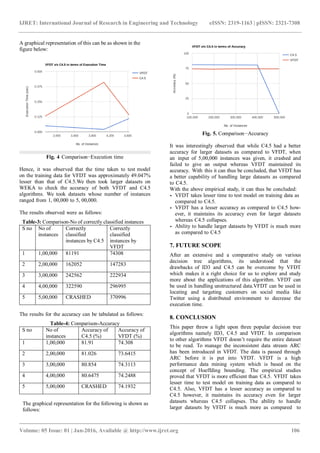
The graphical representation for the following is shown as
follows:
Fig. 5. Comparison−Accuracy
It was interestingly observed that while C4.5 had a better
accuracy for larger datasets as compared to VFDT, when
an input of 5,00,000 instances was given, it crashed and
failed to give an output whereas VFDT maintained its
accuracy. With this it can thus be concluded, that VFDT has
a better capability of handling large datasets as compared
to C4.5.
With the above empirical study, it can thus be concluded:
• VFDT takes lesser time to test model on training data as
compared to C4.5.
• VFDT has a lesser accuracy as compared to C4.5 how-
ever, it maintains its accuracy even for larger datasets
whereas C4.5 collapses.
• Ability to handle larger datasets by VFDT is much more
as compared to C4.5
7. FUTURE SCOPE
After an extensive and a comparative study on various
decision tree algorithms, its understood that the
drawbacks of ID3 and C4.5 can be overcome by VFDT
which makes it a right choice for us to explore and study
more about the applications of this algorithm. VFDT can
be used in handling unstructured data.VFDT can be used in
locating and targeting customers on social media like
Twitter using a distributed environment to decrease the
execution time.
8. CONCLUSION
This paper threw a light upon three popular decision tree
algorithms namely ID3, C4.5 and VFDT. In comparison
to other algorithms VFDT doesn’t require the entire dataset
to be read. To manage the inconsistent data stream ARC
has been introduced in VFDT. The data is passed through
ARC before it is put into VFDT. VFDT is a high
performance data mining system which is based on the
concept of Hoeffding bounding. The empirical studies
proved that VFDT is more efficient than C4.5. VFDT takes
lesser time to test model on training data as compared to
C4.5. Also, VFDT has a lesser accuracy as compared to
C4.5 however, it maintains its accuracy even for larger
datasets whereas C4.5 collapses. The ability to handle
larger datasets by VFDT is much more as compared to
IJRET: International Journal of Research in Engineering and Technology eISSN: 2319-1163 | pISSN: 2321-7308
_______________________________________________________________________________________
Volume: 05 Issue: 01 | Jan-2016, Available @ http://www.ijret.org 107
C4.5. Both ID3 and C4.5 have a few drawbacks which
are overcome by VFDT. Having concluded so, VFDT
becomes a perfect choice for various applications which
includes handling unstructured data.
ACKNOWLEDGEMENT
We would like to express deep sense of gratitude to Prof.
Sharmishta Desai for providing us with her help
whenever required. We would also like to thank our family
and friends for their continuous support.
REFERENCES
[1] Pedro Domingos and Geoff Hulten Mining High-
Speed Data Streams Dept. of Computer Science and
Engineering , University of Washington, Box
352350,Seattle, WA 98195-2350, U.S.A.
[2] M.V.V.S Subramanian, Sri. V. Venkateswara Rao
“VFDT Algorithm for Decision Tree Generation ”Sri
Vasavi Engineering College,Tadepalli Gudem, WG DIST.
IJDCST −November, Issue− V−1, I−7,SW−94
[3] Tusharkumar Trambadiya, Praveen Bhanodia “A
Comparative study of Stream Data mining Algorithms
”International Journal of Engineering and Innovative
Technology (IJEIT) Volume 2, Issue 3, September 2012.
[4] Wei Peng, Juhua Chen and Haiping Zhou, of ID3, “An
Implementation Decision Tree Learning Algorithm ”,
University of New South Wales, School of Computer
Science and Engineering, Sydney, NSW 2032, Australia.
[5] Data Mining:Concepts and Techniques Second Edition
by Jiawei Han,elsevie.
[6] Badr HSSINA, Abdelkarim MERBOUHA,Hanane
EZZIKOURI,MohammedERRITALI:A Comparative study
of decision tree ID3 and C4.5 , (IJACSA).
[7] Rupali Bhardwaj, Sonia Vatta Implementation of ID3
in International Journal of Advanced Research in
Computer Science and Software Engineering.
[8] Xie Niuniu ,College of Information Science and
Engineering Henan University of Technology Zhengzhou,
China , Liu Yuxun , College of Information Science and
Engineering Henan University of Technology Zhengzhou,
China Review of Decision Trees.
[9] Ahmed Bahgat El Seddawy, Prof. Dr. Turky Sultan,
Dr. Ayman Khedr Department of Business Information
System, Arab Academy for Science and Technology, Egypt
Department of Information System, Helwan University,
Egypt Applying Classification Technique using DID3
Algo- rithm to improve Decision Support System under
Uncertain Situations , International Journal of Modern
Engineering Research (IJMER).
[10](1) Harvinder Chauhan,(2) Anu Chauhan ,(1)Assistant
Professor, P.G.Dept. of Computer Science Kamla Nehru
College For Women, Phagwara (Punjab),(2)Research
Scholar, Implementation of decision tree algorithm c4.5,
International Journal of Scientific and Research Publica-
tions, Volume 3, Issue 10, October 2013.
[11] Prof.Sharmishta Desai, Dr.S.T.Patil, Differ en tia l
Evolution algorithm with Support Vector Machine to
classify objects efficiently, International Journal of Advance
Research in Computer Science and Management Studies,
March 2014.
[12] Prof.Sharmishta Desai, Dr.S.T.Patil, Automatic
detection and classification of objects with optimized
search space, International Journal of Advance Research In
Science And Engineering, March 2014.
[13] Prof.Sharmishta Desai, Dr.S.T.Patil, Efficient
regression algorithms for classification of social media
data ,International Conference on Pervasive Computing
IEEE 2015.

Efficient classification of big data using vfdt (very fast decision tree)

  • 1.
    IJRET: International Journalof Research in Engineering and Technology eISSN: 2319-1163 | pISSN: 2321-7308 _______________________________________________________________________________________ Volume: 05 Issue: 01 | Jan-2016, Available @ http://www.ijret.org 102 EFFICIENT CLASSIFICATION OF BIG DATA USING VFDT (VERY FAST DECISION TREE) Sourav Roy1 , Brina Patel2 , Samruddhi Purandare3 , Minal Kucheria4 1 Student, Computer Department, MIT College of Engineering, Maharashtra, India 2 Student, Computer Department, MIT College of Engineering, Maharashtra, India 3 Student, Computer Department, MIT College of Engineering, Maharashtra, India 4 Student, Computer Department, MIT College of Engineering, Maharashtra, India Abstract Decision Tree learning algorithms have been able to capture knowledge successfully. Decision Trees are best considered when instances are described by attribute-value pairs and when the target function has a discrete value. The main task of these decision trees is to use inductive methods to the given values of attributes of an unknown object and determine an appropriate classification by applying decision tree rules. Decision Trees are very effective forms to evaluate the performance and represent the algorithms because of their robustness, simplicity, capability of handling numerical and categorical data, ability to work with large datasets and comprehensibility to a name a few. There are various decision tree algorithms available like ID3, CART, C4.5, VFDT, QUEST, CTREE, GUIDE, CHAID, CRUISE, etc. In this paper a comparative study on three of these popular decision tree algorithms - (Iterative Dichotomizer 3), C4.5 which is an evolution of ID3 and VFDT (Very Fast Decision Tree has been made. An empirical study has been conducted to compare C4.5 and VFDT in terms of accuracy and execution time and various conclusions have been drawn. Key Words: Decision tree, ID3, C4.5, VFDT, Information Gain, Gain Ratio, Gini Index, Over−fitting. --------------------------------------------------------------------***---------------------------------------------------------------------- 1. INTRODUCTION Data mining is a process which involves analysis and is designed to explore large quantity of data in search of fitting patterns and relationships between variables. In order to do so, it implements numerous techniques and algorithms. Decision tree algorithm is one such algorithm. A decision tree is a tree in which each branch node denotes a choice between a number of alternatives while every leaf node represents a decision or classification. Decision trees gain information for the purpose of decision- making. Root node is the starting node for a decision tree on which a user takes actions. Decision Tree Learning Algorithm is applied and from this node, users split each node recursively. The final result depicts a decision tree in which each branch denotes a possible decision and its outcome [4]. ID3, C4.5 and VFDT are the most common decision tree algorithms which use different splitting criteria for splitting the node at every level to form a homogeneous node. The ID3 algorithm is a simple decision tree algorithm (Quinlan, 1983). It determines the classification of objects by testing the values of the attributes. It builds a decision tree in a top-down manner, beginning with a set of objects and specification of properties.C4.5 is an evolution of ID3 (Quinlan, 1993). Using C4.5 the decision tree is generated by recursively splitting the data. The decision tree grows using Depth-first strategy. VFDT is built incrementally over time by splitting nodes using a small amount of the incoming data stream [2]. 2. DECISION TREE A decision tree is a tree in which each branch node denotes a choice between a number of alternatives while every leaf node represents a decision or classification. Decision trees build regression models or classification models in the form of a tree structure. They break down a dataset into smaller subsets and at the same time a respective decision tree is developed incrementally. The concluding result is a tree containing decision nodes and leaf nodes. A decision node (e.g., Age) has either two or more than two branches (e.g., youth, middle- aged and senior). Leaf node (e.g., yes or no) depicts a decision or a classification. The root node is the topmost decision node in a tree which is the best predictor. Decision trees can handle both numerical and categorical data. Fig. 1. Decision Tree Example
  • 2.
    IJRET: International Journalof Research in Engineering and Technology eISSN: 2319-1163 | pISSN: 2321-7308 _______________________________________________________________________________________ Volume: 05 Issue: 01 | Jan-2016, Available @ http://www.ijret.org 103 1. ID3 ALGORITHM Iterative Dichotomiser 3, popularly known as ID3, is an algorithm for constructing decision trees that was developed by J. Ross Quinlan. ID3 adopts a greedy mechanism where trees are constructed through non backtracking top-down manner. Decision trees are used for classification adopting divide and conquer strategy. The process of constructing these trees starts with the training phase where data is represented in form of attributes and their associated classes. Attributes define the property or characteristics of that tuple while class denotes the label under which the tuple falls. Trees are built by recursively partitioning the training tuples into smaller subsets. INPUT:  Training data.  Attribute list containing set of attributes.  Attribute selection method is used to decide the splitting criterion that selects the best attribute to partition the data tuples into different classes. OUTPUT:  A well-constructed decision tree. METHOD:  Start with a single leaf as the root node. To decide which attribute will serve as the decision node, call attribute selection method i.e calculate information gain of all the attributes.  Select the attribute with maximum information gain to serve as the decision node. Label it as N.  Delete this attribute from the attribute list.  For each outcome k of this decision node N, -Let Dk be set of data tuples in the data set satisfying outcome or result k; -If Dk doesn’t have any outcomes then attach a leaf labeled with the majority class in D to node N; else attach the node returned by calling the method again on Dk, and attribute list created by deleting the currently selected attribute; - end for -return N; ATTRIBUTE SELECTION: Data tuples are associated with a set of attributes. While constructing the tree these attributes form the decision nodes. It is very important to select attributes which will serve as the best splitting criterion for making decisions on test tuples. The process of selecting attributes assigns a rank or score for each attribute describing the given training data. The attribute having the best or maximum score is selected as the splitting or decision attribute for the given tuples. Different attribute selection measures are adopted by different algorithms. ID3 adopts the measure of Information Gain for attribute selection. The attribute having the highest or maximum information gain among other attributes is selected as the splitting attribute and becomes the decision node. The selected attribute reduces the information needed to categorize the tuples in the resulting partitions. This in turn reduces or minimizes the entropy in the data tuples. Info (D) = Σ pi log2 (pi) Where, D:Data pi: Probability that a particular where a tuple in D is in Class Ci and is given by |Ci,D| / |D|. Info(D) : the amount of information needed to classify data tuple in a particular class. The term |Dj / D: the weight of the jth partition. The information gain of an attribute can be calculated by using: Gain(A) = Info(D) InfoA (D). The attribute A with the maximum information gain is selected as the splitting attribute and serves as the conditional node. It is easier to construct trees using ID3 algorithm, however there are various problems associated with it. Over-fitting may occur if a small sample tuple is tested. Also only one attribute at a time is tested for making a decision. ID3 requires the entire dataset to reside in the memory, thus making it inefficient when it comes to space requirements. 4. C4.5 ALGORITHM C4.5 is an extension to basic ID3 algorithm developed by Ross Quinlan to generate decision trees. C4.5 overcomes the drawback of Quinlan’s earlier ID3 algorithm. One of the limitations of ID3 is that it is sensitive to attributes with large numbers of values. C4.5 follows a greedy non- backtracking approach. C4.5 constructs tree in top-down recursive divide and conquer manner. C4.5 is supervised learning algorithm used for solving classification problems. Given a training dataset, the samples are described by accumulation or collections of attributes and are associated with a class label. C4.5 learns to associate attribute values to class labels that can be applied to classify test data. The information gain is biased towards tests with multiple outcomes as it prefers to select attributes with large number of values. C4.5 uses an extension to information gain known as gain ratio and attempts to overcome this bias. C4.5 uses gain ratio as its attribute selection method to decide the best splitting criterion to partition the data tuple into different classes. It tries to normalize the information gain defined with Info(D) as: [5] For each outcome, it considers the number of tuples having a particular outcome with respect to the total number of tuples in training data D.
  • 3.
    IJRET: International Journalof Research in Engineering and Technology eISSN: 2319-1163 | pISSN: 2321-7308 _______________________________________________________________________________________ Volume: 05 Issue: 01 | Jan-2016, Available @ http://www.ijret.org 104 The gain ratio is defined as: The attribute containing the highest information gain value is chosen to make the decision. This algorithm has some base cases:  If all the samples in the training data set belong to the same class, decision tree is simply a leaf identifying that class.  If D contains no samples, then C4.5 algorithm at a given node uses the criterion the most frequent class in D. Decision tree constructed will be a leaf having class that will be majority class in D.  If instance of previously-unknown class is encountered, C4.5 creates a decision node higher up the tree using the expected value. ALGORITHM: Input: Training Dataset D Output: Decision tree C4.5 (D) • Tree = {} • if D is pure OR meets stopping criteria then • terminate • end if • for all attributes a∈ D do • Compute information-gain and the gain ratio for finding best splitting attribute • end for • abest = Best splitting attribute • Tree = Create a decision node that tests abest in the root • Dv = Evaluate sub-datasets from D based on best splitting attribute • for all Dv do • Treev = C4.5(Dv) • Attach Treev to the corresponding branch of Tree • end for • return Tree Improvements over ID3 algorithm: C4.5 made a number of improvements to ID3. Some of these are: • Handling both continuous and discrete valued data- To handle continuous attributes, C4.5 creates a threshold and then splits the list into nodes whose attribute values are less than or equal to threshold and whose attribute values are greater than threshold. • Handling missing values − C4.5 marks missing attribute values as ? for missing data and missing attributes are not used in gain calculations • Handles attributes with different costs. • Pruning trees− C4.5 traverses the tree when it is created and attempts to eliminate branches that do not help by replacing them with leaf nodes. [6] 5. VERY FAST DECISION TREE (VFDT) To overcome the limitations of the previous algorithms used to construct decision trees, VFDT was developed by. It avoids favoring the attribute with a large number of attribute values leading to better tree results. The major advantage of this technique in contrast with traditional algorithms, the VFDT does not require that the entire dataset to be read as part of the learning process. This in turn reduces time required to construct the tree. VFDT is thus efficient in terms of time and memory requirements. VFDT effectively performs a test-and- train process each time test data arrives. As VFDT can handle missing values, it implements a mechanism called ARC (Auxiliary Reconciliation Control) . This technique minimizes the impacts of imperfect data streams and handles noisy data. It also resolves the data synchronization problems by ensuring data is pipelined into the VFDT one window at a time. Along with it, it also predicts missing values, filters noisy data, and handles delays in the data streams before they are given to the VFDT classifier. ALGORITHM: VFDT uses a statistical method called the Hoeffding bound or additive Chernoff bound to decide the splitting criterion of the attribute while constructing the tree during training process. The tree is built by recursively replacing leaves i.e the selected attributes with decision node. A heuristic evaluation function is used to determine the best splitting criterion for converting leaves to nodes. Nodes contain the selected attributes and leaves contain the class labels. When a test data sample arrives, the tree is traversed from the root to the leaf, evaluating the relevant attributes satisfying the decisions at every node. The splitting technique uses a heuristic evaluation function G(.). The necessary number of samples uses HB (Hoeffding Bound) to limit the amount of training data required to construct the tree for making decisions. Where • n:no of independent observations • r:random variable whose range is R, • 1-δ :Confidence level Let x1 be the attribute with the highest G(.), and x2 be the attribute with the second-highest G(.). Formula: ∆G = G(x1)− G(x2) If ∆G>HB with n samples is observed in a leaf, and HB states with probability 1-δ that x1 is the attribute with the highest value in G(.), then the leaf is converted into a decision node that splits on x1.
  • 4.
    IJRET: International Journalof Research in Engineering and Technology eISSN: 2319-1163 | pISSN: 2321-7308 _______________________________________________________________________________________ Volume: 05 Issue: 01 | Jan-2016, Available @ http://www.ijret.org 105 Fig. 2. VFDT algorithm 5.1 ARC DESIGN To avoid and handle the impacts of imperfect data,[2]a data cache and missing-data-guessing mechanism called the auxiliary reconciliation control (ARC) is proposed. ARC is designed to work with VFDT to handle unstructured data .The ARC solves the data synchronization problems and provides a solution for the same. It does so by by allowing data flow into VFDT one window at a time. It has the ability to predict missing values and handles slight variations and fluctuations in incoming data before it is given to VFDT for classification. The architecture of ARC contains set of data preprocessing and cleaning functions. The ARC can be programmed as a standalone program Synchronization or co-ordination is facilitated by using the concept of sliding window . This mechanism allows a single segment of data to arrive at a time at regular or fixed intervals. When there is no data arrival, the ARC and the VFDT will perform no action and will remain on stand still mode. Fig. 3. ARC Mechanism Summary of algorithms: Table-1: Comparison of algorithms S NO PARAMETER ID3 C4.5 VFDT 1 Tree structure Multi tree Multi tree Multi tree 2 Handling missing data No Yes Yes 3 Method of handling continuous attributes Discretization Pre-sorting Concept drift 4 Time required for tree construction More Moderate Less 5 Error rate High Medium Low 6 Scalability Poor Poor good 6. EMPERICAL STUDY The aim of this section is to derive knowledge from actual observations rather than from theory or belief. In order to measure the efficiency of VFDT algorithm, we compared it to C4.5 algorithm with respect to execution time and accuracy. For doing so, we have used WEKA which is a collection of machine learning algorithms used for data mining tasks. The algorithms in WEKA can either be applied directly to a dataset or called from user’s Java code. It contains tools for classification, data preprocessing, clustering, regression, visualization and association rules. Initially, we started off with smaller datasets with number of instances ranging from 2744 to 4627.Then datasets in range of lakhs were also considered for measuring the efficiency of the VFDT algorithm. For performing the following empirical study, we have used WEKA 3.7.13 on HP Pavilion having an i5 processor, 4GB RAM and 1 TB Hard Disk. WEKA is a collection of machine learning algorithms used for data mining tasks. The results observed were as follows: Table-2: Comparison-Execution time S no No of instances Time taken to test model on training data for C4.5 algorithm(sec) Time taken to test model on training data for VFDT algorithm(sec) 1 2744 0.13 0.05 2 4062 0.41 0.02 3 4627 0.14 0.11
  • 5.
    IJRET: International Journalof Research in Engineering and Technology eISSN: 2319-1163 | pISSN: 2321-7308 _______________________________________________________________________________________ Volume: 05 Issue: 01 | Jan-2016, Available @ http://www.ijret.org 106 A graphical representation of this can be as shown in the figure below: Fig. 4 Comparison−Execution time Hence, it was observed that the time taken to test model on the training data for VFDT was approximately 49.047% lesser than that of C4.5.We then took larger datasets on WEKA to check the accuracy of both VFDT and C4.5 algorithms. We took datasets whose number of instances ranged from 1, 00,000 to 5, 00,000. The results observed were as follows: Table-3: Comparison-No of correctly classified instances S no No of instances Correctly classified instances by C4.5 Correctly classified instances by VFDT 1 1,00,000 81191 74308 2 2,00,000 162052 147283 3 3,00,000 242562 222934 4 4,00,000 322590 296995 5 5,00,000 CRASHED 370996 The results for the accuracy can be tabulated as follows: Table-4: Comparison-Accuracy S no No of instances Accuracy of C4.5 (%) Accuracy of VFDT (%) 1 1,00,000 81.91 74.308 2 2,00,000 81.026 73.6415 3 3,00,000 80.854 74.3113 4 4,00,000 80.6475 74.2488 5 5,00,000 CRASHED 74.1932 The graphical representation for the following is shown as follows: Fig. 5. Comparison−Accuracy It was interestingly observed that while C4.5 had a better accuracy for larger datasets as compared to VFDT, when an input of 5,00,000 instances was given, it crashed and failed to give an output whereas VFDT maintained its accuracy. With this it can thus be concluded, that VFDT has a better capability of handling large datasets as compared to C4.5. With the above empirical study, it can thus be concluded: • VFDT takes lesser time to test model on training data as compared to C4.5. • VFDT has a lesser accuracy as compared to C4.5 how- ever, it maintains its accuracy even for larger datasets whereas C4.5 collapses. • Ability to handle larger datasets by VFDT is much more as compared to C4.5 7. FUTURE SCOPE After an extensive and a comparative study on various decision tree algorithms, its understood that the drawbacks of ID3 and C4.5 can be overcome by VFDT which makes it a right choice for us to explore and study more about the applications of this algorithm. VFDT can be used in handling unstructured data.VFDT can be used in locating and targeting customers on social media like Twitter using a distributed environment to decrease the execution time. 8. CONCLUSION This paper threw a light upon three popular decision tree algorithms namely ID3, C4.5 and VFDT. In comparison to other algorithms VFDT doesn’t require the entire dataset to be read. To manage the inconsistent data stream ARC has been introduced in VFDT. The data is passed through ARC before it is put into VFDT. VFDT is a high performance data mining system which is based on the concept of Hoeffding bounding. The empirical studies proved that VFDT is more efficient than C4.5. VFDT takes lesser time to test model on training data as compared to C4.5. Also, VFDT has a lesser accuracy as compared to C4.5 however, it maintains its accuracy even for larger datasets whereas C4.5 collapses. The ability to handle larger datasets by VFDT is much more as compared to
  • 6.
    IJRET: International Journalof Research in Engineering and Technology eISSN: 2319-1163 | pISSN: 2321-7308 _______________________________________________________________________________________ Volume: 05 Issue: 01 | Jan-2016, Available @ http://www.ijret.org 107 C4.5. Both ID3 and C4.5 have a few drawbacks which are overcome by VFDT. Having concluded so, VFDT becomes a perfect choice for various applications which includes handling unstructured data. ACKNOWLEDGEMENT We would like to express deep sense of gratitude to Prof. Sharmishta Desai for providing us with her help whenever required. We would also like to thank our family and friends for their continuous support. REFERENCES [1] Pedro Domingos and Geoff Hulten Mining High- Speed Data Streams Dept. of Computer Science and Engineering , University of Washington, Box 352350,Seattle, WA 98195-2350, U.S.A. [2] M.V.V.S Subramanian, Sri. V. Venkateswara Rao “VFDT Algorithm for Decision Tree Generation ”Sri Vasavi Engineering College,Tadepalli Gudem, WG DIST. IJDCST −November, Issue− V−1, I−7,SW−94 [3] Tusharkumar Trambadiya, Praveen Bhanodia “A Comparative study of Stream Data mining Algorithms ”International Journal of Engineering and Innovative Technology (IJEIT) Volume 2, Issue 3, September 2012. [4] Wei Peng, Juhua Chen and Haiping Zhou, of ID3, “An Implementation Decision Tree Learning Algorithm ”, University of New South Wales, School of Computer Science and Engineering, Sydney, NSW 2032, Australia. [5] Data Mining:Concepts and Techniques Second Edition by Jiawei Han,elsevie. [6] Badr HSSINA, Abdelkarim MERBOUHA,Hanane EZZIKOURI,MohammedERRITALI:A Comparative study of decision tree ID3 and C4.5 , (IJACSA). [7] Rupali Bhardwaj, Sonia Vatta Implementation of ID3 in International Journal of Advanced Research in Computer Science and Software Engineering. [8] Xie Niuniu ,College of Information Science and Engineering Henan University of Technology Zhengzhou, China , Liu Yuxun , College of Information Science and Engineering Henan University of Technology Zhengzhou, China Review of Decision Trees. [9] Ahmed Bahgat El Seddawy, Prof. Dr. Turky Sultan, Dr. Ayman Khedr Department of Business Information System, Arab Academy for Science and Technology, Egypt Department of Information System, Helwan University, Egypt Applying Classification Technique using DID3 Algo- rithm to improve Decision Support System under Uncertain Situations , International Journal of Modern Engineering Research (IJMER). [10](1) Harvinder Chauhan,(2) Anu Chauhan ,(1)Assistant Professor, P.G.Dept. of Computer Science Kamla Nehru College For Women, Phagwara (Punjab),(2)Research Scholar, Implementation of decision tree algorithm c4.5, International Journal of Scientific and Research Publica- tions, Volume 3, Issue 10, October 2013. [11] Prof.Sharmishta Desai, Dr.S.T.Patil, Differ en tia l Evolution algorithm with Support Vector Machine to classify objects efficiently, International Journal of Advance Research in Computer Science and Management Studies, March 2014. [12] Prof.Sharmishta Desai, Dr.S.T.Patil, Automatic detection and classification of objects with optimized search space, International Journal of Advance Research In Science And Engineering, March 2014. [13] Prof.Sharmishta Desai, Dr.S.T.Patil, Efficient regression algorithms for classification of social media data ,International Conference on Pervasive Computing IEEE 2015.