Classification : Decision
Tree (DT)
Adama Science and Technology University
School of Electrical Engineering and Computing
Department of CSE
Dr. Mesfin Abebe Haile (2021)
Outline
 What is decision tree (DT) algorithm
 Why we need DT
 Pros and Cons of DT
 Information Theory
 Some Issues in DT
 Assignment II
02/04/25 2
Decision Tree (DT)
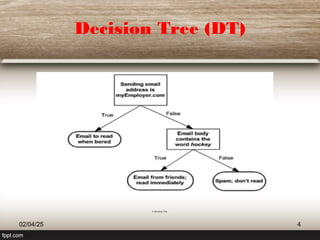
 Decision trees: splitting datasets one features at a time.
 The decision tree is one of the most commonly used classification technique.
 It has a decision blocks (rectangles).
 Termination block (ovals).
 The right and left arrows are called branches.
 The kNN algorithm can do a grate job of classification, but it didn’t lead to
any major insight about the data.
02/04/25 3
Decision Tree (DT)
A decision Tree
02/04/25 4
Decision Tree (DT)
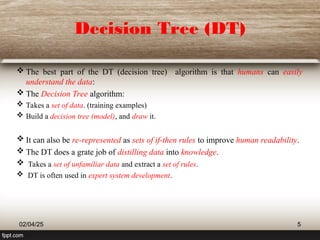
 The best part of the DT (decision tree) algorithm is that humans can easily
understand the data:
 The Decision Tree algorithm:
 Takes a set of data. (training examples)
 Build a decision tree (model), and draw it.
 It can also be re-represented as sets of if-then rules to improve human readability.
 The DT does a grate job of distilling data into knowledge.
 Takes a set of unfamiliar data and extract a set of rules.
 DT is often used in expert system development.
02/04/25 5
Decision Tree (DT)
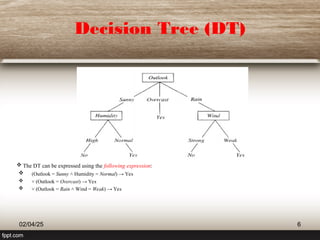
 The DT can be expressed using the following expression:
 (Outlook = Sunny Humidity =
˄ Normal) → Yes
 (Outlook =
˅ Overcast) → Yes
 (Outlook =
˅ Rain Wind =
˄ Weak) → Yes
02/04/25 6
Decision Tree (DT)
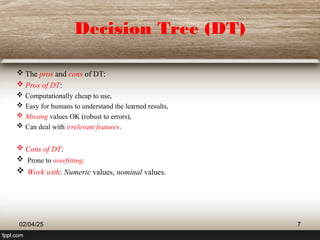
 The pros and cons of DT:
 Pros of DT:
 Computationally cheap to use,
 Easy for humans to understand the learned results,
 Missing values OK (robust to errors),
 Can deal with irrelevant features.
 Cons of DT:
 Prone to overfitting.
 Work with: Numeric values, nominal values.
02/04/25 7
Decision Tree (DT)
 Appropriate problems for DT learning:
 Instance are represented by attribute-value pairs (fixed set of attributes and
their values),
 The target function has discrete output values,
 Disjunctive descriptions may be required,
 The training data may contain errors,
 The training data may contain missing attribute values.
02/04/25 8
Decision Tree (DT)
 The mathematics that is used by DT to split the dataset is called
information theory:
 The first decision, you need to make is:
 Which feature shall be used to split the data.
 You need to try every feature and measure which split will give the
best result.
 Then split the dataset into subsets.
 The subsets will then traverse down the branches of the decision
node.
 If the data on the branch is the same, stop; else repeat the splitting.
02/04/25 9
Decision Tree (DT)
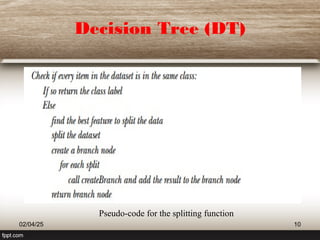
Pseudo-code for the splitting function
02/04/25 10
Decision Tree (DT)
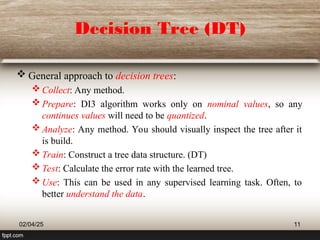
 General approach to decision trees:
 Collect: Any method.
 Prepare: DI3 algorithm works only on nominal values, so any
continues values will need to be quantized.
 Analyze: Any method. You should visually inspect the tree after it
is build.
 Train: Construct a tree data structure. (DT)
 Test: Calculate the error rate with the learned tree.
 Use: This can be used in any supervised learning task. Often, to
better understand the data.
02/04/25 11
Decision Tree (DT)
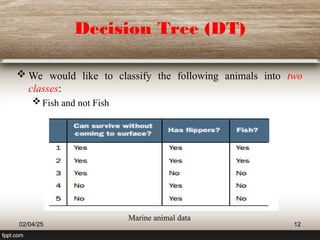
 We would like to classify the following animals into two
classes:
Fish and not Fish
02/04/25 12
Marine animal data
Decision Tree (DT)
 Need to decide whether we should split the data based on the
first feature or the second feature:
To make more organize the unorganized data.
One way to do this is to measure the information.
Measure the information before and after the split.
 Information theory is a branch of science that is concerned with
quantifying information.
 The change in information before and after the split is known
as the information gain.
02/04/25 13
Decision Tree (DT)
 The split with the highest information gain is the best option.
The measure of information of a set is known as the Shannon
entropy or entropy.
One way to do this is to measure the information.
 The change in information before and after the split is known
as the information gain.
02/04/25 14
Decision Tree (DT)
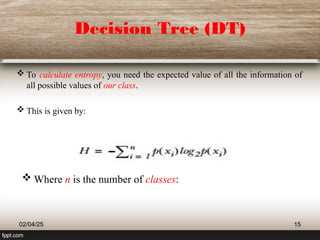
 To calculate entropy, you need the expected value of all the information of
all possible values of our class.
 This is given by:
02/04/25 15
 Where n is the number of classes:
Decision Tree (DT)
 The higher the entropy, the more mixed up the data.
 Another common measure of disorder in a set is the Gini
impurity.
Which is the probability of choosing an item from the set and the
probability of that data item being misclassified.
Calculate the shannon entropy of a dataset.
Dataset splitting on a given feature.
Choosing the best feature to split on.
02/04/25 16
Decision Tree (DT)
 Recursively building the tree.
Start with dataset and split it based on the best attribute.
The data will traverse down the branches of the tree to another
node.
This node will then split the data again (recursively)
Stop under the following conditions: run out of attributes or if the
instances in a branch are the same class.
02/04/25 17
Decision Tree (DT)
02/04/25 18
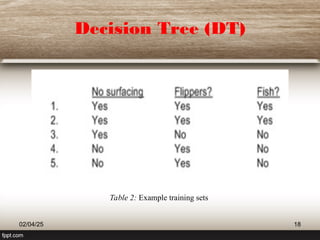
Table 2: Example training sets
Decision Tree (DT)
02/04/25 19
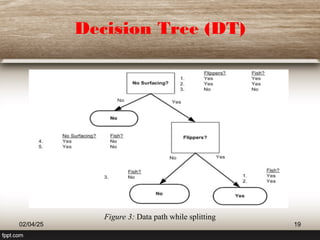
Figure 3: Data path while splitting
Decision Tree (DT)
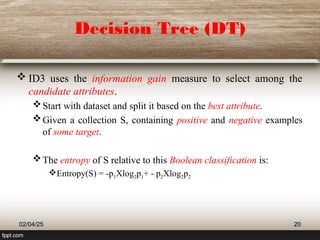
 ID3 uses the information gain measure to select among the
candidate attributes.
Start with dataset and split it based on the best attribute.
Given a collection S, containing positive and negative examples
of some target.
The entropy of S relative to this Boolean classification is:
Entropy(S) = -p1Xlog2p1+ - p2Xlog2p2
02/04/25 20
Decision Tree (DT)
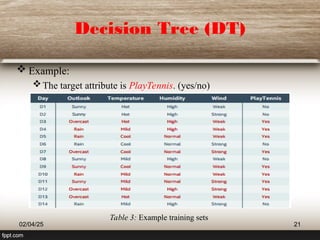
 Example:
The target attribute is PlayTennis. (yes/no)
02/04/25 21
Table 3: Example training sets
Decision Tree (DT)
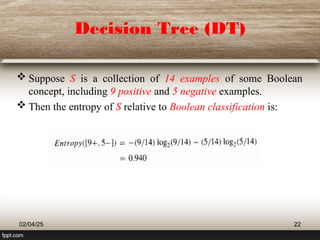
 Suppose S is a collection of 14 examples of some Boolean
concept, including 9 positive and 5 negative examples.
 Then the entropy of S relative to Boolean classification is:
02/04/25 22
Decision Tree (DT)
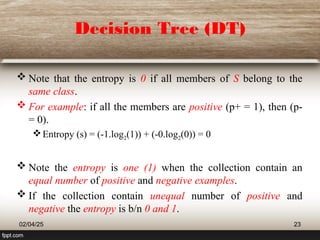
 Note that the entropy is 0 if all members of S belong to the
same class.
 For example: if all the members are positive (p+ = 1), then (p-
= 0).
Entropy (s) = (-1.log2(1)) + (-0.log2(0)) = 0
 Note the entropy is one (1) when the collection contain an
equal number of positive and negative examples.
 If the collection contain unequal number of positive and
negative the entropy is b/n 0 and 1.
02/04/25 23
Decision Tree (DT)
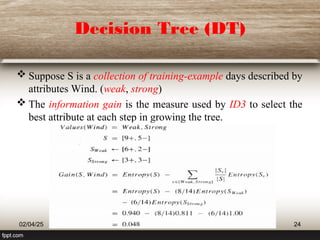
 Suppose S is a collection of training-example days described by
attributes Wind. (weak, strong)
 The information gain is the measure used by ID3 to select the
best attribute at each step in growing the tree.
02/04/25 24
Decision Tree (DT)
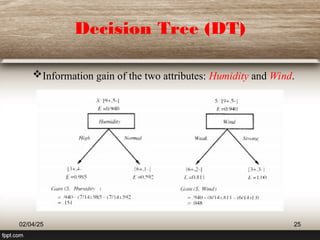
Information gain of the two attributes: Humidity and Wind.
02/04/25 25
Decision Tree (DT)
 Example:
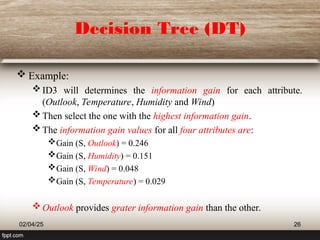
ID3 will determines the information gain for each attribute.
(Outlook, Temperature, Humidity and Wind)
Then select the one with the highest information gain.
The information gain values for all four attributes are:
Gain (S, Outlook) = 0.246
Gain (S, Humidity) = 0.151
Gain (S, Wind) = 0.048
Gain (S, Temperature) = 0.029
Outlook provides grater information gain than the other.
02/04/25 26
Decision Tree (DT)
 Example:
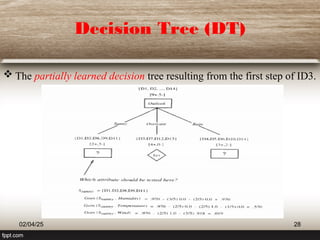
According to the information gain measure, the Outlook attribute
selected as the root node.
Branches are created below the root for each of its possible
values. (Sunny, Overcast, and Rain)
02/04/25 27
Decision Tree (DT)
 The partially learned decision tree resulting from the first step of ID3.
02/04/25 28
Decision Tree (DT)
 The overcast descendant has only positive examples and
therefore becomes a leaf node with classification Yes:
 The other two nodes will be expand by selecting the attribute
with the highest information gain relative to the new subsets.
02/04/25 29
Decision Tree (DT)
 Decision Tree learning can be:
Classification tree: finite set values target variables
Regression tree: continuous values target variable
There are many specific Decision Tree algorithms:
ID3 (Iterative of ID3)
C4.5 (Successor of ID3)
CART(Classification and Regression Tree)
CHAID (Chi – squared Automatic Interaction Detector)
MARS: extends DT to handle numerical data better
02/04/25 30
Decision Tree (DT)
 Different Decision Tree algorithms use different metrics for
measuring the “best attribute” :
Information gain: used by ID3, C4.5 and C5.0
Gini impurity: used by CART
02/04/25 31
Decision Tree (DT)
 ID3 in terms of its search space and search strategy:
ID3’s hypothesis space of all decision tree is a complete space of
finite discrete-valued functions.
ID3’s maintains only a single current hypothesis as it searches
through the space of decision trees.
ID3 in its pure form perform no backtracking in its search. (post-
pruning the decision tree)
ID3 uses all training examples at each step in the search to make
statistically based decisions regarding how to refine its current
hypothesis. (much less sensitive to error)
02/04/25 32
Decision Tree (DT)
 Inductive bias in Decision Tree learning (ID3) :
Inductive bias are the set of assumption.
ID3 selects in favor of shorter trees over longer ones. (breadth
first approach)
Selects trees that place the attributes with the highest information
gain closest to the root.
02/04/25 33
Decision Tree (DT)
 Issues in Decision Tree learning:
How deeply to grow the decision tree,
Handling continuous attributes ,
Choosing an appropriate attributes selection measure,
Handling training data with missing attribute values,
Handling attributes with differing costs and,
Improve computational efficiency.
 ID3 extended to address most of these issues to C4.5.
02/04/25 34
Decision Tree (DT)
 Avoiding over fitting the Data:
 Noisy data and too small training examples are problems.
 Over fitting is a practical problem for Decision Tree and many of
the learning algorithms.
 Over fitting was found to decrease the accuracy of the learned tree
by 10-25%.
 Approach to avoid over fitting:
 Stop growing the tree, before it over fitting. (direct but less practical)
Allow the tree to over fitting, and then post-prune (the most successful
in practice)
02/04/25 35
Decision Tree (DT)
 Incorporating continuous-value attributes:
Initial definition of ID3, attributes and target value must be
discrete set of values.
The attributes tested in the decision nodes of the tree must be
discrete value :
 Create a new Boolean attribute for the continuous value or
 Multiple interval rather than just two interval.
02/04/25 36
Decision Tree (DT)
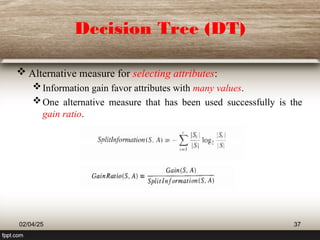
 Alternative measure for selecting attributes:
Information gain favor attributes with many values.
One alternative measure that has been used successfully is the
gain ratio.
02/04/25 37
Decision Tree (DT)
 Handling training example with missing attribute value:
Assign it with the most common value among training examples at
node n.
Assign the probability to each of the possible values of the attribute.
The 2nd
approach, is used in C4.5.
02/04/25 38
Decision Tree (DT)
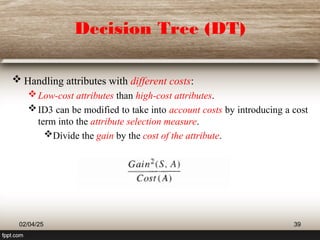
 Handling attributes with different costs:
Low-cost attributes than high-cost attributes.
ID3 can be modified to take into account costs by introducing a cost
term into the attribute selection measure.
Divide the gain by the cost of the attribute.
02/04/25 39
Question & Answer
02/04/25 40
Thank You !!!
02/04/25 41
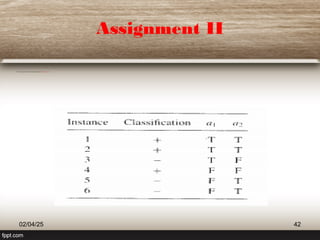
Assignment II
 Answer the given questions by considering the following set oftraining examples.
02/04/25 42
Assignment II
(a) What is the entropy of this collection of training examples with respect to the target function classification?
 (b) What is the information gain of a2 relative to these training examples?
02/04/25 43
Decision Tree (DT)
 Do some research on the following Decision Tree algorithms:
ID3 (Iterative of ID3)
C4.5 (Successor of ID3)
CART(classification and Regression Tree)
CHAID (Chi – squared Automatic Interaction Detector)
MARS: extends DT to handle numerical data better
02/04/25 44

Lecture -3 Classification(Decision Tree).ppt

  • 1.
    Classification : Decision Tree(DT) Adama Science and Technology University School of Electrical Engineering and Computing Department of CSE Dr. Mesfin Abebe Haile (2021)
  • 2.
    Outline  What isdecision tree (DT) algorithm  Why we need DT  Pros and Cons of DT  Information Theory  Some Issues in DT  Assignment II 02/04/25 2
  • 3.
    Decision Tree (DT) Decision trees: splitting datasets one features at a time.  The decision tree is one of the most commonly used classification technique.  It has a decision blocks (rectangles).  Termination block (ovals).  The right and left arrows are called branches.  The kNN algorithm can do a grate job of classification, but it didn’t lead to any major insight about the data. 02/04/25 3
  • 4.
    Decision Tree (DT) Adecision Tree 02/04/25 4
  • 5.
    Decision Tree (DT) The best part of the DT (decision tree) algorithm is that humans can easily understand the data:  The Decision Tree algorithm:  Takes a set of data. (training examples)  Build a decision tree (model), and draw it.  It can also be re-represented as sets of if-then rules to improve human readability.  The DT does a grate job of distilling data into knowledge.  Takes a set of unfamiliar data and extract a set of rules.  DT is often used in expert system development. 02/04/25 5
  • 6.
    Decision Tree (DT) The DT can be expressed using the following expression:  (Outlook = Sunny Humidity = ˄ Normal) → Yes  (Outlook = ˅ Overcast) → Yes  (Outlook = ˅ Rain Wind = ˄ Weak) → Yes 02/04/25 6
  • 7.
    Decision Tree (DT) The pros and cons of DT:  Pros of DT:  Computationally cheap to use,  Easy for humans to understand the learned results,  Missing values OK (robust to errors),  Can deal with irrelevant features.  Cons of DT:  Prone to overfitting.  Work with: Numeric values, nominal values. 02/04/25 7
  • 8.
    Decision Tree (DT) Appropriate problems for DT learning:  Instance are represented by attribute-value pairs (fixed set of attributes and their values),  The target function has discrete output values,  Disjunctive descriptions may be required,  The training data may contain errors,  The training data may contain missing attribute values. 02/04/25 8
  • 9.
    Decision Tree (DT) The mathematics that is used by DT to split the dataset is called information theory:  The first decision, you need to make is:  Which feature shall be used to split the data.  You need to try every feature and measure which split will give the best result.  Then split the dataset into subsets.  The subsets will then traverse down the branches of the decision node.  If the data on the branch is the same, stop; else repeat the splitting. 02/04/25 9
  • 10.
    Decision Tree (DT) Pseudo-codefor the splitting function 02/04/25 10
  • 11.
    Decision Tree (DT) General approach to decision trees:  Collect: Any method.  Prepare: DI3 algorithm works only on nominal values, so any continues values will need to be quantized.  Analyze: Any method. You should visually inspect the tree after it is build.  Train: Construct a tree data structure. (DT)  Test: Calculate the error rate with the learned tree.  Use: This can be used in any supervised learning task. Often, to better understand the data. 02/04/25 11
  • 12.
    Decision Tree (DT) We would like to classify the following animals into two classes: Fish and not Fish 02/04/25 12 Marine animal data
  • 13.
    Decision Tree (DT) Need to decide whether we should split the data based on the first feature or the second feature: To make more organize the unorganized data. One way to do this is to measure the information. Measure the information before and after the split.  Information theory is a branch of science that is concerned with quantifying information.  The change in information before and after the split is known as the information gain. 02/04/25 13
  • 14.
    Decision Tree (DT) The split with the highest information gain is the best option. The measure of information of a set is known as the Shannon entropy or entropy. One way to do this is to measure the information.  The change in information before and after the split is known as the information gain. 02/04/25 14
  • 15.
    Decision Tree (DT) To calculate entropy, you need the expected value of all the information of all possible values of our class.  This is given by: 02/04/25 15  Where n is the number of classes:
  • 16.
    Decision Tree (DT) The higher the entropy, the more mixed up the data.  Another common measure of disorder in a set is the Gini impurity. Which is the probability of choosing an item from the set and the probability of that data item being misclassified. Calculate the shannon entropy of a dataset. Dataset splitting on a given feature. Choosing the best feature to split on. 02/04/25 16
  • 17.
    Decision Tree (DT) Recursively building the tree. Start with dataset and split it based on the best attribute. The data will traverse down the branches of the tree to another node. This node will then split the data again (recursively) Stop under the following conditions: run out of attributes or if the instances in a branch are the same class. 02/04/25 17
  • 18.
    Decision Tree (DT) 02/04/2518 Table 2: Example training sets
  • 19.
    Decision Tree (DT) 02/04/2519 Figure 3: Data path while splitting
  • 20.
    Decision Tree (DT) ID3 uses the information gain measure to select among the candidate attributes. Start with dataset and split it based on the best attribute. Given a collection S, containing positive and negative examples of some target. The entropy of S relative to this Boolean classification is: Entropy(S) = -p1Xlog2p1+ - p2Xlog2p2 02/04/25 20
  • 21.
    Decision Tree (DT) Example: The target attribute is PlayTennis. (yes/no) 02/04/25 21 Table 3: Example training sets
  • 22.
    Decision Tree (DT) Suppose S is a collection of 14 examples of some Boolean concept, including 9 positive and 5 negative examples.  Then the entropy of S relative to Boolean classification is: 02/04/25 22
  • 23.
    Decision Tree (DT) Note that the entropy is 0 if all members of S belong to the same class.  For example: if all the members are positive (p+ = 1), then (p- = 0). Entropy (s) = (-1.log2(1)) + (-0.log2(0)) = 0  Note the entropy is one (1) when the collection contain an equal number of positive and negative examples.  If the collection contain unequal number of positive and negative the entropy is b/n 0 and 1. 02/04/25 23
  • 24.
    Decision Tree (DT) Suppose S is a collection of training-example days described by attributes Wind. (weak, strong)  The information gain is the measure used by ID3 to select the best attribute at each step in growing the tree. 02/04/25 24
  • 25.
    Decision Tree (DT) Informationgain of the two attributes: Humidity and Wind. 02/04/25 25
  • 26.
    Decision Tree (DT) Example: ID3 will determines the information gain for each attribute. (Outlook, Temperature, Humidity and Wind) Then select the one with the highest information gain. The information gain values for all four attributes are: Gain (S, Outlook) = 0.246 Gain (S, Humidity) = 0.151 Gain (S, Wind) = 0.048 Gain (S, Temperature) = 0.029 Outlook provides grater information gain than the other. 02/04/25 26
  • 27.
    Decision Tree (DT) Example: According to the information gain measure, the Outlook attribute selected as the root node. Branches are created below the root for each of its possible values. (Sunny, Overcast, and Rain) 02/04/25 27
  • 28.
    Decision Tree (DT) The partially learned decision tree resulting from the first step of ID3. 02/04/25 28
  • 29.
    Decision Tree (DT) The overcast descendant has only positive examples and therefore becomes a leaf node with classification Yes:  The other two nodes will be expand by selecting the attribute with the highest information gain relative to the new subsets. 02/04/25 29
  • 30.
    Decision Tree (DT) Decision Tree learning can be: Classification tree: finite set values target variables Regression tree: continuous values target variable There are many specific Decision Tree algorithms: ID3 (Iterative of ID3) C4.5 (Successor of ID3) CART(Classification and Regression Tree) CHAID (Chi – squared Automatic Interaction Detector) MARS: extends DT to handle numerical data better 02/04/25 30
  • 31.
    Decision Tree (DT) Different Decision Tree algorithms use different metrics for measuring the “best attribute” : Information gain: used by ID3, C4.5 and C5.0 Gini impurity: used by CART 02/04/25 31
  • 32.
    Decision Tree (DT) ID3 in terms of its search space and search strategy: ID3’s hypothesis space of all decision tree is a complete space of finite discrete-valued functions. ID3’s maintains only a single current hypothesis as it searches through the space of decision trees. ID3 in its pure form perform no backtracking in its search. (post- pruning the decision tree) ID3 uses all training examples at each step in the search to make statistically based decisions regarding how to refine its current hypothesis. (much less sensitive to error) 02/04/25 32
  • 33.
    Decision Tree (DT) Inductive bias in Decision Tree learning (ID3) : Inductive bias are the set of assumption. ID3 selects in favor of shorter trees over longer ones. (breadth first approach) Selects trees that place the attributes with the highest information gain closest to the root. 02/04/25 33
  • 34.
    Decision Tree (DT) Issues in Decision Tree learning: How deeply to grow the decision tree, Handling continuous attributes , Choosing an appropriate attributes selection measure, Handling training data with missing attribute values, Handling attributes with differing costs and, Improve computational efficiency.  ID3 extended to address most of these issues to C4.5. 02/04/25 34
  • 35.
    Decision Tree (DT) Avoiding over fitting the Data:  Noisy data and too small training examples are problems.  Over fitting is a practical problem for Decision Tree and many of the learning algorithms.  Over fitting was found to decrease the accuracy of the learned tree by 10-25%.  Approach to avoid over fitting:  Stop growing the tree, before it over fitting. (direct but less practical) Allow the tree to over fitting, and then post-prune (the most successful in practice) 02/04/25 35
  • 36.
    Decision Tree (DT) Incorporating continuous-value attributes: Initial definition of ID3, attributes and target value must be discrete set of values. The attributes tested in the decision nodes of the tree must be discrete value :  Create a new Boolean attribute for the continuous value or  Multiple interval rather than just two interval. 02/04/25 36
  • 37.
    Decision Tree (DT) Alternative measure for selecting attributes: Information gain favor attributes with many values. One alternative measure that has been used successfully is the gain ratio. 02/04/25 37
  • 38.
    Decision Tree (DT) Handling training example with missing attribute value: Assign it with the most common value among training examples at node n. Assign the probability to each of the possible values of the attribute. The 2nd approach, is used in C4.5. 02/04/25 38
  • 39.
    Decision Tree (DT) Handling attributes with different costs: Low-cost attributes than high-cost attributes. ID3 can be modified to take into account costs by introducing a cost term into the attribute selection measure. Divide the gain by the cost of the attribute. 02/04/25 39
  • 40.
  • 41.
  • 42.
    Assignment II  Answerthe given questions by considering the following set oftraining examples. 02/04/25 42
  • 43.
    Assignment II (a) Whatis the entropy of this collection of training examples with respect to the target function classification?  (b) What is the information gain of a2 relative to these training examples? 02/04/25 43
  • 44.
    Decision Tree (DT) Do some research on the following Decision Tree algorithms: ID3 (Iterative of ID3) C4.5 (Successor of ID3) CART(classification and Regression Tree) CHAID (Chi – squared Automatic Interaction Detector) MARS: extends DT to handle numerical data better 02/04/25 44