NAME: Principles of Records Management
CODE: PA 516
CLASS: DPA I
Semester: I
LEVEL: NTA Level 5
DURATION: Six Months
3/16/2015 MUSHI SYLVANUS 1
WELCOME
You are welcome
In new semesterAttention
DPA I
3/16/2015 MUSHI SYLVANUS 2
TOPIC
PRINCIPLES OF RECORDS
MANAGEMENT
3/16/2015 MUSHI SYLVANUS 3
1.TERMS RELATED TO RECORDS
MANAGEMENT
 Records can be defined as information captured
by individual, organization or institution in
whatever media and form for carrying out
business.
Or Recorded information of any kind and in any
form, either originated or received by an
organization. Include papers, correspondence,
forms, books, photographs, films, sound
recordings, maps, drawings, and other documents.
3/16/2015 MUSHI SYLVANUS 4
Terms definitions cont…
 Public records record created or received and
maintained in any public sector agency.
 Private records.
Records created or received and maintained in
any private or non-governmental organization
such as organizations, families, or individuals
relating to their private and public affairs.
3/16/2015 MUSHI SYLVANUS 5
Terms definitions cont…
Information can be defined as the
processed data which have complete
meaning for decision making
Data is incomplete information collected
for interpretation. Or refers to the
collected facts to be analyzed.
3/16/2015 MUSHI SYLVANUS 6
Terms definitions cont…
 File An organized physical assembly of documents
grouped together for current use. Or an organized
physical assembly (usually within a folder) for current
use because they relate to the same subject, activity or
transaction.
 Records Centre a low-cost facility for the controlled
maintenance, retrieval, and disposal of inactive
records. A commercial records centre, operated by a
private company, houses records of many
organizations on a fee basis.
3/16/2015 MUSHI SYLVANUS 7
Terms definitions cont…
 Records Manager
A person assigned primary responsibility for the records
management program.
 Records keeping
A process of maintaining, distributing, indexing and storing
records for their proper use. The processes of creating and
maintaining complete and accurate records of business
activities
3/16/2015 MUSHI SYLVANUS 8
Terms definitions cont…
A building or part of a building designed for the low-
cost storage, maintenance, and communication of
semi-current records pending for their ultimate
disposal.
 Active/current Records
Records regularly used in day to day operation of an
organization and are kept in the records office/ place
of origin. Records providing current or most recent
information.
3/16/2015 MUSHI SYLVANUS 9
Terms definitions cont…
 Semi-current records
Records required infrequently in the conduct of
current organizational activities, are kept to the
records centre.
 Non-current records
Records no longer needed for current business. Are
destroyed or transferred to the archive.
3/16/2015 MUSHI SYLVANUS 10
Terms definitions cont…
 Administrative Records
Records documenting the daily operation and
administration of an office.
 Archival Records
Records of enduring value, documenting the
history and the development of the
organization
3/16/2015 MUSHI SYLVANUS 11
Terms definitions cont…
 Archives
Are records usually but not necessarily noncurrent
records, of enduring value selected for permanent
preservation.
Refers to place or building/ room/ storage area where
archival materials are kept.
It refers to the organization responsible for appraising,
acquiring, preserving and making available archival
material.
3/16/2015 MUSHI SYLVANUS 12
Terms definitions cont…
 Appraisal is the process of determining the
value of records for further use, for whatever
 Disposal
The final removal, whether for destruction or
formal transfer to another agency, e.g., records
storage centre or archives, of records that have
reached the end of their retention period.
3/16/2015 MUSHI SYLVANUS 13
Terms definitions cont…
 Disposition
Refers to the action that are associated with
implement decisions about the retention or destruction
of records.
Any means of changing the location or physical
format of the records. Includes destruction by
shredding or recycling, digitizing, microfilming,
duplication, or transfer.
3/16/2015 MUSHI SYLVANUS 14
Terms definitions cont…
 Vital(Essential) Records
Records essential to resume or continue operations of
the organization, including records necessary to
recreate the organization’s legal and financial
position, and to fulfill obligations to the organization,
its students and employees, and to outside parties.
 Format
The physical form in which material appears – books,
slides, photographs, film, recordings, etc.
3/16/2015 MUSHI SYLVANUS 15
Terms definitions cont…
 Legal Value
The usefulness of records as evidence supporting an
organization’s transactions, activities, claims, and
obligations.
 Life Cycle of Records
the records management premise (argue) that records
pass through three stages: creation, maintenance and
use, and disposition.
3/16/2015 MUSHI SYLVANUS 16
Terms definitions cont…
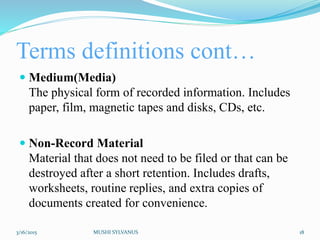
 Medium(Media)
The physical form of recorded information. Includes
paper, film, magnetic tapes and disks, CDs, etc.
 Non-Record Material
Material that does not need to be filed or that can be
destroyed after a short retention. Includes drafts,
worksheets, routine replies, and extra copies of
documents created for convenience.
3/16/2015 MUSHI SYLVANUS 17
Terms definitions cont…
 Medium(Media)
The physical form of recorded information. Includes
paper, film, magnetic tapes and disks, CDs, etc.
 Non-Record Material
Material that does not need to be filed or that can be
destroyed after a short retention. Includes drafts,
worksheets, routine replies, and extra copies of
documents created for convenience.
3/16/2015 MUSHI SYLVANUS 18
Terms definitions cont…
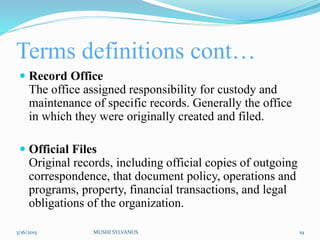
 Record Office
The office assigned responsibility for custody and
maintenance of specific records. Generally the office
in which they were originally created and filed.
 Official Files
Original records, including official copies of outgoing
correspondence, that document policy, operations and
programs, property, financial transactions, and legal
obligations of the organization.
3/16/2015 MUSHI SYLVANUS 19
Terms definitions cont…
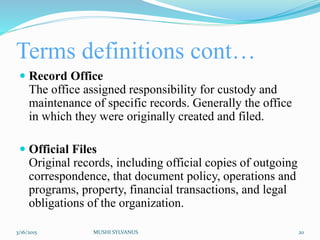
 Record Office
The office assigned responsibility for custody and
maintenance of specific records. Generally the office
in which they were originally created and filed.
 Official Files
Original records, including official copies of outgoing
correspondence, that document policy, operations and
programs, property, financial transactions, and legal
obligations of the organization.
3/16/2015 MUSHI SYLVANUS 20
Terms definitions cont…
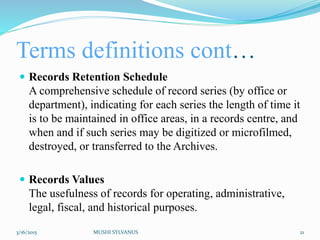
 Records Retention Schedule
A comprehensive schedule of record series (by office or
department), indicating for each series the length of time it
is to be maintained in office areas, in a records centre, and
when and if such series may be digitized or microfilmed,
destroyed, or transferred to the Archives.
 Records Values
The usefulness of records for operating, administrative,
legal, fiscal, and historical purposes.
3/16/2015 MUSHI SYLVANUS 21
Terms definitions cont…
 Retention Period
The length of time records must be kept before they
are eligible (qualified) for destruction or archival
preservation. The retention period begins at a cut-off
date (e.g., the end of the fiscal, calendar, or academic
year) or is triggered by a cut-off event, such as a
termination of employment, contract closure, etc.
3/16/2015 MUSHI SYLVANUS 22
Terms definitions cont…
 Subject File a file in which documents are
arranged by subject. Not to be confused with a
case file.
 Transfer, the change in physical custody of
records from one organization or unit to
another, e.g., from an office to a records center.
3/16/2015 MUSHI SYLVANUS 23
Records management system
Records management system; This refers to
unified set of resources, responsibilities,
procedures and equipment designed to
maintain and provide access to records
within the programme. (Shepherd and Yeo,
2003). Paper based system use the range of
stationary and storage equipment including
files, boxes, cabinet and shelves.
3/16/2015 MUSHI SYLVANUS 24
Definition cont…
Electronic Records requires hardware
including computers and storage media
like CDs and DVDs as well as software.
3/16/2015 MUSHI SYLVANUS 25
Types of records
1. Types of records based on media or format:
Is the way where by record is designed or created, arranged and
presented include:-
a) Paper based records are those records created received and
kept on the paper medium ( in a hard copy ) for stance paper
file, paper report, letters financial statements etc.
b) Electronic records are those records that created, received,
kept and accessed by using electronic devices. Or are those
records that are held on digital form on a magnetic or optical
computer storage media. This include things like Hard Disk,
Video tape, Audio tape and Compact Disks etc
3/16/2015 MUSHI SYLVANUS 26
2.Types of records based on Use/Function
a) Administrative records- are those records relating
to general administrative activities common to all
organization, such as maintenance of resources care of
the fiscal plan or other routine office matters also some
time known as housekeeping record. Or records that
carries administrative matters such as recruitment,
planning, promotion, demotion, transfer, personnel
records.
b) Personal records- records deals with individual
information.
3/16/2015 MUSHI SYLVANUS 27
Types cont…..
c) Financial records-are those records that
resulting from the conduct of business and
activities relating to financial matters and its
management such as salary slip, Bank
statement Loans, Vouchers and cheque etc.
d) Medical record- is a history of the patient’s
treatment written by the doctor attending him
or her it may also include other notes on
patient’s diagnosis and treatment provided by
nursing and other allied/associated staff
3/16/2015 MUSHI SYLVANUS 28
Types cont…..
e) Legal records- are records generated
specifically from the process of land
acquisition by an individual or an organization.
f) Land records- are records generated
specifically from the legal process, from the
work of the court, police and the public
prosecutors.
3/16/2015 MUSHI SYLVANUS 29
3.Types of records based on Ownership
The state of owning recorded materials
includes:-
a) Private or personal records refers to the records
relating to private matters or affairs that created, received
and maintained by non-governmental Agencies
institutions, families or individuals. Or are records deal
with individual information
b) Public or general records- refers to records created,
received and maintained in any public sector or Agency
for stance Ministries Department. It is also a collection of
different records that found in a certain organization.
3/16/2015 MUSHI SYLVANUS 30
4.Types of records based on classification
The records based on classification are:-
a) Top Secret- is a record or material required high degree
of protection because its un authorized disclosure could
cause exceptional grave damage to the national security
example major government plans, vital strategic
information for action pending negotiations economic
agreements, new constitutional development.
b) Secret- is a record or material required a substantial
degree of protection since its disclosure could cause
serious damage or endanger national security. Example
defense ensues, emergency and security system political
intelligent reports.
3/16/2015 MUSHI SYLVANUS 31
Types cont….
c) Confidential- it is record or material required
protection because its unauthorized disclosure could
cause damage or administrative embarrassment or
difficult or would be advantage to a foreign nation.
Example intelligent report routine confidential report,
technical information for organization new materials.
d) Open record- is a record which does not required
high degree of protection .
3/16/2015 MUSHI SYLVANUS 32
5.Types of records based on specialized records
a)Medical records; records that written by the doctor
who attended the patient showing the history of the
patient and the medication that will be applied to such
patient such as x-rays, patient file, demographic data,
diagnostic results etc.
b) Land records; are those records that concerned with
land matters includes land use, land reforms, land
management, planning, land disputes, title deeds etc.
3/16/2015 MUSHI SYLVANUS 33
Types cont….
c) Financial records; Records resulting from the
conduct of business and activities relating to financial
management such as salary slip, bank-pay-slip,
payment voucher, budget, audit report, loans etc.
d) Legal records; records that contains legal matters,
these kind of records are derived from different
sources such as police, court of law and Public
Prosecution Office (PSO). Legal records include
summons, subpoena, search warrant, case file etc.
3/16/2015 MUSHI SYLVANUS 34
6.Types of records based on sensitivity
a) Active / Current Records: are records regularly used by
the organization and therefore maintained in their place of
origin.
 Features:
 Records received from outside from outside the
organization or created by the organization.
 Records are frequently used it and it gain highly value.
 Stored in records office within the organization.
 Custodians are professional records staffs and secretaries.
 Records are used to transact organizational business
3/16/2015 MUSHI SYLVANUS 35
Features cont….
 Records are kept as evidence of the transaction
 Its management requires registry/records office
procedures.
 Should be correctly reflect what is being
communicated
 Records Should be authentic
 Records Should be usable
 Records Should be reliable
 Records Should be protected against unauthorized
alteration
3/16/2015 MUSHI SYLVANUS 36
b) Semi –Active / semi Current Records
Are records required so infrequently in the conduct of
current organizational activities, thus they should be
transferred from the records centre.
Features
 Reference, legal, financial value.
 Stored in records centers.
 Records received from records office
 Records are used as reference material by the
originating office.
3/16/2015 MUSHI SYLVANUS 37
Features cont…
 Records are kept as evidence of the transaction
 Its management requires records centre procedures.
 Records Should be authentic
 Records Should be usable
 Appraisal decision/review should take place at this
stage.
 Records should one day be transferred to archival
institution or destroyed.
3/16/2015 MUSHI SYLVANUS 38
c) Non-Active Records
These Are records which are no longer needed by
current or day to day organizational activities.
 Features:
 As most records destroyed (95-97%) therefore only 3-
5% of the records are retained not used regularly.
 Kept for reference, legal, evidential, historical, artifact
and research purpose.
 Records received from records offices and records
offices and records centers.
 Stored in archival repository
3/16/2015 MUSHI SYLVANUS 39
Features cont…
 Records can be accessed by the public if required.
 Its management requires archival finding aid which
are user friendly instructions
 Its retrieval requires archival finding aids.
 Records should correctly reflect what was
communicated.
 Records should be authentic.
 Records should be usable.
3/16/2015 MUSHI SYLVANUS 40
The importance of records
 Records enable effective and consistent decision
making.
 Organization used records to support accountability.
 Records are used for cultural purposes, research and
restore corporate history.
 Records is an evidence of any activities.
 Records protect human rights.
 Help in the transaction of day to day activities.
 Accurate records of the agency contact with the client
and aid in continuity of case management between co-
workers.
3/16/2015 MUSHI SYLVANUS 41
2.TYPES OF RECORDS MANAGEMENT
SYSTEMS
i) Alphabetical system
ii) Numerical system
iii) Alphanumerical system
iv) Geographical system
v) Chronological system
vi) Direct Access system
vii) Indirect Access system
viii) Keywords Classification System
3/16/2015 MUSHI SYLVANUS 42
i) Alphabetical system
The Alphabetical system, this is the files
classification system/scheme whereby files
are arranged in alphabetical order. For
example, subject correspondence would be
arranged from A-Z, based on names of
subject. This method is also called the
“dictionary’’ method because it is the
method used in dictionaries.
3/16/2015 MUSHI SYLVANUS 43
Advantages of alphabetical system
 Easy and simple to understand and operate.
 Self indexing. No separate index is need.
 Provide direct reference while offering quick
check.
 There is convenience of grouping paper with
names.
3/16/2015 MUSHI SYLVANUS 44
Disadvantages of alphabetical system.
 There may be congestion under under common
names example names starting with M and N.
 Difficult to forecast the space requirement
under different letters of alphabets.
 Misfiling is possible due to misspelling of
names.
3/16/2015 MUSHI SYLVANUS 45
ii) Numerical system/scheme
Numerical classification scheme/system;
This use numbers or dates to arrange
information and there are three types within
this scheme.
a) Straight Numeric system simply number
files consecutively and arrange files in
sequence. Straight numeric system are
simple to use, simple to manage, and simple
to expand.
3/16/2015 MUSHI SYLVANUS 46
Straight numeric cont….
The disadvantage of straight numeric are
High activity files are grouped, leading
to congestion. Difficult to assign blocks
of files to individuals for filing and
retrieving. Finally is no real way to
handle miscellaneous records, they
usually require separate filing system or
the use of an index to retrieve.
3/16/2015 MUSHI SYLVANUS 47
b) Duplex numeric system
This consist of two or more number segments used
to classify numerical codes assigned to files. Files
are arranged numerically depending on
combinations of these segments. For example
middle digits system use the middle number
sequence as a major file heading , terminal digit
systems use the final segments and the primary
digit use the initial number segment. Duplex
usually used in a large volume of records .
3/16/2015 MUSHI SYLVANUS 48
c) Decimal system
 This use ten general divisions, which can be
subdivided by groups of ten as usually
needed. The most decimal system is Dewey
Decimal System, developed in 1873, and
used by 90% of the worlds libraries. Under
this method each folder or records is given
number and the files are placed in strict
numerical order. In this method records are
arranged from the lowest to highest.
3/16/2015 MUSHI SYLVANUS 49
Decimal system cont…
Users understand the straight numerical
sequences (1, 2, 3, 4, 5, 6, 7, etc) quicker
than the alphabetical schemes. Filing
expansion is easier, due to new numbers
may be assigned without disturbing the
arrangements of existing folders. Misfiling
can be quickly identified because the
number out of sequence is easy detected if
color-coding is used.
3/16/2015 MUSHI SYLVANUS 50
Advantages of Numerical classification
system
 Make easy in sorting papers prior to filing.
 Greater accuracy in filing.
 He system is very flexible.
 Misfiling is very minimal.
 The file number can be used as a reference in
future correspondence.
3/16/2015 MUSHI SYLVANUS 51
Disadvantages of Numerical
classification system
 More time is needed to index before a file is
located.
 Not easy to arrange files for miscellaneous
papers.
 Greater care is required to avoid errors
arising from mental transpiration of figures.
 The cost of the index and space makes this
system expensive.
 Etc.3/16/2015 MUSHI SYLVANUS 52
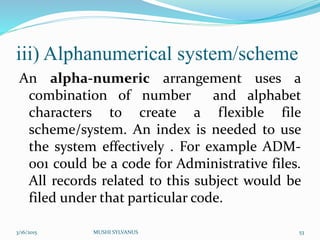
iii) Alphanumerical system/scheme
An alpha-numeric arrangement uses a
combination of number and alphabet
characters to create a flexible file
scheme/system. An index is needed to use
the system effectively . For example ADM-
001 could be a code for Administrative files.
All records related to this subject would be
filed under that particular code.
3/16/2015 MUSHI SYLVANUS 53
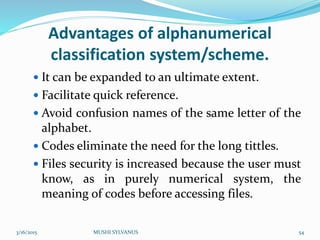
Advantages of alphanumerical
classification system/scheme.
 It can be expanded to an ultimate extent.
 Facilitate quick reference.
 Avoid confusion names of the same letter of the
alphabet.
 Codes eliminate the need for the long tittles.
 Files security is increased because the user must
know, as in purely numerical system, the
meaning of codes before accessing files.
3/16/2015 MUSHI SYLVANUS 54
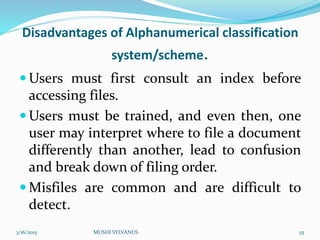
Disadvantages of Alphanumerical classification
system/scheme.
 Users must first consult an index before
accessing files.
 Users must be trained, and even then, one
user may interpret where to file a document
differently than another, lead to confusion
and break down of filing order.
 Misfiles are common and are difficult to
detect.
3/16/2015 MUSHI SYLVANUS 55
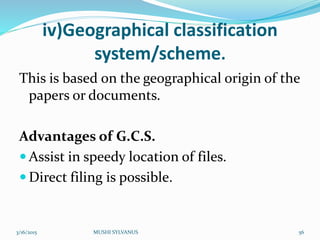
iv)Geographical classification
system/scheme.
This is based on the geographical origin of the
papers or documents.
Advantages of G.C.S.
 Assist in speedy location of files.
 Direct filing is possible.
3/16/2015 MUSHI SYLVANUS 56
Disadvantages of G.C.S.
 If the geographical location is not known
misfiling is possible.
 If can not work for itself, as for better results
it should be combined with any other
method.
 Separate index has to be prepared.
3/16/2015 MUSHI SYLVANUS 57
v) Chronological classification
scheme/system
This is the type of classification scheme
whereby file is arranged in strict date order
or specification scheme.
Advantages of C.C.S.
 When dates are known it is useful method.
 Good for overall classification.
 Simple to operate.
3/16/2015 MUSHI SYLVANUS 58
Disadvantages of C.C.S.
 Useful only for small business.
 Not useful when the date is not known.
 Incoming letters must be separated from
outgoing replies.
3/16/2015 MUSHI SYLVANUS 59
vi) Direct access system
Direct access scheme allows the user to
access the file without first referring to an
index. Direct access may be ideal for small
offices that produce a low volume of records.
Example: If it is easier to find information
by person’s name, the system would be
alphabetical. One looks files directly by
name.
3/16/2015 MUSHI SYLVANUS 60
Advantages of direct classification
system.
 Eliminate the need for an index.
 Allows the user to browse through files.
 Time associated with filing and records
retrieval is reduced.
 Users require little or no training to access the
system.
3/16/2015 MUSHI SYLVANUS 61
Disadvantages of Direct access
classification system.
 Filing for large systems becomes a problem.
 Selecting termilogy names may be difficult
with subject files.
 Files captions may be longer than codes;
filing is difficult.
3/16/2015 MUSHI SYLVANUS 62
vii) Indirect access scheme/system
An indirect access system requires the use of
an index or codes to locate a file, such as
assigning a number to a file e.g. case
number, project numbers, and patient
numbers.
Advantages
 Codes are easier to note and refer to on a
document or folder than words caption.
3/16/2015 MUSHI SYLVANUS 63
Advantages cont…
 Sorting is easier
 Greater accuracy in filing and retrieving is
achieved with the use of codes.
 Security of the files is enhanced because
users unfamiliar with the system will have
difficulty accessing documents.
3/16/2015 MUSHI SYLVANUS 64
Disadvantages of Indirect access
system/scheme.
 Users access is dependent on the accuracy of
the index.
 Coding and indexing are time consuming.
 Browsing is not feasible.
3/16/2015 MUSHI SYLVANUS 65
viii) Keyword filing system/scheme
This is the records management indexing
system which used to classify records of an
organization based on functions and
activities of organization.
3/16/2015 MUSHI SYLVANUS 66
RECORDS CENTRE MANAGEMENT TECHNIQUES
 Records Centre: A building or part of a building
designed or adapted for the low-cost storage and
maintenance of semi-current records pending their
ultimate disposal. The primary function for the records
centre is to hold semi-current records and make
available for use until the date of their disposal.
Therefore, the records centre is a temporary or, as it is
often called, an intermediate storage facility. In other
words, it is an intermediate stage between the
organisation’s records offices and the archival
institution.
3/16/2015 MUSHI SYLVANUS 67
Types of records centre
a) Off site records centre is located away from the
building used for substantive functions of the
organization.
 Can be situated in low cost areas such as
warehouse areas where there is low population.
 Higher level of security and larger capacity can
often be provided.
 However, their distance from users can increase
cost e.g. transportation which may cause delays
some times.
3/16/2015 MUSHI SYLVANUS 68
Types cont….
b) On site records centre Is that located within
the building used for the substantive functions
of the organization.
 If the storage space is available and suitable
it will facilitate easy access for the records
housed there.
3/16/2015 MUSHI SYLVANUS 69
Functions of Records Centre
Records Centre provides a general service to all
parts of the government or corporation. It is a
high-density, low-cost storage area, equipped with
a system for retrieving and consulting the records
held. The records centre receives and makes
available all records that have regardless of their
bulk or form. It is also a service intermediate
between the records offices of agencies and the
archival institution.
3/16/2015 MUSHI SYLVANUS 70
Functions cont…
 Receiving semi current records: when an office
ask to transfer records to the records centre, the
records centre will send an appropriate number of
empty boxes and a supply of records centre
transfer list to that office.
 The office will select those semi-active records
and send them to the records centre waiting for
their ultimate disposal.
3/16/2015 MUSHI SYLVANUS 71
Functions cont…
 Storing semi- active/ semi Current Records. After
registering records the next function is to store those listed
and transferred records under a well protected and suitable
environment the records centre hold semi-current records
and make available for use until the date of their disposal.
 Retrieving and using Records. The offices that created
he records may borrow records from the records centre and
return it under the agreed period of time. The request to
borrow the record can be done by person, telephone or fill
the request form. It is the duty of records centre to ensure
that record is returned as it was issued.
3/16/2015 MUSHI SYLVANUS 72
Functions cont…
 Disposal of records. Disposal of records includes
Destruction of records and Transfer of records with
enduring values to the archival repository. Records
centre staffs facilitate the authorized and timely
destruction of records that are no longer needed.
 Transferring records to the archival institution.
All records with enduring value are transferred from
the records centre to the archival repository under the
authority of retention and disposal schedule. All
records transferred must be listed.
3/16/2015 MUSHI SYLVANUS 73
Functions cont…
 Measuring and Reporting on the
Performance. The records centre must
always be able to account for its operations
and their costs. It should also be able to
identify measurable benefits to the
government. These statistics can be
calculated and used by the records centre for
monitoring, planning purposes and
Controlling records centre forms.
3/16/2015 MUSHI SYLVANUS 74
Procedures for transferring records to the
records centre
Steps/procedures to undertake by the records
centre staffs when transferring records to the
records centre.
i) Check the records
ii) Prepare the boxes
iii) Determine the action category
iv) Distribute the transfer list
v) Label the boxes
vi) Store the records
vii) Update the location register and accessions register.
3/16/2015 MUSHI SYLVANUS 75
Procedures cont….
i) Checking the Records
 Remove the records centre transfer list from the box.
 Check that the form has been completed correctly, with
an adequate description of the contents, but with the
box number, location and action date columns left
blank.
 Check that the contents are actually the same as those
listed on the transfer list, the files are in order and have
been properly prepared for transfer. Records should be
clean and orderly, without metal clips
3/16/2015 MUSHI SYLVANUS 76
Procedures cont….
ii) Preparing the Boxes
 Each box should be marked in sequence with
the next available box number.
 Carry on numbering in order. When each box in
the consignment has been numbered, the
numbers that have been used should be crossed
off the list, so that the they will not be reused by
mistake. Note that box numbers are not the
same as location codes. A location code refers to
only shelf space.
3/16/2015 MUSHI SYLVANUS 77
Procedures cont….
iii) Determining the Action Category
 The approved list of disposal schedules should then be
consulted. Look at the appropriate schedule(s) and
decide what is the correct action category of these
records, and the appropriate action date. The action
category can be either ‘DESTROY REVIEW OR
TRANSFER. The instruction should be entered in the
action category space. The correct destruction date,
review or transferring date should be written into the
appropriate column of each copy of the transfer list.
There must be only one action date for each whole box.
3/16/2015 MUSHI SYLVANUS 78
Procedures cont….
iv) Distributing the Transfer Lists
 The first copy should go in the master
transfers file. This file contains the transfer list
in the date order as received.
 The second copy should go in the action dates
file. This file holds the records centre transfer
list in a single sequence by the action date,
irrespective of the office of origin
3/16/2015 MUSHI SYLVANUS 79
Procedures cont….
 The third copy should go in the records office
transfers file. This file holds forms to be sent
back to the transferring records office or
agency for retention as a permanent record for
their use. Agencies will consult this form to
find out the box number of any record they
require. On receipt of this copy the record
office should destroy the fourth copy they kept
at the time of the transfer.
3/16/2015 MUSHI SYLVANUS 80
Procedures cont….
v) Labelling the Boxes
 It is also useful to attach a label to each box. This
label should indicate the
 originating office code number
 box number
 location code.
 For security reasons, it is important that these
should be the only marks on the outside of boxes, so
that unauthorised people cannot easily identify
records, particularly sensitive or confidential files.
3/16/2015 MUSHI SYLVANUS 81
Procedures cont….
vi) Storing the Records
 Boxes should be placed in the shelf spaces that
correspond to their location codes. Their box
numbers are then recorded in the records centre
location register alongside the correct location
code.
 Records centre staff should always be able to
find the location code of any box from its
number, and they should always be able to go
straight to the shelf space from the location
code.
3/16/2015 MUSHI SYLVANUS 82
Procedures cont….
vii) Updating the Location Register
 The location register holds the following
information:
 Records office code
 Box numbers
 Location codes.
 When any changes are made on the location on
the records the location register should be
updated for easy retrieval.
3/16/2015 MUSHI SYLVANUS 83
Terms and conditions for accessing
records in the records centre
3/16/2015 MUSHI SYLVANUS 84

516 SPECIALIZED RCS

  • 1.
    NAME: Principles ofRecords Management CODE: PA 516 CLASS: DPA I Semester: I LEVEL: NTA Level 5 DURATION: Six Months 3/16/2015 MUSHI SYLVANUS 1
  • 2.
    WELCOME You are welcome Innew semesterAttention DPA I 3/16/2015 MUSHI SYLVANUS 2
  • 3.
  • 4.
    1.TERMS RELATED TORECORDS MANAGEMENT  Records can be defined as information captured by individual, organization or institution in whatever media and form for carrying out business. Or Recorded information of any kind and in any form, either originated or received by an organization. Include papers, correspondence, forms, books, photographs, films, sound recordings, maps, drawings, and other documents. 3/16/2015 MUSHI SYLVANUS 4
  • 5.
    Terms definitions cont… Public records record created or received and maintained in any public sector agency.  Private records. Records created or received and maintained in any private or non-governmental organization such as organizations, families, or individuals relating to their private and public affairs. 3/16/2015 MUSHI SYLVANUS 5
  • 6.
    Terms definitions cont… Informationcan be defined as the processed data which have complete meaning for decision making Data is incomplete information collected for interpretation. Or refers to the collected facts to be analyzed. 3/16/2015 MUSHI SYLVANUS 6
  • 7.
    Terms definitions cont… File An organized physical assembly of documents grouped together for current use. Or an organized physical assembly (usually within a folder) for current use because they relate to the same subject, activity or transaction.  Records Centre a low-cost facility for the controlled maintenance, retrieval, and disposal of inactive records. A commercial records centre, operated by a private company, houses records of many organizations on a fee basis. 3/16/2015 MUSHI SYLVANUS 7
  • 8.
    Terms definitions cont… Records Manager A person assigned primary responsibility for the records management program.  Records keeping A process of maintaining, distributing, indexing and storing records for their proper use. The processes of creating and maintaining complete and accurate records of business activities 3/16/2015 MUSHI SYLVANUS 8
  • 9.
    Terms definitions cont… Abuilding or part of a building designed for the low- cost storage, maintenance, and communication of semi-current records pending for their ultimate disposal.  Active/current Records Records regularly used in day to day operation of an organization and are kept in the records office/ place of origin. Records providing current or most recent information. 3/16/2015 MUSHI SYLVANUS 9
  • 10.
    Terms definitions cont… Semi-current records Records required infrequently in the conduct of current organizational activities, are kept to the records centre.  Non-current records Records no longer needed for current business. Are destroyed or transferred to the archive. 3/16/2015 MUSHI SYLVANUS 10
  • 11.
    Terms definitions cont… Administrative Records Records documenting the daily operation and administration of an office.  Archival Records Records of enduring value, documenting the history and the development of the organization 3/16/2015 MUSHI SYLVANUS 11
  • 12.
    Terms definitions cont… Archives Are records usually but not necessarily noncurrent records, of enduring value selected for permanent preservation. Refers to place or building/ room/ storage area where archival materials are kept. It refers to the organization responsible for appraising, acquiring, preserving and making available archival material. 3/16/2015 MUSHI SYLVANUS 12
  • 13.
    Terms definitions cont… Appraisal is the process of determining the value of records for further use, for whatever  Disposal The final removal, whether for destruction or formal transfer to another agency, e.g., records storage centre or archives, of records that have reached the end of their retention period. 3/16/2015 MUSHI SYLVANUS 13
  • 14.
    Terms definitions cont… Disposition Refers to the action that are associated with implement decisions about the retention or destruction of records. Any means of changing the location or physical format of the records. Includes destruction by shredding or recycling, digitizing, microfilming, duplication, or transfer. 3/16/2015 MUSHI SYLVANUS 14
  • 15.
    Terms definitions cont… Vital(Essential) Records Records essential to resume or continue operations of the organization, including records necessary to recreate the organization’s legal and financial position, and to fulfill obligations to the organization, its students and employees, and to outside parties.  Format The physical form in which material appears – books, slides, photographs, film, recordings, etc. 3/16/2015 MUSHI SYLVANUS 15
  • 16.
    Terms definitions cont… Legal Value The usefulness of records as evidence supporting an organization’s transactions, activities, claims, and obligations.  Life Cycle of Records the records management premise (argue) that records pass through three stages: creation, maintenance and use, and disposition. 3/16/2015 MUSHI SYLVANUS 16
  • 17.
    Terms definitions cont… Medium(Media) The physical form of recorded information. Includes paper, film, magnetic tapes and disks, CDs, etc.  Non-Record Material Material that does not need to be filed or that can be destroyed after a short retention. Includes drafts, worksheets, routine replies, and extra copies of documents created for convenience. 3/16/2015 MUSHI SYLVANUS 17
  • 18.
    Terms definitions cont… Medium(Media) The physical form of recorded information. Includes paper, film, magnetic tapes and disks, CDs, etc.  Non-Record Material Material that does not need to be filed or that can be destroyed after a short retention. Includes drafts, worksheets, routine replies, and extra copies of documents created for convenience. 3/16/2015 MUSHI SYLVANUS 18
  • 19.
    Terms definitions cont… Record Office The office assigned responsibility for custody and maintenance of specific records. Generally the office in which they were originally created and filed.  Official Files Original records, including official copies of outgoing correspondence, that document policy, operations and programs, property, financial transactions, and legal obligations of the organization. 3/16/2015 MUSHI SYLVANUS 19
  • 20.
    Terms definitions cont… Record Office The office assigned responsibility for custody and maintenance of specific records. Generally the office in which they were originally created and filed.  Official Files Original records, including official copies of outgoing correspondence, that document policy, operations and programs, property, financial transactions, and legal obligations of the organization. 3/16/2015 MUSHI SYLVANUS 20
  • 21.
    Terms definitions cont… Records Retention Schedule A comprehensive schedule of record series (by office or department), indicating for each series the length of time it is to be maintained in office areas, in a records centre, and when and if such series may be digitized or microfilmed, destroyed, or transferred to the Archives.  Records Values The usefulness of records for operating, administrative, legal, fiscal, and historical purposes. 3/16/2015 MUSHI SYLVANUS 21
  • 22.
    Terms definitions cont… Retention Period The length of time records must be kept before they are eligible (qualified) for destruction or archival preservation. The retention period begins at a cut-off date (e.g., the end of the fiscal, calendar, or academic year) or is triggered by a cut-off event, such as a termination of employment, contract closure, etc. 3/16/2015 MUSHI SYLVANUS 22
  • 23.
    Terms definitions cont… Subject File a file in which documents are arranged by subject. Not to be confused with a case file.  Transfer, the change in physical custody of records from one organization or unit to another, e.g., from an office to a records center. 3/16/2015 MUSHI SYLVANUS 23
  • 24.
    Records management system Recordsmanagement system; This refers to unified set of resources, responsibilities, procedures and equipment designed to maintain and provide access to records within the programme. (Shepherd and Yeo, 2003). Paper based system use the range of stationary and storage equipment including files, boxes, cabinet and shelves. 3/16/2015 MUSHI SYLVANUS 24
  • 25.
    Definition cont… Electronic Recordsrequires hardware including computers and storage media like CDs and DVDs as well as software. 3/16/2015 MUSHI SYLVANUS 25
  • 26.
    Types of records 1.Types of records based on media or format: Is the way where by record is designed or created, arranged and presented include:- a) Paper based records are those records created received and kept on the paper medium ( in a hard copy ) for stance paper file, paper report, letters financial statements etc. b) Electronic records are those records that created, received, kept and accessed by using electronic devices. Or are those records that are held on digital form on a magnetic or optical computer storage media. This include things like Hard Disk, Video tape, Audio tape and Compact Disks etc 3/16/2015 MUSHI SYLVANUS 26
  • 27.
    2.Types of recordsbased on Use/Function a) Administrative records- are those records relating to general administrative activities common to all organization, such as maintenance of resources care of the fiscal plan or other routine office matters also some time known as housekeeping record. Or records that carries administrative matters such as recruitment, planning, promotion, demotion, transfer, personnel records. b) Personal records- records deals with individual information. 3/16/2015 MUSHI SYLVANUS 27
  • 28.
    Types cont….. c) Financialrecords-are those records that resulting from the conduct of business and activities relating to financial matters and its management such as salary slip, Bank statement Loans, Vouchers and cheque etc. d) Medical record- is a history of the patient’s treatment written by the doctor attending him or her it may also include other notes on patient’s diagnosis and treatment provided by nursing and other allied/associated staff 3/16/2015 MUSHI SYLVANUS 28
  • 29.
    Types cont….. e) Legalrecords- are records generated specifically from the process of land acquisition by an individual or an organization. f) Land records- are records generated specifically from the legal process, from the work of the court, police and the public prosecutors. 3/16/2015 MUSHI SYLVANUS 29
  • 30.
    3.Types of recordsbased on Ownership The state of owning recorded materials includes:- a) Private or personal records refers to the records relating to private matters or affairs that created, received and maintained by non-governmental Agencies institutions, families or individuals. Or are records deal with individual information b) Public or general records- refers to records created, received and maintained in any public sector or Agency for stance Ministries Department. It is also a collection of different records that found in a certain organization. 3/16/2015 MUSHI SYLVANUS 30
  • 31.
    4.Types of recordsbased on classification The records based on classification are:- a) Top Secret- is a record or material required high degree of protection because its un authorized disclosure could cause exceptional grave damage to the national security example major government plans, vital strategic information for action pending negotiations economic agreements, new constitutional development. b) Secret- is a record or material required a substantial degree of protection since its disclosure could cause serious damage or endanger national security. Example defense ensues, emergency and security system political intelligent reports. 3/16/2015 MUSHI SYLVANUS 31
  • 32.
    Types cont…. c) Confidential-it is record or material required protection because its unauthorized disclosure could cause damage or administrative embarrassment or difficult or would be advantage to a foreign nation. Example intelligent report routine confidential report, technical information for organization new materials. d) Open record- is a record which does not required high degree of protection . 3/16/2015 MUSHI SYLVANUS 32
  • 33.
    5.Types of recordsbased on specialized records a)Medical records; records that written by the doctor who attended the patient showing the history of the patient and the medication that will be applied to such patient such as x-rays, patient file, demographic data, diagnostic results etc. b) Land records; are those records that concerned with land matters includes land use, land reforms, land management, planning, land disputes, title deeds etc. 3/16/2015 MUSHI SYLVANUS 33
  • 34.
    Types cont…. c) Financialrecords; Records resulting from the conduct of business and activities relating to financial management such as salary slip, bank-pay-slip, payment voucher, budget, audit report, loans etc. d) Legal records; records that contains legal matters, these kind of records are derived from different sources such as police, court of law and Public Prosecution Office (PSO). Legal records include summons, subpoena, search warrant, case file etc. 3/16/2015 MUSHI SYLVANUS 34
  • 35.
    6.Types of recordsbased on sensitivity a) Active / Current Records: are records regularly used by the organization and therefore maintained in their place of origin.  Features:  Records received from outside from outside the organization or created by the organization.  Records are frequently used it and it gain highly value.  Stored in records office within the organization.  Custodians are professional records staffs and secretaries.  Records are used to transact organizational business 3/16/2015 MUSHI SYLVANUS 35
  • 36.
    Features cont….  Recordsare kept as evidence of the transaction  Its management requires registry/records office procedures.  Should be correctly reflect what is being communicated  Records Should be authentic  Records Should be usable  Records Should be reliable  Records Should be protected against unauthorized alteration 3/16/2015 MUSHI SYLVANUS 36
  • 37.
    b) Semi –Active/ semi Current Records Are records required so infrequently in the conduct of current organizational activities, thus they should be transferred from the records centre. Features  Reference, legal, financial value.  Stored in records centers.  Records received from records office  Records are used as reference material by the originating office. 3/16/2015 MUSHI SYLVANUS 37
  • 38.
    Features cont…  Recordsare kept as evidence of the transaction  Its management requires records centre procedures.  Records Should be authentic  Records Should be usable  Appraisal decision/review should take place at this stage.  Records should one day be transferred to archival institution or destroyed. 3/16/2015 MUSHI SYLVANUS 38
  • 39.
    c) Non-Active Records TheseAre records which are no longer needed by current or day to day organizational activities.  Features:  As most records destroyed (95-97%) therefore only 3- 5% of the records are retained not used regularly.  Kept for reference, legal, evidential, historical, artifact and research purpose.  Records received from records offices and records offices and records centers.  Stored in archival repository 3/16/2015 MUSHI SYLVANUS 39
  • 40.
    Features cont…  Recordscan be accessed by the public if required.  Its management requires archival finding aid which are user friendly instructions  Its retrieval requires archival finding aids.  Records should correctly reflect what was communicated.  Records should be authentic.  Records should be usable. 3/16/2015 MUSHI SYLVANUS 40
  • 41.
    The importance ofrecords  Records enable effective and consistent decision making.  Organization used records to support accountability.  Records are used for cultural purposes, research and restore corporate history.  Records is an evidence of any activities.  Records protect human rights.  Help in the transaction of day to day activities.  Accurate records of the agency contact with the client and aid in continuity of case management between co- workers. 3/16/2015 MUSHI SYLVANUS 41
  • 42.
    2.TYPES OF RECORDSMANAGEMENT SYSTEMS i) Alphabetical system ii) Numerical system iii) Alphanumerical system iv) Geographical system v) Chronological system vi) Direct Access system vii) Indirect Access system viii) Keywords Classification System 3/16/2015 MUSHI SYLVANUS 42
  • 43.
    i) Alphabetical system TheAlphabetical system, this is the files classification system/scheme whereby files are arranged in alphabetical order. For example, subject correspondence would be arranged from A-Z, based on names of subject. This method is also called the “dictionary’’ method because it is the method used in dictionaries. 3/16/2015 MUSHI SYLVANUS 43
  • 44.
    Advantages of alphabeticalsystem  Easy and simple to understand and operate.  Self indexing. No separate index is need.  Provide direct reference while offering quick check.  There is convenience of grouping paper with names. 3/16/2015 MUSHI SYLVANUS 44
  • 45.
    Disadvantages of alphabeticalsystem.  There may be congestion under under common names example names starting with M and N.  Difficult to forecast the space requirement under different letters of alphabets.  Misfiling is possible due to misspelling of names. 3/16/2015 MUSHI SYLVANUS 45
  • 46.
    ii) Numerical system/scheme Numericalclassification scheme/system; This use numbers or dates to arrange information and there are three types within this scheme. a) Straight Numeric system simply number files consecutively and arrange files in sequence. Straight numeric system are simple to use, simple to manage, and simple to expand. 3/16/2015 MUSHI SYLVANUS 46
  • 47.
    Straight numeric cont…. Thedisadvantage of straight numeric are High activity files are grouped, leading to congestion. Difficult to assign blocks of files to individuals for filing and retrieving. Finally is no real way to handle miscellaneous records, they usually require separate filing system or the use of an index to retrieve. 3/16/2015 MUSHI SYLVANUS 47
  • 48.
    b) Duplex numericsystem This consist of two or more number segments used to classify numerical codes assigned to files. Files are arranged numerically depending on combinations of these segments. For example middle digits system use the middle number sequence as a major file heading , terminal digit systems use the final segments and the primary digit use the initial number segment. Duplex usually used in a large volume of records . 3/16/2015 MUSHI SYLVANUS 48
  • 49.
    c) Decimal system This use ten general divisions, which can be subdivided by groups of ten as usually needed. The most decimal system is Dewey Decimal System, developed in 1873, and used by 90% of the worlds libraries. Under this method each folder or records is given number and the files are placed in strict numerical order. In this method records are arranged from the lowest to highest. 3/16/2015 MUSHI SYLVANUS 49
  • 50.
    Decimal system cont… Usersunderstand the straight numerical sequences (1, 2, 3, 4, 5, 6, 7, etc) quicker than the alphabetical schemes. Filing expansion is easier, due to new numbers may be assigned without disturbing the arrangements of existing folders. Misfiling can be quickly identified because the number out of sequence is easy detected if color-coding is used. 3/16/2015 MUSHI SYLVANUS 50
  • 51.
    Advantages of Numericalclassification system  Make easy in sorting papers prior to filing.  Greater accuracy in filing.  He system is very flexible.  Misfiling is very minimal.  The file number can be used as a reference in future correspondence. 3/16/2015 MUSHI SYLVANUS 51
  • 52.
    Disadvantages of Numerical classificationsystem  More time is needed to index before a file is located.  Not easy to arrange files for miscellaneous papers.  Greater care is required to avoid errors arising from mental transpiration of figures.  The cost of the index and space makes this system expensive.  Etc.3/16/2015 MUSHI SYLVANUS 52
  • 53.
    iii) Alphanumerical system/scheme Analpha-numeric arrangement uses a combination of number and alphabet characters to create a flexible file scheme/system. An index is needed to use the system effectively . For example ADM- 001 could be a code for Administrative files. All records related to this subject would be filed under that particular code. 3/16/2015 MUSHI SYLVANUS 53
  • 54.
    Advantages of alphanumerical classificationsystem/scheme.  It can be expanded to an ultimate extent.  Facilitate quick reference.  Avoid confusion names of the same letter of the alphabet.  Codes eliminate the need for the long tittles.  Files security is increased because the user must know, as in purely numerical system, the meaning of codes before accessing files. 3/16/2015 MUSHI SYLVANUS 54
  • 55.
    Disadvantages of Alphanumericalclassification system/scheme.  Users must first consult an index before accessing files.  Users must be trained, and even then, one user may interpret where to file a document differently than another, lead to confusion and break down of filing order.  Misfiles are common and are difficult to detect. 3/16/2015 MUSHI SYLVANUS 55
  • 56.
    iv)Geographical classification system/scheme. This isbased on the geographical origin of the papers or documents. Advantages of G.C.S.  Assist in speedy location of files.  Direct filing is possible. 3/16/2015 MUSHI SYLVANUS 56
  • 57.
    Disadvantages of G.C.S. If the geographical location is not known misfiling is possible.  If can not work for itself, as for better results it should be combined with any other method.  Separate index has to be prepared. 3/16/2015 MUSHI SYLVANUS 57
  • 58.
    v) Chronological classification scheme/system Thisis the type of classification scheme whereby file is arranged in strict date order or specification scheme. Advantages of C.C.S.  When dates are known it is useful method.  Good for overall classification.  Simple to operate. 3/16/2015 MUSHI SYLVANUS 58
  • 59.
    Disadvantages of C.C.S. Useful only for small business.  Not useful when the date is not known.  Incoming letters must be separated from outgoing replies. 3/16/2015 MUSHI SYLVANUS 59
  • 60.
    vi) Direct accesssystem Direct access scheme allows the user to access the file without first referring to an index. Direct access may be ideal for small offices that produce a low volume of records. Example: If it is easier to find information by person’s name, the system would be alphabetical. One looks files directly by name. 3/16/2015 MUSHI SYLVANUS 60
  • 61.
    Advantages of directclassification system.  Eliminate the need for an index.  Allows the user to browse through files.  Time associated with filing and records retrieval is reduced.  Users require little or no training to access the system. 3/16/2015 MUSHI SYLVANUS 61
  • 62.
    Disadvantages of Directaccess classification system.  Filing for large systems becomes a problem.  Selecting termilogy names may be difficult with subject files.  Files captions may be longer than codes; filing is difficult. 3/16/2015 MUSHI SYLVANUS 62
  • 63.
    vii) Indirect accessscheme/system An indirect access system requires the use of an index or codes to locate a file, such as assigning a number to a file e.g. case number, project numbers, and patient numbers. Advantages  Codes are easier to note and refer to on a document or folder than words caption. 3/16/2015 MUSHI SYLVANUS 63
  • 64.
    Advantages cont…  Sortingis easier  Greater accuracy in filing and retrieving is achieved with the use of codes.  Security of the files is enhanced because users unfamiliar with the system will have difficulty accessing documents. 3/16/2015 MUSHI SYLVANUS 64
  • 65.
    Disadvantages of Indirectaccess system/scheme.  Users access is dependent on the accuracy of the index.  Coding and indexing are time consuming.  Browsing is not feasible. 3/16/2015 MUSHI SYLVANUS 65
  • 66.
    viii) Keyword filingsystem/scheme This is the records management indexing system which used to classify records of an organization based on functions and activities of organization. 3/16/2015 MUSHI SYLVANUS 66
  • 67.
    RECORDS CENTRE MANAGEMENTTECHNIQUES  Records Centre: A building or part of a building designed or adapted for the low-cost storage and maintenance of semi-current records pending their ultimate disposal. The primary function for the records centre is to hold semi-current records and make available for use until the date of their disposal. Therefore, the records centre is a temporary or, as it is often called, an intermediate storage facility. In other words, it is an intermediate stage between the organisation’s records offices and the archival institution. 3/16/2015 MUSHI SYLVANUS 67
  • 68.
    Types of recordscentre a) Off site records centre is located away from the building used for substantive functions of the organization.  Can be situated in low cost areas such as warehouse areas where there is low population.  Higher level of security and larger capacity can often be provided.  However, their distance from users can increase cost e.g. transportation which may cause delays some times. 3/16/2015 MUSHI SYLVANUS 68
  • 69.
    Types cont…. b) Onsite records centre Is that located within the building used for the substantive functions of the organization.  If the storage space is available and suitable it will facilitate easy access for the records housed there. 3/16/2015 MUSHI SYLVANUS 69
  • 70.
    Functions of RecordsCentre Records Centre provides a general service to all parts of the government or corporation. It is a high-density, low-cost storage area, equipped with a system for retrieving and consulting the records held. The records centre receives and makes available all records that have regardless of their bulk or form. It is also a service intermediate between the records offices of agencies and the archival institution. 3/16/2015 MUSHI SYLVANUS 70
  • 71.
    Functions cont…  Receivingsemi current records: when an office ask to transfer records to the records centre, the records centre will send an appropriate number of empty boxes and a supply of records centre transfer list to that office.  The office will select those semi-active records and send them to the records centre waiting for their ultimate disposal. 3/16/2015 MUSHI SYLVANUS 71
  • 72.
    Functions cont…  Storingsemi- active/ semi Current Records. After registering records the next function is to store those listed and transferred records under a well protected and suitable environment the records centre hold semi-current records and make available for use until the date of their disposal.  Retrieving and using Records. The offices that created he records may borrow records from the records centre and return it under the agreed period of time. The request to borrow the record can be done by person, telephone or fill the request form. It is the duty of records centre to ensure that record is returned as it was issued. 3/16/2015 MUSHI SYLVANUS 72
  • 73.
    Functions cont…  Disposalof records. Disposal of records includes Destruction of records and Transfer of records with enduring values to the archival repository. Records centre staffs facilitate the authorized and timely destruction of records that are no longer needed.  Transferring records to the archival institution. All records with enduring value are transferred from the records centre to the archival repository under the authority of retention and disposal schedule. All records transferred must be listed. 3/16/2015 MUSHI SYLVANUS 73
  • 74.
    Functions cont…  Measuringand Reporting on the Performance. The records centre must always be able to account for its operations and their costs. It should also be able to identify measurable benefits to the government. These statistics can be calculated and used by the records centre for monitoring, planning purposes and Controlling records centre forms. 3/16/2015 MUSHI SYLVANUS 74
  • 75.
    Procedures for transferringrecords to the records centre Steps/procedures to undertake by the records centre staffs when transferring records to the records centre. i) Check the records ii) Prepare the boxes iii) Determine the action category iv) Distribute the transfer list v) Label the boxes vi) Store the records vii) Update the location register and accessions register. 3/16/2015 MUSHI SYLVANUS 75
  • 76.
    Procedures cont…. i) Checkingthe Records  Remove the records centre transfer list from the box.  Check that the form has been completed correctly, with an adequate description of the contents, but with the box number, location and action date columns left blank.  Check that the contents are actually the same as those listed on the transfer list, the files are in order and have been properly prepared for transfer. Records should be clean and orderly, without metal clips 3/16/2015 MUSHI SYLVANUS 76
  • 77.
    Procedures cont…. ii) Preparingthe Boxes  Each box should be marked in sequence with the next available box number.  Carry on numbering in order. When each box in the consignment has been numbered, the numbers that have been used should be crossed off the list, so that the they will not be reused by mistake. Note that box numbers are not the same as location codes. A location code refers to only shelf space. 3/16/2015 MUSHI SYLVANUS 77
  • 78.
    Procedures cont…. iii) Determiningthe Action Category  The approved list of disposal schedules should then be consulted. Look at the appropriate schedule(s) and decide what is the correct action category of these records, and the appropriate action date. The action category can be either ‘DESTROY REVIEW OR TRANSFER. The instruction should be entered in the action category space. The correct destruction date, review or transferring date should be written into the appropriate column of each copy of the transfer list. There must be only one action date for each whole box. 3/16/2015 MUSHI SYLVANUS 78
  • 79.
    Procedures cont…. iv) Distributingthe Transfer Lists  The first copy should go in the master transfers file. This file contains the transfer list in the date order as received.  The second copy should go in the action dates file. This file holds the records centre transfer list in a single sequence by the action date, irrespective of the office of origin 3/16/2015 MUSHI SYLVANUS 79
  • 80.
    Procedures cont….  Thethird copy should go in the records office transfers file. This file holds forms to be sent back to the transferring records office or agency for retention as a permanent record for their use. Agencies will consult this form to find out the box number of any record they require. On receipt of this copy the record office should destroy the fourth copy they kept at the time of the transfer. 3/16/2015 MUSHI SYLVANUS 80
  • 81.
    Procedures cont…. v) Labellingthe Boxes  It is also useful to attach a label to each box. This label should indicate the  originating office code number  box number  location code.  For security reasons, it is important that these should be the only marks on the outside of boxes, so that unauthorised people cannot easily identify records, particularly sensitive or confidential files. 3/16/2015 MUSHI SYLVANUS 81
  • 82.
    Procedures cont…. vi) Storingthe Records  Boxes should be placed in the shelf spaces that correspond to their location codes. Their box numbers are then recorded in the records centre location register alongside the correct location code.  Records centre staff should always be able to find the location code of any box from its number, and they should always be able to go straight to the shelf space from the location code. 3/16/2015 MUSHI SYLVANUS 82
  • 83.
    Procedures cont…. vii) Updatingthe Location Register  The location register holds the following information:  Records office code  Box numbers  Location codes.  When any changes are made on the location on the records the location register should be updated for easy retrieval. 3/16/2015 MUSHI SYLVANUS 83
  • 84.
    Terms and conditionsfor accessing records in the records centre 3/16/2015 MUSHI SYLVANUS 84