Electronic Files Are Records Too!Presented by:Bob Larrivee, Director/Industry AdvisorAIIM International
AIIM Industry Watch - ERMElectronic records are more than twice as likely to be described as “Unmanaged” than paper records71% of organizations have a procedure for legal hold of paper records in the event of litigation, but only 57% have one for electronic recordsFor 25% of organizations, legal discovery of paper records would take at least a month, whereas for electronic records this is 17%
Reliance on IT staff to carry out legal discovery on electronic recordsRecords management staff deals with paper records.Organizations with no ECM/ERM system60% would not be confident, if challenged, that their electronic records have not been changed, deleted or inappropriately accessed38% admit that there is little or no enforcement of their records management policies55% set no guidance on dealing with important emails as recordsAIIM Industry Watch - ERM
31% of organizations have 20 or more content repositories that could usefully be linkedEmail as the highest priorityOver 70% of organizations have made no plans or provision for long-term archiving of electronic recordsNo policies for migrating to new media, translating formats, or virtualization of applicationsAIIM Industry Watch - ERM
More FactsUniversity of California-San Diego Global Information Industry Center2008 American Information Consumption 34 gigabytes of words per day on average3.6 ZettaBytes (zettabyte = a million-million gigabytes)Includes audio, video, written wordRichard Saul Wurman, Author “Information Anxiety” “A weekday edition of the New York Times contains more information than the average person was likely to come across in a lifetime during 17th-century England.”
Source: AIIM’s State of the ECM IndustryPoor Information EffectivenessOn a scale of 1 to 10 (terrible to excellent), rate the effectiveness of your organisation in managing information54% give themselves a grade of 5 or less>90% of organisations view their ability to manage electronic information as critical to their future. © AIIM | All rights reserved6
The Importance of RecordsGrowing awareness of importance of records managementIncreasing government requirements for retention and dispositionSarbanes-OxleyHIPPA
January 12, 2009President Obama announces digital health recordsCompliance required by 2014August 19, 2009HHS announces “Information Breach” regulations36+ Breaches listed by HHS as of 03/2010Affecting 500+ individualsAdditional Mandates
What is Records Management?Field of management responsible for the efficient and systematic control of the creation, receipt, maintenance, use and disposition of records, including processes for capturing and maintaining evidence of and information about business activities and transactions in the form of recordsSource: ISO 15489
Definition of RecordInformation created, received, and maintained as evidence and information by an organisation or person, in pursuance of legal obligations or in the transaction of businessSource: ISO 15489
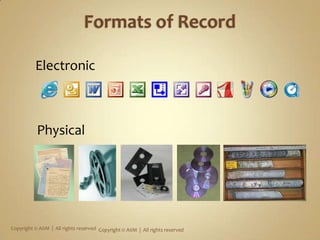
Formats of RecordElectronicPhysicalCopyright © AIIM  |  All rights reserved
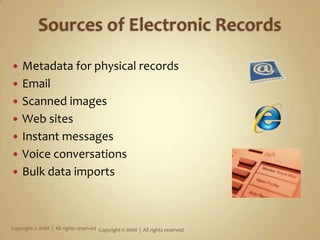
Sources of Electronic RecordsMetadata for physical recordsEmailScanned imagesWeb sitesInstant messagesVoice conversationsBulk data importsCopyright © AIIM  |  All rights reserved
Why not Capture Everything?Hard cost of storageVolume of non-records to sift throughOperationally For legal or audit requirementsIncreased liability for disclosing too muchCopyright © AIIM  |  All rights reserved
Develop a Capture ProcessInitial assessmentDetermine what to captureDetermine when to captureDetermine how to capture Introduce records capture proceduresPlan longer term sustainability and digital preservationCopyright © AIIM  |  All rights reserved
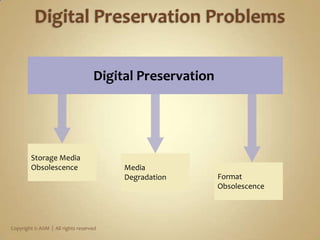
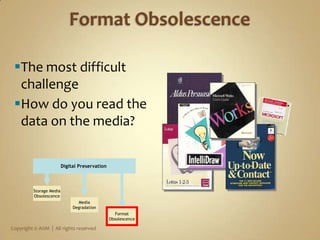
Storage MediaObsolescenceMediaDegradationDigital Preservation ProblemsDigitalPreservationFormatObsolescenceCopyright © AIIM  |  All rights reserved
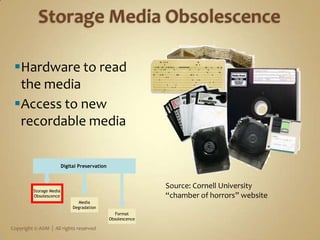
Storage Media ObsolescenceHardware to read the media
Access to new recordable mediaSource: Cornell University “chamber of horrors” websiteCopyright © AIIM  |  All rights reserved
Media MegradationStorage media deteriorates over timeDeterioration minimised by good storageDigital preservation techniques can be used to compensateCopyright © AIIM  |  All rights reserved

Electronic files are records too

  • 1.
    Electronic Files AreRecords Too!Presented by:Bob Larrivee, Director/Industry AdvisorAIIM International
  • 2.
    AIIM Industry Watch- ERMElectronic records are more than twice as likely to be described as “Unmanaged” than paper records71% of organizations have a procedure for legal hold of paper records in the event of litigation, but only 57% have one for electronic recordsFor 25% of organizations, legal discovery of paper records would take at least a month, whereas for electronic records this is 17%
  • 3.
    Reliance on ITstaff to carry out legal discovery on electronic recordsRecords management staff deals with paper records.Organizations with no ECM/ERM system60% would not be confident, if challenged, that their electronic records have not been changed, deleted or inappropriately accessed38% admit that there is little or no enforcement of their records management policies55% set no guidance on dealing with important emails as recordsAIIM Industry Watch - ERM
  • 4.
    31% of organizationshave 20 or more content repositories that could usefully be linkedEmail as the highest priorityOver 70% of organizations have made no plans or provision for long-term archiving of electronic recordsNo policies for migrating to new media, translating formats, or virtualization of applicationsAIIM Industry Watch - ERM
  • 5.
    More FactsUniversity ofCalifornia-San Diego Global Information Industry Center2008 American Information Consumption 34 gigabytes of words per day on average3.6 ZettaBytes (zettabyte = a million-million gigabytes)Includes audio, video, written wordRichard Saul Wurman, Author “Information Anxiety” “A weekday edition of the New York Times contains more information than the average person was likely to come across in a lifetime during 17th-century England.”
  • 6.
    Source: AIIM’s Stateof the ECM IndustryPoor Information EffectivenessOn a scale of 1 to 10 (terrible to excellent), rate the effectiveness of your organisation in managing information54% give themselves a grade of 5 or less>90% of organisations view their ability to manage electronic information as critical to their future. © AIIM | All rights reserved6
  • 7.
    The Importance ofRecordsGrowing awareness of importance of records managementIncreasing government requirements for retention and dispositionSarbanes-OxleyHIPPA
  • 8.
    January 12, 2009PresidentObama announces digital health recordsCompliance required by 2014August 19, 2009HHS announces “Information Breach” regulations36+ Breaches listed by HHS as of 03/2010Affecting 500+ individualsAdditional Mandates
  • 9.
    What is RecordsManagement?Field of management responsible for the efficient and systematic control of the creation, receipt, maintenance, use and disposition of records, including processes for capturing and maintaining evidence of and information about business activities and transactions in the form of recordsSource: ISO 15489
  • 10.
    Definition of RecordInformationcreated, received, and maintained as evidence and information by an organisation or person, in pursuance of legal obligations or in the transaction of businessSource: ISO 15489
  • 11.
  • 12.
    Sources of ElectronicRecordsMetadata for physical recordsEmailScanned imagesWeb sitesInstant messagesVoice conversationsBulk data importsCopyright © AIIM | All rights reserved
  • 13.
    Why not CaptureEverything?Hard cost of storageVolume of non-records to sift throughOperationally For legal or audit requirementsIncreased liability for disclosing too muchCopyright © AIIM | All rights reserved
  • 14.
    Develop a CaptureProcessInitial assessmentDetermine what to captureDetermine when to captureDetermine how to capture Introduce records capture proceduresPlan longer term sustainability and digital preservationCopyright © AIIM | All rights reserved
  • 15.
    Storage MediaObsolescenceMediaDegradationDigital PreservationProblemsDigitalPreservationFormatObsolescenceCopyright © AIIM | All rights reserved
  • 16.
  • 17.
    Access to newrecordable mediaSource: Cornell University “chamber of horrors” websiteCopyright © AIIM | All rights reserved
  • 18.
    Media MegradationStorage mediadeteriorates over timeDeterioration minimised by good storageDigital preservation techniques can be used to compensateCopyright © AIIM | All rights reserved

Editor's Notes

  • #3 In a recent AIIM Industry Watch Report based on Electronic Records Management (ERM) titled Electronic Records Management - still playing catch-up with paper, we found that electronic records are still taken less seriously than physical records. We also found that it appears organizations are placing the responsibility for applying good records management practices to electronic records is being placed on IT rather than the records manager. Several other key findings from this report include:· Electronic records are more than twice as likely to be described as “Unmanaged” than paper records· 71% of organizations have a procedure for legal hold of paper records in the event of litigation, but only 57% have one for electronic records· For 25% of organizations, legal discovery of paper records would take at least a month, whereas for electronic records this is 17%
  • #4 There is a reliance on IT staff to carry out legal discovery on electronic records in the majority of companies, whereas records management staff or line-of-business staff deals with paper records.The report continues to cite that:· Of those organizations with no ECM/ERM system, 60% would not be confident, if challenged, that their electronic records have not been changed, deleted or inappropriately accessed· 38% of those polled admit that there is little or no enforcement of their records management policies and 55% set no guidance on dealing with important emails as records
  • #5 · 31% of organizations have 20 or more content repositories that could usefully be linked, with email as the highest priority content· Over 70% of organizations have made no plans or provision for long-term archiving of electronic records, with no policies for migrating to new media, translating formats, or virtualization of applications 
  • #7 For example, from the 2008 survey on the State of the ECM Industry, AIIM found that when survey respondents were asked:On a scale of 1 to 10 (terrible to excellent), rate the effectiveness of your organisation in managing information…54% give themselves a grade of 5 or less52% have “little or no confidence” that their electronic information is “accurate, accessible, and trustworthy.”And yet >90% of organisations view their ability to manage electronic information as CRITICAL to their future. This can have multiple, serious impacts on the ability of the organisation to operate as it desires and expects to be able to.
  • #9 Modernizing Patient Records: Will it really work?January 12, 2009President Obama announces digital health records for all within 5 yearsAugust 19, 2009HHS announces “Information Breach” regulationsAs I have said in the past, I think the efforts by our current administration and President Obama is highly commendable. I think the suggestion and action to move our healthcare system into a digital state is long overdue but I just can’t help feeling that making patient records digital is not going far enough.
  • #13 The ERM system must be able to capture documents that have already been created; for example records originating from a variety of other sources including:~Metadata for physical records (such as paper, microfiche and others)~emails~Scanned images~Web sites, pages and transactions~Instant messages~Voice conversations, for example as part of a customer relationship management system~And bulk data imports, for example from a legacy application or a network file share.
  • #14 PS: Determining what to capture.So why shouldn’t organisations simply capture everything and keep it forever? There are a number of reasons. First, there is the hard cost of storage. It is true that storage is cheaper every day than the day before, but the cost of storage is higher than the simple price for a 1 TB internal hard disk at the local consumer electronics store. It includes the cost to provision and configure the storage, the cost to back it up, and the cost to restore it if it becomes necessary. Moreover, once organisations hit certain levels of storage, the class of storage changes and becomes significantly more expensive. The next reason has to do with the volume of non-records the organisation would need to sift through if necessary. This has ramifications for both operational usage, where users might have to look through ancient invoices to find the one they need, and to respond to legal or audit queries. Consider that in paper-based records management, organisations generally do not retain every single invoice, piece of paper, or take-out menu they have ever received; this is not only a storage space issue, but also a findability issue. This is exacerbated in the electronic realm because of the volume of electronic documents floating about the typical office environment. Finally, the organisation could face increased liability for disclosing too much information. For example, in a lawsuit the organisation could inadvertently disclose trade secrets, or a government agency could release information that compromises state secrets. For all of these reasons, the smaller the haystack, the more efficient the access.
  • #21 In my view, this is somewhat disturbing as the only thing different between a physical record and an electronic record is the format in which it is contained. The idea that IT should be responsible for applying good records management practices to electronic records is placing the organization at risk that the right information is not being kept and there would be a lack of compliance with records retention policies. The good news is an encouraging number of organizations are homogenizing their electronic and physical policies and practices, and many are moving to an all-electronic model, linking their repositories together in order to improve the legal discovery process and enhance operational efficiency. Organization need to recognize that records management practices should embrace and include electronic records as part of the overall records management program. Just like the physical, records retention, security and disposition policies apply and there is no reason or excuse in today’s business world that this should be different. In my view of an ideal world, Records management is responsible to set policy and manage the activities for all records with IT in place establish and maintain the technology infrastructure that supports those policies and activities. While I do not feel the exclusion of electronic records as part of an overall records management program is intentional, I do feel that the underlying problem is one of being overwhelmed and not knowing how to begin. The first step in all of this it the make the first step be a realization that records are records regardless of format and they need to be addressed as part of the “total” records management program. What say you? How are you managing your electronic records? Do you have a story to tell? I want to hear from you and learn what you and your organization are doing.